
2027 How Much Can a Project Manager with an MBA Make?

Co-Founder and Chief Data Scientist
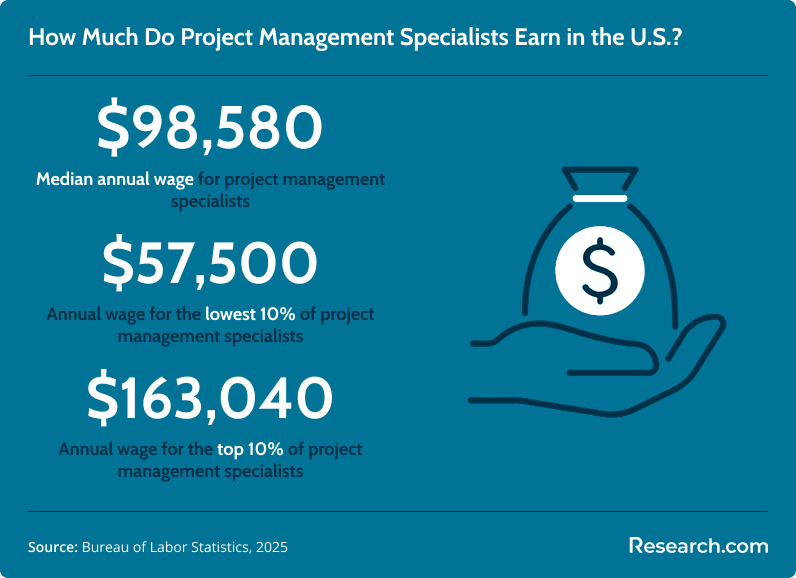
Did you know the top 10% of project management specialists in the U.S. earn over $163,000 a year? For professionals considering an MBA, that number raises an important question: how much of a salary boost does the degree actually deliver?
This article breaks down the latest data from the various Bureau of Labor Statistics, Zippia, ZipRecruiter, and more to compare earnings by education level, industry, and location. By the end, you’ll know whether pursuing an MBA in project management is worth the investment for your career.
Key Things You Should Know About MBA Project Manager Salary
- An MBA can raise earning potential significantly. While the median salary for project management specialists sits around $98,580, professionals with advanced degrees such as an MBA report averages well above $109,000, with top earners crossing the $160,000 mark.
- Salary outcomes vary widely depending on industry. Finance, insurance, and professional services sectors consistently pay MBA project managers the most, with averages exceeding $110,000 annually, compared to lower-paying sectors such as construction or administrative services.
- Location remains a major factor. States like New Jersey, Washington, and Virginia report annual wages near or above $120,000, while metropolitan hubs like San Jose top the list with median wages of $150,720, offering the highest returns for MBA project managers.
- How much can a project manager with an MBA make for 2027? MBA Salary
- Is it worth doing an MBA to become a project manager? Degree Value
- How much more do project managers with an MBA make compared to those without? MBA vs. Non-MBA
- How much does industry or sector affect MBA project manager pay? Pay by Industry
- How much does location influence MBA project manager salary? Pay by Location
- How does experience level affect salary for MBA project managers? Pay by Experience
- Can specialized MBA concentrations, like project management, boost earnings? Specialized MBA
- What types of roles do you get after an MBA in project management, and how do they pay? What types of roles do you get after an MBA in project management, and how do they pay?
- Does the ROI of an MBA in Project Management Justify the Investment? Does the ROI of an MBA in Project Management Justify the Investment?
- What kind of bonuses or total compensation can MBA-holding project managers expect? What kind of bonuses or total compensation can MBA-holding project managers expect?
- Do top business schools or ranking affect project manager MBA salaries? Do top business schools or ranking affect project manager MBA salaries?
How much can a project manager with an MBA make for 2027?
Project management salaries already trend high, but an MBA adds another layer of earning power. According to the Bureau of Labor Statistics, the median annual wage for project management specialists is about $98,580, with the top 10% earning more than $163,000. However, Zippia’s breakdown by education shows that project managers with a master’s degree—which includes MBAs—average around $109,564 annually, nearly $10,000 more than those with only a bachelor’s degree.
Location and industry amplify these numbers further. For example, project managers in finance and insurance average $111,350, while those in tech-focused hubs like San Jose can see median pay climb to $150,720. In short, an MBA often positions project managers for the higher-paying roles and industries where advanced skills in strategy, leadership, and business analysis are most valued. For professionals weighing the degree, these figures illustrate the real financial upside of combining project management expertise with an MBA credential.
For those aiming for the pinnacle of prestige and network access, learning how to get into Ivy League MBA programs can be a strategic step toward maximizing both career opportunities and earning potential.
Is it worth doing an MBA to become a project manager?
The decision to pursue an MBA as a project manager depends on your career goals, industry, and tolerance for the financial and time investment. On average, an MBA can add about $10,000 annually to a project manager’s salary compared to bachelor’s degree holders. While that increase alone may not always justify the tuition, the degree also unlocks access to senior roles in finance, consulting, and technology where six-figure salaries are the norm.
Beyond pay, an MBA delivers strategic, financial, and leadership training that aligns well with the complex demands of large-scale project management. Employers in high-growth industries often prioritize candidates with advanced credentials, making the MBA a career accelerator. However, for those targeting sectors with lower salary ceilings—such as construction or administrative services—the return on investment may be less compelling. Comparing a masters in accounting vs MBA shows how the MBA stands out for versatility and long-term career flexibility across industries.
To put the salary advantage in perspective, the infographic below shows how median wages for project management specialists compare to the lowest and highest earners. It illustrates both the security of median pay and the strong upside for top performers.
How much more do project managers with an MBA make compared to those without?
One of the clearest benefits of earning an MBA is the salary premium it brings. Zippia’s data shows project managers with a master’s degree, which includes MBAs, earn an average of $109,564 per year—roughly $10,000 more than those with only a bachelor’s degree at $99,138. Over the course of a career, this gap can compound into hundreds of thousands in additional earnings, especially when combined with promotions and access to higher-paying industries like finance and technology.
The salary gap widens further when comparing master’s-level project managers to those with lower levels of education. For example, individuals with only an associate degree average $84,019, while those with a high school diploma or less average $80,440. This means an MBA doesn’t just open doors to more advanced roles—it also places professionals in the top earning tiers of the field.
For those looking to further enhance credentials, pursuing specialized accounting certificates can complement an MBA and provide additional leverage in finance-related project management positions.
The chart below shows how education directly influences project manager salaries, highlighting the substantial advantage of holding an MBA compared to other educational levels.
How much does industry or sector affect MBA project manager pay?
Industry is one of the biggest determinants of salary for MBA-trained project managers. While the degree provides a general boost in earning potential, the sector you choose can significantly amplify or limit your pay. For example, project managers in finance and insurance earn median annual wages of $111,350, making it one of the most lucrative paths.
Professional, scientific, and technical services are another strong option, with median pay of $106,130, reflecting the high demand for advanced management skills in consulting and technology-driven fields. Manufacturing also performs well at $101,920, though it trails the financial sector. Meanwhile, administrative support services and construction, while still offering solid salaries, average below $100,000, at $97,100 and $96,700, respectively.
For MBA graduates, this means the degree’s value is maximized when paired with industries that reward advanced leadership and business strategy expertise. Choosing the right sector can easily mean a difference of over $15,000 annually.
Additionally, selecting the most appropriate bachelor degree for MBA preparation can further strengthen your candidacy and long-term earning potential by providing foundational knowledge in finance, business, or analytics that aligns with high-paying industries.
The chart below breaks down median wages across industries, clearly showing how much pay levels fluctuate depending on sector and why industry choice is critical for MBA project managers.
How much does location influence MBA project manager salary?
Where you work often matters as much as what degree you hold. For MBA project managers, salaries can vary by tens of thousands of dollars depending on state or metropolitan area. According to the Bureau of Labor Statistics, project managers in New Jersey earn the highest median pay at about $136,990, followed closely by Washington and Virginia, where wages exceed $120,000. In contrast, states like Florida and Texas typically offer averages closer to $100,000.
Metropolitan areas highlight these differences even more sharply. The San Jose-Sunnyvale-Santa Clara, CA region leads the nation with median annual pay of $150,720, reflecting both the cost of living and the concentration of technology-driven industries. Other high-paying hubs include San Francisco, New York, and Seattle, where MBA project managers regularly cross six figures.
Location doesn’t just influence salary; it can shape career trajectory. Those seeking faster ROI on their degree often combine geographic mobility with flexible education options such as shortest MBA programs in marketing online, which allow professionals to quickly position themselves in high-paying markets.
How does experience level affect salary for MBA project managers?
Experience is a powerful multiplier of salary for MBA project managers. Entry-level professionals with an MBA may begin slightly above the median wage for project management specialists, which is about $98,580, but real salary acceleration occurs after five to ten years in the field. Mid-career project managers often move into senior project or program management roles, where salaries regularly exceed $120,000. Those with 15–20 years of experience may transition into director or executive-level positions, where pay can reach or surpass the $150,000 range.
The MBA credential amplifies this trajectory because it signals both leadership readiness and advanced business acumen, qualities employers seek when filling senior roles. Specialized MBAs can further enhance opportunities—healthcare and technology, for instance, reward managers with domain expertise alongside leadership skills. Professionals looking to accelerate their career path sometimes pursue a fast-track MBA in healthcare management online, which allows them to enter leadership pipelines earlier and capitalize on experience-driven salary growth.
Can specialized MBA concentrations, like project management, boost earnings?
Specialized MBA concentrations can provide a measurable earnings advantage by aligning advanced business training with in-demand technical and leadership skills. For example, project management-focused MBAs combine strategic planning, budgeting, and organizational leadership with practical execution training, helping graduates qualify for roles that pay well above the field’s median of $98,580.
Employers value these tailored skill sets because they bridge the gap between broad business knowledge and industry-specific demands. This is particularly true in sectors like IT, healthcare, and finance, where project complexity is high and strong leadership is essential. Graduates from specialized programs may also accelerate into senior management or director positions faster than peers with general business degrees. Professionals seeking speed and specialization sometimes pursue 1 year MBA programs, which deliver both the credential and focus without delaying entry into high-paying opportunities.
The chart below illustrates the skills employers emphasize most when hiring project managers, highlighting how specialized MBA training can align with market demand and directly boost earning potential.
What types of roles do you get after an MBA in project management, and how do they pay?
An MBA in project management doesn’t just increase salary—it expands the range of roles available. Graduates often step into senior project manager or program manager positions, with pay averaging between $110,000 and $130,000 depending on industry and location. From there, opportunities branch into director-level jobs such as Director of Project Management or Operations Director, where salaries frequently exceed $140,000.
In industries like technology and healthcare, MBAs with project management concentrations are well positioned for specialized leadership tracks, such as IT Project Manager, Infrastructure Manager, or Product Manager, where compensation reflects both management and technical expertise. This pathway mirrors the flexibility of other specialized MBAs—just as those exploring what can you do with an MBA HR find career options in human resources leadership, project management MBAs unlock senior roles in strategic execution.
Ultimately, the degree equips professionals to oversee larger budgets, more complex initiatives, and cross-functional teams, all of which command higher compensation and faster advancement compared to peers without an MBA credential.
Does the ROI of an MBA in Project Management Justify the Investment?
Evaluating the return on investment for an MBA in project management requires a balanced view of upfront costs against long-term career gains. Quantitative benefits, such as increased salary and accelerated promotion paths, are complemented by qualitative factors including enhanced leadership skills and strategic networking. Critical financial considerations—tuition fees, potential loss of income during study, and opportunity costs—should be measured against expected pay increments and bonus structures over time. Prospective students increasingly explore cost-effective pathways by reviewing options like cheapest MBA programs online to ensure that educational expenditures align with long-term financial and professional goals.
What kind of bonuses or total compensation can MBA-holding project managers expect?
Salary is only one part of the financial package for MBA-trained project managers. Many also receive performance bonuses, profit-sharing, and equity options that substantially increase total compensation. According to industry surveys, annual bonuses for project managers in finance, consulting, and technology often range from 10% to 20% of base salary, meaning a professional earning $110,000 could reasonably expect $11,000 to $22,000 in additional income.
Equity-based compensation is becoming more common in technology and startup environments, where project managers play a key role in scaling operations. Benefits such as retirement contributions, paid leave, and tuition reimbursement can further raise overall value. MBA holders are especially attractive candidates for employers who tie incentives to long-term strategic outcomes, since their training emphasizes both execution and organizational leadership.
For professionals aiming to maximize compensation, pairing industry choice with the right degree can help. For instance, fast-track online MBA programs in healthcare administration prepare graduates for high-demand roles that frequently include incentive pay tied to project outcomes in hospitals or healthcare systems.
Do top business schools or ranking affect project manager MBA salaries?
Where you earn your MBA can matter almost as much as the degree itself when it comes to project manager pay. Graduates from top-ranked business schools often enjoy stronger employer recognition, access to exclusive recruiting pipelines, and higher starting salaries. For example, while the national average salary for MBA-level project managers is around $109,564, alumni of elite institutions frequently report compensation packages well above that level, especially when entering competitive industries such as consulting, finance, or technology.
School reputation also shapes long-term career trajectories. Employers may associate a degree from a prestigious program with advanced leadership training and a proven alumni network, which can translate into faster promotions and higher-paying assignments. In contrast, lower-ranked schools may still provide valuable education but often lack the brand recognition that commands a salary premium.
For students concerned about academic history, there are also MBA programs with low GPA requirements that offer a path to develop advanced business skills and access rewarding project management careers, even if their undergraduate performance was less competitive.
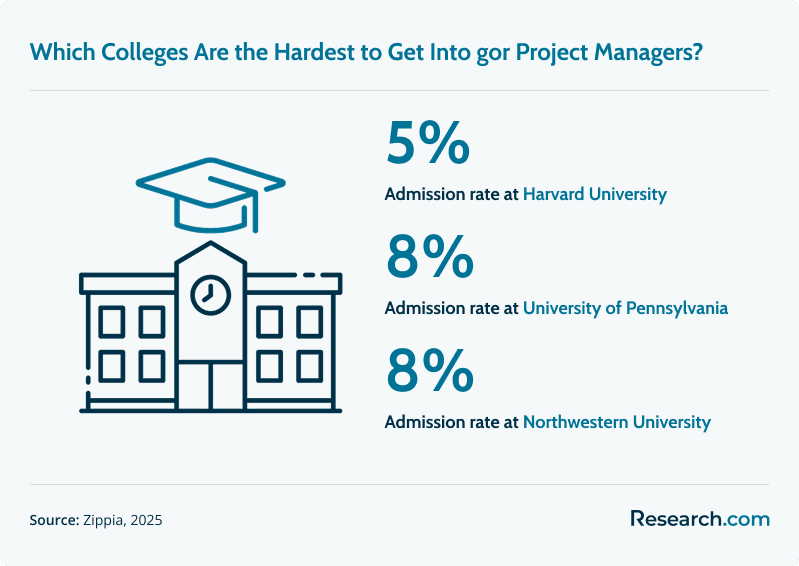
The infographic below highlights the selectivity of the hardest schools to enter for aspiring project managers, underscoring how top-tier institutions combine exclusivity with high earning potential for MBA graduates.
Here's What Graduates Have To Say About Their MBA Project Manager Salary
- Liora: "Completing my MBA online gave me flexibility without sacrificing career momentum. Within a year, I transitioned into a senior project manager role with a 25% salary increase. The program sharpened my leadership and financial analysis skills, which employers immediately valued. Online learning fit perfectly into my busy life and still opened high-paying opportunities."
- Darius: "After earning my MBA online, I finally broke through the salary plateau I had faced for years. My annual pay jumped from $92,000 to $118,000, and I was offered bonus incentives for leading cross-functional teams. The remote format not only saved commuting time but also taught me to collaborate digitally—skills that boosted my value."
- Mirella: "The online MBA experience was intense but rewarding. I balanced work, family, and study, and it paid off when I landed a program manager role earning $127,000. Employers respected the dedication it took to complete the degree virtually, and it positioned me as someone who could manage complex, fast-paced environments."
Key Findings
- Project management specialists earn a median of $98,580, with the top 10% making more than $163,000.
- MBA project managers average $109,564 annually, about $10,000 more than those with only a bachelor’s degree.
- Industry matters: finance and insurance roles pay the most at $111,350, while construction averages $96,700.
- Location drives salary: project managers in San Jose earn about $150,720, compared to $100,000 in states like Texas.
- Experience boosts pay, with senior MBA project managers often surpassing $120,000–$150,000 depending on role and sector.
- Bonuses and equity can add 10–20% of base salary, especially in finance, consulting, and technology.
References:
- Bureau of Labor Statistics. Occupational Outlook Handbook: Project Management Specialists.
- Bureau of Labor Statistics. Occupational Employment and Wages: Project Management Specialists, May 2023.
- Zippia. How To Become A Project Manager: What It Is and Career Path.
- Zippia. Project Manager Demographics and Statistics [2025]: Number of Project Managers in the US.
- Zippia. Project Manager Education Requirements: Degrees, Majors, Colleges.
- ZipRecruiter. Project Manager Resume Keywords and Skills.
- ZipRecruiter. Project Manager Salary.
Other Things You Should Know About MBA Project Manager Salaries
In 2027, location significantly influences a project manager's salary, with major cities typically offering higher wages. For example, salaries in New York or San Francisco might be substantially higher than those in smaller cities or rural areas, due to cost of living and demand.
Yes, cities like San Francisco, New York, and Boston generally offer higher salaries for project managers with an MBA in 2027, often exceeding $120,000 annually, due to high demand in tech and finance sectors.
Certifications can significantly impact the salary of a project manager with an MBA in 2027. Obtaining credentials such as PMP or Agile certifications can enhance skills and marketability, often leading to higher earning potential and more competitive salaries.
In 2027, industry choice significantly influences the salary of a project manager with an MBA. Sectors like technology, finance, and healthcare tend to offer higher salaries due to demand and complexity, while industries like non-profit might offer lower compensation.


