
2027 DNP to PhD in Nursing: Bridge Program Requirements

Co-Founder and Chief Data Scientist
In today’s healthcare landscape, nurse leaders often face a tough challenge: balancing the immediate demands of clinical practice with the need for groundbreaking research that drives long-term improvements in patient care. While a Doctor of Nursing Practice (DNP) equips nurses with advanced clinical expertise, a PhD in Nursing provides the research and academic foundation to shape policies, develop evidence-based practices, and educate the next generation of nurses. Having both credentials under your belt not only enhances your authority in clinical and academic settings but also positions you as a rare bridge between practice and research.
This article will walk you through the requirements of DNP-to-PhD bridge programs, helping you understand what it takes to pursue this dual path and how it can open doors to leadership, innovation, and lasting impact in nursing.
What are the benefits of pursuing DNP to PhD in nursing bridge programs?
- Accelerated Pathway: Complete both degrees more quickly than pursuing them separately, reducing time in school while advancing your career sooner.
- Cost Efficiency: Save on tuition and related expenses by enrolling in a combined program instead of funding two full degrees.
- Integrated Learning Experience: Benefit from a curriculum designed to connect clinical practice with research, rather than treating them as separate pursuits.
- Broader Career Flexibility: Position yourself for roles that demand both clinical authority and research expertise, from advanced practice leadership to academic appointments.
- Greater Impact in Healthcare: Leverage dual training to implement evidence-based changes that improve patient care, influence policy, and shape the future of nursing.
What can you do with a DNP and PhD in nursing?
Earning both a DNP and a PhD in nursing creates a powerful combination of clinical expertise and research-driven knowledge, allowing nurses to excel across multiple dimensions of healthcare. With this dual preparation, you can influence practice, education, and policy at the highest levels. Here are some of the career paths and opportunities available:
- Academic Leadership: Teach in universities, lead nursing programs, and mentor future nurse leaders while contributing to scholarly publications.
- Research Advancement: Conduct groundbreaking studies that address healthcare challenges and translate findings into real-world solutions.
- Healthcare Administration: Take on executive roles in hospitals or health systems, shaping patient care strategies and organizational policies.
- Policy Development: Contribute to national and global health policy by integrating clinical insights with evidence-based research.
- Specialized Clinical Leadership: Use advanced clinical expertise alongside research training to design and implement innovative care models.
With both degrees, you’re not limited to a single career path; you’re positioned at the intersection of practice, research, and leadership, making your contributions to nursing both versatile and far-reaching.
Where can you work with both a DNP and a PhD in nursing?
Holding both a DNP and a PhD in nursing opens doors to a wide range of professional settings where you can make a significant impact. This combination of advanced clinical practice and research expertise allows you to thrive in environments that value both hands-on leadership and scholarly contributions. Some common places you can work include:
- Universities and Nursing Schools: Serve as faculty, department chairs, or program directors while teaching and conducting research.
- Hospitals and Health Systems: Lead clinical innovation, oversee patient care initiatives, and guide evidence-based practice implementation.
- Research Institutions: Conduct and direct nursing and healthcare research projects that influence best practices and future advancements.
- Government and Policy Organizations: Work with public health agencies, advisory boards, or legislative groups to shape healthcare policy.
- Professional Associations and Nonprofits: Lead initiatives that promote nursing education, practice standards, or community health programs.
With both degrees, your career opportunities extend beyond traditional nursing roles, allowing you to work at the forefront of healthcare transformation.
How much can you earn with both a DNP and a PhD in nursing?
Holding both a Doctor of Nursing Practice (DNP) and a PhD in Nursing positions professionals to pursue roles that combine advanced clinical, leadership, and scholarly responsibilities, often leading to elevated earning potential. While compensation can vary widely depending on specialization, workplace setting, and geography, here’s a breakdown of what you can typically expect
According to Discover DNP, DNP-prepared nurses usually earn an average annual salary of $107,000, with specializations like certified registered nurse anesthetists (CRNAs) making more than $160,000 per year. Needless to say, nurses with a DNP and who specialize as CRNAs earn the highest salaries among all nurses. Meanwhile, those with a PhD in Nursing earn an average annual salary of $99,000.
Academic Influence reports that advanced practice registered nurses (APRNs) typically earn $87,000 to $181,000 per year, nurse educators earn around $75,000-$120,000, nurse administrators earn $85,000-$150,000, nurse researchers earn $70,000-$130,000, and PhD-nurse scientists earn $80,000-$150,000.
Overall, your exact salary figure as a nurse with a DNP or PhD depends on your specific professional title or position, your field of specialization, your work setting, your location, and your length of service.
- What is the difference between a DNP and a PhD in Nursing? DNP vs. PhD
- What is a DNP to PhD in Nursing bridge program? Bridge Program
- How long does it take to complete a DNP to PhD in Nursing bridge program? Completion Time
- What are the requirements for entering a DNP to PhD in Nursing bridge program? Requirements
- What skills does a DNP to PhD in Nursing bridge program require? Core Skills
- How much does a DNP to PhD in Nursing bridge program cost? Program Cost
- What financial aid options are available for those pursuing DNP to PhD in Nursing bridge programs? Financial Aid
- What is the job outlook for graduates of DNP to PhD in Nursing programs? Job Outlook
- How do I choose the best DNP to PhD in Nursing bridge program? How do I choose the best DNP to PhD in Nursing bridge program?
- What are the common challenges students experience while pursuing a DNP to PhD in Nursing bridge program? What are the common challenges students experience while pursuing a DNP to PhD in Nursing bridge program?
- What additional academic pathways can further bolster my nursing credentials? What additional academic pathways can further bolster my nursing credentials?
What is the difference between a DNP and a PhD in Nursing?
The Doctor of Nursing Practice (DNP) and the Doctor of Philosophy (PhD) in Nursing are both terminal degrees, but they serve very different purposes in the profession. A DNP is focused on advanced clinical practice, preparing nurses to apply evidence-based knowledge directly to patient care and healthcare leadership.
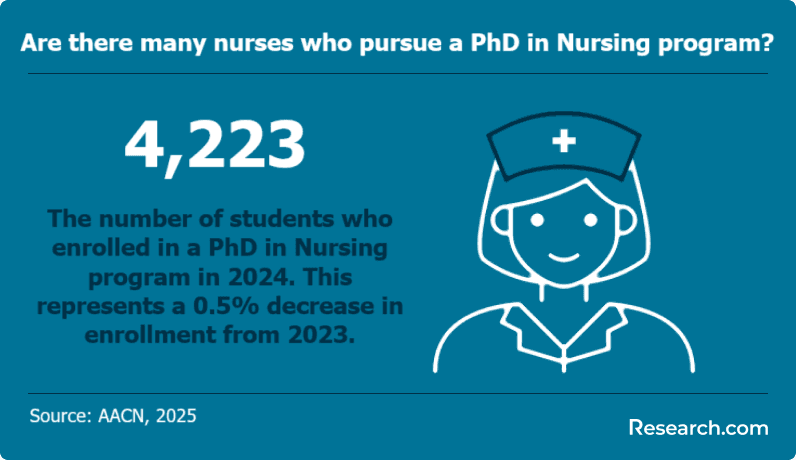
In contrast, a PhD in Nursing (the number of nurses who pursue it is presented below) emphasizes research and academia, equipping nurses to generate new knowledge, conduct studies, and educate future nurses. Understanding the differences helps you decide which path—or a combination of both—best aligns with your career goals.
Here are the key differences:
- Focus: DNP emphasizes clinical practice; PhD emphasizes research and scholarship.
- Primary Role: DNP graduates are advanced practitioners and healthcare leaders; PhD graduates are researchers, scholars, and educators.
- Outcomes: DNPs apply evidence in practice; PhDs create the evidence through research.
- Career Paths: DNPs often work in clinical settings, hospitals, and administration; PhDs work in universities, research institutions, and policy organizations.
- Capstone Requirement: DNP requires a practice-focused project; PhD requires a dissertation based on original research.
- Program Length: DNP programs usually take 2–4 years; PhD programs often take 4–6 years to complete.
In terms of pay, both a DNP and a PhD in nursing result in the highest paying nursing jobs. However, a nurse with an MSN or a DNP who specializes as a certified registered nurse anesthetist (CRNA) tops the list.
What is a DNP to PhD in Nursing bridge program?
A DNP to PhD in Nursing bridge program is a specialized educational pathway designed for nurses who already hold a DNP and want to advance into the research- and academia-focused realm of a PhD in Nursing. Instead of starting from scratch, these programs recognize prior coursework and clinical expertise, allowing students to transition more efficiently into doctoral-level research training.
The bridge curriculum typically emphasizes research methodology, statistics, and scholarly writing, helping nurses move from clinical practice leadership to generating original research that drives healthcare innovation. By combining the practice-focused foundation of the DNP with the research depth of the PhD, graduates are uniquely equipped to translate clinical problems into research questions and apply findings back into practice. This makes the DNP to PhD bridge an ideal choice for nurses who want to merge their clinical expertise with the ability to influence policy, shape nursing education, and advance evidence-based care.
If you want to learn more about the benefits of pursuing a DNP to PhD in Nursing bridge program, read up on "What does a DNP do" and compare it with what a PhD in Nursing does, and see how the two degrees overlap and how they differ in terms of roles.
How long does it take to complete a DNP to PhD in Nursing bridge program?
The time it takes to complete a DNP to PhD in Nursing bridge program depends on the school, program structure, and whether you study full-time or part-time. Most programs are designed to shorten the pathway by granting credit for your DNP coursework and clinical experience, allowing you to focus primarily on research, dissertation work, and advanced theory.
On average, these bridge programs can be completed in 3 to 5 years. Full-time students may finish closer to the three-year mark, while part-time learners—often balancing work and study—may take four to five years. The timeline typically includes coursework in research design and statistics, comprehensive exams, and the completion of an original dissertation. By streamlining the process, the bridge program saves time compared to pursuing each doctorate separately, making it a more efficient route to advancing your nursing career.
You can also go for accelerated DNP programs before you pursue your PhD in nursing. This way, your career advancement journey takes a lot less time than it usually does if you go the traditional route.
What are the requirements for entering a DNP to PhD in Nursing bridge program?
Admission into a DNP to PhD in Nursing bridge program typically requires meeting both academic and professional standards, since these programs are designed for experienced nurses who already hold a DNP. Schools may vary in their exact criteria, but most programs share common requirements that ensure students are well-prepared for the transition from practice-focused study to research-driven doctoral work.
Typical requirements include:
- Doctor of Nursing Practice degree from an accredited institution. You can check out the easiest DNP programs if your ultimate goal is to earn your PhD in nursing.
- Active RN license in good standing, often required in the state where you will complete your studies.
- Professional experience in advanced nursing practice, leadership, or related roles.
- Graduate-level GPA (usually 3.0 or higher) to demonstrate academic readiness.
- Letters of recommendation from academic or professional mentors who can attest to your research potential and leadership skills.
- Statement of purpose or research interests outlining your career goals and reasons for pursuing a PhD.
- CV or résumé detailing clinical, academic, and leadership experience.
- Interview (in some programs) to assess your fit and alignment with faculty expertise.
For nurses who earned their DNP through online DNP programs without clinical hours, bridge programs may be especially attractive, as they allow these students to focus on research and scholarly development without repeating clinical requirements.
Some universities may also require submission of a writing sample, GRE scores (though increasingly waived), or evidence of prior scholarly work. These requirements ensure that candidates are prepared to shift from the clinical application focus of the DNP to the rigorous research expectations of a PhD program.
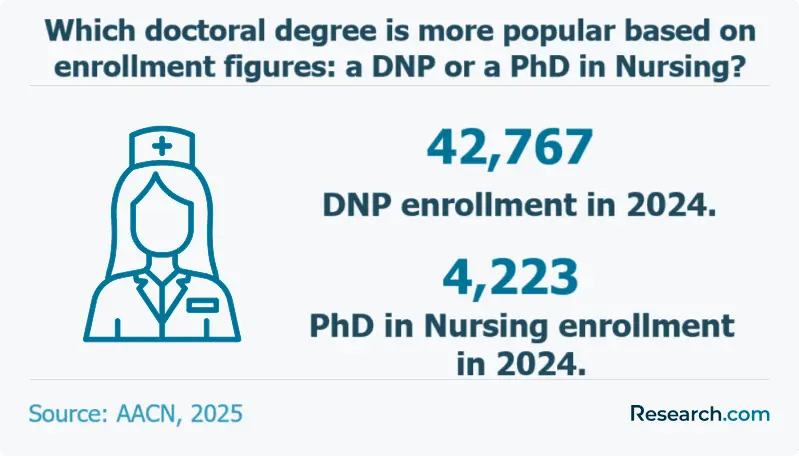
Looking at the enrollment figures below, there are way less nurses who pursue a PhD in Nursing than there are nurses who pursue a DNP. As such, DNP to PhD bridge programs make it more attractive for DNP nurses to cross over into the world of research, scholarly work, and the academe.
What skills does a DNP to PhD in Nursing bridge program require?
Succeeding in a DNP to PhD in Nursing bridge program calls for a blend of clinical expertise, academic readiness, and personal qualities that support advanced scholarship. Since these programs are designed to transition nurses from practice-focused leadership into research and academia, students are expected to bring both professional experience and the ability to adapt to rigorous study.
Key skills and qualities include:
- Strong Clinical Background: Ability to draw on advanced nursing practice experience to identify real-world problems that can be explored through research.
- Research and Analytical Thinking: Comfort with data analysis, statistics, and critical inquiry to generate and evaluate evidence.
- Academic Writing and Communication: Skill in producing scholarly papers, dissertations, and research publications, as well as presenting findings clearly.
- Time Management and Self-Discipline: Balancing coursework, dissertation research, and professional responsibilities requires organization and persistence.
- Leadership and Collaboration: Working with faculty, peers, and interdisciplinary teams to develop and apply evidence-based solutions.
- Intellectual Curiosity: A passion for asking questions, seeking new knowledge, and advancing the science of nursing.
These skills not only help students thrive during the program but also prepare them to influence patient care, policy, and education after graduation.
How much does a DNP to PhD in Nursing bridge program cost?
The cost of a DNP to PhD in Nursing bridge program can vary widely depending on the university, program length, and whether you attend a public or private institution. On average, tuition ranges from $30,000 to $70,000 or more for the entire program, though elite private universities may charge even higher. Public universities often offer lower rates, especially for in-state students, while online programs sometimes provide more flexible pricing.
In addition to tuition, students should budget for fees, textbooks, technology requirements, and research-related expenses such as dissertation costs. Fortunately, many schools offer financial aid, scholarships, tuition reimbursement programs, and research assistantships to help offset costs.
You can look into PhD in Nursing or DNP salary by specialty and you will see that while the upfront expense can be significant, the investment often pays off. You will enjoy higher earning potential, as well as expanded career opportunities and the ability to influence healthcare at a systems level.
What financial aid options are available for those pursuing DNP to PhD in Nursing bridge programs?
Financing a DNP to PhD in Nursing bridge program can feel overwhelming, but there are several forms of financial support available to help ease the burden. Many schools and organizations recognize the importance of preparing nurse leaders and researchers, so funding opportunities are often geared toward advanced nursing students.
Common financial aid options include:
- Federal Student Aid: Loans and grants available through the FAFSA, which most graduate nursing students are eligible to apply for.
- Scholarships and Fellowships: Many universities, nursing associations, and private foundations offer merit- or need-based awards for doctoral-level nursing students.
- Graduate Assistantships or Research Assistantships: Opportunities to work with faculty on teaching or research projects in exchange for tuition remission or stipends.
- Employer Tuition Reimbursement: Some healthcare organizations provide financial assistance to nurses furthering their education, especially if the degree benefits the organization.
- Loan Forgiveness Programs: Federal and state programs, such as the Nurse Faculty Loan Program (NFLP) or Public Service Loan Forgiveness (PSLF), which help reduce debt for those working in qualifying roles like academia or public service.
By combining these options, students can often make the cost of a bridge program far more manageable, allowing them to focus on their studies and career goals rather than financial strain.
What is the job outlook for graduates of DNP to PhD in Nursing programs?
Graduates of DNP to PhD in Nursing bridge programs are uniquely positioned in the workforce, as they bring together advanced clinical expertise and high-level research skills. The demand for nurses with doctoral degrees is expected to remain strong, fueled by a nationwide nursing shortage, the need for nurse educators, and the push for evidence-based improvements in healthcare.
For those considering long-term career and financial growth, a DNP to PhD path ranks among some of the highest paying doctoral degrees, reflecting both specialized clinical knowledge and research leadership opportunities.
According to the U.S. Bureau of Labor Statistics (BLS), the overall employment of nurse anesthetists, nurse midwives, and nurse practitioners is projected to grow 35% from 2024 to 2034, translating to about 32,700 projected openings for these professionals each year, on average, over the decade.
At the same time, the American Association of Colleges of Nursing (AACN) reports a persistent shortage of nursing faculty, creating significant opportunities for PhD-prepared nurses in academia. Those with both a DNP and PhD can step into leadership roles in research institutions, universities, hospitals, government agencies, and healthcare organizations.
Overall, the job outlook is highly favorable, with graduates well-prepared to shape the future of nursing through clinical innovation, policy influence, and groundbreaking research.
The chart below shows the employment growth rate breakdown for nursing occupations requiring a DPN or PhD.
How do I choose the best DNP to PhD in Nursing bridge program?
Selecting the right DNP to PhD in Nursing bridge program is an important step, as the choice can shape your educational experience and career trajectory. Since these programs vary in structure, focus, and resources, it’s helpful to evaluate them against your personal and professional goals.
Key factors to consider include:
- Accreditation: Ensure the program is accredited by recognized nursing education bodies, such as the Commission on Collegiate Nursing Education (CCNE) and the Accreditation Commission for Education in Nursing (ACEN). This guarantees quality of education, as well as eligibility for financial aid.
- Faculty Expertise: Look for faculty members whose research aligns with your interests, as they will guide your dissertation and academic development.
- Program Format: Decide whether you prefer online, hybrid, or on-campus learning to fit your schedule and lifestyle.
- Time to Completion: Compare program lengths and flexibility (full-time vs. part-time options) to match your career and personal commitments.
- Cost and Financial Aid: Factor in tuition, fees, and available scholarships or assistantships.
- Career Support: Investigate the program’s track record in job placement, networking opportunities, and connections with healthcare or academic institutions.
By weighing these considerations, you can identify a bridge program that not only accelerates your path to a PhD but also provides the mentorship, resources, and opportunities needed to achieve your long-term goals.
For those focused on financial outcomes, it’s also worth considering what PhD pays the most, as certain nursing and healthcare research specializations can lead to particularly high-earning roles in academia, hospitals, or policy-making institutions.
What are the common challenges students experience while pursuing a DNP to PhD in Nursing bridge program?
While a DNP to PhD in Nursing bridge program offers an efficient path to advanced expertise, it also comes with challenges that students must be prepared to navigate. Balancing the demands of clinical knowledge with the rigor of research-focused study can be demanding, especially for those managing work and personal responsibilities alongside their education.
For many prospective students, understanding how hard is it to get a doctorate helps set realistic expectations and highlights the level of dedication and discipline required to succeed in such a rigorous program.
Some common challenges include:
- Time Management: Juggling coursework, research, professional duties, and family life can be overwhelming without strong organizational skills.
- Academic Transition: Shifting from a practice-focused DNP to the research-intensive requirements of a PhD, such as statistics, methodology, and dissertation writing, may feel daunting.
- Financial Strain: Tuition and related expenses can add stress, particularly for students without employer support or sufficient financial aid.
- Isolation in Research: Unlike clinical practice, the research phase often requires independent work, which can feel isolating without a strong support system.
- Burnout Risk: The combination of advanced study, professional responsibilities, and personal commitments can lead to fatigue if self-care is neglected.
Recognizing these challenges early allows students to seek resources—such as mentorship, peer networks, and academic support—that can make the journey more manageable and rewarding.
It is also important that you weigh what can you do with a DNP and PhD under your belt against the challenges it brings. Your ability to handle these challenges will determine whether pursuing a DNP to PhD bridge program would be worth it or not.
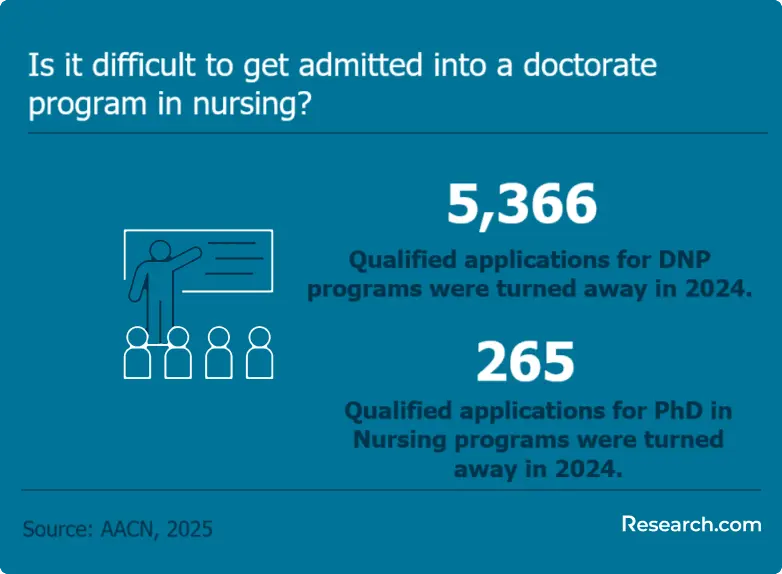
The image below shows that while there is an increase in applications for DNP and PhD in Nursing programs in 2024, a huge percentage of applicants were turned away because of the persistent shortage of nurse faculty. Having to fight for a spot in these nursing programs is also one of the challenges that aspirants have to face.
Key Findings
- DNP enrollments continue to rise, with programs expanding from just 70 students in 2003 to approximately 42,767 students in 2024. This demonstrates remarkable continuous growth over 21 years. In 2024 alone, DNP programs grew by 2.0% (an increase of 936 students from 2023’s figure).
- DNP programs are now offered at 439 schools of nursing across the U.S.
- In contrast, enrollment in PhD in Nursing programs declined for the eleventh consecutive year. Enrollment has decreased by 17.9%, from 5,145 in 2013 to 4,223 students in 2024. There was a slight 0.5% decrease (21 students) from 2023 to 2024.
- Applications to DNP programs increased by 18.5% from 2023 to 2024, while those to PhD programs rose by 7.2%.
- In 2024, more than 13,000 qualified applications were turned away from graduate nursing programs due to the persistent shortage of nurse faculty.
- The roles most commonly held by DNP-prepared nurses—such as nurse practitioners, CRNAs, and nurse midwives—are projected to grow by 35% between 2024 and 2034, adding 134,000 new jobs to bring total employment to about 516,700.
Here’s What Graduates of DNP to PhD in Nursing Bridge Programs Have to Say About Their Career
- Angie: "Completing the DNP to PhD bridge program gave me the unique opportunity to combine clinical leadership with advanced research skills. My DNP prepared me to excel in practice, but the PhD allowed me to study evidence-based approaches at a deeper level and contribute to new knowledge. Today, I lead multi-institutional research projects while still maintaining a voice in clinical care. The dual preparation has opened doors I never imagined. "
- Dom: "The transition from my DNP to earning a PhD was challenging but transformative. The PhD component strengthened my ability to design and implement rigorous studies that directly influence patient care protocols. Having both credentials gave me the confidence and credibility to secure a faculty position, where I now mentor students and drive innovation in nursing practice. I feel I’m impacting healthcare from both the bedside and the classroom."
- Sheryl: "I initially pursued a DNP to sharpen my clinical expertise, but enrolling in the bridge program helped me see the bigger picture of nursing science. The PhD expanded my analytical and policy-development skills, which has been essential in my current role as a healthcare consultant. This combination not only advanced my career but also positioned me to shape systemic changes in patient care delivery at a national level. It’s been a powerful and rewarding journey. "
What additional academic pathways can further bolster my nursing credentials?
Graduates with dual doctoral qualifications can expand their expertise by pursuing targeted certificate or refresher programs that align with emerging healthcare trends. Specialized programs in areas such as healthcare informatics, quality improvement, or leadership can offer focused training to complement advanced clinical and research skills. For example, enrolling in an easy RN to BSN degree program can reinforce foundational knowledge, ensuring a well-rounded academic profile. These complementary opportunities allow professionals to stay abreast of evolving practices while enhancing their strategic thinking and adaptability in dynamic healthcare settings.
References:
- American Association of Colleges of Nursing. (2024, May). Nursing Faculty Shortage Fact Sheet. AACN.
- American Association of Colleges of Nursing. (2025, June 17). Schools of Nursing Enrollment Increases Across Most Program Levels, Signaling Strong Interest in Nursing Careers. AACN.
- Barham, J. (2024, May 29). DNP vs PhD in Nursing. Academic Influence.
- Chauhan, T. (2021, January 1). Nurses with Doctorates- Responsibilities, Scope, Opportunities and Salary. The PhD Hub.
- Logan, W. (2024, June 26). PhD in Nursing. Discover DNP.
- PR Newswire. (2025, June 17). Schools of Nursing See Enrollment Increases Across Most Program Levels, Signaling Strong Interest in Nursing Careers. PR Newswire.
- United States Bureau of Labor Statistics. (2023, April 25) Occupational Employment and Wage Statistics | 29-1171 Nurse Practitioners. BLS.
- United States Bureau of Labor Statistics. (2025, August 28). Occupational Outlook Handbook | Nurse Anesthetists, Nurse Midwives, and Nurse Practitioners. BLS.
- Walden University. (n.d.). PhD in Nursing | Bridge Option for Students With a DNP. Walden University.
- Zippia. (2025, January 8). Research nurse skills for your resume and career. Zippia.
Other Things You Should Know About DNP to PhD in Nursing Programs
Yes, several universities provide online or hybrid bridge programs to make them accessible to nurses nationwide. These formats typically include virtual coursework combined with occasional on-campus residencies or intensives. Online delivery can make it easier for working nurses to continue their education while managing professional and personal responsibilities. Be sure to check the specific residency requirements of each program.
Applicants typically need a completed Doctor of Nursing Practice (DNP) degree and a strong academic record. Additional prerequisites might include specific coursework completed during the DNP program, foundational statistics courses, and relevant clinical or research experience.


