
2027 How Hard Is It to Get a PhD? Challenges & Tips for Success

Co-Founder and Chief Data Scientist
About 2% of the U.S. population holds a Doctor of Philosophy, with men and women equally likely to achieve this degree, placing the country close to leading European nations in educational attainment (World Population Review, 2025). Pursuing a Doctor of Philosophy is a significant commitment, best suited for students who are deeply curious, highly motivated, and passionate about advancing knowledge in their chosen field.
Based on my experience and research, my team and I will dive into the requirements, challenges, practical tips, and strategies for earning a PhD successfully, while also sharing stories and insights from those who’ve been through the process.
What are the benefits of getting a PhD?
- The median basic annual salary reached $75,000 for science and engineering fields and $72,000 for non-science and engineering disciplines (National Center for Science and Engineering Statistics, 2025).
- Doctoral degree holders, including PhD graduates, enjoy a strong financial and job security advantage, with median weekly earnings of $2,278 and an exceptionally low unemployment rate of just 1.2%, according to the Bureau of Labor Statistics (2025).
- A PhD establishes you as an expert in your field, opening doors to leadership positions, research opportunities, and professional credibility.
- Beyond financial and professional benefits, a PhD allows you to contribute original knowledge to your field, develop critical thinking skills, and engage in meaningful research.
- How competitive is it to get into a PhD program? Competition
- What are the requirements for enrolling in a PhD program? Program Requirements
- How long does it take to complete a PhD program? Duration
- How hard is a PhD compared to a Master's study? Difficulty
- What are the types of PhD programs? Program Types
- How much does it cost to get a PhD? Program Costs
- What are the common challenges that PhD students face? Challenges
- What tips should I know to successfully get a PhD? Tips
- What can you do with a PhD? What can you do with a PhD?
- Is a PhD worth it for 2027? Is a PhD worth it for 2027?
- Can additional certifications enhance your PhD journey? Can additional certifications enhance your PhD journey?
How competitive is it to get into a PhD program?
Gaining admission into a PhD program or any doctoral program is highly competitive, as universities seek candidates who not only demonstrate strong academic performance but also show the potential to contribute original research to their field.
According to the 2024 Graduate Enrollment and Degrees report by the Council of Graduate Schools, 21.0% of doctoral applicants were accepted for admission into a PhD program in 2023. Doctoral programs at private, not-for-profit R1 institutions were the most selective, accepting only 12.0% of applications received.
In addition to high grades, universities assess the quality of an applicant’s research proposal, prior research or work experience, recommendation letters, and overall alignment with faculty expertise. Applicants are expected to articulate a clear research direction and show evidence of independent inquiry, problem-solving skills, and academic writing ability.
In some fields, prior publications, conference presentations, or demonstrated laboratory or analytical skills further strengthen an application. Funding availability also affects competitiveness, as programs have limited resources to support doctoral students.
Therefore, gaining admission requires a combination of strong credentials, research readiness, and a convincing case for why the applicant is prepared for the demands of doctoral study.
What are the requirements for enrolling in a PhD program?
The requirements for enrolling in a PhD program vary by institution and country, but most universities expect candidates to meet several academic and professional standards. For students aiming to get a PhD, the most common requirements include the following:
- Educational background. Most programs require at least a bachelor’s degree, though many expect applicants to hold a master’s degree, especially in research-intensive fields.
- Strong academic record. Applicants are generally expected to demonstrate a GPA of 3.0 to 3.5 or higher, depending on the competitiveness of the institution.
- Standardized test scores. Some programs, particularly in the United States, may require GRE scores, while international students are often asked to submit TOEFL or IELTS results to demonstrate English proficiency.
- Research proposal or statement of purpose. Candidates must usually submit a research proposal or essay outlining their intended research area, motivation for pursuing a PhD, and long-term career goals.
- Letters of recommendation. Universities typically require two to three recommendation letters from faculty members or professionals who can evaluate the applicant’s academic and research potential.
- Evidence of research experience. Many programs expect applicants to have prior research experience, such as a master’s thesis, published articles, or relevant work in laboratories or research projects.
- Alignment with faculty expertise. Admission committees also consider whether the applicant’s research interests align with the expertise of available supervisors, as strong mentorship is crucial for doctoral success.
How long does it take to complete a PhD program?
Completing a full-time PhD program, such as an online PhD in higher education, generally requires 36 to 72 months, depending on the country and academic structure. In the United States, most full-time PhD students finish their degree in 8 to 12 semesters (approximately 48 to 72 months, or 4 to 6 years). Programs that allow students to enter directly after a bachelor’s degree may include additional coursework, extending the total duration.
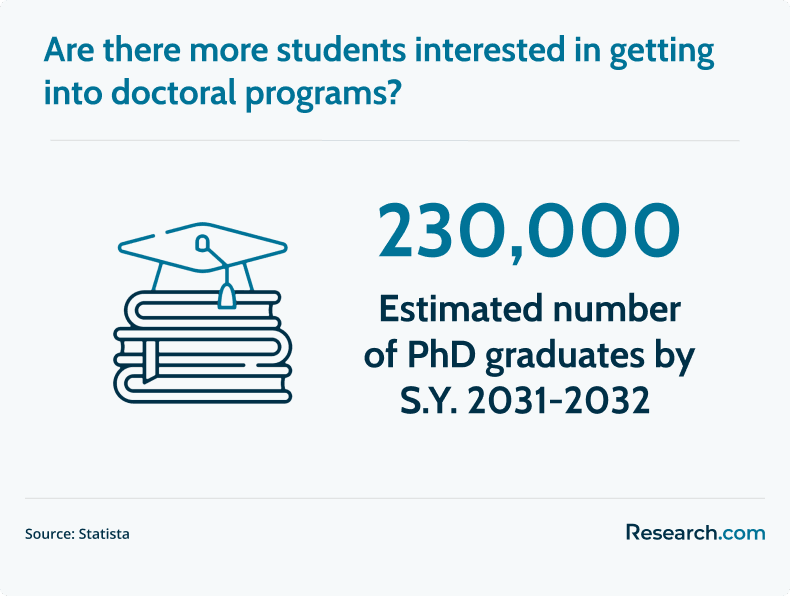
Looking ahead, the demand for doctoral education is projected to grow steadily; by the 2031-2032 academic year, the combined number of male and female doctoral graduate students in the United States is expected to reach nearly 230,000 (Statista, 2025). Overall, students who enroll full-time to get a PhD can expect to complete the degree within 3 to 6 years of continuous study, depending on the academic system.
How hard is a PhD compared to a Master's study?
A PhD is generally considered significantly more challenging than a master’s degree, including the fastest online master's degree in nutrition, because of the depth, duration, and originality of work required. A master’s program usually lasts 12 to 24 months and focuses on advanced coursework, skill-building, and in some cases, a smaller-scale research project or thesis.
In contrast, a PhD often spans 36 to 72 months of full-time study and demands the creation of original knowledge through extensive research, data collection, and dissertation writing. While a master’s degree demonstrates advanced understanding of existing knowledge, a PhD requires students to push the boundaries of their field by developing new theories or insights.
Doctoral students must also pass comprehensive exams, publish in peer-reviewed journals, and often teach or assist in academic work. For those aiming to get a PhD, the intellectual, emotional, and time investment is far greater than that required for a master’s, making it a more demanding but ultimately more rewarding academic pursuit.
For students aspiring to doctoral study, the distribution of PhD and doctorate graduates across U.S. states highlights where strong institutions are concentrated.
According to the chart below, California produced the most doctorate recipients with 6,788 graduates, followed by Texas (4,396) and New York (4,277). These states are home to many of the nation’s leading universities, such as Stanford, Harvard, Columbia, and the University of Texas at Austin, which offer outstanding research facilities, faculty expertise, and academic communities.
What are the types of PhD programs?
PhD programs span multiple disciplines, and they can be grouped into broad categories such as humanities, social sciences, STEM fields, health sciences, and professional areas. Below are some examples under each category:
Humanities
- PhD in English or Literature. Students analyze texts, theory, and criticism, often preparing for careers in academia, publishing, or cultural research.
- PhD in History. This program focuses on historical analysis, archival research, and historiography, preparing graduates for roles in teaching, museums, or policy. Those who have completed the best online history bachelor's degree programs may be qualified to apply for this PhD in some universities, even without a master’s degree.
Social Sciences
- PhD in Psychology. Students study human behavior and cognition, with specializations in clinical, developmental, or neuroscience research.
- PhD in Political Science. This degree explores governance, public policy, and international relations, preparing graduates for academic or policy careers.
- PhD in Economics. The program emphasizes quantitative analysis, economic theory, and policymaking.
STEM (Science, Technology, Engineering, Mathematics)
- PhD in Biology. Research covers molecular biology, ecology, genetics, and biotechnology, often leading to careers in research or industry.
- PhD in Computer Science. Students focus on AI, data science, cybersecurity, or software development.
- PhD in Engineering. Options include civil, mechanical, electrical, or computer engineering with emphasis on innovation and problem-solving.
Health Sciences
- PhD in Nursing. Unlike Doctor of Nursing Practice or the easiest DNP programs, a PhD in Nursing is research-focused, preparing graduates to become scholars and researchers who generate new knowledge, rather than emphasizing clinical practice.
- PhD in Public Health. Students conduct research in epidemiology, health policy, and global health issues.
Professional Fields
- PhD in Business Administration. This program emphasizes organizational behavior, finance, strategy, and management research.
- PhD in Education. Graduates focus on educational theory, policy, and practice, often leading to leadership or faculty positions.
Students seeking a faster pathway may also consider fast-track doctorate programs in educational policy online, which provide an alternative route for advancing careers in education leadership.
How much does it cost to get a PhD?
The cost of earning a PhD can vary widely depending on the country, institution, and field of study, but in the United States, it typically ranges between $28,000 and $55,000 per year in tuition and fees (Education Data Initiative, 2024).
Since most full-time PhD programs take four to six years to complete, the total direct cost may exceed $150,000 to $300,000 before considering living expenses, books, research materials, or health insurance. In fact, the Education Data Initiative (2024) also mentioned that the average research doctorate holder owes $187,030 in education debt.
To avoid debts, PhD students can get financial assistance. According to the chart below, 36.1% of doctoral students were supported through research assistantships or traineeships, while 24.2% received fellowships, scholarships, or dissertation grants. Another 20.4% held teaching assistantships, which commonly include tuition remission and stipends.
Meanwhile, a smaller share relied on their own resources (15.0%) or employer/other sources (4.2%). These figures show that while the sticker cost of a PhD is high, students who want to get a PhD can often secure funding that makes the degree much more affordable and sustainable.
What are the common challenges that PhD students face?
To get a PhD is an intellectually rewarding journey, but it comes with unique hurdles that test persistence, adaptability, and resilience. From academic expectations to personal well-being, PhD students must navigate a variety of obstacles throughout their programs. Below are ten of the most common challenges faced by doctoral candidates:
Meeting rigorous academic requirements
PhD students must complete advanced coursework, pass comprehensive exams, and conduct independent research. The pressure to meet high academic standards can feel overwhelming, especially when combined with strict deadlines and grading expectations.
Managing the dissertation process
The dissertation is often the most challenging part of a PhD. Students must design a feasible project, collect and analyze data, and write hundreds of pages of original research. The uncertainty of research outcomes and potential setbacks, like failed experiments or rejected proposals, can be discouraging.
Publishing academic papers
In many fields, publishing in peer-reviewed journals is expected before graduation. This can be stressful, as the peer-review process is slow, competitive, and often involves multiple rounds of revisions or rejections. Students may struggle with balancing paper submissions alongside dissertation writing.
Balancing work and personal life
PhD studies demand long hours, which can make it difficult to maintain healthy relationships, family commitments, or hobbies. Burnout is common when students neglect rest, exercise, or social support while focusing exclusively on research.
Coping with financial pressure
Although many programs offer stipends, they are often modest and may not cover the full cost of living. Students may also need to take on teaching or part-time jobs, adding to their workload and stress.
Handling uncertainty about career paths
Unlike professional degrees, a PhD does not guarantee a stable academic job. The academic job market is highly competitive, and many graduates transition to industry, government, or consulting — sometimes feeling unprepared for non-academic roles.
Dealing with supervisor relationships
A supportive advisor can make or break the PhD experience. Conflicts in communication, mismatched expectations, or a lack of mentorship can hinder progress and cause stress. Students often feel stuck because their supervisor plays a key role in approving their work.
For students exploring PhD pathways outside traditional research fields, there are also specialized doctoral options designed for personal, professional, or ministry development. For example, some learners pursue a doctorate degree in theology online, which can offer more flexibility, a structured curriculum rooted in reflective scholarship, and the ability to balance academic study with ongoing life or ministry responsibilities.
What tips should I know to successfully get a PhD?
Pursuing a PhD is a long-term commitment that begins with a competitive admissions process and continues through years of rigorous study and research. Below are practical tips for gain admission into a PhD program as well as completing it:
Tips for Getting Accepted into a PhD Program
- Research programs thoroughly. Applicants should compare universities, faculty expertise, and program requirements to find the best match for their research interests.
- Strengthen academic credentials. A strong GPA, a relevant master’s degree, and prior research experience make applicants more competitive. Publishing or presenting at conferences adds further value.
- Build faculty connections. Reaching out to potential supervisors, attending academic events, or networking can improve acceptance chances and help secure mentorship.
- Craft a compelling research proposal. A clear, original, and feasible proposal demonstrates the ability to contribute new knowledge to the field.
- Highlight fit in applications. Applicants should emphasize how their interests align with faculty expertise and the program’s strengths.
Tips for Completing a PhD Successfully
- Develop time management skills. Balancing coursework, research, and teaching requires organization and prioritization to avoid burnout.
- Secure funding early. Exploring assistantships, fellowships, or grants helps reduce financial stress and keeps focus on research.
- Stay resilient through setbacks. Research often involves unexpected challenges; persistence and adaptability are essential.
- Seek feedback regularly. Guidance from supervisors and peers improves research quality and prevents delays.
- Publish during the program. Submitting papers to journals or conferences builds an academic portfolio before graduation.
- Keep career goals in sight. Students should align their research and skills development with long-term career paths in academia, government, or industry.
For students who need more flexibility, many accredited universities now offer remote doctoral pathways. Understanding how to get PhD degree online can be especially helpful for working professionals, caregivers, or individuals seeking to continue their education without relocating. Online formats often allow students to balance research with employment while still receiving faculty mentorship and access to institutional resources.
What can you do with a PhD?
When you get a PhD, you open doors to a wide range of professional opportunities both inside and outside academia. Below are some of the most common career paths:
- Academic Careers. Many PhD graduates become professors, researchers, or lecturers, contributing to higher education and advancing knowledge in their fields.
- Government and Policy Roles. PhD holders often work in government agencies, shaping public policy, conducting research, or serving as advisors.
- Industry Research and Development. Many industries, such as pharmaceuticals, technology, and engineering, employ PhDs to lead innovation and applied research.
- Consulting. PhD graduates can leverage their expertise to advise businesses, organizations, or governments on specialized challenges.
- Nonprofit and Think Tanks. PhDs contribute to mission-driven organizations by conducting research, evaluating programs, and shaping advocacy.
- Entrepreneurship. Some graduates launch startups, apply their research commercially, or create businesses based on their innovations.
- Writing and Publishing. With advanced knowledge and research skills, PhDs often author books, academic papers, or contribute as subject-matter experts in publishing.
Many of these opportunities emphasize leadership, critical thinking, and the ability to solve complex problems—skills developed throughout doctoral study. For those interested in applying these strengths within schools or higher education, exploring how to get an education doctorate can provide a practical pathway into administrative leadership, curriculum development, educational consulting, and academic policy roles. This route blends scholarship with real-world impact, offering a direct avenue into shaping learning environments and institutional change.
Based on employment pathway data from surveyed PhD graduates at two U.S. universities and one New Zealand university, the largest share (33.3%) were employed in fixed-term academic roles. Another 17.5% each found work in government and in the for-profit private sector. Overall, 47.5% secured permanent positions, indicating that while many begin in temporary roles, long-term career stability remains a realistic outcome for PhD holders.
Is a PhD worth it for 2027?
Determining whether a PhD is worth pursuing for 2027 depends on both career aspirations and personal motivation, but the evidence shows strong outcomes for graduates.
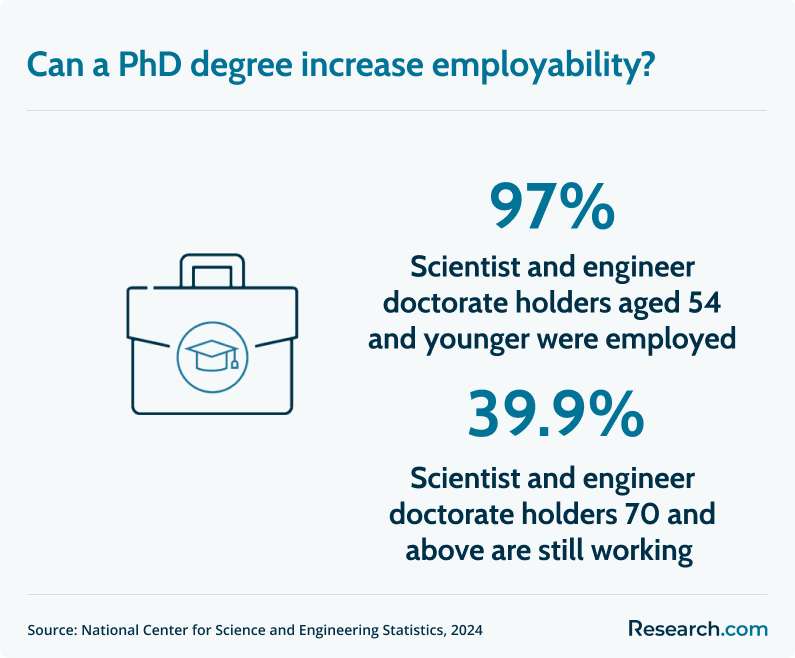
Data from the National Center for Science and Engineering Statistics (2024) shows that nearly all doctorate holders aged 54 or younger in the United States were employed, reflecting exceptional job security. Even at later stages of life, such as ages 71–75, close to two-fifths of graduates remained active in the workforce, and more than half of them had re-entered employment after previously retiring. This suggests that when you get a PhD, the doctoral training provides lasting career value across a lifetime.
In terms of job satisfaction, the outlook is also highly positive. A study by Spronken-Smith, Brown, and Cameron (2024) revealed that more than four out of five PhD graduates were satisfied with their careers. Interestingly, satisfaction rates were similar whether graduates pursued traditional academic positions or transitioned into roles in government, industry, or other sectors, highlighting the flexibility of the degree.
Although earning a PhD often requires intensive study, it can unlock specialized opportunities in teaching, research, and leadership, while also supporting long-term career resilience. For individuals who are driven by curiosity, discovery, and impact, investing in a PhD for 2027 remains a strong and worthwhile choice.
Additionally, students comparing advanced academic paths may also look at programs among the highest paying doctorate degrees, especially those in fields such as healthcare, engineering, or business, where long-term earnings and leadership opportunities can be especially strong.
Key Findings
- Funding sources for doctoral students show that 20.4% rely on teaching assistantships, while the largest share, 36.1%, is supported through research assistantships or traineeships.
- Employment outcomes reveal that one-third (33.3%) of PhD graduates are working in academic fixed-term positions.
- Job security remains uneven, as 47.5% of doctorate holders secured permanent employment, whereas 52.5% continue in temporary roles.
- Geographic distribution of doctorates highlights that California produced the highest number of research doctorate recipients in 2024 (6,788), followed by Texas (4,396) and New York (4,277).
- Career satisfaction remains high, with 82% of PhD graduates reporting that they are happy with their work, regardless of whether they are employed inside or outside academia.
Can additional certifications enhance your PhD journey?
Integrating supplemental credentials with doctoral training can improve career adaptability without detracting from the in‐depth research focus of a PhD program. Targeted certifications may provide specialized expertise in emerging fields, helping candidates bridge the gap between academic research and industry demands. For example, obtaining cheap graduate certificates can support skill diversification while demonstrating a commitment to continual professional development.
References:
- Bureau of Labor Statistics. (2025, May). Education pays, 2024. Career Outlook. https://www.bls.gov/careeroutlook/2025/data-on-display/education-pays.htm
- National Center for Science and Engineering Statistics. (2024, December 2). Doctorate recipients from U.S. universities: 2023. National Science Foundation. https://ncses.nsf.gov/surveys/doctorate-recipients/2023
- National Center for Science and Engineering Statistics. (2025, August 28). Survey of earned doctorates (SED) 2024. National Science Foundation. https://ncses.nsf.gov/surveys/earned-doctorates
- Spronken-Smith, R., Brown, K., & Cameron, C. (2024). Work happiness of PhD graduates across different employment sectors. New Zealand Journal of Educational Studies, 59(3), 565–582. https://doi.org/10.1007/s40841-024-00339-1
- Statista. (n.d.). Number of doctoral degrees by gender since 1950. Statista. https://www.statista.com/statistics/185167/number-of-doctoral-degrees-by-gender-since-1950/
- World Population Review. (2025). PhD percentage by country. https://worldpopulationreview.com/country-rankings/phd-percentage-by-country
Other Things to Know About Getting a PhD
In 2027, consider the potential supervisor's expertise, track record with previous students, research interests alignment, and communication style. Emerging fields and interdisciplinary opportunities may also influence your decision. Be sure to discuss your career objectives and their support for both academic and non-academic career paths.
In 2027, the typical duration of coursework in a PhD program is 1 to 3 years, depending on the field of study and program structure. Coursework usually precedes dissertation work and is designed to provide foundational knowledge required for specialized research.


