
2027 Best Online Doctorate in Theology Programs

Co-Founder and Chief Data Scientist
If you're a leader in ministry or a faith-based organization, you've likely felt the increasing pressure to demonstrate a higher level of expertise. You're not alone in sensing that a deeper authority is needed to lead effectively. In fact, only 14% of clergy have earned a doctoral or professional degree, placing those who do in an elite group of qualified leaders.
Pursuing an online doctorate in theology is a powerful, strategic step toward gaining the competence and credibility your role demands. The career planning experts who created this guide have over a decade of experience helping professionals like you. We'll provide the clear answers you need to choose the program that elevates your career to its highest level.
What are the benefits of getting an online doctorate in theology?
- It opens doors to top-tier career paths, including roles as clergy, postsecondary teachers, and executive managers in faith-based organizations.
- The degree unlocks higher earning potential, with the average salary for ministers around $56,840 and opportunities for significant growth in academic and executive roles.
- It provides the flexibility to pursue a terminal degree without having to leave your current ministry or professional context.
What can I expect from an online doctorate in theology?
You should expect a rigorous academic experience that typically takes three to seven years to complete. The journey involves advanced, seminar-style coursework and comprehensive exams. It culminates in a significant original research project, known as a dissertation or doctoral thesis.
The most important thing to understand is that this process is designed to fundamentally change your professional identity. Unlike a master's degree, where you primarily consume knowledge, an online doctorate in theology trains you to become a producer of knowledge.
Whether your focus is academic research or developing new models for ministry, the entire program is designed to hone your ability to create, articulate, and defend an original contribution to the field. This transformation is the true heart of the doctoral experience.
Where can I work with an online doctorate in theology?
Graduates with this degree typically work across three main sectors: higher education, church and denominational leadership, and the non-profit world. The most common roles are postsecondary teachers, clergy, and executive managers in faith-based organizations.
However, the specific career path you can pursue depends almost entirely on the type of doctorate you choose. This is the most important distinction you need to understand.
A Doctor of Philosophy (Ph.D.) is the research degree designed for a career in academia. It prepares you to become a professor or a scholarly author. A Doctor of Ministry (D.Min.) or a Doctor of Theology (Th.D.), on the other hand, is a professional doctorate. It is designed for advanced practitioners who will lead at the highest levels of ministry and non-profit work.
How much can I make with an online doctorate in theology?
The financial value of this degree comes from the access it gives you to senior-level positions, which come with higher pay scales. It's less about an immediate salary bump and more about qualifying you for top-tier leadership roles.
For example, while a pastor with a few years of experience might earn around $49,574, an experienced minister in a senior role can earn closer to $59,280. The doctorate is often the credential that makes you a serious candidate for those top positions.
For those on an academic track, salaries vary by institution. However, the consistent demand for postsecondary teachers indicates a stable and viable career path for qualified Ph.D. graduates.
- List of the Best Online Doctorate in Theology Programs for 2027 List of Programs
- How long does it take to complete an online doctorate in theology program? Completion Time
- How does an online doctorate in theology program compare to an on-campus program? How does an online doctorate in theology program compare to an on-campus program?
- What is the average cost of an online doctorate in theology program? Program Cost
- What are the financial aid options for students enrolling in an online doctorate in theology program? Financial Aid
- What are the prerequisites for enrolling in an online doctorate in theology program? What are the prerequisites for enrolling in an online doctorate in theology program?
- What courses are typically in an online doctorate in theology program? What courses are typically in an online doctorate in theology program?
- What types of specializations are available in an online doctorate in theology program? Specializations
- How to choose the best online doctorate in theology program? How to choose the best online doctorate in theology program?
- What career paths are available for graduates of an online doctorate in theology program? Career Paths
- Can you fast-track your online doctorate in theology program? Can you fast-track your online doctorate in theology program?
- What is the job market for graduates of an online doctorate in theology program? Job Market
List of the Best Online Doctorate in Theology Programs for 2027
How do we rank schools?
We understand that choosing a doctoral program is a major decision, and the financial commitment is a huge part of that. That’s why you need to know exactly how we evaluate the programs on our list.
Our rankings are based on solid data from trusted, official sources, including the IPEDS database, Peterson’s database, the College Scorecard, and the National Center for Education Statistics. Using this information gives us a factual, unbiased way to compare what each school offers you. If you’d like to see the full details of our process, you can find them on Research.com’s methodology page.
1. Columbia International University – PhD in Theological Studies
Columbia International University offers a fully online program for those seeking to investigate deep theological questions. It equips you with advanced research and writing skills to contribute to theological scholarship, guided by an experienced faculty mentor who supports your academic and spiritual growth.
- Program Length: 3 to 5 years
- Concentrations: Systematic Theology; Historical Theology; Apologetics; and Theological Ethics
- Required Credits to Graduate: 45
- Cost per Credit: $580
- Accreditation: Association of Theological Schools (ATS) and Association for Biblical Higher Education (ABHE)
2. St. Thomas University – PhD in Theology and Leadership
St. Thomas University provides a 100% online program rooted in the Catholic theological tradition. The curriculum is built to prepare you for advanced scholarship and effective ministry, forming you into an ethical leader equipped for service within the church’s worldwide mission.
- Program Length: 3 to 5 years
- Required Credits to Graduate: 58
- Cost per Credit: $700
- Accreditation: Higher Learning Commission (HLC)
3. Regent University – PhD in Renewal Theology
Regent University delivers a hybrid program centered on a Renewal perspective, combining online coursework with a two-week on-campus residency. This structure allows you to explore biblical studies and church history, preparing you to add original research to the broader academic conversation.
- Program Length: 4 to 7 years
- Concentrations: Biblical Studies; Christian Theology; Church History; and Practical Theology
- Required Credits to Graduate: 60
- Cost per Credit: $670
- Accreditation: Association of Theological Schools (ATS)
4. Saint Leo University – Doctorate in Applied Theology
Saint Leo University offers a distinctive, fully online Doctor of Theology program, provided by a Catholic university. The program is designed for active professionals in ministry or education, focusing on developing the research skills necessary to apply theological insights to practical, real-world challenges.
- Program Length: 4 years
- Required Credits to Graduate: 60
- Cost per Credit: $780
- Accreditation: Southern Association of Colleges and Schools Commission on Colleges (SACSCOC)
5. Kairos University – Doctor of Theology
Kairos University guides you through a personalized, mentor-led program designed to sharpen your skills in your current ministry context. The focus is on practical theological reflection, helping you develop ministry practices that are both biblically sound and immediately relevant to your community.
- Program Length: 3 to 5 years
- Required Credits to Graduate: 42
- Tuition: Subscription-based at $600/month
- Accreditation: Association of Theological Schools (ATS)
6. United Theological Seminary – Doctor of Theology
United Theological Seminary offers a customized research degree for leading pastor-scholars through a flexible, low-residency format. The program admits a small number of students to ensure close faculty mentorship, shaping a plan of study around your specific research interests and goals.
- Program Length: 3 to 5 years
- Required Credits to Graduate: 42
- Cost per Credit: $845
- Accreditation: Association of Theological Schools (ATS)
7. Atlantic International University – Doctorate of Theology
Atlantic International University offers a distinctive, student-driven curriculum that prioritizes personalized learning for individuals in church or mission vocations. This flexible, andragogic online program empowers you to design your own course of study, fostering deep understanding in your specific areas of interest.
- Program Length: 3 to 7 years
- Required Credits to Graduate: 54 to 70
- Total Tuition: $13,500 (Andragogic); $19,850 (Pedagogic)
- Accreditation: Accreditation Service for International Schools, Colleges, and Universities (ASIC)
8. Calvary University – PhD in Bible & Theology
Calvary University provides a 100% online, cohort-based program with a dual discipline in Bible and Theology. It is designed to produce outstanding scholars who can serve both the academy and the church through deep exegetical research from a traditional dispensationalist perspective.
- Program Length: 4 years
- Required Credits to Graduate: 60
- Cost per Credit: $538
- Accreditation: Association for Biblical Higher Education (ABHE)
9. Liberty University – Online PhD in Practical Theology
Liberty University’s 100% online program trains you to use theological principles to address the tangible needs of Christian communities. The curriculum is designed to develop your research and teaching skills for addressing practical ministry issues in churches, parachurch organizations, and non-profits.
- Program Length: 3 to 5 years
- Required Credits to Graduate: 51
- Cost per Credit: $410
- Accreditation: Southern Association of Colleges and Schools Commission on Colleges (SACSCOC)
10. Oral Roberts University – PhD in Contextual Theology
Oral Roberts University offers a modular program centered on the theological expressions of the global Spirit-empowered movement. By blending online learning with short residencies, the program trains you to be a scholar-practitioner who can effectively serve in a global ministry context.
- Program Length: 4 years
- Required Credits to Graduate: 51
- Cost per Credit: $640
- Accreditation: Association of Theological Schools (ATS)
How long does it take to complete an online doctorate in theology program?
Most programs are designed to be completed in three to five years; however, it's wise to plan for up to seven years. This timeline typically breaks down into two to three years of focused coursework, followed by an additional one to three years dedicated to researching and writing your dissertation.
Factors That Influence Program Length
The single most significant variable in any doctoral program is the dissertation. Many students complete their courses on schedule but get stuck in a phase known as "All But Dissertation," or ABD. This is where a program's structure and the quality of its faculty mentorship become critical.
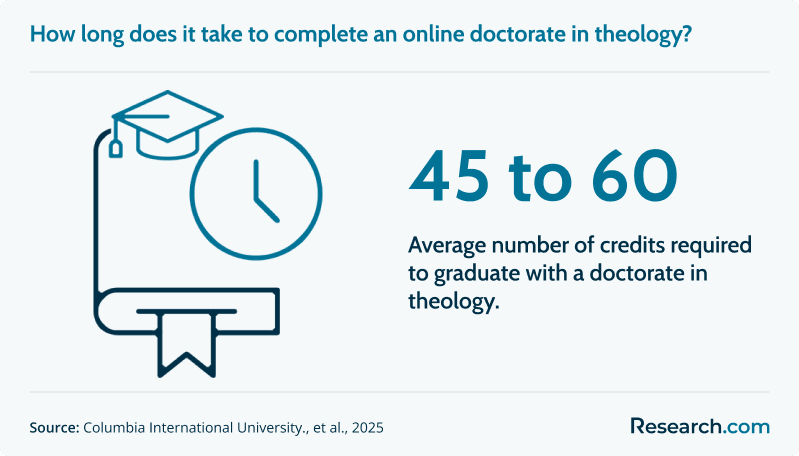
A good program will have a clear, structured process for guiding you from a research proposal to a finished dissertation. Choosing a school with a strong support system is the best way to ensure you complete the degree on time. Some students consider fast track online theology degrees to find structured timelines, but the key is always the dissertation support. Programs typically require between 45 and 60 credits, which gives you a good sense of the coursework phase.
How does an online doctorate in theology program compare to an on-campus program?
The core difference comes down to a trade-off between flexibility and immersion.
A fully online program offers maximum flexibility, allowing you to complete your studies without relocating or leaving your current professional role. An on-campus program offers a deep immersion in an academic community, providing more opportunities for spontaneous, face-to-face interaction with peers and faculty.
Finding the Right Fit: From Fully Online to Hybrid Residencies
It's important to know that "online" doesn't always mean 100% remote. Many of the best programs use a hybrid model, which combines the convenience of online coursework with short, intensive on-campus residencies. These residencies, which may occur once or twice a year, are designed to foster strong professional networks.
Fully online programs are excellent for self-motivated students who need to balance their studies with a demanding career. Hybrid programs, on the other hand, are often the perfect compromise. They offer the flexibility you need while still providing the dedicated, in-person time that is so valuable for guiding class discussions and building the strong peer relationships that will last throughout your career.
As you consider which format fits your life, you may also want to explore different schools to see what they offer.
What is the average cost of an online doctorate in theology program?
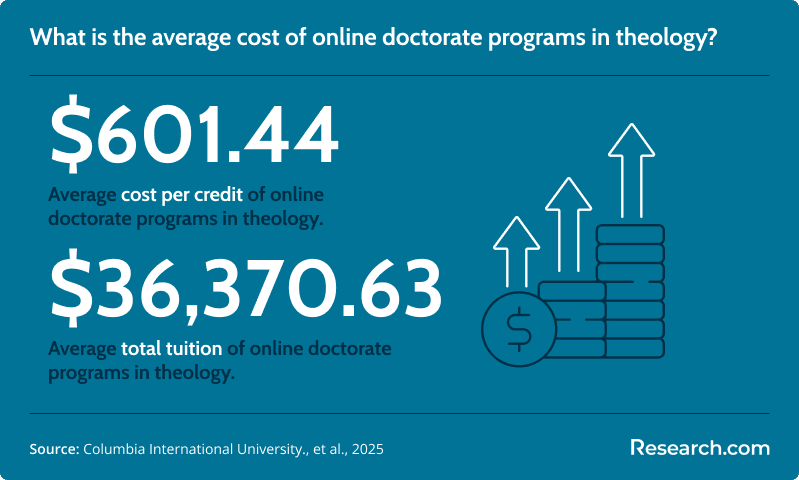
According to our current data, the average cost per credit for an online doctorate in theology is approximately $601. This results in an average total tuition for a complete program of roughly $36,370. However, the tuition is only one part of the overall financial picture.
Calculating Your Total Investment
When building your budget, it's essential to consider the cost per credit beyond the initial cost. The total cost of your degree will also include institutional fees, technology fees for online learning platforms, and the cost of books and research materials.
The most significant variable to consider is travel. If you choose a hybrid program with on-campus residencies, you must factor in the cost of flights, lodging, and meals for those trips. A program that seems cheaper on paper can quickly become more expensive once you add in the travel required for two or three residencies per year.
What are the financial aid options for students enrolling in an online doctorate in theology program?
Financial aid for doctoral programs is primarily based on federal and private loans. While some institutional scholarships may be available, you shouldn't expect the kind of grant aid that is common for undergraduate degrees.
The most important funding sources to investigate are specific to your context. Many denominations and employers offer tuition assistance or professional development funds for their leaders. This should be your first area of inquiry as you explore how to pay for your degree.
A Key Strategy: Public Service Loan Forgiveness (PSLF)
For many in this field, the most powerful financial tool is the Public Service Loan Forgiveness program. If you work full-time for a qualifying non-profit organization—which includes most churches and faith-based non-profits—this federal program can forgive your remaining federal student loan balance after you've made 120 qualifying monthly payments.
This is a long-term strategy, but it can make the debt from an online doctorate in theology far more manageable. Understanding how PSLF works is essential for anyone planning a career in ministry or the non-profit sector. It's a vital piece of the financial puzzle, much like how some individuals might explore the fastest online Christian ministry degrees to manage time and cost.
What are the prerequisites for enrolling in an online doctorate in theology program?
Most programs require an accredited Master of Divinity (M.Div.) or a related theological master's degree with a minimum GPA of 3.5. You will also need to submit strong academic writing samples, letters of recommendation, and a statement of purpose outlining your research interests.
For those who still require this foundational credential, pursuing an online theology degree is the logical first step.
The Language Requirement: A Critical Checkpoint
A crucial prerequisite for many programs, especially Ph.D. tracks, is proficiency in biblical languages. This often means you'll need to demonstrate competency in either biblical Greek or Hebrew before you can even apply.
This isn't just an academic hurdle; it's a necessary tool for genuine doctoral research. The ability to engage with primary texts in their original language is a hallmark of advanced theological scholarship. D.Min. programs may have more flexible language requirements, but for a Ph.D., it is often a non-negotiable entry point. Be sure to check this specific requirement early in your search.
What courses are typically in an online doctorate in theology program?
Doctoral coursework is less about lectures and more about deep engagement with scholarly material. The curriculum is typically built around three key areas: advanced seminars in your specialization, courses in research methodology, and dedicated dissertation credits.
These courses are small, reading-intensive seminars where you are expected to contribute to the scholarly conversation. The goal is to move beyond simply understanding a topic to critically analyzing and evaluating it.
Why This Curriculum Matters for Leaders
The structure of a doctoral curriculum is designed for one primary purpose: to transform you from a consumer of knowledge into a producer of it. The research methodology courses are the heart of this process, as they give you the tools to conduct original, scholarly research.
Many prospective students who are still early in their academic planning sometimes wonder can you double major in college as a way to prepare for advanced theological study. While double majoring can provide breadth, the doctoral curriculum itself is designed to give you deep specialization and research focus—something far beyond undergraduate academic structure.
The seminars provide deep content knowledge, but the dissertation is where you apply that knowledge to create something new. This rigorous training is what distinguishes doctoral graduates. As the data shows, only 14% of clergy hold a doctoral degree, placing those who complete this process in an elite tier of thinkers and leaders.
What types of specializations are available in an online doctorate in theology program?
You will find a range of specializations, with the most common being Biblical Studies, Systematic Theology, Historical Theology, and Practical Theology. Some universities also offer more niche concentrations, such as Renewal Theology or Contextual Theology, allowing you to focus on a specific area of interest.
Your choice of specialization is one of the most important decisions you will make. It will determine your faculty mentor, the focus of your research, and the specific expertise you will be known for throughout your career.
Interdisciplinary Approaches: Theology in Practice
The most forward-thinking scholars often enrich their theological work by drawing from other fields. A specialization in Practical Theology, for example, can be powerfully combined with insights from different disciplines to address complex ministry challenges.
If you are focused on revitalizing a church's community engagement, pairing your theological study with insights from the best online social work degree programs could provide a unique and highly effective skill set. Thinking this way enables you to establish a scholarly brand that is not only academically sound but also highly relevant to the needs of the modern world.
How to choose the best online doctorate in theology program?
Choosing the "best" program isn't about rankings; it's about finding the right fit for your specific goals. The most effective approach is to follow a clear, four-step process.
First, clarify your primary goal to decide between a Ph.D. for an academic career or a D.Min. for advanced practice. Second, verify the program's accreditation. Third, research the faculty to ensure their expertise aligns with your research interests. Finally, assess whether the program's modality and total cost align with your lifestyle.
Understanding Accreditation: Your North Star
Of these four steps, the most important is accreditation. A degree from an unaccredited institution will not be recognized by other universities, employers, or denominational bodies. Choosing a diploma mill is the biggest risk you can take in this process.
For an online doctorate in theology, you should look for accreditation from agencies recognized by the Council for Higher Education Accreditation (CHEA). The most respected accreditors in this field are The Association of Theological Schools (ATS), the Association for Biblical Higher Education (ABHE), and the Transnational Association of Christian Colleges and Schools (TRACS). Accreditation is your non-negotiable guarantee of quality.
As you weigh these factors, take the time to explore and compare specific programs that have the accreditation you need. Many students researching doctoral options are also thinking about earlier steps in the education journey, including what's the fastest way to get a bachelor's degree. While accelerated bachelor's pathways can shorten the timeline, doctoral programs require a deeper commitment to scholarship, reflection, and research—making the selection process especially important.
What career paths are available for graduates of an online doctorate in theology program?
Your career path will be shaped by the type of degree you earn. A Ph.D. is designed for a life of scholarship and prepares you for roles like Tenure-Track Professor, Academic Dean, or scholarly author.
A D.Min. or Th.D. is a professional doctorate that qualifies you for high-level leadership in practice. Graduates often become Senior Pastors, Denominational Executives, Non-Profit CEOs, or specialized consultants. Exploring various Christian leadership careers can give you a broader sense of the possibilities.
A Look at the Modern Professoriate
While the tenure-track professorship remains the traditional goal for Ph.D. graduates, many scholars today build what is known as a "portfolio career." This modern, resilient path often involves a mix of part-time teaching, writing books, consulting for organizations, and public speaking. This approach enables you to craft a flexible and impactful career centered on your unique expertise.
The academic world itself is also evolving. For instance, a contemporary snapshot reveals that the field of theology has a more balanced gender distribution than many other disciplines, with women comprising a significant portion of the professoriate.
For those interested in teaching at the K–12 level or in church-affiliated school systems, this degree can also support a transition into education. Many graduates explore options for how to get a teaching certificate online to expand their reach beyond ministry and academic scholarship. This can be a strategic way to diversify career pathways and serve educational communities while applying theological training in a practical, meaningful way.
Can you fast-track your online doctorate in theology program?
Some institutions offer flexible pathways that allow qualified candidates to accelerate their progress without compromising academic rigor. By leveraging prior learning, professional experience, and a structured course sequence, certain programs may enable students to shorten the duration of their studies. For example, reviewing accelerated doctoral programs in education online can provide insights into strategies and policies that might be adapted to theological studies. This approach requires a careful evaluation of credit transfer options, accelerated coursework formats, and a commitment to maintaining high-quality research and mentorship throughout the accelerated process.
What is the job market for graduates of an online doctorate in theology program?
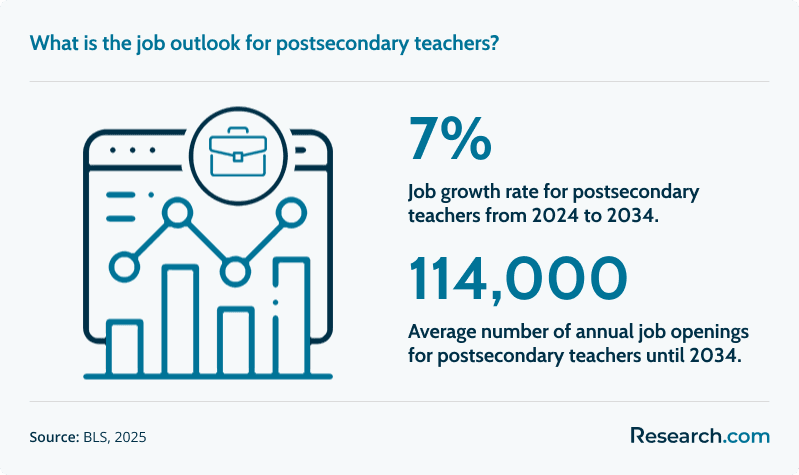
The job market can be best understood as comprising two distinct fields. The academic market for tenure-track professors is highly competitive; however, government data projects a healthy 7% job growth for postsecondary teachers overall, with approximately 114,000 openings expected each year.
For ministry and non-profit leaders, the market is robust. The job outlook for clergy is stable, and the increasing professionalization of faith-based organizations means there is a strong and growing demand for leaders with advanced credentials.
Projecting Future Demand
The long-term value of an online doctorate in theology lies in its ability to prepare you for future challenges. In a world of increasing public skepticism, organizations need leaders who can offer thoughtful, credible, and deeply informed guidance.
This degree equips you with the specialized expertise to address complex emerging issues, from bioethics to digital ministry. Completing this program doesn't just make you a candidate for a job; it positions you as a trusted voice of authority who is prepared to lead with competence and conviction for decades to come.
Many students exploring advanced theological study also compare timelines and expectations across other graduate programs, such as asking how long does it take to get a MSW online. The online doctorate in theology typically requires a longer and more research-intensive path, but it offers a similarly flexible format designed for working adults who want to advance their careers without pausing their professional or ministry responsibilities.
Here’s What Graduates Have to Say About Their Online Doctorate in Theology Program
- Malachi: "For years, I felt I’d hit a ceiling in my ministry. I had the experience, but not the formal authority to be considered for senior leadership roles. This program gave me the credential I needed, but more than that, it gave me a deeper confidence in my own theological voice. Because it was online, I could continue serving my congregation the entire time, applying what I learned almost immediately."
- Anaya: "My preaching had started to feel routine, like I was drawing from a well that was running dry. The doctoral program was like a spring rain, filling it back up with new ideas and deeper insights into scripture. The online format was perfect because I could take a concept from a Thursday night class and build an entire sermon around it for Sunday. My congregation noticed the difference right away."
- Kenji: "The dissertation felt like a mountain, but the structured process and my faculty advisor's guidance made the climb manageable. It taught me how to sustain a complex argument and produce a piece of original scholarship that I'm genuinely proud of. That research has now become the foundation for my first book proposal and has opened doors to speaking invitations I never would have received otherwise."
Key Findings
- Earning a doctorate places you in an elite group, as only 14% of clergy hold a doctoral or professional degree, providing the credentialed authority needed for top-tier leadership.
- With an average total tuition of around $36,370, prospective students must engage in careful financial planning, making strategies like Public Service Loan Forgiveness a critical consideration.
- The academic job market for postsecondary teachers is projected to grow by 7%, indicating a stable and viable career path for Ph.D. graduates seeking a platform of influence in scholarship.
- Programs typically require 45 to 60 credits to graduate, a significant time investment where the dissertation and faculty mentorship become the most critical factors for timely completion.
- While the average salary for ministers is around $56,840, the doctorate's primary financial value lies in unlocking access to senior leadership and executive roles, which often come with higher compensation.
- The modern academic landscape in this field is more balanced than many others, with women now comprising 53.9% of theology professors, reflecting an evolving and inclusive scholarly community.
References:
- CareerOneStop. (2024). Occupation profile: Philosophy and religion teachers, postsecondary. U.S. Department of Labor. Retrieved September 29, 2025, from CareerOneStop.
- CareerOneStop. (2025). Occupation profile: Clergy. U.S. Department of Labor. Retrieved September 29, 2025, from CareerOneStop.
- Colorado Christian University. (n.d.). Biblical studies vs. theological studies. CCU. Retrieved September 29, 2025, from CCU.
- Data USA. (2025). Religious studies. Retrieved September 29, 2025, from Data USA.
- Gallup. (2024). Church attendance has declined among most religious groups. Gallup. Retrieved September 29, 2025, from Gallup.
- Gordon-Conwell Theological Seminary. (2025). Status of global Christianity, 2025. Retrieved September 29, 2025, from Gordon-Conwell Theological Seminary.
- O*Net Online. (2025). Summary report for: 21-2011.00 - Clergy. U.S. Department of Labor. Retrieved September 29, 2025, from O*Net Online.
- O*Net Online. (2025). Summary report for: 21-2021.00 - Directors, religious activities and education. U.S. Department of Labor. Retrieved September 29, 2025, from O*Net Online.
- Payscale. (2025). Average pastor salary. Retrieved September 29, 2025, from Payscale.
- Payscale. (2025). Average professor of theology salary. Retrieved September 29, 2025, from Payscale.
- Pew Research Center. (2025). Religious switching. Retrieved September 29, 2025, from Pew Research Center.
- Statista. (2025). Self-described religious identification of Americans. Retrieved September 29, 2025, from Statista.
- United States Conference of Catholic Bishops. (2024). New survey on men being ordained to the priesthood underscores significant influence of parents and Catholic education. USCCB. Retrieved September 29, 2025, from USCCB.
- U.S. Bureau of Labor Statistics. (2025). Occupational outlook handbook: Postsecondary teachers. U.S. Department of Labor. Retrieved September 29, 2025, from BLS.
- ZipRecruiter. (2025). Minister salary. Retrieved September 29, 2025, from ZipRecruiter.
- Zippia. (2025). What does a professor of theology do? Retrieved September 29, 2025, from Zippia.
Other Things You Should Know About Online Doctorate in Theology Programs
In 2027, notable online Doctorate in Theology programs include Liberty University, Regent University, and the University of Aberdeen. These programs often offer various specializations and focus on comprehensive theological education to prepare students for roles in academia, ministry, and research.
Admission requirements typically include a master's degree in theology or a related field, a minimum GPA of 3.0, and submission of GRE scores. Applicants may also need to provide letters of recommendation and a personal statement outlining their research interests and career goals.


