
2027 Best Accelerated Finance Degree Programs Online

Co-Founder and Chief Data Scientist
The business and finance industry is booming, with 911,400 job openings projected annually until 2032. The demand for many related roles, like financial analyst and financial examiner, will grow much faster than average, meaning it is timely to consider entering the field.
An accelerated online finance program can prepare you for intellectually stimulating and financially rewarding roles in a short time. This guide covers essential information about accelerated hybrid or online finance degree programs, including duration, costs, and the best program options. We also explore the career outlook for graduates.
What are the benefits of getting a degree in finance?
- An accelerated online finance degree offers a fast track to entering a high-demand field with lucrative career prospects.
- Graduates can work in corporate, non-profits, the government, and more.
- Finance graduates typically earn well above the national average.
What can I expect from an accelerated finance program?
Accelerated online finance degree programs are a good option for students with existing college credits or a degree in an unrelated field. Students typically have a higher course load per semester and follow intensive study plans. They can also transfer credits toward degree requirements. As a result, they can earn their finance degrees in nearly half the time it would typically take.
Where can I work with a finance degree?
Many organizations—corporations, non-profits, and start-ups—need finance experts to help them manage their assets and improve cash flow. Many finance graduates work in-house at major companies. Others work at consulting firms. Outside corporate, finance graduates can work in government or charitable organizations.
How much can I make with a finance degree?
Finance graduates are prepared for some of the most lucrative jobs and typically make well above the national average. According to Payscale, the average person with a B.S. in finance takes home about $79,000 annually. In comparison, the U.S. Bureau of Labor Statistics (BLS) estimates the average wage for all workers at $48,060.
What you make will depend on the role you select. You might make $74,740 as a cost estimator or $84,940 as a budget analyst. As a financial analyst, you can make as much as $99,890.
- 2027 List of the Best Accelerated Finance Programs Online List of Programs
- How long does it take to complete an accelerated finance program? How long does it take to complete an accelerated finance program?
- How does an online finance program compare to an on-campus program? How does an online finance program compare to an on-campus program?
- What is the average cost of an accelerated finance program? Program Cost
- What are the financial aid options for students enrolling in an accelerated finance program? Financial Aid
- What are the prerequisites for enrolling in an accelerated finance program? Program Requirements
- What courses are typically in an accelerated finance program? What courses are typically in an accelerated finance program?
- What types of specializations are available in accelerated finance programs? What types of specializations are available in accelerated finance programs?
- How to choose the best accelerated finance program? How to choose the best accelerated finance program?
- What factors should students consider when selecting an accelerated online finance program? What factors should students consider when selecting an accelerated online finance program?
- What career paths are available for graduates of accelerated finance programs? What career paths are available for graduates of accelerated finance programs?
- What is the job market for graduates with a degree in finance? Job Outlook
- Is an Accelerated Finance Degree Worth the Investment? Is an Accelerated Finance Degree Worth the Investment?
- How do accelerated finance programs integrate emerging technologies? How do accelerated finance programs integrate emerging technologies?
- What challenges should I anticipate with an accelerated online finance program? What challenges should I anticipate with an accelerated online finance program?
- How do career services in accelerated finance programs boost job placement? How do career services in accelerated finance programs boost job placement?
- How do employers perceive accelerated online finance degrees? How do employers perceive accelerated online finance degrees?
Best Accelerated Finance Programs for 2027: Online and Hybrid Options
Choosing an accelerated finance degree is usually a time-sensitive decision: you want a credible credential, but you do not want to spend four years away from career progress. The right program can help transfer students, working adults, military learners, and career changers move faster into roles involving financial analysis, corporate finance, banking, investment services, risk management, or financial planning.
This guide explains how accelerated online and hybrid finance programs work, how long they take, what they cost, what to check before enrolling, and which career paths may follow. It also compares program formats, accreditation, transfer-credit policies, financial aid options, technology trends, and common mistakes so you can decide whether a fast-track finance degree is a practical investment for your goals.
Quick Answer: What Is the Best Accelerated Finance Program?
The best accelerated finance program is the one that matches your current credits, schedule, budget, career target, and need for accreditation. Students with many transfer credits may finish fastest in degree-completion programs, while students pursuing advanced finance roles may prefer accelerated master’s programs. Before enrolling, verify institutional or business-school accreditation, total cost after transfer credits and aid, course pacing, career support, and whether the curriculum includes practical finance tools such as financial modeling, Excel-based analysis, valuation, and data analytics.
How We Selected These Accelerated Finance Programs
Accelerated finance programs were reviewed with attention to delivery format, completion speed, transfer-credit options, tuition information, curriculum relevance, and institutional quality signals. A fast program is not automatically a good program; the strongest options combine speed with credible accreditation, finance-focused coursework, and realistic support for adult and online learners.
Our review considers information from the IPEDS database, Peterson’s database, the Distance Learning Licensed Data Set from the College Scorecard database, and the National Center for Education Statistics. For more detail on how Research.com evaluates programs, see our methodology section.
Accelerated Finance Programs at a Glance
| School | Program Type | Fastest Listed Completion Time | Cost Information | Accreditation Listed |
| DeSales University | B.S. in Finance | As few as 18 months | $575 per credit | Accreditation Council for Business Schools and Programs (ACBSP) |
| University of Maryland Global Campus | Online bachelor’s in finance | As few as 18 months | $324 per credit (in-state rate), $499 per credit (out-of-state rate), $250 per credit (military rate) | Middle States Commission on Higher Education (MSCHE) |
| Bemidji State University | Business administration with finance emphasis | 24 months | $10,522 total estimated cost per semester | Higher Learning Commission (HLC) |
| Lamar University | Online BBA in Finance | 24 months | $314 per credit hour | Association to Advance Collegiate Schools of Business (AACSB) |
| Albertus Magnus College | B.S. in Finance | As few as 18 months | $563 per credit | International Accreditation Council for Business Education (IACBE) |
| Rasmussen University | Online finance degree completion program | As few as 18 months | $24,821 to $29,771 total program cost | Higher Learning Commission (HLC) |
| California State University East Bay | Online BSBA degree completion program with finance concentration | Varies | $433 per unit | Association to Advance Collegiate Schools of Business (AACSB) |
| Eastern Kentucky University | Online BBA in Finance | As few as 24 months | $434 per credit hour | Association to Advance Collegiate Schools of Business (AACSB International) |
| University of Houston at Clear Lake | Online MS in Finance | 15 months | $22,138 to $29,000 per year (resident rate), $31,750 to $38,612 (non-resident rate) | Association to Advance Collegiate Schools of Business (AACSB) |
| Cambridge College Global | Online Master of Science in Finance | As few as 14 months | $21,150 total program cost | New England Commission of Higher Education (NECHE) |
Top Accelerated Finance Programs
1. DeSales University
DeSales University offers an accelerated B.S. in Finance with some online course availability. The program emphasizes financial markets, institutions, risk management, portfolio management, and the global economic forces that influence financial decision-making. Students can also choose a Data Analytics Track, which may be useful for learners interested in finance roles that rely heavily on data interpretation.
- Program length: As few as 18 months
- Tracks/concentrations: Data Analytics
- Estimated cost: $575 per credit
- Required credits to graduate: 120
- Accreditation: Accreditation Council for Business Schools and Programs (ACBSP)
- Transfer-credit note: The program accepts up to 75 transfer credits.
2. University of Maryland Global Campus
The online finance degree from the University of Maryland Global Campus is built for students who want a broad base in business, accounting, economics, corporate finance, and financial management. Case-based assignments help students connect classroom concepts to practical decisions in organizations. Its transfer-credit policy may make it especially appealing for students who already have substantial college credit.
- Program length: As few as 18 months
- Tracks/concentrations: None specified
- Estimated cost: $324 per credit (in-state rate), $499 per credit (out-of-state rate), $250 per credit (military rate)
- Required credits to graduate: 120
- Accreditation: Middle States Commission on Higher Education (MSCHE)
- Transfer-credit note: The program accepts up to 90 transfer credits.
3. Bemidji State University
Bemidji State University offers a business administration program with a finance emphasis for students who want finance training within a broader business curriculum. Coursework includes business fundamentals along with finance topics such as budgeting, working capital, and investment analysis. This option may suit students who want finance skills that can apply to corporate settings, entrepreneurship, or general business management.
- Program length: 24 months
- Tracks/concentrations: Finance
- Estimated cost: $10,522 total estimated cost per semester
- Required credits to graduate: 64
- Accreditation: Higher Learning Commission (HLC)
4. Lamar University
The Lamar University online BBA in Finance focuses on applying financial theory through practical work, including statistical analysis and Excel-based exercises. Students study financial asset valuation and prepare for roles related to management, international finance, and investments. Transfer credits may shorten the path for students who have already completed college coursework.
- Program length: 24 months
- Tracks/concentrations: None specified
- Estimated cost: $314 per credit hour
- Required credits to graduate: 120
- Accreditation: Association to Advance Collegiate Schools of Business (AACSB)
5. Albertus Magnus College
Albertus Magnus College offers a B.S. in Finance with an accelerated route for students interested in areas such as corporate finance or personal financial planning. The curriculum combines finance theory with practical business applications, making it a possible fit for learners who want a concentrated finance credential without a traditional-length schedule.
- Program length: As few as 18 months
- Tracks/concentrations: None specified
- Estimated cost: $563 per credit
- Required credits to graduate: 54
- Accreditation: International Accreditation Council for Business Education (IACBE)
6. Rasmussen University
The Rasmussen University online finance degree completion program is designed for learners who want to keep working while strengthening their finance skills. Students study financial modeling, theory-based problem-solving, and communication of financial recommendations. The program also includes an accelerated Master’s pathway for students who want to begin moving toward an MBA.
- Program length: As few as 18 months
- Tracks/concentrations: None specified
- Estimated cost: $24,821 to $29,771 total program cost
- Required credits to graduate: 90
- Accreditation: Higher Learning Commission (HLC)
7. California State University East Bay
California State University East Bay offers a fully online, asynchronous BSBA degree completion program with a finance concentration. The curriculum blends finance concepts with applied financial management, which can prepare students for opportunities in banking, investment, securities, and related business roles.
- Program length: Varies
- Tracks/concentrations: Finance
- Estimated cost: $433 per unit
- Required credits to graduate: 54
- Accreditation: Association to Advance Collegiate Schools of Business (AACSB)
8. Eastern Kentucky University
Eastern Kentucky University offers an online BBA in Finance that covers corporate finance, investment theory, and forensic accounting. The program uses 8-week terms, which can help motivated students move through courses more quickly. Learners may choose among finance-related tracks and, depending on prior college credit, may qualify for an accelerated completion route.
- Program length: As few as 24 months
- Tracks/concentrations: Business Finance, Banking and Financial Services, Financial Planning
- Estimated cost: $434 per credit hour
- Required credits to graduate: 120
- Accreditation: Association to Advance Collegiate Schools of Business (AACSB International)
9. University of Houston at Clear Lake
The University of Houston-Clear Lake offers a fully online, accredited MS in Finance program. The curriculum includes international tax law, economics, global financial markets, and other topics connected to current finance practice. Graduates have used the degree for paths in corporate finance, banking, financial planning, and related fields.
- Program length: 15 months
- Tracks/concentrations: None specified
- Estimated cost: $22,138 to $29,000 per year (resident rate), $31,750 to $38,612 (non-resident rate)
- Required credits to graduate: 30
- Accreditation: Association to Advance Collegiate Schools of Business (AACSB)
10. Cambridge College Global
Cambridge College Global offers an online accelerated Master of Science in Finance. Unlike a general MBA, this program centers on financial modeling, markets, and investment strategy. Students complete 10 courses and may finish in as few as 14 months.
- Program length: As few as 14 months
- Tracks/concentrations: Global Finance Trading, Leadership, Ethics and Corporate Social Responsibility
- Estimated cost: $21,150 total program cost
- Required credits to graduate: 30
- Accreditation: New England Commission of Higher Education (NECHE)
Key Findings
- Accelerated undergraduate finance programs commonly appeal to transfer students because prior credits can sharply reduce the time and cost required to graduate.
- Several listed bachelor’s programs can be completed in as few as 18 months, while the fastest listed master’s option can be completed in as few as 14 months.
- Accreditation matters. It can affect credit transfer, graduate-school options, employer confidence, and eligibility for many forms of federal financial aid.
- Online programs can offer strong flexibility, but acceleration increases workload intensity. Students should ask about weekly time expectations before enrolling.
- The lowest advertised tuition is not always the lowest total cost. Fees, transfer-credit limits, residency rates, textbooks, technology requirements, and course repeats can change the final price.
How Long Does It Take to Complete an Accelerated Finance Program?
An accelerated bachelor’s degree in finance can often be completed in one-and-a-half to two years of full-time study, especially when students transfer previous credits. This is faster than a traditional bachelor’s route, which usually takes four years. The same acceleration logic applies to graduate study: some finance master’s programs may take as little as one year instead of the usual two years. Students comparing finance and accounting should also review how timelines differ in an accelerated accounting degree online.
The real completion time depends on transfer credits, course availability, term length, enrollment intensity, and whether the school requires prerequisites before upper-division finance coursework. A program advertised as “as few as 18 months” may take longer if you enter with few credits or need general education requirements.
| School | Shortest Listed Time to Earn a Finance Degree | Number of Credits Required |
| DeSales University | As few as 18 months | 120 |
| University of Maryland Global Campus | As few as 18 months | 120 |
| Bemidji State University | 24 months | 64 |
| Lamar University | 24 months | 120 |
| Albertus Magnus College | As few as 18 months | 64 |
How Does an Online Finance Program Compare to an On-Campus Program?
Online and campus-based finance degrees can lead to the same credential when they are offered by the same institution and meet the same academic requirements. In many cases, online students complete comparable coursework in financial accounting, investments, corporate finance, markets, valuation, and financial modeling.
The difference is usually the learning experience. Campus students may benefit from in-person networking, finance clubs, employer visits, libraries, tutoring centers, and easier access to faculty. Online students typically gain more scheduling flexibility, avoid commuting, and may be able to continue working full-time. For an accelerated program, that flexibility can be decisive.
| Factor | Online Accelerated Finance Program | On-Campus Finance Program |
| Best fit | Working adults, transfer students, military learners, caregivers, and students outside commuting distance | Students who want in-person learning, campus recruiting, clubs, and face-to-face faculty contact |
| Schedule | Often asynchronous or built around shorter terms | Usually follows set class meeting times and campus calendars |
| Networking | Requires intentional use of virtual events, LinkedIn, alumni contacts, and career services | Often easier through in-person events, finance organizations, and employer sessions |
| Cost considerations | May reduce commuting and relocation expenses | May include housing, commuting, parking, and campus-based fees |
| Main risk | Students may underestimate the self-discipline required in compressed courses | Students may have less flexibility if they work or have family responsibilities |
What Is the Average Cost of an Accelerated Online Finance Program?
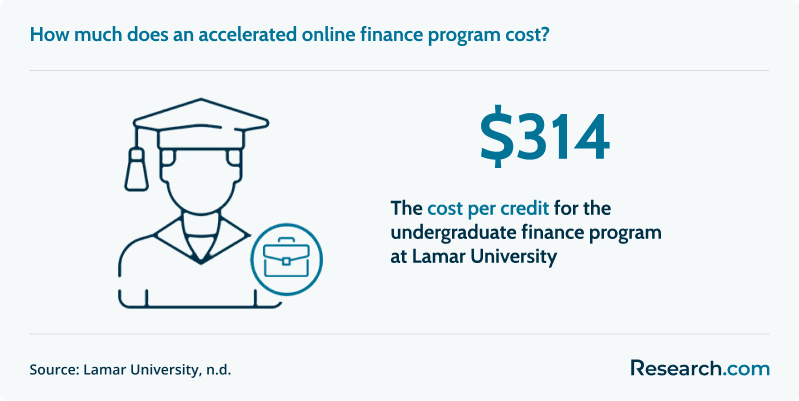
Accelerated finance programs are not automatically the lowest-cost path. Many schools still require the same total credit load as a traditional program, even if classes are delivered in shorter terms. For example, Lamar University lists $314 per credit hour for 120 credit hours, while Albertus Magnus College lists $563 per credit for 54 credits. Students comparing low-cost routes should also review broader options for the cheapest bachelor degree.
The most important number is not the advertised per-credit price. It is the total amount you will pay after transfer credits, scholarships, employer tuition assistance, military benefits, fees, books, technology costs, and any prerequisite courses. Students with prior credits should ask each school for a written transfer evaluation before deciding.
| Cost Factor | Why It Matters | Question to Ask |
| Transfer credits | Accepted credits can reduce both tuition and time to graduation. | How many of my credits will apply directly to the finance degree? |
| Per-credit tuition | Small price differences can become large across many credits. | Is the rate different for in-state, out-of-state, online, or military students? |
| Fees | Technology, graduation, assessment, and course fees can raise the final bill. | Can you provide a complete program-cost estimate in writing? |
| Course sequencing | Missing prerequisites may delay graduation and add cost. | Are any courses only offered once per year? |
| Financial aid eligibility | Accreditation and enrollment status can affect aid access. | Will this program qualify for federal financial aid if I meet eligibility rules? |
What Financial Aid Options Are Available for Accelerated Finance Students?
Students should start with the Free Application for Federal Student Aid (FAFSA), which is used to determine eligibility for federal grants, loans, and work-study opportunities. Aid availability depends on the student’s circumstances, enrollment level, school participation, and program eligibility.
Beyond federal aid, ask the finance department and financial aid office about institutional scholarships, transfer-student awards, adult-learner grants, military benefits, and payment plans. If you are employed, ask whether your company offers tuition reimbursement or professional-development funding. Employer support is especially relevant for workers moving toward management, finance, analytics, or business leadership roles. Students considering graduate study can compare costs with the cheapest online masters programs.
What Are the Prerequisites for Enrolling in an Accelerated Finance Program?
Admission requirements vary by school and degree level. Undergraduate programs usually require proof of high school completion or previous college credit, while degree-completion programs may expect students to enter with a set number of transferable credits. Online finance degrees can provide a faster entry point into the business field, just as ABA approved online paralegal programs can help students prepare for entry-level legal-support roles.
Common undergraduate application requirements may include:
- A high school diploma or bachelor’s degree
- Evidence of math readiness, which may include algebra, statistics, or calculus through coursework or placement testing
- Introductory business coursework, such as accounting, microeconomics, or macroeconomics
- A minimum GPA requirement, typically 3.0 or higher
- Standardized test scores, if required by the institution
What Courses Are Typically Included in an Accelerated Finance Program?
Finance programs teach students how money moves through companies, markets, financial institutions, investment products, and regulatory environments. Compared with an online accounting degree, finance usually focuses more on decision-making, capital allocation, valuation, risk, and investment strategy, while accounting centers more on recording, reporting, and analyzing financial transactions.
Common courses in accelerated finance curricula include:
- Financial Accounting and Analysis
- Corporate Finance
- Investments
- Financial Markets and Institutions
- Financial Derivatives
- Financial Modeling
- Valuation
- Financial Regulations
What Types of Specializations Are Available in Accelerated Finance Programs?
Many undergraduate finance programs move quickly through core finance concepts and may not offer many formal specializations. Instead, they prepare students for broad entry-level roles or future graduate study. Students who want deeper specialization may find more options at the master’s level.
Common finance specializations include:
- Financial Analysis
- Investment Management
- Corporate Finance
- FinTech
- Real Estate Finance
- Global Finance
When comparing specializations, look at actual course titles rather than relying only on the concentration name. A “financial planning” track should include planning-focused coursework, while a “data analytics” or “FinTech” track should show practical exposure to analytics tools, financial data, or technology-driven finance applications.
How to Choose the Best Accelerated Finance Program
Start with accreditation. A low-cost finance or business program can still be a strong option when it is properly accredited and has a curriculum that fits your goals. Students comparing business degrees should review whether a cheap online business degree has recognized institutional accreditation and, when relevant, business-school accreditation such as AACSB. The same scrutiny applies when reviewing affordable finance degree online programs USA.
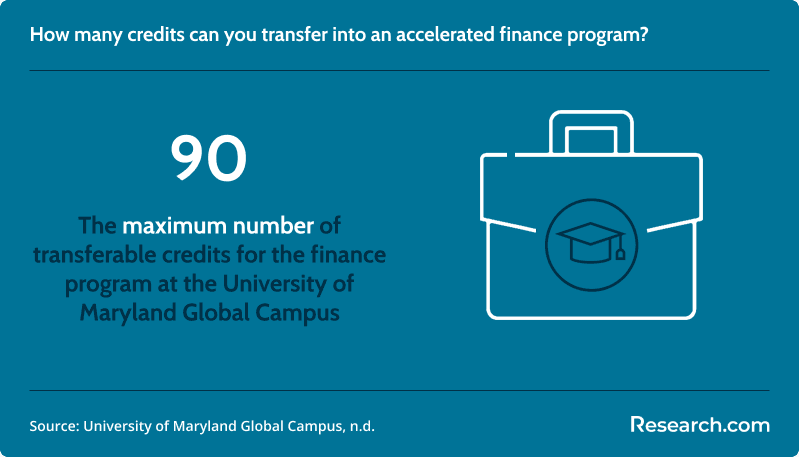
Next, request a transfer-credit review. For accelerated students, transfer policy may determine whether the program is truly fast. A school that accepts a high number of credits, such as the University of Maryland Global Campus with up to 90 transfer credits, may be a better fit for a student with prior coursework than a program with a lower transfer limit.
- Confirm accreditation. Check institutional accreditation first, then review business-program accreditation if that matters for your career or graduate-school plans.
- Calculate total cost. Include tuition, required fees, books, software, technology, and any courses that will not be covered by transfer credits.
- Match the curriculum to your career goal. Corporate finance, financial planning, banking, investments, and analytics may require different elective choices.
- Ask about pace. Find out how many hours per week students typically spend per course and whether terms are 8 weeks, 10 weeks, or another format.
- Evaluate support services. Look for tutoring, writing help, career coaching, resume reviews, internship support, and faculty access.
- Check career outcomes carefully. Do not assume a degree guarantees a specific salary or job title; ask for transparent graduate outcome data when available.
What Factors Should Students Consider When Selecting an Accelerated Online Finance Program?
An accelerated online finance degree is a serious commitment because the faster schedule leaves less room for falling behind. Students should evaluate the program as both an academic product and a career investment. If you are comparing broader fast-track options, start with accelerated online bachelor degree programs accredited to understand why accreditation and structure matter.
| Selection Factor | Why It Should Influence Your Decision | Warning Sign |
| Accreditation | It affects credibility, transferability, aid eligibility, and future graduate-school options. | The school cannot clearly identify its accreditor or the accreditor is not recognized. |
| Course format | Asynchronous courses may help working students, while synchronous classes may provide more live interaction. | The school advertises flexibility but requires frequent meetings you cannot attend. |
| Faculty background | Faculty with finance or industry experience can connect coursework to practical problems. | No faculty information is available for the online program. |
| Transfer policy | Accepted credits can shorten the program and lower the total cost. | The school will not provide a clear credit evaluation before enrollment. |
| Career services | Resume reviews, interview coaching, employer events, and alumni access can support the job search. | Career support is limited to a generic job board. |
| Workload | Compressed terms can be demanding, especially in quantitative courses. | No one can explain typical weekly time commitments. |
What Career Paths Are Available for Graduates of Accelerated Finance Programs?
Accelerated finance programs can support career entry, career change, or advancement, depending on the degree level and the student’s prior experience. Bachelor’s graduates often pursue roles that involve financial reporting, business analysis, budgeting, client services, banking operations, or entry-level investment support. Master’s graduates may target more advanced analytical, corporate finance, or financial management roles.
Students who want broader leadership preparation may later consider an MBA online no GMAT or compare affordable online MBA finance programs. According to the Graduate Management Admission Council (GMAC), its 2023 report found that about 74% of global corporate employers hired workers with a master of finance, while 91% hired MBAs, including those with a finance concentration.
Professional credentials can also strengthen a finance resume. Depending on the role, students may consider the Chartered Financial Analyst (CFA), Securities Industry Essentials (SIE), or other certifications aligned with investment analysis, financial planning, or securities work.
| Career Direction | Typical Focus | Helpful Preparation |
| Corporate finance | Budgeting, forecasting, capital planning, and business performance | Corporate finance, financial modeling, Excel, accounting, and valuation |
| Financial analysis | Interpreting financial data to support decisions | Investments, statistics, data analytics, reporting, and presentation skills |
| Banking and financial services | Client finance, lending, banking operations, and compliance | Financial institutions, regulations, risk, and customer-facing communication |
| Financial planning | Helping individuals plan around saving, investing, retirement, and risk | Planning coursework, investments, ethics, tax concepts, and client communication |
| Investment-related roles | Markets, securities, portfolios, and investment research | Investments, derivatives, valuation, financial markets, and relevant credentials |
What Is the Job Market for Graduates With a Degree in Finance?
The finance job market varies by role, location, experience, credential, and industry. The broader outlook for business and financial occupations is positive in the source data cited in the original article. Based on BLS reports, opportunities for finance graduates are projected to grow by 5% from 2022 to 2032, compared with a national average job growth rate of 3%.
Some finance-related roles are projected to grow faster. Financial examiners are listed with a projected job growth rate of 20%, while financial analyst roles are projected to grow by 8% by 2032. These projections do not guarantee employment for any individual graduate, but they do show that finance skills remain relevant across regulated, analytical, and decision-support roles.
Is an Accelerated Finance Degree Worth the Investment?
An accelerated finance degree can be worth it when it helps you finish faster without sacrificing accreditation, learning quality, career support, or affordability. The value is strongest for students who can transfer credits, keep working while studying, qualify for financial aid or employer support, and use the degree for a specific career move.
The degree may be less worthwhile if you must borrow heavily, cannot manage the compressed workload, need in-person recruiting access, or choose a program without verifying accreditation and total cost. Students considering a graduate path should compare finance programs with other efficient options, including the easiest master's degrees, but should not choose based on speed alone.
| An Accelerated Finance Degree May Be Worth It If... | It May Not Be the Best Fit If... |
| You already have transfer credits that shorten the degree. | You would need to complete nearly all credits at a high tuition rate. |
| You can study consistently in shorter, more intensive terms. | You need a slower pace because of work, caregiving, or math preparation needs. |
| The program is accredited and clearly aligned with your target role. | The school is unclear about accreditation, outcomes, or total costs. |
| You can use employer aid, scholarships, military benefits, or federal aid. | You would rely on high borrowing without a realistic repayment plan. |
| You are comfortable networking online and using virtual career services. | You strongly prefer in-person recruiting, clubs, and faculty interaction. |
How Do Accelerated Finance Programs Integrate Emerging Technologies?
Finance programs are increasingly expected to prepare students for a technology-heavy workplace. Relevant coursework may include data analytics, financial modeling, fintech, blockchain concepts, machine learning applications, and digital tools used in forecasting, risk management, investment analysis, and decision support. Students exploring broader fast-track study options can compare these features with other accelerated degree programs.
When reviewing technology content, ask whether students complete hands-on projects or only discuss concepts. Practical exposure to spreadsheets, databases, analytics tools, simulations, or case studies is more useful than a course description that mentions technology without applied work.
Is an Accelerated Associates Degree Online a Viable Pathway to Finance Success?
An accelerated associates degree online can be a practical first step for students who want a lower-cost, faster entry into college-level business and finance study. It may help students pursue entry-level administrative, banking, bookkeeping-adjacent, or support roles while building credits that can later transfer into a bachelor’s program.
The main limitation is that many finance analyst and corporate finance roles prefer or require a bachelor’s degree. If you choose the associate route, prioritize regionally accredited schools, confirm transfer agreements, and ask bachelor’s programs how many credits will apply before you enroll.
What Are the Highest-Paying Jobs for Finance Majors?
Finance can lead to high-paying business careers, but salaries depend on role, location, employer, experience, performance, credentials, and market conditions. Investment banking, financial management, strategic finance, risk management, and senior financial leadership are often associated with higher compensation, but they can also be competitive and demanding.
For example, an investment banker may start around $85,000, with compensation rising significantly with experience. Financial analysts and planners may also reach strong earnings levels. Research on finance major salary notes that professionals specializing in financial planning can earn upwards of $88,000, with potential for bonuses. Financial managers and chief financial officers (CFOs) often earn well over $120,000 because they oversee major financial strategy, reporting, and leadership responsibilities.
Students should treat salary figures as context rather than promises. The best way to assess earning potential is to compare salary data for the exact role, region, industry, and credential level you are targeting.
What Are the Benefits of Pursuing a Fastest Masters Degree in Finance?
A fastest masters degree in finance may help students build advanced skills in investment analysis, financial management, valuation, modeling, risk analysis, and financial strategy in a shorter timeframe. This can be useful for professionals who already work in business or finance and want to qualify for more specialized or senior roles.
The main trade-off is intensity. A short master’s program may require substantial weekly study time and may leave less room for internships, networking, or gradual skill development. Before enrolling, compare the curriculum with your career goal and ask whether the program supports preparation for credentials such as the Chartered Financial Analyst (CFA), if that is relevant to your path.
What Are the Best Networking Strategies for Finance Graduates Entering the Job Market?
Finance hiring often rewards both technical competence and professional visibility. Graduates from accelerated online programs may need to be especially intentional about networking because they may not have the same in-person campus access as traditional students.
- Join professional associations: Organizations such as the CFA Institute or the Financial Planning Association (FPA) can provide events, education resources, and professional communities.
- Attend industry events: Finance conferences, employer panels, webinars, and career fairs can help students learn hiring expectations and meet professionals.
- Use alumni networks: Alumni can provide informational interviews, referrals, mentorship, and insight into specific employers or roles.
- Build a focused LinkedIn presence: Keep your profile current, highlight projects and skills, follow finance employers, and engage with relevant professional groups.
- Request informational interviews: Short conversations with analysts, planners, bankers, or finance managers can clarify career paths and hiring expectations.
- Show evidence of skills: Projects involving financial models, valuation, investment analysis, or data dashboards can make a resume stronger than coursework alone.
What Additional Certifications Can Enhance My Finance Career?
Certifications can help finance professionals signal specialized knowledge, but the right credential depends on the role. Investment analysis, financial planning, securities, risk management, and corporate finance each have different credential expectations. Students comparing shorter credential routes can review options related to the easiest finance certifications, but should choose based on employer relevance rather than ease alone.
Before paying for a certification, ask whether employers in your target role request it, whether it requires exams or work experience, whether continuing education is required, and whether the credential is recognized in your industry.
How Can I Find an Affordable Online Finance Degree Without Sacrificing Quality?
Finding the cheapest online finance degree is not only about choosing the lowest tuition. A program becomes affordable when it is accredited, accepts useful transfer credits, fits your schedule, provides adequate support, and does not require unnecessary extra courses.
- Compare total program cost, not just tuition: Ask for tuition, required fees, books, software, and graduation costs.
- Verify accreditation: Confirm that the institution is accredited and that any business-school accreditation is clearly stated.
- Consider public institutions and transfer pathways: Public universities and community colleges may offer lower-cost routes, especially for students who transfer credits strategically.
- Ask about credit for prior learning: Some schools award credit for previous coursework, military training, professional experience, or exams.
- Review course availability: A low-cost program can become expensive if required classes are not offered often enough to support timely graduation.
- Use aid strategically: Combine scholarships, employer tuition assistance, payment plans, military benefits, and federal aid when available.
What Challenges Should I Anticipate With an Accelerated Online Finance Program?
The biggest challenge is pace. Finance courses can be quantitative, and compressed terms may require students to master accounting, statistics, valuation, investments, and modeling concepts quickly. Students who are returning to school after a long break may need extra preparation in math, Excel, or academic writing.
Accelerated online programs can also limit informal networking, live collaboration, and internship participation if students are already working full-time. If you need a lower-pressure starting point, comparing options such as the cheapest associate's degree online may help you evaluate whether a shorter credential or transfer pathway is more realistic.
| Common Challenge | Better Strategy |
| Underestimating weekly workload | Ask advisors how many hours students typically spend per course each week. |
| Choosing only by speed | Compare accreditation, curriculum, cost, support, and career outcomes before prioritizing timeline. |
| Ignoring transfer policies | Request a written credit evaluation before committing. |
| Focusing only on tuition | Calculate fees, books, software, lost work time, and loan costs. |
| Assuming online means easy | Prepare for independent study, strict deadlines, and limited recovery time in short terms. |
| Skipping career planning | Use career services early, not only during the final term. |
How Do Career Services in Accelerated Finance Programs Boost Job Placement?
Career services can be especially important in accelerated programs because students have less time to build a resume, network, and prepare for interviews. Strong programs may offer resume reviews, mock interviews, employer events, alumni introductions, internship guidance, and coaching for finance-specific job searches.
Students targeting high-earning finance or business roles should ask whether career services are tailored to finance or only general business employment. Career support does not guarantee a job, but it can help students understand how to compete for roles connected to degrees that can lead to six-figure salaries.
How Do Employers Perceive Accelerated Online Finance Degrees?
Employers are generally more likely to respect an accelerated online finance degree when it comes from an accredited institution, includes rigorous coursework, and is supported by evidence of practical skills. The word “accelerated” is usually less important than whether the graduate can analyze financial information, use relevant tools, communicate clearly, and solve business problems.
Students can improve employer perception by completing strong projects, earning relevant certifications, building internship or work experience, and explaining the program’s rigor confidently. For career planning context, students may also compare finance with other degrees that can lead to six-figure salaries, while remembering that no degree guarantees a specific income.
Questions to Ask Before Enrolling
- Is the institution accredited, and is the business or finance program separately accredited?
- How many of my transfer credits will count toward the degree requirements?
- What is the complete estimated cost after tuition, fees, books, and technology expenses?
- How many hours per week should I expect to study in each accelerated course?
- Are courses asynchronous, synchronous, or a mix of both?
- Will I have access to finance-specific tutoring, advising, and career support?
- Does the curriculum include financial modeling, valuation, investments, markets, and data tools?
- What kinds of roles do graduates usually pursue?
- Are internships, projects, simulations, or portfolio-building assignments available?
- What happens if I need to slow down or pause enrollment?
Key Insights
- An accelerated finance degree is best for students who can handle a compressed workload and have a clear reason to finish faster.
- Transfer credits often make the biggest difference in speed and affordability, so request a written credit evaluation before enrolling.
- Accreditation should be nonnegotiable because it affects credibility, financial aid, transferability, and graduate-school options.
- Online finance programs can offer flexibility, but students must be proactive about networking, internships, career services, and skill-building.
- Compare programs by total cost, curriculum fit, career support, and completion requirements—not by advertised timeline alone.
- Finance career outcomes vary widely. Use salary and job-growth data as planning context, not as a guarantee of employment or income.
References:
- Zippia. Internship statistics and paid-internship data discussed in Boskamp, E. (2023, June 19): https://www.zippia.com/advice/internship-statistics
- Payscale. Bachelor of Science (BS / BSc), Finance salary information, updated April 9, 2024: https://www.payscale.com/research/US/Degree=Bachelor_of_Science_(BS_%2F_BSc)%2C_Finance/Salary
- U.S. Bureau of Labor Statistics. Accountants and Auditors, Occupational Outlook Handbook, updated April 17, 2024: https://www.bls.gov/ooh/business-and-financial/accountants-and-auditors.htm
- U.S. Bureau of Labor Statistics. Budget Analysts, Occupational Outlook Handbook, updated April 17, 2024: https://www.bls.gov/ooh/business-and-financial/budget-analysts.htm
- U.S. Bureau of Labor Statistics. Business and Financial Occupations, Occupational Outlook Handbook, updated April 17, 2024: https://www.bls.gov/ooh/business-and-financial/home.htm
- U.S. Bureau of Labor Statistics. Financial Analysts, Occupational Outlook Handbook, updated April 17, 2024: https://www.bls.gov/ooh/business-and-financial/financial-analysts.htm
Other Things You Should Know About Accelerated Finance Programs Online
The best online accelerated finance degree programs in 2027 emphasize practical skills and real-world application, featuring in-depth coursework in financial analysis, investment strategy, and risk management. Integrated technology and internship opportunities with top financial institutions also enhance student experience, bridging academic knowledge with industry practice.
Applicants typically need a bachelor's degree in a related field and a minimum GPA of 3.0 for admission into the top 2027 accelerated finance degree programs online. Additional requirements may include professional experience in finance or completion of specific prerequisite courses.


