
2027 How Long Does It Take to Complete an MSW Program?

Co-Founder and Chief Data Scientist
As an education and career expert, I know the journey toward a Master of Social Work (MSW) in the USA is a significant step. However, a common obstacle many prospective students encounter is the sheer difficulty of obtaining precise, up-to-date program information. The internet is full of conflicting advice and outdated facts, making it hard to form a clear plan.
My purpose is to help you overcome this. I will serve as your knowledgeable guide, providing clear and reliable insights into MSW programs, specializations, career outlooks, and beyond. Together, we'll cut through the misinformation and focus on the data that truly matters for your future.
What are the benefits of getting an online Master's in Social Work?
- Career advancement: An MSW is the standard for clinical practice, enabling leadership roles and licensure as a Licensed Clinical Social Worker (LCSW).
- Earning potential: MSW graduates earn about $13,000 more annually than bachelor’s degree holders. Median LCSW salaries range from $69,000–$90,000, with top earners making over $130,000 (Payscale, 2025; Salary.com, 2025).
- Flexible learning: Online programs offer study-from-anywhere convenience, with both synchronous and asynchronous coursework to fit professional schedules.
What can I expect from an online Master's in Social Work?
- Focused Advanced Topics: Expect an intensive curriculum centered on core areas like social welfare policy, human behavior, and clinical practice methods.
- Structured Curriculum: Delivery typically combines online coursework, virtual discussions, and a critical component of hands-on field placements.
- Applied Strategic Knowledge: Emphasis on developing skills to advocate for clients, conduct research, and apply ethical principles in diverse settings.
- Condensed Timeline: Programs can be completed in as little as 12 months for advanced standing students, or over four years for part-time students.
- Networking Opportunities: Connect with experienced faculty and a diverse cohort of professional peers from a wide range of social work practice areas.
Where can I work with an online Master's in Social Work?
- Healthcare and Medical Settings: Work as a Medical Social Worker in hospitals, clinics, or long-term care facilities to assist patients and families.
- Mental Health and Substance Abuse: Provide therapy and counseling in private practices, community mental health centers, or substance abuse treatment facilities.
- School Systems: Act as a School Social Worker, addressing the academic, social, and emotional needs of students.
- Government and Military: Handle large-scale policy and direct client services for public sector and defense agencies, such as the VA.
- Consulting Firms: Advise organizations on how to develop effective social programs and improve community outreach.
- Pathway to Leadership: The degree provides a strong foundation for moving into senior roles like Director of Social Services or Vice President of a non-profit.
How much can I make with an online Master's in Social Work?
- Entry-Level Roles: Social workers with an MSW typically earn a median salary between $57,000 and $65,000, depending on the role and location (Payscale, 2025).
- Clinical & Licensed Roles: Licensed Clinical Social Workers (LCSW) can expect a median salary ranging from $69,000 to over $90,000, with top earners reaching over $130,000 in specialized roles and locations (Payscale, 2025).
- Government and Research Roles: Social workers employed by federal government agencies often have higher earning potential, with average salaries reaching over $91,000 (Salary.com, 2025).
- How Long Does It Take to Complete an MSW Program in 2027? MSW Duration
- What are the career opportunities for MSW program graduates? Career Paths
- What are the salaries of MSW program graduates? Salaries
- What is the job market like for MSW program graduates? Job market
- What are some specializations within an MSW program? Specializations
- What internship and research opportunities are available in an MSW program? What internship and research opportunities are available in an MSW program?
- What are the biggest challenges faced by students pursuing an MSW degree? What are the biggest challenges faced by students pursuing an MSW degree?
- What are the biggest opportunities for students pursuing an MSW degree? Opportunities
- How can interdisciplinary collaboration expand MSW career prospects? How can interdisciplinary collaboration expand MSW career prospects?
- What are some current and future trends in the social work field? Trends
- Can an Accelerated Online Psychology Degree Complement Your MSW Career? Can an Accelerated Online Psychology Degree Complement Your MSW Career?
How long does it take to complete an MSW program in 2027?
The time required to complete an MSW program varies significantly based on your educational background and the program format you choose. There are several pathways available, each with a different timeline.
- Full-time Traditional: The most common pathway for students with a bachelor's degree in any field. The program typically takes two years to complete.
- Part-time Traditional: Designed for working professionals, this option allows students to take a lighter course load. These programs typically last between three to four years.
- Advanced Standing (Full-time): For those who already hold a bachelor's degree in social work (BSW) from an accredited program. This accelerated track can be completed in as little as 12 to 16 months.
- Advanced Standing (Part-time): A flexible option for BSW graduates who need to continue working. This pathway typically takes two years to complete.
- Accelerated Programs: Some universities offer intensive, fast-paced programs that can be completed in as few as nine to 16 months.
- Field Education: All accredited programs require a significant number of supervised field education hours, which are integrated throughout the curriculum.
- Licensure: The process to become a licensed clinical social worker (LCSW) requires more than just the MSW degree, typically adding two to three years of supervised practice after graduation.
Ultimately, your timeline will depend on the program's structure and your ability to commit to full-time or part-time study. If time is of the essence, you can go with the fastest online MSW programs available. It is important to find a program that aligns with your personal and professional needs.
What are the career opportunities for MSW program graduates?
A Master of Social Work degree prepares you for a vast array of impactful careers, extending far beyond the traditional image of a social worker. An MSW provides you with the skills and credentials to take on clinical, leadership, and policy-focused roles.
- Child and Family Social Worker: Provides support and advocacy for children and families, often working for child welfare agencies or in community services.
- Clinical Social Worker: Provides psychotherapy, counseling, and case management to individuals, families, and groups in hospitals, clinics, or private practice.
- Community Organizer: Works to empower communities by addressing systemic issues through collective action and resource mobilization.
- Corporate Social Responsibility Manager: Applies a social work lens to help businesses develop and implement ethical and socially conscious practices.
- Forensic Social Worker: Forensic social workers work within the legal system to assist individuals involved in the court system, from victims to offenders.
- Gerontological Social Worker: Specializes in working with older adults, addressing issues such as aging, caregiving, long-term care, and end-of-life planning.
- Healthcare Social Worker: Assists patients and their families in medical settings, helping them navigate complex healthcare systems and cope with illness.
- Human Resources Specialist: Applies social work skills in workplace settings to support employee wellbeing, conflict resolution, and organizational culture.
- Mental Health and Substance Abuse Counselor: Specializes in diagnosing and treating mental health and addiction disorders. Addiction counselor certification programs are popular in this occupation.
- Military Social Worker: Military social workers offer a range of services to active-duty service members, veterans, and their families, addressing trauma and adjustment issues.
- Policy Analyst: Researches, develops, and advocates for social policies at the local, state, or federal level.
- Program Administrator or Director: Oversees the operations of a social service agency, managing staff, budgets, and program effectiveness.
- School Social Worker: Works within the educational system to address the social, emotional, and behavioral needs of students.
- University Student Services Advisor: Supports college and university students with academic, career, and personal counseling, enhancing retention and success.
The training provided by an MSW degree offers both depth in clinical skills and breadth in systemic understanding, giving you the versatility to choose a career that matches your passion.
What are the salaries of MSW program graduates?
Earning a Master of Social Work significantly enhances your earning potential compared to a bachelor's degree. However, salaries can vary widely depending on your role, specialization, location, and years of experience.
- Entry-Level MSW: Social workers with an MSW typically earn a median salary between $57,000 and $65,000.
- Licensed Clinical Social Worker: Professionals with an LCSW license can expect a median salary ranging from $69,000 to over $90,000.
- Healthcare Social Worker: The mean annual salary for this specialty is approximately $68,090.
- Mental Health Social Worker: Professionals in this field can expect a median annual salary of around $60,060.
- School Social Worker: The median annual salary for a school social worker is about $58,570.
- Government Roles: Social workers employed by federal agencies often have a higher earning potential, with salaries that can exceed $91,000.
- Senior and Specialized Roles: Highly experienced professionals in administrative or specialized roles can reach an earning potential of over $130,000.
According to 2025 data from various sources, the baseline average for social workers with an MSW is around $57,001 annually, while the broader category of social workers with an MSW earns approximately $63,029 per year.
Across all specialties, the U.S. Bureau of Labor Statistics reports a median salary of $61,330, with a range from $41,580 to $99,500. A clear trend shows that specialized and leadership positions command higher salaries, such as a social work administrator/manager at $103,794 and a program director at $82,397. In clinical roles, typical earnings for a licensed clinical social worker (LCSW) are between $74,547 and $92,858; MSW vs LCSW salaries differ by a significant amount.
Other specialized roles, such as geriatric social worker ($85,267), military social worker ($76,266), and healthcare social worker ($67,430), also demonstrate a strong earning power. These figures, shown in the graph below, indicate that an MSW degree is a strategic investment that provides a clear path to higher compensation and increased career opportunities.
For those seeking to maximize income in the field, understanding top paying social work jobs can help guide specialization and career planning decisions.
An MSW is a strategic investment in a career path with growing demand and a strong financial outlook.
What is the job market like for MSW program graduates?
The job market for MSW program graduates remains strong, supported by steady national growth, specialized opportunities, and resilience in healthcare and social services. Graduates can expect consistent employment prospects, particularly in clinical and healthcare-focused roles.
- Annual openings: Some estimates suggest around 67,000 job openings per year for social work careers through the decade (University of Pittsburgh, 2025; St. Bonaventure University, 2025).
- Context amid national trends: Despite broader labor market slowdowns and rising graduate unemployment, healthcare and social assistance continue to hire, keeping social work relatively resilient (Reuters, 2025; MarketWatch, 2025; Financial Times, 2025).
- Expansion of social and community service management roles: Managers in these areas are projected to see 6% growth and about 18,600 annual openings (U.S. Bureau of Labor Statistics, 2024).
- Healthcare social workers: Employment in this area is expected to grow by 8% from 2024 to 2034, reflecting the rising demand for coordinated care and an aging population (U.S. Bureau of Labor Statistics, 2024).
- Mental health and substance abuse social workers: These roles are projected to grow by 10% from 2024 to 2034, one of the strongest growth areas within the field (U.S. Bureau of Labor Statistics, 2024).
- Overall positive outlook: Multiple academic and professional sources highlight a projected 7% growth rate for social work through the early 2030s—well above average for all occupations (Baylor University, 2025; Indiana University, 2025; Research.com, 2025).
- Sector-wide opportunity: Community and social service occupations overall are expected to see nearly 313,700 openings per year across the U.S. economy (U.S. Bureau of Labor Statistics, 2024).
- Social workers in child, family, and school settings: Projected growth stands at 3%, reflecting a steadier rate of demand in these services (U.S. Bureau of Labor Statistics, 2024).
- Steady national growth: Employment of social workers overall is projected to grow 6% from 2024 to 2034, faster than the average across all occupations (U.S. Bureau of Labor Statistics, 2024).
- Strong total demand: Between 2024 and 2034, an estimated 44,700 positions per year will open for social workers (U.S. Bureau of Labor Statistics, 2024).
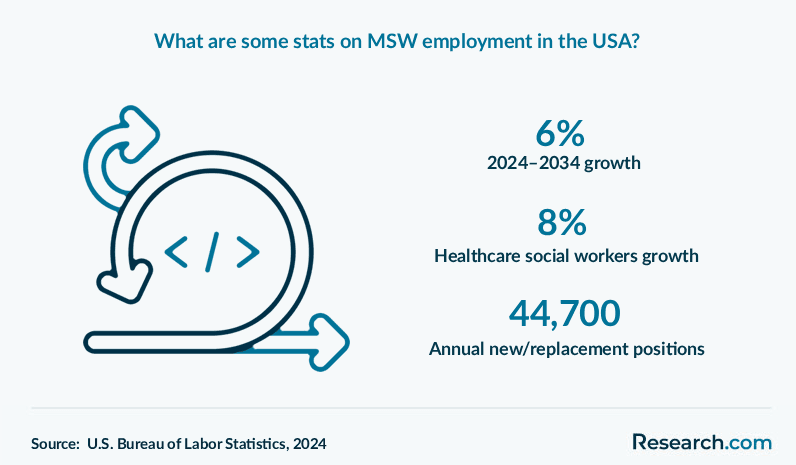
The U.S. Bureau of Labor Statistics projects a strong outlook for social workers, with overall employment expected to grow 6% from 2024 to 2034—faster than the national average. Healthcare social workers are forecast to grow even faster at 8%. Across the decade, about 44,700 new or replacement positions are projected each year, as shown in the graphic below. Some of the easiest online MSW program offerings can help accelerate your career path.
What are some specializations within an MSW program?
An MSW program allows you to concentrate on a specific area of interest, providing you with the focused expertise needed for advanced practice. This specialization is typically chosen during your second year of study.
- Child and Family Social Work: Focuses on the well-being of children and families, including child welfare, adoption, and school social work.
- Clinical Social Work: For students who want to provide direct therapeutic services to individuals and families. Online clinical MSW programs are one of the best choices for busy professionals to specialize in clinical work.
- Community and Macro Practice: Prepares social workers for leadership, policy advocacy, and administration at a community or organizational level.
- Gerontology: Concentrates on working with the elderly population and their unique needs.
- Medical and Public Health Social Work: Prepares social workers to practice in healthcare settings, addressing the social determinants of health.
- Mental Health and Substance Abuse: Focuses on diagnosing and treating behavioral health issues and addiction.
- Military Social Work: Specializes in supporting military personnel, veterans, and their families.
- School Social Work: Centers on addressing the social, emotional, and behavioral needs of students within educational systems.
- Social Policy and Administration: Emphasizes policy analysis, program evaluation, and leadership roles in shaping social welfare systems.
By choosing a specialization, you can tailor your education to a specific passion and become an expert in that field.
According to a 2023 report from the Council on Social Work Education, the top five certificate programs offered by master's programs reveal clear trends in enrollment data. While school social work (40 offerings) and addictions/substance abuse (37 offerings) are the most widely available, the most popular choice by a significant margin is the health, behavioral health, and mental health certificate, which has a total enrollment of 1,617 across just 22 programs and a high average enrollment of 77.0 students per program.
In contrast, aging/gerontology programs are offered by 30 institutions but have a notably low total enrollment of only 136 students. These figures, shown in the graph below, indicate a high demand for specialized skills in mental health and a more moderate, yet consistent, interest in other key areas like school social work and child welfare.
What internship and research opportunities are available in an MSW program?
Hands-on experience is a cornerstone of MSW education, and programs offer a wide range of opportunities to apply your knowledge in real-world settings. These experiences are critical for developing professional skills and building a professional network.
- Field Education: A mandatory component of all accredited MSW programs, requiring hundreds of supervised hours in a social service setting.
- Clinical Placements: Internships in hospitals, mental health clinics, and private practices that provide direct client-facing experience.
- Macro Practice Placements: Internships with government agencies or non-profit organizations to gain experience in policy, advocacy, and administration.
- Research Assistantships: Working directly with faculty on social work-related research projects.
- Capstone Projects: Opportunities to design and implement your own research or community-based intervention.
These practical opportunities are vital for building a strong resume and gaining the experience needed to succeed after graduation.
For students considering advanced clinical practice, it’s also useful to be familiar with PsyD in counseling requirements, as this can influence the types of internships, research experiences, and supervision needed to meet doctoral-level expectations.
Which universities offer top-ranked MSW programs?
While there are many excellent MSW programs across the USA, some universities are consistently recognized for their high-quality education, renowned faculty, and extensive resources. These are some of the most highly-regarded schools.
- Columbia University: Offers a wide array of specializations (e.g., international social welfare, advanced clinical practice), with access to global partnerships and NYC-based agencies.
- New York University (Silver School of Social Work): Provides clinical training with an urban focus, opportunities for international study, and strong support for licensure preparation.
- University of California, Berkeley: Known for its focus on social justice, public service, and innovative research; provides pathways in clinical social work, management, and policy.
- University of Chicago (Crown Family School): Emphasizes evidence-based practice, policy analysis, and interdisciplinary research, with close ties to urban community initiatives.
- University of Michigan (Ann Arbor): Offers extensive field placement opportunities, dual-degree options, and strong research centers in child welfare, mental health, and poverty solutions.
- University of North Carolina at Chapel Hill: Features flexible study formats, including online and hybrid MSW options, plus strong community engagement through statewide fieldwork.
- University of Pennsylvania (School of Social Policy & Practice): Integrates policy, leadership, and clinical training; highlights include interdisciplinary dual degrees and strong alumni networks.
These programs are known for their rigorous academics, diverse student body, and strong professional networks that can significantly benefit your career. Some of these also offer accelerated MSW programs, so check them out, too.
What are the biggest challenges faced by students pursuing an MSW degree?
While incredibly rewarding, an MSW program presents unique challenges that require resilience and dedication. Understanding these obstacles in advance can help you prepare for a more successful academic journey.
- Intensive Fieldwork: Managing the significant time commitment of 16-20 supervised hours per week on top of academic coursework.
- Emotional Labor: Handling the emotional and psychological demands of working with clients facing complex and often traumatic situations.
- Balancing Academics: Juggling rigorous class schedules and demanding academic projects with the responsibilities of your field placement.
- Financial Stress: The cost of tuition and living expenses can be a major source of stress, especially for students not working full-time.
- Licensure Exams: The pressure to pass state and national licensure exams after graduation can be a significant hurdle.
- Maintaining Self-Care: The challenge of setting boundaries and prioritizing your own well-being to prevent burnout is a key part of the program.
For those looking to enter the field more quickly, pursuing a 2 year counseling degree can be an effective stepping stone before committing to a full MSW program.
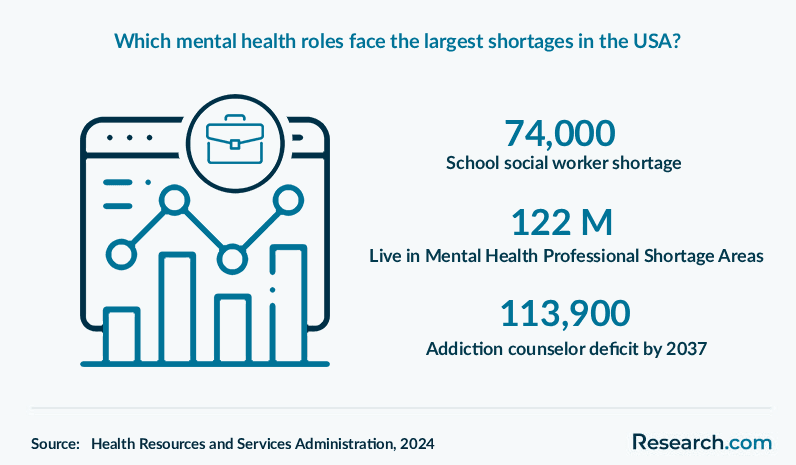
The U.S. faces a projected shortage of 74,000 school social workers over the next decade, with broader behavioral health gaps affecting over 122 million people in designated Mental Health Professional Shortage Areas. By 2037, deficits are expected to reach 113,900 addiction counselors and 43,700 adult psychiatrists, with social worker adequacy at just 22%, as shown in the graphic below.
Currently, 41 states report MSW-level shortages—30 moderate and 9 catastrophic—with Texas showing a 27% unmet demand and a projected 33,825 job deficit by 2030; only 56% of its workforce needs are met, and 97% of counties face full mental health shortages. These figures underscore a nationwide crisis in social work staffing, especially in rural and underserved areas.
What are the biggest opportunities for students pursuing an MSW degree?
A Master of Social Work degree provides a unique set of opportunities for personal and professional growth. This advanced education opens doors to a career of purpose and impact that is highly valued.
- High Job Demand: Entering a field with a very positive job outlook and projected growth across numerous sectors.
- Increased Earning Potential: The ability to command a significantly higher salary than with a bachelor's degree alone.
- Leadership Roles: The MSW curriculum prepares graduates for supervisory, administrative, and director-level positions.
- Direct Impact: The chance to make a tangible and profound difference in the lives of individuals, families, and communities.
- Career Versatility: The skills learned are transferable to a wide range of fields beyond traditional social work, including human resources, policy, and corporate social responsibility.
- Professional Networking: The ability to build strong, lasting connections with fellow students, faculty, and professionals during field placements.
- Specialization: The opportunity to become an expert in a specific area of passion.
The MSW degree is more than just a credential; it is a pathway to a fulfilling and meaningful professional life.
Heightened awareness of mental health—driven by professionals, advocacy, and government efforts—has led to increased demand for services, especially following the pandemic. In response to nationwide staffing shortages, practitioners adopted teletherapy platforms to expand access.
For students exploring where to pursue graduate education, identifying an HBCU with psychology master's programs can provide supportive environments, strong mentorship, and culturally informed training that enhance both professional and personal development.
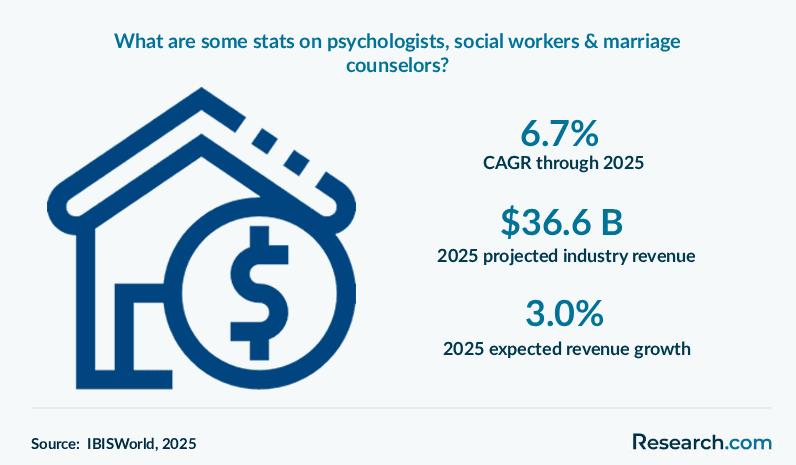
Industry revenue for psychologists, social workers & marriage counselors in the USA surged in 2020 and 2021 and is projected to grow at a 6.7% CAGR, reaching $36.6 billion by 2025, with a 3.0% increase expected in 2025 alone, as shown in the graphic below.
Demand remains strong for child, family, and school social workers, particularly in densely populated areas, where specialized, certified professionals continue to be in high demand due to their irreplaceable expertise.
How can interdisciplinary collaboration expand MSW career prospects?
MSW programs that integrate interdisciplinary approaches with fields such as psychology, public health, and nonprofit management can create more robust and adaptive career pathways. Collaboration with professionals from varied disciplines enriches the curriculum through joint seminars, elective courses, or dual degree options, fostering enhanced clinical and policy-making skills. This cross-functional exposure supports a broader understanding of mental health and social services, leading to innovative program design and leadership opportunities in diverse community settings. For complementary perspectives and advanced mental health training, consider exploring online accredited PsyD programs.
What are some current and future trends in the social work field?
The field of social work is dynamic and constantly evolving to meet societal needs. Staying informed about these trends can help you choose a specialization that will remain relevant and in demand.
- Aging Population Services: Rising demand for geriatric care and elder advocacy as the U.S. population ages.
- Climate and Environmental Justice: Growing recognition of environmental issues as social justice concerns, with social workers addressing climate-related displacement and health disparities.
- Community-Based Interventions: Increased reliance on neighborhood and grassroots programs to address local needs and strengthen community resilience.
- Cultural Competence and Humility: Emphasis on training social workers to serve diverse populations effectively and respectfully.
- Data-Driven Practice: Use of analytics and outcome measures to evaluate program effectiveness and improve interventions.
- Diversity, Equity, and Inclusion (DEI): Expanded efforts to dismantle systemic inequities and promote representation in social work leadership and services.
- Global and Transnational Social Work: Growing engagement in international practice, addressing issues such as migration, refugees, and global inequality.
- Integrated Healthcare: Collaboration with doctors, nurses, and allied health professionals to deliver holistic, team-based care.
- Policy and Advocacy Work: Strengthened focus on influencing legislation, funding, and systemic reform at local, national, and global levels.
- Prevention and Early Intervention: Expansion of proactive strategies to address issues before they escalate, especially in child welfare and mental health.
- Telehealth and Digital Services: Use of online platforms and remote counseling to expand access, especially in rural and underserved areas.
- Trauma-Informed Care: Broadening adoption of practices that acknowledge and address the long-term effects of trauma.
- Workforce Wellbeing: Growing recognition of burnout and compassion fatigue, with programs designed to support social worker mental health and sustainability in the field.
These trends highlight the profession's adaptability and its commitment to addressing the most pressing social issues of our time.
Can an Accelerated Online Psychology Degree Complement Your MSW Career?
An additional, focused study in psychology can provide a robust framework for understanding client behavior and refining intervention strategies. Integrating insights from an accelerated online psychology degree with MSW training may enhance analytical skills and expand clinical approaches, offering practitioners a competitive edge in specialized settings.
Here's What Graduates Say About Their MSW Degrees
- Marisol: "I chose to pursue my MSW because it opened the door to advanced clinical training and licensure. The field placements gave me real-world confidence and showed me how impactful social workers can be in healthcare. – "
- Darius: "My MSW program connected me with professors who are leaders in social policy research. Beyond the academics, I found a community that encouraged advocacy and gave me the tools to make systemic change. "
- Anika: "Balancing online classes with my job was easier than I imagined, thanks to the flexible MSW format. I’ve grown not only in skills but also in compassion, and now I feel ready to step into leadership roles."
Key Findings
- Social worker shortages: The U.S. is projected to face a shortfall of 74,000 school social workers over the next decade. HRSA notes that over 122 million people live in Mental Health Professional Shortage Areas, and by 2037, deficits could reach 113,900 addiction counselors and 43,700 psychiatrists, with social worker adequacy at only 22%.
- Industry revenue growth: The mental health sector is on track for a 6.7% CAGR, reaching $36.6 billion in 2025, including a 3.0% rise that year alone.
- Salaries, entry-level roles: Average MSW roles earn about $57,001 (Payscale), while the median for all social workers is $61,330 (BLS, 2024), ranging from $41,580 to $99,500.
- Salaries, licensed roles: Licensed clinical social workers (LCSWs) earn $74,547–$92,858, with higher pay in senior positions.
- Salaries, specialized roles: A geriatric social worker earns $85,267, a military social worker $76,266, and a healthcare social worker $67,430.
- Salaries, leadership roles: Administrators average $103,794, while program directors earn $82,397.
- Certificate program trends: In 2023, CSWE reported school social work (40 programs) and addictions/substance abuse (37) among the top offerings, but health/behavioral/mental health led with 1,617 enrollments and an average of 77.0 students across 22 institutions. By contrast, aging/gerontology had 30 programs but only 136 total enrollments.
- Job outlook: Social worker employment is projected to grow 6% from 2024–2034, with healthcare roles at 8% and about 44,700 new or replacement positions annually.
References:
- Baylor University. (2025). Career outcomes and job outlook. Baylor University.
- Council on Social Work Education. (2023). 2022–2023 statistics on social work education in the United States. Council on Social Work Education.
- Health Resources and Services Administration. (2024, November). State of the Behavioral Health Workforce Report. U.S. Department of Health & Human Services.
- IBISWorld. (2025). Psychologists, social workers & marriage counselors in the US (NAICS 62133). IBISWorld.
- Indiana University School of Social Work. (2025). Career outlook and rankings. Indiana University.
- Payscale. (2025, August 12). Master of Social Work (MSW) jobs by salary. Payscale.
- Salary.com. (2025, September 1). Social Worker (MSW) salary in the United States. Salary.com.
- Pitt Online MSW. (2025). Five social work settings for MSW graduates to consider. University of Pittsburgh.
- Salary.com. (2025, September 1). Clinical Mental Health Social Worker – MSW salary, hourly. Salary.com.
- Salary.com. (2025, August 1). Clinical social workers: average annual salary. Salary.com.
- Salary.com. (2025). Licensed Clinical Social Worker salary in the United States. Salary.com.
- U.S. Bureau of Labor Statistics. (2024, April 17). Community and social service occupations. U.S. Bureau of Labor Statistics.
- U.S. Bureau of Labor Statistics. (2024, May). Social workers: Occupational outlook handbook. U.S. Bureau of Labor Statistics.
- U.S. Bureau of Labor Statistics. (2023). Social Workers, All Other: Occupational Employment and Wages, May 2023. U.S. Bureau of Labor Statistics
Other Things You Should Know About MSW Degree Programs
Yes, the MSW timeline can shift depending on the chosen specialization. Clinical tracks often require more supervised practicum or field placement hours, which may extend the time to completion compared to macro or policy-focused programs. Students pursuing dual specializations—such as combining clinical practice with administration or policy—may also need additional semesters to fulfill the broader course load.
On the other hand, some schools structure their programs to allow specialization within the standard timeline by carefully sequencing coursework and fieldwork. Flexible and part-time pathways give students additional control over pacing, though this usually lengthens the program beyond the traditional two-year frame.
State regulations do not typically affect the duration of completing an MSW program. Most programs in 2027 are designed to be completed in 1-2 years for full-time students. However, licensure requirements may vary, which can influence post-graduation steps.


