
2027 How to Get a Doctorate Degree in Education

Co-Founder and Chief Data Scientist
Many experienced educators find themselves at a crossroads, qualified for more responsibility but lacking the one credential that opens the door to executive leadership. You are an expert in your field, but you have hit a ceiling.
Earning a doctorate degree in education is the definitive step to breaking through it. This terminal degree is the recognized qualification for roles like superintendent, dean, or chief learning officer. The career planning experts who created this guide have 10 years of experience helping professionals like you navigate this process. We're here to give you the clear, direct answers you need.
What are the benefits of a doctorate in education?
- You become qualified for top-tier leadership roles like superintendent, provost, and chief learning officer.
- Your earning potential increases significantly, with the average salary for Ed.D. holders reaching $87,000 annually.
- High-quality online programs provide the flexibility you need to advance your career while still working full-time.
What can I expect from a doctorate in education program?
You should plan on a multi-year commitment. Think of it as a marathon, not a sprint. The experience is fundamentally different from a master's program, where you primarily master existing knowledge. A doctorate challenges you to create new knowledge.
The process typically involves a few key stages. You'll start with advanced coursework to build your foundation. After that, you'll pass comprehensive exams to demonstrate your expertise. This milestone serves as the gateway to the final and most significant phase: the dissertation.
This is where you design and conduct an original research study. Completing it signifies that you have made a genuine contribution to the field. Earning a doctorate degree in education means you've proven you can operate at the highest level of academic and professional practice.
Where can I work with a doctorate in education?
The degree opens doors in four main areas: K-12 leadership, higher education administration, government and non-profit policy, and the private sector.
While many graduates pursue roles like school superintendent or university dean, the skills you gain are highly transferable. You're being trained in research, data analysis, and large-scale organizational management. That expertise is in demand everywhere.
Think about a role like chief learning officer at a major corporation, responsible for all employee training and development. Or consider becoming a senior policy advisor for a state department of education or a national foundation. The degree proves you can think systematically and lead complex organizations, no matter the sector.
How much can I make with a doctorate in education?
According to Payscale, the average salary for a professional with a doctorate in education is around $87,000 per year. It is critical to understand that this figure is just an average. Your actual earning potential depends heavily on the specific career path you choose.
Top-level administrative roles, like a school district superintendent or a university dean, often command salaries well into the six figures. In contrast, faculty positions can have a wider salary range depending on the institution and your academic rank. This degree positions you for the highest-paying roles, but the specific job title is what determines your income.
- How to Get a Doctorate Degree in Education for 2027 Steps To EdD
- How long does it take to get a doctorate in education? Completion Time
- How does an online doctorate in education compare to an on-campus program? How does an online doctorate in education compare to an on-campus program?
- What is the average cost of a doctorate in education? Program Cost
- What are the financial aid options for a doctorate in education? Financial Aid
- What are the prerequisites for a doctorate in education program? Program Requirements
- What courses are typically in a doctorate in education curriculum? What courses are typically in a doctorate in education curriculum?
- What types of specializations are available for a doctorate in education? Specializations
- How do you choose the best doctorate in education program? How do you choose the best doctorate in education program?
- What career paths are available with a doctorate in education? Career Paths
- What is the job market for doctorate in education graduates? Job Outlook
- What are common challenges encountered during a doctorate in education program? What are common challenges encountered during a doctorate in education program?
How to Get a Doctorate Degree in Education for 2027
Getting a doctorate degree in education (Ed.D.) is a multi-step process that builds on previous academic and professional experience. It's a journey for aspiring educational leaders who want to solve complex, real-world problems in schools, universities, or other organizations.
Step 1: Laying the Foundational Work
Before you can even apply, you must have a strong academic foundation. Most Ed.D. programs require a master's degree in education or a related field. While some programs may consider a bachelor's degree with significant professional experience, a master's is the standard prerequisite. During this time, you should also be gaining relevant work experience in an educational setting. This is crucial because the Ed.D. is a practitioner's degree, designed for individuals who are already working in the field and want to advance into leadership roles.
Step 2: Researching and Applying to Programs
Once you have the necessary qualifications, the next step is to research and choose a program that aligns with your career goals. This involves looking at a school's curriculum, faculty, specializations, and admission requirements. The application process typically includes:
- Submitting an online application
- Providing official transcripts
- Submitting a resume or curriculum vitae (CV)
- Writing a statement of purpose or personal essay
- Securing letters of recommendation
- Completing a writing sample
This phase is critical because it's where you demonstrate your readiness for doctoral-level work and prove that you're a good fit for the program's unique focus.
Step 3: Completing Coursework
After being admitted, you'll begin the coursework phase, which is designed to deepen your understanding of educational theory, research methods, and leadership practices. The curriculum typically includes a mix of core courses, specialization courses, and research seminars.
- Core courses
- Specialization courses
- Research courses
This phase is where you build the intellectual toolkit necessary to tackle your final project and future professional challenges.
Step 4: The Dissertation or Capstone Project
This is the culminating and most significant part of the Ed.D. program. Unlike the Ph.D.'s focus on creating new knowledge for academia, the Ed.D.'s final project is an "action research" study. It's often called a dissertation in practice or a capstone project and involves:
- Identifying a "problem of practice"
- Conducting research
- Developing a practical solution
- Presenting your findings
The significance of this step is that it allows you to apply everything you've learned to solve a tangible problem, demonstrating your ability to be a leader and a change agent in your field.
Step 5: Graduation and Career Advancement
The final step is earning your degree and applying your newfound expertise. With a doctorate in education, you're positioned to take on senior leadership roles, such as:
- School district superintendent or principal
- University administrator or dean
- Chief Learning Officer
- Director of training and development
- Education policy analyst
The degree signifies your expertise and commitment to improving educational outcomes, opening doors to advanced career opportunities and higher earning potential.
For those wondering about the level of challenge, many ask, “is getting a PhD hard?” While it requires dedication, persistence, and significant effort, the process is manageable with proper planning, support, and a clear focus on your professional goals.
How long does it take to get a doctorate in education?
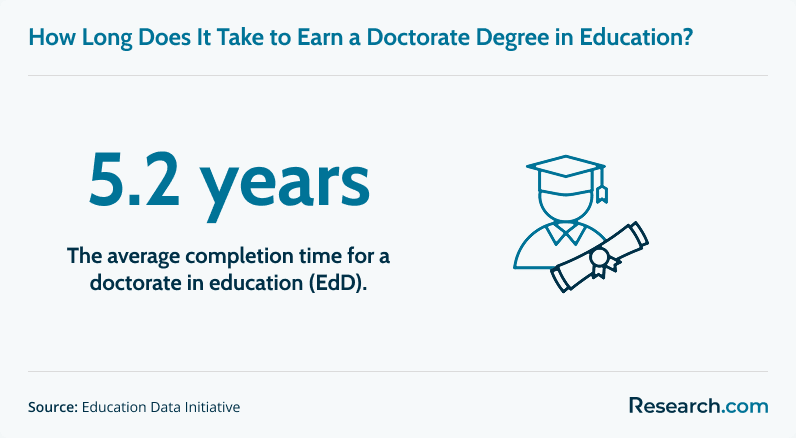
For a full-time student, you can expect the program to take between three and five years to complete. If you are a working professional studying part-time—the more common path for this degree—the timeline is typically four to seven years. The total length of a doctorate degree in education depends on the program's structure and its total credit requirement, which is often between 60 and 66 credits.
Factors That Influence Your Timeline
The main variable in any doctoral program is the dissertation. The coursework phase is highly structured and predictable, usually lasting about two years. The dissertation, however, is a self-directed research project.
Your progress during this phase depends on your topic's complexity, your research efficiency, and your personal motivation. Some accelerated programs are designed to provide more structure during this stage; for example, exploring the fastest EdD online program can show you what these condensed timelines look like. Most programs, however, build in flexibility, which is why the total time can vary.
How does an online doctorate in education compare to an on-campus program?
The choice comes down to flexibility versus traditional networking. For properly accredited institutions, the academic rigor, curriculum, and quality of the degree are equivalent whether you study online or on campus.
Online programs are designed for working professionals who need to fit their studies around a demanding career and family life. They offer the ability to learn from anywhere without relocating or quitting your job. With over 43% of all graduate students now studying exclusively online, it has become a standard, respected path to a terminal degree.
Making the Right Choice for Your Career
The "best" format really depends on your specific career goals. If you are a mid-career professional looking to advance in your current field or a related one, an online program is an excellent and practical choice. You can immediately apply what you are learning to your professional practice.
If your goal is to become a full-time university professor or a dedicated researcher, an on-campus program might offer an edge. The daily, in-person access to faculty mentors, research labs, and campus resources can be invaluable for building a traditional academic career. Ultimately, you should choose the format that aligns with your life and your professional ambitions.
For those considering the next step before a doctorate, it’s also helpful to know how long does a master’s in education take, as this can influence your planning for a smooth transition into doctoral studies. Typically, a master’s in education takes about 1.5 to 3 years depending on whether you study full-time, part-time, or through an accelerated program.
What is the average cost of a doctorate in education?
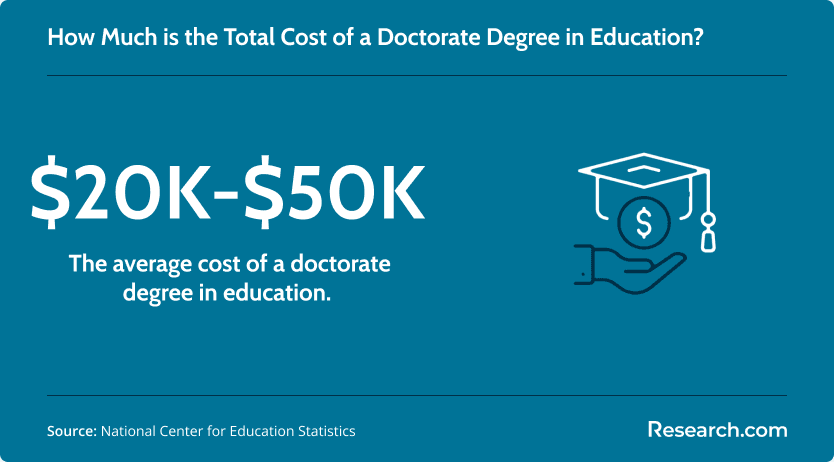
You should expect total tuition costs to range anywhere from $20,000 to over $50,000 for the entire program. The cost of a doctorate degree in education varies widely based on whether the institution is public or private and whether you pay in-state or out-of-state tuition. For a single year, the National Center for Education Statistics reports that the average all-in cost for graduate school—including tuition, fees, and living expenses—is over $20,000.
Beyond Tuition: Understanding the Full Cost
It's important to look past the advertised tuition rate. You also need to account for mandatory university fees, technology fees, and potential costs associated with your dissertation research, such as travel or transcription services.
A common mistake is assuming a public university is always the most affordable option. While their sticker price is often lower, private universities may offer more generous funding packages, such as graduate assistantships that waive tuition and provide a stipend. For this reason, you should always evaluate the net cost of a program after factoring in any financial aid offers, not just the initial tuition.
What are the financial aid options for a doctorate in education?
You have several avenues to fund your degree, and it's not all about taking on debt. The key is to think like a strategist, combining different sources to minimize your out-of-pocket costs.
The main options include academic fellowships, graduate assistantships, federal loans, and employer tuition assistance programs. With the average debt for an Ed.D. holder exceeding $66,000, your goal should be to maximize non-loan aid. For many, the most effective strategy starts with exploring affordable online EdD programs and then leveraging aid to cover the remaining costs.
A Deeper Look at Assistantships
Graduate assistantships are the most powerful funding tool, especially for full-time students. Think of this as a work-study arrangement. In exchange for working a set number of hours per week for the university, you typically receive a full tuition waiver and a modest living stipend.
These positions usually come in two forms. A teaching assistantship might involve helping a professor teach an undergraduate course, while a research assistantship would have you supporting a faculty member's research projects. These roles not only fund your degree but also provide invaluable professional experience.
What are the prerequisites for a doctorate in education program?
While every university has its own specific criteria, most programs require a similar set of core materials for admission. You will almost certainly need a relevant master's degree, often with a minimum GPA. Beyond academics, programs look for professional experience, especially for practitioner-focused Ed.D. programs.
You can also expect to submit Graduate Record Examinations (GRE) scores, though some schools are making this optional. The most important qualitative components are a compelling statement of purpose and strong letters of recommendation from academic or professional mentors.
Crafting a Standout Application
Your statement of purpose is the single most important part of your application. It's more than just a resume in essay form; it's your intellectual and professional vision. This is where you connect your past experiences to your future goals and, most importantly, explain why this specific program and its faculty are the right fit to help you achieve them.
A powerful statement shows you have done your homework. It demonstrates a clear understanding of the program's strengths and explicitly names one or two faculty members whose research aligns with your interests. For those still planning their graduate studies, understanding the requirements for masters in education is a great first step.
What courses are typically in a doctorate in education curriculum?
Doctoral coursework is designed to move you from being a consumer of knowledge to a producer of it. The curriculum is typically built around four distinct components.
- You will take foundational core courses in areas like educational theory, history, and policy.
- You will complete a sequence of advanced research methodology courses, covering both qualitative and quantitative methods.
- You will take a block of courses in your chosen specialization, such as curriculum and instruction or educational leadership.
- The last block is dedicated to your dissertation research.
The Role of Comprehensive Exams
After you've completed most of your coursework, you will face a major milestone known as comprehensive exams, or "comps." These exams are the gateway to the dissertation phase. They are designed to ensure you have a deep and integrated mastery of your field before you begin your independent research.
Passing them signifies that you have officially advanced to doctoral candidacy. This is a critical checkpoint in the doctoral journey, confirming you have the expertise needed to produce original scholarship.
Some students interested in a specific applied field might explore a background in the most affordable online master's in instructional design to prepare for this kind of specialized doctoral work. For education administrators earning a median wage of $103,460, pursuing certifications in specific fields can further boost earning potential. Past the exams and other requirements, you might want to compare the states that pay the most, as shown below.
What types of specializations are available for a doctorate in education?
Choosing a specialization is how you tailor the doctorate to fit your precise career goals. It's the single most important academic choice you'll make in the program.
Common areas of focus include:
- Educational Leadership: Prepares you for top administrative roles like principal or superintendent.
- Curriculum and Instruction: Focuses on designing, implementing, and assessing learning programs.
- Higher Education Administration: Designed for those seeking leadership roles in colleges and universities.
- Special Education: Concentrates on leading programs and developing policy for students with diverse learning needs.
- Instructional Technology: Focuses on the integration of technology into teaching and learning.
How to Align Your Specialization with Your Career
Your choice of specialization should be a direct reflection of your professional ambitions. If you're a practitioner-leader, research which specializations are in highest demand for the leadership roles you're targeting. For example, many superintendent positions require a doctorate in Educational Leadership. This is a key distinction when considering the difference between DBA and EdD; the EdD is tailored for this kind of sector-specific leadership.
If you're an aspiring academic, your specialization should align perfectly with the research interests of the faculty you want to work with. Your goal is to find a niche where you can become a recognized expert, and that starts with choosing the right subfield.
How do you choose the best doctorate in education program?
With so many options available, you need a clear framework for making your choice. The "best" program is the one that best fits your specific career goals, learning style, and life circumstances.
Use these five key factors to evaluate each program on your list:
- Accreditation: Is the institution and program properly accredited? This is non-negotiable.
- Faculty Expertise: Does the program have faculty whose research interests align with yours?
- Program Format: Does the delivery format (online, on-campus, hybrid) fit your life?
- Cost and Funding: What is the total cost after factoring in potential financial aid?
- Program Culture: Does the program feel supportive and collaborative?
The Advisor-Student Relationship: The Most Important Factor
For any doctorate degree in education, the single most important factor for success is your relationship with your faculty advisor or dissertation chair. This person will guide your research, mentor you through the academic process, and become a key part of your professional network.
A famous professor at a top-ranked university who is too busy to meet with you is a far worse choice than a dedicated mentor at a less famous school who is invested in your success. Before you apply, identify two or three potential advisors at each institution and reach out to them to discuss your research interests. Their response will tell you a lot about the program's culture.
Understanding these factors is especially valuable when preparing for the PhD application process, as it helps you target programs that match your research goals, personal needs, and professional aspirations, increasing your chances of admission and long-term success.
What career paths are available with a doctorate in education?
A doctorate degree in education qualifies you for the highest levels of leadership in the field. It signals that you have the expertise to manage complex systems, lead people, and make data-informed strategic decisions.
The most common career paths fall into two major categories. In K-12 and higher education, graduates pursue roles like School Superintendent, University Provost or Dean, or Director of Curriculum. In the public and non-profit sectors, you'll find graduates working as Education Policy Advisors for government agencies or as Research Directors for foundations. These roles all require the advanced analytical and management skills a doctorate provides.
Beyond Academia: Leadership Roles in the Private Sector
The degree's value extends well beyond traditional educational institutions. Many corporations and tech companies now have a Chief Learning Officer or a Director of Training and Development who holds a doctorate in education.
In these roles, you are responsible for the entire learning ecosystem of the company, from new hire onboarding to executive leadership training. Your expertise in instructional design, adult learning theory, and program assessment is directly applicable and highly valued in a corporate environment.
For those interested in expanding their expertise into library and information sciences, it is worth exploring online MLIS programs accredited ALA, as these programs provide advanced skills in information management, digital librarianship, and archival studies, opening up additional leadership opportunities in educational and corporate information management settings.
What is the job market for doctorate in education graduates?
The job market for graduates is stable and growing, but the outlook varies significantly depending on the career path you choose.
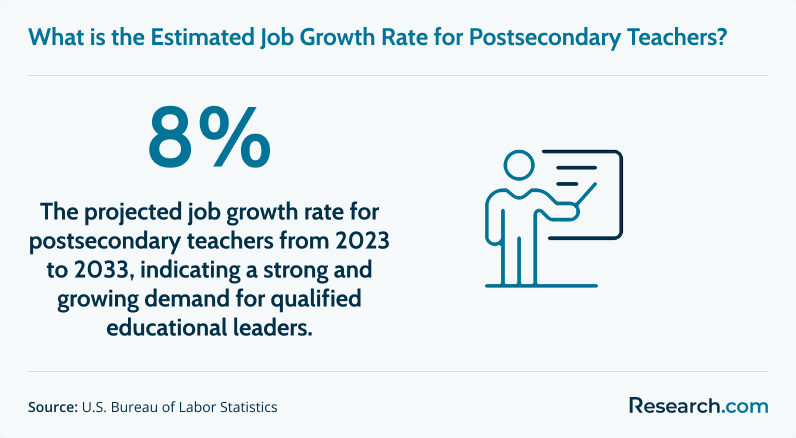
For leadership and administrative roles, the U.S. Bureau of Labor Statistics (BLS) projects steady growth. For example, the market for postsecondary education administrators is expected to grow, with a median salary of over $102,000 per year. For postsecondary teachers, the BLS projects 8% growth through 2033, with a median salary of over $84,000 annually.
Navigating the Two Job Markets: Practitioner vs. Academic
It's helpful to think of there being two distinct job markets for graduates with a doctorate degree in education. The market for practitioners and administrators is healthy and expanding. School districts, universities, and corporations have a consistent need for well-trained leaders with expertise in management and educational systems.
The traditional academic job market for tenure-track professors, however, is extremely competitive. While opportunities exist, the number of Ph.D. graduates often exceeds the number of available faculty positions. A successful career in this area requires a highly focused research agenda, a strong publication record, and a clear-eyed understanding of the competitive landscape. If you're considering this path, you might also want to research the average masters in education salary to see if it aligns with your career goals."
What are common challenges encountered during a doctorate in education program?
Candidates may face several obstacles throughout their doctoral journey. Balancing full-time professional responsibilities with rigorous academic requirements is a consistent challenge, often demanding superior time management and prioritization skills. Additionally, the self-directed nature of dissertation research may require adjusting to less structured environments, where receiving and incorporating critical feedback is essential. Securing consistent funding and navigating funding opportunities add another layer of complexity. Moreover, staying current with emerging trends and supplementary credentials—such as exploring what is the highest paying certification—can provide a competitive advantage and enhance future career prospects.
Here's What Professionals Have to Say About Their Doctorate Degree in Education
- David: "I spent a decade as a school principal and knew I could do more, but I couldn't get considered for district-level positions. The doctoral program gave me a 30,000-foot view of how finance, policy, and curriculum all connect across a large system. It wasn't just about running one school anymore; it was about leading a whole community. Six months after graduating, I was hired as the assistant superintendent."
- Maria: "In the corporate world, I was seen as the "training manager," not a strategist. The research skills I learned were what changed everything. I could finally build a data-backed case for our learning initiatives and show the C-suite a real return on investment. That doctorate gave me the language and the credibility to move from the training room to the boardroom."
- Aisha: "Working in one school felt important, but I wanted to help shape the system itself. The program taught me how to rigorously analyze educational policy and use evidence to advocate for change. Now I work for a foundation that funds new school initiatives, and I use the research skills I learned every single day to decide which programs will have the greatest impact."
Key Findings
- The degree significantly boosts earning potential for leadership roles, with postsecondary administrators earning a median salary of over $102,000 per year.
- Total tuition for the entire program represents a major financial commitment, typically ranging from $20,000 to over $50,000 depending on the institution.
- Online programs have become a mainstream and respected option for working professionals, with over 43% of all U.S. graduate students now studying exclusively online.
- Earning a doctorate requires a significant time investment, with the average student taking 5.2 years to complete their program.
- The job market for academic roles is growing faster than average, with the U.S. Bureau of Labor Statistics projecting an 8% increase in postsecondary teaching positions by 2033.
- Strategic financial planning is essential, as the average student loan debt for graduates with a doctorate in education is over $66,000.
Other Things You Should Know About Getting a Doctorate Degree in Education
What is the difference between an Ed.D. and a Ph.D. in Education?
An Ed.D., or Doctor of Education, is a professional doctorate designed for practitioners who want to become leaders in the field. Its focus is on applying existing research to solve real-world problems in schools and organizations. A Ph.D., or Doctor of Philosophy, is a research doctorate for those who want to become scholars or university professors. Its focus is on conducting original research to create new knowledge.
Do all programs require a traditional dissertation?
No, many modern Ed.D. programs now offer a capstone project or a "dissertation in practice" instead of a traditional dissertation. These projects are more applied and focus on solving a specific problem within your current workplace or community. This is different from a traditional Ph.D. dissertation, which requires you to develop a new theoretical contribution to the field.
Are GRE scores always required for admission?
No, GRE scores are not always required for a doctorate in education. A growing number of universities have made the GRE optional for their doctoral programs. These "test-optional" schools place more emphasis on other parts of your application, such as your professional experience, your master's degree GPA, and your statement of purpose.
Is it possible to work full-time while earning a doctorate?
References:
- Office of Occupational Statistics and Employment Projections. (2024). Instructional coordinators. U.S. Bureau of Labor Statistics.
- Office of Occupational Statistics and Employment Projections. (2024). Postsecondary education administrators. U.S. Bureau of Labor Statistics.
- Office of Occupational Statistics and Employment Projections. (2024). Training and development managers. U.S. Bureau of Labor Statistics.
- Organiation for Economic Co-operation and Development. (2024). Education policy outlook 2024: Reshaping teaching into a thriving profession from ABCs to AI. OECD Publishing.
- Organization for Economic Co-operation and Development. (2024). Education policy outlook 2024: Reshaping teaching into a thriving profession from ABCs to AI. OECD Publishing.
Other Things You Should Know About Getting a Doctorate Degree in Education
The dissertation process involves selecting a research topic, conducting an extensive study, and defending your work before a committee. It typically takes 1–3 years to complete. Exact requirements, including format and submission deadlines, vary by institution, so consult your program's guidelines.
Yes, many institutions offer part-time doctorate in education programs in 2026. These programs are designed for working professionals, allowing them to balance their studies with their careers. Part-time options typically extend the duration of the program, often ranging from 4 to 6 years.


