
2027 Highest-Paying PhD Degrees to Pursue

Co-Founder and Chief Data Scientist
Earning a PhD can open doors to some of the highest-paying and fastest-growing careers in today’s job market. For instance, physicists with a doctorate make over $145,000 annually, while information security analysts enjoy both strong pay and a job outlook of +32%.
In this article, we’ll break down the highest-paying PhD degrees to pursue for 2027, exploring salaries, job growth, and return on investment. By the end, you’ll know which PhD paths provide the strongest balance between financial rewards and career opportunities.
Key Things You Should Know About PhD Degrees
- PhD programs are research-intensive and often take four to seven years to complete. Students progress through coursework, comprehensive exams, and original dissertation research that contributes new knowledge to their field, making the degree both time-consuming and academically demanding.
- Unlike professional doctorates, PhDs are focused on research and academic scholarship. While some graduates enter industry, many pursue careers in universities, government labs, or think tanks. The emphasis is on generating original findings and advancing expertise in a highly specialized discipline.
- A PhD can significantly increase long-term earning potential. For example, doctoral degree holders earn a median annual wage of $109,668, nearly 50% more than bachelor’s graduates. However, return on investment varies depending on the field, job demand, and the career path chosen after graduation.
- What are the highest-paying PhD degrees to pursue for 2027? Top Paying PhDs
- Which PhD fields pay the best starting salaries? Best Starting Salaries
- What PhD programs offer the best mid-career earnings? Mid-Career Earnings
- Which PhD degrees are most in demand by employers today? In-Demand Fields
- Do high-paying PhD programs also have strong long-term job growth? Job Growth
- Is investing in a PhD worth it financially? Is investing in a PhD worth it financially?
- How long do top-earning PhD programs typically take to complete? Completion Time
- Can you earn a high-paying PhD online? Online PhD
- What are the essential quality metrics to evaluate PhD programs? What are the essential quality metrics to evaluate PhD programs?
- What funding options exist for expensive PhD degrees? What funding options exist for expensive PhD degrees?
- What career paths do top-paid PhD holders follow outside academia? What career paths do top-paid PhD holders follow outside academia?
What are the highest-paying PhD degrees to pursue for 2027?
Choosing a PhD is not only an academic decision. It is a multi-year investment that can affect your income, career mobility, research opportunities, and ability to move into leadership roles. The highest-paying PhD fields for 2027 are concentrated in areas where employers need advanced quantitative, scientific, policy, and technical expertise: physics, computer science, political science, engineering, cybersecurity, economics, mathematics, statistics, and environmental science.
This guide compares high-paying PhD paths using the salary and job outlook figures cited in the article, explains which degrees have the strongest early and long-term earning potential, and shows how to evaluate program quality, funding, online options, and career paths outside academia. If you are still deciding whether a doctorate fits your goals, it is also worth reviewing how to earn a doctorate degree online, especially if you need a flexible program while continuing to work.
Quick answer: Which PhDs usually lead to the highest salaries?
Among the PhD-aligned careers covered here, physics has the highest cited median annual salary at $166,290, followed by computer and information research science at $140,910 and political science at $139,380. Information security, chemical engineering, mathematics, economics, electrical engineering, and statistics also show six-figure median salaries. Environmental science has a lower cited median salary at $80,060, but it may appeal to students who value sustainability, policy impact, and applied research.
| PhD field | Common PhD-level career target | Cited median annual salary | Best fit for students who want to... |
| Physics | Physicist | $166,290 | Conduct advanced research in matter, energy, space, defense, or high-tech industries |
| Computer Science | Computer and information research scientist | $140,910 | Build new computing methods, artificial intelligence systems, and machine learning models |
| Political Science | Political scientist | $139,380 | Analyze policy, government systems, elections, international affairs, and public institutions |
| Information Security | Information security analyst | $124,910 | Lead cybersecurity research, defense strategy, risk analysis, and data protection efforts |
| Chemical Engineering | Chemical engineer | $121,860 | Improve industrial systems in pharmaceuticals, energy, food processing, and materials |
| Mathematics | Mathematician | $121,680 | Apply advanced modeling, logic, optimization, cryptography, or quantitative finance skills |
| Economics | Economist | $115,440 | Shape economic policy, forecasting, corporate strategy, or financial analysis |
| Electrical Engineering | Electrical engineer | $111,910 | Design advanced systems in electronics, telecommunications, energy, and automation |
| Statistics | Statistician | $103,300 | Use data modeling to support decisions in healthcare, government, technology, or research |
| Environmental Science | Environmental scientist | $80,060 | Work on climate, conservation, sustainability, regulation, or environmental consulting |
Physics
A physics PhD can lead to some of the strongest earnings among research-focused doctorates. Physicists have a cited median annual wage of $166,290, and the top 10% earn more than $208,000. Doctoral training is often essential because the work involves original research, complex modeling, experimentation, and advanced scientific theory. Common settings include universities, federal laboratories, defense contractors, aerospace organizations, and technology companies. The cited job growth rate is +4%, so this path is best for students who are comfortable with competitive research environments and long academic preparation.
Computer Science
A PhD in computer science is one of the most flexible high-earning doctorate options because it can lead to university research, private-sector R&D, artificial intelligence labs, machine learning teams, and advanced computing roles. Computer and information research scientists have a cited median salary of $140,910, with the top 10% earning more than $208,000. The cited job growth rate is +20%, making this one of the stronger combinations of pay and demand. This degree is especially useful for students who want to create new algorithms, lead research teams, publish technical work, or work on frontier technologies rather than only implement existing systems.
Political Science
A political science PhD can produce strong earnings for graduates who move into policy analysis, government research, consulting, think tanks, international organizations, or academia. Political scientists have a cited median salary of $139,380, with earnings ranging from around $80,000 at entry level to more than $190,000 in senior roles. The cited job growth rate is +3% for 2023–33, so opportunities may be more selective than in technology-heavy fields. This path fits students who want to influence governance, legislation, public strategy, foreign policy, campaigns, or institutional decision-making through evidence-based research.
Chemical Engineering
A PhD in chemical engineering prepares graduates for high-level research and development in industries where process design, materials, energy systems, pharmaceuticals, and manufacturing efficiency matter. Chemical engineers have a cited median annual salary of $121,860, and the top 10% earn more than $187,500. The cited job growth rate is +3%. A doctorate can be especially valuable for students who want to lead complex research projects, manage technical innovation, teach at the university level, or work in specialized industrial roles that require deep scientific and engineering expertise.
Information Security
Information security is one of the strongest doctorate-aligned fields for students interested in cyber defense, secure systems, digital risk, cryptography, policy, and applied research. Information security analysts have a cited median salary of $124,910, and the top 10% earn more than $172,000. The cited job growth rate is +29%, reflecting high employer demand for cybersecurity expertise. A PhD is not required for every cybersecurity job, but it can strengthen a candidate’s profile for research leadership, government advisory work, advanced security architecture, and academic roles.
Economics
An economics PhD remains a high-value credential for students who want to work in forecasting, policy analysis, finance, consulting, academic research, or corporate strategy. Economists have a cited median annual salary of $115,440, with salaries starting around $65,000 and exceeding $210,000 in top policy or corporate roles. The cited job growth rate is +1%, so the labor market may be more competitive than faster-growing fields. The degree is strongest for students who have excellent quantitative skills and want to use data, theory, and modeling to explain markets, public policy, labor behavior, or institutional decision-making.
Mathematics
A mathematics PhD can lead to academic research, quantitative finance, cryptography, operations research, algorithm design, and data-heavy roles in technology or science. Mathematicians have a cited median salary of $121,680, and top salaries exceed $169,000 in fields such as quantitative finance and cryptography. The cited job growth rate is +8%. This doctorate is highly transferable because advanced mathematical training signals strong abstract reasoning, modeling ability, and problem-solving skill, but students should think early about whether they want a theoretical academic path or an applied industry path.
Electrical Engineering
A PhD in electrical engineering can support careers in telecommunications, energy systems, electronics, semiconductor research, robotics, signal processing, and advanced design. Electrical engineers have a cited median annual salary of $111,910, and the top 10% earn more than $162,000. The cited job growth rate is +7%. A doctorate is most useful for students who want to work on highly specialized research problems, direct technical teams, teach engineering, or contribute to new systems rather than focus only on standard engineering implementation.
Statistics
A statistics PhD is valuable across healthcare, technology, government, finance, insurance, life sciences, and social research. Statisticians have a cited median salary of $103,300, with top salaries exceeding $146,000. The cited job growth rate is +8%. Doctoral-level statisticians often work on advanced modeling, causal inference, experimental design, data science leadership, and research methodology. This path is a good fit for students who enjoy both mathematical rigor and real-world data problems.
Environmental Science
An environmental science PhD generally pays less than the highest-earning technical doctorates listed here, but it can offer meaningful work in climate science, conservation, sustainability, environmental consulting, public policy, and regulatory research. Environmental scientists have a cited median salary of $80,060, and the top 10% earn more than $130,000. The cited job growth rate is +4%. This doctorate may make sense for students who prioritize environmental impact and research leadership over maximizing salary alone.
Which PhD fields pay the best starting salaries?
Early-career earnings vary by field, employer, location, research specialty, and whether the graduate enters academia, government, or private industry. Still, the salary figures cited here show a clear pattern: doctoral-level careers tied to physics, computing, cybersecurity, engineering, mathematics, economics, and policy research often begin from a stronger earnings base than many other fields.
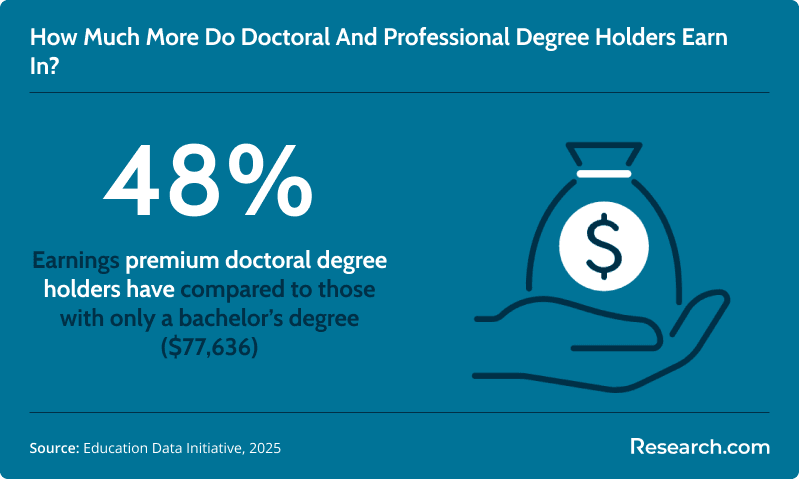
According to the Education Data Initiative figures cited in the original article, adults with a doctoral degree earn a median of $109,668, compared with $77,636 for bachelor’s graduates. That gap explains why many students consider a PhD despite the time commitment. However, a doctoral salary premium is not automatic. It depends heavily on discipline, funding, time to completion, debt, and the career path selected after graduation.
- Physics has the highest cited median salary among the fields listed, at $166,290.
- Computer and information research science follows at $140,910 and is strongly tied to artificial intelligence, advanced computing, and research-intensive technology work.
- Political science has a cited median salary of $139,380, especially relevant for policy, government, consulting, and research organizations.
- Information security has a cited median salary of $124,910, reflecting the value of cybersecurity expertise.
- Chemical engineering and mathematics both sit just above $121,000 in cited median salary figures.
- Economics at $115,440 and electrical engineering at $111,910 also exceed the doctoral median cited above.
- Statistics at $103,300 remains a strong option for students who want data-focused work.
- Environmental science is lower at $80,060, but it may still be worthwhile for students targeting sustainability, conservation, or environmental policy roles.
Specialization can change the earnings picture substantially. For example, students evaluating behavioral science doctoral pathways may want to compare PhD in ABA salary expectations with broader psychology, education, and healthcare roles before committing to a program.
Use the comparison below as a decision tool, not a guarantee. Salaries can differ widely by employer, region, security clearance, publication record, industry experience, and whether the graduate has built marketable technical skills during the PhD.
| Best early salary potential | Fields from this guide | Why these fields can pay well early |
| Very high | Physics, computer science, political science | Advanced research skills, scarce expertise, and access to high-level research, technology, or policy roles |
| High | Information security, chemical engineering, mathematics, economics, electrical engineering | Strong demand for specialized quantitative, engineering, cybersecurity, and economic analysis skills |
| Strong but more variable | Statistics, environmental science | Good applied opportunities, but outcomes depend heavily on industry, sector, and specialization |
What PhD programs offer the best mid-career earnings?
Mid-career earnings often matter more than first-job salary because many PhD holders need several years after graduation to convert research expertise into leadership, consulting, principal scientist, policy director, or senior technical roles. The strongest mid-career outcomes typically come from programs that combine rigorous research training with employer-relevant skills.
- Physics and computer science can lead to higher compensation when graduates move from postdoctoral or early research roles into senior R&D, national lab, consulting, artificial intelligence, or technology leadership positions.
- Economics and political science can pay more over time when graduates gain credibility in government agencies, finance, think tanks, public affairs, international organizations, or strategy consulting.
- Chemical engineering and information security may see strong advancement because employers need leaders who can solve technical problems with business, safety, compliance, and security implications.
- Mathematics and statistics often become more lucrative when graduates apply their skills to finance, biotech, healthcare analytics, artificial intelligence, or data science leadership.
- Environmental science can become more financially competitive when graduates build expertise in sustainability strategy, environmental regulation, climate risk, consulting, or corporate compliance.
Students who want to shorten the path from graduate study to advanced research roles may consider combined master’s and PhD programs. These pathways can reduce duplicated coursework, but they are still demanding and should be evaluated carefully for funding, faculty fit, and completion expectations.
The infographic below illustrates how doctoral and professional degree holders compare with other education levels in annual earnings, which is useful for understanding the long-term income advantage that advanced credentials may provide.
How to identify a PhD with strong mid-career payoff
| Program feature | Why it affects mid-career earnings | Question to ask before applying |
| Faculty research strength | Strong advisors can connect students to funded projects, publications, and professional networks. | Do faculty publish and win grants in the exact specialty I want to pursue? |
| Industry partnerships | Employer-connected programs may lead to internships, consulting projects, and nonacademic job options. | Which companies, agencies, labs, or organizations recruit from this department? |
| Quantitative and technical training | Data, modeling, coding, and analytical skills can increase mobility outside academia. | Will I graduate with skills that employers can immediately use? |
| Funding package | Lower debt improves return on investment, especially in fields with long training periods. | Is funding guaranteed, and for how many years? |
| Placement record | Actual graduate outcomes are more useful than marketing claims. | Where have recent graduates worked five years after finishing? |
Which PhD degrees are most in demand by employers today?
Employer demand is strongest where doctoral training overlaps with urgent business, government, and research problems: artificial intelligence, cybersecurity, data analysis, biotechnology, finance, engineering systems, and evidence-based policy. High salary alone does not always mean high job growth, so applicants should compare both compensation and projected demand.
- Computer and information research scientists are described with a projected growth figure of +23% in the original demand discussion, reflecting employer interest in artificial intelligence, big data, and machine learning.
- Information security analysts are described with demand growth of +32% in that same demand-focused section, tied to expanding cybersecurity threats and the need to protect sensitive systems.
- Mathematicians and statisticians are described with +31% growth in the demand discussion because employers rely on quantitative analysis in finance, biotech, government research, and technology.
Outside STEM, employers still value advanced policy, economic, and social science training. Political scientists support policy research and strategic advising, while economists contribute to forecasting, market analysis, public finance, and regulatory decision-making. In clinical fields, degree type also matters. For example, understanding the difference between a PsyD and a PhD in clinical psychology can help students choose between practice-oriented and research-oriented training.
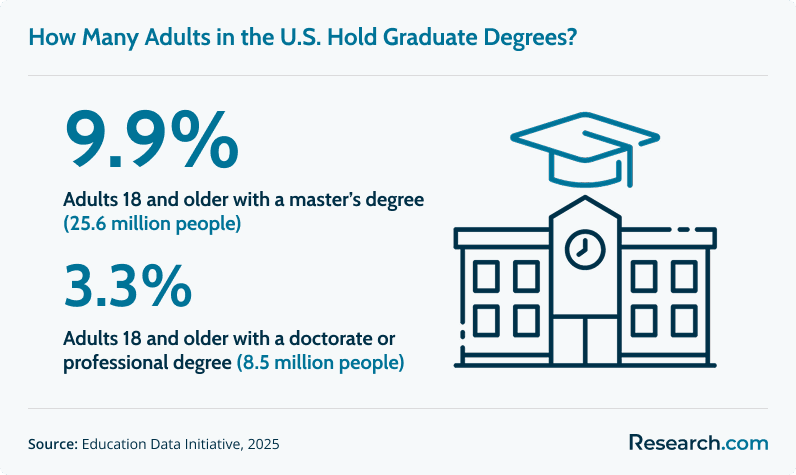
The infographic below notes that only 3.3% of U.S. adults hold doctoral or professional credentials in 2025, which helps explain why advanced expertise remains valuable in specialized labor markets.
What employers typically want from PhD graduates
| Employer need | PhD fields that often align | Skills that improve hiring prospects |
| Artificial intelligence and advanced computing | Computer science, mathematics, statistics, electrical engineering | Machine learning, algorithms, coding, model evaluation, research publication |
| Cybersecurity and digital risk | Information security, computer science, mathematics | Threat modeling, secure systems, cryptography, incident analysis, policy knowledge |
| Policy and economic strategy | Political science, economics, statistics | Quantitative methods, policy writing, forecasting, causal analysis, communication |
| Industrial and scientific innovation | Physics, chemical engineering, electrical engineering | Experimental design, simulation, systems thinking, lab leadership, technical writing |
| Sustainability and environmental risk | Environmental science, economics, statistics | Climate analysis, regulation, GIS, consulting, data interpretation |
Do high-paying PhD programs also have strong long-term job growth?
Not always. Some of the highest-paid PhD-aligned careers have only moderate projected growth, while several fast-growing fields pay slightly less than the top salary leaders. The best choice is usually not the degree with the single highest salary figure; it is the degree that fits your strengths, has a realistic job market, can be funded responsibly, and leads to roles you would actually want.
- Physics and chemical engineering have cited six-figure median salaries, but their cited growth rates are +4% and +3% through 2034.
- Economics has a cited median salary above $115,000, but the cited growth figure is +1%.
- Information security analysts combine a cited median salary of $124,910 with projected growth of +29%. Students in this area may also strengthen their profile with security analyst certifications, especially for applied or leadership roles.
- Computer and information research scientists have a cited growth figure of +20%, supported by demand for artificial intelligence, machine learning, and advanced computing.
- Mathematicians and statisticians are cited at +8%, reflecting steady need for quantitative talent in healthcare, finance, technology, and biotech.
- Electrical engineers and political scientists show more moderate cited outlooks of +7% and +3%.
The chart below compares projected job outlook for selected PhD-level roles from 2024 to 2034 and can help you see which options combine income potential with employment growth.
How to balance salary and job outlook
| If your priority is... | Consider these fields | Be careful about... |
| Highest salary ceiling | Physics, computer science, political science, economics | Competitive hiring, long research timelines, and limited tenure-track openings |
| Strong demand | Information security, computer science, mathematics, statistics | Keeping technical skills current as tools and employer expectations change |
| Industry mobility | Computer science, electrical engineering, chemical engineering, statistics | Choosing a dissertation topic that is too narrow for nonacademic employers |
| Mission-driven work | Environmental science, political science, economics | Potentially lower starting pay in government, nonprofit, or academic roles |
Is investing in a PhD worth it financially?
A PhD can be financially worthwhile, but only when the total cost, time commitment, funding, and career outcome make sense together. The cited Education Data Initiative figures show a median annual salary of $109,668 for doctoral degree holders, nearly 50% more than the cited $77,636 for bachelor’s graduates. Professional degree holders such as MDs or JDs average $114,712 in the cited figures, but research-based PhD programs may offer assistantships or fellowships that reduce tuition costs and debt.
The return on investment differs sharply by discipline. Computer science, physics, engineering, mathematics, statistics, and information security often have clearer pathways to high-paying industry roles. Other fields may offer strong intellectual or social impact but more modest earnings, especially if graduates pursue academia, government, or nonprofit work. Program type matters as well. Students comparing research doctorates with applied doctorates should understand distinctions such as EdD vs PhD because the curriculum, career goals, and expected outcomes may differ.
Students focused primarily on financial outcomes should compare funded programs, realistic placement data, and discipline-specific earnings. Reviewing the highest paying PhD programs can be useful, but salary should be weighed alongside debt, time to completion, program reputation, advisor fit, and job market risk.
The chart below compares estimated annual salaries by education level in 2025 and shows the income premium associated with doctoral and professional credentials.
When a PhD is more likely to be worth the investment
- You receive a strong funding package that covers tuition and provides a stipend.
- The degree is required or strongly preferred for your target career.
- The program has clear placement outcomes in academia, industry, government, or research organizations.
- Your dissertation area connects to funded research, employer demand, or a defined professional niche.
- You are comfortable spending four to seven years in intensive study before reaching full earning potential.
When a PhD may not be the best financial move
- You would need to take on substantial debt for a field with limited salary growth.
- Your target role can be reached faster with a master’s degree, professional certification, or work experience.
- The program cannot show where graduates are employed.
- You are choosing a doctorate mainly for prestige rather than a specific career purpose.
- You are not interested in research, writing, data analysis, teaching, or long-term independent projects.
How long do top-earning PhD programs typically take to complete?
Most PhD programs take four to seven years, depending on the discipline, research design, funding, advisor availability, dissertation progress, and whether the student studies full time. STEM doctorates such as physics, computer science, engineering, and chemical engineering often require advanced coursework, lab work, publications, grant-funded research, and dissertation defense. Social science programs such as economics or political science may involve intensive methods training, field research, data collection, and extended writing.
Students who enter directly from a bachelor’s degree may spend longer in coursework than students who already hold a related master’s degree. Some healthcare and nursing pathways are designed to move students through graduate levels more efficiently. For example, students researching nursing doctorates may compare the shortest BSN to PhD online programs if they want a more direct bridge from undergraduate nursing preparation to doctoral study.
| Timeline factor | How it can affect completion |
| Funding stability | Students with secure assistantships or fellowships may be able to study full time and finish more predictably. |
| Research requirements | Lab experiments, fieldwork, data collection, or publication expectations can extend the timeline. |
| Advisor fit | A supportive advisor can help students define a manageable project and avoid unnecessary delays. |
| Program structure | Cohort-based and applied programs may have more defined milestones than open-ended research doctorates. |
| Work and family obligations | Part-time enrollment can improve access but may lengthen time to completion. |
Can you earn a high-paying PhD online?
Yes, some high-paying PhD pathways can be completed online or in hybrid formats, but availability depends on the field. Online doctoral options are more common in disciplines that rely heavily on theory, data analysis, writing, policy research, education, public health, information science, business, or applied social science. They may suit working professionals who cannot relocate or pause their careers.
Fully online options are less common in fields that require extensive laboratory access, specialized equipment, clinical placements, or in-person research infrastructure. Areas such as organic chemistry, biomedical engineering, aerospace engineering, and some physics specialties usually require significant campus or lab-based work. Even when coursework is online, residencies, dissertation defenses, research intensives, or practicum requirements may still apply.
Convenience should not be the main selection criterion. Students sometimes search for the easiest PhD to get, but a doctorate should be judged by accreditation, faculty expertise, dissertation support, research fit, employer recognition, funding, and career outcomes. An easy program with weak credibility can be more costly in the long run than a rigorous program with strong support.
| Online PhD option | Potential advantage | Main risk to check |
| Fully online | Maximum flexibility for working adults and students who cannot relocate | May have limited research infrastructure or weaker employer recognition in some fields |
| Hybrid | Combines online coursework with in-person research, residencies, or labs | Travel requirements can add cost and scheduling challenges |
| Campus-based | Best access to labs, faculty, funded projects, and research communities | May require relocation and full-time study |
What are the essential quality metrics to evaluate PhD programs?
A high salary projection does not make a PhD program strong. Program quality depends on accreditation, faculty expertise, research alignment, funding, dissertation support, student outcomes, and whether graduates move into the roles you want. Before applying, compare programs using evidence rather than rankings or marketing language alone.
| Quality metric | Why it matters | What to ask the program |
| Accreditation | Accreditation affects credibility, financial aid eligibility, transferability, and employer recognition. | Is the institution accredited by a recognized accrediting body? |
| Faculty fit | Your advisor and committee can shape your research direction, funding access, and career network. | Which faculty are accepting doctoral students in my research area? |
| Funding | Assistantships and fellowships can substantially reduce the cost of a doctorate. | Is funding guaranteed, and what does it include? |
| Placement outcomes | Graduate employment data shows whether the program leads to realistic career opportunities. | Where are graduates employed one, three, and five years after completion? |
| Research infrastructure | Labs, datasets, grants, software, archives, and partnerships affect dissertation quality and marketability. | What resources will I have for my dissertation research? |
| Professional development | Career support matters for students planning nonacademic careers. | Does the department support internships, industry networking, teaching experience, or consulting projects? |
Some students can build specialized expertise without immediately committing to a doctorate. For example, affordable online graduate certificate programs may help professionals test a field, strengthen a doctoral application, or add a targeted credential to an existing graduate degree.
What funding options exist for expensive PhD degrees?
PhD funding can make the difference between a strong return on investment and years of financial strain. Many research-heavy PhD programs, especially in STEM fields, may offer assistantships, fellowships, tuition support, stipends, or health insurance. However, funding is not universal, and not every offer covers the full cost of attendance. Applicants should compare funding packages as carefully as they compare faculty and curriculum.
- Research assistantships: Students receive support in exchange for research work connected to faculty grants, labs, datasets, or sponsored projects.
- Teaching assistantships: Students are funded for responsibilities such as teaching discussion sections, grading, leading labs, or supporting undergraduate courses.
- University fellowships: Merit-based awards may provide tuition support and stipends without a required work assignment.
- Government grants and scholarships: Some awards support doctoral study in healthcare, STEM, public service, education, or national priority fields.
- Employer sponsorship: Companies may help pay for doctoral training when the research aligns with business needs or workforce development goals.
- Service-based scholarships: Some funding requires graduates to work in a specific field, location, or underserved area after completion.
Funding questions to ask before accepting a PhD offer
- Is tuition fully covered, partially covered, or billed separately?
- Is the stipend guaranteed for the full program or only the first year?
- Does the funding include health insurance or fees?
- What teaching, research, or service work is required?
- What happens if a grant ends or an advisor leaves?
- Are summer funding and conference travel support available?
- Can students take internships or outside consulting work?
What career paths do top-paid PhD holders follow outside academia?
Many high-earning PhD graduates work outside colleges and universities. In fact, some of the strongest salaries are found in industry, government, consulting, finance, technology, healthcare, defense, and corporate research. The key is translating doctoral training into skills employers understand: advanced analysis, technical problem-solving, research design, communication, leadership, and the ability to manage uncertainty.
Computer science and engineering PhDs may lead artificial intelligence, robotics, aerospace, semiconductor, biotech, or software research projects. Economists and political scientists may work in think tanks, government agencies, financial institutions, consulting firms, or policy organizations. Mathematicians and statisticians often move into data science, quantitative finance, risk modeling, healthcare analytics, or machine learning. Environmental science graduates may work in sustainability consulting, climate risk, regulatory compliance, or public-sector research.
Doctoral career choices also depend on whether the degree is research-focused or practice-focused. For example, students comparing a PhD with a DSW degree should consider whether they want to conduct research, teach, lead applied social programs, or work in nonprofit and government administration.
| Nonacademic career path | PhD fields that often fit | Typical value of the doctorate |
| Research and development leadership | Physics, computer science, engineering, chemistry-related fields | Ability to lead original research, manage technical teams, and develop new products or methods |
| Data science and analytics | Statistics, mathematics, economics, computer science | Advanced modeling, experimental design, causal inference, and large-scale data interpretation |
| Cybersecurity strategy | Information security, computer science, mathematics | Deep systems knowledge, security research ability, and high-level risk assessment |
| Policy and consulting | Political science, economics, environmental science, statistics | Evidence-based analysis, forecasting, program evaluation, and strategic recommendations |
| Executive or technical management | Engineering, computer science, economics, healthcare-related fields | Credibility in complex technical environments and ability to connect research with business goals |
What graduates say about earning a PhD online
- Suzy: "Completing my PhD online let me keep my full-time job while continuing advanced research. I could apply what I was studying directly to my work, which made the degree feel practical rather than separate from my career."
- Dale: "My virtual PhD program connected me with classmates from different countries and professional backgrounds. The online discussions were serious, detailed, and collaborative, so I never felt that distance learning meant learning alone."
- Elodie: "An online PhD gave me the structure I needed without forcing me to step away from family responsibilities. The faculty support and digital resources were stronger than I expected, and the format still supported rigorous scholarship."
Common mistakes to avoid when choosing a high-paying PhD
- Choosing only by salary: A high median wage does not guarantee admission, funding, graduation, or a job in that field.
- Ignoring accreditation: Always verify institutional accreditation before applying, especially for online programs.
- Assuming online means easier: A credible online PhD still requires original research, writing, faculty review, and dissertation defense.
- Overlooking funding details: A partially funded doctorate may cost far more than a lower-ranked program with guaranteed support.
- Not checking placement outcomes: Ask where graduates actually work, not just what careers the degree could theoretically lead to.
- Selecting the wrong advisor: A poor faculty fit can delay research progress and weaken your professional network.
- Assuming academia is the only path: Many high-paying PhD careers are in industry, government, consulting, and research organizations.
- Forgetting opportunity cost: Four to seven years in a PhD program can mean delayed full-time earnings, even with a stipend.
Key Insights
- Physics, computer science, and political science show the highest cited median salaries among the PhD-aligned fields in this guide.
- Information security and computer science stand out because they combine six-figure cited median salaries with strong projected demand.
- A high-paying PhD is not automatically a good investment; funding, time to completion, job placement, and career fit matter just as much as salary.
- Online PhDs can be legitimate and useful in some fields, but lab-heavy STEM programs often require campus-based or hybrid research.
- Students should compare programs by accreditation, faculty fit, research infrastructure, funding guarantees, and graduate outcomes before applying.
- The strongest nonacademic PhD outcomes often come from pairing deep research expertise with practical skills in data, computing, cybersecurity, engineering, policy, or consulting.
References:
- Bureau of Labor Statistics. Chemical Engineers.
- Bureau of Labor Statistics. Computer and Information Research Scientists.
- Bureau of Labor Statistics. Computer and Information Technology Occupations.
- Bureau of Labor Statistics. Economists.
- Bureau of Labor Statistics. Electrical and Electronic Engineering Technologists and Technicians.
- Bureau of Labor Statistics. Electrical and Electronics Engineers.
- Bureau of Labor Statistics. Environmental Science and Protection Technicians.
- Bureau of Labor Statistics. Environmental Scientists and Specialists.
- Bureau of Labor Statistics. Information Security Analysts.
- Bureau of Labor Statistics. Mathematicians and Statisticians.
- Bureau of Labor Statistics. Math Occupations.
- Bureau of Labor Statistics. Physicists and Astronomers.
- Bureau of Labor Statistics. Political Scientists.
- Bureau of Labor Statistics. Occupational Employment and Wage Statistics: Chemical Engineers.
- Bureau of Labor Statistics. Occupational Employment and Wage Statistics: Economists.
- Bureau of Labor Statistics. Occupational Employment and Wage Statistics: Physicists.
- Bureau of Labor Statistics. Occupational Employment and Wage Statistics: Political Scientists.
- Bureau of Labor Statistics. Occupational Employment and Wage Statistics: Statisticians.
- Education Data Initiative. Educational Attainment Statistics.
- National Center for Education Statistics (NCES). Degrees Conferred by Postsecondary Institutions, Table 318.10.
Other Things You Should Know About PhD Degrees
In 2027, industries like technology, finance, and pharmaceuticals tend to offer the highest salaries for PhD graduates. Roles such as data scientists in tech, quantitative analysts in finance, and research scientists in pharma are particularly lucrative, often exceeding $150,000 annually.
In 2027, the highest-paying PhD degrees include those in fields like pharmacology, computer science, engineering, and data science. These areas offer robust demand and substantial salaries due to technological advancements and the increasing need for specialized expertise in these industries.


