
2027 Highest-Paying Doctoral Degrees

Co-Founder and Chief Data Scientist
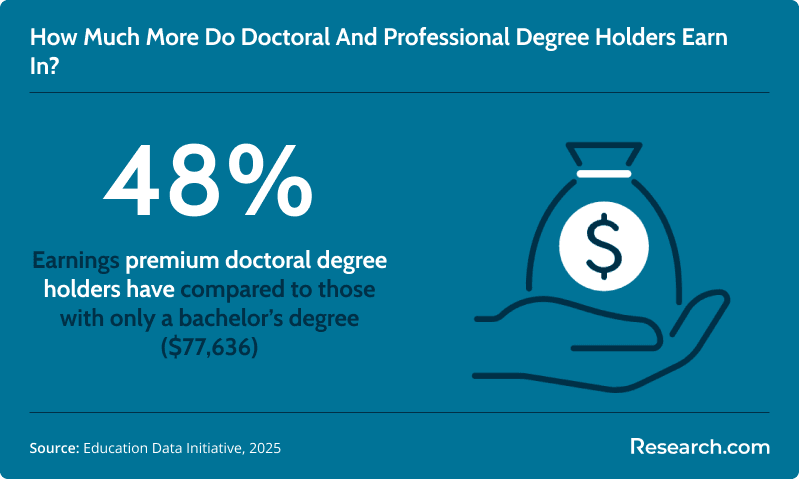
Did you know that professionals with doctoral or professional degrees earn nearly 50% more than those with only a bachelor’s degree? Choosing the right doctoral program can mean the difference between a good salary and a six-figure career path.
In this article, we’ll break down the highest-paying doctoral degrees for 2027, show how much you can expect to earn, and highlight the job outlook in these fields. By the end, you’ll know which doctoral paths offer the best return on your investment and long-term career security.
Key Things You Should Know About Doctoral Degrees
- Doctoral degrees take time and commitment, often requiring between three to seven years to complete depending on the field. They usually involve coursework, comprehensive exams, and original research or practical training that proves mastery in a specialized area.
- Not all doctoral degrees are the same. Professional doctorates such as MD, JD, or PharmD are practice-focused and prepare students for high-paying careers in applied fields, while PhDs emphasize academic research, teaching, and advancing knowledge in a discipline.
- A doctoral degree can significantly increase earning potential. Data shows that doctoral and professional degree holders earn median annual salaries exceeding $109,000, offering one of the highest pay premiums compared to bachelor’s and master’s degree holders across industries.
- What are the highest-paying doctoral degrees for 2027? Top Paying Degrees
- Which high-paying doctoral programs also offer the strongest job growth over the next decade? Job Growth
- How much can you expect to earn early career vs. mid-career with a PhD? Early vs. Mid Pay
- Is a professional doctorate (e.g., MD, PharmD) better paid than a PhD? PhD vs. Professional
- Which doctoral disciplines have the highest return on investment (ROI)? Highest ROI Fields
- How long does it typically take to complete a high-paying doctoral degree? Time to Complete
- Do doctoral programs in high-paying fields offer funding or financial support? Funding & Support
- What career paths can high-earning doctorate holders pursue outside academia? What career paths can high-earning doctorate holders pursue outside academia?
- Are some doctoral degrees losing their academic value despite high pay? Are some doctoral degrees losing their academic value despite high pay?
- Which PhD specializations are hot hires for industry vs. research roles? Which PhD specializations are hot hires for industry vs. research roles?
What are the highest-paying doctoral degrees for 2027?
Choosing a doctorate is not just an academic decision. It can shape your earning power, debt load, professional mobility, and the number of years you spend outside the full-time workforce. For 2027, the strongest financial outcomes are concentrated in health professions, computing, engineering, economics, and physical sciences, according to Bureau of Labor Statistics (BLS) salary and employment outlook data used in this guide.
This guide is for prospective doctoral students, career changers, master’s graduates, and working professionals comparing PhD and professional doctorate options. You will learn which doctoral-level careers pay the most, which have stronger projected growth, how professional doctorates compare with research PhDs, what funding options may reduce cost, and how to judge whether a high-paying doctorate is actually worth the time and investment.
Quick answer: which doctorates tend to pay the most?
The highest-paying doctoral paths are usually tied to clinical practice, advanced technology, scientific research, and specialized engineering. Among the careers covered here, computer and information systems managers report the highest salary at $169,510 with +15% projected job growth, followed closely by physicists at $166,620 and general dentists at $165,590. However, not every high-paying role requires a doctorate for entry, so students should evaluate whether the doctorate is required, preferred, or mainly useful for research leadership and advancement.
| Career path | Reported salary | Projected job growth | Doctoral credential commonly associated with the path | Best fit for students who want... |
| Computer and Information Systems Managers | $169,510 | +15% | Advanced study in technology, management, or related fields | Technology leadership, IT strategy, cybersecurity oversight, and executive-track roles |
| Physicists | $166,620 | +4% | Ph.D. in physics or a closely related discipline | Research, academia, national laboratories, or advanced technical innovation |
| Dentists (General) | $165,590 | +4% | DDS or DMD plus state licensure | Direct patient care, clinical practice ownership, and health services |
| Computer and Information Research Scientists | $145,080 | +23% | Ph.D. in computer science or a related field | AI, machine learning, advanced computing, and research-driven technology roles |
| Pharmacists | $137,480 | +5% | Pharm.D. plus state licensure | Medication management, patient counseling, pharmaceutical services, or healthcare administration |
| Aerospace Engineers | $131,500 | +6% | Ph.D. may support advanced research or specialized engineering work | Aircraft, spacecraft, propulsion, satellites, defense, or space systems |
| Electrical and Electronics Engineers | $118,780 | +7% | Ph.D. may support R&D, academic, or highly specialized roles | Power systems, communications, electronics, navigation, and emerging hardware technologies |
| Economists | $115,440 | +1% | Ph.D. in economics is common for senior research and academic positions | Policy analysis, forecasting, research, consulting, and quantitative modeling |
| Mechanical Engineers | $102,320 | +9% | Ph.D. may support advanced research, teaching, and innovation roles | Robotics, materials, energy systems, product development, or engineering R&D |
| Medical Scientists | $100,590 | +10% | Ph.D. in biomedical sciences, life sciences, or a related field | Laboratory research, drug development, disease study, and public health research |
Computer and Information Systems Managers
Computer and information systems managers lead the technology operations that keep organizations secure, connected, and competitive. Their work can include IT budgeting, cybersecurity planning, cloud infrastructure decisions, software implementation, vendor management, and aligning technology investments with business goals. A doctorate is not always mandatory for this occupation, but advanced graduate training can be useful for senior leadership, research-heavy technology strategy, and executive roles in complex organizations.
- Salary: $169,510
- Job Growth: +15%
Physicists
Physicists study matter, energy, motion, and the fundamental principles that explain how the physical world works. Doctoral preparation is especially important for independent research, university faculty positions, national lab roles, and specialized work in areas such as quantum science, optics, materials, medical technology, and energy research.
- Salary: $166,620
- Job Growth: +4%
Dentists (General)
General dentists diagnose oral health problems, treat teeth and gum conditions, perform preventive care, and educate patients on long-term dental health. This path requires a Doctor of Dental Surgery (DDS) or Doctor of Dental Medicine (DMD), followed by state licensure. It is one of the clearest examples of a professional doctorate leading directly to a high-paying licensed occupation.
- Salary: $165,590
- Job Growth: +4%
Computer and Information Research Scientists
Computer and information research scientists create new computing methods and improve existing technologies. Many work on artificial intelligence, machine learning, algorithms, cybersecurity, robotics, data systems, and advanced software architecture. A Ph.D. is commonly expected for research-intensive roles, especially those focused on original innovation rather than routine software development.
- Salary: $145,080
- Job Growth: +23%
Aerospace Engineers
Aerospace engineers design, evaluate, and improve aircraft, spacecraft, satellites, defense systems, and related technologies. Entry-level engineering work commonly starts at the bachelor’s level, but doctoral training can strengthen a candidate’s profile for advanced propulsion research, space systems design, academic appointments, and leadership in highly technical R&D teams.
- Salary: $131,500
- Job Growth: +6%
Economists
Economists use data, theory, and statistical modeling to analyze markets, labor trends, policy decisions, financial behavior, and resource allocation. A Ph.D. is especially valuable for university research, senior government analysis, think tanks, consulting, and private-sector roles that require sophisticated quantitative methods. The salary can be strong, but the projected growth rate is comparatively limited.
- Salary: $115,440
- Job Growth: +1%
Electrical and Electronics Engineers
Electrical and electronics engineers build and test systems used in communications, power generation, electronics, navigation, transportation, and advanced devices. A doctorate may be most useful for those aiming at R&D, faculty positions, semiconductor work, signal processing, advanced hardware, or next-generation energy and communications systems.
- Salary: $118,780
- Job Growth: +7%
Pharmacists
Pharmacists prepare and dispense medications, advise patients about proper use, check for interactions, and collaborate with healthcare teams. A Doctor of Pharmacy (Pharm.D.) and state licensure are required. Some graduates also move into pharmaceutical management, clinical specialization, regulatory work, or research-related roles.
- Salary: $137,480
- Job Growth: +5%
Medical Scientists
Medical scientists investigate diseases, treatments, health outcomes, and biological processes that affect human health. They may work in universities, hospitals, pharmaceutical companies, government agencies, or research institutes. A Ph.D. in biomedical science or a related field can prepare graduates for laboratory leadership, clinical research, and translational science.
- Salary: $100,590
- Job Growth: +10%
Mechanical Engineers
Mechanical engineers design and improve machines, devices, tools, engines, manufacturing systems, and energy-related technologies. While many roles are available with a bachelor’s degree, doctoral graduates may qualify for advanced work in robotics, materials science, biomechanics, thermal systems, and research leadership.
- Salary: $102,320
- Job Growth: +9%
Which high-paying doctoral programs also offer the strongest job growth over the next decade?
The best doctoral investment is not always the one with the highest salary. A stronger choice often combines high pay, clear employer demand, manageable debt, and realistic access to jobs after graduation. Economists, for example, have a strong salary figure, but the BLS outlook cited here shows only 1% projected growth. That does not make economics a poor field, but it does mean applicants should evaluate placement outcomes carefully.
Computer and information research scientists stand out because they combine $145,080 in salary with +23% projected growth. That outlook reflects the continued need for advanced computing expertise in artificial intelligence, machine learning, cybersecurity, data infrastructure, and automation. Computer and information systems managers also show a strong combination of salary and demand, with $169,510 in salary and +15% projected growth.
Healthcare and life science paths can also offer a durable employment case. Medical scientists show +10% growth, while pharmacists and dentists remain tied to licensed healthcare services. Engineering fields such as mechanical, electrical, electronics, and aerospace engineering may not always require doctorates, but doctoral credentials can matter for specialized research, advanced product development, and academic or laboratory leadership.
Before choosing one of these paths, consider both competitiveness and completion difficulty. A helpful next step is understanding how challenging PhD programs can be, especially in fields where research expectations, funding availability, qualifying exams, and faculty mentorship can determine whether students finish on time.
| Growth profile | Doctoral-level career examples | What the outlook suggests |
| Strong growth plus high salary | Computer and Information Research Scientists; Computer and Information Systems Managers | These paths may offer the strongest balance of pay and expansion, especially for students with advanced technical skills. |
| Moderate growth plus high salary | Medical Scientists; Mechanical Engineers; Electrical and Electronics Engineers; Aerospace Engineers | Demand exists, but the doctorate may be most valuable when tied to research, specialization, or leadership. |
| High salary with slower growth | Dentists; Physicists; Economists | Students should pay close attention to geographic demand, licensing requirements, research funding, and employer type. |
| Licensed healthcare pathway | Dentists; Pharmacists | The credential is directly connected to professional practice, but debt, licensure, and market conditions still matter. |
The chart below compares projected growth across selected doctoral-level occupations, making it easier to see which fields pair high compensation with stronger long-term hiring potential.
How much can you expect to earn early career vs. mid-career with a PhD?
A doctorate can improve earning potential, but the payoff usually depends on field, employer, funding, and how quickly the graduate enters a well-paid role. Education Data Initiative reports median wages of $109,668 annually for people with doctoral degrees in 2025. That figure is useful as a broad benchmark, but it should not be treated as a guaranteed starting salary for every PhD graduate.
Early-career outcomes vary widely. A professional doctorate in dentistry or pharmacy may lead into a licensed clinical role soon after graduation, while a research PhD may involve postdoctoral work, grant-funded roles, or a longer transition into industry. Computer science, economics, physics, engineering, and biomedical research can produce strong earnings, but the timeline depends heavily on specialization and employer demand.
Mid-career earnings can rise when doctorate holders move into principal scientist roles, research leadership, consulting, product strategy, policy leadership, or executive management. Niche specializations can also create different pay patterns. For example, students comparing behavioral science paths may want to review PhD in ABA salary-related program considerations to understand how a specialized doctorate can connect to specific employment markets.
| Career stage | What usually drives earnings | What to check before enrolling |
| During the doctorate | Assistantships, fellowships, stipends, tuition support, or loans | Whether funding is guaranteed, renewable, and enough to cover living costs |
| First role after graduation | Licensure, employer type, specialization, geography, and prior experience | Placement data, typical job titles, postdoctoral expectations, and board or licensing requirements |
| Mid-career | Leadership responsibilities, research output, consulting ability, management track, and industry demand | Promotion pathways, industry mobility, and whether the degree is valued outside academia |
| Long-term | Ownership, executive advancement, grants, patents, clinical specialization, or high-level technical expertise | Debt-to-income ratio, opportunity cost, and whether the credential remains useful over time |
The chart below places doctoral and professional degree earnings in context with other education levels for 2025, showing the broad wage advantage associated with advanced credentials while leaving room for field-by-field differences.
Is a professional doctorate (e.g., MD, PharmD) better paid than a PhD?
Professional doctorates often produce higher and more predictable earnings when they lead directly to licensed clinical practice. Credentials such as the MD, Pharm.D., DDS, and DMD are designed around professional entry into healthcare roles. In the data used here, pharmacists report $137,480 and general dentists report $165,590, both above the $109,668 annual wage benchmark for doctoral degree holders in 2025.
A PhD is different. It is usually a research doctorate focused on generating original knowledge, preparing scholars, or developing highly specialized expertise. PhD graduates may work in academia, government, laboratories, consulting, technology, healthcare research, or industry R&D. Their earnings can be excellent in fields such as computer science, physics, economics, and engineering, but the path is often less linear than a licensed professional doctorate.
The better-paid option depends on the field, not just the title of the degree. In clinical psychology, for example, comparing the difference between a PhD and PsyD in clinical psychology can clarify how research training, clinical practice, licensure preparation, and career goals affect financial outcomes.
| Factor | Professional doctorate | Research PhD |
| Main purpose | Preparation for a licensed or practice-based profession | Preparation for research, scholarship, advanced analysis, or academic work |
| Common examples | MD, Pharm.D., DDS, DMD | Ph.D. in computer science, economics, physics, engineering, biomedical science, or education |
| Typical earnings pattern | Often stronger immediately after licensure or residency requirements are met | Can be high, but may depend on postdoctoral work, industry transition, publications, or specialization |
| Primary risk | High tuition, licensure barriers, residency or clinical training requirements, and debt | Long completion time, uncertain academic job market, funding gaps, and opportunity cost |
| Best for | Students committed to a regulated profession with clear credential requirements | Students who want research depth, technical expertise, academic options, or industry R&D roles |
The infographic below compares wages for doctoral and professional degree holders in 2025 and illustrates why professional degrees often show a strong salary advantage when they are linked to licensed practice.
Which doctoral disciplines have the highest return on investment (ROI)?
Return on investment is about more than salary. A doctorate with impressive pay can still be a weak financial choice if it requires heavy borrowing, takes many years to complete, or leads to a narrow job market. A useful ROI review should compare tuition, fees, living expenses, lost income while studying, funding support, time-to-degree, licensing costs, and realistic post-graduation earnings.
Analysis from FREOPP indicates that most medical and dental doctorate programs generate lifetime returns above $1 million, while law degrees also perform strongly with a median ROI of around $470,000. The same analysis shows that many PhD programs, including some in STEM, can have less predictable financial returns depending on discipline and career path.
Among research doctorates, computer science, engineering, economics, physics, and public health are often viewed as stronger ROI candidates because they connect advanced training to industry, analytics, health, innovation, and policy demand. Psychology can be more variable. Students weighing clinical, research, and practice-oriented routes should compare PhD psychology salary and PsyD career considerations before assuming one credential automatically pays better than another.
| Doctoral area | ROI outlook based on the article’s cited evidence | Why outcomes can differ |
| Medical and dental doctorates | Often strongest, with lifetime returns exceeding $1 million in the cited FREOPP analysis | Clinical licensing can connect the degree to high-paying practice, but debt and training time can be substantial. |
| Law degrees | Median ROI of around $470,000 in the cited FREOPP analysis | Results depend on school reputation, legal market, geography, and employment sector. |
| Computer science, engineering, economics, physics, and public health PhDs | Often stronger among PhD options | These fields may connect to technology, research, analytics, health, and policy roles outside academia. |
| Psychology and other applied social science doctorates | Highly dependent on degree type and career track | Licensure, supervised hours, institutional reputation, and whether the graduate enters clinical practice, research, or administration can change ROI. |
| Humanities and some academic-only PhDs | Often less predictable financially | Limited tenure-track hiring and funding constraints can reduce the earnings payoff. |
How long does it typically take to complete a high-paying doctoral degree?
Time-to-degree is one of the biggest hidden costs of doctoral education. Many PhD programs take between 4 to 7 years, especially in research-heavy fields such as computer science, physics, economics, engineering, and biomedical science. Students typically complete advanced coursework, exams, research training, and a dissertation based on original work.
Professional doctorates can follow a different schedule. Programs such as MD, DDS, and PharmD are often structured around 4 years of professional study, but full earning power may come later if the field requires residency, internships, board exams, or additional clinical preparation. This distinction matters because delayed full-time earnings can reduce ROI even when the eventual salary is high.
Some applied doctorates may be completed in 3 to 5 years, particularly when students enter with a relevant master’s degree or pursue a practice-focused format. In social work, for example, comparing a PhD with a DSW degree can help applicants understand how research-oriented and practice-oriented doctorates differ in length, purpose, and career outcomes.
| Doctoral path | Typical time frame stated in this guide | What can extend the timeline |
| Research PhD | 4 to 7 years | Dissertation scope, research delays, funding gaps, advisor changes, publication expectations, and qualifying exams |
| Professional doctorate such as MD, DDS, or PharmD | Typically structured around 4 years | Residency, internships, clinical placements, licensing exams, and specialty training |
| Applied doctoral tracks in fields such as nursing or social work | 3 to 5 years in some cases | Part-time enrollment, practicum requirements, capstone work, and whether the student already has a master’s degree |
The chart below shows U.S. doctoral degree completions from 2020 to 2025, including projected estimates. The trend reflects continued interest in advanced credentials even though doctoral study requires a major time commitment.
Do doctoral programs in high-paying fields offer funding or financial support?
Funding can make the difference between a doctorate that is financially manageable and one that creates a debt burden for years. Research PhD programs, especially in STEM and other grant-supported fields, may offer tuition remission, stipends, health insurance, teaching assistantships, research assistantships, or fellowships. The strongest offers often reduce or eliminate tuition while providing work experience connected to the student’s field.
Professional doctorates are often funded differently. Students in MD, DDS, DMD, and Pharm.D. programs may rely more on loans, scholarships, service-based programs, institutional aid, or employer support. Because these programs can lead to licensed professional practice, students sometimes accept higher debt, but they should still compare repayment expectations against realistic salaries.
Common doctoral funding options
- Research Assistantships (RAs): Students receive financial support while working on faculty research, sponsored projects, laboratory work, or data analysis.
- Teaching Assistantships (TAs): Funding is tied to teaching, grading, discussion sections, labs, or undergraduate instructional support.
- University Fellowships: Competitive awards may provide tuition support, stipends, or partial funding without the same work expectations as assistantships.
- Government Grants and Scholarships: Public funding may be available for fields tied to health sciences, STEM innovation, public service, or workforce needs.
- Employer Sponsorships: Some organizations help employees pay for doctoral study when the degree supports business, research, leadership, or technical goals.
- Service-Based Scholarships: Programs such as the National Health Service Corps may support health-related education in exchange for service commitments.
Funding should be part of the application strategy, not an afterthought. When reviewing how to apply for a PhD program, pay attention to whether applicants must identify faculty mentors, research areas, assistantship interest, or separate fellowship deadlines. Missing those steps can reduce the chance of receiving a competitive package.
What career paths can high-earning doctorate holders pursue outside academia?
Many doctorate holders no longer view tenure-track academia as the only successful outcome. Technology firms, healthcare systems, pharmaceutical companies, consulting firms, financial institutions, government agencies, defense contractors, research laboratories, and policy organizations all hire people with doctoral-level expertise. In some fields, industry roles may offer higher salaries, faster advancement, or more applied work than academic jobs.
| Nonacademic career path | Doctoral backgrounds that may fit | Typical value employers want |
| Industry research and development | Engineering, physics, life sciences, medical science, computer science | Original research, technical problem-solving, experimentation, product innovation, and scientific leadership |
| Healthcare practice and administration | MD, DDS, DMD, Pharm.D., health sciences doctorates | Clinical expertise, patient care, quality improvement, compliance, and healthcare operations |
| Management consulting | Economics, data science, engineering, public health, business-related doctorates | Structured analysis, quantitative reasoning, evidence-based recommendations, and executive communication |
| Data science and analytics | Computer science, statistics, economics, physics, engineering | Modeling, machine learning, forecasting, experimentation, and large-scale data interpretation |
| Public policy and government | Economics, public health, social science, physical science, biomedical fields | Policy analysis, regulatory expertise, program evaluation, and research translation |
| Executive and technical leadership | Technology, engineering, healthcare, science, and management-related doctorates | Strategic decision-making, team leadership, innovation management, and cross-functional problem-solving |
Working professionals who cannot pause their careers often explore ways to earn a doctorate online. Online and hybrid formats can be useful when they provide strong faculty access, credible research support, transparent residency or practicum requirements, and institutional accreditation. They are not automatically easier, and students should confirm that the format fits their field’s licensure, research, and employer expectations.
Are some doctoral degrees losing their academic value despite high pay?
Yes, some doctorates may have weaker practical value if they lead to limited job options, high debt, or credentials that employers do not require. The risk is especially visible in fields with few tenure-track openings, limited research funding, or more graduates than available academic jobs. A doctorate can still be intellectually valuable, but students should separate personal fulfillment from financial return.
Healthcare and STEM doctorates tend to have stronger labor-market connections when the credential leads to licensure, industry R&D, technical leadership, or funded research. By contrast, some humanities, education, and social science paths may offer less predictable employment outcomes. This does not mean those fields lack value; it means applicants need clearer evidence of placement rates, funding, and career pathways before enrolling.
Students should also avoid choosing a program only because it appears less demanding. Searching for the easiest PhD to get may help identify accessible programs, but ease of admission or completion does not necessarily translate into better earnings, stronger employer demand, or long-term career stability.
Common mistakes when choosing a high-paying doctorate
- Looking only at salary: High pay matters, but job growth, debt, licensing, completion time, and opportunity cost can change the real payoff.
- Assuming a doctorate is always required: Some high-paying careers can be entered with a bachelor’s or master’s degree, while a doctorate is mainly useful for research or leadership.
- Ignoring accreditation and licensure: This is especially risky in healthcare, psychology, education, and other regulated fields.
- Overlooking funding details: A “funded” offer may not cover fees, summer support, health insurance, or local living costs.
- Relying only on rankings: Program reputation helps, but advisor fit, placement outcomes, funding stability, and research resources may matter more.
- Assuming online programs meet every requirement: Online doctoral study can be legitimate, but students must verify residency, clinical, internship, and state licensure rules.
- Underestimating time-to-degree: An extra year or two in school can mean additional costs and delayed earnings.
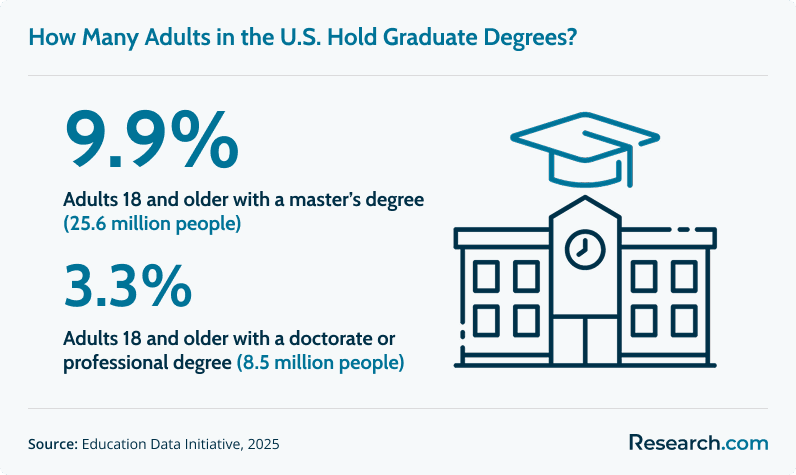
The infographic below shows how uncommon advanced graduate credentials remain in the United States. Only 3.3% of adults hold a doctorate or professional degree, underscoring how demanding these pathways can be despite their potential earnings value.
Which PhD specializations are hot hires for industry vs. research roles?
The strongest PhD hiring markets are usually found where deep expertise solves expensive, complex problems. In industry, that often means computer science, data science, engineering, physics, biomedical research, pharmaceutical science, and related technical fields. Employers in AI, cybersecurity, aerospace, biotech, energy, finance, healthcare technology, and advanced manufacturing may value doctoral graduates who can design experiments, build models, manage uncertainty, and lead innovation.
Research-focused roles remain important in physics, astronomy, economics, biomedical science, public health, and other fields connected to universities, government laboratories, think tanks, and grant-funded institutes. These jobs can be intellectually rewarding, but they may depend on funding cycles, publication records, postdoctoral experience, and institutional hiring needs.
Education doctorates show why degree type matters. The EdD vs PhD distinction can help applicants decide whether they want a practice-based leadership route or a research-centered academic path. Professionals aiming for school district leadership, student affairs, policy, instructional design, or higher education administration may also review how to get a doctorate in education before choosing a program format.
| Specialization area | Stronger fit for industry | Stronger fit for research or academia | Decision point |
| Computer science and data science | AI, machine learning, cybersecurity, analytics, software research | Algorithms, systems research, academic computer science | Choose based on whether you want product impact, technical leadership, or scholarly research. |
| Engineering | Aerospace, robotics, energy, electronics, manufacturing, product R&D | University labs, funded research centers, engineering faculty roles | Check whether the job you want truly requires a PhD or values industry experience more. |
| Biomedical and medical science | Biotech, pharmaceuticals, clinical research organizations, medical devices | Academic labs, public health research, government science agencies | Ask whether postdoctoral training is expected before stable employment. |
| Economics | Consulting, finance, technology policy, business analytics | Universities, central banks, government agencies, think tanks | Quantitative skills and applied data experience can strongly influence options. |
| Education | School systems, higher education administration, policy, instructional leadership | Education research, faculty roles, research institutes | Decide early whether an EdD or PhD better matches your end goal. |
How to choose a high-paying doctoral program wisely
A high salary figure should start your research, not end it. Before applying, compare programs using evidence that shows whether graduates finish, get funded, become licensed if needed, and secure jobs that justify the investment.
- Confirm the credential requirement. Determine whether your target occupation requires a doctorate, prefers one, or rewards equivalent experience.
- Check accreditation. For licensed fields, verify both institutional and programmatic accreditation where applicable.
- Review funding in writing. Ask whether tuition, fees, stipends, health insurance, and summer support are covered and for how many years.
- Study placement outcomes. Look for recent graduate job titles, employers, licensure pass rates, postdoctoral placements, and time-to-employment.
- Compare total cost, not just tuition. Include fees, living expenses, travel, books, clinical costs, technology, exam fees, and lost income.
- Evaluate faculty fit. In research doctorates, advisor availability and research alignment can strongly affect completion time.
- Ask about online or hybrid requirements. Confirm residencies, labs, practicums, internships, and state authorization rules.
- Estimate ROI conservatively. Use realistic salary ranges, likely completion time, debt repayment, and the probability of entering your preferred career path.
Questions to ask before enrolling
- What percentage of students receive full funding, partial funding, or no funding?
- How long do students in this program actually take to graduate?
- Where have graduates worked in the last several years?
- Does this program meet licensure requirements in the state where I plan to work?
- How much debt do graduates typically carry?
- Are assistantships guaranteed or competitive each year?
- Will I need a postdoc, residency, internship, or supervised clinical hours after graduation?
- How does the program support industry careers outside academia?
- What happens if my advisor leaves, retires, or stops taking students?
- Can I transfer credits, study part time, or continue working while enrolled?
Here's What Graduates Have to Say About Their Doctoral Degree Program
- : "Completing my doctorate online let me keep working while handling family responsibilities and advanced study. The workload was demanding, but connecting my research to real problems at work made the experience feel immediately useful. — Melinda"
- : "The online format gave me access to classmates in different countries and industries, which changed how I approached research. I still had rigorous academic expectations, but the digital tools made collaboration and source access much easier. — Leander"
- : "My doctoral program strengthened my discipline as much as my subject knowledge. I was able to learn from faculty remotely while staying in my professional role, and that combination helped me grow faster than I expected. — Rick"
References:
- Bureau of Labor Statistics. Aerospace Engineers occupational outlook.
- Bureau of Labor Statistics. Computer and Information Research Scientists occupational outlook.
- Bureau of Labor Statistics. Computer and Information Systems Managers occupational outlook.
- Bureau of Labor Statistics. Computer and Information Technology Occupations overview.
- Bureau of Labor Statistics. Dentists occupational outlook.
- Bureau of Labor Statistics. Economists occupational outlook.
- Bureau of Labor Statistics. Electrical and Electronic Engineering Technologists and Technicians occupational outlook.
- Bureau of Labor Statistics. Electrical and Electronics Engineers occupational outlook.
- Bureau of Labor Statistics. Mechanical Engineers occupational outlook.
- Bureau of Labor Statistics. Medical Scientists occupational outlook.
- Bureau of Labor Statistics. Pharmacists occupational outlook.
- Bureau of Labor Statistics. Physicists and Astronomers occupational outlook.
- Bureau of Labor Statistics. Registered Nurses occupational outlook.
- Bureau of Labor Statistics. Occupational Employment and Wage Statistics: Aerospace Engineers.
- Bureau of Labor Statistics. Occupational Employment and Wage Statistics: Economists.
- Bureau of Labor Statistics. Occupational Employment and Wage Statistics: Mechanical Engineers.
- Bureau of Labor Statistics. Occupational Employment and Wage Statistics: Dentists, General.
- Bureau of Labor Statistics. Occupational Employment and Wage Statistics: Pharmacists.
- Bureau of Labor Statistics. Occupational Employment and Wage Statistics: Physicists.
- Education Data Initiative. Educational Attainment Statistics.
- Foundation for Research on Equal Opportunity (FREOPP). Is Grad School Worth It? A Comprehensive Return on Investment Analysis.
- National Center for Education Statistics (NCES). Degrees Conferred by Postsecondary Institutions, Table 318.10.
Key Insights
- The strongest-paying doctoral paths in this guide are concentrated in technology leadership, physics, dentistry, computer research, pharmacy, and advanced engineering.
- High salary does not automatically mean high ROI. Time-to-degree, debt, funding, licensure, and job availability can change the financial outcome dramatically.
- Computer and information research scientists offer one of the strongest combinations of salary and growth, with $145,080 in salary and +23% projected growth.
- Professional doctorates such as DDS, DMD, and Pharm.D. often connect more directly to licensed high-paying work, while PhDs may offer broader research and industry flexibility.
- PhD programs in STEM and research-intensive fields may provide assistantships or fellowships, but professional doctorates often require more loan-based planning.
- Online and hybrid doctorates can work well for some professionals, but students must verify accreditation, licensure fit, residencies, and research support before enrolling.
- The safest decision is not simply choosing the highest-paying field; it is choosing a doctorate with strong demand, clear credential value, realistic funding, and career outcomes that match your goals.
Other Things You Should Know About the Highest-Paying Doctoral Degrees
Multiple factors influence salaries, including industry demand, geographic location, and specialization within the field. For example, an MD specializing in neurosurgery may earn more due to high demand in metropolitan areas. Research opportunities can also impact potential earnings in fields like biotechnology.
In 2027, graduates with high-paying doctoral degrees can pursue career opportunities such as medical researchers, business executives, engineering managers, data scientists, university professors, and clinical psychologists. These roles generally require expertise gained through a doctoral program and offer substantial financial rewards.
In 2027, the highest-paying doctoral degrees are primarily in fields such as medicine, dentistry, and pharmacy. PhDs in engineering, computer science, and finance also offer substantial salaries, reflecting demand in both healthcare and technology sectors. Compensation varies by location and industry.


