
2027 Best Online Direct-Entry Doctor of Nursing Practice (DNP) Programs

Co-Founder and Chief Data Scientist
You're an excellent clinician, but do you feel like you've hit a ceiling? The fact that only 2.7% of RNs hold a doctorate isn't a barrier—it's your opportunity. It points to a critical gap in executive nursing leadership that you are perfectly positioned to fill.
For experienced nurses ready to lead, the challenge is finding the most efficient path to that goal. This guide, created by career planning experts with over 10 years of experience, is your answer. We'll show you how the best direct-entry DNP programs online are designed to move you from expert practice to executive influence.
What are the benefits of getting a direct-entry DNP?
- This degree is your key to executive leadership, qualifying you for influential roles like Chief Nursing Officer and health policy analyst.
- You can expect to command a top-tier salary, with average annual earnings for advanced practice nurses ranging from $122,000 to over $184,000 depending on the work environment.
- The flexibility of direct-entry DNP programs online allows you to advance your career without pausing it, joining the 40% of graduate students who chose fully online programs in 2021.
What can I expect from a direct-entry DNP program?
You can expect a rigorous curriculum designed to shift your perspective from bedside care to systems-level leadership. This isn't just a more advanced version of your BSN. The coursework moves beyond clinical tasks to focus on new competencies in healthcare policy, data analytics, and financial management.
The goal is to teach you how to think like an executive. You'll learn to lead teams, use evidence to improve outcomes for entire patient populations, and manage quality improvement projects. A significant part of your program will involve a DNP project, where you'll apply these new skills to solve a real-world problem in a clinical or administrative setting, proving your value to employers before you even graduate.
Where can I work with a direct-entry DNP?
A direct-entry DNP opens doors to leadership roles that are often out of reach for BSN- or MSN-prepared nurses. While you can certainly work in an advanced clinical capacity, the degree’s primary value is qualifying you for new environments. You’ll be a strong candidate for positions in hospital administration, the C-suite, and health systems leadership.
Many DNP graduates also pursue careers in academia as university faculty or in government and private-sector organizations as health policy analysts. Furthermore, as more states grant full practice authority, the DNP is becoming the gold standard for nurses who want to open their own independent practices.
How much can I make with a direct-entry DNP?
You can expect to command a high salary. As of 2024, nurse practitioners earn a median annual wage of $132,050, and a DNP gives you a distinct advantage at the top end of that scale. Doctorally prepared nurses often have access to higher pay grades and leadership bonuses.
However, the most significant financial impact comes from the career paths the DNP unlocks. The degree makes you a competitive candidate for executive roles that have entirely different and higher salary bands. Think of it as an investment that provides an immediate salary bump while also giving you access to much greater long-term earning potential.
- List of the Best Online Direct-Entry Doctor of Nursing Practice (DNP) Programs for 2027 List of Programs
- How long does it take to complete a direct-entry DNP program? Completion Time
- How does an online direct-entry DNP program compare to an on-campus program? How does an online direct-entry DNP program compare to an on-campus program?
- What is the average cost of a direct-entry DNP program? Program Cost
- What are the financial aid options for students enrolling in a direct-entry DNP program? Financial Aid
- What are the prerequisites for enrolling in a direct-entry DNP program? What are the prerequisites for enrolling in a direct-entry DNP program?
- What courses are typically in a direct-entry DNP program? What courses are typically in a direct-entry DNP program?
- What types of specializations are available in a direct-entry DNP program? What types of specializations are available in a direct-entry DNP program?
- How to Choose the Best Online Direct-entry DNP Program How to Choose the Best Online Direct-entry DNP Program
- What career paths are available for graduates of a direct-entry DNP program? Career Paths
- What is the job market for graduates of a direct-entry DNP program? Job Market
- What challenges should prospective students consider before enrolling in a direct-entry DNP program? What challenges should prospective students consider before enrolling in a direct-entry DNP program?
List of the Best Online Direct-Entry Doctor of Nursing Practice (DNP) Programs for 2027
How do we rank the programs?
Recognizing that paying for an DNP degree is a significant investment, our ranking methodology ensures that students can make informed decisions based on comprehensive and transparent information. The ranking draws upon reliable sources such as the IPEDS database, Peterson's database, the College Scorecard database, and The National Center for Education Statistics.
These sources provide a robust foundation of data to evaluate and rank best online direct-entry doctor of nursing practice programs. For more details on our methodology, please visit Research.com's methodology page.
1. Boston College - Doctor of Nursing Practice
Boston College offers a DNP program focused on translating research into practice to prepare evidence-based practitioners who can lead change in complex health systems. The curriculum emphasizes managing organizational systems to ensure the delivery of safe, high-quality, and cost-effective person-centered care.
- Program Length: Approximately 4 years
- Required Credits to Graduate: 31
- Cost per Credit: $1,876
- Accreditation: New England Commission of Higher Education (NECHE)
2. Pacific Lutheran University - Doctor of Nursing Practice
Pacific Lutheran University provides a DNP program with small cohort sizes to ensure a high-quality, personalized educational experience. The curriculum is designed to help graduates develop and evaluate quality within a health system and collaborate with inter-professional teams to improve health outcomes.
- Program Length: Approximately 3 years
- Required Credits to Graduate: 80
- Cost per Credit: $1,230
- Accreditation: Northwest Commission on Colleges and Universities (NWCCU)
3. Seattle University - Doctor of Nursing Practice
Seattle University's Advanced Practice Nursing Immersion program offers a direct-entry DNP for graduates with a non-nursing degree. The intense, practice-based curriculum builds a strong foundation for a rewarding healthcare career, with the first five quarters focused on pre-licensure coursework for the NCLEX-RN exam.
- Program Length: Approximately 4 years
- Required Credits to Graduate: 163-177
- Cost per Credit: $973
- Accreditation: Northwest Commission on Colleges and Universities (NWCCU)
4. University of Hawaiʻi at Mānoa - Doctor of Nursing Practice
The University of Hawaiʻi at Mānoa offers a DNP program rooted in the unique health needs of local communities and the university's mission to serve Hawaii. The curriculum emphasizes independent advanced nursing practice, leadership in health systems, and advocacy for equitable healthcare access throughout the state.
- Program Length: 3-4 years
- Required Credits to Graduate: 77
- Cost per Credit: $1,001
- Accreditation: Senior College and University Commission of the Western Association of Schools and Colleges (WASC)
5. University of Vermont - Doctor of Nursing Practice
The University of Vermont's direct-entry DNP program provides a swift and effective path for non-nursing majors to become advanced practice registered nurses in primary care. The program blends on-site and online learning, with the first year requiring on-site attendance followed by a hybrid format.
- Program Length: Approximately 4 years
- Required Credits to Graduate: 106-112.5
- Cost per Credit: $692 (in-state); $1,200 (out-of-state)
- Accreditation: New England Commission of Higher Education (NECHE)
6. University of Washington - Doctor of Nursing Practice
The University of Washington provides a DNP program that equips students with advanced clinical and leadership skills through a rigorous, evidence-based education. The curriculum, offered in a hybrid format, focuses on leadership, health equity, and quality improvement to prepare graduates to influence healthcare outcomes.
- Program Length: 3-4 years
- Required Credits to Graduate: 172
- Cost per Credit: $1,062
- Accreditation: Northwest Commission on Colleges and Universities (NWCCU)
7. Columbia University - Masters Direct Entry Program to Doctorate of Nursing Practice
Columbia University's Masters Direct Entry program is an accelerated path for non-nurse college graduates to become registered nurses with a Master of Science degree. The curriculum emphasizes care coordination and religio-cultural care, with over 1,000 clinical hours in diverse settings.
- Program Length: Approximately 4 years
- Required Credits to Graduate: Approximately 120
- Total Tuition: $102,806
- Accreditation: Middle States Commission on Higher Education (MSCHE)
8. Simmons University - Doctor of Nursing Practice
Simmons University's direct-entry DNP program offers a dynamic pathway to advanced practice nursing for those without a nursing degree. The program is committed to preparing nurses for clinical excellence and transformative practice in a diverse, global community, beginning with foundational MSN coursework.
- Program Length: Approximately 3 years
- Required Credits to Graduate: 104
- Cost per Credit: $1,476
- Accreditation: New England Commission of Higher Education (NECHE)
How long does it take to complete a direct-entry DNP program?
You should plan for three to four years of full-time study to complete a BSN-to-DNP program. Part-time options are often available and can extend this timeline to five or six years, offering more flexibility for working professionals.
This integrated path is the most efficient route to the terminal degree for those starting with a bachelor's degree. It's important not to confuse this with programs for nurses who already hold a master's degree; for example, the shortest MSN to DNP program can often be completed in just one to two years.
A Strategic Commitment
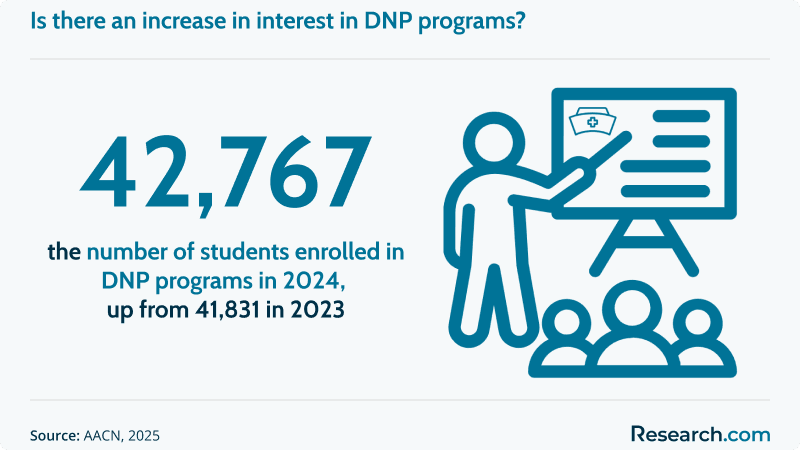
The 3-to-4-year commitment is significant, but you'll be in good company. The growing recognition of the DNP's value is why 42,767 students are currently enrolled in these programs nationwide. This timeline reflects a comprehensive curriculum that prepares you for top-tier leadership roles.
For anyone asking “how long is a BSN to DNP program,” the three-to-four-year timeline provides a realistic expectation while ensuring all clinical, leadership, and evidence-based practice competencies are met.
How does an online direct-entry DNP program compare to an on-campus program?
When the program is properly accredited, there is no difference in the quality, rigor, or value of the degree you earn. Employers view an online DNP from an accredited institution as equivalent to one earned on campus. The sole determinant of a program's quality is its accreditation from either the Commission on Collegiate Nursing Education (CCNE) or the Accreditation Commission for Education in Nursing (ACEN).
The Strategic Advantage of Flexibility
For experienced nurses, the flexibility of direct-entry DNP programs online is a critical strategic advantage. These programs are specifically designed for working professionals who need to balance their education with ongoing career and family commitments. The normalization of online learning in higher education is clear—in 2021, 40% of all post-baccalaureate students were enrolled in fully online programs, making it a mainstream and respected path to a doctorate.
For those wondering “is a DNP a doctor,” it’s important to note that while a DNP confers a doctoral-level degree, DNPs are clinical experts in nursing and not medical physicians.
What is the average cost of a direct-entry DNP program?
The cost of a direct-entry DNP program varies widely by institution. You can expect tuition for public, in-state graduate programs to average around $11,000 per year, while private nonprofit universities can average close to $20,000 annually or more.
It's natural to focus on that number, but as your advisor, I encourage you to look at the complete financial picture.
Calculating Your Return on Investment
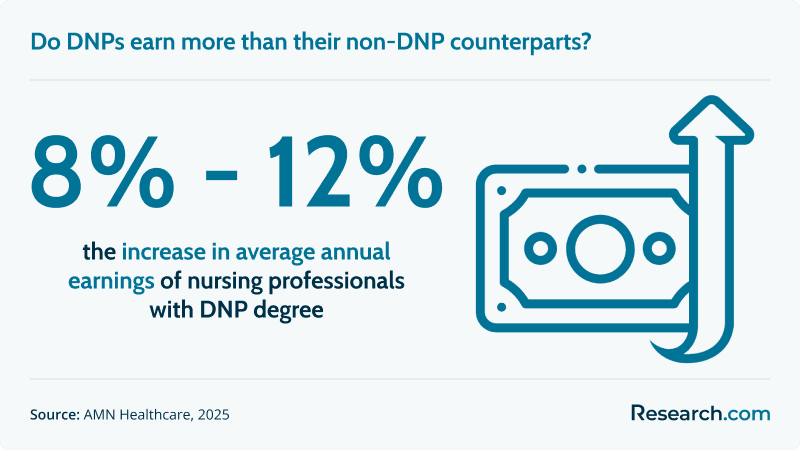
The true cost must be weighed against the significant financial return. DNP-prepared nurses see a clear salary premium, with data showing an 8% to 12% increase in average annual earnings. This immediate bump helps offset the initial cost, but the real value is long-term.
The DNP gives you access to nursing executive-level roles with much higher salary bands, fundamentally changing your lifetime earning potential. The cost isn't just an expense; it's a strategic investment in your future.
What are the financial aid options for students enrolling in a direct-entry DNP program?
You have several strong options available to help fund your DNP education. It's very common for graduate students to use a combination of these resources to make their degree program affordable. The key is to start your research early and apply for everything you may be eligible for.
Here are the primary sources of financial aid to explore:
- Federal Student Loans. The first step for most students is completing the Free Application for Federal Student Aid (FAFSA) to access federal loan programs like Direct Unsubsidized Loans and Grad PLUS Loans.
- Employer Tuition Assistance. Many healthcare systems offer tuition reimbursement or assistance programs for nurses advancing their education, so be sure to check with your human resources department.
- Scholarships and Grants. Numerous professional nursing organizations, private foundations, and government bodies offer scholarships specifically for graduate nursing students.
- Nurse Faculty Loan Program (NFLP). If you plan to become a nursing instructor after graduation, this federal program can provide cancellation for up to 85% of your loan.
Exploring these pathways can significantly reduce your out-of-pocket costs and make a top-tier DNP program a manageable financial goal.
What are the prerequisites for enrolling in a direct-entry DNP program?
Admissions requirements for direct-entry DNP programs online are designed to ensure you have the right foundation for doctoral-level success. While specific requirements vary, they generally fall into two main categories depending on your educational background.
- For BSN-Prepared Nurses: You will need a Bachelor of Science in Nursing from an accredited institution and an active, unencumbered RN license. Most programs also require at least one year of clinical experience.
- For Non-Nursing Graduates: You must hold a bachelor's degree, typically in a related science field, and complete a specific list of prerequisite courses in subjects like anatomy, physiology, and statistics.
- For All Applicants: Expect to submit a resume, letters of recommendation, a statement of purpose outlining your leadership goals, and official transcripts from all previous institutions.
Admissions committees are looking for leadership potential, a different focus than you might find in some ASN to NP programs. Your application should tell a clear story about your vision for leading change in healthcare.
What courses are typically in a direct-entry DNP program?
The curriculum is designed to build on your BSN foundation and teach you the executive-level skills required to lead complex health systems. Coursework focuses on evidence-based practice, advanced statistics, and healthcare informatics, teaching you how to use data to drive clinical and operational decisions.
You will also take courses in health policy, finance, and quality improvement. This is where you learn the language of the C-suite. The goal is to equip you with a completely new toolkit that is distinct from what is taught in associate's programs, which is why it's useful to understand the differences between ADN AAD and AAS nursing degrees.
The DNP Project: A Capstone Experience
A core component of every DNP program is the DNP project. This is a scholarly project where you will identify a problem within a healthcare setting and implement an evidence-based solution. It’s your opportunity to demonstrate your mastery of the curriculum and produce a tangible outcome that improves patient care or organizational efficiency, proving your value as a leader.
What types of specializations are available in a direct-entry DNP program?
Direct-entry DNP programs offer specializations that fall into two main categories, allowing you to tailor the degree to your specific career goals. Your choice of specialization is one of the most important decisions you will make in the application process.
- APRN Clinical Tracks: These specializations prepare you for an advanced practice registered nurse (APRN) role, such as Family Nurse Practitioner (FNP), Psychiatric Mental Health Nurse Practitioner (PMHNP), or Adult-Gerontology Nurse Practitioner. This is the required path for students entering with a non-nursing bachelor's degree.
- Aggregate/Systems-Level Tracks: These specializations focus on leadership and management rather than direct patient care. Tracks like Executive Leadership, Public Health, and Health Informatics are ideal for experienced nurses who want to move into administrative, policy, or C-suite roles.
Choosing a specialization for your direct-entry DNP programs online will directly impact your future work environment and earning potential. Many students also explore DNP in nursing education online programs if they wish to focus on preparing the next generation of nurses, combining leadership training with a strong pedagogical foundation. As the data shows, salaries for advanced practice nurses can vary significantly based on the setting, from community health clinics to inpatient hospital care.
How to Choose the Best Online Direct-entry DNP Program
Choosing the right program is about finding the best strategic fit for your career stage. A high-quality program will have a clear structure to support you, whether you are an experienced nurse or new to the field. Look for these key factors.
- Confirm accreditation. The program must be accredited by the CCNE or ACEN; this is non-negotiable and guarantees the quality and value of your degree.
- Investigate the faculty. For experienced nurses aiming for leadership, look for faculty who are currently practicing as executives. For those new to nursing, ensure the faculty has deep clinical expertise.
- Verify clinical placement support. This is critical for students entering with a non-nursing degree. The best programs have dedicated staff and established partnerships to guarantee your clinical placements.
- Align the specialty tracks. Ensure the program offers the specific APRN or leadership specialization that matches your long-term career vision.
The goal isn't to find the easiest online DNP programs, but to find the one with the resources and focus to get you where you want to go. The right direct-entry DNP programs online will feel like a partnership in your career advancement.
What career paths are available for graduates of a direct-entry DNP program?
A direct-entry DNP qualifies you for a wide range of senior roles across healthcare, academia, and policy. This degree is the key that unlocks career paths where you can have the greatest impact on the systems that deliver care.
- Hospital and Health System Leadership: DNP graduates are prime candidates for C-suite roles like Chief Nursing Officer, as well as executive positions like Director of Quality Improvement or Vice President of Patient Care Services.
- Advanced Clinical Practice Leadership: You can lead clinical teams, manage service lines, or open an independent practice in states with full practice authority.
- Academic and Research Roles: The DNP prepares you for tenure-track faculty positions at universities, where you can educate the next generation of nurses and conduct practice-focused research.
- Health Policy and Advocacy: You can work for government agencies, non-profits, or private-sector firms as a policy analyst or consultant, shaping the future of healthcare.
For those interested in leadership and education without direct patient care, DNP online no clinicals programs provide an ideal pathway, allowing graduates to focus on administrative, policy, and academic roles while completing the degree entirely online.
These are not just jobs; they are long-term careers. The experience you gain in these roles, combined with your doctoral credential, leads to significant salary growth over time, with the highest earnings often coming after more than a decade in the profession.
What is the job market for graduates of a direct-entry DNP program?
The job market for DNP graduates is exceptionally strong. As healthcare grows more complex, the demand for doctorally prepared leaders is increasing. This makes your DNP a highly valuable and sought-after credential.
Don't worry that few jobs explicitly require a DNP. Your advantage lies in being the top candidate for the best jobs that prefer one. This degree is quickly becoming the expected standard for any significant leadership role.
The rise of online learning, with 40% of graduate students now online, makes this path more accessible than ever. Pursuing direct-entry DNP programs online is the most strategic way to future-proof your career, a move far more impactful than debating, What is the fastest RN certification program?.
Share of Postbaccalaureate Students in Fully Online Programs

Here’s What Graduates Have to Say about Their Direct-Entry DNP Program
- Maria: "I was a charge nurse for a decade and knew my stuff, but I was never in the room where decisions were made. The DNP changed that. It wasn't about learning more clinical tasks; it was about learning the language of finance, policy, and systems-level change. Now, when I speak in an executive meeting, people listen because I have the data and the credential to back up my experience."
- Brian: "The DNP project was the most valuable part of the whole experience for me. I focused on reducing patient readmission rates on my floor, and my hospital actually implemented my proposal before I even graduated. Seeing my academic work make a real, measurable difference in patient care was the moment it all clicked. It proved I could lead change, not just follow protocols."
- Emily: "As a working parent, the flexibility of the online program was everything. I could listen to lectures on my commute and join discussion boards late at night. It was still rigorous and demanding, but it fit into the cracks of my life in a way a traditional program never could. I didn't have to put my life on hold to build my future."
Key Findings
- A Doctor of Nursing Practice provides a significant financial return, with graduates earning an 8% to 12% salary premium over non-doctoral nurses.
- The DNP is a widely recognized and sought-after credential, with 42,767 students currently enrolled in programs across the country.
- This degree unlocks access to the highest-paying roles in healthcare leadership, where average salaries in inpatient hospital settings can reach $184,000.
- Online DNP programs are a mainstream and respected educational path, reflecting a broader trend where 40% of all graduate students studied fully online in 2021.
- The DNP is an investment in long-term career growth, with earning potential for experienced APRNs increasing to an average of $154,000 after more than 20 years in the profession.
- Graduates join an elite group of nursing leaders, as only 2.7% of all registered nurses in the United States hold a doctoral degree.
What challenges should prospective students consider before enrolling in a direct-entry DNP program?
When evaluating a direct-entry DNP program, consider the substantial academic and time commitments required to manage an intensive curriculum alongside professional and personal obligations. Prospective students must be prepared for the rigorous integration of advanced clinical concepts and leadership competencies, ensuring the transition from practitioner to executive is both strategic and well-supported. Additionally, candidates without a nursing background need to assess preparatory coursework and foundational clinical experiences to avoid potential delays in meeting licensure requirements; for some, exploring alternatives such as easy RN to BSN programs may offer a more gradual entry into the field. Evaluating long-term career goals against the challenges of immediate workload, time management, and the evolving regulatory landscape is essential for a successful transition into advanced practice nursing.
References:
- American Association of Colleges of Nursing. (2022, August). Doctor of Nursing Practice (DNP) fact sheet. Retrieved September 11, 2025, from https://www.aacnnursing.org/news-data/fact-sheets/dnp-fact-sheet
- Herzing University. (n.d.). MSN vs. DNP – What’s the difference? Retrieved September 11, 2025, from https://www.herzing.edu/difference/msn-vs-dnp
- Kaplow, R., & Reed, K. D. (2019). Specialty certification: A path to improving outcomes. American Journal of Critical Care, 30(2), 156–159. https://doi.org/10.4037/ajcc2019275
- National Center for Education Statistics. (n.d.). Tuition and required fees in degree-granting postsecondary institutions, by control of institution and level of student: 2020-21 and 2021-22. Retrieved September 11, 2025, from https://nces.ed.gov/ipeds/search/viewtable?tableId=36320
- National Center for Education Statistics. (2023, May). Graduate degree fields. Retrieved September 11, 2025, from https://nces.ed.gov/programs/coe/indicator/ctb/graduate-degree-fields
- National Center for Education Statistics. (2023, May). Postbaccalaureate enrollment. Retrieved September 11, 2025, from https://nces.ed.gov/programs/coe/indicator/chb/postbaccalaureate-enrollment
- U.S. Bureau of Labor Statistics. (2023, September 6). Nurse anesthetists, nurse midwives, and nurse practitioners. In Occupational Outlook Handbook. Retrieved September 11, 2025, from https://www.bls.gov/ooh/healthcare/nurse-anesthetists-nurse-midwives-and-nurse-practitioners.htm
Other Things You Need To Know About Direct-Entry DNP Programs
Yes, many 2027 online direct-entry DNP programs offer flexible scheduling to accommodate working professionals. These programs often provide part-time enrollment options and asynchronous coursework, allowing students to balance their studies with full-time employment. However, clinical hours may still require a significant time commitment.
Online direct-entry DNP programs in 2027 offer various clinical experience opportunities through partnerships with healthcare facilities. Students may complete up to 1,000 hours of supervised clinical practice, allowing them to gain essential experience in diverse healthcare settings.


