
2027 Is DNP a Doctor? Understanding Their Role, Scope & Salary

Co-Founder and Chief Data Scientist
Did you know nurse practitioners with a Doctor of Nursing Practice (DNP) degree earn a median salary of over $132,000, while physicians often make more than $239,000 a year? The title “doctor” can be confusing, especially when comparing DNP-prepared nurses to medical doctors (MDs).
This article breaks down what a DNP is, how their training differs from physicians, their scope of practice, job outlook, salaries, and the cost of education. By the end, you’ll have clear, fact-based insights to decide if pursuing a DNP aligns with your career goals.
Key Things You Should Know About Becoming a DNP
- A Doctor of Nursing Practice (DNP) is a terminal degree in nursing that emphasizes advanced clinical practice rather than academic research. It prepares nurses for leadership, direct patient care, and healthcare system improvements at the highest professional level.
- DNP programs usually require a Bachelor of Science in Nursing (BSN) or a Master of Science in Nursing (MSN) for admission. Students complete advanced coursework in clinical practice, evidence-based care, health policy, and leadership, alongside extensive supervised clinical hours.
- Graduates with a DNP are not medical doctors but can use the title “doctor” in academic or clinical settings. Their scope of practice is regulated by state laws, and in many states, they have full authority to diagnose, prescribe medications, and manage treatment independently.
- Is DNP a doctor? DNP vs Doctor
- What is the difference in prerequisites for DNP and MD programs? Program Prerequisites
- How long does it take to become a DNP vs an MD? Completion Time
- What is the difference in curriculum and training between DNP and MD programs? Curriculum & Training
- What is the difference in scope of practice and autonomy between DNPs and MDs? Scope & Autonomy
- How much does a DNP earn compared to an MD? Earnings
- What are the differences in specialties and career paths for DNPs and MDs? Specializations
- How do certification and licensing differ between DNPs and MDs? Certification
- What are the job market outlooks for DNPs vs MDs in 2027? What are the job market outlooks for DNPs vs MDs in 2027?
- Is pursuing a DNP a good alternative to medical school for aspiring healthcare providers? Is pursuing a DNP a good alternative to medical school for aspiring healthcare providers?
Is DNP a doctor?
A Doctor of Nursing Practice (DNP) holds a doctoral-level degree in nursing, but they are not the same as a medical doctor (MD). The distinction lies in both education and scope of practice.
- MDs complete medical school and residency training, focusing on diagnosing complex diseases, performing surgeries, and providing comprehensive medical care.
- DNPs, on the other hand, specialize in advanced clinical nursing, applying evidence-based practice to improve patient outcomes and healthcare systems.
While DNPs can be addressed as “doctor” in academic or clinical settings, their role differs significantly from physicians. They emphasize prevention, patient education, and holistic care, often serving as primary care providers in states where they have full practice authority. Their training prepares them for advanced DNP job duties such as prescribing medication, ordering tests, and leading clinical teams, but always within the legal limits set by state boards of nursing.
What is the difference in prerequisites for DNP and MD programs?
Below is a clear comparison of what most U.S. DNP and MD programs require before you can apply. While individual schools may vary, these are typical prerequisites. If you’re looking for affordable online BSN to DNP degree programs, make sure they still meet these standard prerequisites so your qualification remains competitive.
Prerequisites Comparison
- Bachelor’s degree: Both DNP and MD programs require a bachelor’s degree. For DNPs, this is typically a BSN or another bachelor’s degree combined with an RN license. MD applicants need a bachelor’s degree in any field, though strong science coursework is highly recommended.
- Minimum GPA: Most DNP programs set a minimum GPA of around 3.0 on a 4.0 scale. MD programs also require at least a 3.0, but admitted students often have higher GPAs due to the competitive nature of medical school.
- RN license: An active RN license is mandatory for DNP applicants, whether entering through a BSN-to-DNP or MSN-to-DNP track. MD applicants do not need an RN license, since their path is strictly medical rather than nursing-focused.
- Science prerequisites: Both DNP and MD programs require science coursework, but the depth varies. DNP tracks may ask for biology, chemistry, and statistics, while MD programs demand extensive lab-based courses in biology, chemistry, physics, and often biochemistry.
- Standardized test: The MCAT is required for MD applicants as part of the admissions process. Most DNP programs do not require a standardized test, making the admissions process less test-heavy.
- Clinical or healthcare experience: DNP programs often expect applicants to have RN practice experience, especially for advanced clinical tracks. MD programs strongly recommend clinical exposure through shadowing or volunteering, though they don’t require licensed healthcare experience.
- Letters of recommendation and interviews: Both DNP and MD programs require recommendations, personal statements, and interviews. DNP applicants typically need references from supervisors or nurse educators, while MD applicants often provide academic or healthcare-related endorsements.
Below is a chart that shows how these prerequisite differences translate in practice across typical admitted students. It helps you see which requirements you likely already meet, and which you might need to plan for if you choose DNP vs MD.
How long does it take to become a DNP vs an MD?
The timeline to become a DNP versus an MD is one of the most significant differences between these career paths.
For those wondering specifically how long does it take to go from BSN to DNP, the answer depends on factors like program format, enrollment status, and clinical hour requirements—but on average, nurses can expect to complete the transition in about 3 to 4 years of full-time study, making it one of the most efficient routes to advanced clinical practice in healthcare.
Meanwhile, those entering with a master’s degree may need only 2 to 3 years. This pathway allows practicing nurses to advance their clinical expertise relatively quickly. Some of the most affordable DNP programs also offer online or hybrid formats that reduce time and financial strain.
In contrast, the MD route is much longer. Students typically complete 4 years of medical school after earning a bachelor’s degree, followed by 3 to 7 years of residency, depending on their chosen specialty. This means becoming a fully licensed physician can take anywhere from 11 to 15 years in total.
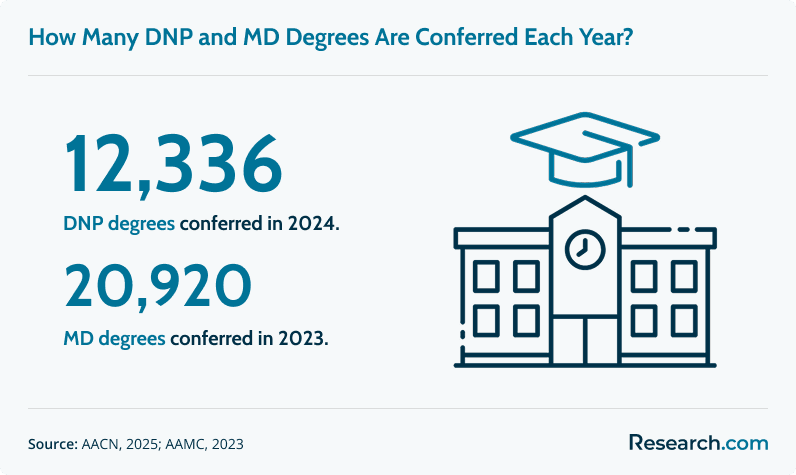
The infographic below shows how many DNP and MD degrees are being conferred each year, highlighting the significant number of graduates entering the workforce despite the different timelines each path requires.
What is the difference in curriculum and training between DNP and MD programs?
The curriculum and training for DNP and MD programs differ substantially in both focus and duration.
DNP programs emphasize
- clinical practice,
- leadership, and
- evidence-based care.
Students complete
- advanced nursing courses,
- health policy,
- informatics, and
- management training alongside
- hundreds of supervised clinical hours.
The aim is to prepare nurses to take on leadership roles, improve healthcare delivery, and provide direct patient care at the highest nursing level.
MD programs, however, are centered on medicine and disease.
- The first two years usually cover basic sciences such as anatomy, pharmacology, pathology, and biochemistry, with lab work and clinical exposure.
- The final two years are primarily clinical rotations in hospitals and clinics, giving students hands-on experience across specialties like internal medicine, pediatrics, and surgery.
- Afterward, residency programs extend training for years, with intensive, specialty-specific practice.
While both paths require rigorous education and hands-on experience, the DNP focuses on holistic and systems-based care, whereas the MD is rooted in diagnosis and treatment of disease. For nurses considering specialization in adult and gerontology care, questions often arise such as “can an AGACNP work in primary care?” While AGACNPs are trained primarily for acute and critical care settings, some do extend their practice into outpatient environments, especially when managing complex or chronically ill adult patients, reflecting the evolving flexibility of advanced nursing roles.
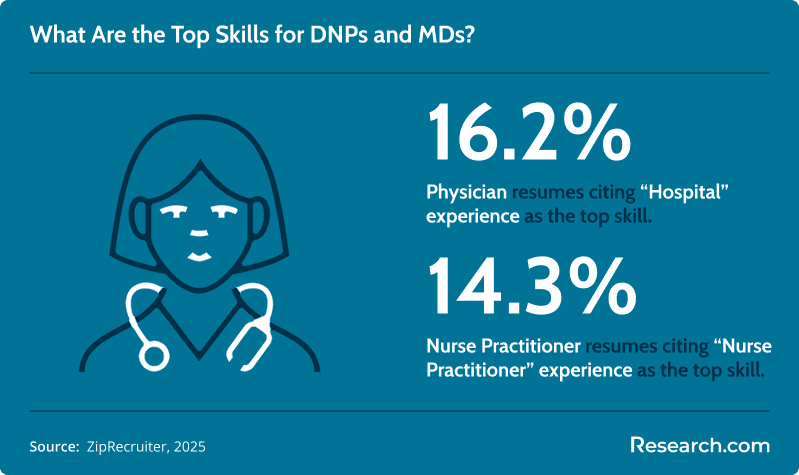
The infographic below highlights the top skills employers look for in both fields, illustrating how training translates into valued competencies in the job market.
What is the difference in scope of practice and autonomy between DNPs and MDs?
The scope of practice and autonomy for DNPs and MDs reflects the fundamental distinction between nursing and medicine.
Physicians (MDs) have the broadest scope, licensed to diagnose, treat, prescribe, and perform surgeries in every U.S. state without restriction. Their training equips them to manage complex medical conditions, direct multidisciplinary teams, and operate independently across all healthcare settings.
DNPs, by contrast, function at the highest level of nursing practice but remain regulated by state laws. In more than 25 states, nurse practitioners, including those with a DNP, have “full practice authority.” This means they can evaluate patients, order tests, diagnose conditions, and prescribe medications independently. In restricted-practice states, however, DNPs must work under physician oversight or collaboration. Their focus often includes preventive care, chronic disease management, and patient education rather than surgical or highly specialized medical interventions.
This distinction shapes how patients experience care, with DNPs emphasizing holistic and continuous management while MDs cover the full medical spectrum. For aspiring nurses who want to advance directly into this leadership level without first earning a master’s degree, exploring the best online direct-entry DNP programs can be an ideal starting point. These programs offer a streamlined path for non-nursing graduates to enter the nursing field and achieve the Doctor of Nursing Practice credential, combining academic rigor with the flexibility of online learning.
How much does a DNP earn compared to an MD?
Compensation is one of the most striking contrasts between a DNP and an MD. According to the Bureau of Labor Statistics, the median annual salary for nurse practitioners, which includes DNP-prepared professionals, is about $132,050. Physicians and surgeons, however, earn at least $239,200 annually, with many specialties significantly exceeding that benchmark. This difference reflects the longer training period, broader scope of practice, and higher autonomy associated with physicians.
While DNP salaries are lower overall, they are still among the top earnings in nursing and healthcare. Factors such as location, specialty, and industry can push earnings higher, especially in states or sectors with strong demand. For those comparing career options, reviewing Doctor of Nurse Practitioner salary trends alongside physician compensation can provide a realistic picture of financial return on investment.
The chart below shows the latest BLS data comparing median annual salaries for DNPs and MDs side by side, making the gap clear.
What are the differences in specialties and career paths for DNPs and MDs?
Specialties and career paths diverge considerably between DNPs and MDs due to their different training and professional focus.
DNPs often pursue tracks such as
- family practice,
- pediatrics,
- psychiatric mental health,
- adult-gerontology, and
- women’s health.
These specialties emphasize primary care, chronic disease management, prevention, and patient education. DNPs may also move into leadership roles, healthcare policy, or academic teaching positions, extending their impact beyond direct patient care.
MDs, by contrast, have a much broader and deeper range of specialties. After medical school, they enter residency programs that may last from three to seven years. Options include highly specialized fields like
- neurosurgery,
- dermatology,
- oncology,
- Cardiology,
- general practice and
- internal medicine.
Physicians may later sub-specialize through fellowships, further refining their expertise.
This difference means DNPs typically lead in nursing-driven care and holistic approaches, while MDs dominate complex, specialized medical treatment and surgical interventions. Both paths, however, provide opportunities for advancement and leadership within healthcare systems.
For nurses specifically interested in anesthesia and critical care, understanding how to become CRNA after BSN is an important next step. The path generally involves gaining critical care experience, completing a Doctor of Nursing Practice (DNP) or Doctor of Nurse Anesthesia Practice (DNAP) program, and obtaining national certification—ultimately allowing BSN-trained nurses to transition into one of the highest-paying and most autonomous advanced practice roles in nursing.
How do certification and licensing differ between DNPs and MDs?
Certification and licensing set clear boundaries between DNPs and MDs, even though both earn doctoral-level degrees.
For DNPs, licensure builds on their registered nurse (RN) license. After completing a DNP program, graduates must pass a national certification exam in their chosen specialty, such as family practice, pediatrics, or psychiatric-mental health. These certifications are typically issued by organizations like the American Nurses Credentialing Center (ANCC) or the American Association of Nurse Practitioners (AANP). States then grant advanced practice registered nurse (APRN) licenses, which determine scope of practice and prescribing authority. Options like the fastest online women's health nurse practitioner DNP programs prepare students for certification in that specific track.
MDs, on the other hand, undergo the United States Medical Licensing Examination (USMLE), which is a multi-step process assessing medical knowledge and clinical skills. Following residency, physicians also pursue board certification in their specialty through organizations such as the American Board of Medical Specialties (ABMS). Licensure is state-specific, but universally required, ensuring physicians meet rigorous standards before practicing independently.
Ultimately, while both professions rely on national exams and state licensure, the systems differ in focus: DNPs certify within nursing specialties, while MDs certify and license through a medical framework tied closely to residency and specialty practice.
What are the job market outlooks for DNPs vs MDs in 2027?
The job market outlook highlights one of the biggest differences between DNPs and MDs. According to the Bureau of Labor Statistics, advanced practice registered nurses, including DNPs, are projected to see a remarkable 35% employment growth from 2024 to 2034. This rapid increase reflects rising demand for primary care providers, the expansion of telehealth, and the ongoing physician shortage in many parts of the U.S. DNPs are increasingly filling critical gaps in accessible, patient-centered healthcare.
By contrast, physicians are expected to see only 3% growth over the same period. While this is steady and aligns with the average across occupations, it reflects the maturity of the physician workforce and the lengthy training pipeline that restricts rapid growth. Nonetheless, physicians remain essential for complex cases, surgical care, and highly specialized medicine.
The chart below illustrates the contrast in job growth projections, clearly showing why DNPs are becoming a key part of the U.S. healthcare workforce.
Is pursuing a DNP a good alternative to medical school for aspiring healthcare providers?
Choosing between a DNP and medical school depends on your career goals, desired responsibilities, and tolerance for the length and cost of training.
A DNP can be an attractive alternative for those who want to
- deliver direct patient care,
- specialize in areas like family or psychiatric health, and
- enter the workforce more quickly.
Programs typically take 3 to 4 years post-BSN, offering graduates the opportunity to practice autonomously in many states. For nurses weighing the question, “Do you need a DNP to be an NP?” understanding the evolving expectations of the profession is essential, as more employers favor doctoral preparation.
Medical school, in contrast, requires a longer commitment—4 years of study plus 3 to 7 years of residency—and leads to significantly higher pay and broader authority. It suits individuals aiming to
- diagnose complex conditions,
- perform surgery, and
- work in highly specialized medical fields.
For aspiring healthcare providers, the decision ultimately comes down to whether they prioritize time, financial investment, or the level of autonomy and scope of practice.
Here's What Graduates Have To Say About Their DNP Program
- Maribel: "Completing my DNP online allowed me to balance full-time work and family responsibilities without losing momentum in my career. The flexibility gave me the chance to immediately apply advanced concepts in my practice, and I felt my confidence grow each semester."
- Lennox: "The online DNP program pushed me to think like a leader, not just a clinician. Courses in health policy and informatics expanded my perspective, while virtual collaboration with peers across the country helped me build lasting professional connections."
- Anika: "Studying for my DNP online showed me how rigorous digital learning can be. From interactive simulations to real-time case studies, the program gave me the tools to manage patients independently and advocate for system-level changes in my hospital."
Key Findings
- DNPs earn a median salary of $132,050, while physicians make at least $239,200.
- Job growth for DNPs is projected at +35%, compared to +3% for physicians.
- DNP degrees conferred in 2024 reached 12,336, while MDs in 2023 totaled 20,920.
- Tuition averages $61,080 annually for DNP programs, versus $235,827 total for four years of medical school.
- Top-paying state for DNPs is California at $158,130, while physicians earn the most in Wisconsin at $397,000.
- MD training takes 11–15 years, while most DNP programs can be completed in 3–4 years post-BSN.
References:
- AACN. DNP Fact Sheet.
- AACN. Schools of Nursing Enrollment Increases Across Most Program Levels Signaling Strong Interest in Nursing Careers.
- AAMC. Medical School Graduates Report.
- AAMC. Medical School Enrollment Reaches New High.
- BLS. Nurse Anesthetists, Nurse Midwives, and Nurse Practitioners: Occupational Outlook Handbook.
- BLS. Occupational Employment and Wage Statistics: Nurse Practitioners.
- BLS. Occupational Employment and Wage Statistics: Physicians.
- BLS. Physicians and Surgeons: Occupational Outlook Handbook.
- NurseJournal. How Much Does Nursing School Cost?
- ProspectiveDoctor. The Least Expensive Medical Schools.
- Weatherby Healthcare. Highest-Paying States for Physicians: See the Top 10.
- ZipRecruiter. NP Must-Have Skills List & Keywords for Your Resume.
- ZipRecruiter. Physician Must-Have Skills List & Keywords for Your Resume.
Other Things You Should Know About DNP
In 2027, DNPs focus on advanced nursing practice, emphasizing clinical expertise, leadership, and research in nursing. MDs, as medical doctors, perform medical diagnostics, surgeries, and patient treatment, offering direct patient care. The key difference lies in the nature of their education and the scope of their clinical responsibilities.
In 2027, DNP graduates may use the title "Doctor" in clinical settings, but policies differ by state and institution. It is crucial for DNP holders to adhere to regional regulations and clearly communicate their role to patients to avoid confusion with medical doctors.
To enroll in a DNP program in 2027, you typically need a Bachelor of Science in Nursing (BSN), active RN licensure, and a minimum GPA of 3.0. Some programs may also require clinical experience or GRE scores as part of the admission process.


