
2027 What Can You Do With a Master's in History

Co-Founder and Chief Data Scientist
A master’s degree in history opens the door to a wide range of career paths, from teaching and research to roles in government, museums, policy, and the private sector. In today’s world, employers value not just subject expertise but also the critical thinking, research, and communication skills that history graduates bring to the table.
This makes the degree highly versatile, preparing students for both traditional academic careers and alternative fields where analytical skills are in demand. In 2027, opportunities for history graduates continue to expand beyond classrooms and archives.
With the growing importance of data-driven storytelling, cultural preservation, and global context in business and policy, a master’s in history offers both intellectual fulfillment and practical career advantages. By understanding the diverse paths available through this guide, students can align their degree with personal passions and long-term professional goals.
What are the benefits of pursuing a master’s in history degree?
- A master’s in history equips students with advanced research skills, including archival work, critical analysis, and historical interpretation.
- The degree provides career flexibility, opening opportunities in education, museums, government, policy, publishing, and even business sectors.
- It strengthens professional credentials, giving graduates a competitive edge for roles that require specialized knowledge and advanced training.
- A master’s serves as a pathway to doctoral study, preparing students for Ph.D. programs and academic careers in higher education.
- What are the main reasons students choose to pursue a master’s in history? Reasons to Pursue
- What core skills does a history graduate gain? Core Skills
- Should graduates consider pursuing a PhD in history? Pursuing a PhD
- How can a master’s in history degree advance professional opportunities? Advancing Your Career
- What teaching opportunities are available with a master’s in history? Teaching Opportunities
- What is the average salary for historians with a master’s degree? Average Salary
- What does the job outlook for history-related careers look like? Job Outlook
- What are the alternative career paths for graduates of a master's in history degree? Alternative Careers
- What roles are available for archivists, curators, or preservationists? What roles are available for archivists, curators, or preservationists?
- Which fields offer the highest earning potential for history graduates? Which fields offer the highest earning potential for history graduates?
- Can further qualifications enhance career advancement? Can further qualifications enhance career advancement?
What are the main reasons students choose to pursue a master’s in history?
Students pursue a master’s in history for a variety of academic, professional, and personal reasons.
For many, it represents a chance to deepen their knowledge of the past and engage in advanced research. Some even start their academic journey by exploring the shortest online history bachelor's degree programs, which can provide a faster path to graduate-level study.
Others view the degree as a stepping stone to teaching, museum work, or government roles that require specialized expertise. At the same time, the program cultivates transferable skills in writing, analysis, and communication that are highly valued across industries.
In addition to professional outcomes, a master’s in history often appeals to those with a strong personal passion for historical study. The degree provides a structured opportunity to focus on areas of interest—whether cultural, political, or social history—while contributing to scholarship and understanding of the human experience.
What core skills does a history graduate gain?
Graduates of a master’s in history program develop a strong set of skills that extend far beyond the study of the past. These abilities are rooted in research, analysis, and communication—competencies that employers across many industries value.
Here is an overview of the core skills history graduates gain:
- Advanced research and analysis: Ability to locate, interpret, and synthesize information from diverse sources.
- Critical thinking: Evaluating evidence, questioning assumptions, and drawing logical conclusions.
- Strong written and verbal communication: Presenting complex ideas clearly for academic, professional, or public audiences.
- Data organization and interpretation: Managing archives, historical records, or large sets of qualitative information.
- Problem-solving and project management: Designing research projects, meeting deadlines, and coordinating work.
- Cultural and global awareness: Understanding diverse perspectives and historical contexts that shape today’s world.
For those looking to finish a degree or return to school, best online degree completion programs offer flexible pathways to gain these valuable skills and advance your career.
According to Zippia, the top skill for on the resumes of historians is the knowledge and management of cultural resources, as well as the ability to conduct historial research. These are listed in the chart below:
Should graduates consider pursuing a PhD in history?
Whether or not to pursue a PhD in history depends largely on a graduate’s career goals. A doctoral degree is typically necessary for those seeking tenure-track faculty positions at universities or aiming to lead original research in the field.
For students passionate about scholarship, teaching at the highest level, or contributing to academic publications, the PhD offers an essential pathway.
However, a PhD also requires a long-term commitment—often five to seven years of intensive study—and the academic job market for historians can be highly competitive. For those interested in enhancing career prospects in finance or related fields, pursuing the best finance certifications can provide a valuable edge.
Graduates who prefer roles in museums, archives, government, policy, or the private sector may find that a master’s in history already provides sufficient preparation without the need for a doctorate.
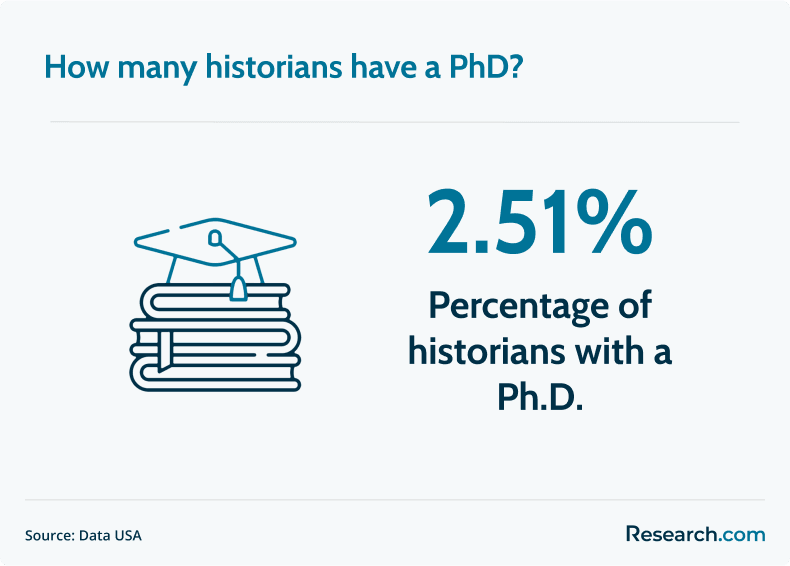
According to Data USA, only 2.51% of historians have a doctorate, while only 11.6% have masters degrees.
How can a master’s in history degree advance professional opportunities?
A master’s in history enhances career opportunities by combining subject expertise with widely applicable skills. The degree not only prepares graduates for academic and educational careers but also opens doors to roles in government, cultural institutions, nonprofits, and the private sector.
Many students begin their academic path with the best bachelor's degree in history online, which lays the foundation for advanced study and professional development. Employers value the ability of history graduates to conduct in-depth research, analyze complex information, and communicate ideas clearly—skills that translate across industries.
For those already in the workforce, a history master’s can provide the advanced credentials needed for promotions, specialized roles, or leadership positions. It also signals a commitment to critical inquiry and professional growth, making graduates stand out in competitive job markets.
What teaching opportunities are available with a master’s in history?
With a master’s in history, graduates can pursue a range of teaching opportunities across different educational levels and settings. Many students begin their academic journey by exploring the most affordable online master's degrees in history, which provide both accessibility and flexibility while preparing them for teaching-focused careers.
While a PhD is generally required for tenure-track university positions, a master’s degree opens doors to several rewarding teaching paths:
- Community Colleges: Many community colleges hire master’s-level historians to teach introductory and survey history courses.
- High Schools (Public or Private): A master’s degree can strengthen a graduate’s qualifications to teach history or social studies at the secondary level, particularly when paired with state teaching certification.
- Adjunct or Part-Time University Roles: Some universities employ master’s-level instructors as adjunct faculty, especially for lower-level or general education history courses.
- Adult Education and Continuing Education Programs: Graduates can teach history-related courses to adult learners through local education centers, online platforms, or community organizations.
- Tutoring and Test Preparation: Master’s-level expertise equips graduates to provide private tutoring or teach prep courses for AP history, SAT subject tests, or GRE subject exams.
What is the average salary for historians with a master’s degree?
A master’s in history opens the door to diverse career opportunities, and salaries vary depending on the role, employer type, and region. According to the U.S. Bureau of Labor Statistics (BLS), the median annual wage for historians was $74,050 in May 2023.
Most professionals in this field work for the federal government, research organizations, or museums, though opportunities in education and the private sector are also common (US BLS, 2024).
For graduates who pursue teaching at the postsecondary level, the earning potential can be even higher, and this overlaps with many of the career opportunities for a master of arts in teaching, particularly in classrooms, community colleges, and adult education.
The US BLS reports that postsecondary history teachers earned a median annual wage of about $90,000 in 2023, though salaries vary by institution type and academic rank (US BLS, 2024). Meanwhile, those working as high school teachers or in community colleges may see more modest salaries, typically in the $60,000 to $70,000 range (U.S. News, 2024).
Beyond teaching, many history master’s graduates enter policy research, government service, or archival management. Salary.com places the average base salary for professional historians in the U.S. at approximately $73,000 to $78,000 per year, with upper ranges exceeding $90,000 depending on specialization and years of experience (Salary.com, 2024).
Overall, while salaries for historians may not reach the levels of some STEM professions, the degree offers competitive pay for those passionate about research, teaching, and preserving cultural knowledge. Location, employer type, and job responsibilities remain the biggest factors influencing earning potential. For those curious about career settings in other research-intensive fields, exploring where do epidemiologists work can provide useful context and inspiration.
Still, the average salaries have been summarized below:
What does the job outlook for history-related careers look like?
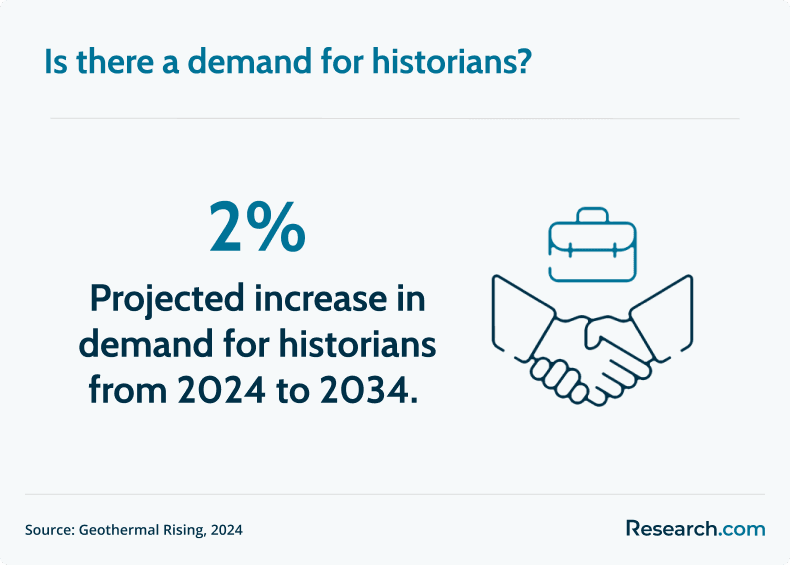
While history remains a vital field for understanding culture, politics, and society, the overall employment outlook for history-related careers is modest compared to other fields. According to the U.S. Bureau of Labor Statistics (US BLS), employment of historians is projected to grow just 2% from 2024 to 2034, slower than the average for all occupations.
This translates to roughly 300 openings per year, driven mostly by retirements or career changes rather than significant industry expansion (US BLS, 2024). By contrast, related fields show somewhat stronger growth, and exploring what jobs can you get with a biomedical engineering degree highlights some of the high-demand, specialized career paths available in STEM.
The BLS projects that jobs for archivists, curators, and museum professionals will grow 6% between 2024 and 2034, about as fast as the national average. Rising demand for professionals who can digitize historical records, design engaging exhibitions, and preserve cultural artifacts is helping sustain these opportunities (US BLS, 2024).
The biggest factor influencing outlook is funding stability. Since many history graduates work in government, education, museums, or nonprofits, job growth often depends on public budgets, grants, and private donations. In higher education, opportunities are highly competitive, with fewer tenure-track roles available.
However, individuals with advanced degrees, specialized expertise, or strong digital skills are better positioned for success. Graduates can also expand into education-related roles outside of the traditional path by exploring alternative teaching certificate jobs, which can provide a faster route into classrooms and training environments without requiring a PhD.
For many, this means the field will remain competitive, but career opportunities extend beyond traditional historian roles, as they face the challenge of the 2% projected increase in job openings in the next decade.
What are the alternative career paths for graduates of a master's in history degree?
Although many history graduates aspire to careers as historians, educators, or researchers, the transferable skills gained in a history master’s program open up diverse opportunities across sectors. Strong research abilities, analytical thinking, and communication skills allow graduates to thrive in fields beyond academia and museums.
These alternative pathways can provide stable employment, competitive salaries, and opportunities to apply historical knowledge in innovative ways:
- Public Policy and Government: Roles in policy analysis, legislative research, and cultural resource management.
- Communications and Media: Careers in journalism, editing, publishing, and content strategy.
- Corporate and Nonprofit Sectors: Opportunities in research, consulting, program management, and development.
- Libraries and Archival Technology: Digitization projects, records management, and digital preservation.
- Cultural Heritage and Tourism: Positions in historical consulting, heritage sites, and tourism development.
- Education and Training (non-academic): Designing corporate training programs, curriculum development, or community education.
What roles are available for archivists, curators, or preservationists?
Graduates with a master’s in history who pursue archival or museum-related careers can enter fields that focus on preserving and interpreting cultural heritage. These professions play an essential role in safeguarding historical records, artifacts, and collections, while making them accessible to the public and future generations.
Here is an overview of the roles available for each profession:
- Archivist: Organizes, digitizes, and manages historical documents and records.
- Curator: Oversees collections, develops exhibitions, and conducts scholarly research.
- Preservationist/Conservator: Restores and maintains historical artifacts, manuscripts, and cultural materials.
- Collections Manager: Maintains cataloging systems and ensures proper storage conditions.
- Exhibit Designer: Creates engaging educational experiences through exhibition planning and design.
- Cultural Heritage Specialist: Advocates for and protects historic sites, landmarks, and monuments.
Collectively, these roles require strong research skills, attention to detail, and knowledge of both traditional and digital preservation methods. Graduates who combine their history training with technical skills in digitization, conservation science, or museum technology are especially well-positioned for success.
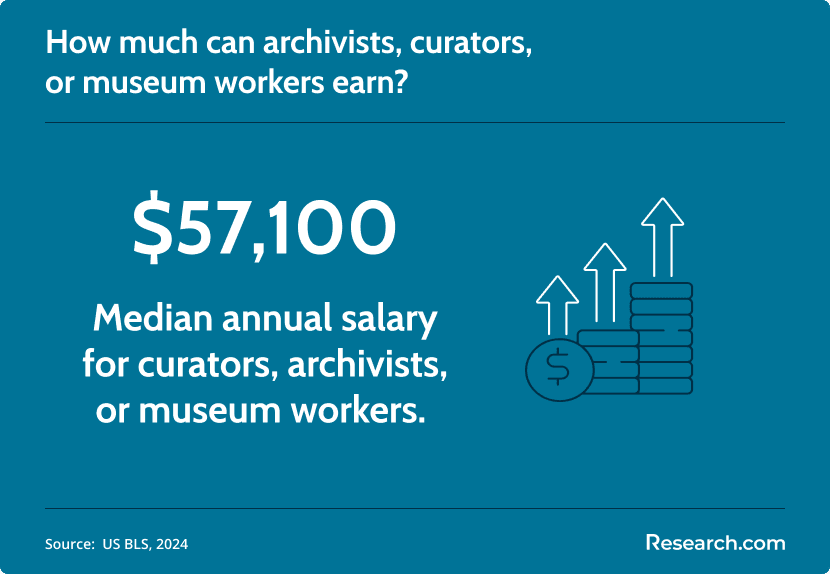
In general, archivists, curators and museum workers can expect an average annual salary of $57,100, according to US BLS.
Which fields offer the highest earning potential for history graduates?
While history is often associated with academia and museum work, some career paths provide substantially higher earning potential. Graduates who leverage their analytical, research, and communication skills in law, government, consulting, and education often see the most competitive salaries.
According to the U.S. Bureau of Labor Statistics (US BLS) and industry reports, median wages for these roles frequently surpass those of traditional historian positions.
One of the top-paying pathways is law and legal services. Many history graduates pursue law school, where their background in research and argumentation translates well into careers as attorneys, paralegals, or legal analysts.
Lawyers in the U.S. earned a median salary of $135,740 in 2022 (US BLS, 2024), making this one of the most lucrative directions for history majors who continue their education.
Postsecondary education also offers strong earning potential, especially for those who advance to the doctoral level. Postsecondary history teachers reported a median annual salary of about $90,000 in 2023 (US BLS, 2024). Senior faculty members, department chairs, or those employed at research universities may earn significantly more.
In the corporate and consulting sector, history graduates who develop expertise in policy analysis, market research, or data-driven storytelling can also command higher salaries. Management analysts, for example, earn a median of $95,290 per year, reflecting strong demand for professionals who can synthesize complex information and advise organizations (US BLS, 2024).
Finally, government and public administration roles—especially at the federal level—can provide stable careers with competitive salaries. Historians employed by the federal government report median wages above $86,000 annually (US BLS, 2024), higher than the overall historian median of $74,050.
Can further qualifications enhance career advancement?
Beyond a master’s in history, targeted certifications and advanced degrees can strategically expand career opportunities. History graduates may benefit from additional qualifications that focus on leadership, education management, and research innovation. For instance, obtaining specialized credentials can open pathways in educational administration and policy-making while strengthening interdisciplinary skill sets. Pursuing programs such as 2 year Ed.D programs online provides an avenue to refine these competencies and integrate them into dynamic career trajectories without repeating previously discussed academic routes.
What Graduates Say About Master's in History Degrees
- Nikolas: "Completing my master’s in history online allowed me to balance full-time work with graduate study. I gained advanced research and writing skills while exploring global historical perspectives, all from the flexibility of my home. The program gave me the confidence to transition into a policy research career."
- Molly: "Studying history online helped me connect with classmates and faculty from across the world, which made discussions richer and more engaging. The digital format also gave me hands-on experience with archival tools and databases that I now use in my museum career."
- Devie: "The online master’s in history taught me how to critically analyze sources and communicate findings effectively, skills that employers truly value. I appreciated being able to work at my own pace while still receiving personalized feedback from professors. It was a transformative academic journey."
Key Findings
- The projected demand for historians is expected to grow by 2% from 2024 to 2034.
- Graduates of master's in history programs can pivot to alternative careers, such as in law, where the average annual salary is over $135,000.
- Archivists, curators, and museum workers have an average salary of over $57,000.
- Almost 16% of historians feature cultural resources on their resumes.
- Only 11.6% of historians have a master's in history degree.
References:
- American Historical Association (AHA). (2024). Careers for History Majors. https://www.historians.org/resource/careers-for-history-majors
- US BLS. (2024). Archivists, Curators, and Museum Workers. https://www.bls.gov/ooh/education-training-and-library/curators-museum-technicians-and-conservators.htm
- US BLS. (2024). Historians. https://www.bls.gov/ooh/life-physical-and-social-science/historians.htm
- US BLS. (2024). Lawyers. https://www.bls.gov/ooh/legal/lawyers.htm
- US BLS. (2024). Management Analysts. https://www.bls.gov/ooh/business-and-financial/management-analysts.htm
- US BLS. (2024). Postsecondary Teachers. https://www.bls.gov/ooh/education-training-and-library/postsecondary-teachers.htm
- U.S. News & World Report. (2024). What You Can Do With a History Master’s Degree. https://www.usnews.com/education/best-graduate-schools/articles/2019-04-29/what-can-you-do-with-a-history-degree
- Salary.com. (2024). Historian Salary in the United States. https://www.salary.com/research/salary/recruiting/historian-salary
- The Career Project. (2024). Historian Career Guide. https://www.thecareerproject.org/career/historian
- U.S. National Archives. (2024). Careers and Internships. https://www.archives.gov/careers/internship-opportunities
Other Things to Know About Pursuing a Master’s in History Degree
In 2027, history graduates can pursue nontraditional roles including digital archivist, public historian, and social media manager for educational institutions. They can leverage their research skills in fields like tourism, content creation, and user experience design.
A master's in history in 2027 develops advanced research skills, including critical analysis of primary sources, qualitative data collection, and historical research methodologies. Students learn to synthesize information, craft compelling narratives, and present findings effectively, preparing them for roles in academia, public policy, and archiving.


