
2027 What Can You Do with a Biomedical Engineering Degree: Careers

Co-Founder and Chief Data Scientist
Choosing a major is one of the first big financial decisions you’ll make, and biomedical engineering is both demanding and costly. According to the U.S. Bureau of Labor Statistics, employment for biomedical engineers is projected to grow 7% until 2034, faster than average, driven by advances in medical devices and biotechnology. With this growth, it’s natural to ask: “What can I actually do with this degree?”
By reading this guide, you’ll gain a clear roadmap of the career opportunities available, from cutting-edge research and development to practical roles in healthcare technology management. Beyond just listing job titles, the article explains salary expectations, industry demand, and the unique benefits of each path, helping you make a confident, well-informed decision about your investment in this degree.
Key Things You Should Know About Biomedical Engineering Degree
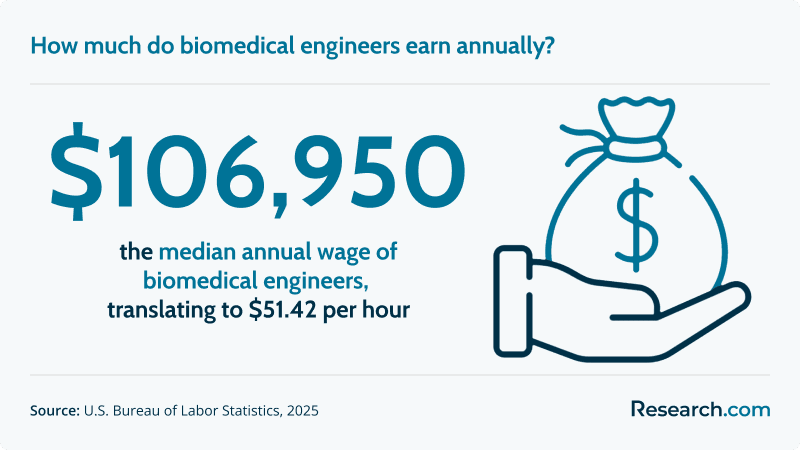
- The financial outlook is strong, with a median annual salary of $106,950 for biomedical engineers.
- Job security is solid, with a projected growth rate of 5% for the field between 2024 and 2034.
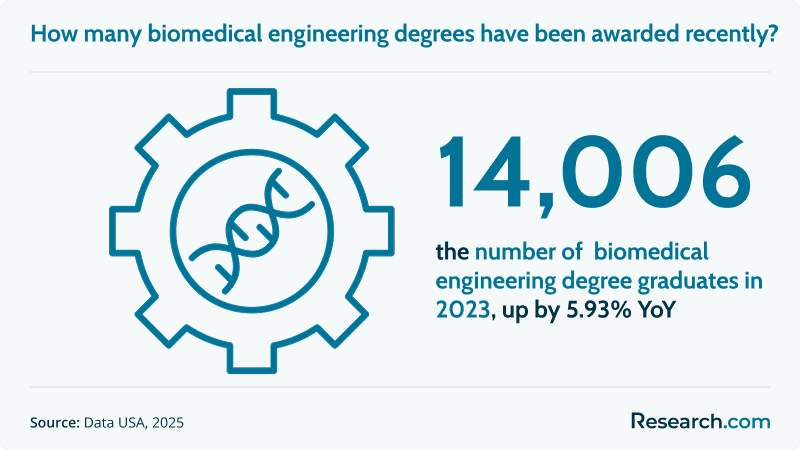
- You would be entering a popular and expanding field, which saw 14,006 graduates in 2023 alone.
- For the highest earning potential, the engineering services sector offers a median salary of $125,010.
- The degree's core purpose is to apply engineering principles to solve complex problems in medicine and healthcare.
- What is a biomedical engineering degree? Degree Overview
- What jobs can I get with a biomedical engineering degree? Best Jobs
- How much can you earn with a biomedical engineering degree? Average Salary
- What is the job outlook for graduates of biomedical engineering degree programs? Job Outlook
- Where can I work with a biomedical engineering degree? Typical Jobs
- What skills do you need for biomedical engineering degree jobs? Skills
- What are the education requirements to enroll in a biomedical engineering degree program? Education Requirements
- What alternative paths are available for biomedical engineering degree? Alternative Paths
- What career paths are available to graduates with a biomedical engineering degree? What career paths are available to graduates with a biomedical engineering degree?
- How do you get started on your biomedical engineering degree? How do you get started on your biomedical engineering degree?
- What advancement opportunities are available after a biomedical engineering degree? Advancement
- Is a biomedical engineering degree worth it? Is a biomedical engineering degree worth it?
Biomedical Engineering Degree Guide: What It Is, Jobs, Salary, and How to Decide
A biomedical engineering degree is for students who want to apply engineering, biology, medicine, and computing to real healthcare problems. Instead of preparing for direct patient care, this major trains you to design, test, improve, and support the technologies clinicians and researchers use, including medical devices, imaging systems, implants, rehabilitation tools, diagnostic equipment, and biomedical software.
This guide is written for high school students comparing engineering majors, college students considering a transfer or concentration, and working adults exploring graduate study or a healthcare technology career. You will learn what the degree covers, which jobs it can lead to, how salaries and job growth look, what skills employers expect, and how to decide whether biomedical engineering is the right academic investment.
The field continues to attract students. In 2023, 14,006 students graduated with biomedical engineering degrees, representing a nearly 6% increase from the previous year. That growth reflects strong interest in careers at the intersection of healthcare and technology, but it also means students should choose programs carefully, build marketable technical skills, and understand how different biomedical engineering roles actually work.
Quick Answer: What Can You Do With a Biomedical Engineering Degree?
With a biomedical engineering degree, you can work in medical device design, product development, clinical engineering, research and development, regulatory affairs, biomaterials, biomechanics, rehabilitation engineering, quality assurance, and healthcare technology support. Most roles involve solving technical problems related to human health rather than providing direct clinical care.
The degree is usually worth considering if you enjoy math, physics, biology, design, data analysis, and hands-on problem solving. It may be less suitable if you mainly want direct patient interaction, a less math-heavy major, or a career path with minimal technical coursework.
| Question | Short answer |
| What does the degree study? | Engineering design, biomedical science, medical technology, computing, materials, mechanics, and systems used in healthcare. |
| What is the median annual salary? | The median annual salary for biomedical engineers is $106,950. |
| What is the job outlook? | Biomedical engineering employment is projected to grow 7% from 2024 to 2034. |
| Where do graduates work? | Medical device companies, hospitals, research labs, manufacturing firms, engineering services, startups, and government agencies. |
| What should students check before enrolling? | Accreditation, lab access, faculty research areas, internship opportunities, career outcomes, transfer policies, cost, and fit with career goals. |
What Is a Biomedical Engineering Degree?
A biomedical engineering degree is an undergraduate or graduate program that combines engineering methods with life science and medical applications. Students learn how to identify a health-related problem, translate it into technical requirements, develop a solution, test whether it works safely, and improve it based on data.
At the bachelor’s level, the curriculum commonly includes calculus, physics, chemistry, biology, engineering design, programming, biomechanics, biomaterials, instrumentation, physiology, statistics, and laboratory work. The goal is not only to understand the human body, but to use engineering tools to create or improve healthcare technologies.
Biomedical engineers often build the tools used by physicians, scientists, and patients. Examples include diagnostic systems, implantable devices, surgical tools, prosthetics, rehabilitation equipment, drug delivery technologies, and software used to model or analyze biological systems.
How Biomedical Engineering Differs From Pre-Med or Biology
Biomedical engineering is more design- and systems-focused than many traditional life science majors. Biology and pre-med coursework often emphasizes understanding living systems and preparing for clinical or research pathways. Biomedical engineering uses that scientific knowledge to develop practical technologies, test designs, analyze performance, and solve constraints involving safety, usability, cost, regulation, and manufacturing.
| Major or path | Main focus | Best fit for students who want to... |
| Biomedical engineering | Medical technology design, testing, systems, devices, and engineering analysis | Create or improve healthcare tools, devices, software, or equipment |
| Biology or biochemistry | Living systems, molecules, cells, organisms, and lab science | Prepare for research, healthcare, pharmaceuticals, or related science careers |
| Mechanical or electrical engineering | Broad engineering fundamentals that can be applied to medical technology | Keep career options wider while later specializing in healthcare applications |
| Clinical healthcare certificate or degree | Direct patient procedures and healthcare delivery | Work more directly with patients in a clinical setting |
What Jobs Can You Get With a Biomedical Engineering Degree?
A biomedical engineering degree can lead to technical, research, regulatory, clinical technology, and product-focused roles. The best job fit depends on your strongest skills: design, coding, mechanical systems, electronics, materials, lab research, documentation, quality, or communication with clinicians.
Some students also pair biomedical engineering with population health interests. For example, students who want to understand healthcare systems, epidemiology, or health policy may compare engineering roles with public health specializations that focus more on community health, prevention, and policy.
Product Development Engineer
Product development engineers help turn a clinical need into a usable medical product. They may define technical requirements, create prototypes, run tests, document design changes, work with manufacturing teams, and support improvements after feedback from users or regulators.
Clinical Engineer
Clinical engineers work in hospitals and healthcare systems, where they support medical equipment used in patient care. Their responsibilities can include evaluating technology, troubleshooting equipment, coordinating maintenance, improving safety processes, and helping clinical teams choose or use complex devices.
Regulatory Affairs Specialist
Regulatory affairs specialists help organizations prepare products and documentation for review by government agencies. In the United States, this work often connects to FDA requirements. The role is a strong fit for people who are detail-oriented, comfortable with technical writing, and interested in how medical products move from development to approval and market use.
Research and Development Engineer
R&D engineers work on new or improved biomedical technologies. They may design experiments, analyze results, test prototypes, model biological systems, evaluate device performance, or collaborate with scientists and clinicians on early-stage innovation.
Biomaterials Developer or Scientist
Biomaterials specialists focus on materials that interact with the body. Their work may involve implants, heart valves, tissue scaffolds, coatings, controlled drug release materials, or other applications where safety, durability, and biological compatibility matter.
Rehabilitation Engineer
Rehabilitation engineers design and adapt technologies that help people with physical or cognitive limitations. This may include prosthetics, orthotics, mobility devices, specialized wheelchairs, communication tools, or customized assistive systems that improve independence and function.
Biomechanics Engineer
Biomechanics engineers study how forces, motion, fluids, and mechanical stress affect biological systems. Their work can support orthopedic implants, injury modeling, sports equipment, gait analysis, cardiovascular flow studies, and rehabilitation technologies.
Public Health and Safety-Related Roles
Biomedical engineering supports public health by creating and improving the technologies used in prevention, diagnosis, treatment, monitoring, and recovery. However, it is different from emergency response or crisis management careers, which focus more on planning, coordination, and public safety operations.
To compare the difference, students can review what you can do with a bachelor's degree in emergency management. Biomedical engineering generally focuses on developing and maintaining technology, while emergency management focuses on preparing for and responding to large-scale disruptions.
| Career area | Typical work | Good fit if you enjoy... |
| Medical device development | Designing, prototyping, testing, and improving healthcare products | Engineering design, problem solving, CAD, testing, teamwork |
| Clinical engineering | Supporting medical equipment in hospitals and healthcare systems | Troubleshooting, safety, working near clinical teams |
| Regulatory affairs | Preparing technical documentation and supporting compliance | Writing, rules, precision, risk management |
| R&D | Testing new ideas, analyzing data, and developing early-stage technologies | Lab work, research, experiments, innovation |
| Biomaterials | Developing materials that can function safely in or near the body | Chemistry, materials science, biology, testing |
| Rehabilitation engineering | Creating assistive technologies for mobility, communication, or daily function | Human-centered design and practical problem solving |
How Much Can You Earn With a Biomedical Engineering Degree?
The median annual salary for biomedical engineers is $106,950. Salary can vary by role, employer, location, education level, experience, and specialization. A graduate working in entry-level testing or support may earn less than the median, while experienced engineers in specialized or leadership roles may earn more.
Industry also matters. Biomedical engineers working in the specialized engineering services sector earn a median salary of $125,010. This shows why students should look beyond the job title and consider which industries, employers, and technical specialties align with their income goals.
How to Interpret Biomedical Engineering Salary Data
Salary figures are useful, but they are not guarantees. A degree can help you qualify for relevant roles, but compensation depends on your internships, portfolio, technical tools, communication skills, location, and ability to work in regulated healthcare environments.
It is also useful to compare biomedical engineering with other STEM careers. For example, a paleontologist salary is often shaped by academic, museum, field research, or government opportunities, while biomedical engineering pay is frequently influenced by medical technology, device manufacturing, engineering services, and healthcare innovation.
| Salary factor | Why it matters |
| Industry | Medical devices, engineering services, hospitals, research labs, and manufacturing can have different pay structures. |
| Technical specialization | Skills in areas such as imaging, software, biomaterials, biomechanics, or regulatory work can shape job options. |
| Experience | Internships, co-ops, capstone projects, and early job performance affect advancement. |
| Education level | Some research, management, or specialized roles may prefer or require graduate study. |
| Location | Pay often reflects regional employer demand and cost of living. |
What Is the Job Outlook for Biomedical Engineering Graduates?
The employment outlook for biomedical engineers is positive, with projected growth of 7% from 2024 to 2034. This suggests continued demand for professionals who can combine engineering analysis with healthcare applications.
Several forces support the field: medical technology development, demand for improved devices and diagnostics, interest in personalized and data-driven care, and the need to maintain safe, effective equipment in healthcare settings. At the same time, competition can be stronger for desirable R&D or product design roles, especially when applicants lack internships or hands-on project experience.
The rise in graduates also matters. With 14,006 biomedical engineering degree completions in 2023, students should not assume the major alone will secure a job. Employers often look for evidence that candidates can design, test, analyze, document, and communicate in real technical environments.
Where Can You Work With a Biomedical Engineering Degree?
Biomedical engineering graduates work across healthcare, manufacturing, research, technology, and government-related settings. The work environment you choose will shape your daily responsibilities, the pace of innovation, and the skills you need most.
Many people picture biomedical engineers working only in laboratories, but the field is broader. One notable data point is that 22% of biomedical engineers work directly in research and development. Others support manufacturing, product quality, regulatory submissions, hospital equipment, or consulting projects.
| Work setting | What biomedical engineers may do there | Best fit for... |
| Medical device companies | Design, test, improve, document, and support medical products | Students interested in product development and commercialization |
| Hospitals and healthcare systems | Manage, evaluate, troubleshoot, and improve medical equipment use | Students who want a technical role close to patient care environments |
| Research and development organizations | Develop prototypes, run studies, analyze results, and test new concepts | Students who enjoy experimentation and early-stage innovation |
| Manufacturing companies | Scale production, improve processes, support quality, and solve production issues | Students who like operations, systems, and practical implementation |
| Government or regulatory agencies | Review, evaluate, document, or support safety and compliance processes | Students who are detail-oriented and interested in public protection |
| Startups | Work across design, testing, documentation, fundraising support, and product iteration | Students comfortable with ambiguity and broad responsibilities |
What Skills Do Biomedical Engineering Jobs Require?
Biomedical engineering jobs require a mix of quantitative reasoning, design thinking, scientific knowledge, technical documentation, and collaboration. The best candidates can move between biological concepts and engineering constraints without losing sight of safety, usability, and evidence.
Government occupational data emphasizes work activities such as analyzing information, solving complex problems, using technical knowledge, updating skills, and communicating with others. In practice, that means biomedical engineers must be comfortable learning continuously because medical technology, software tools, materials, and regulatory expectations change over time.
| Skill category | Examples | How to build it as a student |
| Engineering fundamentals | Mechanics, circuits, signals, systems, materials, design constraints | Take core engineering courses seriously and apply concepts in projects. |
| Biomedical science | Physiology, biology, chemistry, biomechanics, biomaterials | Connect science coursework to real device or treatment applications. |
| Data and computing | Programming, modeling, statistics, simulation, data analysis | Build projects using technical software and document your results clearly. |
| Testing and validation | Prototype evaluation, lab methods, performance testing, troubleshooting | Seek labs, capstones, internships, or co-ops with hands-on testing. |
| Documentation | Reports, design history, procedures, regulatory or quality records | Practice precise technical writing and version-controlled documentation. |
| Communication | Working with engineers, clinicians, researchers, managers, and users | Join team projects and practice explaining technical decisions to non-specialists. |
What Are the Education Requirements for a Biomedical Engineering Degree Program?
Students applying to a bachelor’s program in biomedical engineering should be prepared for a demanding math and science curriculum. Typical preparation includes calculus, physics, chemistry, and biology, along with the broader requirements set by each university.
Those courses are not just admissions hurdles. They are the foundation for engineering analysis, human physiology, biomaterials, biomechanics, electronics, imaging, and design. Students who enter without strong preparation may need additional support or prerequisite coursework before progressing into advanced engineering classes.
Why Biochemistry and Core Science Matter
Biomedical engineering sits at the intersection of physical systems and living systems. Physics helps explain force, motion, electricity, and imaging. Chemistry and biology help students understand tissues, cells, materials, and biological interactions. For students strongly interested in molecular or lab-focused work, it can also be helpful to compare biomedical engineering with biochemistry degree jobs.
Accreditation: A Critical Program Check
Before enrolling, students should check whether the engineering program is appropriately accredited. Accreditation can affect employer confidence, graduate school options, and professional pathways. Do not assume that every program with “biomedical” in the name has the same recognition, curriculum quality, lab access, or career support.
What Alternative Paths Can Lead to Biomedical Engineering Careers?
A dedicated biomedical engineering major is the most direct academic route, but it is not the only way into healthcare technology. Many professionals enter the field through mechanical engineering, electrical engineering, materials science, computer engineering, chemical engineering, biology, or biochemistry, then add biomedical experience through research, internships, graduate study, or specialized projects.
Transfer students should pay close attention to credit policies because engineering curricula are often sequential. Students comparing schools may want to review top colleges with high transfer acceptance rates, but acceptance rate alone is not enough. The more important question is whether calculus, physics, chemistry, biology, and engineering credits will apply to the degree without delaying graduation.
| Path | When it makes sense | Possible drawback |
| Biomedical engineering major | You are confident you want healthcare technology, device design, or biomedical systems. | May be narrower than a traditional engineering major at some schools. |
| Mechanical engineering plus biomedical electives | You are interested in prosthetics, biomechanics, orthopedic devices, or manufacturing. | You may need extra biology or physiology coursework. |
| Electrical or computer engineering plus biomedical projects | You are interested in imaging, sensors, medical electronics, signal processing, or software. | You may need to seek healthcare-specific internships or labs. |
| Biology, biochemistry, or materials science with engineering experience | You are interested in biomaterials, tissue engineering, or research-heavy roles. | Some engineering positions may prefer an engineering degree. |
| Clinical certificate route | You want direct patient-facing technical work rather than engineering design. | It usually does not substitute for an engineering degree in design roles. |
Students comparing biomedical engineering with direct clinical work should understand the difference. For example, accelerated online phlebotomy technician certificate programs prepare learners for a specific healthcare procedure-focused role, while biomedical engineering is centered on designing, testing, and supporting healthcare technologies.
What Career Paths Are Available After a Biomedical Engineering Degree?
A biomedical engineering degree can support a long-term career path that moves from technical execution to specialization, project leadership, management, consulting, or regulatory strategy. Advancement depends on experience, results, communication ability, and the type of organization you join.
| Career stage | Typical responsibilities | How to move forward |
| Entry-Level Engineer or Engineer I/II | Testing, documentation, data analysis, prototype support, troubleshooting, and design assistance | Build technical credibility, learn regulated processes, and ask for project ownership. |
| Senior Engineer | Leads complex technical tasks, mentors junior staff, reviews designs, and solves higher-risk problems | Develop a specialization and show consistent judgment in technical decisions. |
| Lead Engineer or Project Manager | Coordinates timelines, budgets, cross-functional teams, vendors, risks, and product milestones | Strengthen leadership, communication, planning, and business skills. |
| Regulatory, Quality, or Technical Specialist | Focuses on compliance, validation, safety, documentation, or specialized technical review | Become fluent in standards, risk management, and evidence-based decision-making. |
| Consultant or Manager | Advises organizations, manages teams, or guides strategy for products and processes | Combine technical depth with business, client, or operational experience. |
Specialization can influence advancement. Existing data shows strong expansion in areas such as Biomaterials (13.49%) and Immunotherapeutics (12.78%), while Biomechanics has declined. Students should use such trends carefully: they can help guide electives, research projects, and internships, but they should not replace personal fit or program quality.
Biomedical engineering also connects to commercialization, contracts, intellectual property, product liability, and corporate decision-making. Students aiming for leadership may benefit from understanding types of business law that affect technology companies and regulated products.
How Do You Get Started With a Biomedical Engineering Degree?
The best way to start is to build academic readiness, compare programs carefully, and gain early exposure to real biomedical engineering work. This is a technical major, so preparation before enrollment can make the first year much more manageable.
- Strengthen your math and science base. Prioritize calculus, physics, chemistry, and biology. These courses support nearly every advanced topic in biomedical engineering.
- Explore engineering before committing. Try robotics, coding, CAD, electronics, lab research, science fairs, or design competitions to see whether you enjoy technical problem solving.
- Research accredited programs. Compare curriculum structure, lab facilities, capstone projects, research areas, internship support, and graduate outcomes.
- Look for faculty and labs that match your interests. A student interested in tissue engineering should evaluate different programs than a student interested in imaging, biomechanics, or medical software.
- Ask about internships and co-ops. Employer experience can be one of the strongest signals on your resume.
- Talk to current students and alumni. Ask what the workload is like, which courses are hardest, how advising works, and where graduates actually work.
Students who want a flexible route into engineering fundamentals may also compare options such as the best online physics bachelor's degree, especially if they are exploring technical preparation before selecting a more specialized graduate or engineering pathway.
Questions to Ask Before Choosing a Biomedical Engineering Program
| Question | Why it matters |
| Is the program properly accredited? | Accreditation can affect employer trust, graduate school options, and professional pathways. |
| What labs, equipment, and design spaces do undergraduates use? | Hands-on experience is important for internships and entry-level jobs. |
| Are internships, co-ops, or industry projects built into the program? | Work experience can help distinguish you from other graduates. |
| Which biomedical engineering specialties are strongest at the school? | Faculty expertise and research labs should match your interests. |
| How do transfer credits apply to the engineering sequence? | Lost credits can add time and cost. |
| What do recent graduates do after completing the degree? | Actual outcomes are more useful than broad marketing claims. |
What Advancement Opportunities Are Available After a Biomedical Engineering Degree?
A bachelor’s degree in biomedical engineering can lead to growth beyond entry-level engineering work, especially for graduates who build strong technical records and learn how regulated healthcare products are developed, tested, documented, and improved.
Common advancement paths include senior engineer, lead engineer, project manager, quality specialist, regulatory affairs specialist, product manager, consultant, research lead, or technical manager. Some professionals stay deeply technical, while others move toward business, operations, compliance, or leadership.
Graduate education can help in some pathways, but it is not automatically required for every promotion. A master’s degree may be useful for research-intensive roles, management tracks, or specialized areas where deeper expertise is valued. The right decision depends on your employer, target role, cost, and whether additional education will clearly improve your opportunities.
Moving From Technical Work to Leadership
Leadership in biomedical engineering requires more than technical skill. Project managers and technical leaders must communicate across engineering, clinical, regulatory, manufacturing, quality, finance, and executive teams. They also need to understand timelines, budgets, risk, documentation, and trade-offs.
For engineers who want to combine technical knowledge with organizational leadership, it may be useful to review what you can do with a master's degree in engineering management. This type of path can be relevant for professionals aiming at project leadership, operations, product development management, or executive roles in medical technology organizations.
Is a Biomedical Engineering Degree Worth It?
A biomedical engineering degree can be worth it for students who are strong in math and science, motivated by healthcare problems, and willing to build hands-on technical experience before graduation. The field offers a compelling combination of purpose, technical challenge, and career potential, with a median annual salary of $106,950 and projected job growth of 7% from 2024 to 2034.
However, the degree is not automatically the best choice for every student interested in healthcare. It is rigorous, math-heavy, and often less patient-facing than many people expect. Students who mainly want direct clinical work may prefer nursing, allied health, medicine, or certificate-based healthcare roles. Students who want broader engineering flexibility may choose mechanical, electrical, computer, or chemical engineering and add biomedical experience through electives or internships.
| Choose biomedical engineering if... | Consider another path if... |
| You want to design or improve healthcare technologies. | You want daily direct patient care as your main responsibility. |
| You enjoy math, physics, biology, computing, and design. | You prefer a science major with less engineering analysis. |
| You are willing to pursue internships, lab work, or technical projects. | You expect the degree alone to guarantee a specific job or salary. |
| You are interested in medical devices, diagnostics, biomaterials, imaging, or rehabilitation tools. | You want the broadest possible engineering path before specializing. |
| You can handle a demanding, interdisciplinary curriculum. | You are not prepared for advanced quantitative coursework. |
Common Mistakes to Avoid
- Choosing a program without checking accreditation. Program recognition can matter for employers, graduate study, and long-term credibility.
- Looking only at tuition. Total cost should include fees, housing, transportation, equipment, time to degree, lost credits, and internship access.
- Assuming all biomedical engineering programs are the same. One school may be stronger in biomaterials, while another may emphasize imaging, biomechanics, devices, or computational work.
- Waiting too long to get hands-on experience. Internships, co-ops, labs, and capstone projects can be decisive for entry-level hiring.
- Ignoring documentation and communication skills. Biomedical products exist in regulated environments, so clear records and technical writing matter.
- Assuming salary outcomes are guaranteed. Median salary data is helpful, but actual pay depends on experience, location, specialization, employer, and performance.
- Choosing the major only because it sounds like medicine. Biomedical engineering is primarily an engineering discipline, not a substitute for clinical training.
Here’s What Graduates Have to Say About Their Biomedical Engineering Degree Program
- Samira: "I entered the major with only a broad idea of the profession. The biggest surprise was how much of the work involved modeling, data analysis, testing, and documentation. Once I understood the daily tasks, I could focus on building the right technical skills instead of chasing a vague idea of the field."
- Isolde: "I worried that a bachelor’s degree would limit me after my first job. Seeing the progression from entry-level engineer to senior engineer, lead engineer, and project manager helped me understand that the degree can support long-term growth if I keep developing my skills."
- Lars: "The path felt overwhelming at first because I did not know which courses mattered most. Having the prerequisites spelled out, especially calculus, physics, chemistry, and biology, made the process feel much more concrete and gave me a practical plan for preparing."
Key Insights
- Biomedical engineering is an engineering degree applied to healthcare. It focuses on designing, testing, improving, and supporting medical technologies rather than providing direct patient care.
- The career options are broader than product design. Graduates can work in R&D, clinical engineering, regulatory affairs, biomaterials, biomechanics, rehabilitation engineering, manufacturing, quality, and consulting.
- The field has strong career indicators. Biomedical engineers have a median annual salary of $106,950, and employment is projected to grow 7% from 2024 to 2034.
- Program choice matters. Students should compare accreditation, lab access, internship support, faculty specialties, transfer policies, and actual graduate outcomes before enrolling.
- Hands-on experience is essential. Internships, co-ops, research labs, capstones, coding projects, and design portfolios can make a major difference in early career opportunities.
- Alternative routes are possible. Mechanical, electrical, computer, chemical, materials science, biology, or biochemistry pathways can lead into biomedical work when paired with relevant experience.
- The degree is worth it for the right student. It is a strong fit for students who like math, science, design, and healthcare technology, but it may not be ideal for those seeking primarily patient-facing clinical work.
References:
- Data USA. (2025). Biomedical engineering. Retrieved September 22, 2025, from Data USA biomedical engineering profile
- O*NET OnLine. (2025). 17-2031.00 - Biomedical engineers. Retrieved September 22, 2025, from O*NET biomedical engineers occupational profile
- StartUs Insights. (2025). Biomedical engineering outlook. Retrieved September 22, 2025, from StartUs Insights biomedical engineering outlook
- U.S. Bureau of Labor Statistics. (2025). Occupational outlook handbook: Biomedical engineers. Retrieved September 22, 2025, from BLS biomedical engineers profile
- U.S. Food and Drug Administration. (2025). Overview of device regulation. Retrieved September 22, 2025, from FDA overview of device regulation
- Additional source links preserved: BLS biomedical engineers; StartUs Insights outlook; O*NET biomedical engineers; Data USA biomedical engineering
Other Things You Should Know About Biomedical Engineering Degree Programs
Biomedical engineers seeking career advancement in 2027 should consider certifications like the Certified Biomedical Auditor (CBA) or Certified Clinical Engineer (CCE). These certifications are recognized by professional bodies and can enhance expertise in quality management and clinical engineering sectors.
In 2027, 3D printing is revolutionizing careers in biomedical engineering by expanding opportunities in prosthetics, tissue engineering, and custom medical devices. Understanding 3D design software and materials science will be crucial for graduates to leverage these innovations.
In 2027, biomedical engineering graduates will find career opportunities expanding in telemedicine technology, personalized medical devices, and bioinformatics. Emerging roles also include positions in wearable health technology and developing equipment for remote patient monitoring, as these fields grow rapidly.


