
2027 Best Online Bachelor's Degrees in Physics

Co-Founder and Chief Data Scientist
Choosing a college degree can feel like a huge gamble, especially when the career path isn't perfectly clear. But the data shows real opportunity, with over 800 active job openings for physics graduates and salaries seeing a 12% increase. An online bachelor's degree in physics is a powerful launchpad into some of today's most rewarding STEM careers.
To help you see that path clearly, our career planning experts, with over a decade of experience, have created this comprehensive guide. We'll break down everything from program costs and curriculum to the specific jobs you can land after graduation.
What are the benefits of getting an online bachelor’s degree in physics?
- This degree prepares you for high-demand roles in technology, data analysis, and engineering, giving you the skills to solve complex problems.
- Graduates command strong earning potential, with an average salary of $108,077 per year, reflecting a 12% increase in the field.
- The online format provides the flexibility to balance your studies with work or other life commitments, allowing you to learn from anywhere.
What can I expect from an online bachelor’s degree in physics?
You can expect a rigorous and structured academic program that demands significant self-discipline. An online bachelor's degree in physics requires active participation in virtual labs, online lectures, and collaborative projects with classmates and professors.
Most programs require around 120 credit hours to complete, which typically takes about four years for a full-time student. The curriculum is built on a strong foundation of core physics principles, including mechanics, electromagnetism, and quantum mechanics.
While tuition costs vary, the focus is always on delivering a comprehensive science education that prepares you for technical and analytical careers. Success in this environment depends on your ability to manage your time effectively and engage deeply with the material.
Where can I work with an online bachelor’s degree in physics?
A physics degree opens doors to a wide range of industries well beyond traditional research labs. Your advanced analytical skills are in high demand across the private and public sectors.
- Technology: Physics graduates develop software and analyze complex data systems, making up 13% of the workforce in this sector.
- Healthcare: You can find roles applying physics principles to medical technology and diagnostics, with 28% of graduates working in this field.
- Education: Many graduates pursue careers in teaching or instructional design, and this path accounts for 15% of physics majors.
- Manufacturing: Roles in process engineering, research and development, and quality control attract 12% of those with this degree.
- Professional Services: Companies in finance and consulting hire physics majors for their quantitative modeling skills, representing 8% of career paths.
How much can I make with an online bachelor’s degree in physics?
Earning potential with a physics degree is strong, with an average salary of $108,077 per year, or about $52 per hour. Most graduates can expect to earn between $89,133 and $131,077.
Several key factors influence exactly how much you can make.
- Experience Level: Experts with over eight years in the field earn an average of $114,317.
- Geographic Location: Salaries are higher in states like California, where the average is $119,209.
- Industry Sector: Working in scientific research and development services can lead to top-tier salaries around $169,950.
- Educational Attainment: Earning a master's degree can increase your median salary to between $104,226 and $115,639.
- List of the Best Online Bachelor’s Degrees in Physics for 2027 List of Programs
- How long does it take to complete an online bachelor’s degree in physics? Completion Time
- How does an online bachelor’s degree in physics compare to an on-campus program? How does an online bachelor’s degree in physics compare to an on-campus program?
- What is the average cost of an online bachelor’s degree in physics? Program Cost
- What are the financial aid options for students enrolling in an online bachelor’s degree in physics? Financial Aid
- What are the prerequisites for enrolling in an online bachelor’s degree in physics? What are the prerequisites for enrolling in an online bachelor’s degree in physics?
- What courses are typically in an online bachelor’s degree in physics? What courses are typically in an online bachelor’s degree in physics?
- What types of specializations are available in online bachelor’s degree in physics programs? Specializations
- How to Choose the Best Online Bachelor’s Degree in Physics How to Choose the Best Online Bachelor’s Degree in Physics
- What career paths are available for graduates of an online bachelor’s degree in physics? Career Paths
- What is the job market for graduates of an online bachelor’s degree in physics? Job Market
List of the Best Online Bachelor’s Degrees in Physics for 2027
How do we rank schools?
Recognizing that paying for a degree is a significant investment, our ranking methodology ensures that students can make informed decisions based on comprehensive and transparent information. The ranking draws upon reliable sources such as the IPEDS database, Peterson's database, the College Scorecard database, and The National Center for Education Statistics.
These sources provide a robust foundation of data to evaluate and rank online bachelor's in physics programs. For more details on our methodology, please visit Research.com’s methodology page.
1. Arizona State University - Bachelor of Arts in Physics
Arizona State University provides a science-oriented liberal arts education that explores the fundamental principles of the physical universe. The program emphasizes analytical and computational skills suitable for students who wish to teach or complement an interdisciplinary degree in another science.
- Program Length: 4 years
- Required Credits to Graduate: 120
- Cost per Credit: $1,343
- Accreditation: Higher Learning Commission (HLC)
2. Liberty University - Bachelor of Science in Physics
Liberty University offers a career-focused curriculum designed to build logic, reason, and problem-solving skills from a biblical worldview. The program prepares students for technical roles such as mechanical engineer, particle accelerator operator, and data analyst.
- Program Length: 4 years
- Required Credits to Graduate: 120
- Cost per Credit: $390 (in-state); $455 (out-of-state)
- Accreditation: Southern Association of Colleges and Schools Commission on Colleges (SACSCOC)
3. University of West Florida - Bachelor of Science / Bachelor of Arts in Physics
The University of West Florida trains students to become expert problem-solvers by applying scientific principles to real-world challenges. The program offers distinct tracks in physics and engineering physics, preparing graduates for careers in research, engineering, or education.
- Program Length: 4 years
- Required Credits to Graduate: 120
- Cost per Credit: $218.98 (in-state); $648.37 (out-of-state)
- Accreditation: Southern Association of Colleges and Schools Commission on Colleges (SACSCOC)
4. Indiana University Southeast - Bachelor of Arts in Physics
Indiana University Southeast offers a hybrid program that combines rigorous theoretical instruction with extensive hands-on learning in small class settings. It provides the flexibility to pair physics with other disciplines, ideal for careers in education, data science, or engineering.
- Program Length: 4 years
- Required Credits to Graduate: 120
- Total Tuition: Approximately $24,770 (in-state); $39,376 (out-of-state)
- Accreditation: Higher Learning Commission (HLC)
5. Eastern Michigan University - Bachelor of Science in Physics
Eastern Michigan University engages students in a quantitative curriculum focused on modern physics, computational physics, and electronics. The program is designed to develop a deep, analytical understanding of physical principles for technical and research-oriented careers.
- Program Length: 4 years
- Required Credits to Graduate: 120
- Cost per Credit: $700
- Accreditation: Higher Learning Commission (HLC)
6. Illinois Institute of Technology - Bachelor of Science in Physics with Health Physics
Illinois Institute of Technology offers an accelerated master's program that combines a physics B.S. with a Master of Health Physics. The curriculum prepares students for specialized careers as radiation health physicists in government, industry, and environmental fields.
- Program Length: 5 years
- Required Credits to Graduate: 125
- Total Tuition: Approximately $51,648
- Accreditation: Higher Learning Commission (HLC)
7. Embry-Riddle Aeronautical University - Bachelor of Science in Engineering Physics
Embry-Riddle Aeronautical University focuses on engineering fundamentals as a gateway into the space program and aerospace careers. The curriculum emphasizes research and instrumentation related to space exploration, from atmospheric physics to spacecraft control systems.
- Program Length: 4 years
- Required Credits to Graduate: 127
- Cost per Credit: $522
- Accreditation: Engineering Accreditation Commission (ABET)
8. Colorado State University - Bachelor of Science in Health Physics
Colorado State University empowers students to build careers in radiation safety through a specialized and flexible online program. Taught by certified health physicists, the curriculum combines foundational science with industry-relevant training for in-demand roles.
- Program Length: 4 years
- Required Credits to Graduate: 120
- Cost per Credit: $490
- Accreditation: Higher Learning Commission (HLC)
How long does it take to complete an online bachelor’s degree in physics?
A full-time online bachelor's in physics typically takes four years to complete. This timeline is based on the standard university model of completing around 120 credit hours by taking a full course load each fall and spring semester. This structured path provides a steady, manageable pace for students who are new to college-level science.
However, that four-year timeline is not set in stone. Your completion time can be significantly shorter, especially if you have prior college credits to transfer. Many universities also offer year-round scheduling with summer sessions, allowing you to fit in more courses each year.
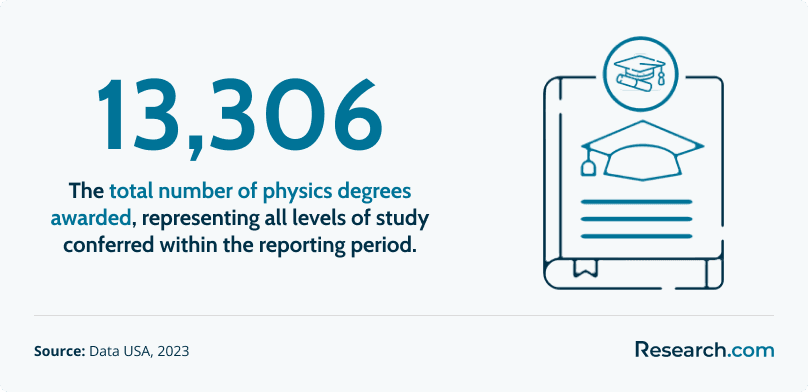
In fact, many schools now offer accelerated online physics degree programs designed for students who want to finish more quickly. This flexibility is a key reason why 13,306 physics degrees were awarded recently, proving it is a popular and achievable goal.
How does an online bachelor’s degree in physics compare to an on-campus program?
An accredited online degree is the same credential as one earned on campus, but the student experience is different. The best format for you depends entirely on your learning style, budget, and career goals.
Online Bachelor's in Physics Programs
The biggest advantage of an online physics degree is flexibility. You can complete coursework from anywhere, fitting your studies around a job or other responsibilities. This format is ideal for self-motivated students who are comfortable with digital learning tools. With online learning growing at a rate of 9.1% annually, it has become a widely accepted and respected educational pathway.
On-Campus Bachelor's in Physics Programs
On-campus programs offer a traditional college experience with direct, in-person access to professors, labs, and classmates. The structured schedule can be beneficial for students who thrive on routine and face-to-face interaction. This environment provides more opportunities for spontaneous collaboration and immediate use of campus resources like libraries and student centers.
What is the average cost of an online bachelor’s degree in physics?
The average cost of an online bachelor's degree in physics is typically between $58,443 and $67,685 for the entire program. However, the full range can vary widely, from as low as $14,000 to over $161,000. These figures depend heavily on whether the institution is public or private and if you qualify for in-state tuition rates.
When you evaluate this cost, it's helpful to think about your future earnings in terms of total compensation, not just salary. Total compensation includes your base pay plus the value of benefits like healthcare, retirement contributions, and paid time off. These benefits add significant value, making the initial investment in your degree a powerful engine for your long-term financial health. If you’re considering further education, understanding the difference between master's and graduate programs can help you plan your academic and financial path more effectively.
What are the financial aid options for students enrolling in an online bachelor’s degree in physics?
Most students have access to financial aid to help pay for their degree. You should explore every available option to make your education as affordable as possible.
- Federal Grants: Pell Grants are a common form of need-based aid from the government that you do not have to repay.
- Federal Loans: Stafford loans are accessible government borrowing options that you repay over time, often with flexible terms.
- Scholarships: These are merit-based awards from universities or private organizations given for academic or other achievements.
- Work-Study Programs: These programs offer part-time jobs to students with financial need to help cover education costs.
- The Free Application for Federal Student Aid (FAFSA): Completing the FAFSA is the single most important step, as 55% of undergraduates receive federal aid after submitting this form for their online bachelor's degree in physics.
For students planning their coursework load, understanding what is upper division and lower division classes can also help in balancing general education and advanced-level subjects efficiently.
What are the prerequisites for enrolling in an online bachelor’s degree in physics?
Most programs require a solid high school academic record, particularly in math and science, along with some standard application documents. The specific requirements can vary, but they generally follow a clear pattern.
- High School Diploma or GED: This is the foundational requirement for admission into any bachelor's program.
- Minimum GPA: Many universities look for a GPA of 2.5 or higher, though competitive programs may have stricter standards.
- Required Coursework: You will need strong grades in subjects like calculus, trigonometry, physics, and chemistry.
- Standardized Test Scores: Some universities require SAT or ACT scores, but many have adopted test-optional policies.
- Transfer Credits: Starting at a community college is a common and cost-effective strategy, with 13% of physics graduates beginning their studies this way.
If you plan to continue to graduate school later, learning about the difference between Master of Science and Arts can help you choose the right academic path for your future goals.
As you plan your path, it's helpful to know that the bachelor's degree is the most common credential for entry into the field, setting a clear and achievable goal for your education.
What courses are typically in an online bachelor’s degree in physics?
The curriculum in a physics program is designed to provide a deep foundation in the fundamental principles that govern the universe. These courses build the powerful analytical and problem-solving skills that are valued in many industries.
- Classical Mechanics: This course covers the study of motion, force, and energy, forming the bedrock of physics and engineering principles.
- Electromagnetism: Here, you will explore the intricate relationship between electric and magnetic fields, which is essential for electronics and communications.
- Quantum Mechanics: This area delves into the principles governing matter and energy at the atomic and subatomic levels, key to modern technology.
- Thermodynamics: This is the study of heat, work, and energy, with direct applications in engineering, materials science, and climate studies.
- Laboratory Methods: Through virtual labs, you will focus on experimental techniques and data analysis, building skills that translate to surprising fields like radiology and patient care, as seen in many applied sciences online programs.
What types of specializations are available in online bachelor’s degree in physics programs?
Specializations allow you to focus your studies on a specific area of physics that aligns with your career interests. This deeper dive helps you develop expertise and can position you for specialized roles or advanced studies after graduation.
- Astrophysics: This specialization focuses on the physics of celestial objects, from planets and stars to galaxies and the universe itself.
- Computational Physics: You will learn to use numerical analysis and computer modeling to solve complex physics problems that cannot be tackled analytically.
- Biophysics: This area applies the principles of physics to understand biological systems, bridging the gap between the physical and life sciences.
- Condensed Matter Physics: This is the study of the macroscopic and microscopic physical properties of materials, such as semiconductors and superconductors.
- Materials Science: This specialization explores the properties of matter and the discovery and design of new materials for various applications. If you’re curious about how focused study paths work in other fields, reviewing what should an early childhood education program be like offers insight into how specialized coursework prepares students for professional roles.
Choosing a specialization is also a strategic way to prepare for graduate school. Many graduates use it as a bridge to advanced degrees, with 20% pursuing master's programs outside of physics and another 15% entering engineering fields. It's a way to customize your education, similar to how students explore other online natural sciences degrees to find the perfect fit for their goals.
How to Choose the Best Online Bachelor’s Degree in Physics
Selecting the right program is about finding the one that best fits your personal and professional goals. A systematic approach can help you evaluate your options and make a confident choice.
- Check for Accreditation: Ensure any program you consider is regionally accredited, as this is the single most important indicator of academic quality and degree value.
- Evaluate the Curriculum: Look for a curriculum with courses and specializations that align with your specific career interests and future plans.
- Investigate Faculty: Research the credentials and experience of the faculty, paying close attention to their background in online teaching and their areas of expertise.
- Assess Technology and Support: A modern, intuitive learning platform and strong student support services are critical for success as an online learner.
- Compare Costs and Aid: Look beyond the sticker price and compare the net cost of each program after factoring in any financial aid offers you receive.
What career paths are available for graduates of an online bachelor’s degree in physics?
An online bachelor's degree in physics prepares you for a wide range of technical and analytical roles where you can apply your problem-solving skills. Many graduates find success in engineering fields, with 27% of them moving directly into these high-demand positions.
1. Data Analyst
Data analysts use their quantitative skills to interpret complex datasets and provide actionable insights for business decisions. They are responsible for cleaning, modeling, and visualizing data to identify trends and solve problems.
Median salary: $97,000 per year.
2. Research Technician
Research technicians work in laboratory settings, assisting scientists with experiments, data collection, and analysis. They are crucial for maintaining lab equipment and ensuring the accuracy of research findings.
Median salary: $58,000 per year.
3. Software Developer
Software developers design, build, and maintain the applications that run on computers and other devices. Their logical thinking skills allow them to write efficient code and develop solutions to technical challenges.
Median salary: $112,000 per year.
4. Aerospace Engineer
Aerospace engineers design and test aircraft, spacecraft, satellites, and missiles by applying principles of physics and mechanics. Many find that an online aerospace engineering degree is a natural next step to specialize in this exciting field.
Median salary: $122,000 per year.
5. Systems Analyst
Systems analysts study an organization's computer systems and procedures to improve efficiency and workflow. They act as a bridge between the business and IT departments to implement technical solutions.
Median salary: $102,000 per year.
These roles are found across many different sectors, from professional and scientific services to manufacturing, showing the broad applicability of a physics education in today's economy.
What is the job market for graduates of an online bachelor’s degree in physics?
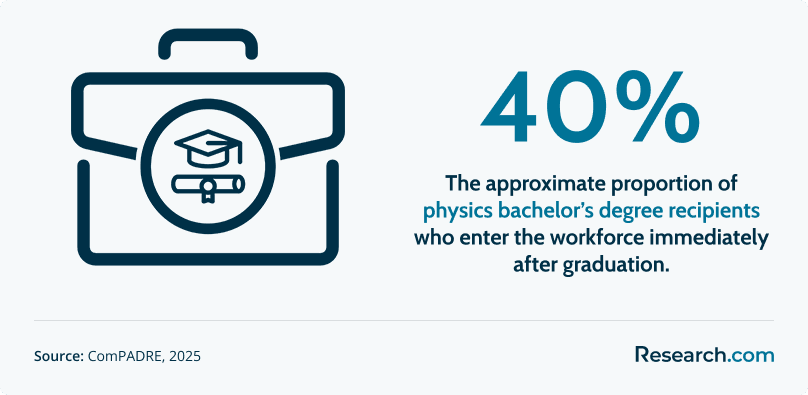
The job market for physics graduates is stable and offers a direct path to employment. In fact, 40% of physics bachelor's recipients enter the workforce immediately after graduation, proving there is a strong demand for their skills right out of college. The overall employment for physicists is projected to grow by 4% over the next decade, which is on par with the average for all occupations, ensuring a consistent need for qualified professionals.
Beyond the numbers, it's helpful to understand the community you are joining. The physics profession is diverse, with an average age of 44 among employed physicists. While men currently make up 80% of the workforce, there is a growing and active effort to increase diversity and inclusion within the field. This creates a welcoming environment for new graduates who are ready to bring their unique perspectives and analytical skills to the profession.
Here’s What Graduates Have to Say about Their Online Bachelor’s Degree in Physics
- Orly: "I went into physics loving the big ideas, but I had no clue what kind of job I could get. This program showed me how my skills in modeling applied directly to data science, which I never would have considered. Being able to study online meant I could also keep my part-time job, so I graduated with a degree and practical experience. It all just clicked into place for me."
- Zoey: "I was skeptical about how a science degree would work online, especially the labs. I thought they would feel like a simulation, but the virtual lab kits and software were incredibly detailed and rigorous. We learned the same principles and techniques, and it prepared me perfectly for the technical side of my quality assurance role. I felt confident from day one on the job."
- Kyly: "I was working as a lab technician when I enrolled, hoping that this degree would help me advance. Halfway through my program, I was able to apply what I learned in my electromagnetism course to a project at work. My manager noticed, and I was promoted to a junior engineering role six months before I even graduated from college. The investment paid off immediately."
Key Findings
- An online bachelor's degree in physics offers a direct path to employment, with 40% of graduates entering the workforce immediately after earning their degree.
- The degree demonstrates a strong return on investment, as graduates command an average salary of $108,077, reflecting the high value employers place on these analytical skills.
- Online learning is a rapidly growing and accepted educational format, with a 9.1% annual growth rate that confirms its legitimacy among students and employers.
- Many graduates successfully complete this degree, with over 13,300 physics bachelor's degrees awarded in the most recent academic year alone.
- The curriculum provides a strong foundation for high-demand technical careers, with 27% of graduates securing roles in the engineering sector.
- The path to a physics degree is flexible, with 13% of graduates starting their education at a community college before transferring to a four-year program.
References:
- American Association for the Advancement of Science. (2022, October 19). Wherefore art thou, physics teacher? Retrieved from AAAS-ARISE
- American Institute of Physics. (2022). Physics bachelor’s: Two-year colleges as a starting point. Retrieved from AIP
- American Institute of Physics. (2023). Physics bachelor’s holders find jobs in many fields. Physics Today, 78(4), 23. Retrieved from Physics Today
- Bureau of Labor Statistics. (2023). Occupational Employment and Wages, May 2023: Physicists (19-2012). Retrieved from BLS OES
- Bureau of Labor Statistics. (2024). Physicists and astronomers. Occupational Outlook Handbook. Retrieved from BLS OOH
- Compadre.org. (n.d.). Physics career facts. Retrieved from Compadre
- Data USA. (2024). Physics (CIP code: 40.0801). Retrieved from Data USA
- Devlin Peck. (2024). Online learning statistics: 2024 report. Retrieved from Devlin Peck
- National Center for Education Statistics. (n.d.). National Postsecondary Student Aid Study (NPSAS). Retrieved from NCES
- Salary.com. (2024). Physicist salary. Retrieved from Salary.com
- Vision Monday. (2024). Distance learning is on the rise among undergraduates. Retrieved from Vision Monday
- Zippia. (2024). Physicist jobs, trends, and demographics. Retrieved from Zippia
Other Things You Need To Know About Online Bachelor's Degrees in Physics
In 2027, online Bachelor's degrees in Physics incorporate virtual labs and simulation software to emulate real-world experiments. They often partner with local institutions to allow students to conduct physical experiments, ensuring graduates gain hands-on experience alongside their theoretical studies.
The top online Bachelor’s degrees in Physics for 2027 feature programs from Arizona State University, Oregon State University, and University of Florida. These institutions provide comprehensive curricula, expert faculty, and robust student support to prepare graduates for further study or immediate career opportunities.
Students need a reliable internet connection, a computer with updated operating systems, and software like Python or MATLAB. Some programs might require virtual lab kits to simulate experiments, ensuring a comprehensive online physics education in 2027.
An online physics program should ideally be accredited by a recognized accrediting body such as the Higher Learning Commission (HLC) or the Middle States Commission on Higher Education (MSCHE). Accreditation ensures that the program meets high academic and professional standards, offering quality education and recognition by employers and other educational institutions.


