2027 Master of Arts vs Master of Science: Explaining the Difference

Co-Founder and Chief Data Scientist
Choosing between a Master of Arts (MA) and a Master of Science (MS) can feel overwhelming, especially when both degrees open doors to advanced knowledge and career growth. While the Master of Arts often emphasizes critical thinking, creativity, and broader perspectives in fields like humanities and social sciences, the Master of Science usually focuses on technical expertise, data-driven analysis, and research in science or professional disciplines. The differences go beyond subject matter—they also shape the skills you’ll build, the opportunities you’ll pursue, and how employers may view your qualifications.
This article breaks down the key distinctions between a Master of Arts and a Master of Science, from coursework and career impact to salary potential and long-term return on investment. In reading this, you will have the clarity you need to choose the path that best aligns with your goals.
What are the benefits of getting a Master of Arts vs Master of Science?
- A Master of Arts (MA) often leads to roles in education, communications, counseling, public policy, and management, while a Master of Science (MS) prepares graduates for technical and research-focused careers in fields like data science, engineering, healthcare, and finance.
- Professionals with an MA typically earn $60,000–$80,000 annually, especially in leadership or administrative positions, whereas MS graduates in STEM-related fields often see higher earnings, ranging from $75,000–$100,000 annually.
- Both MA and MS degrees are widely available online, allowing students to balance work and study. Online MAs emphasize accessibility for professionals in analytical and leadership tracks, while online MS programs focus on delivering advanced technical skills remotely.
What can I expect from a Master of Arts vs Master of Science degree?
A Master of Arts (MA) and a Master of Science (MS) are two of the most common graduate degrees, each offering distinct strengths depending on your career goals. An MA typically focuses on the humanities, social sciences, and fields that emphasize critical thinking, communication, and analytical skills. In contrast, an MS leans toward science, technology, engineering, mathematics, and research-driven disciplines, where data analysis and technical expertise are central.
While both degrees signal advanced knowledge and open doors to higher-level opportunities, they differ in coursework, teaching methods, and long-term career outcomes. For example, an MA may lead to leadership roles in education, communications, or public service, whereas an MS often results in specialized roles in healthcare, finance, or technology. Understanding these differences helps you choose the program that aligns best with your professional aspirations and personal interests.
Where can I work with a Master of Arts vs Master of Science?
Graduates with a Master of Arts (MA) often find careers in industries that value communication, leadership, and cultural understanding. Common fields include education, counseling, public administration, media, and nonprofit organizations. Many MA graduates work in schools, government agencies, research institutes, and consulting firms, where their ability to analyze complex issues and present solutions is highly valued. Those in communications and public relations often work for corporations, marketing agencies, or advocacy groups, while others may pursue opportunities in international relations or policy development. These careers highlight the MA’s focus on people-centered and analytical skills.
By contrast, a Master of Science (MS) is highly sought after in industries that prioritize data-driven decision-making and technical expertise. Graduates often work in healthcare systems, pharmaceutical companies, technology firms, engineering consultancies, and financial institutions. Employers range from hospitals and biotech labs to global corporations and start-ups that rely on innovation and applied research. MS graduates may also enter roles in data analytics, IT, or scientific research, where their specialized training positions them for technical leadership. This path underscores the MS’s emphasis on problem-solving and research application in professional settings.
How much can I make with a Master of Arts vs Master of Science?
Earnings for graduates with a Master of Arts (MA) can vary widely depending on the field, but many fall in the $60,000 to $80,000 per year range. For example, education administrators with an MA earn a median salary of around $74,000, while counselors typically earn between $55,000 and $65,000.
Communications professionals and public policy analysts with advanced training often see earnings closer to $70,000 to $85,000. In general, MA salaries reflect steady growth over time, with opportunities to move into leadership or executive roles that can push earnings into six figures.
By contrast, graduates with a Master of Science (MS) often command higher salaries, especially in technical or STEM-focused industries. Data scientists and IT managers with an MS can earn between $95,000 and $120,000 annually, while engineers with advanced degrees average around $100,000.
Healthcare-related MS degrees, such as nursing or pharmaceutical sciences, can lead to salaries ranging from $85,000 to $110,000. Across fields, MS graduates tend to have higher starting salaries and stronger long-term earning potential due to demand for specialized technical expertise.
Affordable Online Degree Programs in 2027
Many students are looking for a cost-effective and fast bachelor’s degree to launch their careers quickly. To support that goal, we’ve compiled a list of ten programs worth considering. Here are the options:
1. Management Information Systems
A degree in Management Information Systems (MIS) prepares students to bridge the gap between business and technology. Students learn to design, implement, and manage information systems that support organizational goals. Online programs in MIS often include courses in database management, cybersecurity, systems analysis, and project management. Graduates are well-positioned for careers as IT managers, systems analysts, or business technology consultants. Many accredited programs offer flexible schedules and access to virtual labs to gain hands-on experience.
2. Social Work
An online degree in Social Work equips students to support communities and individuals in need. Coursework typically covers human behavior, social policy, counseling techniques, and ethics. Many programs include supervised field placements that can be completed locally, ensuring practical experience. Graduates may pursue roles in healthcare, schools, government agencies, or nonprofit organizations. Accredited programs ensure eligibility for licensure, which is crucial for professional practice.
3. Business Administration
Online Business Administration programs provide a broad foundation in management, finance, marketing, and operations. Students develop strategic thinking and leadership skills applicable across industries. Courses often include case studies, team projects, and real-world simulations. Graduates can pursue management roles in corporate, nonprofit, or entrepreneurial settings. Accredited programs may also offer networking opportunities and career services for online learners.
4. Special Education
A Special Education online program prepares educators to work with students with diverse learning needs. Students learn about individualized education plans, teaching strategies, and behavior management techniques. Programs often include field experiences in local schools or virtual classrooms. Graduates are equipped to support learners in public and private educational settings. Accreditation ensures the program meets state licensure requirements for teachers.
5. Economics
Online Economics programs provide students with analytical tools to study markets, policy, and financial systems. Coursework covers microeconomics, macroeconomics, statistics, and econometrics. Many programs emphasize practical applications, including data analysis and policy evaluation. Graduates can pursue careers in finance, government, research, or consulting. Flexible online options make it accessible to working students or those balancing other commitments.
6. Nursing
Online nursing programs, particularly RN-to-BSN or accelerated options, allow students to advance their careers while balancing work. Coursework combines health sciences, patient care, and leadership training. Many programs include clinical practicum hours that can be completed locally. Graduates are prepared for bedside nursing, management, or specialty certifications. Accredited programs ensure eligibility for licensure and professional growth.
7. Accounting
An online Accounting degree equips students with skills in financial reporting, auditing, taxation, and management accounting. Programs often integrate accounting software and case studies to develop real-world competence. Graduates are prepared for careers in corporate finance, public accounting, or government roles. Many programs align with CPA requirements to facilitate licensure. Online delivery provides flexibility for working professionals or students with other obligations.
8. Management
Online Management programs focus on leadership, strategic planning, and organizational behavior. Students learn to manage teams, projects, and operations effectively. Coursework often includes business ethics, human resources, and decision-making simulations. Graduates are prepared for managerial roles in a variety of industries. Accredited programs often provide career support and networking opportunities for online learners.
9. Computer Science
Online Computer Science programs teach students programming, algorithms, software development, and data structures. Many programs also cover emerging fields like artificial intelligence, cybersecurity, and cloud computing. Students often complete projects that demonstrate practical problem-solving skills. Graduates are prepared for careers in software engineering, data science, or IT consulting. Accredited programs ensure the curriculum meets industry standards and supports future certifications.
10. Healthcare Administration
An online Healthcare Administration degree prepares students to manage healthcare organizations, policies, and resources. Courses cover healthcare law, finance, quality management, and operations. Programs often include case studies and capstone projects that simulate real-world healthcare management scenarios. Graduates can pursue leadership roles in hospitals, clinics, insurance companies, or public health organizations. Accreditation ensures programs meet industry standards and support professional advancement.
- What is the main difference between a Master of Arts (MA) and a Master of Science (MS) degree? MA vs. MS
- How do MA vs MS degrees differ in focus and coursework? Coursework
- What are the standard fields of study associated with a typical MA program versus an MS program? Fields of Study
- What is the average credit load difference between a full-time MA and MS program? Credit Load
- Which degree, MA or MS, generally offers more part-time and online learning options? Which degree, MA or MS, generally offers more part-time and online learning options?
- When a university offers both MA and MS options in a field, how do I choose the right one? Selection Tips
- What are the best funding and scholarship opportunities for graduate students in MA and MS programs? Financial Aid
- How does choosing MA vs MS affect career growth in 10 years? Job Outlook
- How do recruitment managers view the MA vs MS designation on a candidate's resume? How do recruitment managers view the MA vs MS designation on a candidate's resume?
- Which degree is better for leadership and management roles? Which degree is better for leadership and management roles?
- How can online learning impact the effectiveness of MA vs MS programs? How can online learning impact the effectiveness of MA vs MS programs?
What is the main difference between a Master of Arts (MA) and a Master of Science (MS) degree?
The fundamental difference between a Master of Arts (MA) and a Master of Science (MS) lies in their academic focus and approach to learning. While both are valuable, rigorous graduate-level degrees, they represent distinct educational philosophies.
A Master of Arts (MA) is usually broader, emphasizing the humanities, social sciences, communication, education, and the arts. MA programs often focus on theoretical knowledge, critical analysis, and qualitative research. Coursework may be more discussion- or essay-based and may not always require a thesis.
A Master of Science (MS) is more specialized, emphasizing STEM fields, technical disciplines, psychology, economics, and certain social sciences. MS programs generally stress quantitative skills, data analysis, and scientific or research-based methods. Many require a thesis, lab work, or applied research projects.
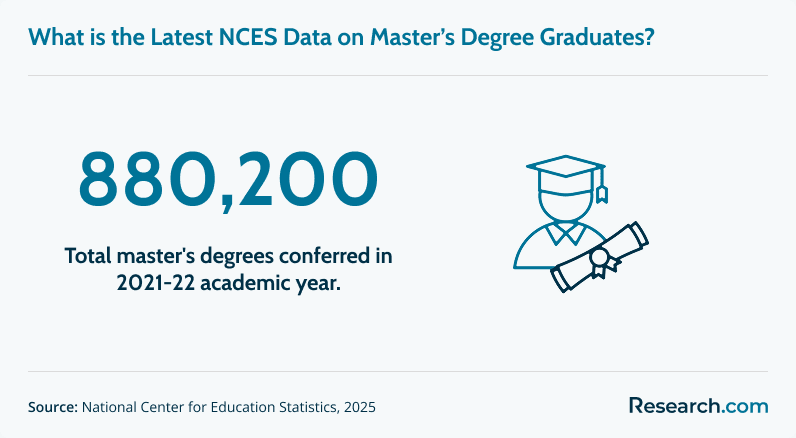
Data from NCES 2025 indicates a total of 880,200 master's degrees conferred in the 2021-22 academic year, as shown below.
How do MA vs MS degrees differ in focus and coursework?
An MA degree emphasizes theory, critical thinking, and broad perspectives—ideal for fields like education, communications, and the humanities. An MS degree, on the other hand, highlights quantitative skills, technical expertise, and research-based learning. Master of Science degree is best suited for science, engineering, and data-driven careers. Some students even consider pursuing dual masters degrees to expand their expertise across multiple fields. Choosing between an MA vs MS depends on your interests, learning style, and long-term career goals.
| Master of Arts | Master of Science | |
| Primary Focus | Theoretical Understanding | Technical Application |
| Core Disciplines | Humanities, Social Sciences, Fine Arts, and Liberal Arts (e.g., History, Literature, Philosophy, Communications). | Scientific, Technical, and Quantitative Fields (e.g., Engineering, Computer Science, Data Analysis, Biology, Finance). |
| Methodology | Emphasizes critical thinking, theoretical discussion, qualitative research, and written communication. | Emphasizes quantitative analysis, hands-on lab work, technical skills, and applied research. |
| Coursework | Tends to be broader, discussion-based, and may offer more flexibility and elective choices. | Tends to be more structured, prescriptive, and focused on specialized technical, mathematical, or scientific concepts. |
| Final Project | Often culminates in a thesis, comprehensive exam, or a written, original scholarly work. | Often culminates in a research thesis (more common), laboratory work, or a practical capstone project demonstrating specialized skills. |
What are the standard fields of study associated with a typical MA program versus an MS program?
The standard fields of study for an MA program generally focus on the humanities, social sciences, and fine arts, which emphasize theoretical knowledge, critical analysis, and communication. An MS program typically focuses on STEM (Science, Technology, Engineering, and Mathematics) disciplines and technical, data-driven fields.
Here are the typical fields of study associated with each degree:
Master of Arts (MA) Fields of Study
Master of Arts (MA) programs are rooted in the liberal arts tradition and emphasize qualitative research, discussion, and broad-based critical thinking.
| Discipline Category | Common MA Fields |
| Humanities | English, History, Literature, Philosophy, Religious Studies, Linguistics. |
| Social Sciences | Sociology, Political Science, Anthropology, International Relations, Public Administration, Criminology. |
| Communication | Communication Studies, Journalism, Media Studies, Public Relations, Creative Writing. |
| Arts & Education | Art History, Music, Theatre, Master of Arts in Teaching (MAT), or Education (often focusing on theory or curriculum design). |
| Interdisciplinary | Liberal Studies, some Counseling programs (with a theoretical/qualitative focus). |
Master of Science (MS) Fields of Study
Master of Science (MS) programs are generally focused on specialized, technical, and quantitative fields that emphasize empirical research, data analysis, and practical application. For students exploring software development careers, understanding the difference between front end and back end developer roles can help align their technical skills with career paths and program selection.
| Discipline Category | Common MS Fields |
| STEM & Analytics | Computer Science, Data Science, Artificial Intelligence (AI), Statistics, Mathematics, Physics, Chemistry, Biology |
| Engineering | Electrical Engineering, Civil Engineering, Mechanical Engineering, Environmental Engineering. |
| Business & Finance | Accounting, Finance, Business Analytics, Management (with a quantitative focus), Supply Chain Management, Economics. |
| Health & Allied Fields | Nursing (MSN), Healthcare Administration, Occupational Therapy, Public Health (often MPH), some Psychology (with a clinical/research focus). |
It's important to note that the distinction is not absolute, and some fields may offer both an MA and an MS, where the difference lies in the specific curriculum focus:
- Psychology: An MA might focus on theoretical, counseling, or human development aspects, while an MS might focus on research methods, neuroscience, or a specific clinical, quantifiable track.
- Economics/Finance: An MA might be more theoretical or historical, whereas an MS would be heavily focused on econometrics, financial modeling, and quantitative analysis.
For students seeking flexibility and quicker completion, there are also one year masters programs online that can provide an accelerated path to graduation.
What is the average credit load difference between a full-time MA and MS program?
The credit load difference between a full-time Master of Arts (MA) and Master of Science (MS) program is generally minimal or non-existent at the full-time semester level. The main difference tends to be in the total number of credits required for the entire degree, depending on the field of study.
Full-Time Semester Credit Load
For both MA and MS programs, the standard full-time credit load in a fall or spring semester is consistently:
- 9 credit hours (3 courses): This is the typical course load that defines a student as "full-time" for financial aid and academic purposes in most U.S. graduate programs.
- 12 credit hours (4 courses): This is often the maximum load allowed per semester without special permission, but it is considered a very heavy load for a graduate student.
As you can see, there is no average difference in the standard full-time semester credit load simply based on the MA vs. MS designation. Students who prefer lighter workloads may also consider easy masters degrees online, which offer more flexible options to balance study with other commitments.
Total Program Credit Load
The distinction becomes more noticeable in the total credits required to graduate, which is primarily driven by the discipline and professional requirements, rather than the MA vs. MS label itself:
| Degree Type | Typical Total Credit Range | Examples of Fields at the Higher End |
| MA (Arts, Humanities, Social Sciences) | 30 to 45 credits | Higher end (40-45+): Education, some Counseling programs, and fields that require extensive practicums or fieldwork (often licensing-focused). |
| MS (STEM, Technical, Professional) | 30 to 60+ credits | Higher end (45-60+): Engineering, Nursing (MSN), Computer Science, and highly specialized technical or clinical fields.Export to Sheets |
In general, most programs fall between 30 and 36 credits. However, professional degrees (which are often MS or specialized master's like MBA, M.Ed., or MSN) that require a substantial amount of mandatory fieldwork, clinical hours, or highly specialized technical courses tend to push the total credit requirement higher, into the 45 to 60+ range.
Which degree, MA or MS, generally offers more part-time and online learning options?
While both offer many flexible options, MA programs in the social sciences, humanities, and education historically and broadly have been among the most adaptable to part-time and fully online formats. However, MS programs in technical and business-related fields are rapidly catching up and, in some cases, may now offer even more pure online options—including some of the fastest masters degree programs available today.
1. General Leaning: Master of Arts (MA)
Master of Arts programs often lend themselves to remote learning and part-time study due to their focus on:
- Humanities, Education, and Social Sciences: Fields like English, History, Communications, and many types of Education (especially those not requiring immediate licensure or clinical hours) are heavily text-based, discussion-based, and research/writing-intensive. This content translates very well to online discussion boards, video lectures, and individual written assignments.
- Target Audience: MA programs often target current educators, working professionals in communications or non-profits, or career changers, all of whom typically need maximum flexibility.
Common Flexible MA Programs:
- Education (M.A.T., M.Ed.): Very commonly offered online and part-time for working teachers.
- Communication / Public Relations: Heavily theoretical and case-study based.
- Psychology (non-clinical): Programs focused on theory, organizational, or general psychology.
2. The Rise of Master of Science (MS)
The line is blurring because many fields traditionally under the "Science" banner have become highly suitable for online/part-time delivery, often due to their purely digital nature.
- Computer Science and Data: These are highly technical fields, but the actual work (coding, analysis, modeling) is almost entirely computer-based and can be done remotely. Consequently, many of the largest, most successful online master's programs are MS degrees (e.g., MS in Computer Science, MS in Data Analytics).
- Business/Management: Although often resulting in an MBA, many specialized business master's degrees (e.g., MS in Finance, MS in Supply Chain Management) are entirely online to accommodate working professionals.
The latest data from the National Center for Education Statistics (NCES) shows how master’s degrees were distributed across fields in the 2021–22 academic year. Business was the most popular area of study, accounting for 23.4% of all master’s degrees conferred.
When a university offers both MA and MS options in a field, how do I choose the right one?
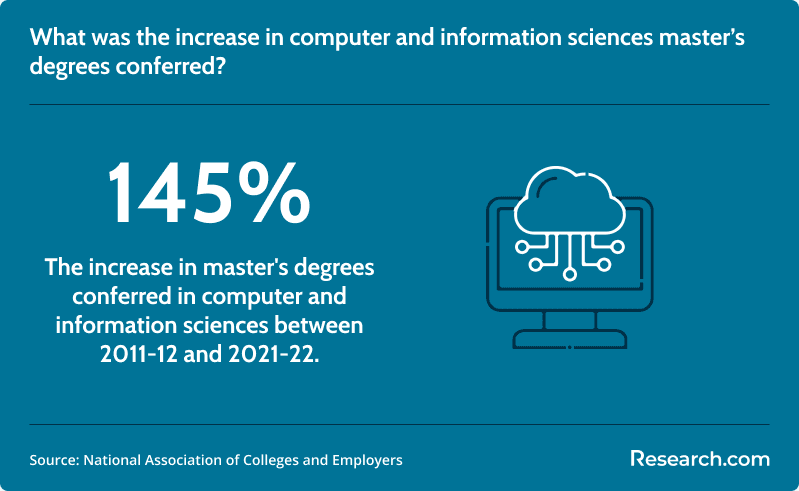
When a university offers both a Master of Arts (MA) and a Master of Science (MS) in the same discipline, students often wonder how to decide between the two. Between 2011–12 and 2021–22, the number of master’s degrees in computer and information sciences rose by 145%, highlighting the rapid expansion of tech-focused careers. However, the choice usually depends on your career goals, learning style, and long-term academic or professional plans. or students in counseling or education fields, understanding CACREP vs COAMFTE accreditation can also guide program selection and ensure that credentials meet industry standards.
Consider Your Career Path
If your career interests lean toward teaching, counseling, communication, leadership, or public service, the MA is often the better fit. These programs emphasize theory and real-world application, preparing graduates for roles that require strong analytical and communication skills. On the other hand, if you are aiming for careers that are technical, research-driven, or STEM-oriented, the MS option is usually more appropriate. An MS can also give you an advantage if you plan to pursue a PhD or enter a research-intensive field, especially in areas tied to high paying master's degrees.
Think About Learning Style
Your preferred way of learning can also guide your decision. MA programs tend to be discussion-based and focus on essay writing, theoretical frameworks, and qualitative research. MS programs, by contrast, rely heavily on lab work, statistical analysis, experiments, and other forms of quantitative research. If you enjoy abstract thinking and theory, the MA may suit you best; if you prefer data, experiments, and problem-solving, the MS might be the better path. Similarly, understanding whether is virtual therapy as effective as in person can help psychology and counseling students decide the best modality for learning and applying clinical skills.
Graduate School and Doctoral Preparation
Both MA and MS degrees can serve as a springboard to doctoral programs, but the emphasis can differ. An MS is often the stronger choice if you are preparing for a research-heavy PhD, since it provides a foundation in data analysis and scientific methods. An MA, however, may be better aligned with applied doctorates or professional fields such as education, social work, or leadership studies, where theory and practice are more important than lab-based research.
Ask About Program Structure
Finally, it’s important to look closely at how each program is structured. Some MS programs require a thesis, capstone project, or lab-based research component, signaling their focus on academic and scientific inquiry. MA programs, in contrast, may include more electives, applied projects, or internships, which highlight professional practice and flexibility. Comparing these structures can help clarify which option aligns with your career direction and preferred way of learning. For those in nursing, pathways from a non nursing degree to BSN provide additional guidance on bridging education into clinical practice.
What are the best funding and scholarship opportunities for graduate students in MA and MS programs?
- University-based scholarships, assistantships & fellowships: Many graduate programs offer teaching assistantships (TA) or research assistantships (RA). These often come with tuition waivers or reductions, plus a stipend. Some universities have merit-based scholarships for top applicants in specific colleges or departments. For example, Drexel’s graduate programs offer merit scholarships automatically upon application.
- External Fellowships and Grants: Major grant-making bodies often support MS students, especially in STEM, with stipends + tuition support. The U.S. NSF GRFP is a classic example. Fellowships aimed at social sciences or humanities also exist but are more competitive, especially for MA students.
- Fully-funded graduate programs: Some departments or universities offer fully funded MA or MS programs, especially when the program includes a strong research component. This could include full tuition, stipend, and sometimes additional allowances.
- International / Government Scholarships: For students outside the country of their chosen university: many governments and international organizations offer scholarships for graduate study abroad.
- Field-specific / Discipline-specific Scholarships: If you are in engineering, economics, modern languages, etc., there are scholarship funds or grants specific to that field. These may come from professional associations, foundations, or even corporate sponsors.
Exploring funding options is a key part of planning for your masters degree, as they can significantly reduce the cost of graduate education and make advanced study more accessible.
Among master's degree completions in 2024, 6,342 completions were in engineering while there were 3,361 in psychology.
How does choosing MA vs MS affect career growth in 10 years?
Career Growth with a Master of Arts (MA)
In the first few years, MA graduates often find roles in education, communications, policy, counseling, leadership, and creative industries. These careers usually value soft skills, critical thinking, and theoretical expertise. Over 10 years, MA holders can expect steady growth into mid- to senior-level management, administrative, or leadership roles, especially if they combine their degree with professional certifications or additional training. While salary growth may be slower than in technical STEM roles, MAs can offer greater career versatility—allowing graduates to pivot into adjacent fields like public relations, human resources, or nonprofit leadership.
Career Growth with a Master of Science (MS)
MS graduates typically start in technical, analytical, or research-driven roles such as engineering, data science, healthcare, or IT. Because these fields are high-demand and fast-growing, career trajectories are often sharper in terms of salary and advancement opportunities. After 10 years, MS holders are well-positioned for senior technical, research, or leadership roles, with many moving into specialized consulting or management. In industries like tech, finance, and healthcare, MS credentials often translate into higher earning potential and faster upward mobility compared to many MA paths.
How do recruitment managers view the MA vs MS designation on a candidate's resume?
Recruitment managers generally view MA vs MS designations through the lens of the skills and value signals each degree represents, rather than the title itself.
- Master of Arts (MA): Employers often associate an MA with strong communication, critical thinking, leadership, and analytical skills. In fields like education, communications, policy, and the humanities, an MA signals that the candidate is well-prepared for roles requiring strategy, interpretation, and people management. However, outside these areas, some recruiters may see the MA as less technical or less specialized.
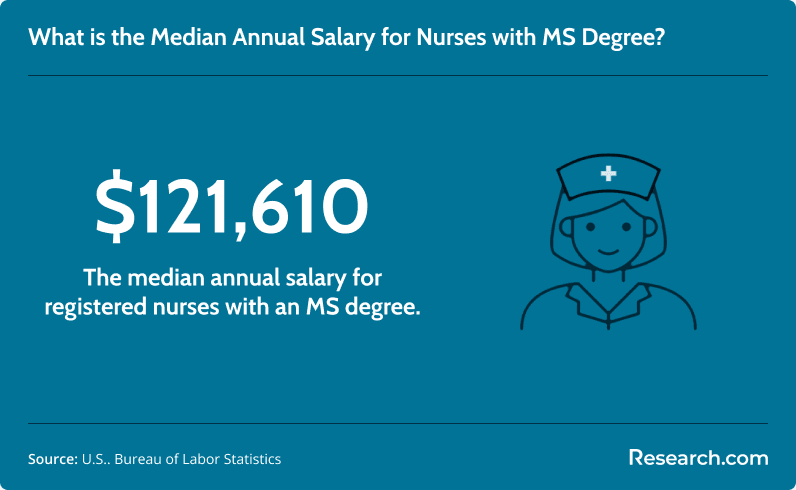
- Master of Science (MS): Recruiters usually perceive an MS as a mark of technical expertise, quantitative ability, and research-driven training. In industries like technology, healthcare, finance, and data analytics, an MS degree signals job-ready, specialized skills that often align with high-demand roles. Many hiring managers in STEM-heavy industries prefer MS graduates when technical proficiency is essential. Health professions accounted for 16.7% of all master’s degrees conferred in 2023, with MSN graduates earning an average median annual salary of $121,610.
Which degree is better for leadership and management roles?
If your long-term goal is leadership or management, an MA often provides a slight edge. These programs usually emphasize communication, organizational theory, critical thinking, and people-focused skills—qualities that align well with supervisory and executive roles. These programs may also include coursework in policy, strategy, or administration, which can prepare graduates for managing teams, leading projects, or shaping organizational culture.
That said, an MS can also open doors to leadership, particularly in industries where technical expertise drives authority—such as healthcare, engineering, IT, or finance. In these cases, leadership roles may require someone with advanced technical knowledge alongside management ability.
In short, an MA tends to be better if you’re aiming for leadership in education, nonprofits, government, or business administration. An MS is stronger if you want to lead within technical, scientific, or data-driven fields.
The Best Blended Options
For roles that are purely focused on high-level management across all industries, there are often specialized degrees that are neither a pure MA nor a pure MS, but combine elements of both:
- Master of Business Administration (MBA): This is the gold standard for general management and executive leadership. It covers finance, marketing, operations, and leadership and is generally considered the best path to the C-suite
- Master of Public Administration (MPA): Best for leadership and management roles in government and non-profit sectors.
- Master of Management (MM): A more general, coursework-heavy option often favored by recent graduates who want foundational business skills.
Here's What Professionals Have to Say About Their MA and MS Degrees
- Elena: "My MA program gave me the chance to think critically about cultural and social issues while strengthening my communication skills. The coursework encouraged creativity and analysis, which I now apply daily in my work in public policy. It wasn’t just about earning a credential—it shaped how I see and impact the world. "
- Daniel: "Completing an MS program gave me the advanced technical skills employers are actively looking for. The emphasis on data and problem-solving helped me transition into a higher-paying role in the tech industry. It felt empowering to see my studies translate so quickly into career growth. "
- Maya: "What I valued most about pursuing my master’s degree was the mix of professional credibility and personal fulfillment. Whether MA or MS, the degree signaled to employers that I was serious about advancing and ready for leadership responsibilities. The journey was challenging, but it gave me a sense of pride I carry every day. "
How can online learning impact the effectiveness of MA vs MS programs?
Both MA and MS programs now offer robust online formats that deliver rigorous curricula and experiential learning through modern virtual platforms. High-quality online degrees emphasize interactive collaboration, comprehensive support services, and access to industry professionals, ensuring that distance learning can match traditional methods in academic rigor and career readiness. Institutions with accredited online programs streamline the transition for working professionals while maintaining the depth and quality required for long-term success.
Key Findings
- In 2024, master’s degree completions included 6,342 in engineering compared to 3,361 in psychology, showing the continued demand for technical fields over social sciences.
- Health professions accounted for 16.7% of all master’s degrees conferred, reflecting the strong growth of healthcare-related graduate education.
- Between 2011–12 and 2021–22, the number of master’s degrees in computer and information sciences rose by 145%, highlighting the rapid expansion of tech-focused careers.
- Business remained the most popular field, with 23.4% of all master’s degrees awarded in 2021–22, far outpacing other disciplines.
- In total, U.S. colleges and universities conferred 880,200 master’s degrees in 2021–22, according to the National Center for Education Statistics (NCES).
References:
- Education Dynamics. (2024). NCES data shows modern learners prioritizing career focused degrees.
- National Association of Colleges and Employers. (n.d.). Graduate outcomes — First-Destination (Class of 2023) [Interactive dashboard].
- National Association of Colleges and Employers. (n.d.). Graduate outcomes — Job Market.
- National Center for Education Statistics. (2023). Master’s degrees conferred by postsecondary institutions, by field of study: Selected academic years, 1970-71 through 2021-22 [Table 323.10]. In Digest of Education Statistics 2023.
- National Center for Education Statistics. (2023). Graduate degree fields [Indicator]. In Condition of Education.
- National Center for Education Statistics. (2023). Master’s degrees conferred by postsecondary institutions, by race/ethnicity and sex: Selected academic years, 1976-77 through 2021-22 [Table 323.20]. In Digest of Education Statistics 2023. Retrieved from
Other Things You Should Know About MA vs MS Degrees
In 2027, both MA and MS degrees can offer a positive ROI, but it varies by field. MS degrees in STEM fields may lead to higher initial salaries, while MAs can excel in arts and humanities with valuable skills. Consider field-specific demand and career goals.
Yes, master’s degrees are increasingly in demand as employers seek candidates with advanced knowledge and leadership potential. In fields like healthcare, education, data science, and business, a graduate degree is becoming a standard expectation. This trend reflects the growing complexity of industries that require specialized training.
In 2027, an MS degree generally offers better salary potential due to its emphasis on technical and scientific skills, which are often in higher demand. However, specific outcomes depend on the field of study and industry needs.