
2027 Graduate Certificate vs. Master’s Degree: Explaining the Difference

Co-Founder and Chief Data Scientist
Unsure whether to pursue a graduate certificate or commit to a master’s degree, professionals risk delaying their career growth and missing roles that increasingly demand advanced credentials. With more than 42% of employers in 2025 favoring candidates who hold specialized postgraduate training, the decision can no longer be postponed without consequence.
This article breaks down the core differences between graduate certificates and master’s degrees, highlighting timelines, costs, and career outcomes. Prepared by experts in career planning, it will guide readers toward the credential that best aligns with their goals—so they can act now, not later.
Key Benefits of Graduate Certificate vs. Master’s Degree
- Opens doors to specialized roles—graduate certificates often lead to niche technical or industry certifications, while master’s degrees qualify candidates for leadership and advanced professional positions
- Increases earning potential—graduate certificate holders can see targeted pay raises, while master’s degree graduates often earn $7,000 to $18,000 more annually than those with only a bachelor’s degree
- Strengthens career resilience—both credentials provide relevant skills, but certificates offer faster upskilling for immediate needs, and master’s degrees deliver deeper expertise for long-term advancement
Affordable Online Degree Programs in 2027
Many students are looking for a cost-effective and fast bachelor’s degree to launch their careers quickly. To support that goal, we’ve compiled a list of ten programs worth considering. Here are the options:
1. Management Information Systems
A degree in Management Information Systems (MIS) prepares students to bridge the gap between business and technology. Students learn to design, implement, and manage information systems that support organizational goals. Online programs in MIS often include courses in database management, cybersecurity, systems analysis, and project management. Graduates are well-positioned for careers as IT managers, systems analysts, or business technology consultants. Many accredited programs offer flexible schedules and access to virtual labs to gain hands-on experience.
2. Social Work
An online degree in Social Work equips students to support communities and individuals in need. Coursework typically covers human behavior, social policy, counseling techniques, and ethics. Many programs include supervised field placements that can be completed locally, ensuring practical experience. Graduates may pursue roles in healthcare, schools, government agencies, or nonprofit organizations. Accredited programs ensure eligibility for licensure, which is crucial for professional practice.
3. Business Administration
Online Business Administration programs provide a broad foundation in management, finance, marketing, and operations. Students develop strategic thinking and leadership skills applicable across industries. Courses often include case studies, team projects, and real-world simulations. Graduates can pursue management roles in corporate, nonprofit, or entrepreneurial settings. Accredited programs may also offer networking opportunities and career services for online learners.
4. Special Education
A Special Education online program prepares educators to work with students with diverse learning needs. Students learn about individualized education plans, teaching strategies, and behavior management techniques. Programs often include field experiences in local schools or virtual classrooms. Graduates are equipped to support learners in public and private educational settings. Accreditation ensures the program meets state licensure requirements for teachers.
5. Economics
Online Economics programs provide students with analytical tools to study markets, policy, and financial systems. Coursework covers microeconomics, macroeconomics, statistics, and econometrics. Many programs emphasize practical applications, including data analysis and policy evaluation. Graduates can pursue careers in finance, government, research, or consulting. Flexible online options make it accessible to working students or those balancing other commitments.
6. Nursing
Online nursing programs, particularly RN-to-BSN or accelerated options, allow students to advance their careers while balancing work. Coursework combines health sciences, patient care, and leadership training. Many programs include clinical practicum hours that can be completed locally. Graduates are prepared for bedside nursing, management, or specialty certifications. Accredited programs ensure eligibility for licensure and professional growth.
7. Accounting
An online Accounting degree equips students with skills in financial reporting, auditing, taxation, and management accounting. Programs often integrate accounting software and case studies to develop real-world competence. Graduates are prepared for careers in corporate finance, public accounting, or government roles. Many programs align with CPA requirements to facilitate licensure. Online delivery provides flexibility for working professionals or students with other obligations.
8. Management
Online Management programs focus on leadership, strategic planning, and organizational behavior. Students learn to manage teams, projects, and operations effectively. Coursework often includes business ethics, human resources, and decision-making simulations. Graduates are prepared for managerial roles in a variety of industries. Accredited programs often provide career support and networking opportunities for online learners.
9. Computer Science
Online Computer Science programs teach students programming, algorithms, software development, and data structures. Many programs also cover emerging fields like artificial intelligence, cybersecurity, and cloud computing. Students often complete projects that demonstrate practical problem-solving skills. Graduates are prepared for careers in software engineering, data science, or IT consulting. Accredited programs ensure the curriculum meets industry standards and supports future certifications.
10. Healthcare Administration
An online Healthcare Administration degree prepares students to manage healthcare organizations, policies, and resources. Courses cover healthcare law, finance, quality management, and operations. Programs often include case studies and capstone projects that simulate real-world healthcare management scenarios. Graduates can pursue leadership roles in hospitals, clinics, insurance companies, or public health organizations. Accreditation ensures programs meet industry standards and support professional advancement.
- What is the main difference between a graduate certificate and a master’s degree? Key Differences
- How much does a graduate certificate cost compared to a master’s degree? Cost
- How long does it take to complete a graduate certificate vs. a master’s degree? Program Length
- What GPA do you need for a graduate certificate vs. a master’s degree? GPA
- What jobs can you get with a graduate certificate vs. a master’s degree? Jobs
- How much more can you earn with a master’s degree vs. a graduate certificate? Salary
- Do graduate certificates offer more specialized skills than master’s degrees? Skills
- Are short-term credentials replacing traditional degrees in some fields? Are short-term credentials replacing traditional degrees in some fields?
- How do international employers evaluate U.S.-issued certificates vs. degrees? How do international employers evaluate U.S.-issued certificates vs. degrees?
- How do you know if you should choose a graduate certificate or a master’s degree? How do you know if you should choose a graduate certificate or a master’s degree?
- Are accelerated online programs as effective as traditional degrees? Are accelerated online programs as effective as traditional degrees?
What is the main difference between a graduate certificate and a master’s degree?
Deciding between a graduate certificate and a master’s degree can shape career growth, earning power, and even how quickly new opportunities open up. Both are advanced credentials, but they’re built for different purposes, with distinct timelines, costs, and outcomes. Understanding those differences makes it easier to choose the one that matches current goals and future plans.
Here are the key differences that set a graduate certificate and a master’s degree apart.
Program Depth and Academic Scope
A graduate certificate delivers focused, skill-based learning designed to sharpen expertise in a specific area. A master’s degree goes further, combining theory, research, and hands-on application for a deeper and broader understanding of the field.
Length of Study
Graduate certificates are typically shorter, often finished in six months to a year, which makes them attractive for quick upskilling. Master’s degrees usually span one to three years, reflecting their more extensive coursework and, in many cases, a thesis or capstone project. Students looking for a fast track online master’s in adult education can often find accelerated programs that shorten the traditional timeline while maintaining graduate-level rigor.
Admission Requirements
Graduate certificate programs generally have simpler entry requirements and may not need standardized tests like the GRE or GMAT. Master’s degrees usually call for a stronger academic record, and some expect professional experience in the field.
Cost and Financial Commitment
Because they require fewer credits and less time, graduate certificates are often more affordable. Master’s degrees come with a higher price tag but tend to pay off in the long run through increased earning potential and better access to advanced positions.
Career Outcomes and Earning Potential
A graduate certificate can be enough to qualify for specialized technical roles or industry certifications that don’t require a full degree. A master’s degree generally leads to leadership, research, and management roles and offers stronger prospects for salary growth over time.
Ideal Candidates
Graduate certificates are a good fit for those who want to add targeted skills, meet licensing requirements, or test a new field without committing to years of study. A master’s degree works best for individuals aiming for deeper expertise, advancement into higher-level positions, or credentials needed for competitive roles. Understanding the upper and lower division classes difference can also help students plan their coursework effectively and maximize their educational outcomes.
How much does a graduate certificate cost compared to a master’s degree?
In the United States, the cost difference between a graduate certificate and a master’s degree can heavily influence which credential feels more practical. Tuition rates vary by school and field, but graduate certificates typically require fewer credits and less time, making them far more affordable than a full degree.
Tuition Range for Graduate Certificates
Graduate certificate programs in the U.S. usually consist of 9 to 18 credits and can be completed in 8 to 12 months. Tuition often ranges from $8,000 to $15,000 in total, though some top universities may charge closer to $17,000 or more.
Tuition Range for Master’s Degrees
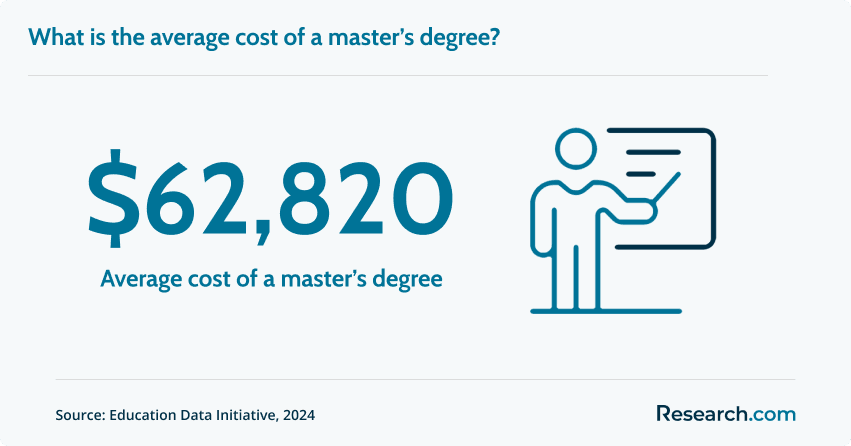
Master’s degree programs generally require 30 to 60 credits and take 1 to 2 years of full-time study. Because of the heavier credit load and longer duration, tuition typically falls around $62,820, depending on the institution, program type, and whether it’s offered online or on campus. Students interested in programs such as the fastest online master’s in reading and literacy may find accelerated tracks that reduce both the time commitment and overall tuition costs.
How long does it take to complete a graduate certificate vs. a master’s degree?
Time commitment plays a major role in choosing between a graduate certificate and a master’s degree in the United States. Both offer valuable credentials, but the difference in duration can impact career plans, costs, and how quickly new skills can be applied. Additionally, understanding the difference between master of arts and master of science can help students select the degree that best aligns with their academic goals and professional aspirations.
Typical Timeline for Graduate Certificates
Graduate certificate programs are designed for speed and focus. Most require 9 to 18 credits and can be completed in as little as 6 to 12 months of part-time or full-time study. Some highly concentrated certificates in technical fields can be finished in one academic term, while online options often allow flexible pacing.
Typical Timeline for Master’s Degrees
Master’s degree programs generally require 30 to 60 credits and take about 1 to 2 years of full-time study. Part-time students, especially those balancing work and school, may take 2 to 3 years or more to finish. Programs that include research, a thesis, or clinical hours often fall on the longer end of that range.
Students seeking the fastest online master’s degree in sports management can often find accelerated tracks designed to reduce the traditional time commitment while maintaining rigorous graduate-level standards.
Graduate certificates offer a faster path to credentials, often completed in under a year, while a master’s degree demands a longer commitment of one to three years depending on study pace and program requirements.
What GPA do you need for a graduate certificate vs. a master’s degree?
Admission requirements often differ between graduate certificates and master’s degrees, and GPA cutoffs are among the most important factors. Understanding these expectations can help applicants prepare stronger applications and avoid unnecessary delays. It’s also helpful to know the difference between double major and dual degree when planning undergraduate coursework that may lead into graduate study.
GPA Requirements for Graduate Certificates
Graduate certificate programs in the U.S. typically have more flexible GPA requirements. Many accept a minimum undergraduate GPA of 2.5 to 3.0 on a 4.0 scale. Some schools consider professional experience or industry certifications as part of the evaluation, which can offset a slightly lower GPA.
GPA Requirements for Master’s Degrees
Master’s degree programs usually set higher GPA thresholds, often requiring a minimum GPA of 3.0 for admission. Competitive or research-focused programs—such as in engineering, public health, or psychology—may look for 3.3 or higher, especially at selective universities.
Applicants seeking the fastest online corrections degree may find programs that balance rigorous coursework with slightly flexible GPA requirements, making accelerated study more accessible for qualified students.
Graduate certificates often accommodate applicants with lower GPAs or non-traditional academic backgrounds, while master’s degrees generally expect a stronger academic record starting at 3.0 and above to ensure readiness for advanced coursework.
What jobs can you get with a graduate certificate vs. a master’s degree?
The credential you choose—whether a graduate certificate or a master’s degree—can shape the types of jobs you qualify for in the United States. Graduate certificates often open doors to specialized technical or industry-focused roles, while master’s degrees usually lead to leadership, research, or advanced professional positions.
Jobs You Can Get with a Graduate Certificate
A graduate certificate is ideal for professionals seeking targeted skills to pivot or advance in their field without committing to a full degree. Common career outcomes include:
- Project coordinator or specialist in fields like healthcare, education, or IT
- Data analyst or business analyst after earning a certificate in analytics or data science
- Human resources specialist with a certificate in HR management
- Cybersecurity technician or network specialist for those in IT security certificates
- ESL or reading specialist for teachers pursuing niche educational endorsements, including programs such as a fast track multilingual learner education online, which prepares educators to support diverse language learners effectively
These roles often prioritize practical expertise and recognized certifications over advanced academic credentials.
Jobs You Can Get with a Master’s Degree
A master’s degree typically qualifies candidates for senior or leadership roles that require in-depth knowledge and higher-level credentials. Examples include:
- Clinical mental health counselor or social worker (required by licensure in most states)
- Healthcare administrator or nurse practitioner for advanced healthcare leadership
- Education administrator or school principal in K-12 settings
- Data scientist or AI engineer for advanced analytics and research-heavy positions
- Marketing director or operations manager in business and corporate sectors
These roles often come with higher earning potential and opportunities for career advancement.
Graduate certificates tend to prepare individuals for specialized, skills-focused positions or endorsements within an existing career path. Master’s degrees, on the other hand, open access to leadership, managerial, or licensed professional roles that require deeper academic preparation and carry higher long-term growth potential. When evaluating programs, it’s important to distinguish between legitimate online colleges vs diploma mills to ensure your investment leads to recognized credentials and career opportunities.
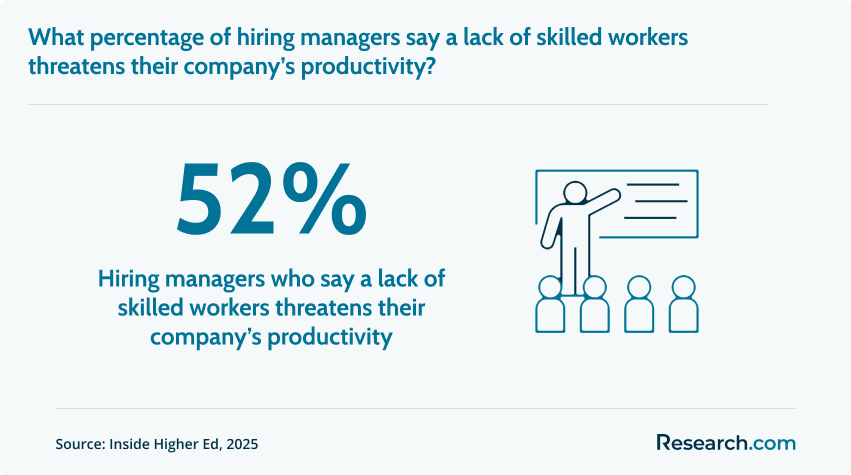
According to recent data, 52% of hiring managers say a lack of skilled workers threatens their company’s productivity—showing how valuable advanced credentials can be in today’s workforce.
How much more can you earn with a master’s degree vs. a graduate certificate?
One of the biggest factors in choosing between a graduate certificate and a master’s degree is the potential return on investment. A master’s degree usually comes with a higher salary boost, while a graduate certificate tends to provide a more modest increase tied to targeted skills.
Average Salary Increase with a Graduate Certificate
A graduate certificate often delivers a 5–15% salary increase compared to having only a bachelor’s degree. The exact gain depends on the field, the skills gained, and whether the credential is tied to a specific industry certification or licensure requirement.
Average Salary Increase with a Master’s Degree
A master’s degree typically brings a 15–25% boost in earnings compared to those with a bachelor’s degree. National data shows that in 2022, professionals with a master’s degree or higher earned a median of $80,200—about 20% more than the $66,600 median for bachelor’s degree holders. In high-demand fields like healthcare, business, and STEM, this difference can translate to an additional $10,000 to $20,000 or more per year.
Factors That Influence the Pay Gap
Several variables affect the difference in earnings between the two credentials:
- Field of study – STEM and healthcare show larger pay gaps than arts or education.
- Experience and seniority – The salary bump tends to grow with work experience.
- Employer and sector – Some industries prioritize advanced degrees more than others.
- Geographic location – Higher-cost regions often offer higher salaries.
Overall, a master’s degree usually results in a significantly higher salary gain—often about $10,000 to $20,000 more per year—compared to what a graduate certificate alone typically delivers.
Do graduate certificates offer more specialized skills than master’s degrees?
Graduate certificates and master’s degrees both enhance professional skills, but they’re designed with different purposes in mind. Graduate certificates typically focus on delivering narrow, career-ready expertise, while master’s degrees combine broader theoretical learning with practical applications.
Specialized Focus of Graduate Certificates
Graduate certificates are built for targeted skill development. They often concentrate on a single area—such as data analytics, project management, digital marketing, or cybersecurity—and aim to prepare students for immediate workforce needs. Because of their focused nature, certificate programs tend to be more specialized and technical, with fewer electives or unrelated coursework.
Broader Skill Development in Master’s Degrees
Master’s degree programs provide a comprehensive curriculum that blends specialized courses with foundational theory, research, and sometimes leadership or policy components. While they cover advanced topics within a field—such as education, engineering, or public health—the added breadth means they’re less narrowly focused than graduate certificates.
Many of the fastest-growing careers that require graduate-level education—like substance abuse and mental health counselors (48,900 projected annual openings), lawyers (35,600), nurse practitioners (29,000), and postsecondary health specialties teachers (28,400)—reflect the demand for this broader preparation.
A graduate certificate typically offers more specialized, job-specific skills for immediate application, whereas a master’s degree equips students with both specialized knowledge and a wider academic foundation needed for leadership, research, or advanced professional roles.
Are short-term credentials replacing traditional degrees in some fields?
Short-term credentials like graduate certificates, micro-credentials, and professional badges are gaining traction in industries where employers prioritize practical, job-ready skills over formal academic degrees. Fields such as technology, digital marketing, and data analytics have seen rising demand for these targeted programs because they address immediate workforce gaps and can be completed in months rather than years.
However, traditional degrees still hold significant value, especially in careers that require licensure, research expertise, or leadership preparation. Professions like healthcare, engineering, and education often continue to rely on master’s degrees as the gold standard for advancement and compliance with regulatory requirements.
Rather than fully replacing degrees, short-term credentials are increasingly complementing or stacking with traditional programs. This hybrid approach allows professionals to stay competitive by acquiring specialized skills quickly while maintaining the broader academic foundation of a degree for long-term career growth.
How do international employers evaluate U.S.-issued certificates vs. degrees?
International employers often regard U.S.-issued master’s degrees as more universally recognized and credible because degrees typically meet global academic standards and are tied to established accreditation bodies. A master’s degree signals advanced theoretical knowledge, research experience, and a sustained commitment to a field—qualities valued in sectors like healthcare, engineering, education, and management.
By contrast, U.S.-issued graduate certificates are assessed more variably. In countries where certificates aren’t a standard part of higher education, employers may see them as professional development credentials rather than formal academic achievements. Their value tends to be highest in industries like IT, finance, and project management, where specific skills and certifications can carry more weight than academic prestige.
Overall, U.S.-issued certificates are most effective when tied to globally recognized standards or in-demand technical skills, while degrees remain the more portable and widely accepted credential for meeting international hiring requirements, especially for senior roles or regulated professions.
How do you know if you should choose a graduate certificate or a master’s degree?
Deciding between a graduate certificate and a master’s degree depends on career goals, time, budget, and the level of expertise required in the chosen field. Understanding what each path offers makes it easier to pick the credential that aligns with both immediate needs and long-term ambitions.
When a Graduate Certificate Makes Sense
A graduate certificate is often the better fit if the goal is to gain targeted skills quickly without committing to years of study. It’s ideal for:
- Meeting specific licensing or industry requirements
- Adding specialized technical or professional skills to an existing career
- Testing interest in a new field before pursuing a full degree
- Saving on tuition and completing a credential in 6–12 months
When a Master’s Degree Is the Better Choice
A master’s degree is worth pursuing when aiming for leadership roles, advanced professional licensure, or in-depth expertise in a field. It’s the stronger option for:
- Qualifying for positions that explicitly require a graduate degree
- Preparing for long-term career advancement in research or management
- Gaining a credential that’s more widely recognized by employers internationally
- Building a comprehensive academic foundation beyond technical skills
Choose a graduate certificate for speed, affordability, and focused skills that meet immediate career needs. Opt for a master’s degree for deeper knowledge, leadership opportunities, and stronger long-term earning potential.
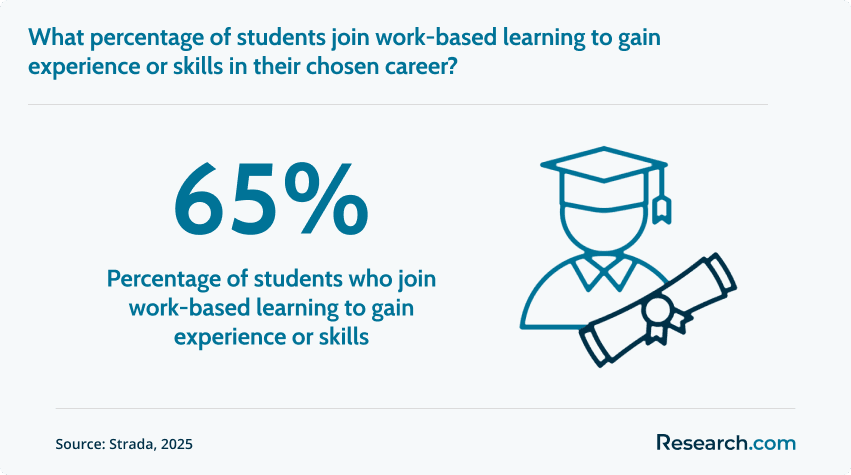
Finally, consider work-based learning. Based on recent studies, 65% of students join work-based learning to gain valuable experience or skills to help with their careers.
Are accelerated online programs as effective as traditional degrees?
Accelerated online programs are designed to provide a streamlined path to upskilling while maintaining academic rigor and industry relevance. These programs often integrate flexible learning models, competency-based assessments, and applied projects that align closely with market demands. They are increasingly evaluated on measurable outcomes such as job placement, salary progression, and direct applicability to emerging industry requirements. Candidates are advised to review accreditation standards and outcome data to ensure that these accelerated pathways deliver tangible career benefits. For further details on high-impact, time-efficient alternatives, consider exploring the best online degrees.
Key Findings
- The typical cost to earn a master’s degree is $62,820, highlighting the significant financial investment required for advanced education.
- 52% of hiring managers say that a lack of skilled workers threatens their company’s productivity, underscoring the importance of upskilling and advanced credentials.
- In 2022, workers with a master’s degree or higher earned a median of $80,200, compared to $66,600 for bachelor’s degree holders and $41,800 for high school graduates, showing clear wage gains with higher education.
- Careers requiring graduate degrees with the most projected annual openings from 2023 to 2033 include substance abuse and mental health counselors (48,900), lawyers (35,600), nurse practitioners (29,000), and postsecondary health specialties teachers (28,400).
- 65% of students participate in work-based learning to gain experience or skills in their chosen career, showing a strong interest in practical, career-aligned education opportunities.
Here’s What Graduates Have to Say About Graduate Certificate vs. Master’s Degree
- Drew: "Earning a graduate certificate in data analytics gave me the exact technical skills my employer needed, and I was promoted within six months. It was a faster, more affordable way to prove my expertise without pausing my career. "
- Jane: "Choosing a master’s degree in education opened doors to leadership positions and a salary jump of over $12,000 a year. The extra time and effort were worth it for the long-term growth it brought me. "
- Harry: "I started with a graduate certificate in cybersecurity to pivot from IT support, and later stacked it into a master’s degree. That step-by-step approach helped me build confidence and spread out the costs."
References:
- Hanson, M. (2024, November 23). Average cost of a master’s degree. EducationData.org.
- Mowreader, A. (2025, September 26). Employers value postsecondary credentials, durable skills. Inside Higher Ed.
- National Center for Education Statistics. (2024). Annual earnings [Indicator]. NCES.
- Strada Education Foundation. (2025). Internships and beyond: Strengthening career value across diverse models of work-based learning. Strada.
- U.S. Bureau of Labor Statistics. (2024, September 11). Projected job openings by educational requirements. BLS.
Other Things You Should Know About Graduate Certificate vs. Master’s Degree
No, a graduate certificate is not the same as a master’s degree. A graduate certificate is a shorter program—often 9 to 18 credits—focused on developing specific skills, while a master’s degree is a full graduate-level credential requiring 30 to 60 credits and deeper academic study. Certificates are designed for quick upskilling or specialization, whereas master’s degrees prepare students for leadership, research, or advanced professional roles that typically demand more comprehensive knowledge.
In 2027, graduate certificates typically cost less than master’s degrees due to their shorter duration and reduced course load. Graduate certificates often require fewer courses, making them a more affordable option for professionals seeking specialized skills without committing to the extensive time and financial investment of a master's program.
A graduate certificate is equivalent to completing a short sequence of graduate-level courses but not a full degree. It usually represents 3 to 6 courses within a master’s program and demonstrates advanced knowledge in a specific area. While it’s not equal to a master’s degree academically, employers often view it as a strong professional credential for demonstrating specialized skills or meeting licensing requirements.
To determine if a graduate certificate or master's degree is more worthwhile in 2027, consider your career goals, time commitment, and financial resources. Certificates offer specialized skills quickly, ideal for immediate skill acquisition. Master's degrees provide comprehensive education, benefiting those seeking career advancement, research roles, or academia.


