
2027 Dual Degree vs. Double Major: Explaining the Difference

Co-Founder and Chief Data Scientist
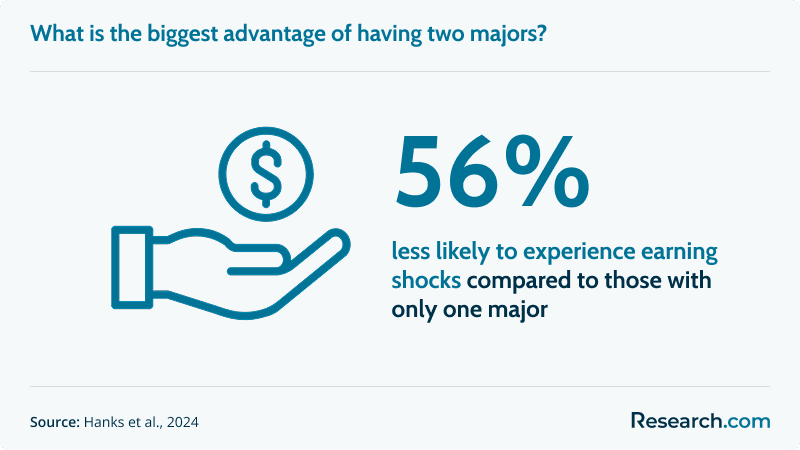
Choosing between a dual degree and a double major is one of the first strategic decisions of your career. Both paths promise a competitive edge, but the right choice can significantly impact your future financial stability. Recent economic research shows that graduates who completed a double major were 56% less likely to experience sudden drops in earnings compared to those with a single major.
This guide, prepared by career planning experts with more than 10 years of experience, is designed to give you clarity. We will break down exactly what each path entails, from coursework and costs to career outcomes. Our goal is to replace any uncertainty with the confidence you need to build the right foundation for your career.
Key Things You Should Know About Dual Degrees and Double Majors
- A dual degree earns you two separate diplomas from two different colleges within a university.
- A double major results in one diploma with two areas of specialization listed.
- Dual degree programs almost always require at least five years of study to complete.
- A double major can typically be completed within the standard four-year timeframe.
- Admissions for dual degree programs are often more complex, sometimes requiring separate applications to each school.
- The best path depends entirely on whether your career goal requires deep, integrated knowledge of two distinct fields.
Affordable Quick Online Degree Programs With High Acceptance Rates
1. Nursing
Nursing programs offered online provide a flexible pathway into one of the most stable and in-demand professions. Many universities offer accelerated RN-to-BSN programs designed for working nurses to complete their bachelor's degree quickly and affordably. These programs focus on building leadership, research, and advanced clinical skills necessary for career advancement in healthcare settings.
2. Computer Science
Online computer science programs are designed to equip you with the technical skills needed for a high-growth career in tech. These programs often focus on practical, job-ready knowledge in areas like software development, data analysis, and cybersecurity. Many institutions with high acceptance rates offer degree-completion tracks, allowing you to transfer existing credits to finish your bachelor's degree faster.
3. Healthcare Administration
A degree in healthcare administration is your entry point into the business side of the rapidly expanding healthcare industry. Online programs are structured to teach you about healthcare policy, finance, and operations management, preparing you for leadership roles in hospitals, clinics, and public health organizations. This path is ideal for those who want to make an impact in healthcare without pursuing a clinical role.
4. Management
Management is a versatile and practical degree that builds a strong foundation for leadership in any industry. Online programs focus on core business principles, including organizational behavior, strategic planning, and project management. Because the skills are so broadly applicable, graduates are prepared for a wide range of roles in both the public and private sectors.
5. Management Information Systems
A degree in Management Information Systems (MIS) places you at the critical intersection of business and technology. Online MIS programs teach you how to leverage technology to solve business problems, focusing on areas like data management, systems analysis, and IT strategy. Graduates are highly sought after for their ability to act as a bridge between technical teams and executive leadership.
6. Accounting
An online accounting degree offers a direct and stable path to a respected professional career. These programs provide the foundational knowledge of financial reporting, auditing, and tax law required for roles in corporate accounting or public auditing firms. Many online curricula are specifically designed to help students meet the educational requirements to sit for the CPA exam.
7. Special Education
For those passionate about teaching, an online degree in special education provides the credentials to work with students with diverse learning needs. Many universities offer master's programs online that allow current teachers to gain this high-demand specialization quickly. The coursework focuses on evidence-based teaching strategies, advocacy, and creating inclusive classroom environments.
8. Economics
An online economics degree builds powerful analytical and quantitative reasoning skills that are valuable in many sectors. The curriculum teaches you to analyze data, understand market trends, and interpret economic policy. This degree opens doors to careers in finance, market research, public policy, and consulting.
9. Business Administration
A degree in business administration is one of the most flexible and practical credentials you can earn online. The programs cover a broad range of essential topics, including marketing, finance, human resources, and operations. This foundational knowledge prepares you for a variety of roles and provides an excellent starting point for future specialization or an MBA.
10. Social Work
Online social work programs, particularly at the master's level (MSW), provide a route to a deeply fulfilling career helping individuals and communities. These programs combine academic coursework on social policy and human behavior with structured fieldwork that can often be arranged in your local area. An online format makes it possible for working professionals to transition into this licensed, service-oriented field.
- Dual Degree vs. Dual Major: Explaining the Difference Dual Degree vs. Major
- What are the pros and cons of pursuing a double major? Double Major Pros & Cons
- What are the pros and cons of pursuing a dual degree? Dual Degree Pros & Cons
- How will a dual degree or double major affect your college experience? How will a dual degree or double major affect your college experience?
- How does each path impact tuition and university fees? Program Costs
- What are the financial aid implications of these programs? Financial Aid
- How do employers and graduate schools view these credentials? Employer Perception
- How much more can you earn with two fields of study? Earnings
- What is the process for declaring a double major? What is the process for declaring a double major?
- What is the process for enrolling in a dual degree program? Enrollment
- Are there alternatives to a dual degree or double major? Are there alternatives to a dual degree or double major?
- Dual Degree vs. Double Major: Which one Is right for you? Dual Degree vs. Double Major: Which one Is right for you?
Dual Degree vs. Dual Major: Explaining the Difference
The choice between a double major and a dual degree comes down to your ultimate career goal: do you want to become a specialist in one niche field, or a qualified professional in two distinct fields? A double major gives you one diploma with two areas of expertise, creating a specialist. A dual degree provides two separate diplomas, creating a hybrid professional.
This core difference shapes the entire academic path. A double major is an internal declaration, built by finding the overlap between two existing majors. A dual degree is a formal, structured program you must apply and be admitted to, as you are completing the full, separate curriculum for two credentials.
Why the Difference in Diplomas Matters
This distinction in credentialing directly impacts how you market yourself and the opportunities you can pursue.
A double major is designed to create a single, powerful skillset for a specific, modern career. For example, combining Biology and Statistics doesn't just make you a biologist who knows stats; it makes you a bioinformatician. You are the perfect candidate for a highly specialized role that requires a seamless integration of both disciplines.
A dual degree, however, fully qualifies you for two separate career ladders. A professional who earns a Master of Science in Nursing (MSN) and a Master of Business Administration (MBA) isn't just a "nurse-manager." They are a fully credentialed nurse leader and a fully credentialed business executive. They can pursue roles as a Director of Nursing (a clinical leadership track) or a hospital's Chief Operating Officer (a business leadership track).
| Feature | Double Major | Dual Degree |
| Core Concept | Deepening expertise within a single degree by mastering two distinct fields of study. | Earning two separate, distinct degrees, which can be from different schools within a university or at different academic levels. |
| Final Credential | One diploma that lists two majors (e.g., a Bachelor of Arts with a Major in History and a Major in Political Science). | Two separate diplomas (e.g., a Bachelor of Arts and a Bachelor of Science; or a Bachelor of Science and a Master of Business Administration). |
| Typical Credit Load | 120-140 credits. The final number depends heavily on the credit overlap between the two majors' required courses. | 150+ credits. The student must fulfill the complete and separate requirements for two full degree programs. |
| Typical Timeline | 4 to 4.5 years. Can often be completed in the standard four years with careful planning, AP credits, or summer courses. | 5+ years. It is structurally designed to take longer than a standard bachelor's degree program. |
| Admissions Process | An internal administrative process. Students typically "declare" the second major after enrolling at the university. | A formal admissions process. Students often must apply and be admitted to a specific, structured dual degree program. |
| Best For... | A student aiming for a niche career that benefits from the deep intersection of two fields (e.g., Computer Science and Psychology for UX research). | A professional needing two distinct credentials for a hybrid leadership role (e.g., MSN and MBA for hospital administration). |
What are the pros and cons of pursuing a double major?
Pursuing a double major is a strategic way to build deep, specialized expertise. Like any significant academic commitment, it comes with a distinct set of advantages and disadvantages you need to weigh.
The primary benefit is developing a unique, interdisciplinary skillset that can give you a competitive edge. In popular fields like Business, with over 375,000 graduates annually, this can be a key differentiator. The main drawbacks are a highly rigid schedule with little room for electives and a demanding workload that requires excellent time management. For those curious about taking a double major, in the field of business even without prior experience, it’s helpful to explore can you become a business analyst with no experience.
Deepening Your Expertise in a Specific Field
The strategic goal of a double major is to create a highly specialized profile for a single, niche career path. It’s about combining two fields to master an intersection. A student combining computer science and biology isn't just a biologist who codes; they become a computational biologist, perfectly suited for roles in genetic sequencing or pharmaceutical research.
This approach is especially powerful in established professions where specialization is valued. For instance, many students explore various double major options for accounting students, such as adding finance or information systems, to build a more marketable and resilient career foundation.
The chart below shows the top fields of study for bachelor's degrees, providing context for which areas are most commonly pursued.
What are the pros and cons of pursuing a double major?
A dual degree is a high-stakes investment in your career, demanding a clear-eyed look at the trade-offs.
The most powerful advantage is earning two distinct credentials, which can qualify you for separate, high-level career fields. The primary disadvantages are the substantial costs in both time and money, and a formal, competitive admissions process for a limited number of spots. For aspiring executives, learning how to be a CEO can help clarify the skills, education, and experience needed to reach the top of an organization.
The Strategic Return on Investment
A dual degree is best viewed as a tool for career acceleration or a major professional pivot. It is the most direct path for someone who has hit a ceiling in their technical or clinical field and needs business acumen to move into leadership.
This is common in fields like healthcare, where a nurse leader might pursue both an MSN and an MBA. This combination provides the clinical expertise and the financial and operational skills required for executive roles. It’s a calculated investment, which is why many professionals research the expected RN with MBA salary to justify the commitment. The goal is not just a new job, but a new career trajectory.
How will a dual degree or double major affect your college experience?
Both a dual degree and a double major will significantly increase your workload and demand a more rigid schedule. The specific impact on your life, however, depends entirely on your situation.
For a full-time undergraduate, the challenge is a packed course schedule. This often means less flexibility for electives, a reduced capacity for extracurricular activities, and a greater need for disciplined time management. For a working professional or non-traditional student, the challenge is balancing these demanding academic requirements with a full-time job and family commitments.
Nationwide, undergraduate retention rates are around 64%, a figure that underscores the difficulty of any degree path. For students in these more demanding programs, the risk of burnout is a serious factor.
A Reality Check: Managing Your Time and Energy
Success in these programs hinges on exceptional time management. For undergraduates, this means mapping out your entire four-year plan early to ensure you meet all requirements. You have to be proactive about registering for classes that might only be offered once a year and be realistic about the time you can commit to clubs or a part-time job.
For professionals, the challenge is magnified. It requires setting clear boundaries at work and at home, managing employer expectations, and being disciplined about study time. The timeline can vary; for instance, students often ask, How long does it take to complete a dual degree program in psychology? because evening and part-time options can extend the commitment significantly.
The chart below shows retention rates, highlighting the importance of academic preparedness and support.
How does each path impact tuition and university fees?
A double major can often be completed with no extra tuition cost, provided you finish within the standard four years. A dual degree, because it requires more credits and almost always extends your time at the university, will cost more.
The final price tag depends entirely on your university's tuition structure. Many schools use a flat-rate model for full-time students, where you pay one price for 12-18 credit hours. A demanding double major fits within that band. However, extending your studies into a fifth year means paying for an entire extra year of tuition. For students considering healthcare careers, understanding the difference between a nurse practitioner and a physician assistant can also influence degree planning and clinical training choices.
Planning for the Total Cost
To accurately budget, you need to investigate your school's specific policies. Look past the advertised annual tuition and find the details. Does your university charge a per-credit fee for taking more than 18 credits in a semester? If so, a packed double major schedule could trigger those overload fees.
For a dual degree, ask even more pointed questions. Will your tuition rate change when you officially move into the graduate-level portion of a combined bachelor's/master's program? Answering these questions is the only way to understand the true total investment required for each path.
What are the financial aid implications of these programs?
The most significant financial trap to be aware of is that most financial aid is finite. The majority of institutional scholarships and federal grants for undergraduates are limited to eight semesters of study. If your academic plan extends into a fifth year, you will likely have to rely entirely on loans to cover tuition.
This is a critical piece of information. You cannot assume that your current financial aid package will simply continue until you graduate, especially if you are pursuing a dual degree that is structurally designed to take longer than four years.
Avoiding the 'Financial Aid Cliff'
This eight-semester limit is often called the "financial aid cliff." It's the point where a student's grant aid can suddenly drop to zero, making a program instantly unaffordable. Before committing to a path that requires more than four years, you must speak directly with your university's financial aid office. Ask them to confirm, in writing, how your specific scholarships and grants will be affected.
For students in combined bachelor's/master's programs, it's even more complex. Your aid status can change the moment you are officially classified as a graduate student, which can happen before you've finished eight semesters. Understanding these policies is essential for sound financial planning.
How do employers and graduate schools view these credentials?
Both credentials signal ambition and a strong work ethic to employers and graduate schools. However, the degree itself is not enough. The value is unlocked when you can articulate a clear, compelling story about why your specific combination makes you the ideal candidate for a specific role or program.
A well-chosen double major or dual degree provides a powerful foundation for career stability. This long-term value is backed by data, which shows that individuals with two majors are 56% less likely to experience earning shocks. But to realize that potential, you have to connect the dots for your audience.
Unlocking C-Suite and Leadership Pathways
Your resume, cover letter, and interview are where you build the narrative around your credentials. You must explain how your unique academic training created a skill set that directly solves a problem for the employer or prepares you for a specific field of research.
For example, a professional with two distinct degrees can show a clear path to leadership. This combination opens up specific, high-level roles, with many MSN MBA dual degree jobs focused on healthcare management and executive leadership. The goal is to present your education not as a list of courses, but as a deliberate strategic choice that makes you a more capable and valuable professional.
How much more can you earn with two fields of study?
Strategic combinations of majors can lead to significantly higher earnings and greater long-term financial stability. The key is to choose fields that are complementary and in high demand.
Pairing a quantitative or technical field with another discipline often yields the best results. For example, combining a STEM major with a liberal arts major can result in an average salary of over $81,000. Similarly, blending economics with a foreign language can open up lucrative opportunities in international business. For those interested in tech careers, understanding the difference between data engineer and data scientist can help you target the right skillset for maximum earning potential. The financial return comes from creating a unique and valuable skillset.
Analyzing the Return on Investment
Not all combinations are created equal. It's a common misconception that any two majors will automatically result in a higher salary than a single major. Data shows that a graduate with one high-paying STEM degree, like computer science, will likely earn more than a graduate with two lower-paying liberal arts degrees.
The financial ROI depends entirely on the fields you choose. Before committing, research the average starting and mid-career salaries for graduates with your specific combination of interests. This data-driven approach allows you to make an informed decision, treating your education as the strategic financial investment it is.
The chart below provides a breakdown of average incomes by major type, which can serve as a useful data point in your financial planning.
What is the process for declaring a double major?
Declaring a second major is an internal administrative process that is usually straightforward if you plan ahead. The typical steps involve meeting with advisors, ensuring you meet all prerequisites, and submitting the correct forms to your university's registrar.
The process generally looks like this:
- Meet with your primary academic advisor to map out a potential course plan.
- Check the GPA and prerequisite course requirements for the second major.
- Meet with an advisor from the second department for approval.
- Submit the official declaration form before your university's deadline.
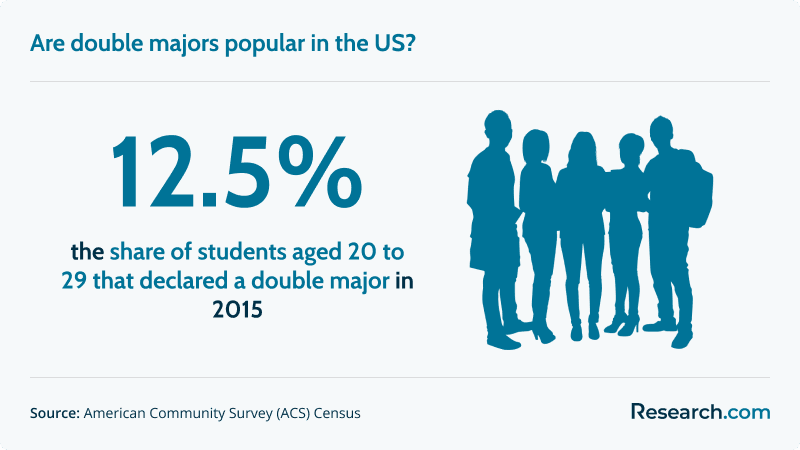
If you follow this path, you'll be joining a select group, as about 12.5% of students pursue a double major.
Joining a Select Group of Students
The key to a smooth process is building relationships with advisors in both departments. They are your best resource for navigating requirements and can become powerful advocates if you need an exception or special permission to enroll in a class.
Don't treat this as just a box to check in your student portal. Proactively engaging with your advisors transforms a bureaucratic hurdle into an opportunity for mentorship and guidance, ensuring you stay on track to graduate on time.
What is the process for enrolling in a dual degree program?
Enrolling in a dual degree program is a formal admissions process, not just an administrative declaration. You must apply to and be accepted by a specific, structured program, often with its own competitive standards.
The process is more rigorous and typically looks like this:
- Research the specific dual degree programs offered by the university.
- Verify that you meet the higher prerequisite and GPA standards for admission.
- Prepare a formal application, which may require separate essays and letters of recommendation.
- Submit your application by the official deadline, which is often much earlier than the deadline for declaring a major.
Crafting a Compelling Application
Success in this process requires you to build a strong case for your candidacy. These programs are looking for students who have a clear, strategic reason for pursuing that specific dual degree combination.
Your application essay is the place to tell that story. You need to connect your past experiences, current academic strengths, and future career goals into a cohesive narrative. Explain precisely why you need both credentials to achieve your objective. Many universities offer dedicated admissions counselors for these flagship programs; connecting with them can provide invaluable insight into crafting a successful application.
Are there alternatives to a dual degree or double major?
Sometimes the goal isn't to get a second degree, but to add a specific, valuable skillset to your primary one. It's easy to fall into an "all-or-nothing" mindset, but for many students, a more targeted approach is the smarter strategic choice.
The answer is yes, excellent alternatives exist. A major/minor combination or adding a formal certificate are often more efficient and effective ways to gain a secondary skillset without the immense commitment of a second full major or degree. These paths offer flexibility and can be tailored to specific career outcomes.
Strategic Minors and Certificates
The "right" choice depends entirely on your end goal. A minor in a complementary field can make you a much more attractive job candidate. For example, a science major who adds a technical writing minor can open up many alternative biology careers in scientific communication, publishing, or regulatory affairs.
Furthermore, industry-recognized certificates are on the rise. For a specific, job-ready skill like project management or digital marketing, a certificate can often provide a faster, cheaper, and more direct path to qualification than a second major. These are not lesser options; they are precise tools for a specific purpose.
Dual Degree vs. Double Major: Which one Is right for you?
The right choice is a personal one that requires a clear-eyed assessment of three things: your specific career goals, your financial situation, and your tolerance for a demanding workload. There is no single "best" answer, only the answer that is best for you.
As you weigh your options, consider the potential financial outcomes. Data on average incomes shows that strategic combinations, particularly those involving STEM fields, can lead to higher earnings. The key is to align that potential return with the significant investment of time and money required.
A Framework for Your Decision
To make your final choice, ask yourself these critical questions. Your answers will point you toward the right path.
- Career: Does my target job require deep, integrated knowledge for one specialized role (favoring a double major), or two separate, distinct credentials for two potential career tracks (favoring a dual degree)?
- Finances: Can I realistically complete this program within the eight-semester financial aid window? Have I researched the total cost, including potential overload fees or a fifth year of tuition?
- Lifestyle: Am I prepared for the academic rigor and reduced flexibility? Have I been honest with myself about my time management skills and my ability to balance this workload with other life commitments?
Answering these questions honestly will give you the clarity to move forward with confidence.
Here’s What Graduates Have to Say about Their Dual Degree and Double Major Choices
- Anna: "Honestly, I started my political science major and felt like something was missing. Adding a second major in Communications just clicked. It taught me how to take all the complex policy ideas I was learning and make them accessible to a real audience. It turned my academic interest into a real passion for public advocacy."
- Isabella: "My parents were so skeptical when I declared a double major in Fine Arts and Business. They wanted me to choose the "safe" path. Now I own and operate my own art gallery, and I use both sides of my education every single day. I can curate a new exhibit and then turn around and confidently manage the payroll and marketing plan."
- Liam: "I felt stuck in my company’s domestic marketing division. The dual MA in International Relations and MBA gave me the credibility to make a significant leap. It provided the hard business skills and the global political context I needed to lead our expansion into the European market. It wasn't just a promotion; it was a completely new career path."
How Can Academic and Career Support Optimize Your Degree Investment?
Leveraging dedicated academic advising, career services, and mentorship programs can refine your curriculum choices and streamline your path to professional success. Structured support helps in aligning course selections with future industry trends, integrating internship opportunities, and accessing niche certifications that complement your dual credentials. Additionally, exploring resources like quick online degrees provides actionable insights into market-relevant educational alternatives that may accelerate your return on investment.
Key Findings
- Graduates with two majors are 56% less likely to experience career-derailing earning shocks, providing a powerful justification for the increased academic workload by confirming long-term career stability.
- Strategic combinations can yield significant financial returns, with double majors blending STEM and liberal arts earning an average salary of $81,466, surpassing the average for a single STEM major.
- The increased academic demand of these paths is a significant factor to consider, as nationwide undergraduate retention rates of around 64% underscore the challenge of completing any degree, let alone a more rigorous one.
- While a significant commitment, pursuing a double major is a recognized path to specialization, with about 12.5% of all students choosing this option to gain a competitive edge in their field.
- In highly competitive fields like business, which sees over 375,000 graduates annually, a dual credential can be a key differentiator that signals advanced expertise to potential employers.
- The financial benefits are highly dependent on the chosen fields, as a double major in two liberal arts fields averages $64,750, significantly less than the nearly $82,000 average for a dual STEM major combination.
References:
- Hanks, A. S., Jiang, S., Qian, X., Wang, B., & Weinberg, B.A. (2024). Do double majors face less risk? An analysis of human capital diversification. National Bureau of Economic Research. Retrieved October 2, 2025, from NBER.
- National Center for Education Statistics. (2022). Undergraduate retention and graduation rates. U.S. Department of Education, Institute of Education Sciences. Retrieved October 2, 2025, from NCES.
- National Center for Education Statistics. (2024). Undergraduate degree fields. U.S. Department of Education, Institute of Education Sciences. Retrieved October 2, 2025, from NCES.
Other Things You Should Know About Dual Degrees and Double Majors
In 2027, a dual degree involves earning two distinct degrees, often from different schools or departments, requiring more credits. A double major consists of two areas of study within one degree, usually with overlapping course requirements, so students can complete them in less time compared to a dual degree.
In a double major, your GPA is typically a combined average of all courses taken for both majors. For a dual degree program, each degree's GPA may be calculated separately, reflecting the coursework for each specific degree. Always confirm with your academic advisor for precise calculations at your institution.
A double major is completed at a single university. A dual degree can sometimes be earned from two different universities, but only through a formal partnership called a "joint degree program." These programs are highly structured and require you to be admitted to both institutions separately. You cannot create your own program by simply enrolling at two different schools at once.


