
2027 How to Become a Business Analyst With No Experience: Education, Salary, and Job Outlook

Co-Founder and Chief Data Scientist
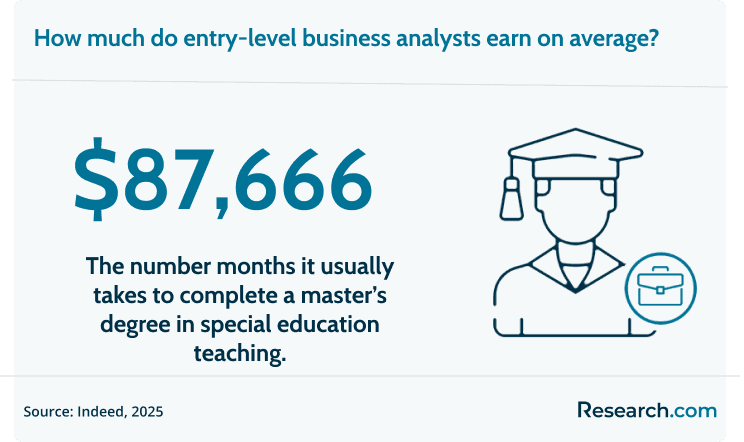
Breaking into a career as a business analyst may feel challenging without prior experience, but the field is more accessible than many realize. With the average entry-level business analyst earning around $87,666 per year, it’s no surprise that more students and career changers are exploring this path.
The good news is that with the right mix of education, skills, and strategic preparation, you can position yourself as a strong candidate even without direct job history. In this guide, we’ll walk you through the essential steps, so you can confidently start your journey toward becoming a business analyst.
Key things you should know about becoming a business analyst:
- Overall employment in business and financial occupations is projected to grow faster than the average for all occupations from 2024 to 2034.
- Many business analysts start without direct experience by leveraging transferable skills and targeted certifications.
- Business analysts work across industries like finance, healthcare, and technology, making it a flexible and future-proof career choice.
- What does a business analyst do, and is it a good career? Overview
- Can I become a business analyst with no prior work experience? No Experience Career
- What daily tasks and responsibilities should I expect as an entry-level business analyst? Daily Tasks
- How much do entry-level business analysts earn on average? Average Salary
- What online courses and MOOCs should I take to start a business analyst career? What online courses and MOOCs should I take to start a business analyst career?
- Which industries hire the most entry-level business analysts? Top Industries
- How can I turn internships, school projects, or volunteer work into business analyst experience? How can I turn internships, school projects, or volunteer work into business analyst experience?
- Which soft skills do hiring managers prioritize for entry-level business analyst roles? Soft Skills
- Which certifications help entry-level candidates become business analysts? Certifications
- What is the job outlook and demand for business analysts over the next 5–10 years? Job Outlook
- Should I Consider Pursuing an MBA to Boost My Business Analyst Career? Should I Consider Pursuing an MBA to Boost My Business Analyst Career?
What does a business analyst do, and is it a good career?
Choosing a business analyst career usually starts with one practical question: can you turn business problems, data, and stakeholder requests into solutions an organization can actually use? Business analysts do exactly that. They help companies understand what is not working, define what needs to change, and guide teams toward better processes, systems, products, and decisions.
This guide is for students, career changers, recent graduates, and early-career professionals who want to know whether business analysis is a realistic path, what entry-level analysts do each day, what skills employers expect, and how to get hired without a long work history. You will also learn how to compare certifications, build experience from projects or internships, evaluate salary expectations, and avoid common mistakes when preparing for your first role.
Quick answer: Is business analyst a good career?
Yes. Business analysis can be a strong career for people who enjoy solving problems, working with data, communicating with different teams, and improving how organizations operate. Entry-level roles can lead to senior analyst, product owner, project manager, business intelligence, operations, consulting, or management positions. The career is especially appealing because business analysts are needed across finance, healthcare, technology, government, consulting, manufacturing, and many other sectors.
A business analyst usually works between business stakeholders and technical or operational teams. The role is not only about writing reports. It involves asking better questions, clarifying requirements, mapping workflows, analyzing data, documenting decisions, and helping teams confirm that a solution meets the original business need.
| Business analyst function | What it means in practice | Why it matters |
| Identify business problems | Interview stakeholders, review current workflows, and define what needs to improve. | Teams cannot build effective solutions if the real problem is unclear. |
| Translate needs into requirements | Convert business goals into clear documentation, user stories, acceptance criteria, or process requirements. | Requirements reduce confusion between business users, developers, managers, and vendors. |
| Analyze data and processes | Use reports, spreadsheets, dashboards, databases, and process maps to find patterns or inefficiencies. | Evidence-based recommendations are easier to defend than opinions or assumptions. |
| Coordinate stakeholders | Facilitate meetings, confirm priorities, manage feedback, and keep teams aligned. | Business change often fails when departments do not share the same expectations. |
| Support implementation | Assist with testing, validation, training materials, and post-launch review. | The analyst helps confirm that the final solution solves the problem it was designed to address. |
Business analysis is also a structured career path. Like tracking BCBA fieldwork hours for behavior analyst preparation, building documented project experience as a business analyst can help you show growth, readiness, and practical competence over time.
Can I become a business analyst with no prior work experience?
Yes. You can move into business analysis without a previous business analyst title, but you need to prove that you already use the kinds of skills the role requires. Employers hiring for junior roles often look for analytical thinking, clear communication, organized documentation, curiosity, and the ability to work with both people and information.
Experience from internships, class projects, part-time jobs, customer service, finance, operations, volunteer work, administrative roles, or campus organizations can be repositioned as business analyst preparation if you describe it correctly. For example, resolving customer issues can show requirements discovery; preparing budget spreadsheets can show data analysis; organizing a student project can show stakeholder coordination and documentation.
The key is to close three gaps: business analysis knowledge, tool exposure, and proof of work. Online courses, portfolio projects, and beginner certifications can help. If you are comparing broader business education options, related programs such as the fastest MBA sports management online can also show how business, analytics, leadership, and industry specialization may overlap in different career paths.
How to become a business analyst with no experience
- Learn the role before applying. Understand requirements gathering, process mapping, stakeholder analysis, user stories, business cases, and testing support.
- Build tool confidence. Start with Excel, SQL basics, Power BI or Tableau, Jira, Confluence, and diagramming tools.
- Create two or three portfolio projects. Use public data, a mock business problem, or a real volunteer project to demonstrate analysis, recommendations, and documentation.
- Rewrite your resume around outcomes. Replace task-only bullets with evidence of analysis, communication, process improvement, reporting, and decision support.
- Apply to adjacent job titles. Look for junior business analyst, business systems analyst, operations analyst, reporting analyst, product analyst, project coordinator, and data analyst roles.
Business analysis has broad accessibility across gender groups. Business analysis is a relatively balanced profession when it comes to gender representation, with 46.1% of all business analysts identifying as women. This suggests that the field attracts professionals from varied backgrounds, especially those who want to combine business strategy, communication, and structured problem-solving.
What daily tasks and responsibilities should I expect as an entry-level business analyst?
An entry-level business analyst usually supports a larger project team rather than owning the entire analysis process alone. Your day may include reviewing data, documenting stakeholder input, updating requirements, preparing meeting notes, testing a system feature, or helping a manager understand whether a process change is working.
| Entry-level responsibility | Typical task examples | Skills used |
| Requirements support | Take notes in stakeholder meetings, clarify requested features, organize requirements, and update documentation. | Listening, writing, organization, attention to detail |
| Data and reporting | Clean spreadsheets, compare metrics, run basic SQL queries, or summarize dashboard findings. | Excel, SQL, data interpretation, critical thinking |
| Process improvement | Map current workflows, identify bottlenecks, and suggest more efficient steps. | Process mapping, observation, problem-solving |
| Testing and validation | Check whether a system or process matches requirements before launch. | Quality review, documentation, logical thinking |
| Communication support | Prepare status updates, meeting summaries, slide decks, and stakeholder follow-ups. | Written communication, presentation, collaboration |
| Tool use | Update Jira tickets, organize Confluence pages, build Power BI visuals, or maintain requirement trackers. | BA tools, project coordination, technical confidence |
Early in your career, accuracy matters more than speed. Managers need to trust that your notes are complete, your data checks are careful, and your documentation reflects what stakeholders actually agreed to. Over time, you will move from supporting analysis to leading interviews, recommending solutions, and influencing project direction.
How much do entry-level business analysts earn on average?
Entry-level business analysts can earn more than many first roles in general business because the job sits at the intersection of operations, technology, data, and project delivery. On average, an entry-level business analyst makes around $87,666 per year, though pay varies by region, employer, industry, tools required, and the complexity of the projects involved.
Large employers, consulting firms, healthcare organizations, banks, insurance companies, and technology teams may offer higher compensation when the role requires systems knowledge, analytics tools, or cross-functional project work. Smaller companies, nonprofits, or local organizations may pay less but can give new analysts broader exposure to multiple responsibilities.
Salary growth is usually tied to demonstrated impact. Analysts who can show that they improved a workflow, reduced manual reporting, clarified requirements, supported a successful system launch, or built useful dashboards are often better positioned for raises and promotions. Upskilling in SQL, Power BI, Tableau, process modeling, Agile, and requirements documentation can also strengthen your earning potential. If you are exploring business-related education more broadly, options such as the shortest online taxation management programs may be relevant for readers comparing specialized business pathways.
| Factor | How it can affect entry-level salary |
| Industry | Finance, consulting, healthcare, and technology roles may pay more when projects are complex or data-intensive. |
| Location | Pay often reflects local labor markets and cost of living. |
| Tools | SQL, Power BI, Tableau, Jira, and advanced Excel can make a beginner candidate more competitive. |
| Business domain knowledge | Knowledge of healthcare, banking, supply chain, insurance, or software workflows can help you stand out. |
| Portfolio evidence | Projects, dashboards, process maps, and requirements samples can help employers see what you can do before hiring you. |
What online courses and MOOCs should I take to start a business analyst career?
The best online learning plan for a future business analyst should cover four areas: business analysis methods, data skills, communication skills, and project delivery. If you are still learning how business programs are structured, understanding what are the main subjects for business administration can help you see how analysis, management, finance, operations, and communication fit together.
Courses are most useful when they lead to visible proof of skill. A certificate alone is not enough. Pair each course with a portfolio artifact such as a requirements document, workflow diagram, dashboard, SQL analysis, stakeholder summary, or project recommendation memo.
- Business analysis fundamentals: Look for courses that teach requirements gathering, stakeholder interviews, business process modeling, use cases, user stories, acceptance criteria, and documentation standards.
- Excel and spreadsheet analysis: Excel remains a common entry-level tool. Practice formulas, pivot tables, lookup functions, charts, cleaning messy data, and building simple reporting templates.
- SQL and databases: SQL helps analysts retrieve, filter, join, and summarize data. Even beginner-level SQL can make your resume stronger for reporting and business systems roles.
- Data visualization: Power BI and Tableau courses can teach you how to turn raw data into charts and dashboards that managers can use for decisions.
- Agile and Scrum basics: Many analysts work with product owners, developers, QA testers, and project managers. Agile training helps you understand sprints, backlogs, user stories, and iterative delivery.
- Communication and presentation: Business analysts must explain findings clearly. Courses in business writing, presentation design, negotiation, and stakeholder communication are valuable.
- Introductory BA certifications: Beginner credentials from recognized business analysis or project management organizations may help demonstrate seriousness, especially if you lack direct work experience.
Most business analysts enter the profession with a bachelor’s degree, which makes up about 71% of the workforce. Common academic backgrounds include business, finance, information systems, management, economics, computer science, and related fields. Readers comparing advanced education in other specialized areas may also encounter accredited doctorate in early childhood education online programs, although those degrees prepare for a very different professional track.
The chart below shows the degree-level breakdown:
Which industries hire the most entry-level business analysts?
Business analysts are hired wherever organizations need to improve systems, processes, reporting, compliance, customer experience, or operational efficiency. For entry-level candidates, the best industry is often the one where you already have some context. A former bank teller may understand financial workflows; a healthcare administrator may understand patient records; a retail supervisor may understand inventory, scheduling, and customer service data.
| Industry | Why business analysts are hired | Common entry-level work |
| Finance and banking | Banks and financial firms need analysts for reporting, compliance, risk systems, digital banking, and customer data projects. | Documenting requirements, reviewing reports, supporting workflow changes, and assisting with system updates. |
| Healthcare and life sciences | Healthcare employers rely on analysts to improve billing, patient record systems, claims workflows, compliance, and operational performance. | Mapping processes, validating data, preparing reports, and supporting technology or compliance projects. |
| Technology and software | Software teams need analysts who can connect user needs, business goals, and product development work. | Writing user stories, updating backlogs, testing features, and communicating between product and technical teams. |
| Government and public sector | Public agencies use analysts to modernize systems, improve service delivery, track program data, and support policy or compliance work. | Preparing documentation, tracking project details, analyzing service data, and supporting implementation teams. |
| Consulting and professional services | Consulting firms hire junior analysts to research client problems, analyze operations, and help build recommendations across industries. | Interview notes, data review, process maps, slide decks, and client-ready summaries. |
| Manufacturing and supply chain | Manufacturers and logistics companies need analysts to improve production planning, procurement, inventory, and supplier performance. | Tracking metrics, identifying bottlenecks, documenting workflows, and recommending process changes. |
Consulting can be a good fit if you want exposure to many industries quickly. Professionals who want to build business creation and strategy skills may also compare options such as the shortest online master’s degree in entrepreneurship, though that path is broader than entry-level business analysis training.
How can I turn internships, school projects, or volunteer work into business analyst experience?
You do not need the title “business analyst” to show business analyst ability. Hiring managers care about whether you can investigate a problem, organize information, communicate with stakeholders, analyze evidence, and recommend a practical solution. Internships, academic assignments, volunteer projects, student leadership, and part-time jobs can all become relevant if you present them through that lens.
The same principle applies in other fields: a person comparing special education degree programs would evaluate fieldwork, specialization, and outcomes, not just the program title. For business analysis, you should evaluate your own background the same way: what proof do you have that you can do the work?
| Experience you may already have | How to frame it for business analyst roles | Portfolio artifact to create |
| Internship reports or spreadsheets | Describe how you cleaned data, compared results, identified patterns, or summarized findings for a decision. | Dashboard, analysis memo, or before-and-after report |
| Class research project | Frame the project as problem definition, research, data interpretation, and recommendation development. | Case study, slide deck, or executive summary |
| Volunteer coordination | Show how you gathered input, organized requirements, scheduled work, or improved a process. | Process map, requirements list, or stakeholder plan |
| Customer service job | Highlight issue tracking, root-cause patterns, customer needs, and process improvement ideas. | Customer pain-point analysis or improvement proposal |
| Student organization leadership | Connect budgeting, event planning, member feedback, and reporting to stakeholder management and operations analysis. | Project charter, budget analysis, or lessons-learned document |
Use professional business analysis language, but do not exaggerate. If you gathered feedback, say so. If you documented requirements, explain the document you created. If you built a dashboard, describe what decision it supported. BA artifacts such as process diagrams, dashboards, workflow notes, user stories, and requirements documents can make your experience easier for employers to evaluate.
Resume examples for non-BA experience
- Weak: Helped with reports for the department.
- Stronger: Reviewed weekly department metrics in Excel, identified recurring data gaps, and summarized findings for the team lead.
- Weak: Worked on a school project about a company.
- Stronger: Analyzed a business process for a class case study, documented current-state issues, and presented three improvement recommendations.
- Weak: Assisted customers with problems.
- Stronger: Tracked customer issues, categorized recurring service problems, and shared process improvement ideas with supervisors.
Which soft skills do hiring managers prioritize for entry-level business analyst roles?
Technical tools matter, but soft skills often determine whether a beginner business analyst succeeds. The role requires frequent clarification, negotiation, documentation, and follow-up. A junior analyst who asks precise questions and writes clear notes can be more valuable than one who knows a tool but cannot communicate findings.
| Soft skill | Why hiring managers value it | How to demonstrate it |
| Communication | Analysts must explain business needs to technical teams and technical constraints to business users. | Bring writing samples, meeting summaries, slide decks, or project documentation. |
| Critical thinking | The job requires separating symptoms from root causes and comparing possible solutions. | Discuss a time you evaluated options and explained your recommendation. |
| Collaboration | Business analysts rarely work alone; they coordinate with managers, users, developers, testers, and vendors. | Use examples involving group projects, cross-functional work, or stakeholder feedback. |
| Adaptability | Requirements, timelines, and priorities can change during projects. | Describe how you adjusted to new information without losing track of the goal. |
| Attention to detail | Errors in requirements, reports, or testing notes can create expensive rework. | Show examples of careful documentation, quality checks, or data validation. |
| Problem-solving | Employers want analysts who can move from “something is wrong” to “here is a workable next step.” | Prepare a short story using problem, action, result, and lesson learned. |
| Time management | Entry-level analysts often balance meetings, documentation, reporting, and follow-up tasks. | Explain how you prioritize deadlines and keep work organized. |
Adaptability is not unique to business analysis. In fields such as counseling, professionals also have to navigate changing rules and practice requirements, including developments related to LPC license reciprocity. For business analysts, adaptability usually means staying useful as tools, project priorities, stakeholder expectations, and technologies shift.
Which certifications help entry-level candidates become business analysts?
Certifications can help if they fill a specific gap in your profile. They are most useful when you lack formal experience, need a structured learning path, or want to show familiarity with standard business analysis practices. They are not a substitute for portfolio work, tool practice, or strong interview examples.
| Certification or credential type | Best for | How to use it strategically |
| ECBA | Beginners who want a formal introduction to business analysis concepts. | The ECBA, associated with the International Institute of Business Analysis (IIBA), can help signal that you understand foundational BA terminology and practices. |
| CCBA | Candidates who have gained some practical exposure through projects, internships, or related roles. | Consider it after you have enough experience to connect the credential with real examples. |
| PMI-PBA | Professionals who want to work in project-heavy environments. | Use it to strengthen your profile for roles involving project requirements, scope, and stakeholder coordination. |
| SQL and data analytics certificates | Entry-level candidates applying to reporting, operations, BI-adjacent, or data-heavy BA roles. | Pair the certificate with a sample SQL project, dashboard, or analysis case study. |
| Agile and Scrum credentials | Candidates targeting software, product, technology, or digital transformation teams. | Use the credential to show that you understand backlogs, sprints, user stories, and team delivery rhythms. |
| Short BA micro-credentials | Career changers who want fast exposure to specific topics. | Treat these as supplements, not as your main qualification. |
How to choose the right certification
- If you have no experience: Start with a beginner BA credential and build portfolio projects at the same time.
- If you already use data at work: Prioritize SQL, Excel, Power BI, or Tableau before a more advanced BA credential.
- If you want tech or product roles: Add Agile or Scrum training and practice writing user stories.
- If you want consulting: Focus on problem-solving cases, presentation skills, business process analysis, and clear documentation.
- If you are on a tight budget: Choose one credential that matches your target role instead of collecting many unrelated certificates.
What is the job outlook and demand for business analysts over the next 5–10 years?
The outlook for business analysts is supported by the broader need for organizations to improve operations, use data more effectively, modernize systems, and respond to technology changes. According to labor market projections, overall employment in business and financial occupations is expected to grow faster than the average for all occupations from 2024 to 2034.
Demand is not limited to one job title. Business analyst work may appear under titles such as business systems analyst, business intelligence analyst, operations analyst, product analyst, process analyst, requirements analyst, or project analyst. This matters for job seekers because searching only for “business analyst” may cause you to miss relevant entry-level openings.
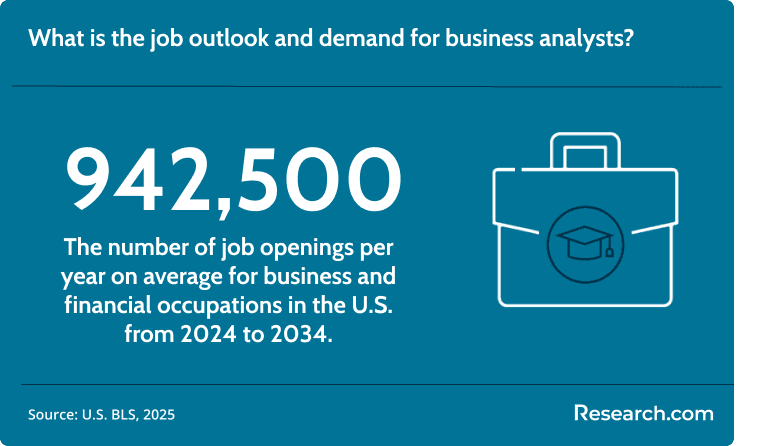
In addition to projected growth, there are about 942,500 openings each year across business and financial occupations, reflecting both new roles and replacement needs. Readers comparing business-related paths in athletics may also want to review a sports manager salary guide to understand how industry choice can affect business career outcomes.
Healthcare is one example of a sector where data, reporting, compliance, and operational improvement are especially important. Career paths such as business intelligence healthcare jobs with high demand show how combining analytics skills with domain knowledge can create more specialized opportunities.
Current trends shaping business analyst careers
Business analysis is changing as organizations adopt more digital systems, automate routine tasks, and expect faster decisions. These changes do not eliminate the need for analysts; they increase the value of analysts who can combine business judgment, data literacy, and communication.
- AI is changing routine analysis. Generative AI and automation tools can help summarize notes, draft documentation, query information, and speed up reporting. Analysts still need to validate outputs, interpret context, ask follow-up questions, and protect data quality.
- Data literacy is becoming a baseline expectation. Even non-technical BA roles increasingly require comfort with spreadsheets, dashboards, metrics, and databases.
- Agile delivery remains common in technology teams. Business analysts who understand backlogs, user stories, sprint planning, and acceptance criteria are better prepared for software and product environments.
- Domain knowledge matters more in specialized industries. Healthcare, finance, insurance, government, and supply chain employers often value candidates who understand industry rules, terminology, and workflows.
- Remote and hybrid work increase the need for strong documentation. When teams are distributed, clear requirements, meeting notes, and decision logs become even more important.
Should I consider pursuing an MBA to boost my business analyst career?
An MBA is not required for most entry-level business analyst roles. For beginners, a focused portfolio, tool skills, internship experience, and a well-targeted resume usually matter more. However, an MBA can make sense later if you want to move into management, strategy, consulting leadership, product leadership, or roles that require stronger finance, operations, and executive decision-making skills.
Before enrolling, compare the cost, time commitment, accreditation, employer reputation, curriculum, flexibility, and likely career benefit. Budget-conscious students may want to compare programs such as the best cheap online MBA if graduate business education fits their long-term goals.
| Career stage | Is an MBA usually necessary? | Better next step |
| No experience | Usually no | Build BA fundamentals, tools, portfolio projects, and internship or volunteer experience. |
| Entry-level analyst | Not usually | Develop SQL, dashboarding, requirements documentation, Agile, and stakeholder skills. |
| Mid-career analyst | Sometimes | Consider an MBA if you want leadership, consulting, strategy, or management roles. |
| Senior analyst or manager | Potentially useful | Evaluate whether the degree supports promotion, industry change, or executive-track goals. |
How to choose the right business analyst path
There is no single best route into business analysis. The right path depends on your background, target industry, budget, timeline, and current skill gaps.
| Your situation | Recommended path | Why it works |
| Recent graduate with a business degree | Apply for junior BA, operations analyst, project analyst, or reporting analyst roles while building tool skills. | You can connect coursework to business processes, data, and stakeholder communication. |
| Career changer from customer service or administration | Highlight process knowledge, issue tracking, stakeholder communication, and documentation. | You may already understand user pain points and operational bottlenecks. |
| Technical beginner interested in software | Learn Agile, user stories, Jira, basic SQL, and software development lifecycle concepts. | Technology teams need analysts who can translate between users and developers. |
| Data-oriented beginner | Build Excel, SQL, Power BI, and Tableau projects, then target reporting or BI-adjacent BA roles. | Data skills can help you stand out in roles where analysis and dashboards are central. |
| Professional with industry experience | Position yourself as a domain-aware analyst in your current field. | Industry knowledge can reduce the employer’s training burden. |
Common mistakes to avoid when trying to become a business analyst
- Applying with a generic resume. A resume that only lists duties will not show BA readiness. Use examples tied to analysis, documentation, process improvement, reporting, and stakeholder work.
- Collecting certificates without building proof. Credentials can help, but employers also want examples of what you can produce.
- Ignoring job title variation. Search for related titles such as business systems analyst, operations analyst, process analyst, project analyst, product analyst, and reporting analyst.
- Focusing only on technical tools. SQL and dashboards help, but communication, requirements clarity, and stakeholder management are central to the role.
- Overstating your experience. Use business analysis language accurately. Do not claim ownership of projects you only supported.
- Skipping domain research. Learn the basic vocabulary and workflows of your target industry before interviews.
- Assuming salary outcomes are guaranteed. Pay depends on employer, location, industry, tools, responsibilities, and your ability to show impact.
- Choosing education without checking fit. If you pursue a degree or certificate, compare cost, accreditation, curriculum, flexibility, and career relevance before enrolling.
Questions to ask before choosing a business analyst program, course, or certification
- Does the course teach requirements gathering, stakeholder analysis, process mapping, and documentation, or is it only a general business overview?
- Will I finish with portfolio artifacts I can show employers?
- Does the curriculum include Excel, SQL, Power BI, Tableau, Jira, Agile, or other tools used in my target roles?
- Is the credential recognized by employers in the jobs I want?
- How much does it cost, and is there a lower-cost way to build the same skill?
- Does the program offer career support, resume help, interview practice, or project feedback?
- Will this option help me get an entry-level role, or is it designed for experienced professionals?
Here’s what graduates have to say about their business analytics degree:
- : "Moving into business analysis changed the direction of my career. I did not begin with a formal BA background, but the work let me apply problem-solving skills in a practical way and contribute to projects that affected the whole organization. The role continues to challenge me in the right ways. — Anthony"
- : "The best part of business analysis is working with both people and information. Some days I am reviewing trends in SQL, and other days I am helping executives and technical teams understand each other. It is satisfying to see analysis turn into better decisions. — Sabrina"
- : "Business analysis gave me a career path with stability and room to grow. I found opportunities to move toward more senior and specialized work, and I gained confidence knowing my work helped improve how organizations operate. — Chandra"
Key Insights
- Business analysts solve practical business problems. They define needs, analyze data and workflows, document requirements, coordinate stakeholders, and help confirm that solutions work.
- You can enter the field without a previous BA title. Internships, school projects, volunteer work, customer service, operations, and administrative experience can all be reframed if you show analysis, communication, documentation, and improvement work.
- Entry-level success depends on proof. Build a small portfolio with dashboards, process maps, requirements documents, user stories, SQL analysis, or case studies.
- Tools matter, but communication matters just as much. Excel, SQL, Power BI, Tableau, Jira, and Agile knowledge are valuable, but hiring managers also look for listening, writing, critical thinking, collaboration, and attention to detail.
- Salary and growth vary by industry and skill set. An entry-level business analyst makes around $87,666 per year on average, but compensation depends on location, employer, industry, responsibilities, and demonstrated impact.
- Business and financial occupations have a positive outlook. Employment in these occupations is expected to grow faster than the average for all occupations from 2024 to 2034, with about 942,500 openings each year across the group.
- Certifications are useful when chosen carefully. A beginner BA credential, SQL certificate, analytics course, or Agile credential can help, but only when paired with projects and a targeted resume.
- An MBA is optional, not required for entry-level BA roles. Consider graduate business education later if your goal is leadership, strategy, consulting, or management.
References:
- CareerExplorer. (n.d.). The job market for business analysts in the United States. CareerExplorer
- Indeed. (2025). Business analyst salary in the United States. Indeed
- U.S. Bureau of Labor Statistics. (2025). Business and Financial Occupations. U.S. BLS
- Zippia. (2025). Business analyst demographics and statistics in the US. Zippia
Other Things You Should Know About Becoming a Business Analyst With No Experience
In 2027, key skills for business analysts include data analysis proficiency, strong communication, problem-solving abilities, and knowledge of business intelligence tools like Tableau. A grasp of financial analysis and project management frameworks, such as Agile, is also beneficial for entering the field without prior experience.
It typically takes about 6 months to 2 years to become a business analyst in 2026 with no experience. This timeframe depends on your educational pursuits, whether you take relevant courses or certifications, and gain applicable skills through internships or project work.


