2027 Data Analyst vs. Data Scientist vs. Data Engineer: Explaining the Difference

Co-Founder and Chief Data Scientist
The demand for data professionals has surged in recent years, with the U.S. Bureau of Labor Statistics projecting a 34% growth in employment for data scientists until 2034, far outpacing most other occupations.
With this rapid expansion, many students and career-changers wonder how the roles of data analyst, data scientist, and data engineer actually differ—and which path might be the best fit. This guide will break down the distinctions in responsibilities, skills, education, and salary so you can confidently understand each career option and decide where your strengths and goals align.
Key things you should know about the difference among data analyst, data scientist, and data engineer:
- Data analysts focus on interpreting data, creating reports, and delivering insights that guide business decisions.
- Data scientists apply advanced statistics, machine learning, and modeling to predict outcomes and solve complex problems.
- Data engineers design and maintain the pipelines, databases, and infrastructure that make large-scale data analysis possible.
- What is the difference between a data analyst vs. data scientist vs. data engineer? Differences
- What is the average salary for a data analyst vs. data scientist vs. data engineer? Average Salary
- Which role is responsible for data pipelines vs. modeling vs. reporting? Which role is responsible for data pipelines vs. modeling vs. reporting?
- What programming languages and tools should a data analyst vs. data scientist vs. data engineer know? Programming Languages & Tools
- Which degree or certificate is most useful for a career in data analytics, data science, and data engineering? Degree Requirements
- How do you move from data analyst to data scientist? How do you move from data analyst to data scientist?
- What senior roles follow after data engineer, data scientist, and data analyst? Senior Roles
- Are online bootcamps enough to get hired as a data analyst vs. data scientist? Are online bootcamps enough to get hired as a data analyst vs. data scientist?
- How do data engineers, data scientists, and data analysts collaborate on a project? How do data engineers, data scientists, and data analysts collaborate on a project?
- What is the job outlook for data scientists in general? Job Outlook
What is the difference between a data analyst vs. data scientist vs. data engineer?
When exploring careers in data, it is common to feel uncertain about the differences between a data analyst, a data scientist, and a data engineer. While these roles all revolve around working with data, they serve unique functions within organizations.
Each position requires distinct skills, tools, and levels of technical expertise. Knowing these differences is essential for choosing the right career path.
Data analyst
A Data analyst is responsible for examining data sets to identify patterns, trends, and actionable insights. They often use tools like Excel, SQL, and business intelligence platforms to create dashboards and reports.
Many professionals enter this role after completing some of the shortest data analytics training courses online, which provide a quick path to building core skills. Analysts work closely with decision-makers to translate data into clear business strategies, making their role highly valuable for providing companies with clarity on past and current performance.
Data scientist
A data scientist takes analysis a step further by building predictive models and applying machine learning techniques. They typically work with large, complex data sets and require strong backgrounds in programming, statistics, and mathematics.
Scientists are often tasked with answering open-ended business questions using advanced analytics. Their work helps organizations forecast outcomes and drive innovation through data-driven decision-making.
Data Engineer
A data engineer focuses on building and maintaining the infrastructure that makes large-scale data analysis possible. They design pipelines, databases, and systems that allow analysts and scientists to access clean and reliable data.
Engineers often work with big data technologies and cloud platforms to ensure scalability and efficiency. Their contribution forms the backbone of any data-driven organization, and professional resources from organizations like the International Data Engineering and Science Association (IDEAS) can help engineers stay updated on best practices.
What is the average salary for a data analyst vs data scientist vs data engineer?
The average salary for data professionals in the United States is highly competitive, but earnings vary depending on specialization and experience level. Data scientists and data engineers tend to command higher pay compared to data analysts, reflecting differences in demand and technical expertise.
Below are the typical average salaries for each role:
- Data Analyst ($84,328): Data Analysts in the U.S. earn an average of $84,559 per year, with higher salaries possible in finance, consulting, and tech industries. Compensation typically grows steadily with experience and advanced technical skills.
- Data Scientist ($112,590): Data Scientists average $118,393 annually, placing them among the top-paid professionals in analytics. Senior-level scientists or those working in specialized industries such as AI or biotech often earn significantly more.
- Data Engineer ($130,758): Data Engineers average $123,050 per year, making this one of the most lucrative data-focused career paths. Salaries can rise well above this figure in roles requiring expertise with big data architecture and cloud platforms.
While all three roles offer competitive pay, Data Engineers and Data Scientists often lead in earning potential, especially as skills and experience grow. Some professionals also pursue advanced certifications, such as a CCSP training course online, to expand their qualifications and increase their market value.
Which role is responsible for data pipelines vs. modeling vs. reporting?
While data analysts, data scientists, and data engineers often collaborate, each role has a primary area of responsibility when it comes to pipelines, modeling, and reporting. Understanding these distinctions makes it easier to see how they work together within a data team.
- Data Engineer (Pipelines): Data engineers are responsible for designing, building, and maintaining data pipelines that move raw information into usable systems. Their work ensures that analysts and scientists have clean, reliable, and scalable data to work with.
- Data Scientist (Modeling): Data scientists focus on creating statistical and machine learning models that uncover patterns, make predictions, or optimize outcomes. Their expertise allows organizations to move beyond descriptive analytics into predictive and prescriptive insights.
- Data Analyst (Reporting): Data analysts take processed data and create reports, dashboards, and visualizations that explain trends in a clear, actionable way. Their work turns complex data into insights that business leaders can use to make informed decisions.
In summary, data engineers establish the technical foundation by ensuring that data pipelines and infrastructure are reliable and scalable. Data scientists build on that foundation by applying advanced modeling techniques to generate predictions and deeper insights.
Finally, data analysts translate the outcomes into reports and visualizations that guide strategic business decisions. Together, they form an interconnected workflow that transforms raw data into meaningful outcomes, ensuring organizations can act with confidence in a rapidly evolving, data-driven world.
What programming languages and tools should a data analyst vs. data scientist vs. data engineer know?
The world of data work relies on a variety of programming languages and tools, each serving a distinct purpose in the data lifecycle. From querying structured databases to building advanced machine learning models, these technologies form the foundation of modern analytics and engineering.
- SQL: Structured Query Language is the standard language for querying and managing relational databases. It is used primarily by analysts and engineers to retrieve, organize, and update structured datasets efficiently.
- Excel: Excel is a spreadsheet application that remains one of the most widely used tools for basic data analysis and reporting. Analysts often rely on it for calculations, pivot tables, and quick visualizations before moving to more advanced platforms.
- Tableau / Power BI: Tableau and Power BI are leading business intelligence tools that specialize in data visualization and dashboard creation. They are used by analysts and business professionals to make data insights more accessible to non-technical stakeholders.
- Python: Python is a versatile, high-level programming language that has become the backbone of modern data science and engineering. It is widely used for tasks ranging from automation and data wrangling to machine learning and artificial intelligence.
- R: R is a statistical programming language developed specifically for data analysis and visualization. It is often chosen by data scientists and statisticians for tasks involving advanced statistical modeling and hypothesis testing.
- Pandas / NumPy: Pandas and NumPy are core Python libraries for handling structured and numerical data. They are heavily used by analysts and scientists to clean, transform, and analyze large datasets with speed and efficiency.
- Jupyter Notebooks / RStudio: Jupyter Notebooks and RStudio are interactive coding environments tailored for experimentation and analysis. They allow professionals to document code, visualize results inline, and share work with collaborators.
- Java / Scala: Java and Scala are programming languages frequently associated with building large-scale data systems. Data engineers use them to work with distributed computing frameworks like Hadoop and Spark.
These programming languages and tools represent some of the most widely used technologies in data analytics, science, and engineering. While they form the backbone of most career paths, they are only a portion of the ever-growing ecosystem, with many additional platforms and frameworks emerging as the field continues to evolve.
Which degree or certificate is most useful for a career in data analytics, data science, and data engineering?
Building a successful career in data engineering often requires a mix of formal education and targeted certifications. Some professionals begin with the shortest online STEM education programs to gain foundational skills before advancing into specialized training. Below are some of the most useful options for aspiring data engineers in the United States:
- Bachelor’s Degree in Computer Science or Software Engineering: A computer science foundation is the most common path into data engineering, as it provides core skills in algorithms, databases, and programming. Employers often list this as a minimum requirement for entry-level roles.
- Bachelor’s Degree in Information Systems or Data Science: This degree emphasizes database management, data modeling, and applied analytics. It is especially useful for students who want to bridge business and technical skills.
- Master’s Degree in Data Engineering or Big Data Systems: Graduate-level programs focus on advanced topics like distributed computing, cloud infrastructure, and real-time data processing. While not required, they can accelerate access to senior or specialized roles.
- AWS Certified Data Analytics – Specialty: This certification demonstrates expertise in designing and managing data solutions on Amazon Web Services, which is a leading cloud platform for large-scale data pipelines. It is highly valued by employers who rely on AWS infrastructure.
- Google Cloud Professional Data Engineer: This certification validates advanced skills in building, optimizing, and securing data pipelines on Google Cloud. It signals strong cloud engineering knowledge and is one of the most recognized credentials in the field.
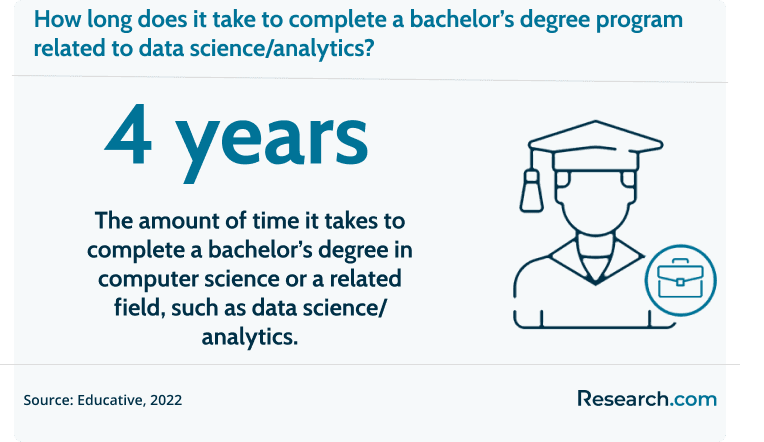
Earning a bachelor’s degree in a field like computer science, software engineering, or a dedicated data engineering BS typically takes four years of full-time study at U.S. universities. For students interested in the foundational sciences, getting an online physics degree bachelor's is another strong option.
If you decide to boost your credentials with a master’s degree, for example, in data engineering or big data systems, you should expect an additional 2 to 3 years of study. Alternatively, for those wanting a faster path, there are certificates like the Data Engineering Professional Certificate that take about 7 months if studying 15 to 20 hours per week.
How do you move from data analyst to data scientist?
Transitioning from a data analyst to a data scientist is a common career path, but it requires developing a deeper skill set beyond reporting and descriptive analytics. While analysts focus primarily on querying, cleaning, and visualizing data, data scientists are expected to build predictive models, apply machine learning techniques, and work with more complex, unstructured datasets.
Key steps in making this move include:
- Strengthen programming skills: Learn Python or R in depth, with a focus on data manipulation, machine learning, and statistical modeling.
- Build a foundation in statistics and math: Understand probability, hypothesis testing, and linear algebra to support advanced modeling.
- Learn machine learning frameworks: Gain hands-on experience with libraries such as scikit-learn, TensorFlow, or PyTorch.
- Expand data handling abilities: Move beyond SQL to work with large datasets using tools like Spark or cloud-based platforms.
- Develop a project portfolio: Create end-to-end projects that showcase predictive modeling, feature engineering, and data storytelling.
- Consider further education or certification: Many professionals pursue online courses, bootcamps, or a master’s degree in data science to formalize their expertise.
With consistent practice and exposure to more advanced projects, analysts can gradually shift into hybrid roles before fully stepping into a data scientist position. Some professionals also pursue an accelerated online master's degree in sports analytics or a related field to strengthen their qualifications and stand out in competitive industries.
What senior roles follow after data engineer, data scientist, and data analyst?
As data professionals gain experience, they often move into more advanced roles that offer higher compensation and greater responsibility. Career progression can lead from technical expertise to leadership or architecture-focused positions. For a look at the essential qualifications for a fulfilling career in education and mental health, you may want to research school counselor license requirements.
Below are some of the most common senior roles that follow after a Data Analyst, Data Scientist, or Data Engineer:
- Senior Data Analyst ($129,781): Senior Data Analysts leverage years of experience to lead reporting initiatives and mentor junior analysts. They often serve as the bridge between business teams and data-driven decision-making at scale.
- Senior Data Scientist ($229,853): Senior Data Scientists take on complex modeling and research projects that influence strategic company decisions. They are also responsible for setting methodological standards and guiding less experienced scientists.
- Senior Data Engineer ($170,725): Senior Data Engineers design and oversee the architecture of large-scale data pipelines and platforms. They frequently lead projects that ensure the scalability, reliability, and efficiency of enterprise data systems.
- Data Architect ($174,794): Data Architects focus on creating high-level frameworks for how data is stored, integrated, and accessed across an organization. Many begin their careers with foundational certifications such as
- Data Science or Engineering Manager ($219,799): Managers in these roles lead teams of analysts, scientists, or engineers and are accountable for both technical direction and people development. They balance strategy, project delivery, and cross-department collaboration.
These senior roles highlight the variety of paths available for experienced data professionals, whether they choose to remain technical specialists or step into leadership. The chart below provides a side-by-side view of the average salaries for each of these positions, making it easy to compare earning potential across career paths.
Are online bootcamps enough to get hired as a data analyst vs. data scientist?
Online bootcamps can be a strong entry point for becoming a Data Analyst, since the role typically emphasizes SQL, Excel, and visualization tools like Tableau or Power BI. Many bootcamps provide hands-on projects and a portfolio that demonstrates these core skills, which are often enough for employers seeking candidates for entry-level analyst positions.
While some employers may prefer a bachelor’s degree in a related field, boot camps can help career changers or recent graduates break into analytics without a traditional academic background. Exploring bachelor's programs online can provide a flexible and structured path for those who seek a formal degree to meet employer requirements or to establish a stronger foundation for career advancement.
For Data scientist roles, however, bootcamps alone are often not sufficient. Employers generally expect candidates to have advanced knowledge of statistics, machine learning, and programming, which usually requires more rigorous academic training or extensive real-world experience.
Programs like an accelerated Microsoft Azure dual certification boot camp online can strengthen technical credentials, but they are typically seen as supplements rather than full replacements for a degree.
Bootcamps may cover the basics of Python and machine learning frameworks, but most companies hiring for data science look for candidates with graduate-level education in computer science, mathematics, or a related discipline.
How do data engineers, data scientists, and data analysts collaborate on a project?
Successful data projects often require collaboration between engineers, scientists, and analysts, each contributing at different stages of the data lifecycle. While their responsibilities differ, their work overlaps to ensure data moves seamlessly from raw collection to actionable insights.
- Data Engineers: They begin the process by building pipelines that collect, clean, and organize raw data from various sources into accessible databases or cloud platforms. Without this foundation, scientists and analysts would lack the reliable data needed for analysis.
- Data Scientists: Once the data is prepared, scientists use it to develop models, test hypotheses, and run advanced analytics. They create predictive or prescriptive outputs that provide deeper insights into trends and potential outcomes.
- Data Analysts: After models are developed, analysts interpret the results and design reports or dashboards. Their work ensures that complex findings are communicated in a way that helps business leaders make informed decisions.
What is the job outlook for data scientists in general?
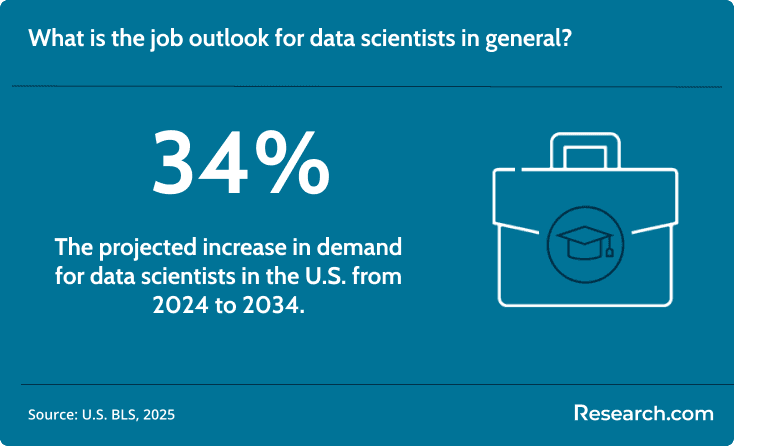
The job outlook for data scientists in the United States remains exceptionally strong, driven by the increasing reliance on data to inform decision-making across industries. Employment of data scientists is projected to grow 34 percent from 2024 to 2034, much faster than the average for all occupations.
This rapid growth reflects the rising demand for professionals who can apply advanced analytics, machine learning, and statistical methods to solve complex business problems and guide innovation. This includes students from HBCU MBA programs online with business leadership training with a focus on historical and cultural significance.
In addition to growth, there will be steady demand from workforce turnover and evolving technology needs. The Bureau of Labor Statistics projects about 23,400 openings for data scientists each year, on average, over the decade.
These opportunities are expected to be especially concentrated in technology, healthcare, finance, and e-commerce, where data-driven strategies are critical to competitiveness.
Here’s what graduates have to say about their data analyst, data science, and data engineering careers:
- Lara: "Starting as a data analyst gave me the confidence to break into the data field without a computer science degree. I loved seeing how my reports directly shaped business strategies, and the clear career pathways made me feel secure about growing in this role."
- Jerome: "Becoming a data scientist has been both challenging and rewarding. The constant opportunity to experiment with machine learning and see my models' impact on real-world outcomes keeps me motivated and excited about the future of data. "
- Vanya: "As a data engineer, I enjoy building the backbone that powers an entire company’s analytics. Working with cutting-edge cloud platforms and big data tools gives me a sense of pride, especially knowing that analysts and scientists rely on the systems I create. "
Key Findings:
- Data engineers, data scientists, and data analysts collaborate in a pipeline where engineers build infrastructure, scientists model data, and analysts report insights.
- The average salary for a data scientist in the U.S. is $129,753, compared to $96,597 for data engineers and $74,593 for data analysts.
- While data analyst roles are the most accessible starting point, data scientist and data engineer careers often require advanced programming and technical expertise.
- About 23,400 openings for data scientists are expected each year, reflecting high demand across industries.
- Employment of data scientists is projected to grow 34% from 2024 to 2034, much faster than the average for all occupations.
References:
Other things you should know about data analyst vs. data scientist vs. data engineer
Yes, coding is often required for these roles. Data analysts typically use SQL and Excel, data scientists often employ Python and R for modeling, and data engineers use languages like Python and Scala for managing data pipelines. Proficiency in coding enhances their effectiveness in analyzing, modeling, and processing data.
In smaller companies or startups, it’s common for one professional to wear multiple hats and handle responsibilities that would typically be split across these roles. However, as organizations grow, the workload and technical requirements often demand specialization.
A single person trying to act as analyst, scientist, and engineer may struggle to maintain efficiency or depth in any one area. Larger companies separate these roles to ensure higher-quality insights, better infrastructure, and more reliable modeling.
In 2027, these roles are distinct yet interconnected. Data analysts focus on interpreting data, data scientists use advanced analytics and modeling, and data engineers ensure data infrastructure supports analysis. While tasks sometimes overlap, each role has unique responsibilities essential for effective data management.