
2027 Best Online Bachelor's Degree Programs

Co-Founder and Chief Data Scientist
A bachelor’s degree is one of the most reliable paths to a stable career, with data showing an 88% employment rate for graduates. Knowing this, however, doesn’t make the next step any easier. Choosing a program can feel overwhelming, especially when you’re trying to avoid debt and ensure employers will respect your degree.
That’s why we’re here to help. The career planning experts who created this guide have over 10 years of experience helping people find the best online bachelor's degree programs for their specific goals. We provide the clear, straightforward advice you need to move forward with confidence.
What are the benefits of getting an online bachelor's degree?
- You gain access to professional careers in high-demand fields like business, healthcare, and technology, setting you up for long-term advancement.
- Graduates significantly increase their earning potential, with an average annual salary of around $95,818.
- The online format offers the flexibility to balance your studies with work and life, earning a credential that 92% of employers view as equal to an on-campus degree.
What can I expect from an online bachelor's degree?
You can expect a structured 120-credit curriculum that takes about four years to complete. Coursework is delivered through a school’s online learning platform, where you will watch lectures, submit assignments, and take exams.
These programs are not self-paced. You will have regular deadlines and be required to interact with your professors and classmates. You will participate in online discussion boards, collaborate on group projects, and receive feedback from your instructors.
You’ll be learning alongside a diverse group of peers. The average online student is 57% women, and many students are working professionals, bringing valuable real-world experience to class discussions. Expect to dedicate significant time each week to your studies, just as you would in an on-campus program.
Where can I work with an online bachelor's degree?
An online bachelor’s degree opens the same career paths as a traditional program. Your chosen field determines which industries and roles you can pursue.
- Corporate and Management Sectors: A bachelor's degree is the standard for professional and management roles across all sectors, as 76.5% of people in these jobs hold a degree.
- Information and Technology: This is a leading industry for graduates, where 64.9% of the workforce holds a bachelor's degree or higher.
- Education and Health Services: This essential sector relies on a highly educated workforce, with 61.2% of its professionals having a degree.
- High-Growth Public and Private Sectors: Future demand is strongest in private education, healthcare, and government, where over 57% of jobs require a degree.
How much can I make with an online bachelor's degree?
The average salary for bachelor's degree holders is around $95,818, which is about $46 per hour. However, several factors can drive your earnings much higher.
- Experience Level: Mid-career professionals who add a degree to their resume can expect to earn up to $125,000.
- Field of Study: Your major is a key factor, with graduates in high-demand fields like petroleum engineering earning over $212,000.
- Industry Sector: Working in a high-paying sector like technology can lead to an average salary of around $120,000.
- Geographic Location: Salaries in major economic hubs are higher, with averages in states like California often exceeding $140,000.
Popular College Degrees Worth Considering in 2027
As online education continues to grow, more students are choosing bachelor’s programs that offer both flexibility and career value. These popular online degrees offer flexibility and strong job demand, helping you gain skills for today’s workforce. Here are some of the most in-demand options:
1. Business Administration
A business administration degree builds leadership, communication, and problem-solving skills. It prepares students for roles in management, marketing, and finance. Graduates often pursue flexible career paths or start their own businesses.
2. Psychology
A psychology degree explores how people think, feel, and behave. Students learn to apply research and critical thinking in human-centered professions. It’s also a strong foundation for graduate study in mental health or counseling.
3. Counseling
A counseling degree focuses on understanding and helping others through communication and empathy. Students gain skills to guide individuals, families, and groups toward emotional well-being. It’s the first step toward becoming a licensed counselor.
4. Nursing
A nursing degree combines science, compassion, and clinical practice. It prepares students to provide safe, effective patient care in hospitals and community settings. Graduates enter a field with consistent job growth and strong career stability.
5. Social Work
A social work degree trains students to advocate for individuals and communities in need. It emphasizes empathy, ethics, and service in diverse social settings. Graduates pursue careers that make a lasting impact in healthcare, education, and public service.
- List of the Best Online Bachelor's Degree Programs for 2027 List of Programs
- How long does it take to complete an online bachelor's degree program? Completion Time
- How does an online bachelor's degree program compare to an on-campus program? How does an online bachelor's degree program compare to an on-campus program?
- What is the average cost of an online bachelor's degree program? Program Cost
- What are the financial aid options for students enrolling in an online bachelor's degree program? Financial Aid
- What are the prerequisites for enrolling in an online bachelor's degree program? What are the prerequisites for enrolling in an online bachelor's degree program?
- What courses are typically in an online bachelor's degree program? What courses are typically in an online bachelor's degree program?
- What types of specializations are available in an online bachelor's degree program? Specializations
- How to Choose the Best Online Bachelor's Degree Program How to Choose the Best Online Bachelor's Degree Program
- What career paths are available for graduates of an online bachelor's degree program? Career Paths
- What is the job market for graduates of an online bachelor's degree program? Job Market
- How Can I Complete My Online Bachelor's Degree Program Faster? How Can I Complete My Online Bachelor's Degree Program Faster?
List of the Best Online Bachelor's Degree Programs for 2027
How do we rank schools?
Recognizing that paying for a degree is a significant investment, our ranking methodology ensures that students can make informed decisions based on comprehensive and transparent information. The ranking draws upon reliable sources such as the IPEDS database, Peterson's database, the College Scorecard database, and The National Center for Education Statistics.
These sources provide a robust foundation of data to evaluate and rank online bachelor's degree programs. For more details on our methodology, please visit Research.com’s methodology page.
1. Florida International University – Online Bachelor of Business Administration in Management
Florida International University provides a comprehensive business foundation, focusing on core principles of organizational management, finance, and marketing. Students learn to apply these concepts to real-world scenarios, developing the skills needed to analyze business challenges and make effective strategic decisions in a flexible online format.
- Program Length: 4 years
- Required Credits to Graduate: 120
- Cost per Credit: $235.57 (in-state); $648.87 (out-of-state)
- Accreditation: Association to Advance Collegiate Schools of Business (AACSB); and Southern Association of Colleges and Schools Commission on Colleges (SACSCOC)
2. Arizona State University – Online Bachelor of Arts in Psychology
Arizona State University offers a comprehensive exploration of human thoughts and behaviors through coursework in statistics, research methods, and core psychological principles. The program equips graduates with a versatile skill set applicable to careers in social services, business, law, and more.
- Program Length: 4 years
- Required Credits to Graduate: 120
- Cost per Credit: $671
- Accreditation: Higher Learning Commission (HLC)
3. Ohio State University – RN to Bachelor of Science in Nursing
Ohio State University’s program is designed for registered nurses seeking to advance their careers through a flexible, 100% online curriculum. The project-based courses expand on existing knowledge, preparing graduates for leadership roles and positioning them for competitive graduate nursing programs.
- Program Length: 1-2 years
- Required Credits to Graduate: 30
- Cost per Credit: $598.50
- Accreditation: Commission on Collegiate Nursing Education (CCNE)
4. University of Utah – Online Bachelor of Social Work
The University of Utah prepares students for entry-level generalist practice with a strong focus on advancing social, economic, and environmental justice. Through a curriculum that includes a supervised internship, graduates are equipped to work effectively with diverse individuals, families, and communities.
- Program Length: 3-4 years
- Required Credits to Graduate: 120
- Cost per Credit: $537.55
- Accreditation: Council on Social Work Education (CSWE)
5. Old Dominion University – Human Services (B.S.)
Old Dominion University prepares students for entry-level roles in community and social service settings, focusing on helping clients solve problems caused by personal and environmental stress. The curriculum covers interpersonal relations, human services methods, and diversity issues, culminating in a professional internship.
- Program Length: 4 years
- Required Credits to Graduate: 120
- Cost per Credit: $264 (in-state); $953.50 (out-of-state)
- Accreditation: Council for Standards in Human Service Education (CSHSE)
6. University of Illinois Springfield – Computer Science, BS
The University of Illinois Springfield provides a firm understanding of the fundamental skills and core theories that define the field of computer science. The program is designed to endure rapid technological change, preparing graduates for versatile and high-demand careers as programmers, analysts, and systems engineers.
- Program Length: 4 years
- Required Credits to Graduate: 120
- Cost per Credit: $566
- Accreditation: Higher Learning Commission (HLC)
7. University of Central Florida – Online Health Information Management, BS
The University of Central Florida integrates business management, systems analysis, and medical coding to prepare students for careers at the heart of the healthcare industry. The program focuses on leveraging information technology to improve patient care, ensuring graduates can manage health data securely and efficiently.
- Program Length: 4 years
- Required Credits to Graduate: 120
- Cost per Credit: $179.19 (in-state); $769.45 (out-of-state)
- Accreditation: Southern Association of Colleges and Schools Commission on Colleges (SACSCOC)
8. Southern New Hampshire University – Online Communication Degree Bachelor of Arts (BA)
Southern New Hampshire University develops versatile communication skills applicable to any industry, covering theory, strategy, and effective message delivery. The program offers several career-focused concentrations, allowing students to tailor their degree to their specific professional goals in a flexible online environment.
- Program Length: 4 years
- Required Credits to Graduate: 120
- Cost per Credit: $342
- Accreditation: New England Commission of Higher Education (NECHE)
9. University of Florida – Bachelor of Science in Interdisciplinary Studies, Concentration in Environmental Management in Agriculture and Natural Resources
The University of Florida offers a solid grounding in hydrology, soil science, and natural resource policy to address modern environmental challenges. The program prepares graduates to integrate agricultural and environmental science in consulting, government, and sustainable production roles.
- Program Length: 4 years
- Required Credits to Graduate: 120
- Cost per Credit: $129.18 (in-state); $552.62 (out-of-state)
- Accreditation: Southern Association of Colleges and Schools Commission on Colleges (SACSCOC)
10. Embry-Riddle Aeronautical University – Bachelor of Science in Aeronautics
Embry-Riddle Aeronautical University offers a multidisciplinary degree designed for students seeking to work in the aerospace industry. The program builds on prior experience with coursework in aviation safety, security, and law, allowing for an accelerated path for those with existing aviation credentials.
- Program Length: 4 years
- Required Credits to Graduate: 120
- Cost per Credit: $522
- Accreditation: Southern Association of Colleges and Schools Commission on Colleges (SACSCOC)
How long does it take to complete an online bachelor's degree program?
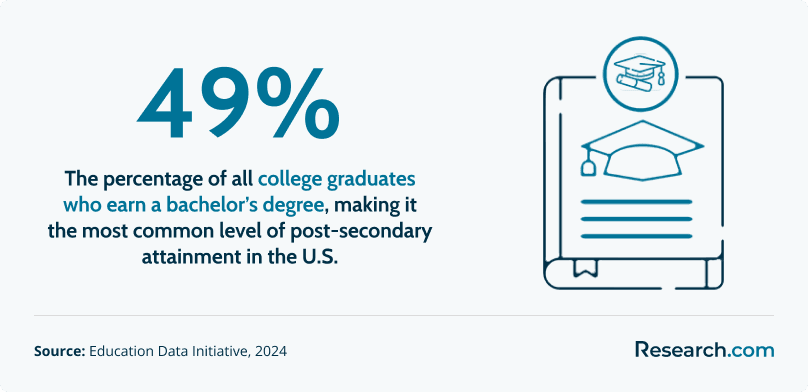
A standard 120-credit online bachelor's degree typically takes four years to complete for a full-time student. This is the most common path in higher education, as nearly half of all graduates earn a bachelor's degree. However, it's also normal for timelines to vary, with about 22% of students taking longer than four years to finish.
Several factors can change your completion time. Studying part-time will extend your timeline, while transferring in previous college credits can shorten it significantly. Many schools also offer accelerated formats to help you finish faster. Some students explore options like 4-week college courses online to complete required courses more quickly.
This four-year timeframe is the standard because the bachelor's is the most common credential people earn. The graphic below shows how it compares to other degrees.
How does an online bachelor's degree program compare to an on-campus program?
The curriculum, credits, and diploma you earn are identical whether you study online or on campus. The key differences are in the delivery method and the overall student experience.
Online Bachelor's Degree Programs
Online programs offer the greatest flexibility, allowing you to fit coursework around your job and family life. This format helps you develop strong self-discipline and digital literacy skills, which are highly valued by employers. You have to be more proactive about networking with classmates and professors since you won't see them in person. If you’re considering advancing your education later, exploring a doctor of education concentration can help you align your studies with your career goals.
On-Campus Bachelor's Degree Programs
On-campus programs provide a traditional college experience with face-to-face instruction and spontaneous collaboration. You have direct access to campus facilities like libraries and labs. The main trade-offs are higher costs for things like housing and transportation, as well as a rigid class schedule that can be difficult to manage with a full-time job.
Ultimately, the choice depends on your life stage and learning style. Employers value both credentials, with data showing that 84% of online undergraduates at ranked programs are employed.
What is the average cost of an online bachelor's degree program?
The average total tuition for an online bachelor's degree is about $43,153 for in-state students. The cost per credit is typically around $404, with most programs falling in a total tuition range of $15,501 to $80,520.
The final price depends on whether the school is public or private and if you qualify for in-state tuition. Even so, an online degree can be over $10,000 cheaper than an on-campus one because you save on costs like housing and transportation. A smart way to lower the total cost even more is to start at one of the cheapest online community colleges and then transfer your credits to a four-year university to complete one of the best online bachelor's degree programs.
As the chart below shows, higher education leads directly to higher earnings, making it a powerful investment in your future.
What are the financial aid options for students enrolling in an online bachelor's degree program?
A wide variety of financial aid options can make your online degree affordable, and nearly 72% of all undergraduate students receive some form of aid to help pay for school. Online students are eligible for the same funding as their on-campus peers.
- Federal Pell Grants: These are need-based grants from the U.S. government that you do not have to repay. About 40% of undergraduates receive Federal Pell Grants, making them one of the most common forms of financial aid for students pursuing a bachelor’s degree.
- Federal Student Loans: The most common form of aid, these government-backed loans offer flexible repayment options after you graduate.
- Scholarships: Many universities and private organizations offer scholarships specifically for online students based on academic merit, financial need, or field of study.
- Employer Tuition Assistance: If you are currently working, your employer may offer a tuition reimbursement program to help cover your educational costs.
- Military and Veteran Benefits: Service members and veterans can use benefits like the Post-9/11 GI Bill, and many schools offer affordable online bachelor's programs for veterans.
What are the prerequisites for enrolling in an online bachelor's degree program?
Prerequisites for the best online bachelor's degree programs ensure you are prepared for college-level work. Admission standards for quality online programs are the same as their on-campus counterparts. If you're exploring options in healthcare, you might also wonder is WGU a good nursing school; its programs are known for flexibility and strong student outcomes.
- High School Diploma or GED: This is the foundational requirement for admission to any accredited bachelor's degree program.
- Minimum GPA: Most universities require a minimum high school GPA, typically around a 2.5, to show you are ready for the coursework.
- Standardized Test Scores: While some schools require SAT or ACT scores, many top programs are now test-optional, evaluating your application more holistically.
- Application and Essays: You will need to submit a standard online application, which may include a personal essay about your academic and career goals.
- Transfer Credits: For those with prior college experience, a key step is assessing how credits transfer, as a clear pathway often exists to go from an AAS to bachelors degree.
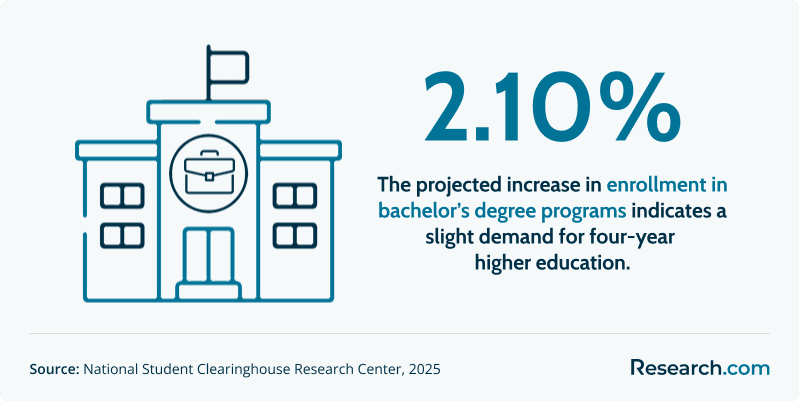
Meeting these requirements is your first step toward enrolling. As the graphic below indicates, the demand for these programs continues to grow.
What courses are typically in an online bachelor's degree program?
An online bachelor's degree is a well-rounded program of study designed to provide both broad knowledge and specialized expertise. The typical standard credit curriculum is divided into several distinct parts.
- General Education Courses: These classes in math, science, and the humanities build a broad foundation of critical thinking and communication skills.
- Core Major Courses: Your program will include required, foundational courses that cover the essential theories and practices of your specific field of study.
- Major Electives: Schools offer a selection of courses that allow you to explore topics within your major that align with your specific interests. For example, if you’re pursuing a social science major, exploring sociology careers can help you choose electives that align with your professional goals.
- Specialization Courses: Many programs feature a focused set of classes that allow you to develop deep expertise in a particular niche within your field.
- Free Electives: Students can often take a few courses from any department in the university to explore other academic interests.
What types of specializations are available in an online bachelor's degree program?
Specializations allow you to tailor your degree to a specific career path, giving you focused knowledge and skills. Choosing the right one is a critical step in maximizing the return on your educational investment.
- Business: This versatile field offers specializations in high-demand areas like finance, marketing, and project management.
- Health Professions: The growing healthcare sector includes specializations such as nursing for registered nurses, health services administration, and public health policy. If you’re exploring long-term care roles, reviewing a nursing home LPN job description can help you understand career paths and skill requirements in this setting.
- Social Sciences and History: This broad area offers focus areas in sociology and political science, preparing you for roles in government and the nonprofit sector.
- Biological and Biomedical Sciences: Students interested in research, medicine, or biotechnology can pursue specializations in molecular biology or genetics.
- Psychology: A psychology degree provides pathways to careers in counseling, human resources, and social work.
- Engineering: This technical field includes in-demand specializations like software development, mechanical engineering, and civil engineering.
The chart below highlights the most common fields where students are currently earning their bachelor's degrees.
How to Choose the Best Online Bachelor's Degree Program
The best program is the one that fits your personal and professional goals. To find the right fit among the best online bachelor's degree programs, evaluate your options using this clear, step-by-step framework.
- Confirm Accreditation: This is the most important first step, as it guarantees the quality of your education and ensures your degree will be respected by employers.
- Align Program with Career Goals: Make sure the curriculum and specializations offered directly support the career path you want to pursue after graduation.
- Evaluate Student Support Services: Look for schools that offer strong academic advising, career counseling, and reliable technical support for online students.
- Analyze Cost and Financial Aid: Compare the total cost of each program after factoring in any grants, scholarships, or loans you expect to receive.
- Check Admission Requirements: Find programs whose requirements you can meet, noting that many are among the best online colleges with no ACT score requirement.
What career paths are available for graduates of an online bachelor's degree program?
A bachelor's degree is the required gateway to a vast number of professional careers. The U.S. Bureau of Labor Statistics officially designates 174 different occupations as typically requiring this credential for entry. Below are just a few of the high-demand career paths available to graduates.
1. Software Developer
Software developers design, build, and maintain the applications and systems that run on computers and other devices. They are the creative minds behind the programs that are essential to business, entertainment, and daily life.
Median salary: $132,460 per year.
2. Registered Nurse
Registered nurses provide and coordinate patient care, educate patients and the public about various health conditions, and provide emotional support to patients and their families. They work in a variety of settings, including hospitals, clinics, and schools.
Median salary: $86,070 per year.
3. Accountant
Accountants prepare and examine financial records, ensuring that they are accurate and that taxes are paid properly and on time. They assess financial operations and work to help organizations run efficiently.
Median salary: $81,370 per year.
4. Market Research Analyst
Market research analysts study consumer preferences, business conditions, and other factors to assess potential sales of a product or service. They help companies understand what products people want, who will buy them, and at what price.
Median salary: $74,680 per year.
5. General and Operations Manager
General and operations managers are responsible for planning, directing, and coordinating the operations of an organization. They oversee multiple departments or locations and ensure the business is running efficiently and profitably.
Median salary: $118,590 per year.
What is the job market for graduates of an online bachelor's degree program?
The job market for graduates with a bachelor's degree is strong, with projected growth that outpaces the average for all other occupations. According to the BLS, employment in bachelor's level occupations is projected to grow by 10% over the next decade. This translates to a huge number of opportunities, as an estimated 43.6 million jobs will require a bachelor’s degree.
The highest demand is concentrated in fast-growing fields like management, healthcare, and technology. The economy is expected to create hundreds of thousands of new positions for roles like general managers, registered nurses, and software developers. Choosing a major that aligns with these high-growth sectors is a key strategy for maximizing your career opportunities after graduation.
The chart below provides a clear look at the projected annual openings for some of the most in-demand roles for college graduates.
Here’s What Graduates Have to Say About Their Online Bachelor's Degree Program
- Angelo: "I was stuck in the same role for five years, constantly being passed over for promotions because I didn't have a bachelor's degree. What was great about studying online was that I could immediately apply what I was learning in my classes to my actual job. Six months after graduating, I was promoted to a management position. It directly translated to the career growth I needed. "
- Jericho: "The nearest university is over two hours away, so moving wasn't an option for me financially. Online learning gave me access to a top-tier program that I never could have attended otherwise. I got a great education without having to leave my hometown and my support system. It really opened up a world of opportunity for me. "
- Lyra: "I've been in my industry for 15 years, but I needed the degree to move into a senior leadership role. I chose a competency-based program that let me test out of subjects I already knew from my work experience. It was challenging, but it meant I didn't have to waste time on things I had already mastered. I was able to finish my entire bachelor's in just under two years. "
How Can I Complete My Online Bachelor's Degree Program Faster?
Accelerated online programs are designed for students who aim to transition into the workforce sooner without sacrificing academic quality. These programs often offer options such as credit for prior learning, intensive course formats, and condensed term schedules to streamline the educational process. Prospective students should explore pathways that allow for legitimate acceleration, such as leveraging credit transfer agreements, enrolling in competency-based courses, or opting for the fastest online degree programs that combine rigorous instruction with expedited timelines. Careful assessment of each program’s structure and accreditation is critical to ensure that speed does not compromise the quality and recognition of your degree.
Key Findings
- An online bachelor's degree holds significant weight with employers, as 92% view credentials from reputable online programs as equal in quality to on-campus degrees.
- The financial return on investment is substantial, with bachelor’s degree holders earning a median of $1,543 weekly, far outpacing the $930 earned by high school graduates.
- Higher education is more accessible than many believe, with data showing that nearly 72% of all undergraduate students receive some form of financial aid to help cover costs.
- This degree is the primary gateway to professional careers, with the U.S. Bureau of Labor Statistics designating 174 occupations as typically requiring a bachelor’s for entry.
- The long-term career outlook is strong, as employment in bachelor's-level occupations is projected to grow by 10% over the next decade, faster than the average for all jobs.
- Students can successfully balance work and school, a fact supported by data showing that 84% of online undergraduates enrolled in ranked programs are currently employed.
References:
- Bureau of Labor Statistics. (2024). Education level and openings, 2024–34. Career Outlook. Retrieved from BLS.
- Bureau of Labor Statistics. (2024). Earnings and unemployment rates by educational attainment. Retrieved from BLS.
- Center on Education and the Workforce, Georgetown University. (2024). Projections of jobs and education requirements through 2031: Executive summary. Retrieved from Georgetown CEW.
- Coursera. (2024). Highest paying bachelor’s degrees. Retrieved from Coursera.
- Education Data Initiative. (2024). Educational attainment statistics. Retrieved from EducationData.
- Education Data Initiative. (2024). Number of college graduates. Retrieved from EducationData.
- National Center for Education Statistics. (2024). Annual reports and information: Indicator on college enrollment. Retrieved from NCES.
- National Center for Education Statistics. (2024). Postsecondary student aid study (NPSAS). Retrieved from NCES.
- National Center for Education Statistics. (2024). Undergraduate enrollment trends. Retrieved from NCES.
- National Student Clearinghouse Research Center. (2025). Current term enrollment estimates. Retrieved from NSC Research Center.
- National University. (2024). Bachelor’s degree statistics. Retrieved from National University.
- Pew Research Center. (2024). Is college worth it? Non-college workers report. Retrieved from Pew Research Center.
- Pew Research Center. (2024). Is college worth it? Economic and social perspectives. Retrieved from Pew Research Center.
- Salary.com. (2024). Bachelor’s salary. Retrieved from Salary.
- U.S. Census Bureau. (2025). Educational attainment data release. Retrieved from U.S. Census Bureau.
Other Things You Should Know About Online Bachelor's Degree Programs
Yes, online bachelor's degree programs in 2027 are eligible for federal financial aid, provided they are accredited by recognized agencies. Students must complete the Free Application for Federal Student Aid (FAFSA) and meet specific financial criteria to qualify for aid options like grants or loans.
In 2027, top-ranked online bachelor's degree programs include those from Arizona State University, University of Florida, and Southern New Hampshire University. These programs are lauded for their flexibility, comprehensive curriculums, and access to resources like virtual libraries and academic advisors, making them popular choices among students.
While most employers recognize the value of online degrees due to reputable accreditation and curriculum rigor, some may still harbor skepticism about their credibility compared to traditional degrees. Factors like program prestige, alumni success, and industry relevance are key in gaining employer respect for online bachelor's degrees in 2027.
For most online bachelor's degree programs, you will need a reliable computer with a current operating system and high-speed internet access. You will also need a webcam and microphone for virtual class meetings or presentations. Some programs may require specific software related to your field of study, which the university will list in its technology requirements.


