
2027 Types of EdD Programs: Choosing the Right Concentration

Co-Founder and Chief Data Scientist
Choosing a doctoral path in education isn’t just about prestige—it’s about direction. In 2024, more than 4,700 people earned doctorates in education, yet their career outcomes and day-to-day work look very different depending on which program they pursued. An EdD can lead to leadership in K-12, higher education, or policy, but each concentration carries its own focus, expectations, and opportunities.
This article breaks down the major types of EdD programs, explains how to evaluate concentrations, and helps you match your choice to your long-term goals.
Key Things You Should Know About the Types of EdD Programs
- EdD programs are professional practice doctorates, designed to prepare graduates for leadership and applied research roles in education rather than academic research careers. This makes them distinct from PhD programs, which primarily focus on theory, research, and scholarly contributions to the field.
- There are multiple concentrations available, including educational leadership, higher education, curriculum and instruction, early childhood, and special education. Each track emphasizes different skills, from managing schools or universities to shaping policy or improving instruction, which means your career direction should determine the concentration you choose.
- Program structures vary significantly—some EdDs are offered fully online, others in hybrid models, and some on campus only. Students must weigh delivery format, residency requirements, time to completion, and dissertation expectations before deciding which program structure best supports their personal and professional commitments.
- What are the types of EdD programs? Types of EdD Programs
- How do I choose the right concentration in 2027? Choosing Concentration
- What are the pros and cons of each EdD concentration? Pros & Cons
- How long does each type of EdD program take? Program Length
- Can I switch concentrations mid-program? Switching Concentrations
- What are the admission requirements for different EdD tracks? Admission Requirements
- How do online/hybrid EdD programs compare to on-campus ones? Online vs On-Campus
- What is a dissertation in practice vs. traditional dissertation? What is a dissertation in practice vs. traditional dissertation?
- What kinds of careers align with different EdD concentrations? What kinds of careers align with different EdD concentrations?
- How much does an EdD program cost by specialization? How much does an EdD program cost by specialization?
What are the types of EdD programs?
There are several types of EdD programs, each defined by its concentration, delivery format, and culminating project. The major varieties include Educational Leadership, Higher Education Administration, Curriculum & Instruction, Organizational Leadership / Change, Learning Technology / Instructional Design, and Special Education Leadership. These types reflect how the practitioner-oriented education degree landscape diversifies given evolving institutional needs.
- Educational Leadership: Focuses on leading K–12 schools and districts. Topics include governance, policy, budgeting, and community relations. Graduates typically become superintendents, principals, or district-level curriculum directors.
- Higher Education Administration: Prepares students to lead in colleges and universities—roles such as dean, provost, student affairs director, or institutional research director. Emphasis is on academic planning, accreditation, and faculty governance.
- Curriculum & Instruction: Centers on improving teaching and learning. Students study assessment, instructional design, teacher training, and curriculum alignment. This type is ideal for professionals who want to design large-scale learning interventions.
- Organizational Leadership / Change: Applies across educational and non-educational institutions (e.g., nonprofits, governmental agencies). The program covers change management, strategic planning, leadership theory, and system transformation.
- Learning Technology / Instructional Design: Focuses on designing, implementing, and evaluating technology-enhanced learning environments. Graduates often lead e-learning initiatives, EdTech integration, or digital curriculum development.
- Special Education Leadership: Combines knowledge of special education theory and law with leadership skills. Students learn to direct programs that serve students with disabilities at district, regional, or governmental levels.
Each type has unique curriculum priorities, stakeholder needs, and career paths. In deciding which to pursue, it’s helpful to look at examples of how these concentrations align with institutional trends and demands in the modern education sector.
How do I choose the right concentration in 2027?
To choose the right EdD concentration, start by aligning your long-term career goals with the specialization’s focus and job outcomes. Next, assess your strengths, current role, and the gaps you want to close. Also evaluate the program format, faculty expertise, and resource support. Finally, compare what each concentration prepares you to do in real settings.
Here are key ways to choose your concentration:
- Career alignment: Look at where you want to work (K–12, higher ed, nonprofits, government) and select a concentration that directly feeds into leadership in that domain.
- Interest and expertise: Pick a concentration that matches your passions and prior experience—if you’re more drawn to curriculum design, go that route; if policy intrigues you, choose that focus.
- Program strength & network: Choose a school that is strong in your intended concentration—its faculty, alumni, and partner institutions will be beneficial. For example, some best music universities in the US offer strong programs and networking opportunities for those interested in music education leadership.
- Format & flexibility: Some specializations are offered more frequently online or hybrid; choose one that fits your work schedule and life situation.
- Demand & market trends: Research which types of educational leadership are growing—especially in your region or country.
- Resource availability: See if the program gives access to internships, practicum placements, or partnerships aligned with your concentration.
Concentration Options and When They Make Sense
- Educational Leadership / K-12: Best if you aim to be a principal, superintendent, or district leader. Choose this when you already work in or plan to stay in a K–12 environment and want direct leadership capacity.
- Higher Education Administration: Ideal if you want to work in colleges or universities (e.g. dean, provost, student affairs). Select this if your inclination is toward postsecondary policy, curriculum, or administration. Students exploring broader higher education leadership may also consider online bachelor degree programs in legal studies to build foundational knowledge in law and policy that can inform administrative decisions.
- Curriculum & Instruction: Pick this concentration if you’re passionate about improving teaching and learning practices, designing assessments, or leading instructional change across schools or districts.
- Organizational Leadership / Change: Opt for this if you envision working in settings beyond schools—such as nonprofits, agencies, or systems that need transformational change.
- Learning Technology / Instructional Design: Best for professionals interested in digital learning, EdTech, blended learning, and instructional systems design. In 2025, this area is growing rapidly.
- Special Education Leadership: Choose this if your focus is on designing and leading programs that support students with disabilities; especially if you have experience or interest in special education.
If you’re comparing doctorate options at that point, you might also find resources on DBA vs EdD helpful for seeing how professional doctorates differ.
What are the pros and cons of each EdD concentration?
Each EdD concentration has strengths and trade-offs—choosing the right one depends on your goals, context, and personal style. The pros and cons will differ by concentration, but here’s a general breakdown followed by concentration-specific considerations. If you're also weighing research doctorates, remember to check out discussions on EdD vs PhD to see how practice versus research orientation matters.
Pros
- Direct applicability: Most EdD concentrations focus on real problems you can apply in your context.
- Leadership preparation: They prepare you for top roles in education leadership, policy, or institutional change.
- Flexibility: Many concentrations are offered online/hybrid, giving working professionals more options.
- Cross-sector relevance: Some concentrations (e.g. organizational leadership) work both inside and outside traditional education.
Cons
- Less emphasis on pure research: If you want a research career, a PhD might serve better.
- Overlap in content: Some courses across concentrations may overlap (e.g. leadership theory), which can feel redundant.
- Resource constraints: Some special concentrations have fewer program offerings, weaker faculty presence, or limited funding.
- Narrowness: If you pick a very niche concentration, job options might be narrower than more general tracks.
How long does each type of EdD program take?
Most EdD programs take between three and five years to complete, depending on the format, concentration, and the student’s pace. Traditional full-time, on-campus programs often run for about three years, while part-time or online programs can extend closer to five years. Program design also matters: some require a dissertation in practice, while others substitute capstone projects, which can shorten or lengthen completion times. Students interested in faith-based leadership can explore bible colleges online, which often offer flexible online EdD tracks aligned with ministry and religious education.
Different concentrations may influence duration. For example, Educational Leadership and Higher Education Administration programs often emphasize practicum or fieldwork that can add time. In contrast, Curriculum & Instruction or Learning Technology may be completed faster due to more streamlined research requirements. Accelerated tracks also exist, particularly in online formats, allowing motivated students to finish sooner. Students comparing timelines should also weigh personal commitments, transfer credits, and whether their institution offers summer or year-round coursework.
For those seeking the fastest EdD online pathways, some universities provide intensive tracks where students can complete requirements in as little as two years, though these programs demand significant time and focus. Ultimately, choosing the right program length involves balancing career goals, workload, and lifestyle needs.
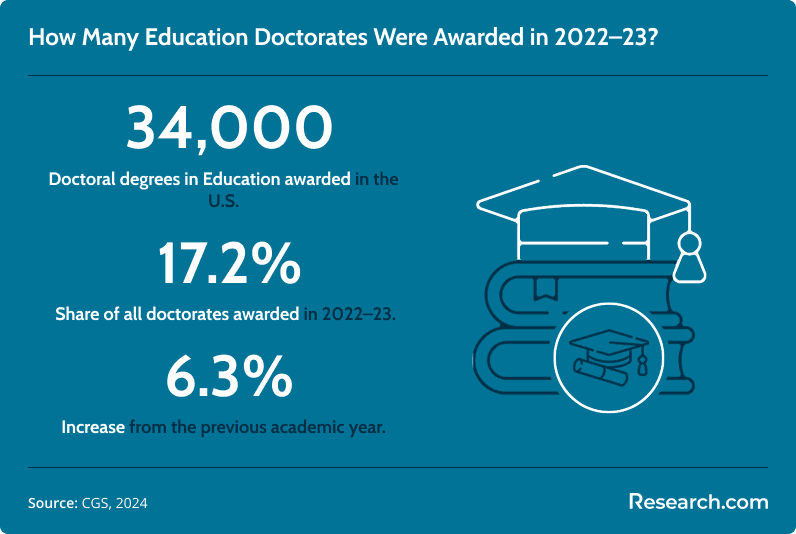
The infographic below highlights recent figures on education doctorates awarded. Seeing the annual output of graduates provides helpful context when considering how long you might commit to such a program and the scale of peers completing similar paths.
Can I switch concentrations mid-program?
Yes, it is possible to switch concentrations mid-program in many EdD tracks, but it often comes with conditions and trade-offs. Most universities allow a concentration change if students meet program requirements and obtain approval from faculty or program directors. However, switching may mean that previously completed coursework does not fully transfer into the new track, resulting in additional credits, extended timelines, and sometimes extra tuition costs.
The feasibility of switching also depends on the overlap between concentrations. For example, moving from Curriculum & Instruction to Educational Leadership may be easier since both share foundational coursework in research and leadership theory. By contrast, shifting into Learning Technology or Special Education Leadership may require taking specialized prerequisite courses that were not part of the original plan.
Students aiming to pivot into a psychology-focused path can explore online PhD in counseling psychology programs to see how their research and leadership skills might transfer to counseling and clinical psychology settings.
What are the admission requirements for different EdD tracks?
Admission requirements for EdD programs generally follow a consistent framework, but specific tracks may add unique expectations. All programs look for applicants with advanced preparation in education or a related field, professional experience, and evidence of leadership potential. Here’s how they typically break down:
General Requirements
- Master’s degree in education or a closely related discipline.
- Minimum GPA of 3.0 (some schools set higher thresholds).
- Professional résumé or CV documenting relevant work experience.
- Personal statement or statement of purpose outlining goals and fit.
- Three letters of recommendation from supervisors or academic references.
- GRE scores (optional at many institutions).
- Writing sample or academic work may be requested.
Track-Specific Requirements
- Special Education Leadership: Prior licensure in special education and documented experience serving students with disabilities.
- Curriculum & Instruction: Evidence of classroom teaching or curriculum development background.
- Higher Education Administration: Previous administrative or student affairs experience in a college or university.
- Learning Technology / Instructional Design: Portfolio or demonstration of digital learning projects or instructional design work.
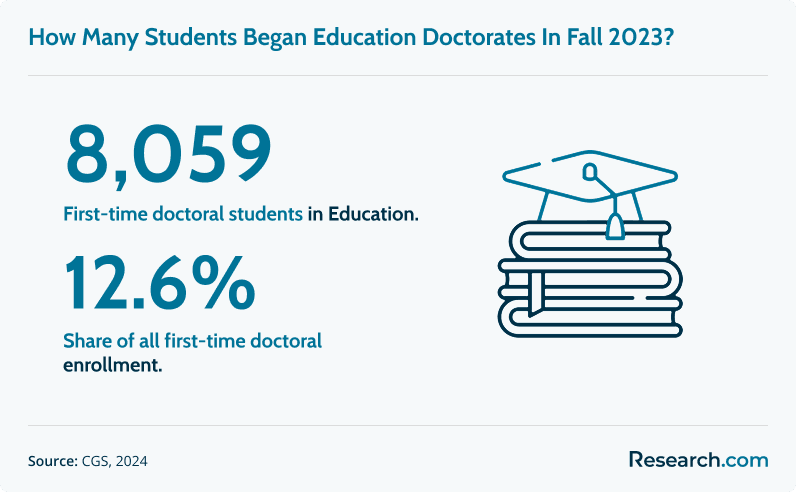
The infographic below highlights how many students entered education doctorates in Fall 2023. These figures help contextualize the scale of admissions, showing both the number of new students and education’s share of overall doctoral enrollment.
How do online/hybrid EdD programs compare to on-campus ones?
Online and hybrid EdD programs provide the same academic credential as on-campus programs, but they differ in delivery, flexibility, and student experience. Online and hybrid formats often appeal to working professionals who cannot relocate or commit to rigid schedules, offering asynchronous or low-residency structures that allow coursework to be balanced with career and family obligations. On-campus programs, in contrast, provide more face-to-face mentorship, immediate access to faculty, and opportunities for in-person networking, though they demand geographic stability and a more structured time commitment.
Hybrid models attempt to bridge the gap by combining online coursework with occasional on-campus residencies. This approach maintains flexibility while still cultivating personal connections. Importantly, whether online, hybrid, or traditional, all EdD programs undergo the same accreditation standards, ensuring comparable academic quality. Many online education programs have evolved to integrate technology, virtual collaboration tools, and robust support services, making them highly competitive alternatives to traditional delivery.
The chart below shows how graduate students across fields engaged in distance education in 2022–23. These figures highlight the growing normalization of online learning, reinforcing why online and hybrid EdD pathways have become mainstream alongside traditional on-campus formats.
What is a dissertation in practice vs. traditional dissertation?
A dissertation in practice is the hallmark of most EdD programs, while the traditional dissertation remains the standard for PhD programs. The key difference lies in focus and application. A traditional dissertation requires students to conduct original scholarly research aimed at advancing theory and contributing to academic literature. It often involves highly controlled studies, comprehensive literature reviews, and detailed methodological frameworks designed for future replication by other researchers.
By contrast, a dissertation in practice emphasizes solving real-world problems within educational settings. Instead of purely theoretical inquiry, students apply existing research to pressing challenges, such as improving student achievement, implementing new technologies, or addressing equity gaps in schools. The output is practical, actionable, and intended to drive organizational change rather than extend academic theory.
Both formats require rigor, but the intended audience differs—scholars and researchers for the traditional dissertation, and practitioners, policymakers, or institutional leaders for the dissertation in practice.
What kinds of careers align with different EdD concentrations?
Graduates of EdD programs can pursue a range of leadership careers, with each concentration aligning to specific roles in education, administration, or policy. These careers focus on shaping institutions, guiding policy, and improving learning systems at multiple levels.
- Chief Academic Officer: Oversees academic programs within school systems or higher education institutions, ensuring instructional quality, curriculum alignment, and faculty development.
- Chief Learning Officer: Leads organizational learning strategies, focusing on training, professional development, and change management across educational or corporate environments.
- Principal (Elementary, Middle, High School): Manages day-to-day operations of schools, supervises teachers, and implements policies to support student learning and school improvement.
- Postsecondary Education Administrator: Directs academic departments, admissions, or student services at colleges and universities, balancing institutional goals with student needs.
- Education Policy Analyst: Researches, evaluates, and advises on education policies, working with government agencies, nonprofits, or think tanks to shape systemic change.
- School Superintendent: Leads entire school districts, managing budgets, policies, staff, and district-wide initiatives aimed at improving educational outcomes.
- Postsecondary Teacher: Teaches at colleges and universities, often combining classroom instruction with applied research and curriculum development.
- Education Consultant: Advises schools, districts, or organizations on instructional practices, leadership strategies, or program development to improve performance.
- Nonprofit Program Director: Oversees educational programs in nonprofit organizations, managing staff, securing funding, and evaluating community impact.
- Curriculum Director: Designs, implements, and reviews curricula at district or state levels, ensuring that instructional materials and standards meet educational objectives.
The chart below provides salary data for these roles, offering perspective on how career alignment with specific EdD concentrations translates into earning potential in the field.
How much does an EdD program cost by specialization?
The cost of an EdD program typically ranges from $30,000 to $80,000, depending on the institution, delivery format, and length of study. Public universities often fall on the lower end, especially for in-state students, while private universities may charge significantly more. Online programs can sometimes reduce overall expenses by lowering fees for campus resources and offering flexible credit pacing.
Specialization rarely changes tuition directly, since most institutions charge the same per-credit rate across concentrations. However, Learning Technology or Organizational Leadership tracks sometimes involve additional technology or project fees. Meanwhile, Special Education Leadership may carry added costs for field placements or licensure-related requirements. In contrast, some Curriculum & Instruction programs are among the most affordable EdD programs, particularly when offered by regional universities with streamlined capstone structures instead of dissertations. Students should also factor in hidden costs like textbooks, residencies, or extended enrollment if research takes longer than expected.
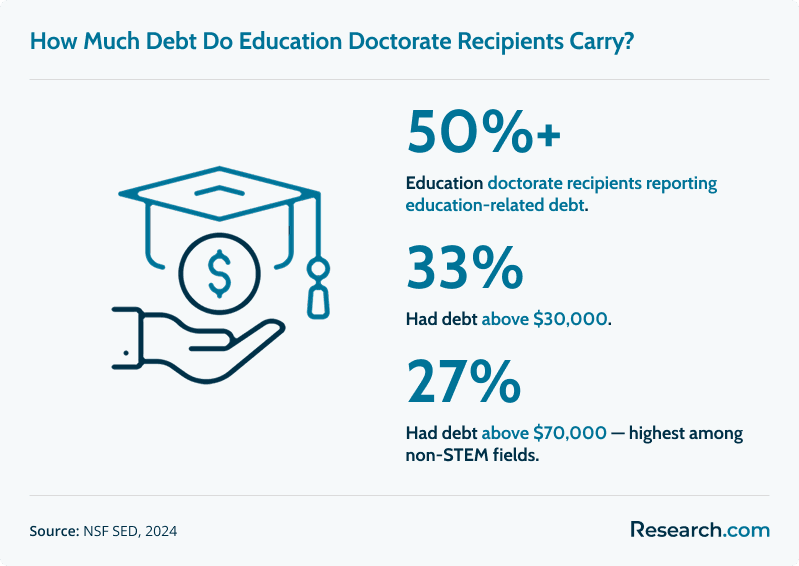
The infographic below highlights debt levels for education doctorate recipients. These figures underscore why evaluating tuition carefully is essential—program costs directly influence long-term financial obligations and repayment, especially given the high proportion of graduates reporting substantial education-related debt.
Here's What Graduates Have To Say About Their EdD Programs
- Minella: "Balancing full-time work with my studies seemed impossible until I enrolled in an online EdD program. The flexibility allowed me to complete coursework on my own schedule while applying lessons directly to my district leadership role. It reshaped how I lead every day. "
- Titus: "The online format connected me with classmates across the country, each bringing unique perspectives from different educational systems. Discussions were dynamic, and I built a network I still lean on today. The program gave me both professional growth and personal confidence. "
- Linda: "I appreciated that the EdD emphasized real-world problem solving rather than abstract theory. My dissertation in practice addressed an issue facing my own institution, and I saw immediate results. The online structure meant I could stay rooted in my community while advancing. "
Key Findings
- In 2022–23, 34,000 doctoral degrees in Education were awarded, making up 17.2% of all doctorates.
- 8,059 students began education doctorates in Fall 2023, representing 12.6% of first-time doctoral enrollment.
- Over 50% of Education doctorate recipients carried education-related debt, with 27% owing more than $70,000.
- About 38.7% of graduate students enrolled exclusively in online programs, reflecting the growth of distance education.
- EdD graduates pursue diverse roles, including chief academic officer, principal, curriculum director, and education consultant.
- EdD programs typically cost $30,000–$80,000, though some concentrations and institutions are among the most affordable EdD programs.
References:
- BLS. Elementary, Middle, and High School Principals.
- BLS. Postsecondary Education Administrators.
- BLS. Postsecondary Teachers.
- CGS. Graduate Enrollment & Degrees 2024.
- College Tuition Compare. Education Major Tuition Data.
- NCES IPEDS. Graduate Student Enrollment in Distance Education.
- NCSES. Survey of Earned Doctorates 2024.
- ZipRecruiter. Chief Academic Officer Salary.
- ZipRecruiter. Chief Learning Officer Salary.
- ZipRecruiter. Curriculum Director Salary.
- ZipRecruiter. Director Nonprofit Salary.
- ZipRecruiter. Education Consultant Salary.
- ZipRecruiter. Education Policy Analyst Salary.
- ZipRecruiter. School Superintendent Salary.
Other Things You Should Know About the Types of EdD Programs
In 2027, concentrations in Educational Technology, Diversity and Inclusion, Curriculum and Instruction, and Leadership and Policy are gaining popularity. These areas address evolving educational needs and societal shifts, equipping educators with skills to foster inclusive environments and integrate technology effectively into learning settings.
Admission requirements for 2027 EdD programs vary by concentration. Some may require a master's degree in education, minimum GRE scores, or specific professional experience. For instance, an EdD in Educational Leadership might necessitate leadership roles in K-12 settings, while others may focus on higher education experience.
In 2027, EdD programs are increasingly offering flexible and interdisciplinary concentrations to meet diverse educational leadership needs. Trends show a rise in specializations such as educational technology, global education, and social justice, reflecting the evolving demands of modern educational environments and the need for versatile leadership skills.


