
2027 Best Online Bachelor's Degree in Legal Studies Programs

Co-Founder and Chief Data Scientist
The legal system's complexity can feel overwhelming, a reality underscored by data showing 92% of low-income Americans lack adequate legal help. This justice gap creates a critical need for skilled professionals at every level. For those exploring their options, an online bachelor's degree in legal studies offers a direct and strategic path into the field.
To help you make an informed choice, our career planning experts, with over 10 years of experience, have developed this comprehensive guide. It provides a clear roadmap that covers everything from program selection to your future career launch.
What are the benefits of getting an online bachelor’s in legal studies program?
- This degree prepares you for a wide range of in-demand careers in law firms, corporations, and government, opening doors to roles like paralegal, compliance analyst, and contract administrator.
- Graduates can expect strong earning potential, with the median wage for legal occupations being approximately $65,000 per year.
- The online format offers the flexibility to earn your degree while managing your current job and life commitments, putting you in control of your schedule.
What can I expect from an online bachelor’s in legal studies program?
You can expect a structured 120-credit curriculum that is academically identical to an on-campus program. This coursework provides a comprehensive foundation in the American legal system. You will complete general education requirements alongside core classes in legal research, writing, torts, and contracts.
A quality online bachelor's degree in legal studies is designed to be just as rigorous as a traditional one. The main difference is how you learn. Many programs offer an asynchronous format, where you complete assignments on your own schedule each week. This offers maximum flexibility. Other programs use a synchronous format with scheduled live online classes, creating a more traditional and interactive classroom experience.
Where can I work with an online bachelor’s in legal studies program?
With this degree, you can find opportunities in a wide range of industries beyond traditional law firms. Graduates with legal expertise are in demand across the economy in both the public and private sectors.
- Legal Services: This is the largest employment sector, where 63.45% of graduates work in roles like paralegals and legal assistants.
- State Government: State governments employ 4.46% of graduates in areas such as court administration and public advocacy.
- Federal Government: This combined government sector provides jobs for 3.56% of graduates in various administrative and regulatory roles.
- Insurance Carriers: Insurance companies employ 2.69% of graduates for positions in claims analysis and policy administration.
- Local Government: Municipal roles, from clerks' offices to local agencies, account for 1.79% of jobs for graduates.
How much can I make with an online bachelor’s in legal studies program?
While salaries can vary, the median wage for legal occupations is approximately $65,000 per year, which is about $31.25 per hour. Your actual earnings will depend on several important factors.
- Education Level: A bachelor's degree averages around $65,000, while an attorney with a law degree can earn $165,000 or more.
- Experience Level: Entry-level roles may start near $100,000, with strong potential for salary growth as you gain experience.
- Industry: Starting salaries in large corporate law firms can reach $225,000, compared to government positions that begin around $80,000.
- Job Title: A litigation associate can earn about $68,000, while a senior paralegal might make around $38,000.
- Location: Salaries are typically highest in major cities like Washington D.C., where they can exceed $220,000.
- List of the Best Online Bachelor’s Degree in Legal Studies Programs for 2027 List of Programs
- How long does it take to complete an online bachelor’s in legal studies program? Completion Time
- How does an online bachelor’s in legal studies program compare to an on-campus program? How does an online bachelor’s in legal studies program compare to an on-campus program?
- What is the average cost of an online bachelor’s in legal studies program? Program Cost
- What are the financial aid options for students enrolling in an online bachelor’s in legal studies program? Financial Aid
- What are the prerequisites for enrolling in an online bachelor’s in legal studies program? What are the prerequisites for enrolling in an online bachelor’s in legal studies program?
- What courses are typically in an online bachelor’s in legal studies program? What courses are typically in an online bachelor’s in legal studies program?
- What types of specializations are available in online bachelor’s in legal studies programs? Specializations
- How to Choose the Best Online Bachelor’s in Legal Studies Program How to Choose the Best Online Bachelor’s in Legal Studies Program
- What career paths are available for graduates of an online bachelor’s in legal studies program? Career Paths
- What is the job market for graduates of an online bachelor’s in legal studies program? Job Market
List of the Best Online Bachelor’s Degree in Legal Studies Programs for 2027
How do we rank schools?
Recognizing that paying for a degree is a significant investment, our ranking methodology ensures that students can make informed decisions based on comprehensive and transparent information. The ranking draws upon reliable sources such as the IPEDS database, Peterson's database, the College Scorecard database, and The National Center for Education Statistics.
These sources provide a robust foundation of data to evaluate and rank online bachelor's in legal studies programs. For more details on our methodology, please visit Research.com’s methodology page.
1. University of Arizona - Law Bachelor of Arts
The University of Arizona offers the nation's first B.A. in Law, teaching students to "think like a lawyer" through a curriculum developed by the James E. Rogers College of Law. The program provides an in-depth foundation in legal subjects and offers an accelerated path to a master's degree.
- Program Length: 4 years
- Required Credits to Graduate: 120
- Cost per Credit: $525
- Accreditation: WASC Senior College and University Commission (WSCUC)
2. University of Central Florida - Online Legal Studies, BA/BS
The University of Central Florida provides a strong foundation in the legal system, with all full-time faculty being graduates of ABA-approved law schools. The curriculum explores the intersection of law with business and technology and requires an internship or capstone project to ensure practical experience.
- Program Length: 4 years
- Required Credits to Graduate: 120
- Cost per Credit: $179.19
- Accreditation: Southern Association of Colleges and Schools Commission on Colleges (SACSCOC)
3. Pennsylvania Western University - Legal Studies, BA
Pennsylvania Western University delivers an ABA-approved curriculum that meets the highest standards of legal education, preparing graduates for high-demand paralegal and court support roles. The program offers the flexibility of online or blended formats and focuses on developing strong analytical and research skills.
- Program Length: 4 years
- Required Credits to Graduate: 120
- Cost per Credit: $333 (in-state)
- Accreditation: Middle States Commission on Higher Education (MSCHE)
4. Colorado State University Global - Online Bachelor’s in Legal Studies
Colorado State University Global offers an interdisciplinary approach, combining core legal principles with courses in political science, history, and ethics to build a comprehensive perspective. The program emphasizes critical thinking and practical skills, including mastery of The Bluebook legal citation system for law school preparation.
- Program Length: 4 years
- Required Credits to Graduate: 120
- Cost per Credit: $375
- Accreditation: Higher Learning Commission (HLC)
5. University of Massachusetts Global - BA in Legal Studies
The University of Massachusetts Global features a curriculum taught by practitioner faculty who have served as attorneys and investigators, ensuring real-world relevance. The program is delivered in a structured eight-week session format and offers distinct concentrations to tailor your education to specific career goals.
- Program Length: 4 years
- Required Credits to Graduate: 120
- Cost per Credit: $500
- Accreditation: WASC Senior College and University Commission (WSCUC)
6. Bellevue University - Bachelor of Science Legal Studies Degree
Bellevue University provides an accelerated cohort model for transfer students, allowing them to take one course at a time with the same group of peers online. This format fosters a collaborative learning environment and focuses on applying critical thinking to real-world legal scenarios.
- Program Length: 4 years
- Required Credits to Graduate: 127
- Cost per Credit: $459
- Accreditation: Higher Learning Commission (HLC)
7. Herzing University - Legal Studies Online Bachelor's Degree Program
Herzing University offers a career-focused curriculum that allows students to transfer up to 93 credits and prepares them for the Certified Paralegal Examination. The program provides significant flexibility and concludes with a choice between a capstone project or a hands-on internship for practical experience.
- Program Length: 36 months
- Required Credits to Graduate: 125
- Cost per Credit: $530
- Accreditation: Higher Learning Commission (HLC)
8. University of Maryland Global Campus - Online Bachelor's Degree: Legal Studies
The University of Maryland Global Campus designs its program for working professionals, featuring hands-on projects like drafting mock client letters and case reports. The curriculum emphasizes career-relevant skills in legal research and analysis, supported by a generous transfer credit policy to save time and money.
- Program Length: 4 years
- Required Credits to Graduate: 120
- Cost per Credit: $330
- Accreditation: Middle States Commission on Higher Education (MSCHE)
9. University of Wisconsin - Bachelor of Arts/Bachelor of Science in Legal Studies
The Universities of Wisconsin delivers an interdisciplinary major through UW-Whitewater that is designed as a direct pathway to law school or legal careers. The curriculum includes courses in public policy and business law and mandates a real-world internship in a court, firm, or government agency.
- Program Length: 4 years
- Required Credits to Graduate: 120
- Cost per Credit: $399
- Accreditation: Higher Learning Commission (HLC)
10. Washburn University - Bachelor of Legal Studies
Washburn University provides extensive hands-on training, including legal research using Westlaw and practical experience in drafting legal documents. The program fosters strong mentorship between students and faculty and offers a Law Early Admission Program (LEAP) for those on a pre-law track.
- Program Length: 4 years
- Required Credits to Graduate: 120
- Cost per Credit: $470
- Accreditation: Higher Learning Commission (HLC)
How long does it take to complete an online bachelor’s in legal studies program?
A standard online bachelor's in legal studies program, which includes 120 credits, typically takes four years of full-time study to complete. However, your personal timeline can be quite different. Many students choose a part-time schedule to balance school with work, and data shows that 22.3% of all bachelor's students take more than four years to finish.
You may also be able to finish your degree faster. If you have prior college experience, most universities will accept transfer credits, which can significantly shorten your time to graduation. Some schools also offer accelerated formats. This flexible approach is a popular feature in many fields, such as an accelerated online political science bachelor's degree. This path is common for working adults, as the average age of employees in the legal studies field is 43.1 years.
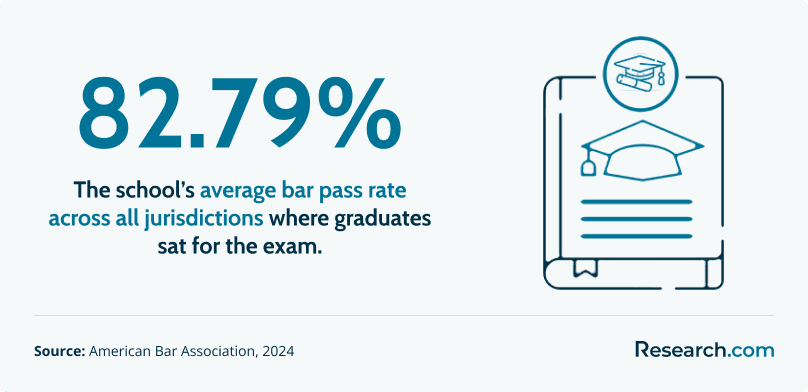
For students on a pre-law track, a key indicator of a program's quality is the success of its graduates. It's helpful to know that the American Bar Association's weighted average bar pass rate across all accredited law schools is a strong.
How does an online bachelor’s in legal studies program compare to an on-campus program?
When a program is accredited, the degree you earn is identical to the one students get on campus. The primary differences are found in the learning format and the overall student experience, not in the academic quality or the diploma itself. It’s also important to understand what is a diploma mill so you can avoid unaccredited institutions that offer degrees with little or no academic value.
Online Bachelor's in Legal Studies Programs
The greatest advantage of an online program is flexibility. Asynchronous classes allow you to complete coursework on your schedule, which is a major benefit for working professionals and those with family commitments. Accreditation ensures the program meets high academic standards. In fact, the legal community's acceptance is growing, with the American Bar Association now allowing law schools to offer as much as 50% of J.D. credits through distance education. Students exploring interdisciplinary interests may also want to understand the difference between a double major vs dual degree to make the most of their academic options.
On-Campus Bachelor's in Legal Studies Programs
A traditional campus program offers a more structured environment. You get valuable face-to-face interaction with your professors and classmates, which can make networking more organic. Students in on-campus programs also have direct access to physical resources like law libraries, in-person academic advising, and student organizations.
What is the average cost of an online bachelor’s in legal studies program?
The average total tuition for an online bachelor's in legal studies is approximately $49,788 for in-state students and $64,395 for out-of-state students. This cost can range widely, from about $21,500 to over $102,000, depending on the institution. On average, you can expect to pay around $410 per credit hour as an in-state student and $532 as an out-of-state student.
The final price will depend on factors like whether you choose a public or private university. It is more helpful to think of this cost as an investment in your future career. To understand the return on this investment, you can look at the potential salaries for the career paths this degree opens up. For example, a litigation associate can earn around $68,000, and a senior paralegal can make about $38,000. The chart below shows some of the highest-paying jobs you can pursue with this degree. Accreditation can also affect your program’s value. For instance, knowing the difference between coamfte vs cacrep in counseling program accreditation helps ensure you select a program that meets professional and academic standards.
What are the financial aid options for students enrolling in an online bachelor’s in legal studies program?
Students in accredited online programs have access to the same financial aid opportunities as on-campus students. Understanding your options is the first step toward creating a plan to fund your education.
- Federal Grants: These are need-based funds from the government, like the Pell Grant, that you do not have to repay.
- Federal Student Loans: These are government-backed loans with favorable interest rates and repayment plans that must be repaid after you graduate.
- Scholarships: These merit-based or demographic-based awards from schools and private organizations represent free money toward your tuition.
- Work-Study Programs: This program provides part-time jobs for students with financial need, allowing you to earn money to help pay for educational expenses.
- The FAFSA: Completing the Free Application for Federal Student Aid is the single most important step and your gateway to accessing most types of aid.
What are the prerequisites for enrolling in an online bachelor’s in legal studies program?
Admission requirements are designed to ensure you are prepared for the focused curriculum of a legal studies program. The prerequisites are straightforward and recognize a variety of academic and professional backgrounds.
- High School Diploma or GED: This is the foundational academic requirement for any bachelor's degree program.
- Minimum GPA: Many universities require a minimum high school GPA, often around a 2.5, but this standard can vary.
- Standardized Test Scores: While some schools still ask for SAT or ACT scores, many top programs are now test-optional.
- Transfer Credits: For students with prior college experience, your previous GPA and transferable credits are the most important admission factors.
- Application Essay: Your essay is a chance to demonstrate your passion for the law and connect it to your life or work experience.
For those planning to attend law school, it's helpful to understand the admissions landscape. The Law School Admission Test (LSAT) is a key factor, used by 98% of matriculants. Acceptance rates for J.D. programs are competitive, with a median rate between 41-42%. After a recent increase in applicants, the number of students currently enrolled in ABA-approved schools provides a clear picture of the field you're preparing to enter, as shown in the chart below.
What courses are typically in an online bachelor’s in legal studies program?
The curriculum is designed to provide a comprehensive understanding of the U.S. legal system, preparing you to join the workforce where 17.9% of professionals hold degrees in legal studies. You will learn a blend of legal theory and essential practical skills through courses like these.
- Introduction to Law: This foundational course covers the history of the legal system, the sources of law, and the structure of the courts.
- Legal Research and Writing: This is a critical, skills-based course where you learn how to find and cite legal precedent and draft professional documents.
- Substantive Law Courses: You will study key areas like Torts, Contracts, and Constitutional Law that form the bedrock of legal theory.
- Procedural Law Courses: These courses, such as Civil Procedure, teach the specific rules and processes of the court system.
- Practical Skills Electives: These modern courses focus on career-ready topics like legal technology, and the analytical skills you develop are so versatile that some students also explore crime analysis online degrees.
What types of specializations are available in online bachelor’s in legal studies programs?
Specializations allow you to develop deep expertise in a specific area of law, which helps you target your career goals more effectively. Choosing a concentration is a key step in tailoring your degree to the job you want after graduation.
- Corporate and Business Law: This area focuses on contracts, corporate governance, and compliance, making it ideal for in-house legal careers.
- Criminal Law: Coursework in this track explores criminal procedure and substantive statutes, preparing you for work in law enforcement or defense firms. Students often compare the best jobs in criminology to these legal support roles.
- Litigation and Trial Advocacy: A focus here prepares you for the process of civil lawsuits, from discovery to trial, for roles like litigation paralegal.
- Intellectual Property: The curriculum in this specialization covers high-tech topics including patents, trademarks, and copyrights.
- Healthcare Compliance: This rapidly growing field concentrates on the complex regulations that govern the healthcare industry.
How to Choose the Best Online Bachelor’s in Legal Studies Program
The best online bachelor’s in legal studies program is the one that fits your specific career goals, budget, and learning style. Use the following factors as a checklist to evaluate your options and make a confident choice.
- Accreditation: Ensure the program has regional accreditation, which is essential for quality, credit transfer, and financial aid eligibility.
- Curriculum and Specializations: Look for a curriculum with courses and specializations that align directly with your desired career path. For instance, understanding the difference between front end and back end development can be useful if you’re interested in legal tech or digital law fields.
- Faculty Expertise: Research the faculty to confirm you will be learning from experienced legal professionals and respected academics.
- Flexibility and Student Support: Consider the learning format and the availability of student support services like academic advising and career counseling.
- Total Cost and Financial Aid: Evaluate the total cost of the program, not just the tuition, and factor in the financial aid package to understand the long-term value.
What career paths are available for graduates of an online bachelor’s in legal studies program?
This degree prepares you for a wide variety of roles within the legal field and in other industries where legal knowledge is a major asset. Graduates are prepared for careers that require strong research, writing, and analytical skills.
1. Paralegal
Paralegals are essential members of a legal team who assist lawyers with legal research, drafting documents, and managing cases. Many roles require specialized knowledge learned in specific business law courses.
Median Salary: $59,200 per year.
2. Compliance Analyst
A compliance analyst ensures that a company is conducting its business in full compliance with all applicable laws and regulations. This involves developing internal policies, conducting audits, and staying current on legal changes.
Median Salary: $71,100 per year.
3. Contract Administrator
Contract administrators manage the entire lifecycle of a company's contracts, from initial negotiation and drafting to execution and renewal. They work to ensure that all parties adhere to the terms of the agreement.
Median Salary: $75,500 per year.
4. Mediator
A mediator is a neutral third party who facilitates negotiations between disputing parties to help them reach a mutual agreement outside of court. This career requires exceptional communication and problem-solving skills.
Median Salary: $64,400 per year.
5. Policy Advisor
Policy advisors research complex issues and advise government officials or private organizations on public policy matters. Their work often involves analyzing proposed legislation and recommending courses of action.
Median Salary: $80,700 per year.
The chart below visually demonstrates how graduates are employed across many different occupational categories, not just strictly legal ones.
What is the job market for graduates of an online bachelor’s in legal studies program?
The job market for graduates of an online bachelor's degree in legal studies is strong, with the U.S. Bureau of Labor Statistics projecting steady growth and about 83,800 openings each year in legal occupations. This positive outlook reflects a growing demand for skilled legal professionals across the economy. The workforce with this specific degree is also expanding, seeing a 3.4% increase in 2023 alone.
Demand is particularly high in complex sectors like healthcare and corporate compliance. This creates a favorable environment for new graduates, as the field is growing, while the number of new degrees awarded recently saw a 16.3% decline, suggesting less competition for roles. The skills you gain are also valuable in related fields. For example, a forensic science technician salary by state can also be quite competitive.
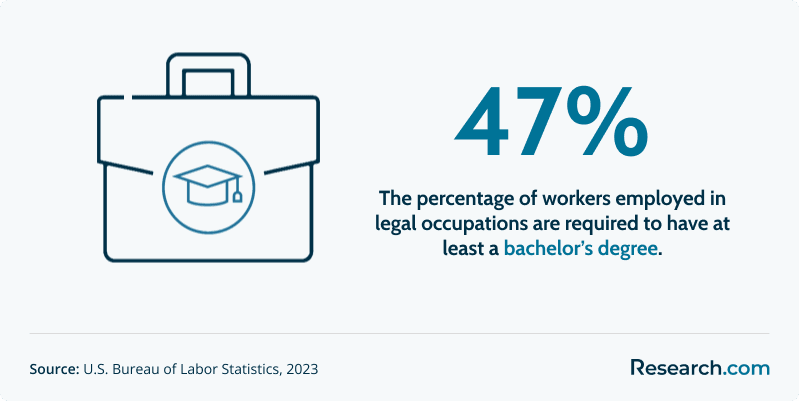
Ultimately, this degree prepares you for a robust and evolving job market. Beyond the specifics of the legal field, a bachelor's degree itself is a valuable asset, with 47% of all workers employed in occupations that require one.
Here’s What Graduates Have to Say about Their Online Bachelor’s in Legal Studies Program
- Danica: "I was working in hospital administration but felt stuck. I wanted to move into the compliance department, but I didn't have the right qualifications and couldn't afford to quit my job to go back to school. Studying online allowed me to gain the specific legal knowledge I needed during nights and weekends. Six months after graduating, I was promoted to Compliance Analyst, a move that came with a significant salary increase."
- Casey: "After ten years as a paralegal, I hit a professional ceiling because I didn't have a bachelor's degree. I already had the practical experience, but I needed the credential to advance. The program built upon my existing knowledge and gave me the academic foundation to qualify for senior roles. I was promoted to Senior Paralegal before I even officially had my diploma in hand."
- Silva: "As a single parent, my schedule is completely unpredictable. The thought of attending scheduled classes was impossible. The asynchronous format of my program was perfect because I could listen to lectures and do my coursework after my daughter was asleep. It was challenging, but the flexibility made it possible for me to finish my degree and build a better future for us."
Key Findings
- Graduates entering the legal field can expect a strong return on their educational investment, with the median wage for legal occupations standing at approximately $65,000 per year.
- The job market for legal professionals is robust and expanding, as the U.S. Bureau of Labor Statistics projects about 83,800 new openings each year, ensuring a stable career path.
- The legitimacy of online education is increasingly recognized, a trend validated by the American Bar Association's decision to allow law schools to offer up to 50% of J.D. credits through distance learning.
- While 63.45% of graduates work in the legal services sector, this degree opens doors to diverse industries, including state government, insurance, and corporate compliance, offering a wide range of career environments.
- This degree is a strategic choice for working professionals seeking to advance their careers, as reflected by the average employee age of 43.1 years in the legal studies field.
- The average total tuition for an online bachelor's in legal studies is approximately $49,788 for in-state students, making it a financially accessible pathway into the legal profession when combined with available aid.
References:
- American Bar Association. (2024). Accreditation statistics. Retrieved from ABA
- Bureau of Labor Statistics. (2023). Lawyers: Occupational outlook handbook. Retrieved from BLS
- Bureau of Labor Statistics. (2023). Legal occupations: Occupational employment and wages. Retrieved from BLS
- Bureau of Labor Statistics. (2024). Law and legal studies: Field of degree. Retrieved from BLS
- Data USA. (n.d.). Legal studies and jurisprudence profile. Retrieved from Data USA
- Education Data Initiative. (2024). Number of college graduates. Retrieved from EducationData
- Juris Education. (2024). Law school acceptance rates. Retrieved from Juris Education
- Law School Admission Council. (2024). Access to legal education expanded through increased distance learning. Retrieved from LSAC
- Law School Admission Council. (2024). The class of 2024: First impressions. Retrieved from LSAC
- Law School Admission Council. (2025). Keeping up with the data: May 2025. Retrieved from LSAC
- Legal Services Corporation. (2024). The justice gap in America. Retrieved from LSC
- Stanford Law School. (2024). Justice for all: Why we have an access to justice gap in America and what can we do about it. Retrieved from Stanford Law
- Zippia. (2024). Legal studies major overview. Retrieved from Zippia
Other Things You Should Know About Online Bachelor’s in Legal Studies Programs
When choosing the best online Bachelor's degree in legal studies in 2027, consider program accreditation, faculty expertise, curriculum comprehensiveness, and opportunities for hands-on experience. Ensure the program offers robust networking opportunities and tech support for a smooth online learning experience. Cost and financial aid availability are also important factors.
Most 2027 online Bachelor's degree programs in legal studies require a high school diploma or GED for enrollment. Additionally, some programs may request ACT/SAT scores or prerequisite coursework in subjects like English or Social Studies. Check individual program requirements for specifics.


