
2027 Best Online Master's in Political Science Programs

Co-Founder and Chief Data Scientist
The job market for political scientists is projected to decline by 3% over the next decade. That single data point makes choosing a graduate program an incredibly high-stakes decision. You might be wondering if this path is a smart investment in your future or a costly mistake, and that uncertainty can be overwhelming.
This is where clear guidance becomes essential. The career planning experts who built this guide have over 10 years of experience helping people navigate these exact challenges. This is more than a simple ranking of online master's programs in political science; it's a comprehensive reality check designed to give you the data on both the opportunities and the risks, so you can make a confident choice.
What are the benefits of getting an online Master's in Political Science?
- This degree develops specialized analytical skills for a focused career as a federal policy analyst or as preparation for a Ph.D. program.
- You can achieve significant earning potential, with the median salary for political scientists in the federal government reaching $151,630.
- The online format provides the flexibility to balance rigorous graduate-level coursework with your current professional and personal commitments.
What can I expect from an online Master's in Political Science?
You can expect a curriculum that is far more rigorous and research-intensive than your undergraduate studies. These programs are designed to teach you how to analyze complex political systems, not just learn about them.
The most important thing to understand is that not all courses are created equal when it comes to your career prospects. While you will study political theory and international relations, the most valuable part of your curriculum will be the quantitative methods courses.
Employers, especially in the federal government, need analysts who can work with data. Learning to use statistical software like R or Stata is no longer optional; it's the core skill that will make you a competitive candidate. When you evaluate a program, your first question should always be about the strength of its research methods training.
Where can I work with an online Master's in Political Science?
The vast majority of positions are located in the Washington, D.C. area, a key factor when considering online master's programs in political science. For those seeking policy-focused careers with more geographic flexibility, a Master of Social Work (MSW) can be a more versatile alternative.
According to the U.S. Bureau of Labor Statistics, the largest employers of political scientists in 2024 were as follows:
- Federal government, excluding postal service: Employs 67% of all political scientists, primarily in analyst and research roles.
- Professional, scientific, and technical services: Employs 15% in areas like consulting, polling, and private-sector research.
- Educational services; state, local, and private: Employs 6% in teaching, academic research, and administrative positions.
- Religious, grantmaking, civic, and professional organizations: Employs 3%, often in advocacy, lobbying, and nonprofit work.
How much can I make with an online Master's in Political Science?
An online Master's in Political Science can lead to a high salary, but your earnings will depend heavily on your sector and years of experience. According to the U.S. Bureau of Labor Statistics, as of May 2024, the median annual wages for political scientists were highest in the federal government.
Here is a breakdown of the top industries:
- Federal government: Offers a median salary of $151,630.
- Professional, scientific, and technical services: Provides a median salary of $130,580 for roles in consulting and research.
- Educational services: Includes state, local, and private institutions with a median salary of $81,620.
- List of the Best Online Master's in Political Science Programs for 2027 List of Programs
- How long does it take to complete an online Master's in Political Science program? Completion Time
- How does an online Master's in Political Science program compare to an on-campus program? How does an online Master's in Political Science program compare to an on-campus program?
- What is the average cost of an online Master's in Political Science program? Program Cost
- What are the financial aid options for students enrolling in an online Master's in Political Science program? Financial Aid
- What are the prerequisites for enrolling in an online Master's in Political Science program? What are the prerequisites for enrolling in an online Master's in Political Science program?
- What courses are typically in an online Master's in Political Science program? What courses are typically in an online Master's in Political Science program?
- What types of specializations are available in an online Master's in Political Science program? Specializations
- How to Choose the Best Online Master's in Political Science Program How to Choose the Best Online Master's in Political Science Program
- What career paths are available for graduates of an online Master's in Political Science program? Career Paths
- What is the job market for graduates of an online Master's in Political Science program? Job Market
- Is an Online Master's in Political Science the Right Advanced Choice for You? Is an Online Master's in Political Science the Right Advanced Choice for You?
List of the Best Online Master's in Political Science Programs for 2027
How do we rank schools?
Recognizing that paying for a degree is a significant investment, our ranking methodology ensures that students can make informed decisions based on comprehensive and transparent information. The ranking draws upon reliable sources such as the IPEDS database, Peterson's database, the College Scorecard database, and The National Center for Education Statistics.
These sources provide a robust foundation of data to evaluate and rank online Master's in Political Science programs. For more details on our methodology, please visit Research.com’s methodology page.
1. Indiana University – Political Science, M.A.
Through Indiana University’s program, you’ll learn to interpret the political landscape using the approaches and methods of a political scientist. Coursework emphasizes empirical social science research and political behavior, opening pathways into NGOs, lobbying, and public service.
- Program Length: 30 credit hours
- Tracks: World politics; and American politics
- Required Credits to Graduate: 30
- Cost per Credit: $350 (in-state)
- Accreditation: Higher Learning Commission (HLC)
2. The University of West Florida – Political Science, M.A. Online
The University of West Florida offers a writing and research-intensive program designed to develop strong analytical skills for careers in policy and government. The curriculum is delivered through synchronous coursework for real-time faculty interaction and can be customized with a thesis or non-thesis track.
- Program Length: 24 months
- Required Credits to Graduate: 33
- Cost per Credit: $384.60 (in-state)
- Accreditation: Southern Association of Colleges and Schools Commission on Colleges (SACSCOC)
3. Liberty University – Master of Science in Political Science – General
Liberty University provides a broad-based, theoretical study of government and politics, examining historical and contemporary ideas from a foundation of Christian principles. This program is designed to develop the research and writing skills necessary for doctoral studies or for a career in diplomacy.
- Program Length: 36 credit hours
- Required Credits to Graduate: 36
- Cost per Credit: $580
- Accreditation: Southern Association of Colleges and Schools Commission on Colleges (SACSCOC)
4. University of Southern Mississippi – Political Science MA
The University of Southern Mississippi offers a student-focused curriculum that explores the connections between government, culture, and economics from domestic and international viewpoints. The program is designed to prepare knowledgeable global citizens through a dynamic online environment that encourages thoughtful discussion and intellectual diversity.
- Program Length: 2 years
- Required Credits to Graduate: 30
- Cost per Credit: $578.12
- Accreditation: Southern Association of Colleges and Schools Commission on Colleges (SACSCOC)
5. University of Illinois Springfield – Political Science, MA
The University of Illinois Springfield blends theoretical knowledge with practical application, leveraging its location in the state capital to prepare students for impactful careers. Designed for working professionals, the curriculum develops advanced analytical skills and allows students to test political theories in real-world scenarios.
- Program Length: 2 years
- Specializations: American Politics; State and Local Government; Comparative Politics; International Relations; Public Policy; Constitutional Theory; US Supreme Court and Judicial Politics; and Political Philosophy
- Required Credits to Graduate: 40
- Cost per Credit: $376.75 (in-state)
- Accreditation: Higher Learning Commission (HLC)
6. Georgia State University – Online Political Science, M.A. - Concentration in Professional Politics
With a curriculum centered on experiential learning, such as internships and consulting projects, Georgia State University helps students build practical skills for careers in professional politics. Its accelerated seven-week minimester format makes it possible for working professionals to finish the degree in just 15 months while learning from faculty who remain active in the field.
- Program Length: 3 to 4 semesters
- Concentration: Professional Politics
- Required Credits to Graduate: 30
- Cost per Credit: $105 (in-state)
- Accreditation: Southern Association of Colleges and Schools Commission on Colleges (SACSCOC)
7. University of Nebraska Omaha – MS in Political Science
The University of Nebraska Omaha offers a broad foundation in political science with a high degree of interdisciplinary flexibility, ideal for working professionals. The program prepares practitioners for diverse careers in government, intelligence, and education by allowing students to incorporate interests from other disciplines.
- Program Length: 3 years (part-time)
- Concentrations: International Affairs; and American Government
- Required Credits to Graduate: 30
- Cost per Credit: $421 (in-state)
- Accreditation: Higher Learning Commission (HLC)
8. Texas Woman's University – Master of Arts in Political Science
Texas Woman's University provides a multicultural view of politics and law, emphasizing the diverse experiences of women, men, and children across varied backgrounds. The program offers personalized faculty attention in small seminars and challenges students to become active practitioners of the discipline.
- Program Length: 2 years
- Required Credits to Graduate: 30
- Cost per Credit: $576 (in-state)
- Accreditation: Southern Association of Colleges and Schools Commission on Colleges (SACSCOC)
How long does it take to complete an online Master's in Political Science program?
Most online master’s programs in political science take about 1.5 to 2 years to complete for full-time students. If you need to balance your studies with a job or family, part-time options are widely available and typically extend the timeline to 3 or 4 years.
Choosing Your Pace: Full-Time, Part-Time, and Accelerated Pathways
For working professionals, part-time study is often the most practical path. It allows you to maintain your career momentum while gaining new skills. However, you need to be realistic about the commitment. Longer programs carry a higher risk of non-completion simply because life can get in the way over several years.
Some universities now offer accelerated one-year programs. These are incredibly intense and are best suited for students who can fully dedicate themselves to their coursework. This trend toward faster credentials is happening across higher education, as you can see with options like the shortest online bachelor's in political science.
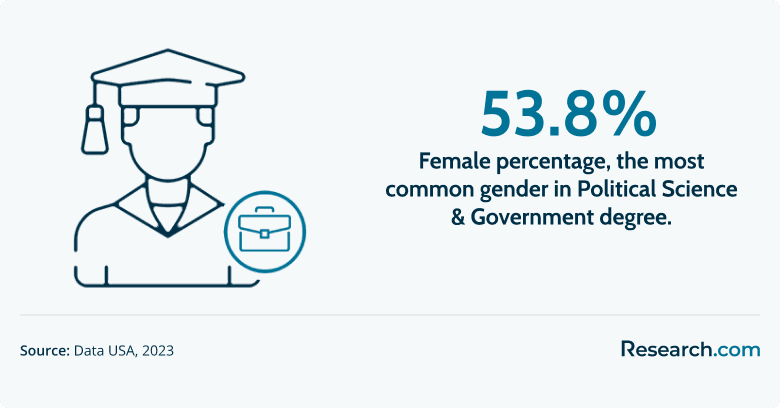
It's interesting to see who is making these choices. Recent data shows that 53.8% of political science degrees are awarded to women, many of whom are drawn to the flexibility that different program paces can offer.
How does an online Master's in Political Science program compare to an on-campus program?
When you're looking at accredited universities, the core academic experience is identical. You'll take the same courses, learn from the same faculty, and earn the exact same degree whether you attend online or in person. If you're still considering your options for foundational education, you may want to weigh the pros and cons of pursuing a second bachelor's degree.
However, thinking that the experiences are completely equal is a major mistake. For a career in federal politics and policy, the single biggest factor for success is your professional network, and that's where the two formats can be worlds apart.
The Deciding Factor: The D.C. Networking Gap
The reality of this field is that careers are built on connections made through internships, informational interviews, and professional events in Washington, D.C. On-campus students have a natural advantage because they are physically present in that ecosystem.
Online students face a significant "networking gap." A degree by itself, even from a top school, won't get you a job if you don't have a bridge to the professional world. That's why you must be an incredibly savvy consumer. The best online programs know this and have an aggressive, explicit strategy to solve the problem, such as a required residency semester in D.C. or dedicated federal placement services with a proven track record.
What is the average cost of an online Master's in Political Science program?
You can generally expect the total tuition for an online master's in political science to be around $14,000 for in-state students and closer to $20,000 for out-of-state students. This is a significant investment, and it's a financial calculation you need to make for any graduate program, whether it's this degree or, for instance, determining the value of pursuing an MBA right after undergrad.
Of course, these are just averages. The actual cost of online master's programs in political science can vary dramatically, with some in-state programs costing as little as $3,150 and some private or out-of-state programs exceeding $34,000. The price tag is important, but it's only half of the equation.
Beyond Tuition: Calculating Your True Return on Investment
A smart financial decision isn't just about the cost; it's about the potential return on that investment. We've talked about the high median federal salary, but for a realistic ROI calculation, you need to look at the entire salary spectrum. Many graduates, especially those without significant prior experience, will start their careers on the lower end of the pay scale.
For example, while the average salary for a political scientist is about $85,116, a quarter of professionals in the field earn around $57,500. Top earners, on the other hand, can make upwards of $119,000. Weighing the program's tuition against these different potential outcomes is the key to making a sound financial choice. This calculation is similar to how professionals assess the value of related fields, such as deciding what are social and behavioral sciences in the context of public health programs and career outlook.
What are the financial aid options for students enrolling in an online Master's in Political Science program?
When researching degrees—including popular options like the best online master's in accounting programs no GMAT—the most important thing to understand about funding a master's degree is that financial aid at the graduate level is primarily based on loans. While some scholarships and assistantships exist, they are far less common than they are for undergraduates.
Your first and most critical step is always to fill out the Free Application for Federal Student Aid (FAFSA). This is your gateway to the best funding options available. Understanding the difference between these options is key to financing your degree responsibly.
Federal vs. Private Loans
Federal loans are the foundation of graduate student funding for a reason. They offer fixed interest rates, flexible repayment plans, and crucial borrower protections that private loans do not. Private loans, which come from banks and other lenders, can have variable rates and much stricter repayment terms, making them a riskier option. You should always exhaust your federal loan eligibility before even considering a private loan.
The Importance of Public Service Loan Forgiveness (PSLF)
For anyone aiming for a career in government, the Public Service Loan Forgiveness (PSLF) program is a potential game-changer. If you work full-time for a qualifying public service employer—like the federal government or a nonprofit—this program can forgive the remaining balance of your federal student loans after you've made 120 qualifying monthly payments. This is a massive long-term financial benefit that can make a public service career, such as a deputy sheriff career path, much more sustainable.
What are the prerequisites for enrolling in an online Master's in Political Science program?
Getting into a competitive master's program involves more than just meeting the minimum requirements on a website. Admissions committees are looking for a clear story of your commitment and capability. Here are the key prerequisites you'll need to focus on.
- Secure a relevant bachelor's degree. While many applicants have a background in political science, a degree in a related field like economics, history, or even one of the shortest online public safety degree programs can provide a strong analytical foundation.
- Meet the minimum GPA requirements. Most programs look for a GPA of 3.0 or higher, but if yours is lower, strong GRE scores or significant work experience can sometimes offset it.
- Demonstrate a strong analytical background. Your undergraduate transcript should show that you have successfully completed courses in subjects like statistics, economics, or research methods.
- Gain relevant internship or work experience. This is the critical, unspoken prerequisite that separates top applicants from the rest; it shows you understand the field and are committed to a career in it.
What courses are typically in an online Master's in Political Science program?
While the exact course titles will vary between universities, most online master's programs in political science are built around a similar core structure. You can expect to see a mix of foundational theory, specialized electives, and a culminating research project. This curriculum prepares you for a variety of roles that require deep analytical skills, just as a social psychology degree prepares students for careers focused on human behavior.
Here's a typical breakdown of what you'll study.
- Core Courses: These are the foundational classes that everyone takes, such as Political Theory, Comparative Politics, and American Politics or International Relations.
- Research Methods: This is often the single most important course for your future employability, as it teaches you the quantitative skills to analyze data.
- Elective Courses: These allow you to focus on a specific area of interest, such as public policy, national security, or political communication.
- Capstone or Thesis: This is a culminating project where you conduct your own original research to demonstrate the skills you've acquired throughout the program.
The skills you gain are most valuable in the places where these jobs are concentrated. As the data shows, the overwhelming majority of political scientists are employed in the District of Columbia, with neighboring Virginia also being a major hub.
What types of specializations are available in an online Master's in Political Science program?
Most programs offer a range of specializations that allow you to focus your studies on a specific area of the field. Just as students researching the best online MBA in energy programs look for targeted degree pathways, political science students can choose from concentrations such as American Politics, International Relations, Comparative Politics, and Public Policy.
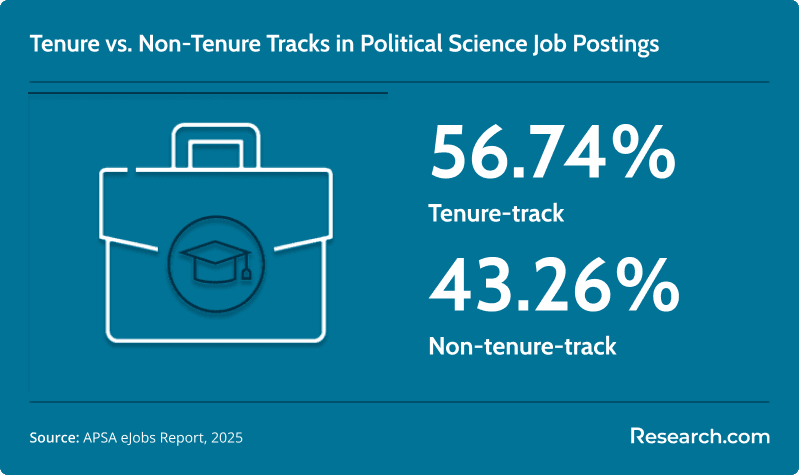
Choosing a specialization is also the point where you begin to align with a specific career track, whether that's in federal service or academia. For those considering a Ph.D., it's important to understand the academic job market. Recent data from the American Political Science Association shows that 56.74% of academic job postings are for tenure-track positions, a competitive landscape that requires early and focused specialization.
Choosing a Strategic Specialization
From a career perspective, your choice of specialization is a strategic decision. While you should follow your interests, you also need to consider what skills and knowledge are in high demand. A specialization in a methodological area, like quantitative analysis or survey research, can make you a valuable asset to almost any organization.
Alternatively, focusing on a high-demand topic like national security or cybersecurity can position you for specific roles within the intelligence community and federal agencies. Aligning your academic focus with a clear career goal, such as pursuing a DEA agent career path, makes you a much more compelling candidate than someone with a generalist background.
How to Choose the Best Online Master's in Political Science Program
Choosing the right program requires you to be a savvy investigator. Use these steps to look past the marketing brochures and find a program that delivers real results.
- Verify Accreditation. This is the absolute first step. Ensure the program is offered by a regionally accredited institution, which guarantees it meets a high standard of academic quality.
- Scrutinize the Curriculum for Quantitative Strength. Look at the required courses. Is there a multi-course sequence in research methods and data analysis? Does the program teach in-demand software like R or Stata?
- Investigate the D.C. Connection. This is non-negotiable for an online program. Ask the admissions office pointed questions: Do you have dedicated career advisors with federal placement experience? Do you offer a D.C. residency semester? What specific internship partnerships do you have?
- Demand Federal Placement Data. This is the "Placement > Prestige" metric in action. Ask for hard numbers: What percentage of your recent online graduates secured jobs with the federal government within six months of graduation?
- Talk to Current Students and Alumni. Reach out on LinkedIn and ask for a brief informational interview. Get their honest assessment of the program's career support and professional network.
Following this framework will help you choose the best of the available online master's programs in political science for your specific career goals.
What career paths are available for graduates of an online Master's in Political Science program?
Just as students exploring options like the best online MSN programs without clinicals often pursue highly specific roles, it’s essential to understand that a master’s in political science leads to a narrow and specialized set of career paths. It is not a general-purpose public service degree. The primary outcomes fall into two main categories: working as an analyst for the federal government or pursuing a Ph.D. to enter academia.
If your goal is broader advocacy or community-based policy work, this is likely not the right degree for you. Here is a breakdown of the specific roles this degree is designed for.
Federal Government and Intelligence Roles
The most common career path is to work as a political scientist or policy analyst for a federal agency. These roles are concentrated in the Washington, D.C. area and almost always require a security clearance. This degree provides the specific research and analytical skills needed to meet CIA agent job requirements and similar positions within the intelligence and defense communities.
Academia and Research
For those who want to teach and conduct research, the master's degree serves as a direct stepping stone to a Ph.D. program. A strong performance in a master's program, particularly in research methods, is a key prerequisite for getting into a top doctoral program.
A More Versatile Alternative: The MSW in Macro Social Work
If these specialized, D.C.-centric paths don't align with your goals, a Master of Social Work (MSW) with a focus on macro social work is a far more flexible option. This degree prepares you for policy advocacy, community organizing, and nonprofit management roles in communities all across the country.
What is the job market for graduates of an online Master's in Political Science program?
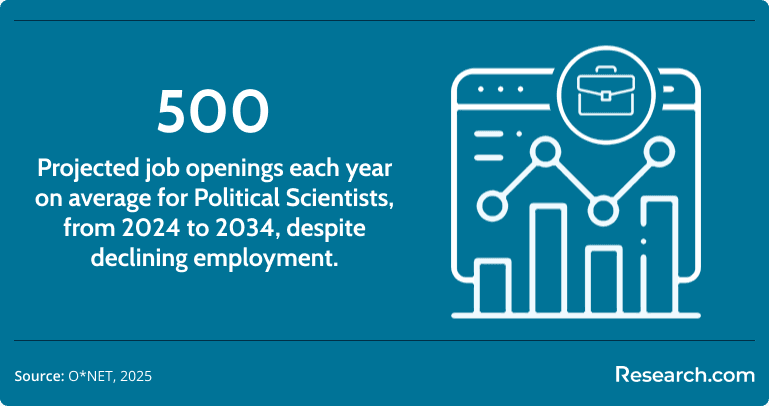
Just as students comparing the best online schools with financial aid for dental assistants look closely at future employment prospects before enrolling, prospective political science graduates must do the same. The job market for political scientists is extremely competitive and projected to decline by 3% over the next decade. According to the U.S. Bureau of Labor Statistics, there will only be about 500 job openings per year nationwide for this profession.
This is not meant to discourage you, but to give you a clear-eyed view of the challenge ahead. Success in this field is possible, but it is reserved for the most prepared and strategically positioned candidates. This is the reality you must weigh when considering online master's programs in political science.
The Specialist's Gamble: A Final Assessment
Pursuing this master's degree is a specialist's gamble. It's a high-stakes investment in a narrow field with a challenging job market. The potential rewards are significant—a high-paying, impactful career in federal service—but the risks of failure are real.
Success requires a specific and dedicated approach: you must build elite quantitative skills, secure D.C.-based internships, and choose a program based on its federal placement data, not just its name. You now have the information to decide if you are willing and able to make that commitment. Whether you choose to pursue this focused path or opt for a more versatile alternative, you can now move forward with a clear understanding of what it takes to succeed.
Is an Online Master's in Political Science the Right Advanced Choice for You?
When evaluating advanced degrees, it is essential to compare the focused expertise of an online Master's in Political Science with alternative programs that may offer broader academic or professional training. Consider factors such as curriculum depth, research methodology emphasis, and the ability to translate theoretical knowledge into practical skills. For instance, while an online master’s provides specialized insights into political dynamics and quantitative analysis, other advanced programs may blend interdisciplinary approaches and flexible study models. Prospective students should compare how each path aligns with specific career objectives and personal learning styles, taking into account factors like professional networking opportunities and placement services. For a comprehensive contrast of advanced degree options, review 2 year Ed.D programs online.
Here’s What Graduates Have to Say about Their Online Master's in Political Science Program
- Zella: "I appreciated that my professors were honest about how competitive this field is. They didn't just teach theory; they pushed us to produce research and policy memos that were professional quality. It was incredibly demanding, but it meant I graduated with a portfolio of work, not just a diploma. That made all the difference when I started applying for jobs at advocacy organizations."
- Annelise: "My parents are getting older, and moving across the country wasn't an option for me. I felt stuck for a while, thinking my career goals were on hold. The online program changed that. Being able to attend lectures from my home office and still be there for my family was the only way I could have advanced my education."
- Elara: "I came into this thinking policy was all about big ideas and passionate arguments. The quantitative methods courses were a shock at first, but they ended up being the most valuable part of the whole degree. Being able to confidently say "I can analyze that data set in Stata" during interviews was what separated me from other recent grads. It gave me a hard skill, not just a credential."
Key Findings
- The job market for political scientists is highly competitive, with a projected 3% decline over the next decade and only about 500 average annual openings, making this a high-risk, high-reward "specialist's gamble."
- Career opportunities are geographically concentrated, with the federal government employing 67% of all political scientists, primarily in the Washington, D.C. area, which is home to nearly 3,000 of these roles.
- While the median federal salary is an attractive $151,630, this figure reflects an experienced workforce where the average employee age is 43.3, not a typical starting salary for recent graduates.
- A realistic return on investment calculation must consider that 25% of political scientists earn around $57,500, a salary that must be weighed against program costs that can exceed $34,000.
- For those considering an academic career, the market is also competitive, with recent data showing that only 56.74% of academic job postings are for tenure-track positions.
- The flexibility of online programs is a key draw for many students, in a field where 53.8% of degrees are awarded to women, who often balance academic pursuits with professional and family commitments.
References:
- American Political Science Association. (2024). The academic job market in political science for the 2023-2024 cycle: A report from APSA eJobs. Retrieved September 29, 2025, from https://apsanet.org/wp-content/uploads/2025/02/2023-2024-eJobs-Report.pdf
- Data USA. (n.d.). Political science & government. Retrieved September 29, 2025, from https://datausa.io/profile/cip/political-science-government
- PayScale. (n.d.). Average political scientist salary. Retrieved September 29, 2025, from https://www.payscale.com/research/US/Job=Political_Scientist/Salary
- U.S. Bureau of Labor Statistics. (2024, May). Occupational employment and wages, May 2023: 19-3094 Political Scientists. Occupational Employment Statistics. Retrieved September 29, 2025, from https://www.bls.gov/oes/2023/may/oes193094.htm
- U.S. Bureau of Labor Statistics. (2024, September 4). Political scientists. Occupational Outlook Handbook. Retrieved September 29, 2025, from https://www.bls.gov/ooh/life-physical-and-social-science/political-scientists.htm
- U.S. Department of Labor, Employment and Training Administration. (n.d.). 19-3094.00 - Political scientists. O*NET OnLine. Retrieved September 29, 2025, from https://www.onetonline.org/link/summary/19-3094.00
- ZipRecruiter. (n.d.). Political sciences salary. Retrieved September 29, 2025, from https://www.ziprecruiter.com/Salaries/Political-Sciences-Salary#TableView
Other Things You Should Know About Online Master's in Political Science Programs
In 2027, many online master's in political science programs have moved away from requiring the GRE, focusing more on applicants’ academic records and professional experiences. However, some programs may still request it, so it's important to check the specific requirements of each school.
Rankings influence the perceived quality and prestige of online master's programs in political science by considering factors such as academic reputation, faculty credentials, and alumni outcomes. This guides prospective students seeking top-quality education tailored to evolving industry standards.


