
2027 Should You Get a Second Bachelor's Degree

Co-Founder and Chief Data Scientist
More than 57 million adults in the U.S. already hold a bachelor’s degree, yet many professionals still consider going back for another one. Rising education costs and the availability of flexible online programs make the decision more complicated than ever.
This article breaks down whether earning a second bachelor’s degree is worth the time, money, and effort in 2027. You’ll learn which degree combinations pay off, how long programs take, potential career outcomes, and whether alternatives like master’s programs may be a better investment.
Key Things You Should Know About Second Bachelor's Degrees
- A second bachelor’s degree is different from pursuing a master’s—it builds another foundation at the undergraduate level. Many schools allow transfer credits from your first degree, which can shorten completion time and reduce costs compared to starting completely from scratch.
- Employers may value a second bachelor’s if it fills a clear skill gap, supports a career change, or adds expertise across fields. However, the salary payoff is not automatic. The impact often depends on the degree pair chosen and the industry’s specific demands.
- Program availability has expanded through online and accelerated formats, making it easier to balance work, family, and school. Still, tuition, living expenses, and lost income while studying are major considerations that can raise the total cost well over six figures.
- Should you get a second bachelor's degree in 2027? Second Degree
- When does a second bachelor’s degree make more sense than a master’s? Second vs. Master’s
- What degree pairs work well together? Best Degree Pairs
- How much will a second bachelor's degree cost (time & money)? Time & Money
- Will a second bachelor’s boost your salary or job prospects? Salary & Job Prospects
- How long does a second bachelor’s degree take to finish? Time to Finish
- Can you transfer credits toward a second bachelor’s degree? Credit Transfers
- What are the alternatives to a second bachelor's degree? Degree Alternatives
- How can you secure funding for a second bachelor's degree? How can you secure funding for a second bachelor's degree?
- What are the risks or downsides of getting a second bachelor’s? What are the risks or downsides of getting a second bachelor’s?
- What should you consider before applying to a second bachelor’s program? What should you consider before applying to a second bachelor’s program?
Should you get a second bachelor's degree in 2027?
Yes, getting a second bachelor’s degree can be worth it in 2027 — but only under the right circumstances. If your first degree does not qualify you for the career you want, or if an entirely different field is now in demand, a second bachelor’s may open doors that short courses or certifications can’t. For example, switching from liberal arts into healthcare or tech often requires foundational knowledge that only another bachelor’s can provide.
That said, this path involves trade-offs. Time, cost, and opportunity cost must be weighed carefully. Many universities now offer accelerated degree programs online that allow learners to complete a second bachelor’s more quickly and flexibly, which helps reduce both tuition and lost income. Yet, even an accelerated program may still require 2-3 years of full- or part-time study depending on how many credits transfer. And higher salary isn’t guaranteed: the degree must align with market needs, licensing requirements, or skills gaps. In short, a second bachelor’s is worth it if it enables clear career advancement or meaningful change rather than just adding credentials.
When does a second bachelor’s degree make more sense than a master’s?
A second bachelor’s degree makes more sense than a master’s when the goal is to gain foundational knowledge in an entirely new field. Unlike graduate programs, a second undergraduate degree covers the basics needed for industries where specialized entry-level skills are critical.
Some situations where it is a better choice include:
- Career changes into technical or regulated fields. For example, someone with a psychology degree may pursue nursing, engineering, or computer science, where entry requires a specific undergraduate background rather than just advanced credentials.
- Meeting professional licensing requirements. Fields like accounting or teaching often require accredited bachelor’s coursework that a master’s alone cannot substitute for.
- Building credibility in cross-disciplinary roles. Combining degrees, such as political science and data analytics, signals both subject matter understanding and technical competence to employers.
- Competing in industries that prioritize formal credentials over advanced specialization. Some sectors, especially healthcare and education, still treat the bachelor’s as the defining qualification for access to professional tracks.
It’s important to note that in certain areas, comparing degree levels reveals practical differences. For example, understanding BS medical billing and coding vs certificate helps show when employers value a complete undergraduate degree instead of a shorter credential.
The chart below illustrates how wages and employment opportunities vary by education level. It helps clarify when a second bachelor’s degree may have advantages over moving directly into a master’s program.
What degree pairs work well together?
You might choose a second bachelor’s degree for different reasons: a career shift, a chance to build cross-disciplinary skills, advancement in your current field, or simply personal interest. Below are examples of degree combinations that make sense in these contexts, offering both practical opportunities and improved career outlook.
BS in Nursing (BSN) + BS in Health Services Administration
Registered nurses earn a median $84,430, with job growth projected at 6% through 2034. Medical and health services managers average $110,680, with much faster-than-average growth of 28%. A second degree can help nurses transition into leadership or administrative roles, and as the best paying healthcare bachelor's degrees show, healthcare management consistently ranks among the most lucrative fields.
BS in Business Administration + BS in Information Systems
Business graduates average $76,570, while computer and information systems managers bring in $164,070 with 15% growth expected by 2034. Together, these degrees prepare professionals who understand both organizational strategy and technical infrastructure, making them highly competitive for executive and IT leadership positions. This pairing balances management with digital expertise.
BS in Psychology + BS in Nursing
Psychology graduates average $53,000, while nurses earn $84,430, with a steady 6% job growth outlook. This combination is particularly valuable in mental health, psychiatric nursing, and behavioral healthcare, where professionals must apply psychological principles to clinical practice. Demand for such roles is expected to grow as mental health services expand.
BS in Mechanical Engineering + BS in Computer Science
Mechanical engineers earn $99,510, with job growth of about 10%. Computer science professionals average $132,000, with a rapid 21% growth rate. Combining these degrees prepares graduates for high-demand fields like robotics, AI-driven manufacturing, and automation engineering, where cross-disciplinary expertise can command some of the highest salaries in the job market.
BS in Biology + BS in Environmental Science
Biologists earn about $70,000, with job growth projected at 5%, while environmental scientists average $78,980, with 6% growth. Pairing these fields strengthens opportunities in conservation, environmental policy, biotech research, and climate adaptation — areas steadily expanding as governments and industries face mounting ecological challenges.
BS in Accounting + BS in Data Analytics
Accountants make a median $79,880, with 4% job growth. Data scientists, however, average $103,500, with an impressive 35% growth, making it one of the fastest-growing fields. This combination gives graduates strong foundations in both finance and analytics, leading to advanced roles in auditing, financial modeling, and business intelligence.
BS in Marketing + BS in Graphic Design
Marketing specialists earn $79,770, with 6% job growth, while graphic designers average $58,910. Although design salaries are lower, pairing it with marketing creates competitive roles in advertising, branding, and digital strategy. Professionals with both creative and strategic expertise are especially sought after in integrated marketing campaigns.
BS in Political Science + BS in International Relations
Political science majors earn around $69,400, with a 7% job outlook. International relations graduates average about $70,000, with steady demand in diplomacy, NGOs, and global policy organizations. This combination is particularly valuable for those pursuing careers in international governance, security analysis, and think tank research.
BA in History + BS in Education
History graduates earn about $64,000, while high school teachers make a median of $63,670, though their job outlook is projected to decline slightly by 2% through 2034. Despite modest growth, this degree pair prepares graduates for careers in teaching, museum education, and curriculum design, where history knowledge enriches education practice.
BS in Environmental Science + BS in Agriculture
Environmental scientists earn $78,980, with 6% growth, while agricultural and food scientists average $74,940, also with 6% growth. This combination is ideal for roles in sustainable agriculture, food safety, and climate-focused industries. Graduates can bridge science and practice, helping shape the future of global food production.
How much will a second bachelor's degree cost (time & money)?
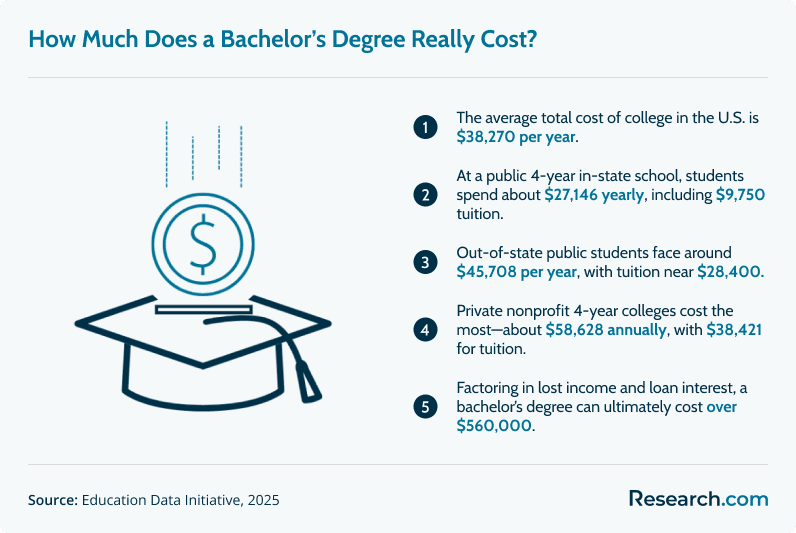
A second bachelor’s degree will cost both time and money, often nearly as much as the first. On average, completing a four-year degree in the U.S. costs about $38,270 per year, including tuition, fees, housing, and other expenses. However, many second-degree students can finish in less time if prior credits transfer, potentially reducing both the duration and overall expense. Public in-state options are the most affordable, with tuition averaging $9,750 per year, while private institutions can exceed $38,000 annually for tuition alone.
Time to completion also varies. While a first bachelor’s degree typically takes 4 to 6 years, a second degree may be finished in 2 to 3 years depending on overlap with past coursework and whether the program offers accelerated or online formats. That said, lost wages during study and long-term student loan interest can push the lifetime cost significantly higher than tuition figures suggest.
The infographic below breaks down the typical annual and total costs of pursuing a bachelor’s degree, showing how tuition, living expenses, and hidden costs can stack up quickly for students considering a second program.
Will a second bachelor’s boost your salary or job prospects?
A second bachelor’s degree does not automatically guarantee a higher salary, but it can expand opportunities depending on the field and how well the second degree complements the first. For instance, combining a BSN with health services administration can help nurses move into management roles, where pay is significantly higher. Similarly, pairing business administration with information systems can open doors to leadership in data-driven industries, boosting both salary potential and career flexibility.
Employers tend to value specialized knowledge, cross-disciplinary skill sets, and adaptability. A second degree can make you stand out in competitive fields like computer science, data analytics, and engineering, where strong growth and above-average pay remain consistent. On the other hand, in careers like education or history, the salary bump may be modest, and pursuing a master’s could offer a better return. Ultimately, the benefit depends on industry demand and whether the degree leads to higher-level responsibilities.
The chart below highlights median annual salaries for selected bachelor’s degree holders, showing the wide range of earning potential. These figures help illustrate when pursuing a second degree could substantially impact your income.
How long does a second bachelor’s degree take to finish?
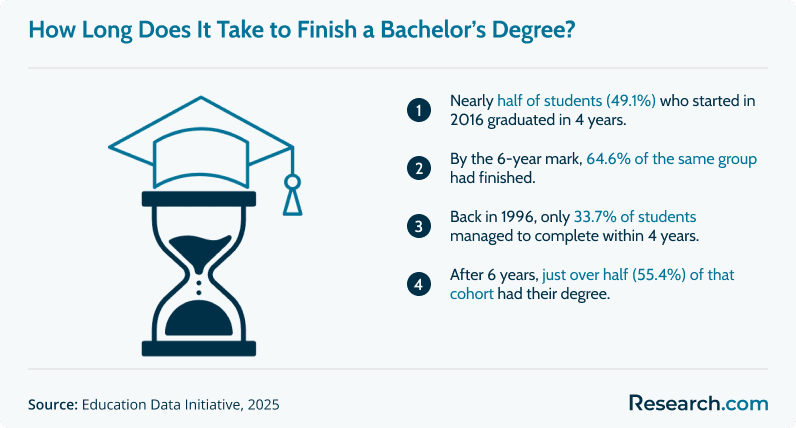
A second bachelor’s degree usually takes less time to complete than the first. While a traditional program often requires four years, many schools allow students to transfer prior credits, cutting the timeline to around two or three years. The exact length depends on the overlap between your previous coursework and the new program’s requirements. For example, someone shifting from biology to nursing may need more time than someone moving from business to information systems, where general education credits transfer more easily. Accelerated formats, summer sessions, or online programs can also shorten the path to completion.
Completion times matter because delays often lead to higher costs and lost earnings. Students need to weigh the benefits of finishing quickly against the demands of balancing work, family, and academics.
The infographic below highlights how graduation timelines have shifted over the years, giving context to why a second bachelor’s might be faster today.
Can you transfer credits toward a second bachelor’s degree?
Yes, you can usually transfer credits toward a second bachelor’s degree, but how many and which ones depend on the institution and field of study. Most schools accept general education and elective credits from your first program, allowing you to skip repeating courses like English composition, math, or introductory sciences. However, major-specific requirements often need to be completed in full, especially if you’re switching to a very different discipline.
Policies vary widely. Some universities cap transferable credits at around 60–90, while others only allow courses with a minimum grade of C or higher. Online programs can be particularly flexible, and researching options such as the best bachelor's degree in history online shows how institutions highlight their transfer-friendly pathways to attract adult learners and career changers.
Overall, transferring credits can significantly shorten the time and cost of completing your second bachelor’s, but you’ll need to confirm specifics with each school before enrolling.
What are the alternatives to a second bachelor's degree?
Alternatives to a second bachelor’s degree can help you build new skills or shift careers without repeating another four years of study. These options often take less time, cost less, and still provide credentials that employers value. Many also allow for more flexible learning schedules.
Some alternatives include:
- Master’s degree programs: For those who already meet prerequisites, graduate studies can provide deeper expertise and higher salary potential.
- Certificate programs: Short-term training in areas like project management, coding, or data analytics can quickly boost employability.
- Post-baccalaureate programs: Ideal for career shifts, especially in fields like healthcare or education, offering targeted training without a full degree.
- Associate degrees: Focused two-year programs that can prepare you for specialized technical or healthcare roles.
Also, online options, such as an online degree in nutrition let you upskill while balancing work and family.
These alternatives may not always match the broad credentials of a bachelor’s, but they deliver practical and marketable skills faster.
How can you secure funding for a second bachelor's degree?
Evaluating diverse financing avenues is essential when planning a second bachelor's degree. Explore federal financial aid options by updating your FAFSA and seek scholarships tailored for career changers or non-traditional students. Some employers offer tuition reimbursement programs that can substantially offset costs. Additionally, specialized loan products with favorable terms for second-degree candidates may be available. For a comparative insight into career-focused education paths that balance cost and earning potential, review the best degrees online. Assessing these funding strategies helps in minimizing debt and aligning educational investment with long-term career benefits.
What are the risks or downsides of getting a second bachelor’s?
The main downside of getting a second bachelor’s degree is that it requires significant time and financial investment without guaranteeing a proportional salary increase. While some students find value in broadening their academic background, others may discover that a master’s program or professional certification offers a better return.
Key risks and downsides include:
- High cost: Tuition, fees, and lost income can easily add up to tens of thousands of dollars.
- Time commitment: Even with transferred credits, completing a second bachelor’s usually takes 2–3 years.
- Opportunity cost: Those years could be spent gaining work experience or pursuing higher-level degrees.
- Limited employer impact: Many employers prioritize advanced degrees, certifications, or work experience over a second undergraduate degree.
- Risk of redundancy: A second bachelor’s may overlap heavily with your first, adding little competitive edge.
Ultimately, the decision requires weighing whether the benefits truly outweigh these risks.
What should you consider before applying to a second bachelor’s program?
Before applying to a second bachelor’s program, the first thing to consider is whether the degree will realistically advance your career or simply duplicate your current qualifications. A second bachelor’s can be valuable, but only if it opens opportunities that your existing degree cannot.
Key considerations include:
- Career goals: Will this program directly align with your long-term professional objectives?
- Financial cost: Tuition, fees, and living expenses can be high, and aid options may be limited.
- Time to completion: Even with transferred credits, plan on 2–3 years of study.
- Transfer credits: Not all prior coursework will count toward your new program.
- Alternative paths: A master’s, certificate, or even an
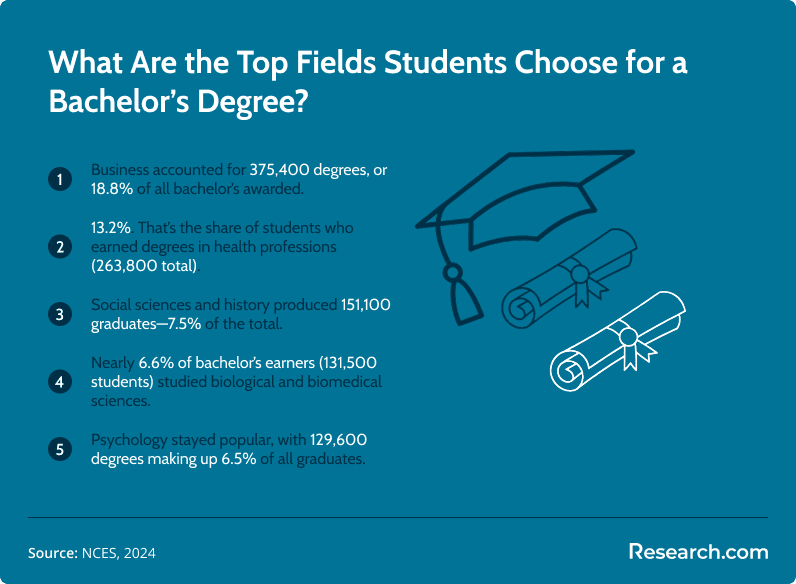
The infographic below highlights the most common bachelor’s degree fields students choose today, offering perspective on where demand and student interest are strongest. This can help you assess whether your intended second degree aligns with current educational and labor market trends.
Here's What Graduates Have To Say About Their Second Bachelor's Degree Programs
- Molina: "Studying online for my second bachelor’s gave me flexibility I didn’t think possible. I balanced work, family, and school while learning skills that directly applied to my job. It was tough, but the payoff in confidence and career options has been worth it."
- Kerry: "I already had a degree in marketing, but adding computer science online completely changed my trajectory. The virtual format meant I could focus on projects at my pace, and now I’m working in a field I used to only dream about."
- Amiel: "Returning for a second bachelor’s online was intimidating at first, but the structure made it accessible. I discovered new perspectives, connected with classmates worldwide, and regained the excitement of learning. It wasn’t just about career—it was about growth."
Key Findings
- A bachelor’s degree costs an average of $38,270 per year in the U.S.
- Median weekly earnings rise from $899 with a high school diploma to $1,493 with a bachelor’s degree.
- Nearly 49.1% of students finish their bachelor’s in 4 years, while 64.6% complete in 6 years.
- Business leads all fields, with 18.8% of bachelor’s degrees awarded as of the latest report.
- Top-paying roles for bachelor’s holders include Computer & Information Systems Managers at $171,200 annually.
- Adding a second bachelor’s degree makes sense in career shifts, cross-disciplinary fields, or where a master’s isn’t required.
References
- Bureau of Labor Statistics (BLS). Accountants and Auditors.
- Bureau of Labor Statistics (BLS). Advertising, Promotions, and Marketing Managers.
- Bureau of Labor Statistics (BLS). Agricultural and Food Scientists.
- Bureau of Labor Statistics (BLS). Agricultural Workers.
- Bureau of Labor Statistics (BLS). Biology Field of Degree.
- Bureau of Labor Statistics (BLS). Computer and Information Research Scientists.
- Bureau of Labor Statistics (BLS). Computer and Information Systems Managers.
- Bureau of Labor Statistics (BLS). Data Scientists.
- Bureau of Labor Statistics (BLS). Environmental Scientists and Specialists.
- Bureau of Labor Statistics (BLS). Graphic Designers.
- Bureau of Labor Statistics (BLS). High School Teachers.
- Bureau of Labor Statistics (BLS). Historians.
- Bureau of Labor Statistics (BLS). Medical and Health Services Managers.
- Bureau of Labor Statistics (BLS). Office and Administrative Support Occupations.
- Bureau of Labor Statistics (BLS). Political Scientists.
- Bureau of Labor Statistics (BLS). Psychologists.
- Bureau of Labor Statistics (BLS). Registered Nurses.
- Bureau of Labor Statistics (BLS). Zoologists and Wildlife Biologists.
- Bureau of Labor Statistics (BLS). OES: Postsecondary Teachers (Code 25-1125).
- Education Data Initiative. Average Cost of College.
- Education Data Initiative. Education Attainment Statistics.
- National Center for Education Statistics (NCES). Bachelor’s Degrees Conferred by Field of Study.
Other Things You Should Know About Second Bachelor's Degrees
In 2027, pursuing a second bachelor's degree can be beneficial if it provides specialized skills or knowledge that meet current job market demands. However, relevant work experience or certifications might be more valued in certain industries. It's important to research specific field requirements before deciding.
Admission requirements for a second bachelor's degree in 2027 typically include a completed application, a previous bachelor's degree, transcripts showing a minimum GPA (often around 2.5 or higher), and sometimes letters of recommendation. Admission criteria may vary by institution, so check specific university guidelines.
Yes, international students can apply for second bachelor’s programs, but the process comes with specific requirements. They must obtain a student visa, demonstrate sufficient financial resources, and meet admission criteria. Some institutions welcome international applicants into online programs as well, which may reduce visa restrictions. Still, tuition costs and work limitations are important factors for international students to weigh carefully.


