
2027 Best Online Master's Programs in Accounting with No GMAT Requirement

Co-Founder and Chief Data Scientist
Only 18% of GMAT test-takers worldwide score 700 or above, a statistic that can feel like a major roadblock when you've hit a ceiling in your accounting career. You know an advanced degree is the next logical step, but the thought of studying for that exam while managing a demanding job is a valid concern for many experienced professionals.
This guide presents the smart path forward. Created by career planning experts with over 10 years of experience, it serves as your practical roadmap. We will explore top online master's programs in accounting that value your professional expertise over a test score, helping you secure the credentials needed to unlock leadership roles.
What are the benefits of getting an online master’s in accounting with no GMAT requirement?
- This degree prepares you for strategic leadership positions in diverse sectors, from Fortune 500 companies to government agencies and non-profits.
- New graduates with a Master of Accounting earn a starting salary of $67,750 per year, reflecting the degree's high value to employers.
- The online format provides the flexibility to earn your degree and advance your career without having to leave your current job.
What can I expect from an online master’s in accounting with no GMAT requirement?
You can expect a rigorous, graduate-level curriculum that is identical in quality and content to an on-campus program. The main difference is the flexible online delivery format, which requires a high degree of self-discipline and proactive time management.
To succeed, students typically dedicate 10 to 15 hours per week to each course they take. The coursework will challenge you to move beyond technical execution and focus on strategic analysis, leadership, and data-driven decision-making.
Top online master's programs in accounting provide robust support systems. You will have access to faculty, career services, and networking opportunities, all delivered through a sophisticated online learning platform.
Where can I work with an online master’s in accounting with no GMAT requirement?
An online master's in accounting opens doors to leadership and strategic roles in nearly every sector of the economy. Graduates can build impactful careers in a wide range of industries.
- Public Accounting: Major international or regional firms within the professional services sector employ 11% of accountants, who focus on auditing or advisory services.
- Corporate and Industry: You can work within a company's finance department, as 23% of accountants do in the Fortune 500 sector, with key opportunities in finance and technology.
- Government: You can apply your skills in federal, state, or local agencies to ensure fiscal integrity, a sector that employs 6% of all accounting professionals.
- Non-Profit: Manage the finances of charities and foundations or work within the education sector, which accounts for 7% of accountants.
- Entrepreneurship: Launch your own consulting or CPA firm to provide specialized financial services to businesses and individuals.
How much can I make with an online master’s in accounting with no GMAT requirement?
New graduates with a Master of Accounting earn a starting salary of $67,750 per year. This advanced degree provides a significant advantage over general accounting industry jobs, which average about $39.27 per hour.
Your total earning potential, however, will depend on several key factors.
- Experience Level: Your professional background is critical, as accountants with more than 10 years of experience can earn over $141,420 annually.
- Industry and Sector: Salaries in high-demand sectors like finance and technology, or within Fortune 500 companies, often exceed the national average.
- Geographic Location: Your earnings can vary based on regional demand. In Texas, for example, a professional with a Master of Science in Accounting earns about $89,121 per year, according to ZipRecruiter.
- Specialization: Developing expertise in a niche area like forensic accounting or data analytics can command a premium salary in the job market.
- List of the Best Online Master’s Programs in Accounting with No GMAT Requirement for 2027 List of Programs
- How long does it take to complete an online master’s in accounting with no GMAT requirement? Completion Time
- How does an online master’s in accounting with no GMAT requirement compare to an on-campus program? How does an online master’s in accounting with no GMAT requirement compare to an on-campus program?
- What is the average cost of an online master’s in accounting with no GMAT requirement? Program Cost
- What are the financial aid options for students enrolling in an online master’s in accounting with no GMAT requirement? Financial Aid
- What are the prerequisites for enrolling in an online master’s in accounting with no GMAT requirement? What are the prerequisites for enrolling in an online master’s in accounting with no GMAT requirement?
- What courses are typically in an online master’s in accounting with no GMAT requirement? What courses are typically in an online master’s in accounting with no GMAT requirement?
- What types of specializations are available in online master’s in accounting with no GMAT requirement programs? Specializations
- How to Choose the Best Online Master’s in Accounting Program with No GMAT Requirement How to Choose the Best Online Master’s in Accounting Program with No GMAT Requirement
- What career paths are available for graduates of online master’s in accounting with no GMAT requirement programs? Career Paths
- What is the job market for graduates of online master’s in accounting with no GMAT requirement programs? Job Market
Best Online Master’s in Accounting Programs with No GMAT Requirement for 2026
An online master’s in accounting with no GMAT requirement can help working professionals, career changers, and future CPA candidates move into higher-level accounting roles without spending months preparing for a standardized test. The no-GMAT format matters because many applicants already have evidence of readiness through prior coursework, professional experience, CPA-track goals, or strong undergraduate performance.
This guide explains how to compare online accounting master’s programs, what they cost, how long they take, what admissions teams usually expect, and which career paths the degree can support. It also highlights important trade-offs: accelerated versus part-time study, AACSB accreditation versus broader institutional accreditation, CPA preparation versus analytics-focused coursework, and total tuition versus long-term return on investment.
Quick answer: Is a no-GMAT online master’s in accounting worth considering?
Yes, a no-GMAT online master’s in accounting is worth considering if you want graduate-level accounting training, need additional credits toward CPA eligibility, or want to move into roles such as controller, forensic accountant, public accounting manager, or financial planning and analysis leader. The strongest programs are accredited, transparent about CPA preparation, flexible enough for working adults, and clear about total tuition, prerequisite courses, and student support.
A no-GMAT policy does not mean the program is easier. It means the school evaluates applicants through other evidence, such as transcripts, resumes, recommendations, essays, work experience, and prerequisite accounting knowledge.
How to use this ranking
Use this list as a starting point, not the only factor in your decision. The best program for you depends on your state’s CPA rules, your accounting background, your schedule, your budget, and whether you want a broad accounting degree or a specialized path in tax, audit, analytics, forensic accounting, or information systems.
How do we rank schools?
Because graduate school is a major financial and career decision, our ranking process prioritizes transparent, decision-useful information. Research.com draws from established education data sources, including the IPEDS database, Peterson's database, the College Scorecard database, and The National Center for Education Statistics.
These sources help evaluate online master’s in accounting programs using available data on institutional quality, costs, student outcomes, and program characteristics. To understand the broader ranking process, review Research.com’s methodology page.
| School | Program | Time to Complete | Credits | Cost | Accreditation |
| University of North Carolina at Chapel Hill | Online Master of Accounting | 12–36 months | 30–48 | $2,025 per credit | AACSB |
| The University of Texas Rio Grande Valley | Master of Accountancy Accelerated Online | ~12 months | 30 | $14,170 total tuition | AACSB |
| University of Illinois Urbana-Champaign | Master’s of Accounting | 18–36 months | 32 | ~$28,096 total tuition | AACSB |
| St. Thomas University | Master of Accounting | 12 months | 30 | $19,500 total tuition | SACSCOC |
| Raymond A. Mason School of Business | Online Master of Accounting | 16 months | 32 | $36,000 total tuition | AACSB |
| University of Michigan-Flint | Master of Science in Accounting | Up to 5 years | 30–36 | $774 in-state; $1,158 out-of-state per credit | AACSB |
| Texas Woman’s University | Master of Science in Accountancy | 12 months | 30 | $428 in-state; $833 out-of-state per credit | AACSB |
| Pace University | Online Master of Science in Accounting | ~3 years | 30–50 | $1,560 per credit | AACSB |
1. University of North Carolina at Chapel Hill - Online Master of Accounting (MAC)
The University of North Carolina at Chapel Hill offers an online MAC built for students entering from different academic and professional backgrounds. Applicants with an accounting foundation and those coming from other fields can follow separate pathways, which helps students build the coursework needed for CPA exam preparation and advancement into accounting leadership roles.
- Program Length: 12–36 months
- Required Credits to Graduate: 30–48
- Cost per Credit: $2,025
- Accreditation: Association to Advance Collegiate Schools of Business (AACSB)
2. The University of Texas Rio Grande Valley - Master of Accountancy (MACC) Accelerated Online
The University of Texas Rio Grande Valley provides an accelerated online MACC designed for students who want to meet the 150-hour requirement for the Texas CPA exam in as few as 12 months. The program emphasizes technical accounting knowledge, analytical thinking, and preparation for work in public accounting, corporate accounting, and government settings.
- Program Length: ~12 months
- Required Credits to Graduate: 30
- Total Tuition: $14,170
- Accreditation: Association to Advance Collegiate Schools of Business (AACSB)
3. University of Illinois Urbana-Champaign - Master’s of Accounting (iMSA)
The University of Illinois Urbana-Champaign offers an online iMSA that combines advanced accounting coursework with data analytics. Students can complete the degree in 18 to 36 months while building skills in financial reporting, analytics, and data-informed business decision-making.
- Program Length: 18–36 months
- Required Credits to Graduate: 32
- Total Tuition: ~$28,096
- Accreditation: Association to Advance Collegiate Schools of Business (AACSB)
4. St. Thomas University - Master of Accounting
St. Thomas University delivers a career-oriented MAcc that can be completed in 12 months. The curriculum is designed to support CPA exam preparation while strengthening practical accounting, data analysis, and ethical leadership skills for students planning to grow within the accounting profession.
- Program Length: 12 months
- Required Credits to Graduate: 30
- Total Tuition: $19,500
- Accreditation: Southern Association of Colleges and Schools Commission on Colleges (SACSCOC)
5. Raymond A. Mason School of Business - Online Master of Accounting (MAcc)
The Raymond A. Mason School of Business offers an online MAcc that can be completed in as few as 16 months. The program focuses on accounting expertise, strategic decision-making, and data analysis, with recruiting connections that may appeal to students targeting major accounting firms and business leadership roles.
- Program Length: 16 months
- Required Credits to Graduate: 32
- Total Tuition: $36,000
- Accreditation: Association to Advance Collegiate Schools of Business (AACSB)
6. University of Michigan-Flint - Master of Science in Accounting (MSA)
The University of Michigan-Flint provides an asynchronous online MSA with flexible completion options and access to the broader University of Michigan system. Students may finish in as few as 10 months, take up to 5 years, or consider the dual MSA/MBA option if they want a broader business credential.
- Program Length: Up to 5 years
- Required Credits to Graduate: 30–36
- Cost per Credit: $774 (in-state); $1,158 (out-of-state)
- Accreditation: Association to Advance Collegiate Schools of Business (AACSB)
7. Texas Woman’s University - Master of Science in Accountancy (MSA)
Texas Woman’s University offers a fully online MSA with an emphasis on preparing women for leadership in accounting. Students can pursue STEM-designated specializations, complete the program in as little as 12 months, and choose a CPA review course as an elective.
- Program Length: 12 months
- Required Credits to Graduate: 30
- Cost per Credit: $428 (in-state); $833 (out-of-state)
- Accreditation: Association to Advance Collegiate Schools of Business (AACSB)
8. Pace University - Online Master of Science in Accounting
Pace University offers an online MS in Accounting supported by New York City business connections and dual accreditation. The program incorporates Becker CPA Review into the curriculum and emphasizes applied learning in auditing and analytics for students who want coursework they can use in professional accounting roles.
- Program Length: ~3 years
- Required Credits to Graduate: 30–50
- Cost per Credit: $1,560
- Accreditation: Association to Advance Collegiate Schools of Business (AACSB)
How Long Does It Take to Complete an Online Master’s in Accounting with No GMAT Requirement?
Most online master’s in accounting programs with no GMAT requirement are designed for adults who need flexibility, much like students comparing the best online NASPAA-accredited MPA programs. Many accounting master’s programs require 30 to 36 credit hours, and full-time students often complete them in 18 to 24 months. Some schools also offer accelerated or extended schedules.
Part-time study is often the most realistic route for students who plan to keep working. Taking fewer courses per term can push completion closer to three years, but it may reduce stress and make the degree more manageable. Accelerated programs can shorten the timeline to as little as 12 months, but they usually require a heavier weekly workload and stronger time management.
Your completion time can also change if you do not already have undergraduate accounting coursework. Students from non-accounting backgrounds may need foundational business or accounting classes before moving into advanced graduate work. With graduate enrollments in accounting programs reaching 24,079 in 2025, online accounting master’s programs remain a common route for professionals seeking advancement.
| Timeline Option | Best For | What to Watch For |
| Accelerated study | Students who can handle a demanding course load and want to finish quickly | Less room for schedule disruptions, overtime work, or family obligations |
| Full-time study | Students who want steady progress without the fastest pace | May still be difficult while working full time |
| Part-time study | Working professionals, parents, and students with unpredictable schedules | Longer time to graduation and potential exposure to tuition changes |
| Extended flexible study | Students who need maximum control over pacing | Requires discipline to maintain momentum over several years |
Online vs. On-Campus Master’s in Accounting: Which Format Is Better?
An online master’s in accounting from an accredited university can provide the same academic credential as an on-campus program. The better choice depends on how you learn, whether you plan to keep working, how much structure you need, and whether relocation is realistic. With 71% of prospective graduate students now preferring fully online programs, including students considering an online MBA general business program, online graduate education has become a mainstream option.
When an online accounting master’s makes sense
An online program is usually the stronger choice if you need to continue earning income, cannot relocate, or want access to programs outside your local area. Many online formats allow students to complete weekly coursework around work obligations, which can be especially useful for accountants during tax season, audit deadlines, or month-end close periods.
When an on-campus accounting master’s makes sense
A campus program may fit better if you want face-to-face networking, a fixed weekly schedule, and easier access to in-person faculty conversations, student organizations, and local recruiting events. The trade-off is that campus study may require commuting, relocation, or reduced work hours.
| Factor | Online Master’s in Accounting | On-Campus Master’s in Accounting |
| Schedule | Often more flexible for working adults | More structured and location-dependent |
| Networking | May rely on virtual events, discussion boards, and online career services | Often stronger for in-person recruiting and peer interaction |
| Work compatibility | Usually easier to combine with full-time employment | May require schedule changes or reduced work hours |
| Program access | Lets students compare schools nationwide | Limited by geography unless the student relocates |
| Best fit | Self-directed learners who need flexibility | Students who prefer classroom structure and in-person support |
What Is the Average Cost of an Online Master’s in Accounting with No GMAT Requirement?
The price of a no-GMAT online master’s in accounting varies widely. Like students weighing the best online MBA in international business programs, accounting students should compare tuition against career goals, CPA preparation, flexibility, and total out-of-pocket cost.
Based on the programs in this guide, tuition can range from about $13,000 to over $97,000, while per-credit prices range from roughly $428 to more than $2,000. The listed tuition is only part of the full cost. Students should also check for technology fees, university fees, textbooks, exam preparation materials, graduation fees, and any prerequisite coursework.
For the 33.7% of accountants who need schedule adaptability, the ability to keep working while enrolled can be a major part of the degree’s value. A lower tuition program is not automatically the best choice, and a higher-cost program is not automatically a better investment. The right question is whether the program helps you reach your target credential, role, and timeline at a cost you can manage.
Cost factors to compare before enrolling
| Cost Factor | Why It Matters | Question to Ask |
| Tuition structure | Some schools charge per credit, while others publish total tuition | Is the listed price the full program cost or only tuition? |
| Prerequisite courses | Students without accounting backgrounds may need extra classes | Will prerequisite credits increase my time and cost? |
| Residency pricing | Public universities may charge different rates for in-state and out-of-state students | Do online students qualify for a separate tuition rate? |
| CPA review materials | Some programs include or integrate CPA preparation | Are CPA review resources included, optional, or separate? |
| Employer support | Tuition assistance can lower the student’s direct cost | Does my employer reimburse graduate accounting coursework? |
Financial Aid Options for Online Master’s in Accounting Students
Several funding options may reduce the cost of an online master’s in accounting. About 74% of graduate students receive some form of aid, so applicants should investigate aid early instead of waiting until after admission.
- Employer Tuition Assistance: Ask your employer whether graduate accounting coursework qualifies for reimbursement, tuition assistance, or professional development funding.
- Federal Student Loans: Complete the Free Application for Federal Student Aid (FAFSA) to determine eligibility for federal graduate loans.
- Private Student Loans: Banks, credit unions, and private lenders may offer additional borrowing options, but terms, interest rates, and repayment protections can differ from federal loans.
- Scholarships and Grants: Look for awards from the university, accounting departments, state CPA societies, professional associations, and nonprofit organizations.
- Military and Veteran Benefits: Eligible service members and veterans may be able to apply military education benefits, including GI Bill® benefits, toward graduate study.
Ways to reduce your total cost
- Ask whether the school accepts transfer graduate credits.
- Confirm whether prerequisite courses can be completed at a lower-cost institution.
- Compare total program cost, not only the advertised per-credit rate.
- Choose a pace that lets you stay employed if your income is essential to financing the degree.
- Apply for school-based scholarships before priority deadlines.
Admissions Requirements for Online Master’s in Accounting Programs with No GMAT Requirement
No-GMAT accounting programs still expect students to show academic and professional readiness. Similar to applicants researching the best online MSW programs that accept low GPA, accounting applicants may find that schools use a holistic process instead of relying on a single test score. Since 82.9% of accounting roles require prior work experience, admissions committees may value a strong resume and career progression.
- Bachelor's Degree: Applicants typically need a bachelor’s degree from an accredited college or university.
- Minimum GPA: Many programs expect a minimum undergraduate GPA, often a 3.0 on a 4.0 scale.
- Professional Work Experience: Some no-GMAT programs prefer or require two or more years of relevant experience.
- Prerequisite Courses: Students without an accounting degree may need introductory or intermediate accounting and business coursework before graduate classes.
- Application Materials: Common requirements include transcripts, a resume, recommendation letters, and a personal statement.
A lower GPA does not always eliminate an applicant, especially when the student has strong professional experience, persuasive recommendations, or clear evidence of recent academic readiness. Students worried about past grades may also want to review online colleges that accept low GPA to better understand how holistic admissions can work.
Questions to ask admissions before applying
- Is the GMAT waived for all applicants, or only for applicants who meet certain criteria?
- Will my previous accounting coursework satisfy prerequisites?
- Can prerequisite courses be completed after admission?
- Does the program meet CPA educational requirements in my state?
- How much work experience do admitted students usually have?
Common Courses in an Online Master’s in Accounting with No GMAT Requirement
An online master’s in accounting usually goes beyond basic bookkeeping or introductory financial accounting. Like students comparing the best online MPH in epidemiology programs, accounting students should look closely at whether the curriculum builds the specialized skills required for their target roles. Many programs align coursework with CPA exam competencies while also adding analytics, reporting, ethics, and decision-making.
- Advanced Financial Reporting: Covers complex reporting standards, financial statement preparation, and analysis for business and government contexts.
- Auditing and Assurance Services: Examines audit planning, evidence, internal controls, risk assessment, and professional standards.
- Regulation and Taxation: Focuses on federal tax topics, business law, professional responsibility, and ethical obligations.
- Managerial and Cost Accounting: Teaches students to use financial data for budgeting, forecasting, performance measurement, and internal decision-making.
- Data Analytics for Accountants: Builds skills for interpreting large financial datasets and using technology to support accounting insight and business strategy.
Accounting professionals increasingly benefit from combining technical accounting with complementary skills in analytics, systems, finance, or business strategy. Students who want to build a broader academic profile can explore double major options for accounting students. This broader skill mix matters in a field where 97.2% of accounting roles require more than just basic people skills.
Specializations Available in Online Master’s in Accounting Programs
Specializations help students tailor a graduate accounting degree to a specific career path. Not every program offers concentrations, but many allow electives or focused coursework in areas that align with CPA preparation, corporate finance, tax strategy, fraud investigation, analytics, or public sector accounting.
| Specialization | What You Study | Best Fit |
| Forensic Accounting | Fraud examination, financial investigations, litigation support, and evidence analysis | Students interested in fraud, compliance, law enforcement, or investigative accounting |
| Taxation | Corporate tax, individual tax, estate planning, international tax, and tax research | Students aiming for tax advisory, CPA firm, or corporate tax roles |
| Data Analytics | Financial datasets, visualization, analytics tools, and data-driven decision-making | Students who want accounting roles with a strong technology and analytics focus |
| Information Systems and IT Audit | Accounting systems, controls, cybersecurity risks, and technology audits | Students interested in systems assurance, internal audit, or IT risk |
| Public Administration/Government Accounting | Public sector reporting, budgeting, compliance, and accountability standards | Students targeting government agencies, nonprofits, or public accountability roles |
Forensic accounting is one option for students who want to investigate financial misconduct and support legal or corporate investigations. Students focused on speed may compare the shortest forensic accounting online degree options to understand how quickly they can build specialized credentials.
How to Choose the Best Online Master’s in Accounting Program with No GMAT Requirement
The best online master’s in accounting is not simply the cheapest, fastest, or most recognizable program. It is the program that fits your background, CPA plans, career goals, learning style, and budget. Before applying, compare schools using factors that affect both educational quality and long-term career value.
- Accreditation: Start here. AACSB accreditation is widely recognized in business education, and 195 universities have earned this distinct accounting accreditation. At minimum, confirm that the institution is properly accredited.
- CPA Alignment: If CPA licensure is your goal, verify that the curriculum and credit structure fit the rules of the state where you plan to become licensed.
- Curriculum and Faculty: Look for courses and instructors that match your goals in audit, tax, analytics, forensic accounting, corporate accounting, or public accounting.
- Flexibility and Format: Confirm whether classes are asynchronous, synchronous, accelerated, part-time, or cohort-based.
- Student Support: Ask whether online students receive career advising, academic support, networking opportunities, CPA guidance, and access to recruiting events.
- Cost and ROI: Compare total tuition, fees, debt, employer reimbursement, and the specific roles you expect the degree to support.
Common mistakes to avoid
| Mistake | Why It Can Hurt You | Better Approach |
| Choosing a program only because it has no GMAT | Admissions flexibility does not guarantee program quality or career fit | Compare accreditation, curriculum, CPA alignment, faculty, and outcomes |
| Looking only at tuition per credit | Fees, prerequisite courses, and materials can raise the final cost | Ask for a full cost estimate before enrolling |
| Assuming the degree automatically meets CPA rules | CPA education requirements vary by state | Contact your state board before committing |
| Ignoring online student support | Weak advising or limited career support can reduce the value of the program | Ask what services online students can access |
| Choosing the fastest program without considering workload | An accelerated format can be difficult during busy work seasons | Select a pace that matches your job and personal obligations |
Career Paths for Graduates of Online Master’s in Accounting Programs
A master’s in accounting can support advancement into accounting leadership, public accounting management, forensic investigation, government accountability, and financial analysis roles. With 37% of accountants staying in their roles for only one to two years, the accounting labor market can create frequent movement and openings for professionals who are ready for more responsibility.
1. Corporate Controller
A corporate controller oversees an organization’s accounting operations, financial reporting, internal controls, and compliance processes. This role often works closely with senior leadership and helps translate accounting data into business decisions.
Median Salary: $121,031 per year.
2. Director of Financial Planning & Analysis (FP&A)
An FP&A director leads budgeting, forecasting, financial modeling, and performance analysis. This position supports executive decision-making by explaining what financial trends mean for strategy, operations, and growth.
Median Salary: $139,998 per year.
3. Senior Manager, Public Accounting
A senior manager in public accounting supervises audit or tax engagements, manages teams, reviews technical work, and maintains client relationships. For many professionals, this role is a key step toward partnership or senior firm leadership.
Median Salary: $125,000 per year.
4. Forensic Accountant
A forensic accountant investigates suspected fraud, embezzlement, financial misstatement, and other complex financial issues. The work may involve corporations, law firms, insurers, government agencies, or law enforcement.
Median Salary: $85,177 per year.
5. Government Accountability Officer
A government accountability officer audits public programs, reviews spending, evaluates compliance, and helps ensure responsible use of public funds. This work supports transparency, accountability, and public trust.
Median Salary: $121,313 per year.
Students interested in international accounting pathways may also want to compare the U.S. CPA route with the CA career path, especially if they plan to work across borders or for multinational employers.
| Career Goal | Useful Program Features | Credentials to Research |
| CPA-track public accounting | CPA-aligned coursework, audit and tax depth, recruiting access | CPA requirements in your state |
| Corporate accounting leadership | Financial reporting, controls, FP&A, analytics, leadership coursework | CPA or other accounting certifications depending on role |
| Forensic accounting | Fraud examination, litigation support, data analysis, ethics | Fraud and forensic accounting credentials |
| IT audit or systems assurance | Information systems, internal controls, data security, audit analytics | Technology and audit-related certifications |
| Government or nonprofit accounting | Public sector reporting, compliance, budgeting, accountability | Public sector accounting credentials where relevant |
Job Market Outlook for Online Master’s in Accounting Graduates
The job market for accountants and auditors remains strong. Employment is projected to grow 5.6% through 2034, which is faster than the average for all occupations. That growth is expected to generate about 124,200 openings each year, on average, over the decade.
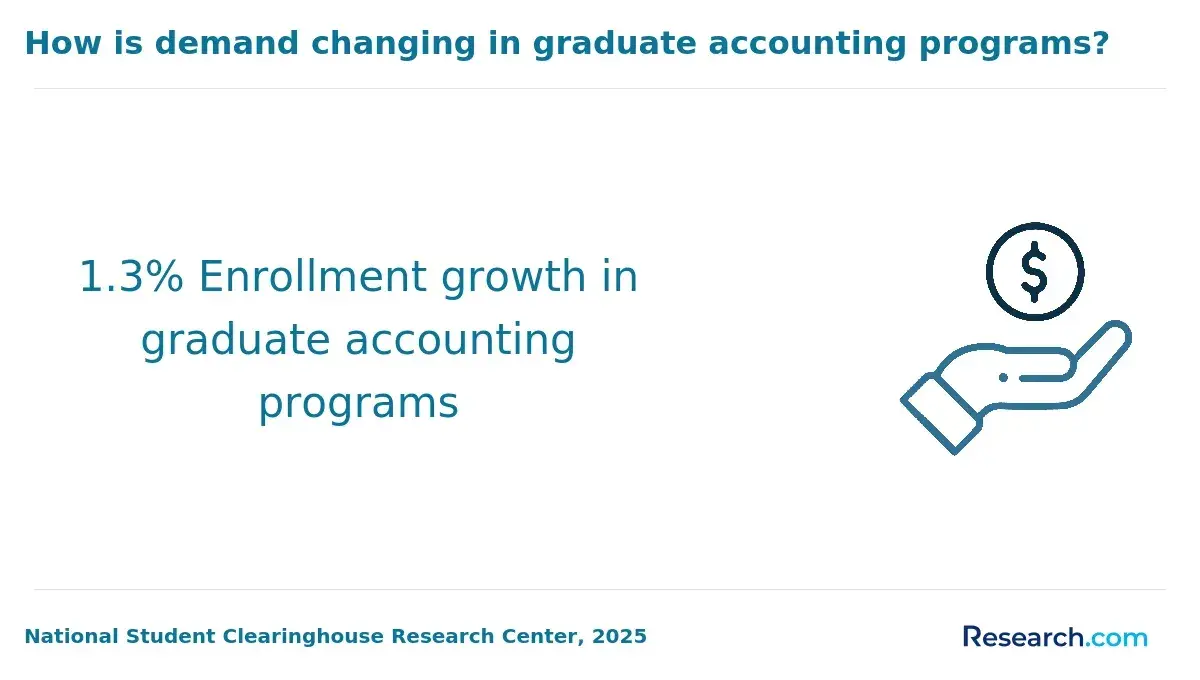
Interest in graduate accounting education also remains active. For the Fall 2025 enrollment period, master's degrees in accounting increased by 1.3%. For students, this means the field is competitive but stable, and an advanced degree may be most valuable when paired with CPA eligibility, analytics skills, relevant work experience, or a clear specialization.
Current trends affecting accounting master’s students
- Data analytics is becoming harder to ignore: Many accounting roles now require the ability to interpret data, use software tools, and explain financial patterns to non-accounting leaders.
- CPA preparation remains a major driver: Students often use the master’s degree to gain additional credits and strengthen exam readiness.
- Employers value applied skills: Courses in audit analytics, systems, taxation, controls, and financial reporting can be more useful than a generic curriculum.
- Online study is now common: Flexible online delivery lets accounting professionals continue working while pursuing graduate education.
- Specialization can improve positioning: Tax, forensic accounting, IT audit, analytics, and public sector accounting can help graduates target specific roles.
What Graduates Say About No-GMAT Online Master’s in Accounting Programs
- Manuel: "The no-GMAT admissions path made graduate school feel realistic. I had been away from college for years, and preparing for a standardized test would have delayed everything. The program looked at my work history and professional growth, which gave me a fairer way to show I was ready."
- Jela: "I had accounting experience, but I needed stronger strategic skills to move into management. The master’s program helped me connect reporting, analysis, and leadership. After graduation, I had a stronger case for the team lead role I wanted."
- Nestor: "I chose the program because I needed additional credits for the CPA path. The best part was that the courses supported my exam preparation instead of feeling disconnected from it. When I started studying for the CPA sections, much of the material felt familiar."
References
- AICPA & CIMA. (2026). Learn more about CPA Exam scoring and pass rates. AICPA & CIMA.
- BLS. (2024). May 2024 Occupational Employment and Wage Statistics. Occupational Employment and Wage Statistics Query System. Retrieved January 2026, from BLS.
- Education Data Initiative. (2025). Average graduate student loan debt. Retrieved from EducationData.
- National Association of State Boards of Accountancy. (2025). How many CPAs are there? NASBA.
- PayScale. (2026). Average Corporate Controller Salary. Retrieved from PayScale.
- Stitch Data. (2024). The state of data science. Retrieved from Stitch Data.
- World Population Review. (2026). PhD percentage by country. Retrieved from World Population Review.
- ZipRecruiter. (2026). Master Of Science In Accounting Salary in Texas. Retrieved from ZipRecruiter.
- Zippia. (2026). Accountant skills for your resume and career. Retrieved from Zippia.
Key Insights
- A no-GMAT online master’s in accounting can be a practical option for experienced professionals, CPA-track students, and career changers who want graduate accounting training without delaying admission for test preparation.
- Program quality depends on more than admissions flexibility. Accreditation, CPA alignment, faculty expertise, curriculum depth, total cost, and online student support should drive your decision.
- Completion time varies widely. Some programs can be finished in 12 months, while part-time and flexible formats may take closer to three years or longer.
- Costs differ substantially, from about $13,000 to over $97,000 among programs in this space. Always compare total program cost, including fees, materials, and prerequisite coursework.
- If CPA licensure is your goal, verify state requirements before enrolling. Do not assume every online accounting master’s automatically satisfies the rules where you plan to practice.
- Specializations in taxation, forensic accounting, data analytics, IT audit, and government accounting can help align the degree with specific career goals.
- The strongest ROI usually comes from matching the program to a clear outcome: CPA eligibility, promotion into leadership, transition into public accounting, or movement into specialized accounting roles.
Other Things You Should Know About Online Master’s in Accounting with No GMAT Requirement Programs
Typical admission requirements for online master's programs in accounting without a GMAT requirement in 2027 include a bachelor's degree in accounting or a related field, official transcripts, a minimum GPA, letters of recommendation, a personal statement, and a resume detailing relevant work experience.
Graduates of online master's in accounting programs with no GMAT requirement in 2026 can expect an average starting salary of $65,000 to $85,000. This can vary based on factors such as geographic location, specific industry, and level of prior work experience.


