
2027 Best Online MPH in Epidemiology Programs

Co-Founder and Chief Data Scientist
Occupations requiring a master’s degree for entry are projected to grow by 16.7%. Advancing to the next stage of your career can feel complex, with high stakes and many options to consider. With an average of 800 epidemiologist openings projected each year over the next decade, choosing the right graduate program is a major decision, and you need to be sure you're making a smart investment in your future.
To give you that clarity, our career planning experts with over 10 years of experience created this guide. It provides a direct, data-backed roadmap to help you evaluate the best online MPH epidemiology programs and choose the one that aligns with your professional goals.
What are the benefits of getting an online MPH in epidemiology program?
- The degree opens doors to impactful roles in a stable and growing field, allowing you to work as an epidemiologist in government, healthcare, or research.
- Graduates can expect strong earning potential, with an average annual salary of around $99,371 for an epidemiologist.
- The online format provides the flexibility needed to earn your degree and advance your skills without having to step away from your current job.
What can I expect from an online MPH in epidemiology program?
You can expect a rigorous, graduate-level curriculum focused on core areas like biostatistics, health policy, and advanced epidemiological methods. These programs are designed to be challenging and require a significant commitment.
Success in an online format depends on strong self-discipline and excellent time management. While you gain flexibility, you are responsible for keeping up with demanding coursework alongside your other responsibilities.
You will also find that programs offer different learning structures. Some are fully asynchronous, letting you complete work on your own schedule. Others use a synchronous model with required live online class sessions. Choosing the format that best fits your life is a critical step in ensuring your success.
Where can I work with an online MPH in epidemiology program?
This degree opens doors to a wide range of employment sectors beyond a single job title. Your skills will be in demand across government, healthcare, research, and academia.
- State and Local Government: You can work in public health departments to monitor community health, representing the largest sector at 32% of the workforce.
- Hospitals and Healthcare Systems: The second-largest sector, employing 21% of epidemiologists, focuses on infection control, patient safety, and quality improvement.
- Scientific Research and Development: This path involves conducting studies and clinical trials for academic institutions, pharmaceutical companies, or private research firms.
- Colleges and Universities: You may pursue academic positions that involve teaching and researching to train the next generation of public health professionals.
- Non-Profit and Global Health Organizations: These positions emphasize impact-driven work on specific diseases or vulnerable populations, often with international reach through organizations.
How much can I make with an online MPH in epidemiology program?
The average salary for an epidemiologist in the U.S. is approximately $99,371 per year. Salaries for graduates of online MPH epidemiology programs are competitive and depend on several key factors. Your earning potential is influenced by where you work, your level of experience, and your specific role.
- Geographic Location: Your salary can be significantly higher in certain areas, with cities like Berkeley, California, averaging $119,440.
- Experience and Education: Earnings grow with experience, and advanced degrees, like a doctorate, can push salaries to over $114,800.
- Employment Sector: Top earners often work in scientific research and development or for pharmaceutical companies. Your benefits package adds significant value, often including over $14,000 in paid time off alone.
- List of the Best Online MPH in Epidemiology Programs for 2027 List of Programs
- How long does it take to complete an online MPH in epidemiology program? Completion Time
- How does an online MPH in epidemiology program compare to an on-campus program? How does an online MPH in epidemiology program compare to an on-campus program?
- What is the average cost of an online MPH in epidemiology program? Program Cost
- What are the financial aid options for students enrolling in an online MPH in epidemiology program? Financial Aid
- What are the prerequisites for enrolling in an online MPH in epidemiology program? What are the prerequisites for enrolling in an online MPH in epidemiology program?
- What courses are typically in an online MPH in epidemiology program? What courses are typically in an online MPH in epidemiology program?
- What types of specializations are available in an online MPH in epidemiology program? Specializations
- How to Choose the Best Online MPH in Epidemiology Program How to Choose the Best Online MPH in Epidemiology Program
- What career paths are available for graduates of an online MPH in epidemiology program? Career Paths
- What is the job market for graduates of an online MPH in epidemiology program? Job Market
List of the Best Online MPH in Epidemiology Programs for 2027
How do we rank schools?
Recognizing that paying for a degree is a significant investment, our ranking methodology ensures that students can make informed decisions based on comprehensive and transparent information. The ranking draws upon reliable sources such as the IPEDS database, Peterson's database, the College Scorecard database, and The National Center for Education Statistics.
These sources provide a robust foundation of data to evaluate and rank MPH in epidemiology programs. For more details on our methodology, please visit Research.com’s methodology page.
1. Texas A&M University - MPH in Epidemiology (Online)
Texas A&M University offers a flexible curriculum designed for both recent graduates and established healthcare professionals seeking to advance. The program prepares students with career-relevant skills to serve in high-impact areas ranging from medical research to emergency management and disease control.
- Program Length: 2 years
- Required Credits to Graduate: 45
- Cost per Credit: $393.93 (resident); $845.98 (non-resident)
- Accreditation: Council on Education for Public Health (CEPH)
2. Drexel University - Online MPH in Epidemiology
Drexel University prepares students to address pressing urban and global health issues by combining a strong foundation in biostatistics with practical experience. The curriculum is designed to develop expert researchers capable of investigating complex health challenges and developing effective prevention strategies.
- Program Length: 18, 21, or 33 months
- Required Credits to Graduate: 56
- Cost per Credit: $1,062
- Accreditation: Council on Education for Public Health (CEPH)
3. University of South Florida - MPH in Epidemiology
The University of South Florida provides a professional degree focused on the practical application of epidemiologic principles and methods. Students gain skills through hands-on data collection and analysis, preparing them for positions that characterize community health and evaluate public health interventions.
- Program Length: Approximately 21 months
- Required Credits to Graduate: 42
- Cost per Credit: $431.43 (in-state); $525.00 (out-of-state)
- Accreditation: Council on Education for Public Health (CEPH)
4. University of South Carolina - Online MPH in Epidemiology
The University of South Carolina delivers a 100% asynchronous program that prepares students to apply epidemiologic methods in practice settings. The curriculum develops skills in conducting studies, performing data analysis, and developing surveillance programs for careers in government and clinical settings.
- Program Length: Approximately 2 years
- Required Credits to Graduate: 43
- Cost per Credit: $669.25 (in-state); $1,367.00 (out-of-state)
- Accreditation: Council on Education for Public Health (CEPH)
5. Georgia State University - MPH in Epidemiology (Online)
Georgia State University offers a program with residency-neutral tuition, providing a solid base in epidemiologic and multivariable methods. Located in a global public health hub, it trains students with an in-depth understanding of cancer, HIV, and environmental epidemiology.
- Program Length: 18 to 24 months
- Required Credits to Graduate: 42
- Cost per Credit: $450
- Accreditation: Council on Education for Public Health (CEPH)
6. Kent State University - Online MPH in Epidemiology
Kent State University’s STEM-designated program equips students with data-driven skills to analyze the distribution and determinants of disease. The flexible online curriculum prepares graduates to address global health challenges and lead in public, private, and non-profit sectors.
- Program Length: As few as 24 months
- Required Credits to Graduate: 46
- Cost per Credit: $695 (in-state); $705 (out-of-state)
- Accreditation: Council on Education for Public Health (CEPH)
7. Loma Linda University - Online MPH in Epidemiology
Loma Linda University's program is designed for "medical detectives" interested in designing and participating in biomedical research studies. It provides theoretical and practical training to investigate risk factors for a variety of disease outcomes, from cancer to heart disease.
- Program Length: 1.5 to 2 years
- Required Quarter Units to Graduate: 56
- Cost per Quarter Unit: $488.57
- Accreditation: Council on Education for Public Health (CEPH)
8. University of North Carolina - MPH in Applied Epidemiology (Online)
The University of North Carolina’s Gillings School of Global Public Health uniquely focuses on skills applicable to both public health practice and academic research. The curriculum emphasizes experiential learning to train students in applying epidemiologic methods to diverse population health issues.
- Program Length: 20–24 months
- Required Credits to Graduate: 42
- Cost per Credit: $1,735
- Accreditation: Council on Education for Public Health (CEPH)
9. San Diego State University - Online MPH in Epidemiology
San Diego State University offers a research-oriented program for professionals with at least three years of work experience. It provides advanced training to identify health inequities in vulnerable communities and build partnerships that positively impact public health outcomes.
- Program Length: 22 months
- Required Credits to Graduate: 51
- Cost per Unit: $629
- Accreditation: Council on Education for Public Health (CEPH)
10. University of Massachusetts Lowell - Online Master of Public Health in Epidemiology
The University of Massachusetts Lowell prepares students to collect and analyze data to inform disease prevention and intervention strategies. The program is designed to develop leaders who can assume hands-on management of public health programs and organizations.
- Program Length: Approximately 2 years
- Required Credits to Graduate: 42
- Cost per Credit: $610
- Accreditation: Council on Education for Public Health (CEPH)
How long does it take to complete an online MPH in epidemiology program?
Most online MPH in epidemiology programs take 18 to 24 months to complete for full-time students. For part-time students, the timeline is typically two to three years. The part-time option is the most common path for working professionals, as it is designed to balance academic rigor with career demands—similar to the flexibility offered by an online MBA in operations management program.
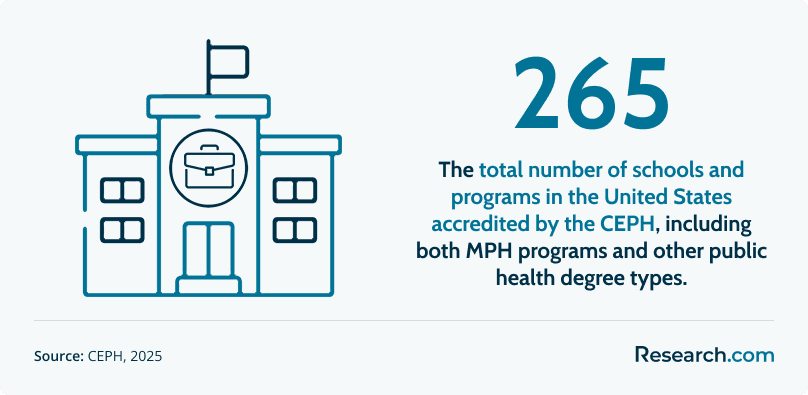
You are entering a large and well-established field of study. There are 265 schools and programs of public health accredited by the CEPH. These institutions awarded over 12,220 master's degrees in a recent academic year, showing a strong and consistent demand for public health expertise. This robust educational infrastructure ensures you can find a quality program that fits your timeline.
How does an online MPH in epidemiology program compare to an on-campus program?
The degree you earn, the diploma you receive, and the program’s accreditation are identical whether you study online or on campus. The primary differences lie in how the courses are delivered and the structure of your learning experience. With 31% of all master’s students now earning their degrees fully online, the digital classroom has become a mainstream and respected pathway—similar to the growth seen in online MBA programs that accept transfer credits, which also offer flexibility without sacrificing academic rigor.
Online MPH in Epidemiology Programs
The biggest advantage of an online program is its flexibility. You can fit your studies around your work and family commitments without having to relocate or pause your career. This format also gives you access to excellent programs across the country, not just those in your immediate area. Succeeding online builds valuable skills in self-discipline and time management that employers respect.
On-Campus MPH in Epidemiology Programs
An on-campus program offers a more traditional educational experience. You benefit from direct, face-to-face interaction with your professors and classmates, which can build a strong professional network. The structured schedule of in-person classes provides a clear routine, and you have immediate access to campus resources like the library, labs, and student services.
What is the average cost of an online MPH in epidemiology program?
The average tuition for an online MPH in epidemiology is approximately $33,290 for in-state students and $38,763 for out-of-state students. However, the total cost can vary significantly depending on the institution. You will find a wide range, with total tuition falling anywhere from $17,000 to over $72,000. The key difference is often whether the university is public or private.
It’s helpful to view this cost as a long-term investment in your career growth rather than a simple expense. Much like an online political science master’s degree, an MPH in epidemiology provides a strong return on investment through higher earning potential and expanded leadership opportunities in government, research, and healthcare.
Even at the 25th percentile, epidemiologists earn enough to offset tuition relatively quickly, while top earners see a substantial return on their degree.
What are the financial aid options for students enrolling in an online MPH in epidemiology program?
Making a plan to fund your degree is a crucial step in the process. While the average student loan debt for a master's degree is around $71,415, a proactive approach can significantly reduce this burden. Several funding avenues are available to help you manage the investment in your education.
- Federal Student Aid: Your first step should be completing the Free Application for Federal Student Aid (FAFSA), which is the gateway to accessing federal loans and grants.
- University and Program Scholarships: Many universities offer merit-based or need-based scholarships specifically for students in their public health programs.
- Employer Tuition Reimbursement: You should check with your current employer, as many companies offer tuition assistance programs to help employees develop valuable new skills.
- Professional Organization Grants: Professional groups, such as the American Public Health Association (APHA), sometimes offer grants or scholarships for their members.
- Public Service Loan Forgiveness (PSLF): If you work in a government or non-profit role after graduation, you may be eligible for the PSLF program, which can lead to loan forgiveness.
What are the prerequisites for enrolling in an online MPH in epidemiology program?
While specific requirements vary by university, most programs look for a similar set of core qualifications. Admissions committees often take a holistic view, valuing professional experience right alongside academic achievements.
- Accredited Bachelor's Degree: You must have a four-year degree from a recognized institution to be considered for admission.
- Minimum GPA: Most programs look for an undergraduate GPA of 3.0 or higher, but significant professional experience can sometimes offset a lower number.
- Foundational Coursework: You will likely need to have completed undergraduate courses in subjects like biology and statistics.
- Professional Experience: Many programs, especially those designed for working adults, highly value relevant work experience. Some applicants even look into related fields like MSN public health nursing jobs to gain this experience.
- Letters of Recommendation: You will need strong letters from academic or professional references who can speak to your ability to succeed in a graduate program.
What courses are typically in an online MPH in epidemiology program?
Accredited programs share a core structure, ensuring you receive a comprehensive public health education focused on practical and analytical skills. The curriculum is designed to equip you with the knowledge and tools used by professionals in the field every day.
- Core Public Health Disciplines: You will build a strong foundation with courses in the five core areas, including biostatistics, epidemiology, health policy, social and behavioral sciences, and environmental health.
- Advanced Epidemiological Methods: These courses provide in-depth training on modern study design, complex data analysis, and the methods used for effective disease surveillance.
- Biostatistics and Data Analysis: You will focus on statistical theory and its application using software, with many programs teaching SAS, the most in-demand technical skill for epidemiologists.
- Specialization Electives: These courses allow you to focus on a specific area of interest, which is essential for shaping future careers in health education and other specialized fields.
- Applied Practice Experience: You will complete a required practicum or capstone project, allowing you to apply your new knowledge in a real-world public health setting.
Just as online masters in accounting no GMAT programs balance flexibility with rigor, accredited MPH in epidemiology programs combine technical depth with practical experience to prepare you for leadership in data-driven health decision-making.
What types of specializations are available in an online MPH in epidemiology program?
Choosing a specialization allows you to develop deep expertise in a specific area of public health. While many online MPH epidemiology programs offer a generalist track, focusing your studies can give you a competitive edge in the job market. This is similar to how someone might pursue an urban planning online degree to focus on a specific aspect of civil infrastructure.
- Infectious Disease Epidemiology: This highly relevant field focuses on tracking and controlling communicable diseases, which cause approximately one in seven deaths worldwide.
- Chronic Disease Epidemiology: You will investigate the causes and distribution of long-term health issues like heart disease, cancer, and diabetes within populations.
- Hospital and Healthcare Epidemiology: This specialization concentrates on preventing and controlling infections within hospitals and other healthcare settings to ensure patient safety.
- Maternal and Child Health: This area focuses on improving the health and well-being of women, children, and families through research and program implementation.
- Environmental Epidemiology: You will study how environmental factors, such as air and water quality, impact the health of populations.
How to Choose the Best Online MPH in Epidemiology Program
Choosing the right online MPH in Epidemiology program is a pivotal step toward advancing your public health career. Using a clear framework to compare your options is the best way to find a program that fits your career goals and learning style.
- Accreditation: You must verify that the program is accredited by the CEPH, which is the non-negotiable standard for quality.
- Curriculum and Skills: Examine the curriculum to ensure it teaches the specific, in-demand technical skills, like SAS or R, that are relevant to your career goals.
- Faculty Expertise: Look for faculty who are not just academics but are also experienced practitioners with real-world experience in the field.
- Format and Flexibility: Choose a program with a delivery format, either asynchronous or synchronous, that fits your personal learning style and weekly schedule.
- Cost and Return on Investment: Evaluate the total cost against the program's career support services and graduate success data to assess its long-term value.
- Career Support Services: Investigate what resources the program offers for internships, professional networking, and job placement assistance after graduation.
What career paths are available for graduates of an online MPH in epidemiology program?
An online MPH in epidemiology equips you with specialized analytical skills for a variety of roles. Graduates are prepared for positions across top employment sectors, including state and local governments and hospitals. Below are five common career paths you can pursue with this degree.
1. Research Analyst
As a research analyst, your work centers on collecting and interpreting data in academic, government, or private settings to uncover health trends and risk factors. This role is foundational to creating evidence-based public health policy.
Median salary: $75,000 per year.
2. Infection Control Practitioner
You will work within hospitals and healthcare facilities to prevent and control the spread of infectious diseases among patients and staff. This is a critical, hands-on role for ensuring patient safety in clinical environments.
Median salary: $82,000 per year.
3. Clinical Trial Manager
Serving as a clinical trial manager means overseeing the operations of research studies, from ethics compliance to budgeting and timelines. This role serves as a crucial bridge between scientific research and practical application.
Median salary: $95,000 per year.
4. Public Health Advisor
Working as a public health advisor involves providing technical guidance for programs within government agencies like the CDC. While this role focuses on data and policy, other public service paths, such as those available with a social work degree online, focus more on direct community intervention.
Median salary: $88,000 per year.
5. Field Epidemiologist
You will investigate disease outbreaks directly in the community, often requiring travel to affected areas to collect data. This is a high-impact role where you implement control measures on the front lines of public health.
Median salary: $90,000 per year.
What is the job market for graduates of an online MPH in epidemiology program?
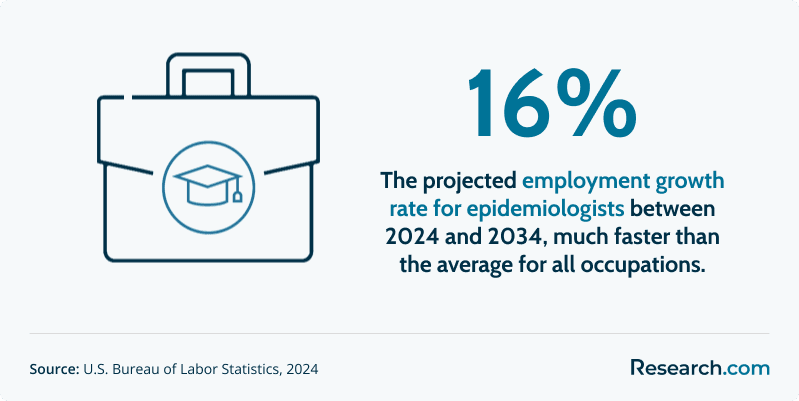
Employment for epidemiologists is projected to grow by 16% between 2024 and 2034, a rate that is much faster than the average for all occupations. This high demand provides a strong sense of security for anyone entering the field. This positive outlook translates directly to successful outcomes for graduates. Data shows that 95% of students with a master's in public health were either employed or pursuing further education within a year of graduating.
This is part of a larger trend, as the entire health workforce has grown by over 4% recently. The skills gained in online MPH epidemiology programs are essential for public health and related sectors, such as the field of emergency management bachelor's degree careers. This combination of high demand and proven success validates the degree as a secure investment in your professional future.
Here’s What Graduates Have to Say about Their Online MPH in Epidemiology Program
- Norelyn: "As a full-time nurse manager, taking two years off for a master's was impossible. The online MPH allowed me to fit challenging coursework into my evenings and weekends without stepping away from my career. The program gave me the analytical skills I needed, and I was able to transition into a director role for infection prevention at my hospital even before I officially graduated. It was the only path that made sense for me."
- Frederick: "I was working as a data analyst in the tech industry and felt a real lack of purpose. I knew I had the quantitative skills for epidemiology, but I was nervous about making such a big career change. This program was the perfect bridge, teaching me how to apply my background to real-world public health problems. Now, I work for the state health department, and I finally feel like my work makes a tangible difference."
- Kenneth: "Working in a clinical lab, I became fascinated by how infectious diseases spread. I chose a program with a strong infectious disease specialization, and it was the best decision I could have made. The focused curriculum gave me the specific expertise I needed to move out of the lab and into a research role. The online format meant I could learn from top experts in the field without having to relocate."
Key Findings
- The job market for epidemiologists is exceptionally strong, with a projected growth rate of 16% through 2034, offering a stable and expanding career path for graduates.
- The financial return on this degree is significant, with an average annual salary of $99,371, providing a clear justification for the educational investment.
- The online format is a mainstream and respected pathway for graduate education, with 31% of all master's students now earning their degrees entirely online.
- While the average tuition is around $33,290 for in-state students, the wide cost range from $17,000 to over $72,000 means prospective students must carefully evaluate a program's total return on investment.
- Graduates enter the job market with confidence, as 95% of public health master's students are employed or pursuing further education within one year of finishing their program.
References:
- Bureau of Labor Statistics. (2023). Epidemiologists: Occupational outlook handbook. Retrieved from BLS.
- Bureau of Labor Statistics. (2023). Occupational employment and wages: Epidemiologists. Retrieved from BLS.
- Council on Education for Public Health. (2023). Accreditation statistics. Retrieved from CEPH.
- Data USA. (n.d.). Epidemiology profile. Retrieved from Data USA.
- Data USA. (n.d.). General public health profile. Retrieved from Data USA.
- EAB. (2023). The future of master’s-level public health programs. Retrieved from EAB.
- Education Data Initiative. (2023). Average graduate student loan debt. Retrieved from EducationData.
- National Center for Education Statistics. (2024). Graduate degree fields. Retrieved from NCES.
- National University. (2024). Master’s degree statistics. Retrieved from National University.
- Our World in Data. (2024). Causes of death. Retrieved from Our World in Data.
- Salary.com. (2024). Epidemiologist salary. Retrieved from Salary.com
- Tufts University School of Medicine. (2024). MPH career pathways and outcomes. Retrieved from Tufts Medicine.
- ZipRecruiter. (2024). MPH epidemiology salary. Retrieved from ZipRecruiter.
- Zippia. (2024). Epidemiologist demographics. Retrieved from Zippia.
- Zippia. (2024). Epidemiologist education. Retrieved from Zippia.
Other Things You Should Know About Online MPH in Epidemiology Programs
Online MPH programs in Epidemiology in 2027 provide unique networking opportunities via virtual conferences, webinars, and dedicated online forums. Schools often host industry guest speakers and panel discussions, allowing students to connect with professionals and peers globally, expanding their professional networks beyond geographical limitations.
In 2027, the entry requirements for the best online MPH in Epidemiology programs typically include a bachelor's degree from an accredited institution, a strong academic record, and relevant coursework or professional experience. Additional requirements might include GRE scores, personal statements, and recommendation letters, depending on the program specifics.


