
2027 Doctor vs. PA vs. NP: Explaining the Difference

Co-Founder and Chief Data Scientist
In the U.S., more than 1.3 million physicians, physician assistants (PAs), and nurse practitioners (NPs) provide care, but their training, responsibilities, and pay differ significantly. For students considering a medical career, understanding these differences can be the key to choosing the right path.
This article breaks down how doctors, PAs, and NPs compare in terms of education, licensing exams, salaries, job outlook, and work environments. By the end, you’ll have a clear picture of which role best fits your career goals in healthcare.
Key Things You Should Know About Doctors, PAs, and NPs
- Doctors (MDs and DOs): Physicians complete the most extensive education and training, including medical school, residency, and sometimes fellowship. They can specialize in any field, from surgery to psychiatry, and earn the highest median salaries in healthcare.
- Physician Assistants (PAs): PAs earn a master’s degree and practice under physician supervision, though their independence varies by state. They can diagnose, treat, prescribe, and even assist in surgeries, offering broad flexibility across specialties.
- Nurse Practitioners (NPs): NPs are advanced practice registered nurses with at least a master’s degree, often a Doctor of Nursing Practice (DNP). In many states, they practice independently, focusing on patient-centered primary or specialty care.
- What’s the difference between Doctor, PA, and NP? Doctor vs PA vs NP
- What degrees and exams are required for each career? Degrees & Exams
- How much do Doctors, PAs, and NPs earn on average? Average Salaries
- What is the job outlook for each role in the next decade? Job Outlook
- How much autonomy do Doctors, PAs, and NPs have in patient care? Autonomy in Patient Care
- What does a typical workday look like in each career? Typical Workday Examples
- Who should consider becoming a Doctor, PA, or NP based on career goals? Who should consider becoming a Doctor, PA, or NP based on career goals?
- Which career offers more flexibility to change specialties? Which career offers more flexibility to change specialties?
- In what settings do Doctors, PAs, and NPs usually work? In what settings do Doctors, PAs, and NPs usually work?
What’s the difference between Doctor, PA, and NP?
Doctors, physician assistants (PAs), and nurse practitioners (NPs) often work together in clinical settings, but their roles are distinct. Each profession has different educational pathways, levels of independence, and approaches to patient care. Understanding these differences can help patients know what to expect and guide future healthcare professionals in choosing the right career path.
Doctors
Doctors (MDs and DOs) are licensed physicians with the broadest scope of practice in healthcare. They can diagnose complex conditions, prescribe medications, and perform surgeries. Their philosophy of care combines evidence-based medicine with specialization in areas such as cardiology, pediatrics, or neurology. Becoming a doctor requires at least four years of medical school, followed by three to nine years of residency, and often additional fellowship training. While they provide comprehensive care, patients may face longer wait times to see them, especially in high-demand specialties.
Physician Assistants
Physician assistants practice medicine under the supervision of doctors, though their autonomy varies by state law and workplace setting. They can examine, diagnose, treat, and prescribe medications, and many also assist in surgical procedures. Education requires a master’s degree from an accredited PA program, usually after completing a bachelor’s degree with science prerequisites and clinical experience. Compared with doctors, PAs often provide faster access to care and flexibility across specialties. Importantly, they differ from other healthcare roles, as explained in this guide on medical assistant vs physician assistant.
Nurse Practitioners
Nurse practitioners (NPs) are advanced practice registered nurses who provide primary and specialty care, often focusing on prevention, wellness, and holistic treatment. Their scope of practice differs by state: in many, they can independently diagnose, prescribe, and manage patient care, while in others they collaborate with physicians. NPs typically hold a master’s or Doctor of Nursing Practice (DNP) degree, with advanced coursework in pharmacology, pathophysiology, and clinical training. Patients often find NPs more accessible for routine care, especially in underserved communities where physician shortages exist.
How long does it take to become a Doctor, PA, or NP?
Becoming a doctor, physician assistant (PA), or nurse practitioner (NP) takes very different amounts of time due to their distinct education and training requirements.
Doctors spend the longest in training, requiring about 11 to 15 years after high school. This includes four years of undergraduate study, four years of medical school, and at least three to nine years in residency, with some pursuing additional fellowship training.
For students seeking advanced degrees with a focus on historical and cultural support, researching HBCU master's programs online offers a valuable and flexible option.
Physician assistants follow a shorter path. They complete a bachelor’s degree, gain healthcare experience, and then enter a PA master’s program that usually lasts two to three years. In total, it takes around seven to eight years to become a licensed PA, making it a faster route to practice medicine compared with doctors.
Nurse practitioners are registered nurses who advance into graduate-level nursing education. Most earn a master’s degree in two to four years, while others pursue a Doctor of Nursing Practice (DNP). Altogether, the process can take six to eight years, depending on whether the nurse enters directly from a bachelor’s program or through a bridge option. For a deeper breakdown of timelines, see this guide on how long is nurse practitioner school.
The chart below shows employment numbers for doctors, physician assistants, and nurse practitioners in 2024. These figures highlight how each career path, despite requiring different amounts of training, plays a vital role in meeting the growing demand for healthcare.
What degrees and exams are required for each career?
Doctors, physician assistants (PAs), and nurse practitioners (NPs) each require advanced degrees and national licensing exams, but the length and intensity of training differ significantly. Doctors undergo the most extensive preparation, while PAs and NPs enter practice sooner with graduate-level credentials. Students who have completed some college but did not finish may find that degree completion online programs offer a flexible path to earning their bachelor's degree.
Doctors (MDs and DOs):
- Bachelor’s degree (commonly in biology, chemistry, or a related science)
- Medical degree: Doctor of Medicine (MD) or Doctor of Osteopathic Medicine (DO)
- Exams: United States Medical Licensing Examination (USMLE) Steps 1–3 for MDs or COMLEX-USA Levels 1–3 for DOs
- Postgraduate residency and, often, fellowship training
Physician Assistants (PAs):
- Bachelor’s degree (science-focused, often with prior clinical experience)
- Master’s degree in Physician Assistant Studies (MPAS) from an accredited program
- Exam: Physician Assistant National Certifying Exam (PANCE), followed by periodic recertification (PANRE)
Nurse Practitioners (NPs):
- Bachelor of Science in Nursing (BSN) and RN license
- Graduate-level degree: Master of Science in Nursing (MSN) or Doctor of Nursing Practice (DNP)
- Exams: Certification exams from the ANCC (e.g., Family Nurse Practitioner) or AANP (FNP exam), depending on specialty
Although the path is shorter for PAs and NPs compared to physicians, each role requires rigorous exams to ensure competency. For those seeking faster entry into healthcare, there are also 2 year medical degrees that prepare students for supporting roles, but advanced providers must meet higher standards.
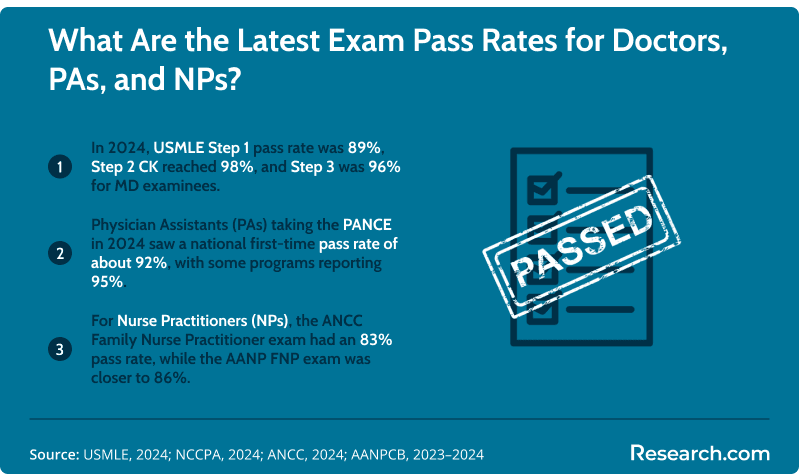
The infographic below highlights the latest pass rates for doctors, physician assistants, and nurse practitioners, showing how exam performance reflects the intensity and competitiveness of each pathway. These outcomes underscore the preparation required to enter and remain in these professions.
How much do Doctors, PAs, and NPs earn on average?
Doctors earn the highest salaries among these three professions, with a median annual wage equal to or greater than $239,200 in 2024. Their extended training, specialized expertise, and ability to perform complex procedures explain why physicians are at the top of the pay scale. However, earnings vary widely by specialty, with surgeons, anesthesiologists, and cardiologists earning well above the median.
Physician assistants (PAs) earn less than doctors but remain among the higher-paid healthcare professionals, with a 2024 median salary of $133,260. Their income reflects their ability to diagnose, treat, and even assist in surgery while requiring fewer years of education than physicians. PAs who work in government or outpatient care centers tend to earn at the higher end of the salary range.
Nurse practitioners (NPs) have slightly lower median pay compared with PAs, at $129,210 in 2024. Despite this, NPs remain highly compensated relative to most nursing roles, especially in primary care and mental health practice. Compensation often increases for NPs in hospitals and specialty practices, while those in physician offices typically earn less.
The chart below illustrates the salary differences among doctors, physician assistants, and nurse practitioners. These figures reflect how training length, specialization, and scope of practice directly influence average earnings across the three professions. For those interested in a counseling profession in the K-12 setting, obtaining school counselor certification is the key credential needed to begin practice.
What is the job outlook for each role in the next decade?
The job outlook for doctors, physician assistants (PAs), and nurse practitioners (NPs) varies significantly, with the fastest growth expected among NPs.
Between 2024 and 2034, physician and surgeon employment is projected to increase by 3%, which is about as fast as the average for all occupations. This growth is driven by an aging population and higher rates of chronic illness, but it is balanced by technological efficiencies and shifts toward team-based care.
In contrast, PAs are projected to see a 20% increase in employment, reflecting their growing role in providing medical care across hospitals, outpatient centers, and underserved communities. Their shorter training timeline compared with doctors allows the healthcare system to integrate PAs quickly to meet demand.
Nurse practitioners will see the most dramatic increase, with employment expected to grow 40%—more than 10 times the growth rate of physicians. This surge is tied to their expanding scope of practice in many states, greater acceptance by patients, and a nationwide push for more primary and preventive care providers. For those interested in public service careers with strong growth potential, pursuing a bachelor's degree fire science online can be a good pathway.
The chart below illustrates the projected growth rates of doctors, physician assistants, and nurse practitioners over the next decade. These figures highlight how workforce needs are shifting and why advanced practice nurses and PAs are becoming increasingly essential in U.S. healthcare.
How much autonomy do Doctors, PAs, and NPs have in patient care?
Doctors have the highest level of autonomy in patient care. They can diagnose, prescribe, and perform procedures without supervision, and their authority spans all specialties and settings. Physicians also lead care teams, set treatment plans, and make critical decisions in complex or emergency cases. Their autonomy reflects their extensive education, residency, and board certification.
Physician assistants, by comparison, must work under the supervision or collaboration of a physician, though the degree of oversight varies by state and practice setting. In some hospitals or clinics, PAs may exercise near independence in routine care, while in other places they must have closer physician involvement. Despite these limitations, their scope still includes diagnosing, prescribing, and assisting in surgeries, which provides them considerable responsibility.
Nurse practitioners’ autonomy depends heavily on state laws. In more than 25 states, NPs have “full practice authority,” meaning they can independently diagnose, prescribe, and manage patient care. In other states, they must collaborate with physicians to some degree. This flexibility has made NPs especially vital in underserved areas where physician shortages limit access to care.
What does a typical workday look like in each career?
Doctors usually start their day early with patient rounds in hospitals or scheduled appointments in private practices. A surgeon might spend hours in the operating room, while a family medicine doctor could move between wellness checkups, diagnosing chronic conditions, and coordinating specialist referrals. Physicians balance direct patient care with charting, reviewing labs, and consulting with other healthcare professionals, often working long hours or being on call for emergencies.
Physician assistants’ workdays mirror that of the doctors they collaborate with, though their roles vary by specialty. A PA in emergency medicine may quickly evaluate and stabilize patients, while a PA in orthopedics might assist in surgeries and manage follow-up appointments. Their schedules are demanding, but they often allow more flexibility compared with physicians.
Nurse practitioners typically focus on holistic and preventive care. For example, an NP in pediatrics may conduct routine checkups, administer vaccines, and counsel parents, while those in primary care clinics spend much of their time managing chronic illnesses. Some pursue specialized fields, such as functional medicine, and resources on how to become an NP in functional medicine outline additional training pathways.
Who should consider becoming a Doctor, PA, or NP based on career goals?
The decision to pursue a career as a doctor, physician assistant (PA), or nurse practitioner (NP) largely depends on your long-term goals, the type of care you want to provide, and how much time you’re willing to invest in education and training. Each role offers unique opportunities and trade-offs.
- Doctors – This path suits those who want the highest level of autonomy, the broadest scope of practice, and the ability to specialize in nearly any area of medicine. It’s a fit for individuals ready to commit a decade or more to medical education, residency, and potentially fellowship training.
- Physician Assistants (PAs) – Becoming a PA is ideal for students who want to enter clinical practice more quickly but still work in diverse specialties. PAs are a strong choice for people who prefer collaboration with physicians and flexibility to change specialties without restarting their careers.
- Nurse Practitioners (NPs) – NPs are best for those drawn to patient-centered, holistic care, often in primary or preventive medicine. Many NPs value the ability to work independently in states granting full practice authority. With the rise of flexible online NP programs, the pathway has become more accessible to working nurses who want to advance their careers.
Each path requires weighing time, cost, and career expectations, but all three roles are essential to meeting America’s growing healthcare needs.
Which career offers more flexibility to change specialties?
Among doctors, physician assistants (PAs), and nurse practitioners (NPs), PAs have the most flexibility to change specialties without returning to school. A PA trained in family medicine can later work in surgery, dermatology, or emergency care simply by receiving on-the-job training in the new field. This adaptability makes the profession attractive for students who want diverse career options throughout their working lives.
Doctors, in contrast, face the greatest limitations once they choose a specialty. After medical school, physicians spend years in residency and sometimes fellowship training. Switching specialties later typically requires repeating another residency, which can add years of training. As a result, doctors usually stick with their chosen specialty for the entirety of their careers.
Nurse practitioners fall somewhere in between. NPs select a patient population focus—such as pediatrics, adult-gerontology, or psychiatric health—during their graduate education. While switching specialties often means additional certification or coursework, it’s generally easier than retraining as a physician. Options like enrolling in the easiest nurse practitioner program can also make the transition less burdensome for those seeking to expand their practice.
Overall, PAs lead in specialty flexibility, NPs have moderate mobility, and doctors face the steepest barriers to change.
In what settings do Doctors, PAs, and NPs usually work?
Doctors, physician assistants (PAs), and nurse practitioners (NPs) are found across nearly all healthcare environments, but their distribution differs based on training and scope of practice.
- Physicians often work in hospitals, specialized clinics, and private practices. Many pursue subspecialties that place them in academic medical centers or surgical facilities, while primary care physicians are concentrated in community and family medicine clinics.
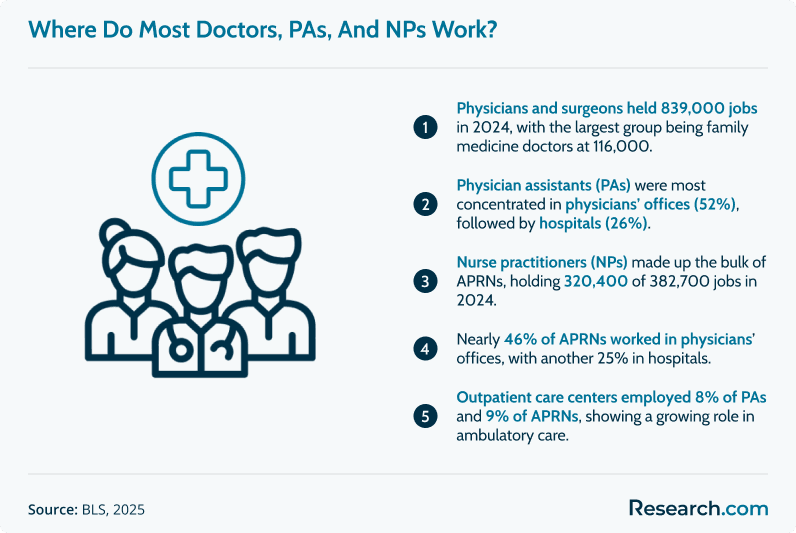
- PAs tend to be clustered in physicians’ offices, where they provide direct patient care in collaboration with doctors. Hospitals are the second-largest employer of PAs, particularly in emergency medicine and surgery. This distribution reflects the PA role as a flexible provider who fills gaps in high-demand settings.
- NPs, as the largest group of advanced practice registered nurses, are widely present in both hospitals and outpatient clinics. They frequently serve as primary care providers, especially in rural and underserved areas. Their growing presence in outpatient care centers highlights the increasing demand for ambulatory and preventive services.
The chart below illustrates how these professionals are distributed across different workplaces, emphasizing where each role contributes most within the U.S. healthcare system.
Here's What Graduates Have To Say About Their Doctor, PA, or NP Careers
- Maylene: "Studying online gave me the flexibility to complete medical school prerequisites while working part-time. Becoming a physician has been demanding, but the chance to treat complex cases and build lifelong patient relationships makes the effort worthwhile. The online resources kept me connected to mentors and peers. "
- Noel: "As a PA, I appreciate how my online master’s program prepared me for real-world collaboration. The virtual simulations and case studies were surprisingly hands-on. Now, I diagnose, treat, and prescribe daily, and I feel confident stepping into different specialties as my career grows. "
- Sahana: "Completing my nurse practitioner training online allowed me to keep working as an RN. The flexibility was a lifesaver. Today, I run my own patient panel in a rural clinic, where I provide primary care and health education. It’s empowering and deeply rewarding. "
Key Findings
- Doctors earn the highest salaries, with median pay at ≥ $239,200 in 2024.
- PAs had a national median salary of $133,260, while NPs earned $129,210.
- Job growth projections are 3% for doctors, 20% for PAs, and 40% for NPs between 2024–2034.
- USMLE Step 1 pass rate in 2024 was 89%, while PANCE had 92%, and NP exams averaged 83–86%.
- In 2024, doctors held 839,000 jobs, PAs 162,700, and NPs 320,400.
- Most PAs and NPs work in physicians’ offices, while doctors are more spread across hospitals and specialties.
References:
- American Nurses Association. Family Nurse Practitioner Certification.
- Board Vitals. ANCC vs. AANP FNP Exam.
- Bureau of Labor Statistics. Nurse Anesthetists, Nurse Midwives, and Nurse Practitioners.
- Bureau of Labor Statistics. Physician Assistants.
- Bureau of Labor Statistics. Physicians and Surgeons.
- Indiana University School of Health & Human Sciences. PANCE Performance.
- National Commission on Certification of Physician Assistants (NCCPA). PANCE Pass Rates.
- National Commission on Certification of Physician Assistants (NCCPA). PA Program Resources.
- United States Medical Licensing Examination (USMLE). Performance Data.
Other Things You Should Know About Doctors, PAs, and NPs
In 2027, doctors are primarily responsible for diagnosing and treating complex conditions, conducting surgeries, and leading healthcare teams. PAs (Physician Assistants) work under doctors to provide medical care, while NPs (Nurse Practitioners) can independently manage patient care, including assessments and treatment plans, often specializing in primary care or acute care.
In 2027, becoming a doctor requires completion of a medical degree (MD or DO), a residency, and often a fellowship. PAs need a master's degree from an accredited PA program, while NPs require a Master of Science in Nursing (MSN) or Doctor of Nursing Practice (DNP) after achieving RN status.
As of 2027, PAs and NPs can prescribe medication in all states, but the extent of their prescriptive authority varies. NPs often have full practice authority in many states, allowing them to prescribe independently, while PAs typically require a collaborative agreement with a physician.


