
2027 Best Online Bachelor's in Fire Science Program

Co-Founder and Chief Data Scientist
A national fire death rate of 13.3% highlights the critical need for qualified leaders in public safety. But for many, the path from a degree to a stable career feels unclear. You might see the importance of the work, but struggle to connect a program to specific, secure job titles. This uncertainty can make it difficult to commit to an educational path.
That is why this guide was developed. Our career planning experts, with more than 10 years of experience, have created a clear roadmap to help you understand the field. It will help you decide if an online bachelor's in fire science is the right step for your future.
What are the benefits of getting an online bachelor's in fire science?
- This degree prepares you for positions like fire captain or emergency manager, giving you a direct path to protecting communities.
- Graduates can expect an average salary of around $62,665, with significant potential for higher earnings in senior roles.
- Earning your online bachelor's in fire science offers the flexibility to advance your career while managing your current work and life duties.
What can I expect from an online bachelor's in fire science?
You can expect a flexible online program that blends fire science with key management and public policy principles. The curriculum is designed to shift your thinking from a tactical first responder to a strategic leader who can manage budgets, people, and community risk.
Coursework often uses real-world case studies and simulations. This approach connects academic theories directly to the challenges you will face in the field. With fire departments responding to over 1.3 million fires a year and EMS or rescue calls making up 65.2% of all incidents, the curriculum is broad and practical.
Most bachelor's programs require 120 credits. Full-time students typically finish in four years, but many programs offer accelerated options or generous credit transfers that can shorten this timeline considerably.
Where can I work with an online bachelor's in fire science?
A bachelor's in fire science opens doors to a wide range of roles in both the public and private sectors. Your skills in risk management, safety, and administration are valuable across many industries beyond traditional firefighting.
- Government Sector: The 53% majority of graduates work in local, state, or federal government agencies, including municipal fire departments and emergency management offices.
- Manufacturing: Companies in this sector employ 7% of graduates in roles focused on industrial fire protection and workplace safety compliance.
- Professional Services: About 5% of graduates find work in consulting firms, insurance companies, as investigators, or as independent safety advisors.
- Utilities: Power plants and other utility companies hire 4% of graduates to manage and mitigate unique fire and safety risks.
- Hospitality: Large hotels and resorts employ 4% of graduates to oversee fire prevention systems and ensure the safety of their guests.
How much can I make with an online bachelor's in fire science?
With a bachelor's degree in fire science, you can earn around $68,000 annually. However, your actual salary will depend on your location, experience, and specific career path.
- Education Level: Earning a bachelor's degree significantly increases your pay potential to around $68,000, compared to roughly $59,000 for an associate degree.
- Location: Your salary can vary widely by state, with professionals in California or Nevada earning over $100,000 while others might average below $45,000.
- Experience Level: Pay grows with experience, starting around $49,000 for entry-level roles and rising to more than $88,000 for senior professionals.
- Industry: While government positions average about $56,000, moving into private sector roles in manufacturing or aviation safety can lead to salaries over $120,000.
- List of the Best Online Bachelor's in Fire Science Programs for 2027 List of Programs
- How long does it take to complete an online bachelor's in fire science program? Completion Time
- How does an online bachelor's in fire science program compare to an on-campus program? How does an online bachelor's in fire science program compare to an on-campus program?
- What is the average cost of an online bachelor's in fire science program? Program Cost
- What are the financial aid options for students enrolling in an online bachelor's in fire science program? Financial Aid
- What are the prerequisites for enrolling in an online bachelor's in fire science program? What are the prerequisites for enrolling in an online bachelor's in fire science program?
- What courses are typically in an online bachelor's in fire science program? What courses are typically in an online bachelor's in fire science program?
- What types of specializations are available in an online bachelor's in fire science program? Specializations
- How to Choose the Best Online Bachelor's in Fire Science Program How to Choose the Best Online Bachelor's in Fire Science Program
- What career paths are available for graduates of an online bachelor's in fire science program? Career Paths
- What is the job market for graduates of an online bachelor's in fire science program? Job Market
List of the Best Online Bachelor's in Fire Science Programs for 2027
How do we rank schools?
Recognizing that paying for a degree is a significant investment, our ranking methodology ensures that students can make informed decisions based on comprehensive and transparent information. The ranking draws upon reliable sources such as the IPEDS database, Peterson's database, the College Scorecard database, and The National Center for Education Statistics.
These sources provide a robust foundation of data to evaluate and rank fire science programs. For more details on our methodology, please visit Research.com’s methodology page.
1. University of Cincinnati - Fire Administration Track: Online Bachelor of Arts in Professional Studies
University of Cincinnati offers a degree completion program for working professionals, allowing students to earn credit for prior work experience. The curriculum is customizable, enabling you to build an educational track that hones your existing skills and aligns with your specific career advancement goals in fire administration.
- Program Length: 4-6 semesters
- Required Credits to Graduate: 120
- Cost per Credit: $642
- Accreditation: Higher Learning Commission (HLC)
2. University of Florida - Bachelor of Science in Fire and Emergency Services
University of Florida’s program is designed for professionals seeking to advance into managerial roles within the public or private sectors. Students can choose to specialize their studies in fire management, emergency medical services management, or emergency management to meet their specific professional aspirations.
- Program Length: 4 years
- Specializations: Fire Management; EMS Management; and Emergency Management
- Required Credits to Graduate: 120
- Cost per Credit: $129.18
- Accreditation: Southern Association of Colleges and Schools Commission on Colleges (SACSCOC)
3. Colorado State University - Fire and Emergency Services Administration B.S.
Colorado State University builds upon your existing technical training to develop the strategic leadership and administrative skills needed for promotion. The program uses case studies and analysis to help you integrate academic knowledge into managerial roles, preparing you for high-level officer positions.
- Program Length: 3-4 years
- Required Credits to Graduate: 120
- Cost per Credit: $490
- Accreditation: Higher Learning Commission (HLC)
4. University of Wisconsin-Oshkosh - Bachelor of Applied Studies (BAS) in Fire and Emergency Response Management
University of Wisconsin-Oshkosh delivers its curriculum in accelerated 7-week sessions, allowing full-time students to finish in as little as two years. This flexible, 100% online program offers distinct emphasis areas in either Emergency Management or Fire Services Management to align with your career track.
- Program Length: ~2 years
- Required Credits to Graduate: 120
- Cost per Credit: $413.37
- Accreditation: Higher Learning Commission (HLC); and International Fire Service Accreditation Congress (IFSAC)
5. New Jersey City University - Bachelor of Science in Fire Science
New Jersey City University offers the only university-based fire science program in the state, with a curriculum that utilizes textbooks recognized for civil service promotional exams. You will learn from active and retired fire officers, focusing on leadership development and teamwork in a highly interactive format.
- Program Length: 3-4 years
- Required Credits to Graduate: 120
- Cost per Credit: $475.61
- Accreditation: Middle States Commission on Higher Education (MSCHE)
6. Embry-Riddle Aeronautical University - B.S. in Emergency Services
Embry-Riddle Aeronautical University’s program is recognized by the Fire Emergency Services Higher Education (FESHE) network, allowing you to earn National Fire Academy certificates. You can tailor your degree with a focus in either Aviation Emergency Management or Fire and Emergency Services.
- Program Length: 3-4 years
- Specializations: Aviation Emergency Management; and Fire and Emergency Services
- Required Credits to Graduate: 120
- Cost per Credit: $522
- Accreditation: International Fire Service Accreditation Congress (IFSAC)
7. University of Nebraska at Omaha - Bachelor of Science in Emergency Management
The University of Nebraska at Omaha provides a broad public safety education, requiring students to select two 15-hour concentration areas. You can pair the Fire Service Management concentration with another area, like public administration or natural disasters, to create a customized and versatile degree.
- Program Length: 3-4 years
- Concentration: Fire Service Management (requires choosing a second concentration)
- Required Credits to Graduate: 120
- Cost per Credit: $291
- Accreditation: Higher Learning Commission (HLC)
8. University of North Carolina at Charlotte - Fire and Safety Engineering Technology, Fire Safety Concentration, B.S.
The University of North Carolina at Charlotte offers a seamless pathway for graduates with an Associate of Applied Science in a related field from a North Carolina community college. The 100% asynchronous online format is designed for working professionals looking to complete their bachelor's degree.
- Program Length: 2 years (with qualifying transfer credits)
- Required Credits to Graduate: 120
- Cost per Credit: $189.48
- Accreditation: Southern Association of Colleges and Schools Commission on Colleges (SACSCOC)
9. Purdue University Global - Online Bachelor’s Degree in Fire Science
Purdue University Global offers a program recognized by the U.S. Fire Administration’s FESHE network, ensuring a curriculum focused on modern fire service needs. You can enhance your administrative skills by personalizing your degree with an optional concentration in business foundations.
- Program Length: 4 years
- Concentration: Business Foundations
- Required Quarter Credits to Graduate: 180
- Cost per Credit: $371
- Accreditation: International Fire Service Accreditation Congress (IFSAC)
10. Liberty University - Bachelor of Science in Fire Administration
Liberty University’s program is designed to help professional firefighters advance into leadership and administrative roles within emergency service organizations. You can tailor your studies by choosing a specialization in areas like Emergency Management, Emergency Medical Services, or Fire Science.
- Program Length: 4 years
- Specializations: Emergency Management; Emergency Medical Services; and Fire Science
- Required Credits to Graduate: 120
- Cost per Credit: $390
- Accreditation: Southern Association of Colleges and Schools Commission on Colleges (SACSCOC)
How long does it take to complete an online bachelor's in fire science program?
A standard 120-credit online bachelor's in fire science typically takes four years to finish, but many students complete it in two years or less. The key is transferring existing college credits. If you already have an associate degree or have completed some college coursework, you can often enter as a junior and focus only on the upper-level classes required for your major.
For working adults, the most important factor in program length is the school's policy on prior learning. Look for programs with generous credit transfer acceptance and options for Prior Learning Assessment (PLA). PLA can award you college credit for professional experience and certifications, saving you significant time and money.
The flexibility of online education is a major advantage. For example, some institutions even offer accelerated formats like 6 week college courses online in various subjects. With approximately 900 colleges and universities offering fire science programs, you have many options to find a school that values your experience, as the chart below illustrates.
How does an online bachelor's in fire science program compare to an on-campus program?
The degree you earn online is identical to the one earned on campus. The curriculum, the faculty, and the university's accreditation are what give a degree its value. The main difference lies in the learning experience and flexibility.
Online Fire Science Degree Programs
Online programs offer the greatest flexibility, allowing you to complete coursework around your work schedule and family commitments. This format is ideal for working professionals or anyone who needs to balance education with other responsibilities. With 53.2% of all college students now enrolled in at least some distance education, it has become a mainstream and respected way to learn. Some students even seek out the shortest online bachelor's degree in emergency management to maximize their time.
On-Campus Fire Science Degree Programs
On-campus programs provide a traditional classroom experience with face-to-face interaction with professors and peers. This structured environment, with set class times and in-person labs, works well for recent high school graduates or those who prefer a more scheduled academic life. Choosing an on-campus or online bachelor's in fire science is about finding the format that best fits your life.
What is the average cost of an online bachelor's in fire science program?
The cost of an online bachelor's in fire science varies significantly depending on the type of institution you choose. Public universities are often the most affordable option, especially if you qualify for in-state tuition rates.
On average, you can expect annual tuition for an online program to be around $10,423 for in-state students at public colleges. Out-of-state students at those same schools might pay closer to $22,577. Private universities typically have a higher sticker price. The cost per credit hour also ranges widely, from about $330 for in-state public schools to over $500 for private institutions.
It is crucial to focus on the net price. The net price is what you actually pay after grants, scholarships, and other financial aid are subtracted. For many students, this number is far lower than the sticker price, so don't let the initial cost figures discourage you. Also, be cautious of unaccredited institutions—understanding the difference between diploma mills and accreditations can help you ensure your degree holds real academic and professional value.
What are the financial aid options for students enrolling in an online bachelor's in fire science program?
Financial aid is the key that makes a college degree affordable for most students. There are many resources available to help you pay for your education, and you should explore all of them.
- FAFSA: The Free Application for Federal Student Aid is your starting point and determines your eligibility for most forms of aid.
- Federal Grants: These are funds from the government that you do not have to repay, such as the Pell Grant for undergraduate students with financial need.
- Student Loans: Federal student loans offer low, fixed interest rates and must be repaid after you leave school, but they make a degree possible for millions.
- Scholarships: Many organizations offer scholarships specifically for fire science students, with some programs reimbursing up to $6,900 in tuition.
- Employer Tuition Reimbursement: If you are already a firefighter, your department may offer a program to help pay for your degree, a benefit that helps many advance their careers.
What are the prerequisites for enrolling in an online bachelor's in fire science program?
Most online bachelor's programs have straightforward admission requirements designed to be accessible. You will typically need to submit an online application, transcripts, and sometimes a personal essay. If you’re planning to expand your studies later, you might also wonder is a dual degree better than a double major; understanding this distinction can help you make smarter academic decisions.
- High School Diploma or GED: This is the fundamental academic requirement for entry into any bachelor's degree program.
- Minimum GPA: Some universities will ask for a minimum GPA from your high school or previous college work, often around a 2.0 to 2.5.
- Transfer Credits: For degree completion programs, you will need an associate degree or a set number of transferable college credits, usually around 60.
- Professional Experience: While many programs are open to all students, some may give preference to applicants with experience in firefighting or public safety.
- Standardized Test Scores: Many institutions no longer require SAT or ACT scores, and you can find many best online colleges with no SAT score requirements.
As the chart below shows, an associate degree is one of the most common degrees awarded in this field. This makes it a popular and effective pathway into a bachelor's degree completion program.
What courses are typically in an online bachelor's in fire science program?
The curriculum in a fire science bachelor's program is designed to build on your technical knowledge and develop your leadership skills. You will find that courses blend scientific principles with the practical realities of administration and law.
- Fire Behavior and Combustion: This course covers the science of how fires start and spread, which is the foundational knowledge for prevention and suppression.
- Fire Prevention and Inspection: You will learn about community risk reduction, public education, and the process of inspecting buildings to enforce fire codes.
- Building Codes and Construction: This class focuses on how different construction types and materials influence fire behavior and firefighter safety.
- Fire Service Administration: You will study the management side of the fire service, including topics like budgeting, human resources, and strategic planning.
- Legal and Ethical Issues: This course examines the legal framework and ethical dilemmas that fire service leaders face in emergency and non-emergency situations.
Just like understanding the difference between front end and back end development helps tech professionals choose their specialization, recognizing how each fire science course builds specific competencies can help you align your education with your career goals.
As the chart below shows, these courses are designed to build the exact skills that are most common and necessary for professionals in the field, such as fire prevention and public safety.
What types of specializations are available in an online bachelor's in fire science program?
Choosing a specialization allows you to focus your studies on a specific area of fire science. This can help you stand out in the job market and align your education directly with your career goals.
- Arson and Fire Investigation: This path focuses on the science of fire cause and origin, preparing you for roles in investigation and evidence collection.
- Emergency Management: You will learn how to plan for and respond to large-scale disasters, coordinating efforts between multiple agencies.
- Fire Administration: This specialization is ideal for aspiring leaders, as it concentrates on the management, budgeting, and policy aspects of running a fire department.
- Fire Protection Technology: This track covers the design and maintenance of fire detection and suppression systems in buildings and industrial settings.
- Public Safety and Security: This broader specialization examines the connections between fire services and law enforcement, and some students even explore the shortest homeland security online programs to complement this focus.
Aligning your degree with a specific track like administration can be a strategic move. While female enrollment in fire science is about 10%, specializing in less physically demanding leadership roles can open more pathways for women to advance in the public safety sector.
How to Choose the Best Online Bachelor's in Fire Science Program
Choosing the right online bachelor's in fire science program is about finding the best fit for your specific goals. Use these key factors to evaluate your options and make a confident choice.
- Accreditation: This is the most important factor and is non-negotiable. The university must have regional accreditation for your degree to be recognized. Programmatic accreditation from a body like IFSAC is also highly valued, with 65% of departments accepting it for career advancement. To better understand different accreditation types, reviewing WASC vs COAMFTE can clarify how each impacts program credibility and recognition.
- Program Costs and Financial Aid: Compare the net price of each program, which is the cost you pay after grants and scholarships. A school with a higher sticker price might offer a more generous aid package, making it more affordable.
- Flexibility and Format: Make sure the program's delivery format matches your needs. If you have a busy schedule, look for asynchronous programs that allow you to complete coursework on your own time.
- Faculty Expertise: Look for instructors who are not just academics but also have years of real-world leadership experience in the fire service.
- Student Support Services: Strong online programs provide robust support, including access to academic advisors, career services, and technical support.
What career paths are available for graduates of an online bachelor's in fire science program?
A bachelor's in fire science is your pathway to leadership and specialized administrative roles. It qualifies you for positions that require a deep understanding of policy, management, and strategy, moving you beyond tactical response.
1. Fire Captain
A fire captain supervises a company of firefighters at a single station and often serves as the incident commander for smaller emergencies. They are responsible for training, performance evaluations, and ensuring their crew is prepared for any situation. This role requires strong leadership and decision-making skills, blending fieldwork with administrative duties.
Median Salary: $80,000 per year.
2. Fire Chief
The fire chief is the top executive of a fire department, responsible for the overall administration, budget, and strategic direction. They work closely with city managers and elected officials to set public safety policy and represent the department to the community. This position is the highest level of leadership and requires extensive experience and education.
Median Salary: $95,000 per year.
3. Fire Inspector
Fire inspectors are prevention specialists who examine buildings to ensure they comply with local and state fire codes. They identify hazards, approve building plans, and may investigate the cause and origin of fires. This role is critical for community risk reduction and preventing fires before they start.
Median Salary: $64,000 per year.
4. Arson Investigator
Arson investigators are highly trained specialists who determine the cause of fires, particularly when criminal activity is suspected. They collect evidence, interview witnesses, and often work with law enforcement to build cases for prosecution. This career combines the science of fire with detective work.
Median Salary: $66,000 per year.
5. Emergency Management Director
Emergency management directors plan and direct responses to large-scale emergencies and natural disasters, from hurricanes to public health crises. They coordinate efforts between fire, police, and medical services to protect the public. The skills learned are highly transferable, leading many to explore careers with a bachelor's degree in emergency management.
Median Salary: $76,000 per year.
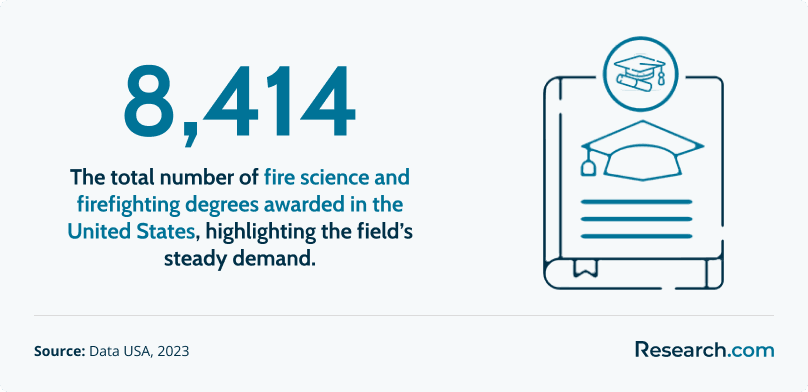
These career paths represent a well-established professional track. As the chart below shows, over 8,414 fire science degrees were awarded last year, demonstrating a clear and consistent demand for qualified leaders in the field.
What is the job market for graduates of an online bachelor's in fire science program?
The job market for graduates with an online bachelor's in fire science is stable and growing. The field has a projected job growth rate of 6%, offering strong career security. With more than 25,813 professionals currently employed and nearly 3,398 active job openings, there is a consistent, healthy demand for individuals with this advanced credential.
A significant factor driving this demand is the retirement of senior personnel across the public safety sector. As experienced leaders complete their careers, agencies need qualified candidates with the formal education required to fill these senior administrative and command positions.
An online bachelor's in fire science specifically develops the analytical and management skills needed for these roles. The diverse nature of incidents that departments handle, as shown in the chart below, further highlights why these advanced competencies are essential for modern public safety leadership.
Here’s What Graduates Have to Say About Their Online Bachelor's in Fire Science Program
- Frank: "I’d been a firefighter for over a decade and hit a ceiling. This degree was the key to unlocking that next step into a lieutenant position. The best part was that I could immediately apply what I was learning about budgeting and administration to my work at the firehouse. Studying online meant I didn’t have to miss a single shift or sacrifice overtime to get it done."
- Jean: " As an EMT, I saw emergencies from one angle, but I wanted to understand the entire system. The courses on emergency management and inter-agency cooperation were eye-opening. I was able to transition from a response role into a planning position with the county’s emergency management office. The degree gave me the credibility and the broader perspective I needed to make that move."
- Jake: " I thought this degree would only lead to a career in a municipal fire department. My classes on building codes and fire protection systems opened my eyes to the private sector. Now I work in corporate safety for a large manufacturing company, a stable job with regular hours. The program showed me how versatile these skills really are in the modern job market."
Key Findings
- Earning a bachelor's degree in fire science can increase your average salary potential to around $68,000, a significant jump from the $59,000 average for those with an associate degree.
- The job market for fire science professionals is projected to grow by 6%, with nearly 3,400 active job openings nationwide, indicating a stable and consistent demand for qualified leaders.
- Online education is now a mainstream path, with over 53% of all college students taking at least some of their courses via distance learning, making it a respected and viable option.
- For those seeking career advancement, programmatic accreditation is critical, as 65% of fire departments recognize IFSAC accreditation as a factor for promotion.
- An associate degree is a common and effective starting point, with 54% of all degrees awarded in fire science being at this level, creating a clear pathway into bachelor's completion programs.
- The government sector remains the primary employer for graduates, with 53% of professionals working in local, state, or federal agencies, offering a secure and well-defined career track.
References:
- Bureau of Labor Statistics. (2022). Firefighters: Occupational employment and wages. Retrieved from BLS.
- Data USA. (n.d.). Fire science and fire fighting profile. Retrieved from Data USA.
- EducationDynamics. (2024). Online college students 2024 report. Retrieved from EducationDynamics.
- FireScience.org. (n.d.). College degree rankings: Online fire science programs. Retrieved from FireScience.org.
- FireScience.org. (n.d.). Most popular fire science degrees for women. Retrieved from FireScience.org.
- Higher Ed Dive. (2024). Online degree students: New research on completion rates. Retrieved from Higher Ed Dive
- Miami Dade College. (n.d.). Fire science program costs. Retrieved from MDC.
- National Center for Education Statistics. (n.d.). IPEDS trend generator: Postsecondary fire science degrees. Retrieved from NCES.
- National Fire Protection Association. (2024). Fire statistical reports: Fires by occupancy or property type. Retrieved from NFPA.
- U.S. Fire Administration. (2024). Fire statistics and reports. Retrieved from USFA.
- U.S. Fire Administration. (2010). Firefighter safety and leadership report. Retrieved from USFA.
- University of Alaska Fairbanks. (n.d.). How to become a student firefighter. Retrieved from UAF.
- ZipRecruiter. (2024). Fire science salary. Retrieved from ZipRecruiter.
- Zippia. (2024). Firefighter demographics. Retrieved from Zippia.
- Zippia. (2024). Firefighter skills. Retrieved from Zippia.
- Zippia. (2024). Firefighter trends. Retrieved from Zippia.
Other Things You Should Know About Online Bachelor's in Fire Science Programs
The duration of an online Bachelor's in Fire Science program in 2027 varies, but most programs can be completed in four years with full-time enrollment. Some universities offer accelerated options or part-time studies, which can affect the timeline.
Yes, many universities award college credit for professional certifications through a Prior Learning Assessment (PLA). You can often earn credits for credentials like Firefighter I/II or paramedic licenses. This process can shorten your program length and lower your overall tuition costs.
Admission requirements typically include a high school diploma or equivalent, a minimum GPA, and standardized test scores such as the SAT or ACT. Some programs may also require a letter of recommendation or a personal statement. It's advised to check specific program prerequisites.


