
States That Will Need Nurses the Most by 2030

Co-Founder and Chief Data Scientist
As an expert in career planning and education, I've seen firsthand the complexities of researching future workforce trends in nursing. When it comes to the projected nursing needs by 2030, finding definitive answers is a significant challenge.
Data from different sources often present varying projections and figures, and this can be very confusing for someone trying to make an informed career decision. This is due to factors like differing methodologies in calculating supply and demand, the evolving landscape of healthcare technology, and unpredictable population shifts.
My goal is to help you break through this noise, identify reliable resources, and understand the factors that will genuinely impact your career outlook.
What are the benefits of getting a nursing degree?
- Career advancement: Provides a focused pathway to specialize and advance into roles like nurse educator, clinical nurse leader, or various nurse practitioner specialties, without the commitment of a full master's degree.
- Earning potential: A nurse with a graduate degree can earn a median salary of around $120,000, which is substantially higher than the median salary for a registered nurse.
- Flexible learning: Online programs are ideal for working nurses, allowing you to balance advanced education with your professional and personal life. You can study from anywhere and at your own pace.
What can I expect from an online nursing degree?
- Focused advanced topics: The curriculum is intensive, concentrating on specific areas such as nursing informatics, administration, education, or a particular patient population like pediatrics or gerontology.
- Structured curriculum: Courses are typically delivered through a mix of online lectures, interactive modules, and virtual labs, often with a required clinical practicum that you can complete in your local area.
- Applied strategic knowledge: The programs emphasize applying evidence-based practices and research to solve real-world healthcare challenges, improving patient outcomes and system efficiency.
- Condensed timeline: These certificates are designed for quick completion, often in under a year, allowing you to rapidly acquire new skills and credentials.
- Networking opportunities: You'll connect with experienced faculty and a diverse cohort of fellow nursing professionals from various backgrounds and geographic locations.
Where can I work with a nursing degree?
- Hospitals and medical centers: Move into leadership roles like clinical nurse leader, nurse manager, or a specialized nurse practitioner within various hospital departments.
- Academic institutions: Work as a nurse educator in a college or university, teaching and mentoring the next generation of nurses.
- Public and community health: Apply your expertise in community health clinics or public health departments to develop and implement health programs.
- Technology and data: With a focus on nursing informatics, you can work in healthcare IT, managing patient data systems and improving workflow efficiency.
- Private practice: A graduate certificate in a nurse practitioner specialty can lead to working in or opening a private practice, offering direct patient care.
How much can I make with a nursing degree?
- Specialist roles: A nurse who earns a graduate certificate and specializes can earn a median annual salary of around $113,000 for advanced practice registered nurses.
- Mid-level roles: Nurses who take on management or education positions can expect median salaries ranging from $80,000 to $90,000, with figures varying by location and specific role.
- Senior roles: Highly experienced nurses who take on senior leadership or specialized clinical roles can command salaries well over $130,000 annually, with some nurse anesthetists earning over $200,000.
- Which states will need nurses the most by 2030? Top States
- What is the return on investment (ROI) for nursing degrees? Degree ROI
- What factors affect nursing shortages across the USA? Nursing Shortages
- What are the typical career opportunities for nurses? Career Opportunities
- What is the job outlook for nurses? Job Outlook
- What are the typical salaries for various types of nurses? Salaries
- What are states doing to address the problem of nurse shortages? Solutions
Which states will need nurses the most by 2030?
It can be challenging to determine which states will have the highest demand for nurses by 2030, as projections from various sources often differ. However, an analysis of 2025 data from the HRSA (Health Resources and Services Administration) points to several key states that are consistently identified as having a significant gap between the supply of nurses and the projected demand for care.
These shortages are largely driven by a combination of an aging U.S. population, an aging nursing workforce nearing retirement, and the limits of nursing education programs to produce enough new graduates to fill the growing number of open positions.
How were the figures calculated, and how do we interpret them?
We used the Health Resources and Services Administration (HRSA) workforce projections data to 2030 from the U.S. Department of Health and Human Services.
Here’s how we calculated adequacy, shortages, and gaps from the HRSA data:
- Adequacy (%): (Supply÷Demand)×100
- This means what we have vs. what we need, in percentage terms.
- Shortage (need): (Demand−Supply}; positive values indicate unmet need (negative = surplus).
- Gap (signed) and gap %: (Supply−Demand)÷Demand×100
- Ranking approach: For each nurse type, states are ranked by the largest 2030 shortages.
In order to read the figures, here is an example:
- Florida: 20,410 (36.02%); adequacy: 63.98% (36,260 vs. 56,670).
- Florida: Shortage = 20,410 (36.02%); adequacy: 63.98% (36,260 vs. 56,670, or 36,260 divided by 56,670 x 100).
- In Florida, the projected 2030 supply is 36,260 against demand of 56,670—an adequacy of 63.98%—which translates to a shortage of 20,410, or 36.02% of demand.
1. Licensed Practical Nurses (LPN/LVN)
Licensed Practical Nurses (LPN/LVN) provide basic nursing care such as vital-sign monitoring, wound care, activities of daily living support, and documentation in hospitals, long-term care, and clinics. They practice under the direction of Registered Nurses and physicians (scope varies by state) and are licensed by the state after passing the NCLEX-PN.
Licensed practical nurse shortages are concentrated in large and fast-growing states, with double-digit percentage gaps in many places. The figures below reflect projected 2030 shortages:
- Florida: 20,410 (36.02%); adequacy: 63.98% (36,260 vs. 56,670).
- Michigan: 13,890 (57.83%); adequacy: 42.17% (10,130 vs. 24,020).
- New York: 13,340 (29.99%); adequacy: 70.01% (31,140 vs. 44,480).
- North Carolina: 12,320 (46.02%); adequacy: 53.98% (14,450 vs. 26,770).
- Illinois: 12,040 (43.70%); adequacy: 56.30% (15,510 vs. 27,550).
- Washington: 11,570 (62.81%); adequacy: 37.19% (6,850 vs. 18,420).
- Arizona: 9,430 (59.09%); adequacy: 40.91% (6,530 vs. 15,960).
- Maryland: 8,750 (58.37%); adequacy: 41.63% (6,240 vs. 14,990).
- Indiana: 7,320 (43.70%); adequacy: 56.30% (9,430 vs. 16,750).
- Colorado: 6,930 (57.51%); adequacy: 42.49% (5,120 vs. 12,050).
These figures indicate sustained strain across Sun Belt and Midwestern states, with adequacy dipping below 45% in multiple markets. Targeted pipeline expansion and retention will be essential to narrow these gaps.
Across the country, licensed practical nurse shortfalls are particularly acute where population growth and aging coincide with slower training pipelines. States such as Washington and Arizona show adequacy under 42%, while larger systems in Florida and New York face substantial numeric shortfalls despite higher absolute supply. Sustained collaboration among schools, employers, and regulators will be needed to stabilize access. This workforce analysis is crucial for all professions, much like prospective students investigate what can you do with a geoscience degree when considering a career in environmental or energy fields.
2. Certified Registered Nurse Anesthetists (CRNAs)
Certified Registered Nurse Anesthetists (CRNAs) provide the full spectrum of anesthesia care—preoperative assessment, induction, maintenance, emergence, and postoperative pain management—in operating rooms, procedure suites, and rural/critical-access settings. They are APRN-licensed with CRNA certification and practice independently in many states or within collaborative models per state law and facility policy.
Nurse anesthetist gaps are highly concentrated and severe in a handful of large states. Percentage shortfalls often exceed 40–50%, as shown in the data and graph below.
- Florida: 3,550 (79.24%); adequacy: 20.76% (930 vs. 4,480).
- California: 3,330 (50.92%); adequacy: 49.08% (3,210 vs. 6,540).
- New York: 1,940 (54.19%); adequacy: 45.81% (1,640 vs. 3,580).
- Virginia: 930 (54.39%); adequacy: 45.61% (780 vs. 1,710).
- New Jersey: 860 (50.00%); adequacy: 50.00% (860 vs. 1,720).
- Illinois: 850 (38.46%); adequacy: 61.54% (1,360 vs. 2,210).
- Washington: 810 (51.59%); adequacy: 48.41% (760 vs. 1,570).
- Indiana: 670 (49.63%); adequacy: 50.37% (680 vs. 1,350).
- Arizona: 630 (42.86%); adequacy: 57.14% (840 vs. 1,470).
- Colorado: 540 (46.96%); adequacy: 53.04% (610 vs. 1,150).
High surgical volumes paired with limited training capacity drive steep deficits in major states, with Florida and California leading the numeric gaps. Without expansion of clinical training, faculty, and retention, anesthesia coverage will remain a bottleneck for perioperative services.
Large coastal states face the biggest numeric shortfalls, while several Mid-Atlantic and Western states show adequacy in the mid-40s to mid-50s, indicating roughly half of demand remains unmet. Prioritizing preceptor incentives, rural rotations, and pipeline growth is likely necessary to protect OR throughput and access to procedural care.
3. Certified Nurse-Midwives (CNMs)
Certified Nurse-Midwives (CNMs) offer primary reproductive care, prenatal and intrapartum management, attend births (hospital and birth center), and deliver postpartum and newborn care; they also provide routine gynecologic services. They are APRN-licensed with CNM certification and have prescriptive authority and varying levels of autonomy depending on the state. The academic foundation for these advanced roles is built upon core nursing education, and many registered nurses (RNs) expand their opportunities by pursuing a bachelor's degree, often inquiring about RN to BSN classes needed.
Nurse midwife shortages are pronounced in several high-growth states and select regions with constrained midwifery pipelines.
- Texas: 880 (76.52%); adequacy: 23.48% (270 vs. 1,150).
- Florida: 710 (83.53%); adequacy: 16.47% (140 vs. 850).
- Georgia: 280 (62.22%); adequacy: 37.78% (170 vs. 450).
- Washington: 200 (60.61%); adequacy: 39.39% (130 vs. 330).
- Alabama: 170 (94.44%); adequacy: 5.56% (10 vs. 180).
- New York: 170 (22.37%); adequacy: 77.63% (590 vs. 760).
- North Carolina: 170 (38.64%); adequacy: 61.36% (270 vs. 440).
- Massachusetts: 150 (50.00%); adequacy: 50.00% (150 vs. 300).
- Minnesota: 140 (60.87%); adequacy: 39.13% (90 vs. 230).
- South Carolina: 110 (50.00%); adequacy: 50.00% (110 vs. 220).
Maternal-child capacity is a critical pressure point where shortages approach or exceed 60–80% in several states and surpass 90% in Alabama. Stabilizing access will require targeted education slots, collaborative practice models, and retention incentives aligned to maternity-care deserts.
Midwife supply falls far short of projected demand in parts of the South and West, while large states like Texas and Florida face the steepest numeric gaps. Expanding midwifery programs, integrating team-based obstetric models, and aligning reimbursement may be necessary to support safe perinatal care across underserved regions.
4. Nurse Practitioners (NPs)
Nurse Practitioners (NPs) are Advanced Practice Registered Nurses (APRNs) who are licensed to assess, diagnose, order and interpret tests, prescribe medications, and manage acute and chronic conditions across a defined patient population. For example, understanding what does a psychiatric nurse practitioner do provides insight into one of these specialties. NPs hold national certification, are state-licensed as APRNs, and their scope of practice (full, reduced, or restricted) is determined by state law.
For nurse practitioners overall, only a few states show material shortages by 2030, as shown in the graphic below; many show surpluses (negative values) due to rapid NP workforce growth.
- California: 660 (1.62%); adequacy: 98.38% (40,140 vs. 40,800).
- Oregon: 600 (11.39%); adequacy: 88.61% (4,670 vs. 5,270).
- Montana: 360 (28.57%); adequacy: 71.43% (900 vs. 1,260).
- Hawaii: -280 (-21.37%); adequacy: 121.37% (1,590 vs. 1,310).
- Rhode Island: -320 (-24.06%); adequacy: 124.06% (1,650 vs. 1,330).
- Nevada: -340 (-9.60%); adequacy: 109.60% (3,880 vs. 3,540).
- Vermont: -360 (-53.73%); adequacy: 153.73% (1,030 vs. 670).
- Delaware: -430 (-32.33%); adequacy: 132.33% (1,760 vs. 1,330).
- District of Columbia: -540 (-77.14%); adequacy: 177.14% (1,240 vs. 700).
- Alaska: -570 (-77.03%); adequacy: 177.03% (1,310 vs. 740).
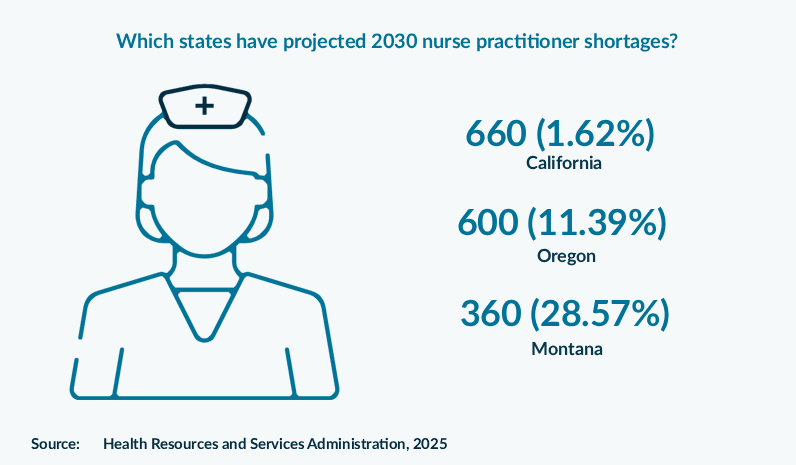
Overall, NP supply growth outpaces demand in many jurisdictions, creating surpluses in several smaller markets while leaving modest gaps in a handful of Western states. Targeted recruitment, redistribution, and scope-of-practice optimization can help close localized access issues.
Nationally, NP growth appears robust, yielding very high adequacy in many small markets while leaving moderate shortfalls in California, Oregon, and Montana. Redistribution, telehealth, and expanded primary-care integration could better align surpluses with need and reduce localized access challenges. There are many accelerated NP programs online that you can choose from,
5. Primary Care Nurse Practitioners (PC-NPs)
Primary Care Nurse Practitioners (PC-NPs)—for example, Family or Adult-Gerontology NPs—deliver comprehensive, continuous primary care, including preventive services, chronic disease management, and same-day acute care. They are APRN-licensed and certified in a primary care population focus, with prescriptive authority and degree of autonomy determined by state practice acts.
Primary care NP projections reveal light shortages in a few large states and modest surpluses elsewhere.
- California: 810 (8.71%); adequacy: 91.29% (8,490 vs. 9,300).
- New York: 550 (11.55%); adequacy: 88.45% (4,210 vs. 4,760).
- Oregon: 20 (1.79%); adequacy: 98.21% (1,100 vs. 1,120).
Primary care NP needs concentrate in California and New York, but most jurisdictions show equilibrium or surplus. Strategic placement and care-team redesign can translate surplus capacity into improved access.
While a few larger states face modest primary-care NP shortfalls, small states and the District of Columbia often have substantial surpluses, reflecting rapid program growth and diffusion into ambulatory care. Directing additional placements to shortage counties and leveraging collaborative practice can mitigate localized gaps without major pipeline expansion.
6. Women’s Health Nurse Practitioners (WHNPs)
Women’s Health Nurse Practitioners (WHNPs) provide gynecologic and reproductive health care across the lifespan, including well-woman exams, contraception, STI management, prenatal/postpartum care, and menopause management. They hold APRN licensure with WHNP certification and may order tests and prescribe medications; practice authority depends on state regulations.
Women’s health NP projections show small-number imbalances that can heavily affect local access.
- Wisconsin: 50 (35.71%); adequacy: 64.29% (90 vs. 140).
- Nevada: 50 (62.50%); adequacy: 37.50% (30 vs. 80).
- Missouri: 20 (13.33%); adequacy: 86.67% (130 vs. 150).
- Rhode Island: 20 (66.67%); adequacy: 33.33% (10 vs. 30).
- Louisiana: 20 (20.00%); adequacy: 80.00% (80 vs. 100).
- Montana: 20 (66.67%); adequacy: 33.33% (10 vs. 30).
- Michigan: 10 (4.00%); adequacy: 96.00% (240 vs. 250).
- Massachusetts: 10 (5.26%); adequacy: 94.74% (180 vs. 190).
Although absolute numbers are small, percentage shortfalls run high in several states, signaling vulnerability of women’s health access in certain markets. Focused recruitment and retention around OB-GYN, FQHCs, and rural clinics could deliver an outsized impact.
Women’s health NP projections suggest pockets of severe proportional need despite low headcounts, particularly in states with sparse specialist distribution. Aligning training sites with maternity-care deserts and stabilizing preceptor capacity can protect continuity of women’s health services.
7. Psychiatric-Mental Health Nurse Practitioners (PMHNPs)
Psychiatric-Mental Health Nurse Practitioners (PMHNPs) evaluate and treat mental health conditions, perform psychotherapy, and provide psychopharmacologic management for children, adolescents, adults, and older adults. They are APRN-licensed with PMHNP certification and may prescribe—including controlled substances—consistent with state scope of practice.
Behavioral health NP or Psychiatric-Mental Health Nurse Practitioners (PMHNPs) demand rises sharply, with large numeric gaps in populous states and moderate shortfalls elsewhere.
- California: 1,640 (52.40%); adequacy: 47.60% (1,490 vs. 3,130).
- Michigan: 470 (50.00%); adequacy: 50.00% (470 vs. 940).
- Illinois: 370 (36.63%); adequacy: 63.37% (640 vs. 1,010).
- Pennsylvania: 280 (24.78%); adequacy: 75.22% (850 vs. 1,130).
- Wisconsin: 170 (36.17%); adequacy: 63.83% (300 vs. 470).
- Virginia: 120 (17.14%); adequacy: 82.86% (580 vs. 700).
- New York: 70 (3.98%); adequacy: 96.02% (1,690 vs. 1,760).
- Alabama: 40 (10.00%); adequacy: 90.00% (360 vs. 400).
- Nevada: 30 (10.71%); adequacy: 89.29% (250 vs. 280).
- Louisiana: 30 (7.50%); adequacy: 92.50% (370 vs. 400).
Psychiatric NP shortages are widespread and acute in California, with several Midwest and Mid-Atlantic states showing 17–36% gaps. Scaling graduate seats, clinical rotations, and collaborative practice in mental health is central to closing access gaps, especially given the crucial question of what makes a good mental health nurse in this demanding field.
Behavioral health access depends increasingly on PMHNPs; projections show double-digit percentage shortfalls across multiple states and the largest numeric gap in California. Expanding integrated care, telepsychiatry, and supervision models can accelerate capacity in high-need communities.
8. Registered Nurses (RNs)
Registered Nurses (RNs) assess patient status, develop and implement care plans, administer medications and treatments, and educate patients and families across inpatient and outpatient settings. They are state-licensed after passing the NCLEX-RN and practice independently within the RN nursing scope, collaborating with physicians and Advanced Practice Registered Nurses (APRNs) for medical diagnosis and orders.
Registered nurse shortages remain the largest by headcount, driven by population growth, aging, and retirements.
- California: 50,300 (14.56%); adequacy: 85.44% (295,100 vs. 345,400).
- Texas: 34,800 (12.55%); adequacy: 87.45% (242,470 vs. 277,270).
- North Carolina: 21,630 (18.51%); adequacy: 81.49% (95,220 vs. 116,850).
- Pennsylvania: 20,500 (14.54%); adequacy: 85.46% (120,530 vs. 141,030).
- Michigan: 20,360 (19.05%); adequacy: 80.95% (86,540 vs. 106,900).
- Virginia: 18,190 (20.88%); adequacy: 79.12% (68,940 vs. 87,130).
- Georgia: 17,970 (17.13%); adequacy: 82.87% (86,920 vs. 104,890).
- Florida: 16,210 (6.59%); adequacy: 93.41% (229,620 vs. 245,830).
- Maryland: 15,250 (24.08%); adequacy: 75.92% (48,090 vs. 63,340).
- Washington: 14,270 (18.41%); adequacy: 81.59% (63,240 vs. 77,510).
The largest numeric RN deficits cluster in high-population states, while several others face 18–24% adequacy gaps. Expanding prelicensure capacity, modernizing clinical education, and strengthening retention will be pivotal to avoiding access constraints.
RN shortfalls of 14–21% in several large states underscore a persistent mismatch between training throughput and service demand, even where adequacy remains above 80–85%. Retention, internationally educated nurse pathways, and innovative care models can help offset near-term shortages while longer-term pipeline investments mature.
What is the return on investment (ROI) for nursing degrees?
The return on investment for a nursing degree is exceptionally strong, often surpassing many other popular degrees. This is due to a high demand for skilled professionals and competitive starting salaries that allow for rapid recoupment of educational costs.
- High ROI: A four-year nursing degree has a high ROI, with some analyses showing a return of over 280% within five years of graduation.
- Rapid Payback: The strong earning potential allows nurses to pay off student loans relatively quickly compared to other fields, making it a sound financial choice.
- Employer Assistance: Many healthcare systems offer tuition reimbursement or loan repayment programs, which further decrease the personal cost of education.
- Stackable Credentials: The profession supports career advancement through certificates and advanced degrees, which can be earned while working and lead to substantial pay increases. You can check our APRN vs NP differences in order to determine what other credentials you would like to obtain.
- Job Security: The consistent demand for nurses, even during economic downturns, ensures a steady income stream and protects your investment.
- Multiple Entry Points: Whether you start with an Associate Degree in Nursing (ADN) or a Bachelor of Science in Nursing (BSN), the path to a high-paying career is clear and well supported.
A nursing degree is a strategic investment in a stable and growing field with a proven track record of financial and professional returns. The profession’s built-in flexibility and career ladder make it a standout choice for those seeking a secure financial future.
What factors affect nursing shortages across the USA?
The ongoing nursing shortage in the United States is a complex issue with no single cause. It results from a combination of demographic shifts, workforce dynamics, educational limitations, and workplace challenges that have created a significant gap between the supply of nurses and the demand for care.
- Aging Nursing Workforce: A large percentage of the current nursing workforce is approaching retirement age, leading to a significant loss of highly experienced nurses and institutional knowledge.
- Aging Population: As the Baby Boomer generation grows older, there is a substantial increase in the demand for healthcare services, particularly for chronic condition management and geriatric care.
- Burnout and Turnover: High patient-to-nurse ratios, extreme work stress, and physically and emotionally taxing shifts contribute to high rates of burnout, causing nurses to leave the profession prematurely.
- Geographic Maldistribution: There is a critical imbalance in the workforce, with a concentration of nurses in urban centers and severe shortages persisting in rural and underserved communities.
- Nursing School Capacity: Many qualified applicants are turned away from nursing programs due to a persistent lack of nursing faculty, insufficient clinical training sites, and limited classroom space.
- Workplace Violence: Nurses are at an elevated risk of experiencing verbal and physical assault from patients or visitors, which negatively impacts job satisfaction and contributes to staff turnover.
- Work-Life Balance: The 24/7 nature of hospital care, including long shifts and frequent overtime, makes achieving a healthy work-life balance difficult, leading to dissatisfaction.
- Impact of the Pandemic: The COVID-19 pandemic accelerated early retirement and resignation rates due to unprecedented levels of stress and inadequate workplace support.
- High Patient Acuity: Advances in medicine mean that only the sickest patients are hospitalized, increasing the complexity and intensity of care required from the remaining nursing staff.
- Lack of Competitive Pay: In regions with a high cost of living, or in certain nursing sectors, the compensation offered may not be competitive enough to attract and retain staff, exacerbating local shortages.
- Physician Shortages: In some areas, a lack of physicians shifts additional responsibilities to advanced practice nurses, further straining the already limited nursing workforce.
These interconnected factors demonstrate that the nursing shortage is a systemic issue that will require multifaceted solutions to ensure a stable and effective healthcare system for the future. The profession must address these challenges to attract new talent and retain experienced nurses.
What are the typical career opportunities for nurses?
A nursing degree is a gateway to an incredibly diverse range of career opportunities, spanning everything from direct patient care to management, education, and technology. The profession allows for specialization and career shifts as a nurse’s interests evolve.
- Registered Nurse (RN): Provide direct patient care in a wide range of settings, including hospitals, clinics, and long-term care facilities.
- Clinical Nurse Specialist (CNS): A specialized nurse who acts as an expert in a specific clinical area, such as pediatrics or oncology, and works to improve patient outcomes.
- Nurse Practitioner (NP): An advanced practice role that involves diagnosing and treating illnesses, ordering and interpreting tests, and prescribing medication. Many online nurse practitioner programs offer various specialties and career paths.
- Nurse Anesthetist (CRNA): Administer anesthesia and related care before, during, and after surgical, therapeutic, diagnostic, and obstetric procedures.
- Nurse Educator: Teach and mentor future generations of nurses in academic or clinical settings.
- Nurse Administrator: Focus on the management and leadership of nursing departments and healthcare facilities.
- School Nurse: Provide healthcare to students and staff in an educational setting.
- Home Health Nurse: Deliver care directly to patients in their homes, a growing field driven by an aging population.
- Public Health Nurse: Work in community settings to promote health and prevent disease for a specific population or community.
- Forensic Nurse: Apply nursing principles to legal cases, often working with victims of crime or trauma.
- Informatics Nurse: Use technology and data to improve nursing practice, patient care, and healthcare efficiency.
- Travel Nurse: Work in various locations across the country on short-term contracts, often for higher pay.
The profession offers a dynamic career trajectory where one can move from a clinical role to an administrative one, or from a generalist to a highly specialized expert. This breadth of opportunity ensures that nurses can find a fulfilling path that aligns with their personal and professional goals.
What is the job outlook for nurses?
The job outlook for nurses is exceptionally strong, with significant growth projected across the United States for the foreseeable future. The demand for nurses is driven by a number of demographic and healthcare system factors.
- Overall Growth: Employment for registered nurses is projected to grow by 5% from 2024 to 2034, which is a faster-than-average rate.
- High Number of Openings: The U.S. Bureau of Labor Statistics (BLS) projects an average of 189,100 job openings for registered nurses each year, primarily due to the need to replace retiring nurses and meet increased demand.
- Aging Population: As the Baby Boomer generation enters retirement age, the demand for geriatric care and chronic disease management is increasing exponentially.
- Increased Chronic Conditions: The rising prevalence of chronic conditions like diabetes and obesity is creating a greater need for healthcare services across all age groups.
- Preventive Care: A growing focus on preventive health and outpatient care is shifting demand for nurses to clinics and ambulatory care settings.
- Geographic Disparities: While the overall outlook is strong, demand for nurses is particularly high in states with high population growth and in rural and underserved areas.
- Specialty Demand: There is a particularly high demand for nurses in specialized roles, such as oncology, critical care, and informatics, which command higher salaries and offer enhanced career stability. Completing online pediatric nurse practitioner programs is a great choice for specialization in pediatric care.
The nursing profession offers robust job security, with a strong and consistent demand for qualified professionals that is not expected to slow down. The long-term outlook remains positive, making it a reliable career choice for those seeking stable employment.
The U.S. Bureau of Labor Statistics' 2025 data illustrates a clear and robust picture of the registered nursing profession's current status and projected outlook, as shown in the graphic below.. In 2024, the median annual pay for registered nurses was $93,600, which translates to approximately $45.00 per hour. The field is substantial, accounting for 3,391,000 jobs nationwide in 2024 (U.S. Bureau of Labor Statistics, 2025).
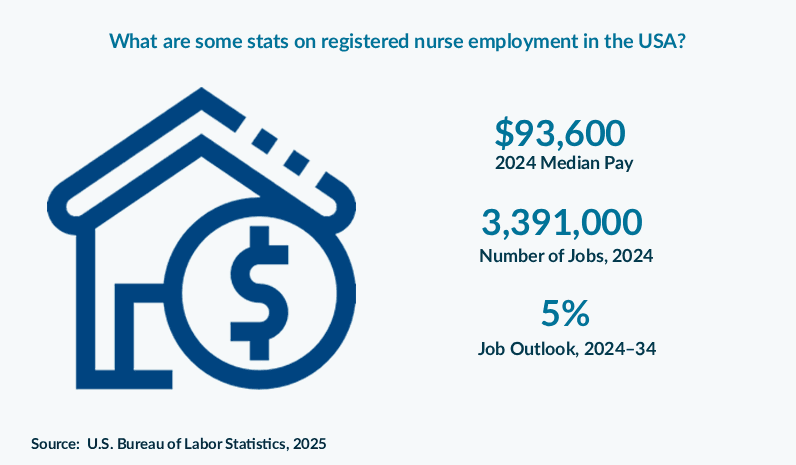
Looking ahead, the employment trend for registered nurses is exceptionally positive. The job outlook for 2024–2034 is projected to grow by 5%, which is faster than the average for all occupations. This growth is expected to create an employment change of 166,100 new jobs during the decade.
What are the typical salaries for various types of nurses?
Salaries for nurses vary significantly based on education level, experience, location, and specialty, but overall, the earning potential is strong. Advanced degrees and specialized certifications lead to substantial increases in income, as shown in the graph below.
- Certified Registered Nurse Anesthetist (CRNA): $223,210 median (BLS, May 2024).
- Clinical Nurse Specialist (CNS): $105,206 average (PayScale, 2025); $94,545 average (ZipRecruiter, Sep 2025).
- Licensed Practical Nurse (LPN): $62,340 median (BLS, May 2024).
- Nurse Educator: $79,940 median (BLS/O*NET, 2024); $87,172 average (PayScale, 2025).
- Nurse Practitioner (NP): $129,210 median (BLS, May 2024).
- Registered Nurse (RN): $93,600 median (BLS, May 2024).
- Travel Nurse: $83,197 average per year (Salary.com, Sep 2025).
A nursing career offers a clear path to increasing earning potential, with opportunities for substantial salary growth through specialization and advanced education. This financial stability, combined with the profession’s strong job security, makes it a highly rewarding career choice. A popular career option is studying in BSN to nurse practitioner programs, among others.
What are the biggest challenges faced by nurses?
Despite its many rewards, the nursing profession is not without its significant challenges, many of which were amplified by the recent pandemic. These issues can impact a nurse’s well-being and, in turn, patient outcomes.
- Staffing Shortages: Many healthcare facilities face inadequate staffing levels, leading to high nurse-to-patient ratios that increase workloads and fatigue. This has led to an increase in online RN programs for non nurses to attract those in the life and health sciences to nursing.
- Physical and Emotional Burnout: The combination of long shifts, emotional labor, and high-stress environments contributes to widespread burnout and compassion fatigue among nurses.
- Workplace Violence: Nurses are at a high risk for verbal and physical assault from patients or visitors, an issue the American Nurses Association (ANA) has called an “underreported epidemic.”
- Moral Distress: Nurses often experience moral distress when they feel they cannot provide the best possible care due to systemic issues like understaffing or lack of resources.
- Work-Life Balance: The 24/7 nature of healthcare, including demanding schedules and mandatory overtime, can make it difficult for nurses to maintain a healthy work-life balance.
- Aging Workforce: As a large portion of the experienced nursing workforce nears retirement, there is a risk of losing critical institutional knowledge and mentorship.
- Technology Overload: The rapid introduction of new technologies and electronic health records (EHRs) can be a source of frustration, adding administrative tasks and taking time away from patient care.
- Emotional Toll of Patient Deaths: Nurses often form close bonds with patients and their families, and patient death can take a significant emotional toll on a nurse’s mental health.
These challenges highlight the need for systemic solutions within the healthcare industry, including better support systems, improved staffing policies, and a greater emphasis on nurse well-being. Addressing these issues is crucial for the long-term health of the nursing workforce and the quality of patient care.
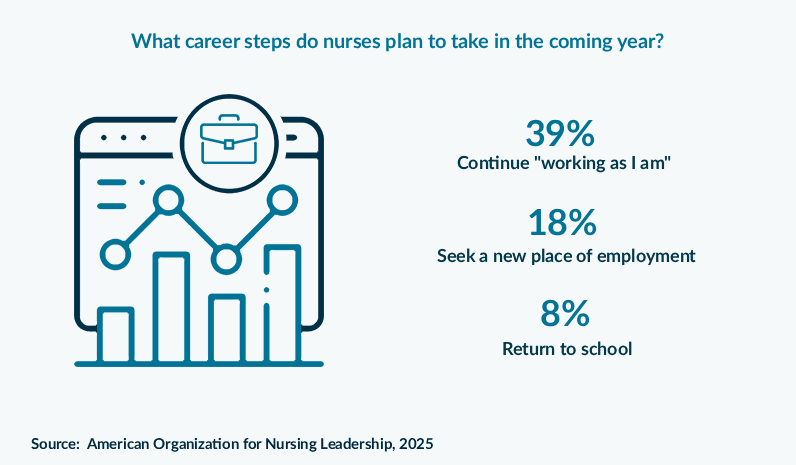
The American Organization for Nursing Leadership’s 2025 survey shows high intended mobility: 39% plan to continue as they are, while 61% plan a change. Top planned moves are 18% seeking a new employer, 8% returning to school, 6% working outside direct patient care, and 5% each changing work setting, exploring internal agency roles, or leaving nursing for another field, as shown in the graphic below. Smaller shifts include 2% each working as a travel nurse, part-time, or per-diem, and 1% moving to virtual nursing.
What are the biggest opportunities for nurses?
The current landscape of healthcare presents numerous opportunities for nurses to innovate, specialize, and take on new roles. The ongoing demand for healthcare services has opened doors for nurses to shape the future of medicine.
- Growing Specialization: The field is expanding, with a growing demand for nurses in specialized areas like informatics, gerontology, palliative care, and telehealth.
- Leadership Roles: Nurses are increasingly moving into leadership and administrative positions, from Nurse Manager to Chief Nursing Officer, allowing them to influence healthcare policy and operations.
- Technological Integration: Nurses are at the forefront of integrating new technologies like AI, wearable devices, and EHR systems to improve patient outcomes and workflow efficiency.
- Advancing Education: Pursuing an advanced degree, such as a Master of Science in Nursing (MSN) or a Doctor of Nursing Practice (DNP), opens up opportunities for autonomy and higher salaries in advanced practice roles.
- Entrepreneurship: Some nurses are using their clinical expertise to start their own businesses, such as nurse consulting firms, legal nurse consulting, or independent telehealth practices.
- Public Health: The focus on population health and preventive care has created new opportunities for nurses to work in community health and public health roles.
- Greater Autonomy: In many states, legislation is expanding the scope of practice for Advanced Practice Registered Nurses (APRNs), allowing them to operate with greater independence and fill care gaps.
- Flexible Work Arrangements: The rise of telehealth and home health has led to more flexible and remote work options, which can improve work-life balance and job satisfaction.
These opportunities position nursing as a dynamic and influential career, empowering professionals to take on new challenges and make a lasting impact on healthcare. The profession is evolving to meet the needs of a changing world, providing nurses with more choices than ever before.
What are some current and future trends in nursing?
The nursing profession is undergoing a significant transformation, with several key trends shaping its future. These changes are influenced by technology, demographics, and a renewed focus on holistic care and workforce well-being.
- Telehealth and Virtual Care: The widespread adoption of telehealth is a major trend, allowing nurses to provide remote consultations, monitoring, and patient education.
- Data Analytics and Nursing Informatics: The rise of electronic health records (EHRs) has made nursing informatics a vital field, as nurses use data to improve patient care and optimize clinical workflows.
- Artificial Intelligence (AI): AI is increasingly being used to assist nurses with tasks like predictive diagnostics, patient monitoring, and clinical decision support, augmenting their role rather than replacing it.
- Emphasis on Holistic Care: There is a growing trend toward a more holistic approach to patient care, focusing on mental health, social determinants of health, and personalized medicine.
- Workforce Well-being: Healthcare organizations are recognizing the need to address nurse burnout and are implementing strategies like flexible scheduling, improved staffing ratios, and mental health support services.
- Advanced Practice on the Rise: The number of Nurse Practitioners and other advanced practice roles continues to surge, as these professionals are increasingly relied upon to provide primary care and fill gaps in the physician workforce.
- Aging Nurse Workforce: The retirement of a large cohort of experienced nurses is a critical trend that will continue to create significant job openings for new nurses entering the field.
- Simulation and VR Training: Nursing education is embracing new technologies like virtual reality and high-fidelity simulation to provide hands-on, realistic training without risk to patients.
- Interprofessional Collaboration: The future of nursing involves more seamless collaboration with other healthcare professionals, using shared data and technology to improve care coordination.
- Shift to Outpatient Care: A growing number of healthcare services are moving from hospitals to outpatient clinics and home health settings, which will shift the demand for nursing jobs accordingly.
These trends highlight a profession that is becoming more technologically advanced, specialized, and focused on the health of both the patient and the provider. Nurses of the future will need to be adaptable, tech-savvy, and compassionate to thrive in this evolving landscape.
What are states doing to address the problem of nurse shortages?
States are implementing a range of targeted legislative and financial measures to expand the nursing workforce, enhance retention, and improve healthcare access. These strategies combine long-term capacity building with immediate support for current nurses.
- Accelerated Licensure Processing: States are streamlining and expediting the licensure process for new graduates and nurses moving from other states to quickly get more qualified nurses into the workforce.
- Apprenticeship Programs: States are funding nurse apprenticeship models that combine paid on-the-job training with classroom instruction to accelerate workforce entry.
- Clinical Training Expansion: Public funding is helping schools add clinical sites and hire more nurse educators to ease education bottlenecks.
- Data-Driven Workforce Planning: States are investing in nursing workforce data systems to better forecast shortages and guide policy decisions.
- Educational Loan Incentives: Loan repayment and forgiveness programs encourage nurses and faculty to work in underserved or academic settings.
- Expanded Scope of Practice (APRNs): Granting full practice authority to advanced practice registered nurses enables autonomous care delivery and expands access.
- Funding for Nurse Educators: States are allocating funds for salary enhancements and bonuses for nurse faculty to make academic careers more financially competitive and expand program capacity.
- High School Pipeline Initiatives: Some states are partnering with K–12 systems to introduce nursing career pathways early, including dual-credit and pre-nursing tracks.
- Interstate Licensure Compacts: Joining the Nurse Licensure Compact allows nurses to practice across state lines more easily.
- Mandated Staffing Ratios: Laws requiring minimum nurse-to-patient ratios aim to improve safety, reduce burnout, and increase retention.
- Mental Health Support Programs: States are funding wellness initiatives and peer support networks to address burnout and improve nurse mental health.
- Pipeline Programs: Funding for “grow your own” initiatives from middle school through community college to expose students to nursing and create clear educational pathways.
- Recruitment and Retention Grants: Grants support hospitals in launching recruitment efforts and wellness programs for nurses.
- Residency and Mentorship Programs: States are supporting programs to ease the transition from school to practice and reduce early-career attrition.
- Tax Credits: Implementing state income tax credits or deductions for practicing nurses, students, or facilities that hire nurses to provide financial relief.
- Tuition Assistance and Scholarships: Expanded funding for nursing students helps reduce financial barriers to entry and completion.
- Workplace Violence Prevention: Enacting and enforcing laws that require workplace violence prevention plans to improve safety and make the profession more sustainable.
These multi-pronged approaches—from addressing educational bottlenecks to legally improving working conditions—demonstrate significant political will to stabilize the nursing profession. By tackling both the inflow and outflow of the nursing workforce, states aim to build a more resilient and geographically balanced healthcare system.
Here's What Graduates Say About Their Nursing Degrees
- Rose: "I feel incredibly fortunate to be a nurse. My BSN program gave me the confidence and clinical knowledge to step into a fast-paced hospital setting right away. The work is challenging, but the reward of helping people at their most vulnerable moments is a feeling I wouldn't trade for anything. I'm currently on a path to specialize in critical care, and the job security and earning potential make me feel very optimistic about my future."
- Nicole: "As a newly certified Psychiatric Nurse Practitioner, I'm grateful for the flexibility and autonomy my advanced degree has provided. My online graduate certificate program allowed me to continue working full-time while gaining the specialized skills I needed. I now have the ability to diagnose and manage mental health conditions, and the work is incredibly fulfilling and has greatly increased my salary."
- Anika: "After working for years as a hospital nurse, my online graduate certificate in nursing informatics allowed me to transition into a new role focused on technology. I now use my clinical expertise to optimize electronic health records and improve patient safety from the systems level. It's a challenging and intellectually stimulating role that has shown me how a nurse's impact can extend far beyond the bedside."
Key Findings
- Licensed Practical Nurses (LPN): Strongest shortages cluster in fast-growing states with limited training capacity; top gaps are Florida: 20,410 (36.02%); adequacy: 63.98% (36,260 vs. 56,670), Michigan: 13,890 (57.83%); adequacy: 42.17% (10,130 vs. 24,020), and New York: 13,340 (29.99%); adequacy: 70.01% (31,140 vs. 44,480). (HRSA HWSM 2030).
- Nurse Anesthetists (CRNA): Operating room demand and constrained pipelines drive steep deficits; leading shortages are Florida: 3,550 (79.24%); adequacy: 20.76% (930 vs. 4,480), California: 3,330 (50.92%); adequacy: 49.08% (3,210 vs. 6,540), and New York: 1,940 (54.19%); adequacy: 45.81% (1,640 vs. 3,580). (HRSA HWSM 2030).
- Nurse Midwives (CNM): Maternal-child capacity is tight in several high-growth states; top gaps are Texas: 880 (76.52%); adequacy: 23.48% (270 vs. 1,150), Florida: 710 (83.53%); adequacy: 16.47% (140 vs. 850), and Georgia: 280 (62.22%); adequacy: 37.78% (170 vs. 450). (HRSA HWSM 2030).
- Nurse Practitioners (NP): Overall supply growth is strong but a few states retain shortages; largest needs are California: 660 (1.62%); adequacy: 98.38% (40,140 vs. 40,800), Oregon: 600 (11.39%); adequacy: 88.61% (4,670 vs. 5,270), and Montana: 360 (28.57%); adequacy: 71.43% (900 vs. 1,260). (HRSA HWSM 2030).
- Primary Care Nurse Practitioners (PC-NP): Most markets are near balance, with modest gaps concentrated in large states; top needs are California: 810 (8.71%); adequacy: 91.29% (8,490 vs. 9,300), New York: 550 (11.55%); adequacy: 88.45% (4,210 vs. 4,760), and Oregon: 20 (1.79%); adequacy: 98.21% (1,100 vs. 1,120). (HRSA HWSM 2030).
- Women’s Health Nurse Practitioners (WHNP): Small headcounts create outsized access risks where shortages exist; leading gaps are Wisconsin: 50 (35.71%); adequacy: 64.29% (90 vs. 140), Nevada: 50 (62.50%); adequacy: 37.50% (30 vs. 80), and Missouri: 20 (13.33%); adequacy: 86.67% (130 vs. 150). (HRSA HWSM 2030).
- Psychiatric–Mental Health Nurse Practitioners (PMHNP): Behavioral health demand outpaces supply in several regions; top gaps are California: 1,640 (52.40%); adequacy: 47.60% (1,490 vs. 3,130), Michigan: 470 (50.00%); adequacy: 50.00% (470 vs. 940), and Illinois: 370 (36.63%); adequacy: 63.37% (640 vs. 1,010). (HRSA HWSM 2030).
- Registered Nurses (RN): The largest numeric deficits occur in high-population states due to growth, aging, and retirements; leading gaps are California: 50,300 (14.56%); adequacy: 85.44% (295,100 vs. 345,400), Texas: 34,800 (12.55%); adequacy: 87.45% (242,470 vs. 277,270), and North Carolina: 21,630 (18.51%); adequacy: 81.49% (95,220 vs. 116,850). (HRSA HWSM 2030).
- Nursing salary benchmarks: CRNA: $223,210 median; CNS: $105,206 average and $94,545 average; LPN: $62,340 median; Nurse Educator: $79,940 median and $87,172 average; NP: $129,210 median; RN: $93,600 median; Travel Nurse: $83,197 average/year.
- Planned career moves: 39% plan to continue as they are and 61% plan changes; 18% seek a new employer, 8% return to school, 6% shift outside direct patient care, 5% change setting, 5% pursue internal agency roles, 5% leave nursing; 2% each plan travel, part-time, or per-diem work, and 1% plan virtual nursing (AONL 2025).
References:
- American Organization for Nursing Leadership. (2025). RN survey 2025: Nursing in transition. American Organization for Nursing Leadership.
- Bureau of Labor Statistics, U.S. Department of Labor. (2024, May). Nurse Anesthetists, Nurse Midwives, and Nurse Practitioners (Occupational Outlook Handbook). Bureau of Labor Statistics.
- Bureau of Labor Statistics, U.S. Department of Labor. (2025, April 18). Registered nurses. Bureau of Labor Statistics.
- Health Resources and Services Administration. (2025). Workforce projections data. U.S. Department of Health and Human Services.
- NurseJournal. (2024, October 18). Advanced Practice Registered Nurse Career Overview. NurseJournal.
- PayScale. (2025, July 9). Clinical Nurse Specialist (CNS) salary. PayScale.
- PayScale. (2025, July 29). Nurse educator salary. PayScale.
- Salary.com. (2025, September 1). Travel nurse salary in United States. Salary.com.
- U.S. Bureau of Labor Statistics. (2025, August 28). Licensed practical and licensed vocational nurses: Occupational Outlook Handbook. U.S. Bureau of Labor Statistics.
- U.S. Bureau of Labor Statistics. (2025, August 28). Nurse anesthetists, nurse midwives, and nurse practitioners: Occupational Outlook Handbook. U.S. Bureau of Labor Statistics.
- U.S. Bureau of Labor Statistics. (2025, August 28). Registered nurses: Occupational Outlook Handbook. U.S. Bureau of Labor Statistics.
- ZipRecruiter. (2025, August). Clinical nurse specialist salary. ZipRecruiter.
- ZipRecruiter. (2025, August). Nurse educator salary. ZipRecruiter.
- ZipRecruiter. (2025, September 17). RN travel nurse salary. ZipRecruiter.
- ZipRecruiter. (2025, September 17). Travel nurse salary. ZipRecruiter.
Other Things You Should Know About the States That Will Need Nurses the Most by 2030
The states expected to face the most critical nursing shortages by 2030 include California, Texas, and Florida. These states are projected to have high demand due to their large and aging populations, leading to the need for increased healthcare services.
Strategies include expanding nursing education programs to increase graduation rates, offering incentives such as scholarships and loan forgiveness to attract nurses, and enhancing technology and administrative support to make nursing roles more efficient.
State legislation can significantly impact nursing demand through scope-of-practice laws, funding for educational programs, and incentives for joining the workforce. By 2030, changes in state policies may increase nursing demand, particularly in rural areas where shortages are more acute.


