
2027 Most Affordable Online Artificial Intelligence Degree Programs

Co-Founder and Chief Data Scientist
An online artificial intelligence degree can be a practical way to move from using AI tools to designing, evaluating, and deploying them. The decision is not simple: tuition varies widely, admissions expectations can be math-heavy, and some “affordable” programs shift hidden costs to students through cloud computing, software, or hardware requirements. This guide is for working adults, career changers, IT professionals, and technically prepared students comparing online AI degrees for cost, credibility, flexibility, and career value.
Below, you will learn how affordable online AI degree programs work, what they cost, how long they take, which schools offer strong options, what employers may expect from graduates, and how to avoid choosing a low-cost program that lacks the technical support needed to build a competitive AI portfolio.
Quick Answer: Is an Affordable Online Artificial Intelligence Degree Worth It?
An affordable online artificial intelligence degree can be worth it if the program is accredited, includes rigorous coursework in programming and mathematics, provides access to AI development tools or cloud credits, and helps you build deployable projects. The strongest value usually comes from programs that combine low tuition with credible faculty, practical capstones, and coursework in machine learning, deep learning, natural language processing, responsible AI, and MLOps.
The degree is less likely to pay off if you choose only by tuition, ignore accreditation, lack the math or coding preparation needed to keep up, or graduate without a public portfolio that shows you can build and deploy AI systems.
Why choose an affordable online Artificial Intelligence degree program?
- In April 2025, CompTIA reported 55,726 new job openings for AI talent from different employers. That represented approximately 21% of all hiring in tech and a 184% increase from the previous year.
- According to the Bureau of Labor Statistics, three major career paths for AI graduates include data scientist, with 2024 median pay of $112,590; software developer, with 2024 median pay of $133,080; and computer and information research scientist, with 2024 median pay of $140,910.
- With accelerated pacing, prior credits, and focused study habits, some students can complete an accredited online AI master’s in about 1 year, while certain bachelor’s pathways may be finished in roughly 2 years.
What can I expect from an Affordable Online Artificial Intelligence Degree?
An online AI degree typically combines computer science, statistics, machine learning, ethics, and applied software development. You should expect to write code, test models, interpret data, troubleshoot errors, and complete projects that require far more than watching recorded lectures. Common topics include neural networks, natural language processing, computer vision, data ethics, algorithm design, and model deployment.
The online format can be demanding because much of the work happens independently. When a Python environment breaks, a PyTorch model fails, or a dataset produces unexpected results, you may need to diagnose the problem through documentation, discussion boards, office hours, and peer forums rather than immediate in-person help. Successful students treat the experience like remote technical work: they document issues, manage deadlines, ask precise questions, and learn to solve problems without constant supervision.
| What to expect | Why it matters | How to prepare |
| Heavy coding and debugging | AI work depends on testing, improving, and deploying models, not just understanding theory. | Build fluency in Python, Git, SQL, and basic command-line workflows before starting. |
| Math-intensive coursework | Linear algebra, calculus, probability, and statistics support machine learning concepts. | Review prerequisite math early, especially if you have been away from school. |
| Project-based evaluation | Employers often want evidence of applied skills. | Use class projects to build a portfolio with clean code, documentation, and results. |
| Asynchronous collaboration | Online students often work with classmates across time zones. | Develop clear written communication and schedule regular check-ins for group work. |
Where can I work with an Affordable Online Artificial Intelligence Degree?
AI graduates can work in technology companies, healthcare organizations, financial services firms, manufacturers, consulting companies, research labs, government contractors, and enterprise IT departments. The setting you choose affects the type of work you will do.
AI-first startups often move quickly and may expect employees to build prototypes, test new model architectures, and work across product, data, and engineering teams. These jobs can offer rapid learning and potential equity upside, but they may also involve higher risk and less structure.
Large enterprises usually use AI differently. In healthcare, finance, manufacturing, insurance, and logistics, many roles focus on integrating AI into existing systems, improving workflows, maintaining compliance, and protecting sensitive data. These jobs may involve fewer “from scratch” model-building tasks and more work around governance, security, reliability, and business implementation.
| Work environment | Best fit for students who want | Trade-offs to consider |
| AI startup | Fast product cycles, experimentation, and broad technical ownership | Less stability, changing priorities, and higher ambiguity |
| Large enterprise | Structured teams, compliance-focused AI adoption, and stable systems work | More approvals, legacy systems, and slower implementation cycles |
| Research organization | Algorithm development, experimentation, and advanced technical depth | May require a graduate degree, publication record, or specialized research background |
| Consulting or services firm | Client-facing projects across industries | Variable workload, travel expectations, and frequent context switching |
How much can I make with an Affordable Online Artificial Intelligence Degree?
AI-related careers can pay well above the national median wage of $49,500, but salaries depend on role, location, experience, portfolio quality, employer type, and technical specialization. Bureau of Labor Statistics data reports a median annual wage of $112,590 for data scientists, with the top 10% earning over $194,410. Software developers had median annual pay of $133,080, with the top 10% earning over $211,450. Computer and information research scientists had median annual pay of $140,910, with top earners exceeding $232,120.
Base salary is only one part of compensation in many technology companies. In competitive AI engineering roles, total compensation may include several components:
- Base salary: The fixed wage paid on a regular schedule.
- Sign-on or performance bonuses: Cash payments tied to hiring, annual performance, or project outcomes.
- Restricted Stock Units (RSUs): Equity awards that commonly vest over a standard four-year schedule.
For engineers working on large language models, recommendation systems, computer vision, or production AI infrastructure, equity and bonuses can significantly change total earnings. Still, compensation is never guaranteed. Candidates with deployable projects, strong engineering fundamentals, and experience moving models into production are usually better positioned than applicants who rely on the degree alone.
- Most Affordable Online Artificial Intelligence Degree Programs for 2027
- How long does it take to complete an Online Artificial Intelligence Degree program?
- How does an Online Artificial Intelligence Degree program compare to an on-campus program?
- What is the average cost of an Affordable Online Artificial Intelligence Degree program?
- What are the financial aid options for students enrolling in an Online Artificial Intelligence Degree program?
- What are the prerequisites for enrolling in an Online Artificial Intelligence Degree program?
- What courses are typically in an Online Artificial Intelligence Degree program?
- What types of specializations are available in Online Artificial Intelligence Degree programs?
- How does an Online Artificial Intelligence Degree differ from an online master of science in data science?
- How do online AI programs stay current with technological advancements?
- How to choose the best Affordable Online Artificial Intelligence Degree program?
- How do online AI programs support networking?
- What career paths are available for graduates of Online Artificial Intelligence Degree programs?
- What is the job market for graduates with an Online Artificial Intelligence Degree?
- How can interdisciplinary studies enhance your online AI degree?
Most Affordable Online Artificial Intelligence Degree Programs for 2027
How do we rank schools?
Choosing an online artificial intelligence degree requires comparing more than price. A low tuition rate is useful only if the school is accredited, the curriculum is rigorous, and the program gives students enough technical support to complete meaningful AI projects. For this guide, programs were reviewed using factors such as total program length, available specializations, cost per credit, course depth, delivery format, and accreditation status. You can review our methodology for more detail on how Research.com evaluates schools and programs.
The analysis draws from established higher education datasets and institutional sources, including the Integrated Postsecondary Education Data System (IPEDS), Peterson’s Distance Learning database, the U.S. Department of Education’s College Scorecard, and the National Center for Education Statistics (NCES).
| School | Program focus | Required credits | Cost detail | Best fit |
| Purdue University Online | AI & Machine Learning or AI Management & Policy | 30 | $933.33 per credit | Professionals choosing between technical AI and AI leadership |
| University of Texas at Austin | Online MSAI | 30 | Approximately $333 per credit | Students seeking a rigorous public university option at a low total cost |
| Columbus State University | Applied Computer Science with AI and Data Science | 30 | $329 plus applicable fees per credit | Students wanting AI within an applied computer science framework |
| Western Governors University | Computer Science master’s with AI specialization | Equivalent to 30–36 credits | $4,755 per 6-month term | Self-directed learners who can move quickly through competency-based work |
| Georgia Institute of Technology | OMSCS with Machine Learning specialization | 30 | Approximately $180 per credit | Students prioritizing affordability and computer science depth |
1. Purdue University Online
Purdue University Online offers a Master of Science in Artificial Intelligence designed for professionals who want either hands-on technical depth or broader AI leadership training. Students choose between AI & Machine Learning and AI Management & Policy. The online structure uses shorter course blocks, and students who complete Purdue’s Foundation in AI graduate certificate can apply those credits toward the master’s degree. The program has no application fee or GRE requirement, allows starts in any term, and is built around a 30-credit curriculum that can be completed in about 18–24 months.
- Program Length: 18–24 months (30 credits at 6 credits per semester, accelerated summer courses available)
- Tracks/concentrations: AI & Machine Learning, AI Management & Policy
- Cost per Credit: $933.33 (same rate for in-state and out-of-state students, 2025 catalog)
- Required Credits to Graduate: 30
- Accreditation: Higher Learning Commission (HLC)
2. University of Texas at Austin
The University of Texas at Austin delivers an online Master of Science in Artificial Intelligence that combines affordability with advanced technical coursework. The program is 100% online, asynchronous, and instructor-paced, making it suitable for working professionals who can manage structured deadlines. Courses include Deep Learning, Reinforcement Learning, Natural Language Processing, and Ethics in AI. With a total cost of approximately $10,000, the program is one of the more cost-conscious options among selective public universities.
- Program Length: 18 to 36 months
- Tracks/concentrations: Students select from a range of electives to tailor their learning
- Cost per Credit: Approximately $333
- Required Credits to Graduate: 30
- Accreditation: Southern Association of Colleges and Schools Commission on Colleges (SACSCOC)
3. Columbus State University
Columbus State University offers a fully online Master of Science in Applied Computer Science with an AI and Data Science concentration. The program is designed for students who want practical preparation in machine learning, intelligent systems, algorithms, and analytics. It may appeal to professionals targeting applied roles such as machine learning engineer, data scientist, or AI-focused software developer.
- Program Length: Typically 24 months
- Tracks/concentrations: AI and Data Science, Software Development
- Cost per Credit: $329 plus applicable fees
- Required Credits to Graduate: 30
- Accreditation: SACSCOC
4. Western Governors University
The Master of Science in Computer Science – Artificial Intelligence specialization from Western Governors University uses a competency-based format, allowing students to progress by demonstrating mastery rather than simply completing seat time. The AI specialization includes deep learning, computer vision, natural language processing, ethical AI, integrated certifications, and project-based assessments. Its flat-rate tuition model can be especially valuable for experienced students who are able to move quickly and study consistently.
- Program Length: Typically 12–24 months. Most finish in about 18 months
- Tracks/concentrations: AI specialization within the Computer Science master’s degree
- Cost per Credit: Flat-rate tuition of $4,755 per 6-month term
- Required Credits to Graduate: Equivalent to 30–36 credits, completed through mastery-based assessments
- Accreditation: Regionally accredited by the Northwest Commission on Colleges and Universities (NWCCU), the program is accredited by the Accreditation Board for Engineering and Technology (ABET)
5. Arizona State University
Arizona State University offers a 100% online Master of Science in Artificial Intelligence in Business through the W. P. Carey School of Business. This degree is best suited for professionals who want to apply AI to business strategy, analytics, forecasting, and ethical implementation rather than pursue a purely engineering-focused curriculum. The program includes a capstone project and gives online students access to faculty who also teach campus-based learners.
- Program Length: Approximately 12 months
- Tracks/concentrations: No formal tracks. Curriculum focuses on AI applications in business
- Cost per Credit: Approximately $1,466.67 (based on total program cost of $44,000 for 30 credits)
- Required Credits to Graduate: 30
- Accreditation: HLC
6. Johns Hopkins Engineering Online
Johns Hopkins Engineering Online offers an online Master of Science in Artificial Intelligence for technical professionals who want a rigorous engineering-oriented curriculum. Students study machine learning, computer vision, natural language processing, production AI, responsible AI, reinforcement learning, and autonomous systems through a flexible online format. The program may be a strong fit for students who value technical electives, small classes, and faculty connected to research through Johns Hopkins APL and the Whiting School of Engineering.
- Program Length: Typically 18–36 months (part-time friendly structure)
- Tracks/concentrations: No formal tracks. Students choose from technical electives to shape their specialization (e.g., NLP, computer vision, production AI)
- Cost per Credit: $1,595 (AY 2024–2025)
- Required Credits to Graduate: 30
- Accreditation: Regionally accredited by the Middle States Commission on Higher Education (MSCHE)
7. Stevens Institute of Technology
Stevens Institute of Technology offers a Master of Science in Applied Artificial Intelligence aimed at engineers and technical professionals who want to use AI in real systems. The curriculum includes deep learning, IoT, cybersecurity, big data, and applied AI topics. Its range of concentrations allows students to connect AI with disciplines such as biomedical engineering, software engineering, electrical engineering, mechanical engineering, and systems biology.
- Program Length: Typically 18–24 months
- Tracks/concentrations: Artificial Intelligence in Design and Construction, Biomedical Engineering, Computer Engineering, Data Engineering, Electrical Engineering, Mechanical Engineering, Software Engineering, Systems Biology
- Cost per Credit: $1,930 (as of Fall 2024)
- Required Credits to Graduate: 30
- Accreditation: MSCHE
8. Georgia Institute of Technology
The Online Master of Science in Computer Science from the Georgia Institute of Technology includes a Machine Learning specialization that gives students a respected pathway into AI-related graduate study. The OMSCS format uses recorded lectures, structured course requirements, and flexible pacing. Students can study deep learning, reinforcement learning, AI ethics, robotics, interactive intelligence, and core computer science topics while paying approximately $180 per credit.
- Program Length: Typically 24–36 months, fully self-paced per semester
- Tracks/concentrations: Machine Learning (formal specialization); students can also tailor electives in AI, robotics, and interactive intelligence
- Cost per Credit: Approximately $180
- Required Credits to Graduate: 30
- Accreditation: SACSCOC
9. Oregon State University
Oregon State University offers online Master of Science and Master of Engineering options in Computer Science with a specialization in Artificial Intelligence. Students can focus on machine learning, robotics, and intelligent systems while choosing between a thesis-based MS and a project-oriented MEng. This structure is useful for students deciding between research preparation and applied professional advancement.
- Program Length: Approximately 1–2 years
- Tracks/concentrations: Artificial Intelligence specialization within MS or MEng in Computer Science
- Cost per Credit: $633
- Required Credits to Graduate: 45
- Accreditation: Institutionally accredited by the Northwest Commission on Colleges and Universities (NWCCU)
10. University of San Diego
The University of San Diego offers a 100% online Master of Science in Applied Artificial Intelligence for professionals who want to develop AI solutions responsibly and apply them in real-world settings. The curriculum emphasizes ethics, implementation, practical problem-solving, and a capstone project. Students take two 7-week courses per semester over five semesters, which creates a structured but working-adult-friendly format.
- Program Length: 20 months (5 semesters)
- Tracks/concentrations: No formal tracks. Curriculum emphasizes applied AI, ethics, and real-world problem-solving
- Cost per Credit: $965
- Required Credits to Graduate: 30
- Accreditation: Institutionally accredited by the WASC Senior College and University Commission (WSCUC)
How long does it take to complete an Online Artificial Intelligence Degree program?
Program length depends on degree level, transfer credits, enrollment intensity, and whether the school uses a traditional semester model or a competency-based format. A standard bachelor’s degree usually requires 120 credits over 4 years. Some accelerated or competency-based routes can shorten that timeline to 24 months, although maximum completion windows may extend to 6 years. An online master’s in artificial intelligence commonly takes 12 to 24 months, with part-time options sometimes stretching to 18–36 months. Focused micro-credentials may average just 15 hours.
The advertised timeline is not always the real timeline. The final capstone, thesis, or practicum can take longer than expected because students may need to clean messy datasets, manage slow model training, troubleshoot cloud environments, or revise models that fail to perform well. These delays are common in applied AI work and should not be treated as personal failure.
If you work full time, build a buffer semester into your plan. Rushing the final project can weaken the portfolio artifact that may matter most when applying for AI jobs.
| Credential | Typical timeline | Best for | Main risk to completion |
| Bachelor’s degree | 120 credits over 4 years; accelerated options may be shorter | Students who need a full undergraduate foundation | Long commitment and potential transfer credit limits |
| Master’s degree | 12 to 24 months; 18–36 months for some part-time learners | Professionals with prior technical education or experience | Advanced math, capstone complexity, and workload balance |
| Certificate or micro-credential | May average just 15 hours | Learners testing interest or adding a targeted skill | May not carry the same hiring weight as a degree |
How does an Online Artificial Intelligence degree program compare to an on-campus program?
Many universities use the same curriculum and faculty for online and campus-based AI programs. Online learning has also become mainstream: in-state public colleges price online credit hours at about $337 on average, and 54.3% of U.S. college students took at least one online course as of Fall 2023. For many students, the academic quality gap between online and campus formats has narrowed significantly.
The bigger difference is access. Campus students may have easier entry to in-person hackathons, research labs, employer events, and local tech recruiters. Online students must be more intentional about visibility because they do not automatically benefit from campus geography or face-to-face recruiting.
To compete effectively, online students should maintain a public GitHub portfolio, contribute to open-source projects when possible, participate in Kaggle or similar competitions, attend virtual career events, and schedule networking conversations before graduation. Online learning gives flexibility, but it also places more responsibility on the student to build a professional network.
| Factor | Online AI degree | On-campus AI degree |
| Schedule flexibility | Usually stronger for working adults and remote learners | Often more fixed around class times and campus availability |
| Networking | Requires proactive outreach and virtual participation | Often easier through labs, events, and campus recruiters |
| Hands-on work | Can be strong if cloud labs and project support are provided | May include easier access to physical labs and in-person support |
| Cost | Can be lower, especially at public online programs | May include commuting, housing, and campus-related costs |
What is the average cost of an Affordable Online Artificial Intelligence Degree program?
The cost of an online AI degree varies sharply by institution type, degree level, and pricing model. An online masters in AI can cost about $10,000 at a public institution such as UT Austin’s $10,000 MSAI, while elite private universities may charge much more. For comparison, the average public-school master's degree costs around $51,740.
Examples of lower-priced or more flexible options include Purdue at $27,999 (933/credit), WGU at $4,325 per term with an averaging estimate of $17,300 total, and Georgia Tech at approximately $180 per credit. Online bachelor’s degrees commonly range from $16,000 to $45,000, while in-state public online credits average $337 each.
Tuition is not the only cost. AI students may need a capable laptop, paid cloud computing, GPU access, specialized software, textbooks, exam fees, or project hosting. A program that appears inexpensive can become less affordable if students must pay separately for the infrastructure required to train models or complete a capstone.
| Cost factor | Why it matters in AI programs | Question to ask before enrolling |
| Tuition and fees | Base tuition does not always include technology or program fees. | What is the full cost to graduate, not just the cost per credit? |
| Cloud computing | Training or fine-tuning models may require paid GPU resources. | Does the school provide AWS, GCP, Microsoft Azure, or other credits? |
| Hardware | A weak laptop can slow down coding, testing, and local development. | What computer specifications are required or recommended? |
| Time to completion | Taking extra terms can increase tuition and fees. | What percentage of online students finish on the advertised timeline? |
From an ROI perspective, students should be cautious about paying a premium for brand prestige alone. Technical interviews often test practical ability through coding assessments, algorithms, portfolio review, and model deployment experience. Money saved on tuition can sometimes be better used for cloud resources, certifications, project hosting, or a stronger portfolio.
The graph below compares tuitions of public in-state and private universities, by delivery format.
What are the financial aid options for students enrolling in an Online Artificial Intelligence Degree program?
Students in online AI programs may be able to use federal aid, institutional scholarships, employer tuition assistance, military benefits, private scholarships, payment plans, or STEM-focused grants. Federal aid eligibility depends on the school, the program, enrollment status, and the student’s personal circumstances.
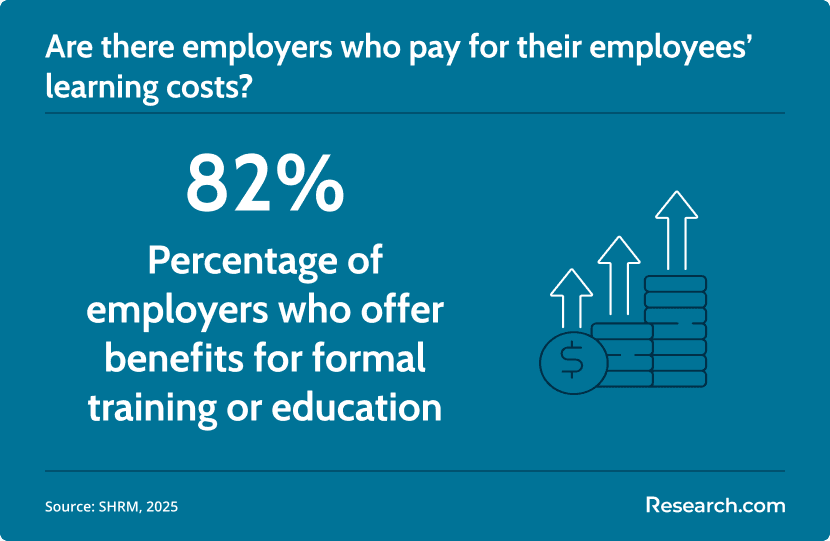
Employer tuition assistance can be especially valuable for professionals already working in IT, analytics, engineering, cybersecurity, or software development. Under Section 127 of the IRS tax code, employers can provide up to $5,250 per year in tax-free educational assistance. Some employers use this benefit to retain workers and help technical staff transition into AI-related roles.
Military-connected students should also review benefits such as the GI Bill®. Students comparing AI programs with adjacent pathways may also consider affordable master's in analytics online programs if they want machine learning and data science coursework at a different price point.
| Aid option | Who should investigate it | Important caution |
| Federal student aid | Students enrolled in eligible accredited programs | Complete required aid forms and confirm program eligibility before assuming coverage. |
| Employer tuition assistance | Working professionals whose employers support formal education | Check grade requirements, repayment clauses, and annual caps. |
| Military benefits | Veterans, service members, and eligible family members | Confirm how benefits apply to online enrollment and program length. |
| Scholarships and grants | Students seeking non-loan funding | Apply early and watch for separate deadlines from the university. |
What are the prerequisites for enrolling in an Online Artificial Intelligence Degree program?
Most AI programs look for evidence that applicants can handle programming, mathematics, and technical problem-solving. Requirements differ by degree level, but readiness in Python, calculus, linear algebra, probability, and statistics is often important.
- Bachelor’s programs: Applicants generally need a high-school diploma and proof of academic preparation. Arizona State University’s online BS in Artificial Intelligence in Business, for example, allows direct entry with a 3.40 unweighted GPA or a 1230 SAT or a 25 ACT or top 8% class rank.
- Master’s programs: Graduate programs often expect an accredited online technology degree or a bachelor’s degree in computer science, engineering, mathematics, or a related field, commonly with a 3.0 GPA. Johns Hopkins Engineering for Professionals expects previous coursework in Calculus I-III, linear algebra, probability and statistics, and Python.
- Application materials: Stevens Institute of Technology requests official transcripts, two recommendation letters, a statement of purpose, and an optional GRE/GMAT. Comparable documents are common at research-focused universities.
- Bridge preparation: Some schools let applicants complete MOOCs, certificates, prerequisite courses, or provisional coursework if they do not meet every technical requirement at admission.
- International applicants: Online AI programs at regionally accredited institutions usually apply the same English-language expectations as campus programs, commonly 90 TOEFL iBT or 6.5 IELTS, and may require course-by-course transcript evaluation.
Applicants who lack the recommended background should not assume they are disqualified, but they should plan for leveling work. Completing a programming course, a statistics refresher, or a graduate certificate before enrollment can make the first semester far more manageable.
What courses are typically in an Online Artificial Intelligence Degree program?
Online AI degrees usually move from foundations to advanced models and then to applied deployment. A strong curriculum should teach both how models work and how to use them responsibly in real systems.
- Mathematics for AI: Linear algebra, probability, statistics, and optimization help students understand how algorithms learn and why models behave as they do.
- Programming and data tools: Python, data structures, SQL, cloud workflows, APIs, and version control prepare students for technical implementation.
- Machine learning: Supervised learning, unsupervised learning, feature engineering, model evaluation, and validation form the core of most programs.
- Deep learning: Students may study neural networks, convolutional models, recurrent models, transformers, diffusion models, and generative AI techniques.
- Natural language processing and computer vision: Electives may cover language models, text analytics, image recognition, object detection, and multimodal AI.
- MLOps and production AI: Deployment, monitoring, model drift, reproducibility, and pipeline management prepare students to move beyond prototypes.
- Ethics, governance, and policy: Courses examine fairness, privacy, transparency, bias, safety, and the social effects of automated decision-making.
- Capstone or practicum: Final projects often require students to design, train, evaluate, and present an AI solution using real or realistic data.
The strongest programs make students connect theory to practice. A graduate should be able to explain a model, evaluate whether it is appropriate, deploy it carefully, and communicate risks to technical and nontechnical stakeholders.
The chart below compares percentages of online students’ preferences for their fields of study.
What types of specializations are available in Online Artificial Intelligence Degree programs?
Specializations help students align coursework with a career goal. Some schools offer formal tracks, while others allow students to build a focus through electives or certificates.
- Machine Learning and Deep Learning: Best for students who want to build predictive systems, neural networks, and advanced statistical models.
- Natural Language Processing (NLP): Useful for work with chatbots, large language models, text analytics, translation, search, and document intelligence.
- Computer Vision and Image Processing: Relevant to healthcare imaging, autonomous systems, manufacturing inspection, surveillance, and visual recognition.
- Robotics and Autonomous Systems: Combines perception, planning, control, and embedded systems for physical AI applications.
- Interactive or Human-Centered AI: Fits students interested in user-facing AI systems, human-computer interaction, agents, and responsible product design.
- AI Management and Policy: Designed for professionals who oversee AI adoption, governance, compliance, ethics, and organizational strategy.
Students planning to work with distributed AI systems may benefit from pairing AI coursework with cloud skills. For example, affordable cloud engineering online training can strengthen preparation for AI infrastructure, model hosting, and AI-as-a-service roles.
| If your goal is... | Consider specializing in... | Portfolio project to build |
| Building AI products | Machine learning, deep learning, or MLOps | A deployed model with an API, documentation, and monitoring plan |
| Working with language models | NLP or generative AI | A retrieval-augmented generation tool or text classification system |
| Entering healthcare or imaging | Computer vision or bioinformatics-related AI | An image analysis project with careful discussion of privacy and bias |
| Leading AI adoption | AI management, ethics, or policy | An AI governance framework or risk assessment for a business use case |
How does an Online Artificial Intelligence Degree differ from an online master of science in data science?
An online AI degree usually emphasizes the design of intelligent systems, advanced algorithms, neural networks, autonomous decision-making, and model deployment. An online master of science in data science is typically broader, focusing on data analysis, statistics, visualization, databases, business intelligence, and predictive modeling.
Choose AI if you want to build or deploy intelligent systems such as language models, computer vision pipelines, recommendation engines, or autonomous tools. Choose data science if you want to analyze complex datasets, produce insights, support business decisions, and build statistical models across industries. The two fields overlap, but the career emphasis differs.
| Comparison point | Online AI degree | Online data science master’s |
| Main focus | Intelligent systems, model architecture, automation, deployment | Data analysis, statistics, prediction, visualization, decision support |
| Typical technical depth | More emphasis on deep learning, NLP, computer vision, and MLOps | More emphasis on analytics, data management, and statistical modeling |
| Common roles | AI engineer, machine learning engineer, MLOps engineer | Data scientist, analytics manager, business intelligence analyst |
| Best choice if... | You want to build AI-enabled products or systems | You want to turn data into insights and decisions |
How do online AI programs stay current with technological advancements?
AI changes quickly, so a credible program should update course content, tools, assignments, and electives regularly. Strong programs often rely on faculty research, employer advisory boards, alumni feedback, cloud platform partnerships, and industry projects to keep courses aligned with current practice.
When reviewing a program, look for recent coursework in areas such as generative AI, responsible AI, MLOps, cloud deployment, edge computing, and model evaluation. You can also compare AI programs with broader online technology degree fast track programs to see whether the curriculum is keeping pace with employer expectations or merely reusing older computer science material under an AI label.
How to choose the best Affordable Online Artificial Intelligence Degree program?
The best affordable AI degree is not automatically the cheapest one. It is the program that gives you the strongest combination of accreditation, technical rigor, support, flexibility, and career-relevant project work at a price you can justify.
Machine learning can require significant computing power. Training deep neural networks, experimenting with large datasets, or fine-tuning open-source models can strain a standard laptop. Before enrolling, ask whether the school provides cloud computing credits, virtual labs, GPU access, or partnerships with providers such as Amazon Web Services (AWS), Google Cloud Platform (GCP), or Microsoft Azure.
You should also confirm institutional quality. Whether you are evaluating a full degree or asking which is a good bootcamp for data science, verify that the school or provider has credible recognition. For degree programs, check whether accreditation is recognized by the Council for Higher Education Accreditation (CHEA).
| Decision factor | What to check | Warning sign |
| Accreditation | Institutional accreditation and, where relevant, programmatic recognition | The school avoids clearly naming its accreditor. |
| Curriculum | Machine learning, deep learning, math, ethics, deployment, and capstone work | The program teaches AI tools but not underlying models or evaluation. |
| Technical infrastructure | Cloud credits, labs, GPU access, software, and support | Students must pay separately for essential compute resources. |
| Faculty and support | Instructor access, tutoring, office hours, and project feedback | The program relies only on recorded content with limited feedback. |
| Career outcomes | Portfolio expectations, employer connections, alumni paths, and career services | The school promises salaries or job placement without evidence. |
Common mistakes when choosing an online AI degree
- Choosing only by tuition: A low sticker price can become expensive if cloud access, software, or extra terms are not included.
- Ignoring accreditation: Some employers and graduate schools may reject credentials from unrecognized institutions.
- Assuming online means easier: AI coursework is still math-heavy and project-heavy, even when delivered asynchronously.
- Skipping prerequisite review: Weak Python, statistics, or linear algebra skills can make the first term overwhelming.
- Relying only on rankings: A highly ranked school may not offer the schedule, support, specialization, or price that fits your situation.
- Graduating without a portfolio: A transcript alone rarely proves that you can build, test, and deploy AI systems.
How do online AI programs support networking?
Online AI programs can support networking through virtual career fairs, alumni groups, employer webinars, research talks, Slack or Discord communities, team projects, and mentorship programs. The best opportunities are structured, recurring, and connected to real employers or technical communities rather than limited to general discussion boards.
Students should also create their own networking plan. Attend online talks, ask faculty about research opportunities, join AI and data communities, contribute to open-source projects, and connect with classmates who work in adjacent industries. Some students also broaden their perspective through interdisciplinary study, including fields such as online geology courses where geoscience and AI applications may intersect.
What career paths are available for graduates of Online Artificial Intelligence Degree programs?
AI careers are becoming more specialized. Many employers now distinguish between people who analyze data, people who design models, people who integrate AI into applications, and people who manage production infrastructure. Before choosing electives, decide whether you want to focus on mathematical modeling, software engineering, applied analytics, product development, or AI governance.
A quantitative foundation can help. For example, the most affordable online bachelor's degree in mathematics may support preparation for graduate AI study or data-heavy technical work. However, AI hiring often rewards a combination of math, coding, deployment ability, and domain understanding.
- Machine learning engineer: Builds, tests, and improves models used in products or internal systems.
- AI engineer: Connects AI models to software applications, APIs, workflows, and user-facing tools.
- MLOps engineer: Manages deployment, monitoring, scalability, latency, reproducibility, and model lifecycle operations.
- Data scientist: Analyzes data, builds prototypes, communicates findings, and supports business or research decisions.
- Computer and information research scientist: Investigates advanced computing problems, develops new approaches, and may work in research-heavy environments.
- AI product manager or AI strategist: Guides AI initiatives, evaluates use cases, coordinates stakeholders, and considers risk, ethics, and business value.
If you are comparing technology career paths, a cybersecurity and data science programs comparison can help you understand how AI-related preparation differs from other high-demand technical fields.
What is the job market for graduates with an Online Artificial Intelligence Degree?
The job market for AI graduates remains active, but it is also competitive. Employers are not simply hiring anyone who lists AI on a resume. They are looking for candidates who understand models, write reliable code, handle data responsibly, and can move systems beyond prototypes.
- Data scientists: BLS projects 33.5% employment growth from 2024-2034 and roughly 23,400 openings each year.
- Software developers and machine-learning engineers: The differences between a software developer and software engineer can affect job titles, but market growth remains strong. Software developer employment is expected to rise 15.8% over the decade as companies embed AI in products. This occupation already adds 115,200 openings annually.
- Computer and information research scientists: Research-focused roles are projected to grow 19.7%, with 3,200 annual postings, reflecting federal and private research and development investment in generative models, autonomy, and quantum-enhanced AI.
- Real-time postings: CompTIA’s April 2025 snapshot counted 55,726 active openings requiring AI skills, up 184% year-over-year and equal to 21% of all tech postings.
- Geography and flexibility: California, Texas, Virginia, and New York lead in absolute openings, but 49 states logged month-over-month posting increases. More than half of listings offer remote or hybrid work arrangements.
- Labor tightness: Even after recent volatility, tech unemployment was just 3.5% in April 2025 versus the national 3.9%, showing continued demand for advanced technical skills.
Graduates should still expect screening tests, technical interviews, portfolio reviews, and competition from experienced engineers. The degree can open doors, but the strongest candidates combine the credential with evidence of applied skill.
The graph below shows the job market changes for occupations affected by AI. Higher percentages represent positive growth, or more job openings.
How can interdisciplinary studies enhance your online AI degree?
AI becomes more valuable when paired with domain expertise. Healthcare, finance, logistics, education, cybersecurity, biology, manufacturing, and environmental science all use AI differently. Students who understand both the technology and the industry context are often better prepared to identify useful problems, avoid harmful applications, and communicate with stakeholders.
For example, students interested in healthcare or life sciences may connect AI coursework with bioinformatics, genomics, or medical data analysis. Comparing AI programs with the cheapest online bioinformatics master's can help learners evaluate whether they want a broad AI degree, a specialized bioinformatics pathway, or a combination of both.
Who should choose an Affordable Online Artificial Intelligence Degree?
| This degree may be a good fit if... | You may want another path if... |
| You already have programming experience or are ready to build it quickly. | You want a nontechnical overview of AI without coding or math. |
| You need flexibility because you work, parent, or live far from campus. | You learn best through daily in-person labs and immediate hands-on support. |
| You want a credential that supports AI engineering, data science, or technical leadership. | You only need a short introduction to tools for your current job. |
| You can commit time to projects, debugging, and portfolio building. | You are not prepared for independent problem-solving in an online format. |
Questions to ask before enrolling
- Is the institution accredited by a recognized accreditor?
- What is the total cost to graduate, including fees, software, hardware, and cloud computing?
- Does the program provide GPU access, cloud credits, virtual labs, or other AI infrastructure?
- How much Python, calculus, linear algebra, probability, and statistics should I know before starting?
- Are courses taught by faculty with AI, machine learning, data science, or computer science expertise?
- Will I complete a capstone, practicum, thesis, or portfolio project?
- How often are AI courses updated to reflect changes in tools, methods, and employer expectations?
- What career services are available to online students specifically?
- Can I attend part time, pause enrollment, or transfer credits if my work schedule changes?
- What do recent graduates actually do after completing the program?
What graduates say about affordable online Artificial Intelligence degrees
- Clyde reported that virtual labs and professor feedback made the online format more interactive than expected, and that the credential helped him move from IT support into a data science role in under two years.
- Gracie said online study made it possible to balance parenting with technical training, later leading to work in healthcare technology using AI for patient diagnostics.
- Jordan described the degree as useful because it connected theory with deployable model-building skills and contributed to a role paying $35,000 more than a previous position.
Key Insights
- An affordable online AI degree is most valuable when it is accredited, technically rigorous, and supported by real project infrastructure such as cloud access or virtual labs.
- Program timelines vary widely: bachelor’s degrees commonly require 120 credits over 4 years, while online AI master’s programs may take 12 to 24 months, with some part-time paths extending to 36 months.
- Cost comparisons should include more than tuition. AI students may face additional expenses for hardware, GPU time, software, cloud computing, and extra terms if a capstone takes longer than expected.
- Online students must take networking seriously. A public GitHub portfolio, documented projects, competitions, open-source work, and virtual employer events can help replace the visibility that campus students get more naturally.
- Career outcomes depend on specialization. Students should decide whether they want to build models, deploy AI systems, analyze data, manage infrastructure, or lead AI strategy.
- The labor market shows strong demand signals, including BLS growth projections and CompTIA’s April 2025 count of 55,726 active AI-skill openings, but employers still expect proof of applied ability.
- Do not choose a program based only on rankings or sticker price. The better question is whether the degree can help you graduate with credible skills, a strong portfolio, and manageable debt.
References:
- ABET (2025, May 20). Criteria for accrediting computing Programs, 2025 - 2026 - ABET. https://www.abet.org/accreditation/accreditation-criteria/criteria-for-accrediting-computing-programs-2025-2026/
- Bureau of Labor Statistics (2025, March 11). AI impacts in BLS employment projections. https://www.bls.gov/opub/ted/2025/ai-impacts-in-bls-employment-projections.htm
- Bureau of Labor Statistics (2025, April 18). Computer and Information Technology occupations. https://www.bls.gov/ooh/computer-and-information-technology
- Bureau of Labor Statistics (2025, April 18). Data scientists. https://www.bls.gov/ooh/math/data-scientists.htm
- Bureau of Labor Statistics (2025, April 18). Software developers, quality assurance analysts, and testers. https://www.bls.gov/ooh/computer-and-information-technology/software-developers.htm
- Education Dynamics. (2024). Online College Students 2024 Report. https://www.educationdynamics.com/the-online-college-students-report-2024
- Federal Student Aid (2025) Eligibility Requirements | Federal Student Aid. https://studentaid.gov/understand-aid/eligibility/requirements
- Hanson, M. (2025, February 22). Average cost of online college [2025]: Yearly tuition + fees. Education Data Initiative. https://educationdata.org/average-cost-of-online-college
- Internal Revenue Service (2025). Employer-offered educational assistance programs can help pay for college. https://www.irs.gov/newsroom/employer-offered-educational-assistance-programs-can-help-pay-for-college
- International Foundation of Employee Benefit Plans. (2024). 2024 Employee Benefits Survey. https://www.ifebp.org/detail-pages/resource/survey/employee-benefits-survey--2024-survey-report
- Sahni, N. R., Stein, G., Zemmel, R.,& Cutler, D. (2024). The Economics of Artificial Intelligence: Health Care Challenges. University of Chicago Press. https://www.nber.org/books-and-chapters/economics-artificial-intelligence-health-care-challenges/potential-impact-artificial-intelligence-health-care-spending
- Society for Human Resource Management. (2025). 2025 Employee Benefits Survey. https://www.shrm.org/topics-tools/research/employee-benefits-survey
- Swaak, T. (2025, April 10). Online college courses used to be an exception. Now, they’re an expectation. The Chronicle of Higher Education. https://www.chronicle.com/article/the-online-overhaul
- Turmoil weighs on tech jobs market, CompTIA reporting confirms. (2 May, 2025). CompTIA. https://www.comptia.org/newsroom/press-releases/turmoil-weighs-on-tech-jobs-market-comptia-reporting-confirms
Other Things You Should Know About Online Artificial Intelligence Degree Programs
In 2027, identify reputable yet affordable online AI degree programs by researching accreditation, comparing tuition costs, and reviewing curriculum quality. Explore program rankings, alumni success, and available technology resources to ensure a balance between affordability and educational excellence.
Yes, many universities offering online AI degree programs in 2027 provide scholarships to help reduce tuition costs. These can be merit-based or need-based. It's advisable to check each institution's financial aid resources to find eligible scholarships and apply early.
Most affordable online AI degree programs in 2026 require a high school diploma or equivalent, basic programming skills, and proficiency in mathematics, including calculus and linear algebra. Some programs may also require introductory courses in computer science to ensure foundational knowledge.


