2027 Online BA in Psychology - General Psychology for Academic Advising Assistants: What to Check Before Changing Careers
Audited and Verified:
Our Editorial and Data Verification Process
Research.com uses government datasets, official education statistics and primary institutional information to support its career and degree guides. Our review process checks factual accuracy, occupational definitions, source dates and the requirements associated with the credentials discussed.
How This Article Was Fact-Checked
Our editorial team verifies salary estimates, employment projections, education requirements and program information against original data providers and official organizations. Salary figures are checked against the relevant occupational definitions and reporting periods. Information about licensure, accreditation and required in-person training is reviewed separately.
Fact-checked and verified on:

Co-Founder and Chief Data Scientist
If you already help students schedule appointments, navigate campus services, or resolve registration problems, you have experience relevant to academic advising. An online BA in general psychology could strengthen your understanding of learning and student development - but it may not be the fastest route to an advisor position.
This guide explains how to compare the degree with your employer's hiring requirements, assess the remaining time and cost, and identify practical experience that could make a career change more realistic.
Key Things You Should Know
- Check actual advisor job postings first: a psychology BA can be relevant, but employers may prioritize advising experience, a completed bachelor's in any field, or a master's degree.
- A bachelor's commonly requires about 120 semester credits; transferred credits reduce the remaining work only when the university applies them to specific degree requirements.
- The federal wage category for school and career counselors and advisors is not a reliable pay estimate for an academic advising assistant; compare local college postings and pay grades instead.
What is an online bachelor's degree in general psychology?
An online BA in general psychology is a broad undergraduate study of behavior, development, learning, and psychological research. "General" usually means the major is not restricted to a formal specialty. A BA may allow more room for electives or language and humanities requirements than a BS, but the distinction varies by university.
For an advising assistant, the degree's value lies in pairing that foundation with existing knowledge of student services. It does not train someone to diagnose students or provide mental health treatment. If a specialized major is appealing, compare its required courses and scheduling rather than assuming its title improves advising prospects; even online forensic psychology bachelor's programs in three years or less address a substantially different career interest.
Can a general psychology degree prepare you for academic advising?
Yes, it can provide relevant preparation, but the degree alone does not qualify someone for every advisor vacancy. Academic advisors may help students interpret degree requirements, plan courses, understand academic policies, and connect with appropriate campus resources. Advising assistants often already contribute through scheduling, records work, student communication, and referrals. The next step depends on which of those duties the target employer assigns to advisors and what its postings require.
The distinction matters most when considering a substantial career change. Someone who already works in a college may be able to seek cross-training, document student-facing responsibilities, and apply for internal opportunities while studying. Someone outside higher education may need direct student-services experience as well as a degree. Neither an advising role nor psychology coursework authorizes counseling or psychotherapy; if that is the intended profession, examine planning completion of accredited clinical counseling coursework as a separate pathway.
Compare the role's demands with evidence you can show an employer:
- Student communication: Examples of explaining policies clearly and referring questions outside your authority.
- Academic systems: Experience with degree audits, registration procedures, and accurate recordkeeping.
- Student support: Examples of accessible communication, professional boundaries, and appropriate referrals.
What accreditation should an online psychology program have?
Confirm that the university holds recognized institutional accreditation and that it covers the institution awarding the online degree. Accreditation matters for academic quality oversight and can affect federal aid eligibility and how other schools review credits. Check the accreditor's current directory and the university's published accreditation information; do not rely solely on an advertisement.
Do not reject a general psychology BA because it lacks APA program accreditation. APA accreditation applies to specified professional psychology training programs and internships, not general bachelor's majors. This distinction also matters when reading forensic psychology degree program quality checks: verify which institution and which credential an accreditation claim actually covers.
Programs commonly combine introductory psychology with developmental and social psychology, statistics, research methods, and upper-level electives. Requirements differ, so inspect the degree map rather than assuming a course is available online every term. For advising work, developmental psychology can inform how students' needs change, while research methods can help you judge claims about student-success initiatives. Neither substitutes for training on a college's policies, degree-audit system, or student-record rules.
Elective choice should follow the target job. Education, learning, cultural psychology, or organizational coursework may be more useful for advising than a narrowly clinical topic. If the intended work is substance-use counseling rather than campus advising, compare the curriculum and state credential rules for cost-conscious substance use counseling undergraduate options; a general psychology elective does not create counseling authority.
Requirements depend on whether you apply as a first-year or transfer student. Universities may request prior transcripts and evidence of secondary-school completion; transfer applicants may face minimum-credit or GPA rules. Admission to the university, admission to a major, acceptance of prior credits, and satisfaction of degree requirements are separate decisions.
If you have college coursework, request an official evaluation showing which credits meet general education, psychology major, prerequisite, and residency requirements. Ask whether an earlier statistics course satisfies the major and whether remaining courses are offered in an order you can attend. Do not buy a faster-looking undergraduate route on the assumption that it also shortens later graduate preparation: even evaluating intensive forensic psychology graduate degree timelines requires a separate check of admissions prerequisites and career fit.
A bachelor's commonly totals about 120 semester credits, often planned over four academic years of full-time study. Your actual timeline depends on applicable transfer credits, enrollment pace, course sequencing, and the university's graduation rules. Online delivery does not necessarily mean that every required course is asynchronous or offered every term.
Ask for a term-by-term plan showing the remaining major courses and prerequisites - not just an estimate based on credits accepted. If speed matters, fast-track bachelor's study in psychology is worth comparing, but a heavier course load is useful only if you can sustain it alongside work and still complete the necessary requirements.
There is no dependable single price for an online BA: tuition rates, fees, accepted credits, enrollment pace, and aid vary by school and student. Compare the cost of the credits you still need, not the advertised cost of a full degree or a single term. Also account for books, technology charges, and any required in-person activity.
Request a written estimate based on your degree audit and ask how part-time enrollment affects aid eligibility. Compare that estimate with psychology degree options with lower tuition, while checking fees and the number of credits each school would actually apply. Employer tuition assistance, if available, may change the calculation; verify its eligibility, grade, and repayment conditions before counting it as savings.
Possible nonclinical paths include student-services support, academic advising where the employer's qualifications are met, program coordination, human-services support, and research assistance. These are not automatic outcomes of the major. Job descriptions may call for different software skills, populations served, prior experience, or graduate education.
For an advising assistant, the most direct move may be an internal advisor or student-success vacancy. Compare its minimum degree requirement with your current credentials before enrolling: if you already have an accepted bachelor's, additional advising responsibilities or targeted training might be more useful than a second one. If later graduate study is genuinely required for your goal, compare its admissions demands and total time; evaluating shorter graduate psychology degree options should not replace checking whether that degree is relevant to the job.
There is no single salary for psychology graduates or a dependable national wage figure that captures every academic advising assistant position. Colleges classify assistant jobs differently, and pay may follow institutional grades or public-sector schedules. Use nearby openings with matching duties, experience requirements, and location as the closest comparison.
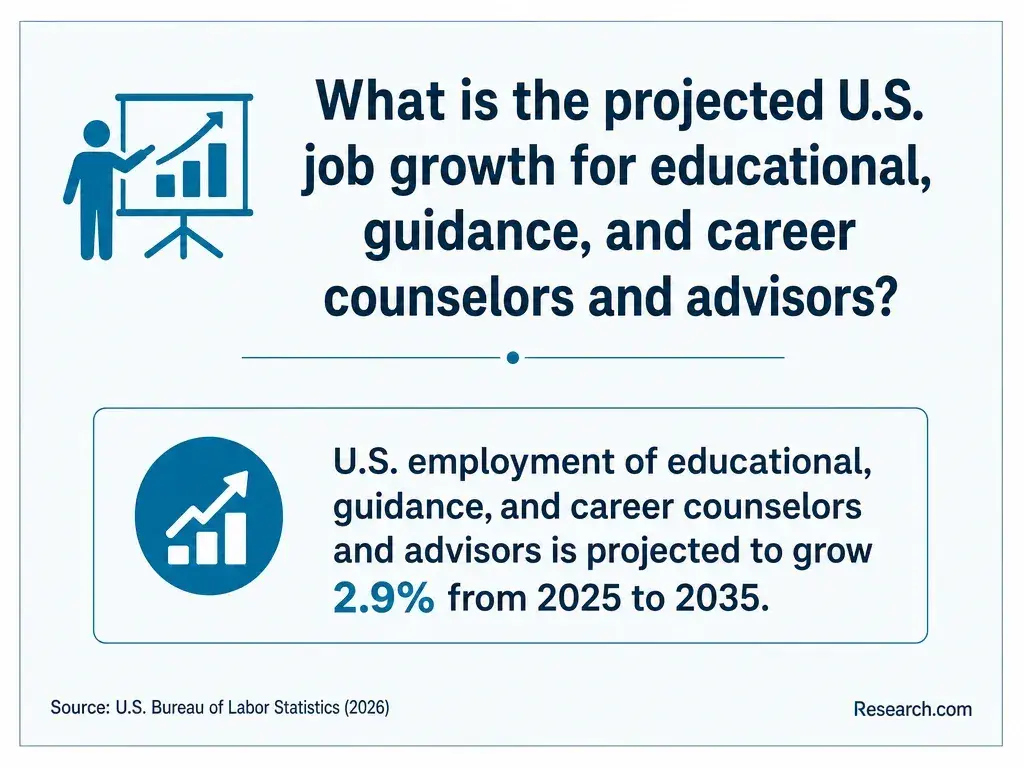
The U.S. Bureau of Labor Statistics reports a May 2024 median annual wage of $65,140 for school and career counselors and advisors. That occupation-wide figure is not an expected salary for an advising assistant or a psychology BA graduate: it combines roles with different settings and qualification requirements. Before taking on education costs, compare attainable local advisor pay with your current compensation and the cost of finishing the degree. The same caution applies when comparing affordable graduate psychology programs: a lower program price does not establish a salary increase.
How do you choose a reputable online psychology degree program?
Start with the target employer, not a program ranking. Collect several advisor postings and note which accept any bachelor's degree, specify a field, require advising experience, or prefer graduate study. Then ask each university for a degree audit, a realistic course schedule, a cost estimate, and details of career support for online students.
Confirm whether required classes include live meetings, campus visits, or a placement - and who arranges any experiential work. Ask how students gain supervised research or applied experience if it would strengthen an advisor application. Finally, keep the desired occupation fixed while comparing programs: mental health counseling tuition fees and financial aid concern a different educational and credential decision, not an upgrade automatically needed for academic advising.
Bottom line: An online general psychology BA makes sense when it completes a degree you need and its remaining cost and coursework fit your advising goal. If you already meet the degree requirement, test whether internal experience, employer training, or a targeted credential addresses the actual gap more directly.
Other Things You Should Know About Psychology
Yes, if your employer permits it. Ask about shadowing, cross-training, or student-success projects, and confirm which decisions must remain with authorized advisors.
Not without the required institutional authorization. Student records may be protected, and coursework does not grant access or permission to reuse them. Ask your instructor and the relevant college office about approved data and privacy procedures.
Your experience may be valuable, but another institution can use different software and policies. Describe the underlying skills - accurate documentation, degree-audit review, and appropriate referrals - rather than claiming its procedures are identical.
Follow the application's instructions and identify the degree and awarding institution accurately. Be ready to discuss the coursework and experience that prepare you for the role; do not assume delivery format determines employer acceptance.
- Accreditation in the U.S. | ed.gov http://www.ed.gov/laws-and-policy/higher-education-laws-and-policy/college-accreditation/accreditation-in-the-us
- Understanding U.S. Accreditation | EducationUSA https://educationusa.state.gov/understanding-us-accreditation
- Skills of a Psychology Major | Evelyn L. Spiro School of Nursing https://wagner.edu/psychology/skills/
- Details - Academic Advisor (Student Services Professional IB) | SDSU https://careers.sdsu.edu/en-us/job/562030/academic-advisor-student-services-professional-ib
- Credit Evaluation Services - Registrar - Cornell University https://registrar.cornell.edu/students/credit-evaluation-services
- How to Become an Academic Advisor | Northeastern University Graduate Programs https://graduate.northeastern.edu/knowledge-hub/how-to-become-an-academic-advisor/
- Bachelor of Arts (BA) in Psychology Degree Program | California Southern University https://www.calsouthern.edu/online-degree-programs/behavioral-sciences/bachelors-psychology-ba/
- Academic Advisors: How to Become One | Franklin University https://www.franklin.edu/career-guide/guidance-and-career-counselors/how-to-become-academic-advisors
- Bachelor of Arts in Applied Psychology | Concordia University Wisconsin https://www.cuw.edu/academics/programs/applied-psychology-bachelors/index.html
- Student Academic Advisor 1 - 4 SV - UCnet https://ucnet.universityofcalifornia.edu/job/class-a/student-academic-advisor-1-4-sv/