2027 Online BA in Psychology - General Psychology for Hospice Volunteers: What to Check Before Changing Careers
Audited and Verified:
Our Editorial and Data Verification Process
Research.com uses government datasets, official education statistics and primary institutional information to support its career and degree guides. Our review process checks factual accuracy, occupational definitions, source dates and the requirements associated with the credentials discussed.
How This Article Was Fact-Checked
Our editorial team verifies salary estimates, employment projections, education requirements and program information against original data providers and official organizations. Salary figures are checked against the relevant occupational definitions and reporting periods. Information about licensure, accreditation and required in-person training is reviewed separately.
Fact-checked and verified on:

Co-Founder and Chief Data Scientist
Hospice volunteering can reveal a career interest in supporting people with serious illness and their families. Before enrolling in an online BA in general psychology, identify the work you want to do: coordinate services, support a hospice team, conduct research, or provide counseling. Those goals call for different qualifications. This guide helps hospice volunteers assess what their experience already offers, what a psychology degree could add, and which program, cost, and credential questions to settle before changing careers.
Key Things You Should Know
- A general psychology BA can support a move into nonclinical service, outreach, or research-support work, but hospice volunteering and the degree alone do not qualify you to provide therapy.
- Start with the duties in local job postings: a hospice coordinator role may value experience and a bachelor's degree, while clinical counseling or social work requires a separate qualifying pathway.
- Before enrolling, confirm institution-level accreditation, a written evaluation of any transfer credits, the full remaining cost, and whether online coursework includes scheduled or in-person obligations.
What Is an Online BA in General Psychology for Hospice Volunteers?
An online BA in general psychology is a broad undergraduate degree covering human behavior, development, research, and evidence-based reasoning. It is not usually a hospice-specific qualification. For a volunteer, its value lies in pairing academic knowledge with demonstrated skills such as listening, following referral procedures, working with a care team, and respecting family preferences.
"Online" describes how courses are delivered, not necessarily when you must attend. Ask whether classes are asynchronous, require live meetings, or include an approved placement. General psychology may be a better fit if you want flexibility across several nonclinical roles. If your goal is specifically substance-use services, compare its curriculum with addiction counseling academic preparation; neither course title nor concentration establishes counseling eligibility on its own.
Can an Online Psychology Bachelor's Degree Lead to Hospice Careers?
Yes, potentially - but the job's duties matter more than the degree's name. A hospice volunteer may already have relevant experience in companionship, communication, and team coordination. The BA can add research literacy and a recognized undergraduate credential; it does not replace employer training, clinical supervision, or a required license.
The distinctions below can help you identify a target before comparing programs. Requirements vary by employer and state.
| Target work | How a psychology BA may help | What else to check |
| Volunteer coordination or community outreach | Supports communication, training, and program-evaluation skills | Hiring criteria, scheduling experience, and nonprofit operations skills |
| Patient or family service support | Provides background in development, stress, and service systems | Permitted duties, documentation training, and employer supervision |
| Hospice social work or mental health counseling | May provide undergraduate preparation | A qualifying professional degree, state requirements, and supervised practice |
If counseling is the firm goal, evaluate a qualifying graduate route rather than treating the BA as the destination. Even when considering shortening the path through a clinical counseling master's, verify state eligibility and required in-person clinical training.
What Accreditation Should an Online Psychology Program Have?
Check that the institution holds recognized institutional accreditation and that the accreditation covers the school offering the online degree. Confirm its status through the accreditor and the U.S. Department of Education's accreditation records, then ask the school whether the specific degree and delivery format have any additional approval requirements.
Do not reject a general psychology BA because it lacks American Psychological Association accreditation: APA accreditation applies to specified professional psychology training, not ordinary undergraduate psychology majors. If your eventual goal is counseling or social work, investigate the recognition and state rules applicable to that professional program. Those requirements also affect financial planning for accredited counseling degrees; a low advertised price is of little use if the program does not meet your intended credential requirements.
Prioritize courses that help you understand people and evaluate services without implying clinical authority. Lifespan development can inform age-appropriate communication; social and cultural psychology can sharpen awareness of family dynamics and differing beliefs about care. Research methods and statistics help you assess claims about grief support or volunteer programs. Health psychology and courses addressing loss or aging may be useful electives where offered.
Compare catalogs rather than assuming every BA has those electives. If you want to work in substance-use services rather than hospice, a more focused curriculum may warrant comparison, including the cost and duration of substance abuse counseling bachelor's degrees. In either field, studying a condition is different from assessing, diagnosing, or treating it.
Schools set their own first-year and transfer requirements, commonly requesting prior transcripts and an application. Some have separate rules for entering the psychology major. Volunteer experience can strengthen an application or clarify your goals, but it normally does not substitute for required academic work.
If you have previous college credit, request a written degree audit before committing. An accepted course might count as an elective without satisfying statistics, research methods, or another major requirement. Ask admissions and the psychology department to identify prerequisites, residency credits, and remaining coursework after transferring into psychology. That answer - not the number of credits initially accepted - determines your likely path to graduation.
Completion time depends on the credits that apply to your degree, course availability, and how many classes you can take while volunteering or working. A fully online program may still have live sessions, group assignments, or a scheduled internship. Ask for a term-by-term plan showing when required methods courses and any capstone are offered.
If you expect to pursue graduate study afterward, keep its timeline separate from the BA timeline. For example, forensic psychology master's completion time comparisons concern a different career direction; a short graduate program is not a shortcut into licensed hospice counseling.
Compare the price of remaining requirements, not the advertised price per credit alone. Obtain an estimate covering tuition, mandatory fees, textbooks or software, and any travel or unpaid time associated with an approved placement. Ask how changing your course load affects financial aid and whether your employer offers education assistance.
Cost comparisons across degree levels can be misleading. Published costs of one-year forensic psychology master's pathways, for instance, do not represent the total cost of first completing a BA or qualify someone for hospice clinical work. Compare each option against the credential your target job actually requires.
Depending on employer requirements and your experience, possibilities include volunteer coordinator, community outreach specialist, service or intake coordinator, program assistant, and research assistant. These roles may involve scheduling, referrals, documentation, recruitment, or basic data work - not independent counseling. Hospice experience is strongest evidence when you can describe specific responsibilities without disclosing patient information.
A general BA also allows a later change of direction, but specialized job lists require scrutiny. For example, forensic psychology master's careers and earning potential describe a different degree and labor market; they should not be treated as likely outcomes for a psychology BA or a hospice career transition.
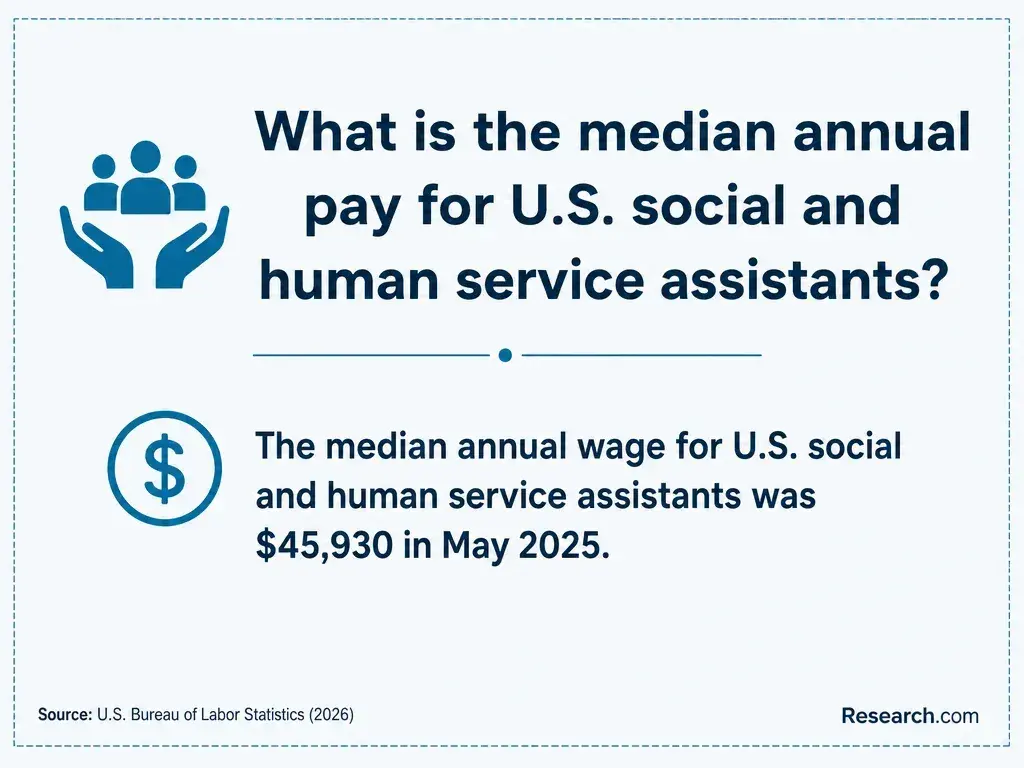
There is no single salary for psychology BA graduates entering hospice-related work. Pay depends on the occupation, location, employer, duties, and prior experience. For a useful benchmark, compare local postings with the U.S. Bureau of Labor Statistics Occupational Outlook Handbook entry for the specific occupation - such as social and human service assistant - rather than using psychologist wages for an unlicensed support role. An occupation-wide median is not a starting offer or a degree-specific outcome.
Calculate your likely change in earnings against the BA's remaining cost and any time away from paid work. The same caution applies if you later consider shorter completion routes for psychology master's students: faster study does not itself establish a salary increase or clinical eligibility.
Does a Psychology BA Qualify You for Counseling or Hospice Licensure?
No. A general psychology BA does not authorize psychotherapy, diagnosis, independent psychological assessment, or use of a protected clinical title. Hospice is a care setting, not a single professional license. Counseling, clinical social work, and psychology have distinct education, supervised-experience, examination, and state-specific rules. Hospice employers may impose additional role and training requirements.
If you want to provide therapy, identify the exact licensed occupation and ask the relevant state board whether a proposed professional program meets its educational criteria. Include graduate study and supervised practice in your plan. Resources on planning the time and cost of a counseling master's can help frame questions, but the board and program must confirm eligibility. If instead you want to coordinate volunteers or support families within a defined nonclinical role, compare local hiring requirements before paying for another degree.
Other Things You Should Know About Psychology
Only if your institution has an applicable prior-learning or approved placement policy. Ask what documentation, faculty oversight, and assessments it requires before assuming hours will count.
Often, yes, but check live-class times, assignment deadlines, and any placement schedule. A manageable plan should leave room for both study and the emotional demands of hospice work.
Discuss your responsibilities and skills using general examples. Do not reveal a patient's identity, health information, or identifiable family circumstances.
Follow your hospice organization's training and reporting procedures promptly. Escalate the concern to the appropriate staff member rather than trying to assess or manage it independently.
- 42 CFR 418.78 -- Conditions of participation - Volunteers. | ecfr.gov https://www.ecfr.gov/current/title-42/chapter-IV/subchapter-B/part-418/subpart-C/subject-group-ECFR74797288a614803/section-418.78
- What Are Palliative Care and Hospice Care? | National Institute on Aging https://www.nia.nih.gov/health/hospice-and-palliative-care/what-are-palliative-care-and-hospice-care
- DAPIP | Homepage - Office of Postsecondary Education (OPE) https://ope.ed.gov/dapip/
- Online Bachelor's Degree in Psychology | Purdue Global https://www.purdueglobal.edu/degree-programs/psychology/bachelor-degree-psychology-online/
- General Psychology | Online Bachelor's Degree | Capella University https://www.capella.edu/online-psychology-degrees/bs-psychology-program/bachelors-general-psychology/
- What Can You Do With a Bachelor's Degree In Psychology? | villa.edu https://www.villa.edu/what-can-you-do-with-a-bachelors-degree-in-psychology/
- Undergraduate Careers in Psychology | colostate.edu https://psychology.colostate.edu/undergraduate-careers-in-psychology/
- Bachelor of Arts in Psychology - Texas State's online programs https://online.txst.edu/degrees/undergraduate/ba-psychology/
- Tuition Basics | University of Phoenix https://www.phoenix.edu/tuition-financial-aid.html
- Psychology careers guide | apa.org https://www.apa.org/education-career/guide/careers