2027 Flexible Online Emergency Management Doctorate Programs: Part-Time, Hybrid, and Self-Paced Options
Audited and Verified:
Our Editorial and Data Verification Process
Research.com uses government datasets, official education statistics and primary institutional information to support its career and degree guides. Our review process checks factual accuracy, occupational definitions, source dates and the requirements associated with the credentials discussed.
How This Article Was Fact-Checked
Our editorial team verifies salary estimates, employment projections, education requirements and program information against original data providers and official organizations. Salary figures are checked against the relevant occupational definitions and reporting periods. Information about licensure, accreditation and required in-person training is reviewed separately.
Fact-checked and verified on:

Co-Founder and Chief Data Scientist
Choosing an online emergency management doctorate is often a scheduling decision as much as an academic one. NOAA recorded 27 U. S. billion-dollar weather and climate disasters in 2024, reinforcing demand for leaders who can plan, coordinate, and evaluate disaster response.
This guide is for working professionals comparing part-time, hybrid, and self-paced doctoral options. You will learn how formats differ, what flexibility really means, what costs and residency rules to check, and how to choose a program that fits your career goals without disrupting your current job.
Key Things You Should Know
- Flexible online emergency management doctorates are most often part-time professional or applied research programs, fully self-paced doctorates are uncommon because dissertations, residencies, and faculty milestones still require scheduled progress.
- The median annual wage for emergency management directors was $86,130 in May 2024, according to the U.S. Bureau of Labor Statistics, but doctoral ROI depends heavily on sector, leadership level, experience, and whether the degree supports a defined advancement goal.
- Cost planning should include tuition, fees, travel for residencies, dissertation continuation charges, and financing, federal graduate Direct Unsubsidized Loans carried an 8.08% interest rate for 2024-2025 loans, while Direct PLUS Loans carried 9.08%.
Which Flexible Online Emergency Management Doctorate Programs Offer Part-Time Options?
Part-time online emergency management doctorate options are usually designed for experienced professionals in public safety, homeland security, disaster science, public administration, public health preparedness, military operations, or nonprofit crisis response. Instead of asking whether a program is "online," ask whether it allows a reduced course load, predictable terms, and a dissertation pace that matches full-time employment.
The table below summarizes the program types most likely to support part-time study. It is useful because emergency management doctorates may appear under several degree names, not only "emergency management."
| Program type | Common degree labels | Why it may be flexible | Best fit |
| Applied emergency management doctorate | Doctor of Emergency Management, Doctor of Disaster Science, Doctor of Public Safety | Often built for mid-career practitioners and may offer evening, online, or low-residency coursework | Emergency managers seeking executive, consulting, or applied research roles |
| Homeland security or public safety doctorate | PhD, DHS, DPS, or Doctor of Strategic Security | May use online seminars and policy-focused research that fits agency or defense careers | Professionals in intelligence, critical infrastructure, law enforcement, or national preparedness |
| Public administration or policy doctorate with disaster focus | DPA, PhD in Public Policy, PhD in Public Administration | Often accepts part-time enrollment and lets students frame dissertations around resilience, recovery, or emergency governance | Government managers, analysts, and agency leaders |
| Public health preparedness doctorate | DrPH, PhD in Public Health, PhD in Health Security | May combine online coursework with applied field projects or limited campus intensives | Students focused on pandemics, health systems, community resilience, and emergency preparedness |
A strong part-time program should publish how many credits students can take per term, whether dissertation enrollment can continue at a reduced load, and what happens if work deployments or disaster response duties interrupt a semester. If a school only advertises "flexible online learning" but does not explain pacing, leave policies, and faculty availability, ask for details before applying.
How Do Hybrid and Fully Online Emergency Management Doctorate Programs Differ?
Hybrid and fully online emergency management doctorates can both work for adults, but they solve different problems. A fully online program minimizes travel and relocation barriers, while a hybrid or low-residency program may offer stronger in-person networking, simulation exercises, dissertation workshops, or access to campus-based research centers.
The comparison below shows the practical differences that matter most before enrolling. Use it to decide whether travel adds enough value to justify time away from work and family.
| Format | How learning usually works | Main advantage | Main trade-off |
| Fully online | Courses, discussions, advising, and dissertation meetings occur remotely | Best for students who cannot travel or who work rotating schedules | Networking and field exercises may require extra effort outside the classroom |
| Hybrid | Online coursework is combined with scheduled campus visits, weekend sessions, or field-based intensives | Useful for students who value face-to-face faculty interaction and cohort building | Travel costs, leave time, and residency dates can reduce flexibility |
| Low-residency online | Most coursework is online, with short required residencies for orientation, research, exams, or dissertation milestones | Balances remote study with structured doctoral support | Students must plan early for travel and employer approval |
Choose fully online if your biggest constraint is location or unpredictable deployment. Choose hybrid if your career goal depends on relationship-building, applied simulations, or in-person access to faculty and agency networks. In either format, quality depends less on delivery mode and more on accreditation, faculty expertise, research support, and how clearly the program handles dissertation progress.
Do Online Emergency Management Doctorate Programs Offer Self-Paced or Asynchronous Learning?
Many online emergency management doctorate programs offer asynchronous coursework, but that is not the same as being fully self-paced. Asynchronous courses let students complete weekly readings, discussions, and assignments without logging in at a fixed class time. Self-paced study usually means students can move through material at their own speed, which is much less common at the doctoral level.
This distinction matters because doctoral education depends on faculty feedback, cohort discussion, research ethics approval, comprehensive exams, and dissertation supervision. Even flexible programs typically use deadlines to keep students moving and to ensure academic quality.
When evaluating asynchronous or self-paced claims, look for the following details in the academic catalog and student handbook:
- Whether courses have weekly deadlines or open completion windows..
- Whether live sessions are optional, recorded, or required.
- How often students must meet with dissertation chairs or committees.
- Whether comprehensive exams are scheduled by the school or by the student.
- Whether students can pause enrollment without losing dissertation momentum or financial aid eligibility.
A good rule of thumb is this: asynchronous coursework can make a doctorate manageable, but a credible emergency management doctorate should not be completely unstructured. If a program promises total flexibility with little faculty contact, that can be a red flag.
A flexible online emergency management doctorate commonly takes several years because students must complete advanced coursework, research training, comprehensive exams or qualifying assessments, and a dissertation or applied doctoral project. Part-time students should be especially careful about maximum time limits, because extending a doctorate can increase both direct costs and opportunity costs.
The table below gives a planning framework rather than a guarantee. Actual timelines vary by transfer credit, enrollment intensity, research topic, dissertation approval, and whether the student pauses for work or family reasons.
| Enrollment pace | Typical structure | Timeline considerations | Who it fits |
| Full-time | Multiple courses per term plus steady research progress | Fastest route, but least compatible with demanding full-time work | Students with employer support, reduced work hours, or funded study time |
| Part-time | One or two courses per term with a longer dissertation runway | More manageable, but may require stronger self-discipline and long-term planning | Working professionals, caregivers, and agency leaders |
| Accelerated online | Shorter terms, heavier course load, or year-round enrollment | Can reduce calendar time but may be difficult during deployments or crisis-response seasons | Students with predictable schedules and strong research readiness |
| Low-residency hybrid | Online terms plus scheduled campus or field residencies | Travel planning can affect completion if residencies are missed | Students who want both remote flexibility and structured in-person support |
The dissertation stage is where timelines most often stretch. Before enrolling, ask whether the program assigns dissertation chairs early, provides research design milestones, and offers writing support after coursework ends. A program that looks short on paper may take longer if students receive limited guidance during the research phase.
Flexible online emergency management doctorates usually accommodate working professionals through predictable course sequencing, asynchronous learning, online advising, and applied assignments tied to real workplace problems. The best programs recognize that many students work in agencies where storms, wildfires, cybersecurity incidents, public health emergencies, or large public events can disrupt normal schedules.
Several features are especially valuable for students who cannot treat graduate school like a full-time job:
- Evening or asynchronous classes that reduce schedule conflicts.
- Part-time enrollment options that maintain progress without overloading the student.
- Applied research projects that can connect to agency policy, mitigation planning, continuity operations, or recovery evaluation.
- Clear leave-of-absence policies for deployments, emergency response assignments, military obligations, or family needs.
- Remote access to library databases, statistics support, writing centers, and dissertation advising.
Students coming from law enforcement, corrections, or public safety leadership may also compare doctoral study with a more practice-oriented online criminal justice degree if their immediate goal is career mobility rather than doctoral-level research. The right choice depends on whether the next step requires advanced scholarship, executive credentials, or simply a broader public safety foundation.
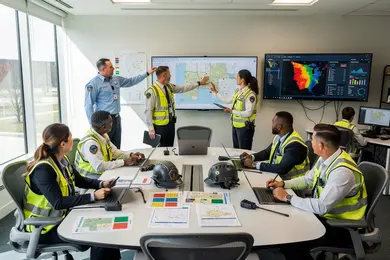
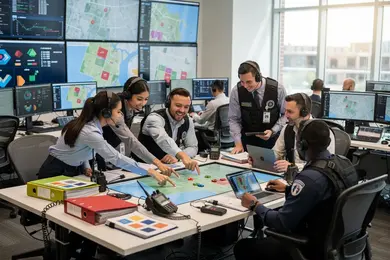
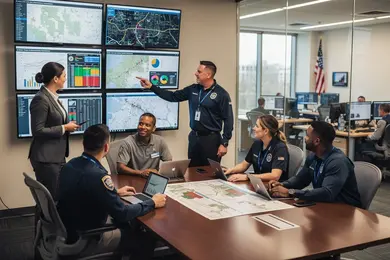
Technology is also changing flexibility. Online programs increasingly use virtual simulations, emergency operations center scenarios, GIS tools, data dashboards, and AI-supported analytics. These tools can make remote learning more realistic, but they do not replace judgment, ethics, communication, and interagency coordination skills.
Attendance and residency requirements vary widely, so students should read the catalog rather than relying on marketing language. "Online" may still include mandatory orientation, research residencies, dissertation defenses, proctored exams, campus intensives, or field experiences arranged near the student's location.
Residency rules matter because they affect travel cost, time off work, family planning, and whether the program is realistic during hurricane season, wildfire season, or other high-demand periods for emergency professionals. A one-week residency may be manageable for one student and impossible for another.
Before applying, ask admissions or the program director these questions in writing:
- Are any campus visits required, and how many days does each visit last?
- Can required residencies be completed virtually, regionally, or during weekends?
- Are live online class meetings mandatory, and are they scheduled in a specific time zone?
- How are comprehensive exams, dissertation proposal defenses, and final defenses conducted?
- What is the policy if a student misses a residency because of deployment, agency activation, illness, or military service?
- Are practicum, field, or research site requirements allowed in the student's home community?
Residency is not automatically bad. For some students, short in-person sessions improve networking, accountability, and access to faculty. The problem is enrolling without knowing the exact attendance rules and then discovering that "online" does not mean "no travel."
The cost of a flexible online emergency management doctorate depends on tuition model, credit requirements, fees, residency travel, dissertation length, books, software, and financing. Because doctoral programs can extend during the dissertation stage, students should compare total program cost rather than only per-credit tuition.
These cost items are the most important to request from each school because they can change the real price of an online doctorate:
- Federal Direct Unsubsidized Loan annual limit for eligible graduate students up to $20,500.
- Federal Direct Unsubsidized Loan interest rate for 2024-2025 loans at 8.08%.
- Federal Direct PLUS Loan interest rate for 2024-2025 loans at 9.08%.
- Residency travel costs: airfare or mileage, lodging, meals, parking, and unpaid leave from work if required.
- Dissertation-related costs, continuation credits, editing, transcription, statistical software, survey tools, and research site expenses.
A helpful way to compare programs is to build a total-cost worksheet. Include required credits, tuition per credit, online fees, technology fees, residency travel, dissertation continuation terms, and the interest rate if you plan to borrow. Students who want a broader example of how tuition and fees can be separated may find this guide to criminal justice degree price comparisons useful, even though doctoral emergency management programs will have their own cost structures.
Do not assume the cheapest program is the best value. A lower tuition rate can be offset by weak dissertation support, limited faculty expertise, or extra semesters. At the same time, a high-cost program should justify its price through accreditation, research fit, student support, employer recognition, and clear completion policies.
Flexible online emergency management doctorate programs are best for students who already have professional experience and need an advanced credential without leaving the workforce. They are usually less suitable for students who want an entry-level emergency management job or who are unsure whether they enjoy research, policy analysis, and long-form writing.
The table below separates good-fit students from students who may be better served by another pathway. This helps prevent overinvesting in a doctorate when a certificate, master's degree, or industry credential would meet the goal more efficiently.
| Student profile | Why the doctorate may fit | Possible better alternative |
| Mid-career emergency manager | Can use doctoral research to solve agency, mitigation, preparedness, or recovery problems | Graduate certificate if the goal is a narrower skill update |
| Public safety or homeland security leader | May benefit from executive-level policy, risk, and interagency coordination training | Master's degree if doctoral research is not needed |
| Instructor, trainer, or aspiring academic | Doctoral credential can support teaching, research, and curriculum leadership | Professional certifications if teaching is not a goal |
| Environmental health, safety, or resilience professional | Disaster preparedness overlaps with risk assessment, safety systems, and organizational continuity | Specialized EHS program if the focus is workplace safety compliance |
| Entry-level career changer | Usually not the most direct route without related experience | Bachelor's, master's, certificate, internship, or entry-level public safety role |
Students whose interests lean toward workplace hazards, compliance, and organizational safety may want to compare emergency management doctorates with the best online environmental health and safety programs. The overlap is real, but the career emphasis differs: emergency management focuses on disasters and continuity, while EHS more often focuses on preventing workplace and environmental harm.
A doctorate is most defensible when it supports a clear next step, such as executive leadership, consulting, teaching, policy research, or specialized disaster science work. If the main goal is simply to enter the field, a shorter and less expensive credential is often the smarter first move.
Program flexibility does not automatically improve or weaken career outcomes. Employers usually care more about the school's accreditation, the relevance of the dissertation or applied project, the student's experience, and whether the graduate can lead complex preparedness, response, recovery, and mitigation work.
The BLS reported a May 2024 median annual wage of $86,130 for emergency management directors. This figure is useful as a labor-market anchor, but it does not represent a guaranteed doctoral salary. Pay can vary by state and local government budgets, federal contractor demand, hospital systems, higher education, utilities, transportation, consulting, and nonprofit disaster organizations.
Flexible doctoral formats can support career outcomes when they let students keep gaining experience while studying. That is especially important in emergency management, where leadership credibility often comes from real incidents, exercises, interagency coordination, grant management, and after-action improvement. A part-time doctoral student who remains employed may graduate with both the degree and additional years of field experience.
However, flexibility can hurt outcomes if it leads to isolation, slow dissertation progress, or weak networking. Students should look for programs with active faculty advising, practitioner cohorts, alumni connections, research methods support, and opportunities to present or publish work. The credential matters, but the work produced during the doctorate often matters just as much.
How Should Students Choose the Most Flexible Online Emergency Management Doctorate Program?
Choosing the most flexible online emergency management doctorate requires more than comparing tuition and course delivery. The best program is the one that fits your schedule, research interests, career goal, budget, and tolerance for residencies while still maintaining strong academic standards.
Use this step-by-step process to compare programs before you apply:
- Confirm institutional accreditation through a recognized accreditor and verify that the degree is listed in the official catalog.
- Match the degree title and curriculum to your goal, such as disaster science, homeland security, public administration, public health preparedness, or public safety leadership.
- Ask whether part-time enrollment is formally allowed and whether students can take one course at a time.
- Request the full residency schedule, including orientation, research seminars, comprehensive exams, proposal defense, and final defense.
- Compare total cost, not just tuition, by including fees, travel, books, software, dissertation continuation, and loan interest.
- Review faculty profiles to see whether anyone supervises research in your intended topic area.
- Ask about dissertation completion support, including chair assignment timing, methods tutoring, writing support, and average milestone expectations.
- Check whether employer tuition assistance, veterans benefits, transfer credit, or prior graduate coursework can reduce cost.
- Speak with current students or alumni if possible, especially those who worked full time while enrolled.
- Avoid programs that are vague about accreditation, total cost, residency rules, dissertation supervision, or time limits.
If you are still early in your public safety education path, it may be more practical to start with the best online associate degree programs in criminal justice or another foundational credential before committing to doctoral study. A doctorate can be valuable, but only when it matches the level of responsibility you are preparing to take on.
Common mistakes include choosing a program based only on speed, assuming "online" means no synchronous attendance, ignoring dissertation fit, overlooking residency travel costs, and treating salary data as a promise. A stronger approach is to define your target role first, then choose the most flexible accredited program that supports that role with credible faculty, research depth, and student support.
Other Things You Should Know About Emergency Management
Usually, yes. Most doctoral programs require a master's degree from an accredited institution, though the required field may vary. Some programs prefer applicants with emergency management, public administration, homeland security, public health, criminal justice, or public safety backgrounds.
They can strengthen an application, especially for applicants with professional emergency management experience. FEMA, ICS, and NIMS training usually does not replace doctoral coursework, but it can show familiarity with the field's operating standards.
Yes, many programs value military, law enforcement, fire service, public health, nonprofit disaster response, or government agency experience. Whether it counts for credit depends on the school's transfer and prior learning policies.
No. Professional certifications in emergency management generally have separate experience, training, exam, and continuing education requirements. A doctorate may support leadership or academic goals, but it is not a universal certification requirement.
- The future of emergency management higher education https://wmpllc.org/ojs/index.php/jem/article/view/4021
- Careers in disaster risk management | RGS https://www.rgs.org/professionals/professional-practice-groups/disaster-risk-management-ppg/resources/careers-in-disaster-risk-management
- 25 Best Online EdD Programs of 2025 https://www.eddprograms.org/schools/best-online-doctor-of-education-programs/
- Emergency remote teaching vs. online learning https://my.chartered.college/research-hub/emergency-remote-teaching-vs-online-learning/
- 2025 Most Affordable Online Emergency Management Degrees https://www.onlineu.com/most-affordable-colleges/emergency-management-degrees
- Health and Human Services: Campus & Online Degrees and Careers https://www.publichealthonline.org/human-services/online-degree-programs/
- Campus vs Online vs Hybrid Doctor of Education (EdD) Programs https://www.onlineeddprograms.com/faqs/campus-online-hybrid-edd-programs