2027 Online BA in Psychology - General Psychology After Credits from Two Community Colleges: Compare Transfer Credit and Remaining Coursework
Audited and Verified:
Our Editorial and Data Verification Process
Research.com uses government datasets, official education statistics and primary institutional information to support its career and degree guides. Our review process checks factual accuracy, occupational definitions, source dates and the requirements associated with the credentials discussed.
How This Article Was Fact-Checked
Our editorial team verifies salary estimates, employment projections, education requirements and program information against original data providers and official organizations. Salary figures are checked against the relevant occupational definitions and reporting periods. Information about licensure, accreditation and required in-person training is reviewed separately.
Fact-checked and verified on:

Co-Founder and Chief Data Scientist
Credits earned at two community colleges can shorten an online psychology BA - but only if the receiving university accepts them and applies them to the right requirements. A course counted as an elective may still leave you needing statistics, research methods, or general education. This guide is for transfer and returning students comparing online general psychology programs.
It shows how to reconcile two transcripts, read a degree audit, estimate remaining coursework and cost, and identify the questions to settle before enrolling.
Key Things You Should Know
- Request a program-specific evaluation of both community-college transcripts; accepted credits and completed BA requirements are different totals.
- Compare each university's remaining major, general education, elective, and residency requirements - not just its advertised transfer-credit maximum.
- Get written answers about statistics and research-methods equivalencies, course sequencing, and online availability before estimating graduation time or cost.
What Is an Online BA in General Psychology After Community-College Credits?
It is a bachelor of arts in psychology completed partly through prior community-college study and partly through a university's online courses. "General psychology" usually means a broad major rather than a formal clinical or other professional specialization. Its precise requirements depend on the university.
Your two colleges may have supplied general education, introductory psychology, statistics, electives, or an associate degree. The university awarding the BA decides how that work fits its curriculum. When comparing distance learning psychology degree options, look for the degree requirements and transfer policies for your intended entry term, not just a description of the online format.
An associate degree may fulfill a general education block under a specific agreement, but it does not automatically fulfill the psychology major or the university's graduation requirements. The central comparison is therefore what remains at each university, not how many credits appear on your old transcripts.
How Do You Compare Transfer Credits From Two Community Colleges?
Start with an official transcript from each college, then request a separate, program-specific transfer evaluation from every university you are seriously considering. Include syllabi for psychology, statistics, research methods, or other courses whose titles do not clearly show their content. If either college operated on quarter credits, ask how the university converts them.
A useful comparison separates the outcomes below. The same course can receive a different decision at different universities, and credits from both colleges must be checked for duplicate or overlapping content.
| Evaluation outcome | What it means for completion |
| Accepted and applied to a requirement | May remove a specified general education, major, or elective requirement. |
| Accepted as elective credit only | Raises the credit total but may leave a required course outstanding. |
| Accepted provisionally | Requires further documentation or approval before you can rely on the equivalency. |
| Not accepted or treated as duplicate | Does not increase usable credits toward this degree. |
Compare each school's audit against both transcripts, and ask the registrar or transfer-credit office about missing credit. Ask the psychology department to review disputed major equivalencies; provide syllabi and request any substitution decision in writing. A switch to a specialized major can change the result: forensic psychology degree formats and academic requirements, for example, may differ from those of a general psychology BA.
How Many Credits and Courses Remain After Transfer Evaluation?
The answer comes from the receiving university's degree audit: its record of which graduation requirements your evaluated courses satisfy. Do not calculate the remainder by subtracting every credit shown on both transcripts from the BA's total. Unapplied electives, duplicate courses, limits on lower-division transfer work, and required university coursework can all change that calculation.
Read the audit in four parts: outstanding general education, psychology major and prerequisites, free electives, and credits that must be completed at the awarding university. The longest remaining requirement - not necessarily the largest credit category - may control your timeline. For instance, a methods course that requires statistics first can delay a capstone even when few credits remain.
Ask an advisor for a term-by-term plan showing when required online courses are offered and whether an approved substitution is possible. If you are also weighing addiction-focused undergraduate psychology degrees, request a separate audit for that major; do not assume its remaining-course list matches the general psychology BA.
Check that the degree-awarding university holds recognized institutional accreditation and that the accreditation covers the institution offering your online degree. The U.S. Department of Education and the accreditor's own directory are appropriate places to confirm status; ask the university which institution will appear on your diploma and transcript if a partner provides courses.
Do not look for APA accreditation as a requirement for a general psychology BA. APA program accreditation applies to specified professional psychology training programs, not ordinary undergraduate psychology majors. Institutional accreditation also does not establish that a BA meets any state's clinical licensing rules.
If you are considering a different, occupation-specific degree instead, check the recognition relevant to that actual credential. For example, compare the stated curriculum and credential pathway of distance learning degrees in addiction counseling against the requirements of the state and role you have in mind.
Expect the audit to distinguish introductory and upper-division psychology, statistics, research methods, distribution-area courses, and any capstone or senior requirement. Exact courses vary. A general BA may cover development, cognition, social behavior, biological foundations, and psychological disorders as academic subjects while allowing electives that suit your interests.
For a student bringing credits from two colleges, statistics and research methods deserve an early equivalency check. A general mathematics course may not satisfy a statistics requirement, and an introductory research course may not match an upper-division psychology methods course. Check prerequisites, course recency rules if any, and whether the online capstone is offered in the term you need.
Choose electives around a concrete goal rather than assuming a course title confers a credential. If your goal is substance-use counseling, comparing undergraduate substance use counseling costs and outcomes may be more useful than adding a few addiction electives to a general BA; neither route should be presumed to meet your state's credential rules without checking them.
University admission, admission to the psychology major, and approval of individual transfer courses are separate decisions. Universities may set different GPA thresholds, prior-credit minimums, application deadlines, or major-entry requirements. Check the rules for applicants with coursework at multiple institutions, even if one college awarded your associate degree.
Prepare official transcripts from both colleges, a record of any completed degree, and syllabi for courses likely to need departmental review. Ask whether courses still in progress can be evaluated provisionally and when final transcripts must arrive. If you need financial aid, submit the required aid application and ask the financial-aid office how transfer work affects satisfactory academic progress; admission and aid approval are not the same decision.
Keep a potential change of major separate from your transfer application. If a substance-use counseling bachelor's is your alternative, information on paying for a substance abuse counseling bachelor's degree can help frame aid questions, but the university must confirm its own eligibility rules and charges.
Estimate time from a term-by-term schedule of unmet requirements, not from accepted credits alone. Course prerequisites, infrequent online offerings, a required capstone, your feasible course load, and any residency rule can extend the plan. Ask whether "online" courses include scheduled meetings or campus visits that could affect your pace.
To compare costs, obtain each school's charges for the remaining courses, including applicable tuition, mandatory fees, materials, and any required travel. Confirm how repeat courses or credits accepted only as electives affect the bill. Then ask the financial-aid office about your individual eligibility and enrollment-level requirements; do not treat an advertised per-credit price as a total-degree quote.
Cost-focused comparisons of psychology degrees can help create a shortlist. The better financial comparison, however, is each university's written estimate for your remaining coursework, alongside its realistic completion schedule.
Online study can reduce commuting and widen the choice of universities willing to evaluate credits from both colleges. Campus study may make it easier to attend research meetings, build faculty relationships, or use local services. Neither format is inherently better for transfer students: compare the actual courses, advising, support, and opportunities available to you.
Ask whether online students can access research assistantships, career services, and faculty office hours; whether group work or exams have fixed times; and whether internships or capstones require an approved local site. A program advertised as asynchronous may still have scheduled obligations. Choose the format you can complete reliably without giving up an experience essential to your next step.
If your eventual goal is licensed therapy, BA format is only one part of a longer decision. Comparing mental health counseling program costs can help you consider a distinct graduate pathway; taking the psychology BA online does not replace its required professional education or supervised training.
A general psychology BA can support applications for nonclinical roles such as human-services support, community-program coordination, research support, recruiting, or customer research. Employers assess the specific job's duties and your experience, not the major name alone. Statistics, careful documentation, respectful communication, and supervised project work may be especially useful evidence alongside the degree.
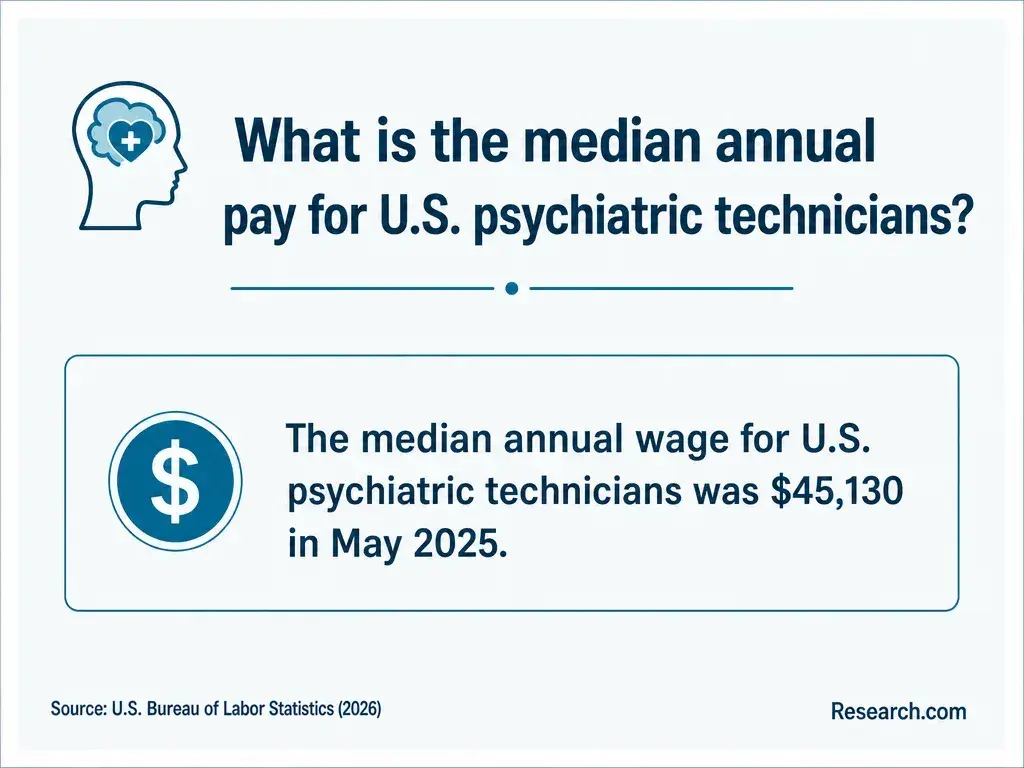
There is no single dependable "psychology BA salary": these jobs fall into different occupations and pay markets. Use the U.S. Bureau of Labor Statistics figure for a specific occupation, then check local postings for its required education and experience. An occupation-wide median is not a predicted offer for a new graduate. Likewise, comparing forensic psychology master's career earnings should not be used to estimate the return on an undergraduate general psychology degree.
Before paying for remaining BA courses primarily for a career change, check postings for your target role. If they value a different credential or direct experience more highly, a targeted course, employer training, or supervised nonclinical work may be a better next investment.
Does a Psychology BA Qualify You for Licensure or Certification?
No psychology BA by itself licenses someone to practice as a psychologist or provide psychotherapy. Coursework about disorders, assessment, or counseling does not authorize diagnosis, independent psychological testing, or treatment. Requirements for licensed psychologists and other mental-health professionals involve distinct qualifying education and jurisdiction-specific steps.
Some support roles have separate state or employer certification requirements. If you have a particular job title in mind, check its state board or certifying body for accepted education, supervised experience, examinations, and permitted duties before choosing a BA. For a counseling goal, clinical counseling master's fees and graduation timelines illustrate why the later qualifying degree must be evaluated separately from the cost of finishing your undergraduate major.
The best next step is to compare written degree audits from your shortlisted universities against the requirements of your intended career or graduate program. That keeps the transfer decision focused on credits you can actually use and preparation you will actually need.
Other Things You Should Know About Psychology
Yes. Ask the receiving university when it needs a final official transcript; an in-progress course generally cannot receive its final transfer decision until the grade is recorded.
Possibly, but obtain advance approval. The university may restrict transfer after enrollment, require a particular course equivalency, or reserve the final credits for its own courses.
Usually the BA diploma names the degree awarded by the university, not prior colleges. Ask the registrar how your associate degree and transferred work will appear on university records.
Ask the community college for an archived syllabus or catalog description. Submit what you can obtain to the university's transfer office, and ask whether the psychology department needs further evidence to assess the course.
- Undergraduate Advising - Arts & Science - New York University https://as.nyu.edu/departments/psychology/undergraduate/psychology-advising.html
- Requirements for the Bachelor's Degree | University at Albany https://www.albany.edu/undergraduate-bulletin/requirements-for-bachelors-degree.php
- Research Credit & Course Applications - College of LSA https://lsa.umich.edu/psych/undergraduates/research/independent-study-courses.html
- Academic Rules - Course Catalog - Syracuse University https://courses.syracuse.edu/undergraduate/academic-rules
- Graduation Requirements for the Bachelor's Degree | fullerton.edu https://catalog.fullerton.edu/content.php
- Transcript Evaluation FAQ | Richmond Community College https://richmondcc.edu/transcript-evaluation-faq
- FAQs | Transfer Center - Santa Rosa Junior College https://transfer.santarosa.edu/faqs
- Major Requirements | Psychology - Natural Sciences https://naturalsciences.uoregon.edu/psychology/undergraduate-programs/major-requirements
- Program: Psychology B.A., with Diversity Concentration | usf.edu https://catalog.usf.edu/preview_program.php
- PSYCBABS Program | University of Utah Catalog https://catalog.utah.edu/programs/PSYCBABS/program-requirements-xiA4n