2027 Online BA in Psychology - General Psychology: Does a Psychology BA Qualify You to Counsel? Questions Before Enrolling
Audited and Verified:
Our Editorial and Data Verification Process
Research.com uses government datasets, official education statistics and primary institutional information to support its career and degree guides. Our review process checks factual accuracy, occupational definitions, source dates and the requirements associated with the credentials discussed.
How This Article Was Fact-Checked
Our editorial team verifies salary estimates, employment projections, education requirements and program information against original data providers and official organizations. Salary figures are checked against the relevant occupational definitions and reporting periods. Information about licensure, accreditation and required in-person training is reviewed separately.
Fact-checked and verified on:

Co-Founder and Chief Data Scientist
An online BA in general psychology can teach you how people think and behave, but it is not a license to provide therapy. That distinction matters if you are choosing a degree because you hope to counsel clients.
This guide is for prospective and returning students weighing an online psychology major against a more direct professional pathway. It explains what the BA can prepare you to do, what licensed counseling typically requires, and which program, cost, and scheduling questions to settle before you enroll.
Key Things You Should Know
- A general psychology BA alone does not authorize independent psychotherapy, diagnosis, or use of a protected counselor title.
- Licensure as a mental health counselor generally requires a qualifying graduate program plus state-specific supervised experience and examination requirements; a psychology BA can be preparation, not the credential itself.
- A bachelor's degree commonly requires about 120 semester credits, but transfer evaluations and remaining requirements - not online delivery alone - determine your time and cost.
Does a psychology BA qualify you to counsel clients?
No. A BA in general psychology is an undergraduate academic degree, not a clinical practice credential. Courses on mental health, interviewing, or psychological assessment do not grant permission to diagnose conditions, provide psychotherapy independently, or present yourself as a licensed counselor.
The word counsel can cause confusion. A support worker might listen to someone's concerns, explain services, document an interaction, or make a referral under an employer's policies. Those duties differ from assessing a mental health condition and delivering treatment. State law, job duties, supervision, and the title you use - not the degree name alone - define the boundary. Addiction services have their own state-specific credentials; an overview of careers in addiction treatment and support settings can help you distinguish recovery-support work from counseling.
If a school suggests that its BA "leads to counseling," ask whether it means preparation for graduate admission, eligibility for a particular nonclinical job, or satisfaction of an identified state credential requirement. Request the applicable licensing board's requirements before relying on the claim.
What can you do with an online BA in general psychology?
A general psychology BA can support applications for nonclinical work in human services, research support, community programs, recruiting, or program administration. It may also supply undergraduate preparation for graduate study. Neither a job offer nor admission to a counseling master's program follows automatically: employers and graduate programs evaluate relevant experience, coursework, and skills.
For a student who wants to work with people soon, the strongest use of the BA may be to pair it with supervised, appropriately bounded experience - such as service coordination or research assistance - while checking the prerequisites for a later professional degree. Compare psychology major options at online colleges by their methods courses and opportunities for practical experience, rather than assuming every general psychology major offers the same preparation.
If your sole goal is a specific support job, check its postings first. An employer-approved certificate, relevant work experience, or another undergraduate major may be a more direct investment than starting a second bachelor's degree.
What degree and license do you need to become a counselor?
For independent mental health counseling in the United States, the usual route is a graduate degree designed to meet a state's counselor-licensure education rules, followed by required supervised practice, an examination, and a license application. Requirements and professional titles vary by state. A general psychology MS is not interchangeable with a licensure-qualifying counseling degree merely because both discuss mental health.
The comparison below separates common goals that are easy to confuse when reviewing degree descriptions.
| Goal | Typical educational route | What to verify |
| Nonclinical support or coordination | Qualifications vary; some roles accept a bachelor's degree or relevant experience | Employer duties, supervision, and any state credential |
| Independent mental health counseling | Qualifying counseling graduate education and state licensure steps | Licensing-board curriculum, supervised hours, examination, and program recognition rules |
| Clinical social work | Qualifying social work graduate education and state licensure steps | Social work program accreditation and board requirements |
If counseling is the destination, work backward from the state where you intend to practice. Ask prospective graduate programs for a written explanation of how their curriculum meets that state's rules. Use accredited clinical counseling program timeline comparisons only after confirming licensure fit; a shorter advertised timeline is not useful if the program does not meet your requirements.
Online and campus BAs can cover comparable academic subjects, but their day-to-day demands may differ. An asynchronous lecture may fit around employment, while scheduled discussions, group projects, proctored exams, research meetings, or an approved placement may not. Online delivery also does not turn an undergraduate internship into a clinical practicum.
Before choosing a format, request a sample term schedule and ask which requirements involve live attendance, campus visits, or local sites. If you expect to continue into counseling training, assess that next step separately: a clinical mental health counseling master's pacing guide can help frame questions about graduate coursework and fieldwork, which may be less flexible than the BA.
Requirements vary, but a general psychology BA commonly combines introductory psychology, statistics, research methods, and courses in areas such as development, cognition, social behavior, biological foundations, and psychological disorders. General education and electives make up the rest of the degree. Studying disorders or treatment theories provides academic knowledge, not clinical authority.
For future counseling applicants, the most useful course question is not "Does this BA teach therapy?" but "Will its transcript meet the graduate programs' prerequisites?" Save course descriptions for psychology, statistics, and methods, and compare them with the admission rules of programs you might apply to. If your interest shifts toward nonclinical graduate research, compare inexpensive psychology master's degree pathways on research training and purpose rather than assuming they lead to counselor licensure.
First-year applicants generally submit evidence of secondary-school completion and the materials the institution requests. Transfer applicants typically submit transcripts from every prior college. Admission to the institution, acceptance of transfer credit, and application of that credit to the psychology major are separate decisions.
If you already have college coursework, obtain a written degree audit before estimating how quickly you can finish. Ask whether prior statistics and psychology courses satisfy major requirements, whether upper-level courses have prerequisites, and how many credits must be completed at the new institution. The school has final authority over its evaluation.
Do not select a BA because an accelerated graduate program appears to accept "any bachelor's degree" without checking its full admissions criteria. Even forensic psychology master's intensive study options may differ in prerequisite and research expectations - and a forensic psychology master's is not, by its name, a counseling license pathway.
A bachelor's degree commonly totals about 120 semester credits. Your remaining credits, course availability, enrollment pace, and any placement or residency requirements determine the actual timeline. A transfer student should budget from an approved degree audit, not from the number of credits a school initially agrees to accept.
For a usable cost estimate, ask each school for tuition based on your expected remaining credits, mandatory online and course fees, books or software, and any travel or unpaid placement expenses. Then confirm financial-aid eligibility for your intended enrollment pace and compare the cost of finishing the BA with the likely cost of any required graduate training. If you are considering a specialized addictions route instead, bachelor's-level substance use counseling scholarship planning can inform your aid questions; verify that any award applies to your actual school and program.
Possible targets include human-services assistant, intake or service coordinator, research assistant, and program support roles. Hiring standards differ: one employer may value client-facing experience, while another requires database skills, a specific credential, or experience with a particular population. Read duties as carefully as titles; "counselor" in a posting does not establish that a BA qualifies you under state law.
Build evidence for the work you want to do. A supervised service role can demonstrate respectful communication, documentation, and referrals; a research project can demonstrate data handling and evidence evaluation. Neither substitutes for clinical supervision toward a license. For justice-related interests, understanding pay and entry requirements in forensic psychology careers can help separate support and research jobs from licensed forensic assessment.
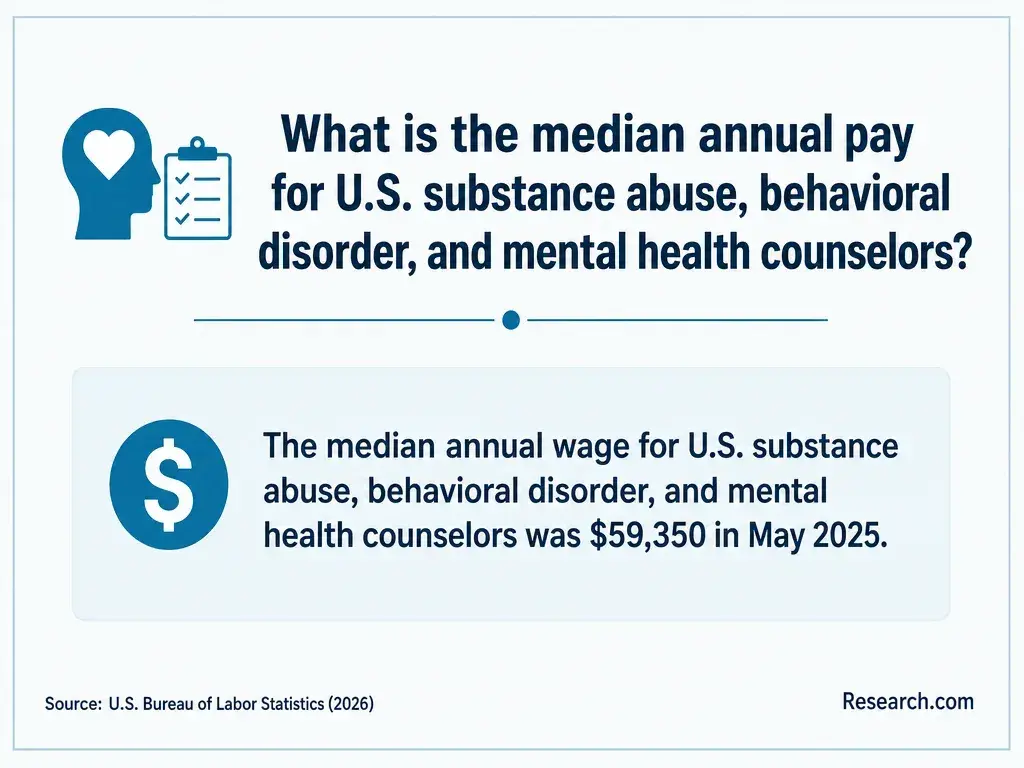
There is no single salary for "a psychology BA." Pay attaches to an occupation, location, employer, and experience level - not to the major alone. The U.S. Bureau of Labor Statistics Occupational Outlook Handbook is a useful starting point for comparing named occupations, but its medians cover workers with varied backgrounds and experience; they are not predictions of a new graduate's offer.
Compare local postings for jobs you could plausibly obtain now with postings for roles requiring additional credentials. Include the cost and time of that additional education before treating a higher occupational median as a return on the BA. If you are weighing a specialized undergraduate route, substance abuse counseling bachelor's affordability and duration offers another cost comparison - but check your state's credential rules before counting on counseling work or earnings.
How can you choose an accredited online psychology program?
Confirm the institution's accreditation through its accreditor and the U.S. Department of Education's recognition information, then verify that the online BA is the degree you intend to enter. Institutional accreditation is important for evaluating the school; it does not certify that a general psychology BA meets counselor-licensure requirements. APA accreditation should not be advertised as accreditation of a general psychology bachelor's program.
Make the final comparison around your goal: the written transfer audit, remaining cost, statistics and methods preparation, access to advising and relevant experience, and the graduate prerequisites you may need later. Ask whether published schedules and support services apply to online students in your entry term. If counseling is your firm objective, also compare the subsequent qualifying degree's full cost using affordability checks for online counseling study. Enroll in the BA only if that combined pathway makes sense for you.
Other Things You Should Know About Psychology
Often, if the agency accepts volunteers and provides appropriate training and oversight. Ask what tasks are permitted and how client privacy will be protected; volunteering does not grant permission to provide therapy.
Not necessarily. Graduate programs set their own admissions rules. Compare your courses and experience with each program's prerequisites rather than assuming the BA's state determines eligibility.
No. An elective is coursework, not a professional credential. Confirm any credential's education and supervised-experience rules with the responsible state authority.
Yes. Retain course descriptions and permitted examples of research or service work for applications. Remove confidential client or participant information, and obtain permission before sharing work produced for an organization.
- Your financial path to graduation | consumerfinance.gov https://www.consumerfinance.gov/paying-for-college/your-financial-path-to-graduation/
- Accreditation in the U.S. | ed.gov http://www.ed.gov/laws-and-policy/higher-education-laws-and-policy/college-accreditation/accreditation-in-the-us
- Frequently Asked Questions for Mental Health Counselors | nysed.gov https://www.op.nysed.gov/professions/mental-health-counselors/faqs-education-requirements
- School-Determined Requirements - FSA Partner Connect https://fsapartners.ed.gov/knowledge-center/fsa-handbook/2026-2027/vol1/ch1-school-determined-requirements
- Types of Financial Aid: Grants, Work-Study, and Loans | studentaid.gov https://studentaid.gov/understand-aid/types
- Occupations Code chapter 503 | texas.gov https://statutes.capitol.texas.gov/docs/OC/htm/OC.503.htm
- FERPA | Protecting Student Privacy - Department of Education https://studentprivacy.ed.gov/ferpa
- Preparing to Transfer to the UW Psychology Department https://psych.uw.edu/undergraduate/prospective-students/transferring-to-uw
- How to Become a Counselor: Education and Career Paths | Gordon College https://www.gordon.edu/stories/how-to-become-a-counselor-education-and-career-paths
- 4 Types of Psychology Degrees: Picking the Right Program | Bouvé College of Health Sciences https://bouve.northeastern.edu/news/4-types-of-psychology-degrees-picking-the-right-program/