
2027 What Can You Do with a Computer Science Master's Degree? Careers, Salaries & Growth

Co-Founder and Chief Data Scientist
A computer science master’s degree is a major investment, so the central question is not simply whether the credential is respected. The better question is whether it fits your career target, budget, technical background, and timeline. For some students, the degree can open doors to advanced roles in software engineering, data science, artificial intelligence, cybersecurity, research, and technical leadership. For others, a shorter certificate, employer-sponsored training, or direct work experience may offer a faster return.
The market case remains strong: employment in computer and information research science roles is expected to grow 21% from 2022 to 2032, much faster than the average for all occupations. Still, outcomes vary by specialization, location, employer, prior experience, and the quality of the program. This guide explains admission requirements, GPA expectations, cost and financing options, completion timelines, career paths, salaries, certifications, industries hiring graduates, job outlook, and the skills students can expect to build.
Key Things to Know About What You Can Do with a Computer Science Master's Degree
- Master's programs typically require a bachelor's degree in a related field, blending core theory with electives and practical projects, available in both online and on-campus formats for flexibility.
- Graduates often secure roles in software development, data science, or cybersecurity, with median starting salaries around $95,000, reflecting strong demand in diverse industries.
- Long-term growth is robust, with tech occupations expected to increase 15% through 2030; comparing program cost, flexibility, and reputation helps maximize return on investment.
What Are the Admission Requirements for a Computer Science Master's Program?
Admission requirements for a computer science master’s program are designed to answer one question: can the applicant succeed in graduate-level computing coursework? Most programs look for evidence of academic preparation, quantitative ability, programming experience, and a clear reason for pursuing the degree. Requirements vary by institution, but applicants should expect the following core components.
- Relevant undergraduate degree: Many programs prefer a bachelor’s degree in computer science, software engineering, electrical engineering, mathematics, data science, or a closely related field. Applicants from non-computing backgrounds may still be considered if they can show preparation in programming, discrete mathematics, algorithms, data structures, and computer systems.
- GPA threshold: A minimum cumulative GPA around 3.0 on a 4.0 scale is commonly expected. Selective programs may look for stronger academic records, especially in technical courses. A lower overall GPA may be less damaging if the applicant performed well in upper-division math, programming, or engineering classes.
- Work or research experience: Professional experience is not always required, but it can strengthen an application. Software development work, data analysis projects, cybersecurity experience, technical internships, publications, or open-source contributions can help demonstrate readiness.
- Standardized tests: The GRE is still requested by some programs, but many schools have made it optional or offer waivers. The GMAT is rarely relevant unless the program has a strong business, analytics management, or technology leadership focus.
- Recommendation letters: Most programs ask for two to three letters of recommendation. Strong letters should describe the applicant’s technical ability, research potential, problem-solving skills, reliability, and readiness for advanced coursework.
- Statement of purpose: The personal statement should explain why the applicant wants the degree, which specialization fits their goals, and how the program connects to their career plans. Vague interest in “technology” is weaker than a focused explanation of intended work in areas such as machine learning, systems, security, human-computer interaction, or software engineering.
- Prerequisite coursework: Students without a formal computer science background may need to complete preparatory courses before or during the program. These may cover programming, algorithms, operating systems, databases, or mathematical foundations.
Applicants should compare prerequisites before applying because “computer science master’s degree” can mean different things across schools. Some programs are designed for experienced technologists; others are bridge programs for career changers. Students considering eventual doctoral study can also review online doctoral pathways to understand how master’s-level preparation may connect to later academic goals.
What Is the Minimum GPA Requirement for a Computer Science Master's Program?
The average GPA needed to get into a computer science master’s degree generally ranges from 2.75 to 3.0 on a 4.0 scale. That range is best understood as a baseline, not a guarantee. Competitive programs may expect a stronger GPA, while some schools use holistic review and may admit applicants with lower GPAs when other parts of the application show strong potential.
| Applicant profile | How admissions committees may evaluate it |
| GPA at or above the stated minimum | The applicant clears an important screening requirement, but still needs strong recommendations, a clear statement of purpose, and evidence of technical readiness. |
| Lower overall GPA but strong technical grades | Programs may give more weight to performance in programming, algorithms, math, systems, and upper-division technical courses. |
| Lower GPA with professional experience | Relevant work experience, strong projects, certifications, or employer recommendations can help offset weaker academic performance. |
| Non-computer science background | The applicant may need prerequisite coursework even if the GPA meets the minimum requirement. |
- Typical GPA range: Most graduate schools expect a minimum GPA between 2.75 and 3.0, but more competitive programs often expect higher academic performance.
- Holistic review: Programs may also consider test scores, technical projects, letters of recommendation, professional experience, and the applicant’s statement of purpose.
- Program competitiveness: Private and prestigious institutions usually maintain stricter GPA standards, while some public universities may allow slightly lower GPAs for applicants with compensating strengths.
- Ways to strengthen a lower-GPA application: Applicants can complete prerequisite courses with strong grades, submit a polished technical portfolio, earn relevant certifications, or use recommendations that speak directly to graduate-level readiness.
- Labor market context: Employment growth in computer and information technology fields is projected at 15% from 2021 to 2031, which helps explain why many programs receive strong applicant interest. Students comparing interdisciplinary routes may also look at accelerated psychology programs when exploring human-computer interaction, behavioral data, or technology-adjacent study paths.
How Much Does a Computer Science Master's Degree Cost and How Can You Finance It?
The cost of a computer science master’s degree depends on tuition, fees, enrollment format, residency status, living expenses, and whether the student reduces work hours while enrolled. Public institutions typically charge about $12,000 annually for in-state students, while private universities may exceed $30,000 per year. Online programs can reduce relocation and commuting expenses, but students should still budget for course materials, technology, software, and possible campus visits.
- Tuition and fees: Start with the published tuition rate, then add mandatory university fees, graduate program fees, lab fees, and technology costs. In-state public tuition is often the lowest-cost route for eligible students.
- Living expenses: Housing, food, transportation, health insurance, and personal expenses can significantly change the total cost of attendance. Students who relocate for an on-campus program should compare the full living-cost impact, not tuition alone.
- Opportunity cost: A full-time program may require reduced work hours or a temporary pause in employment. For working professionals, part-time or online study may preserve income, though it can extend the completion timeline.
- Scholarships and fellowships: Merit scholarships, departmental awards, and graduate fellowships can reduce direct tuition costs. These are often competitive, so applicants should check priority funding deadlines before submitting applications.
- Assistantships: Teaching and research assistantships can be valuable because they may provide stipends, tuition waivers, or both. They are more common in research-oriented and campus-based programs, though availability varies by school and department.
- Employer tuition assistance: Working professionals should ask whether their employer offers tuition reimbursement, professional development funding, or sponsorship for job-relevant graduate study.
- Federal student loans: Federal loans can help cover eligible costs and may offer income-based repayment options. Borrow only after estimating total debt, expected monthly payments, and likely post-graduation earnings.
To evaluate return on investment, compare the total cost of the degree with the jobs you are targeting, not with broad computer science salaries in general. A student pursuing machine learning, cybersecurity, or distributed systems may evaluate different salary prospects than a student preparing for teaching, public-sector technology work, or research. If flexibility and lower relocation costs are priorities, compare campus options with an online degree computer science pathway before committing to a program format.
One graduate described the financial planning process as the difference between finishing confidently and feeling constantly behind. Balancing part-time work with graduate coursework was difficult, but applying early for assistantships made the degree more manageable. A research assistant position helped offset costs and also provided practical experience that supported later job interviews. The main lesson: build the financial plan before enrollment, not after the first tuition bill arrives.
How Long Does It Take to Earn a Computer Science Master's Degree?
Most full-time students complete a computer science master’s degree in 1.5 to 2 years. Part-time and online students commonly take 3-4 years, especially if they continue working while enrolled. The actual timeline depends on course load, prerequisite needs, thesis requirements, transfer credits, internships, and whether the program follows a traditional semester schedule or a more flexible format.
| Program path | Typical completion pattern | Best fit |
| Full-time master’s program | Usually 1.5 to 2 years | Students who can prioritize study and want a faster credential |
| Part-time or online program | Often 3-4 years | Working professionals or students balancing family responsibilities |
| Accelerated or combined pathway | May shorten total time by linking undergraduate and graduate study | Current undergraduates who know they want graduate-level computer science training |
| Thesis track | May take longer because of research and writing requirements | Students considering research roles or doctoral study |
| Non-thesis track | Often more coursework-focused and predictable | Students targeting applied industry roles |
- Full-time enrollment: A full-time schedule allows students to move quickly through required courses, electives, and capstone or thesis work. It may be difficult for students who need to maintain full-time employment.
- Part-time and online programs: Flexible formats can reduce career disruption, but students should confirm course rotation schedules. If a required course is offered only once per year, missing it can delay graduation.
- Accelerated and combined pathways: Some institutions allow students to begin graduate coursework during undergraduate study, reducing the time needed after the bachelor’s degree. Students comparing faster academic routes can review accelerated degree programs to understand common scheduling models.
- Transfer credits: Previously completed graduate-level credits may shorten the program if the school accepts them. Transfer limits, grade requirements, and course age restrictions vary.
- Thesis vs. non-thesis tracks: A thesis can be valuable for research-heavy careers, but it may extend the timeline. A non-thesis track may be better for students who want applied skills and a clearer graduation path.
- Internships and practicums: Experiential requirements can add time, but they may also improve job readiness and create employer connections.
What Career Paths Are Available with a Computer Science Master's Degree?
A computer science master’s degree can support both deep technical roles and leadership-oriented technology careers. The strongest outcomes usually come when students choose a program concentration that matches a specific career direction rather than treating the degree as a general credential.
- Software engineering and development: Graduates may work as software developers, backend engineers, full-stack engineers, mobile developers, or systems engineers. Advanced coursework in algorithms, distributed systems, databases, and software architecture can be especially useful.
- Data science and analytics: Students with strong statistics, machine learning, and programming preparation may pursue roles as data scientists, data engineers, machine learning engineers, or analytics specialists.
- Cybersecurity: A master’s degree with security coursework can lead to roles in security engineering, threat analysis, cloud security, application security, incident response, or cybersecurity management.
- Artificial intelligence and machine learning: Graduates interested in AI may work on natural language processing, computer vision, recommender systems, autonomous systems, or applied machine learning products.
- Research and advanced development: Research-oriented programs can prepare students for roles in labs, R&D teams, or future doctoral study, particularly when the curriculum includes a thesis or faculty-led research.
- Technical leadership and management: With experience, graduates may move into software architecture, engineering management, product management, project management, or technology strategy roles.
- Executive-level careers: Some professionals eventually move into senior leadership positions such as CTO, especially when they combine technical depth with business judgment, communication skills, and team leadership experience.
- Academia and teaching: A master’s degree may support teaching roles at some institutions, though research university faculty positions commonly require additional doctoral preparation.
Demand spans private technology companies, finance, government, defense, healthcare, nonprofits, and academic institutions. One graduate said the degree made a specialized career transition more manageable because graduate projects resembled real technical problems. The coursework also strengthened their confidence in technical interviews and helped them build a professional network beyond their previous workplace.
What Is the Average Salary for Computer Science Master's Degree Holders?
Salaries for computer science master’s degree holders vary by role, location, employer, specialization, experience, and total compensation structure. A master’s degree can improve access to higher-paying technical and leadership roles, but it does not guarantee a specific salary. Students should compare salary expectations by target job title rather than relying on a single average.
- Starting salaries: Recent graduates often earn between $75,000 and $95,000 annually. Location matters: major technology hubs and high-cost metropolitan areas often offer higher pay than smaller markets.
- Mid-level earnings: With five to ten years of experience, salaries typically increase to a range of $110,000 to $140,000. Private technology firms may offer higher compensation than public-sector roles, though benefits and job stability may differ.
- Senior compensation: Experienced professionals in leadership or specialized technical roles can expect salaries above $160,000. Software architecture, machine learning, cybersecurity leadership, and senior engineering management can be especially competitive areas.
- Geographic variation: Metropolitan regions with higher living costs often pay more, but higher rent, taxes, transportation, and childcare costs can reduce the practical advantage of a larger salary.
- Sector differences: Government and public institutions may offer lower base pay but stronger benefits, pension options, or more predictable schedules. Startups and private companies may offer bonuses, equity, or stock options, though those forms of compensation can carry risk.
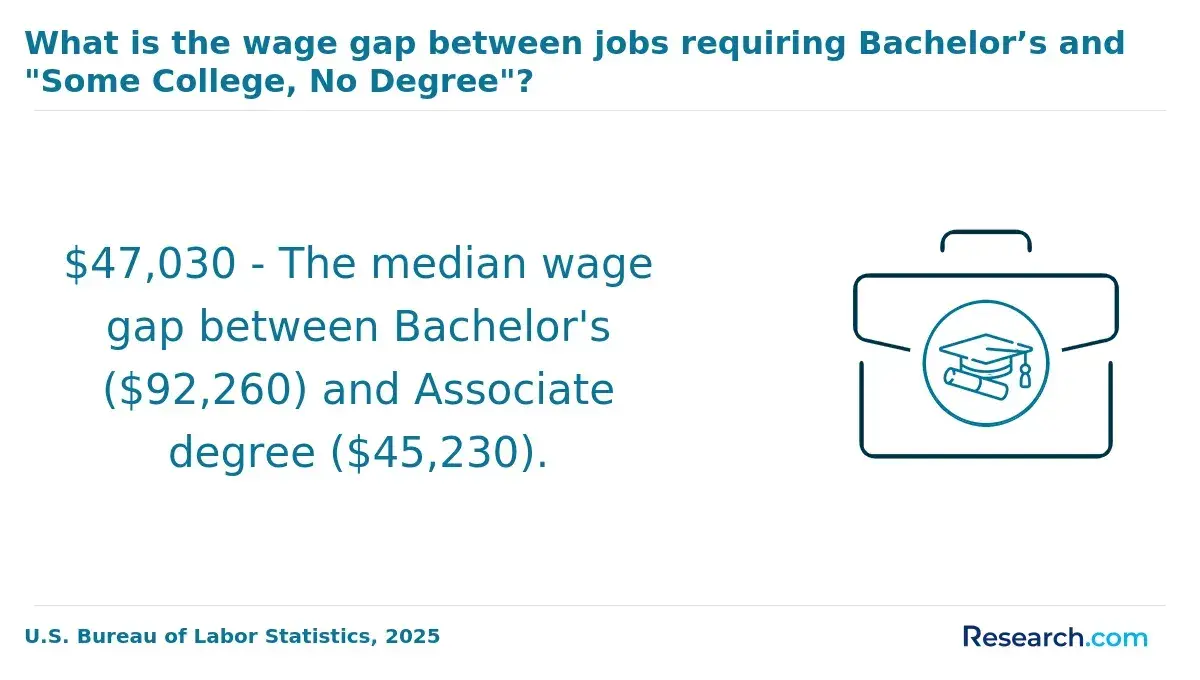
- Master’s degree advantage: Holding a master’s degree frequently results in a 20-30% salary increase over bachelor’s degree holders performing comparable roles, reflecting advanced skills and expertise.
- Total compensation: Base salary is only one part of pay. Bonuses, equity, retirement contributions, health benefits, tuition assistance, and remote-work flexibility can meaningfully change the value of an offer.
The best salary strategy is specialization plus evidence. Employers pay more when candidates can show mastery through projects, internships, research, production systems, publications, or measurable business impact—not just completed coursework.
Breakdown of Private Fully Online Nonprofit Schools

What Professional Certifications Complement a Computer Science Master's Degree?
Certifications can strengthen a computer science master’s degree when they validate a skill employers specifically request. They are most useful in areas with recognized professional standards, such as cybersecurity, cloud systems, Agile development, and project management. They are less useful when collected without a clear job target.
- Certified Information Systems Security Professional (CISSP): Offered by (ISC)², CISSP requires candidates to have at least five years of relevant work experience and to pass a rigorous six-hour exam covering security and risk management, asset security, and related domains. It is highly regarded for roles such as security analyst, security architect, and chief information security officer. Renewal requires earning continuing professional education (CPE) credits annually.
- Certified ScrumMaster (CSM): Administered by the Scrum Alliance, CSM has no strict prerequisites, making it accessible during or shortly after a master’s program. The certification process includes a two-day workshop and a multiple-choice exam focused on Agile project management. It can support roles in software development teams, product ownership, and project coordination.
- Project Management Professional (PMP): From the Project Management Institute (PMI), PMP requires 4,500 hours of project management experience and passing a 180-question exam. It is widely recognized across sectors and can be useful for technology project leadership. Maintaining certification involves earning 60 professional development units every three years.
The timing matters. CSM may be useful while still in school because Agile methods often appear in team-based software projects. CISSP and PMP are usually better pursued after gaining enough professional experience to meet requirements and apply the material in real work settings. Students exploring other affordable graduate credentials in information-focused fields can also compare options such as an MLIS program.
What Are the Top Industries Hiring Computer Science Master's Degree Graduates?
Computer science master’s graduates are hired across industries because nearly every sector depends on software, data, automation, security, and scalable infrastructure. The best industry choice depends on whether the student wants high compensation, mission-driven work, research depth, regulatory complexity, or product-building experience.
- Technology sector: Technology companies hire software engineers, systems architects, machine learning engineers, data scientists, product engineers, and infrastructure specialists. Employers range from startups to large multinational corporations. Strong programming ability, cloud skills, data systems knowledge, and machine learning tools are often important.
- Financial services: Banks, investment firms, insurance companies, and fintech employers use computer science expertise for quantitative analysis, fraud detection, cybersecurity, trading systems, risk modeling, and financial platforms. Understanding regulatory constraints can improve employability.
- Healthcare industry: Healthcare employers need specialists in health informatics, medical imaging, telemedicine, data analytics, privacy, and secure systems. Knowledge of privacy laws such as HIPAA can be especially valuable.
- Government, defense, and public sector: These employers hire for cybersecurity, data infrastructure, software modernization, national security, public systems, and research. Compensation may differ from private tech, but benefits and mission fit can be strong advantages.
- Emerging fields: Artificial intelligence, autonomous vehicles, cybersecurity, robotics, and advanced analytics continue to create specialized roles. These areas often reward applicants who combine graduate study with projects, internships, or research experience.
- Academia and research organizations: Research labs, universities, and scientific institutions may hire graduates for computational research, software systems, data modeling, and technical support for research teams.
According to the U.S. Bureau of Labor Statistics, employment for computer and information research scientists is expected to increase by 22% from 2020 to 2030, reflecting strong and expanding demand across these sectors. Students can improve their odds by selecting electives, internships, capstone projects, and certifications that align with the industry they plan to enter.
What Are the Highest-Paying Jobs for Computer Science Master's Degree Holders?
The highest-paying jobs for computer science master’s degree holders typically require advanced technical judgment, specialized skills, and the ability to solve problems that directly affect revenue, security, scale, or product performance. Compensation also depends on location, employer size, industry, and experience.
- Machine Learning Engineer: Machine learning engineers build algorithms and systems that learn from data. They generally command median salaries exceeding $120,000, especially at AI-focused companies in technology centers like Silicon Valley. Strong coding skills, mathematics, model evaluation, and familiarity with AI frameworks are essential.
- Data Scientist: Data scientists extract insights from large and complex datasets and translate them into decisions. They earn between $100,000 and $130,000 based on experience and specialization. Strong statistics, Python, data engineering awareness, and industry knowledge are important.
- Software Architect: Software architects design large-scale technical systems and guide engineering decisions. They typically receive salaries around or above $120,000. The role requires technical depth, communication, leadership, and the ability to balance performance, maintainability, security, and business goals.
- Cybersecurity Manager: Cybersecurity managers lead teams that protect systems, data, and networks. They average earnings above $110,000. Credentials like the CISSP, along with experience in risk management and network security, can be critical. Government, finance, and defense are common high-value sectors.
- Research Scientist (Computer Science): Research scientists work on advanced algorithms, systems, models, and publications. They may earn beyond $130,000, especially with a doctoral degree. These roles are common in research labs, universities, and innovation-focused companies.
- Product Manager (Tech Products): Technical product managers connect engineering work with customer needs and business strategy. Product managers in technology fields can surpass $115,000 in earnings. Success requires technical literacy, market analysis, communication, prioritization, and project leadership.
Advanced certifications or a doctorate can expand access to upper-tier roles, but they are not substitutes for proven technical results. Candidates pursuing these jobs should build a portfolio of serious projects, internships, research work, or production experience that demonstrates their ability to solve complex problems.
What Is the Job Outlook and Employment Growth for Computer Science Professionals?
The job outlook for computer science professionals remains strong because organizations need people who can build software, secure systems, analyze data, automate workflows, and develop intelligent technologies. For master’s graduates, the strongest opportunities are often in roles that require advanced problem-solving rather than routine coding alone.
- Robust job growth: The U.S. Bureau of Labor Statistics projects employment in areas like software development, data science, and information security analysis to grow by roughly 15% to 25% from 2022 to 2032, far exceeding the national average growth rate of about 5% for all occupations.
- Artificial intelligence and automation: AI tools are changing how software and data work are performed, but they also increase demand for professionals who can design systems, evaluate outputs, manage risk, and integrate new technologies responsibly.
- Cybersecurity and privacy: Data breaches, regulatory requirements, and cloud adoption continue to create demand for security specialists, privacy-aware engineers, and risk-focused technical leaders.
- Global competition: Computer science talent markets are increasingly global. Graduates can improve their competitiveness by developing specialized skills, maintaining a strong portfolio, and staying current with tools used in their target field.
- Industry diversification: Technology hiring is no longer limited to software companies. Finance, healthcare, logistics, entertainment, government, education, and manufacturing all need computing talent.
The outlook is positive, but not automatic. Students should choose a curriculum that develops durable fundamentals—algorithms, systems, security, statistics, software engineering, and data reasoning—alongside current tools. Those interested in interactive media, simulation, or entertainment technology may also compare a game design online degree with a computer science pathway to decide which credential better fits their goals.
What Skills and Competencies Does a Computer Science Master's Program Develop?
A computer science master’s program should develop more than programming ability. The best programs strengthen theoretical understanding, practical engineering judgment, research literacy, and communication skills. These competencies help graduates adapt as tools change and employers shift priorities.
- Advanced programming: Students deepen their ability to write, test, debug, and maintain software. Depending on the program, they may work with systems programming, application development, data pipelines, machine learning code, or distributed applications.
- Algorithms and data structures: Graduate study reinforces the ability to analyze efficiency, select appropriate computational approaches, and solve problems under technical constraints.
- Systems thinking: Students learn how operating systems, networks, databases, cloud infrastructure, and distributed systems interact. This is essential for scalable and reliable software.
- Machine learning and data analysis: Many programs offer coursework in statistics, artificial intelligence, data mining, neural networks, and model evaluation. These skills support work in data science, AI, and analytics.
- Cybersecurity awareness: Security concepts help graduates design safer systems, identify vulnerabilities, and understand risk in software, networks, data, and cloud environments.
- Research and technical evaluation: Students learn to read academic papers, evaluate methods, test assumptions, and distinguish strong evidence from weak claims.
- Software engineering practice: Team projects, version control, design documentation, testing, Agile methods, and code review help students prepare for professional engineering environments.
- Communication and collaboration: Graduates must explain technical decisions to engineers, managers, clients, and nontechnical stakeholders. Clear writing, presentation skills, and teamwork are central to career advancement.
- Leadership and problem-solving: Advanced coursework and projects build the ability to break down ambiguous problems, evaluate trade-offs, and guide technical decisions.
Employers often look for evidence that a candidate can apply these skills under real constraints. Capstone projects, internships, research assistantships, open-source work, and documented technical portfolios can make the degree more credible in the job market.
What Graduates Say About Their Computer Science Master's Degree
- Kelly: "Applying to a computer science master’s program felt overwhelming at first. Reviewing official academic catalogs helped me understand the prerequisites, course sequence, and workload before I applied. That preparation made it easier to choose an online program that fit my schedule without creating unnecessary delays."
- Greyson: "The biggest lesson for me was learning how to evaluate accredited institutions carefully. Checking recognized accrediting agencies helped me separate credible programs from weaker options. That research took time, but it directly affected the value of the degree in my job search."
- Cooper: "As a working professional, I needed clear information before enrolling. Official catalogs and federal education resources helped me understand degree requirements, transfer policies, and realistic workload expectations. I would recommend doing that research before committing to any program."
Other Things You Should Know About Computer Science Degrees
A computer science master's degree often leads to higher starting salaries and faster salary growth compared to a bachelor's degree. Graduates typically qualify for more advanced roles that offer greater responsibility and pay, such as management positions or specialized technical roles. Over time, this degree can significantly increase lifetime earnings, especially when combined with relevant work experience and certifications.
Both online and on-campus computer science master's programs offer quality education, but the choice depends on individual circumstances. Online programs provide flexibility for working professionals and international students, while on-campus programs often offer more direct access to faculty and networking opportunities. Accreditation and curriculum should be the primary factors when choosing a format.
In 2027, a master's degree in computer science can lead to various career paths, including roles like software development manager, data scientist, cybersecurity analyst, and machine learning engineer. The degree equips graduates with analytical and technical skills to excel in these high-demand areas, often leading to leadership positions in tech-driven industries.
In 2027, a computer science master's degree often provides a significant return on investment by enabling graduates to access higher-paying roles in fields like AI and data science. With high demand for tech professionals, many find increased job security and career progression, boosting long-term earning potential.
References
- Polish Graduate tracking system - articles https://ela.nauka.gov.pl/en/labor-market/are_all_computer_scientists_equally_successful
- What certifications should I get for computer science? | edX https://www.edx.org/resources/certifications-computer-science
- How Long Does It Take to Get a Master's in Computer Science? https://www.snhu.edu/about-us/newsroom/stem/how-long-to-get-a-masters-in-computer-science
- 2025 tech job market statistics and outlook https://www.techtarget.com/whatis/feature/Tech-job-market-statistics-and-outlook
- Professional Certifications in Computer Science https://asuengineeringonline.com/professional-programs/professional-certification-computer-science
- Master’s in Computer Science Salary Guide | University of Bridgeport https://www.bridgeport.edu/news/high-paying-jobs-with-a-computer-science-ms/
- Paying for a Computer Science Degree | Scholarships, Grants, Loans https://www.computerscience.org/resources/how-to-pay-for-a-degree/
- Best IT Certifications to Complement Your MCA Degree | TIMSCDR https://www.timscdrmumbai.in/the-best-it-certifications-to-complement-your-mca-degree/
- Computer Science MS https://www.umb.edu/academics/program-finder/computer-science-ms/
- Applications & Admissions https://www.ualberta.ca/en/computing-science/graduate-studies/programs-and-admissions/applications-and-admissions/index.html


