
2027 How To Become a Zoologist? Salary & Career Paths

Co-Founder and Chief Data Scientist
Planning a zoology career starts with a practical question: how do you turn an interest in animals into paid scientific work? Zoologists are trained researchers who study animal behavior, populations, habitats, physiology, evolution, and conservation problems. The career can involve field sites, labs, government offices, zoos, aquariums, universities, and consulting projects, but it usually requires more than a love of wildlife.
This guide explains how to become a zoologist, which degrees can lead to the field, what zoologists do day to day, how long the path can take, what skills employers value, and how salary and job outlook data should shape your decision. It is written for high school students comparing majors, college students building experience, career changers exploring environmental work, and early-career professionals deciding whether graduate school is worth it.
Zoology is especially relevant as biodiversity loss, habitat fragmentation, climate change, and land-use pressure increase the need for evidence-based conservation. The BLS projects employment in this field to grow by 4% through 2033. That points to steady demand, not unlimited opportunity, so students should be intentional about degree choice, field experience, technical training, and employer fit.
Quick Answer: How Do You Become a Zoologist?
Most zoologists begin with a bachelor’s degree in zoology, biology, wildlife biology, ecology, environmental science, or a closely related life-science field. They then build hands-on experience through internships, undergraduate research, field courses, volunteer conservation work, seasonal technician roles, or zoo and aquarium experience. Entry-level jobs may include wildlife technician, research assistant, conservation specialist, animal care professional, or field biologist. Advanced research, university teaching, and senior scientific positions often require a master’s degree or Ph.D.
- Most common entry point: A bachelor’s degree is the usual foundation, and 64.3% of zoologists hold a bachelor's degree.
- Where zoologists work: Jobs may combine outdoor fieldwork, laboratory analysis, office-based reporting, zoo or aquarium settings, and travel to research sites.
- Likely employers: Government agencies, universities, conservation nonprofits, zoos, aquariums, museums, research centers, and environmental consulting firms all hire zoology-related professionals.
- Typical timeline: The path can take four to ten years, depending on whether you enter the workforce after a bachelor’s degree or continue into graduate study.
- Best-fit student: Zoology suits people who like science, research, animals, data, outdoor work, and long-term environmental problem-solving.
- What are the steps to becoming a zoologist for 2027?
- What does a zoologist do?
- What are the different types of zoologists?
- How long does it take to become a zoologist?
- What degree is best for a zoologist?
- What skills do you need to be a successful zoologist?
- How to gain field experience as a zoologist?
- How can zoologists connect their work to broader environmental and sustainability careers?
- What certifications can help a zoologist move forward?
- Can an online environmental science degree support a zoology career?
- How can interdisciplinary study strengthen a zoology career?
- How are new technologies changing zoology research?
- Can a complementary degree improve zoology career options?
- Can sustainability training help zoologists advance?
- How much do zoologists make for 2027?
- What are the pros and cons of being a zoologist?
- What is the future of zoology as a career?What should students remember before choosing this path?
What are the steps to becoming a zoologist for 2027?
The strongest path into zoology combines a science-based degree, early practical experience, and proof that you can collect, analyze, and explain biological data. Employers rarely hire based on the major name alone. They want applicants who can work safely in field settings, follow research protocols, use scientific tools, manage data carefully, and communicate findings to technical and nontechnical audiences.
- Select a relevant undergraduate major. Good starting points include zoology, biology, wildlife science, ecology, environmental science, and related life-science programs. If affordability is a concern, you can compare options such as the cheapest bachelors degree online, but confirm that the program includes enough biology, laboratory science, and field-oriented coursework for zoology jobs.
- Build the right course plan. Prioritize animal biology, ecology, evolution, genetics, statistics, chemistry, conservation biology, research methods, and scientific writing. Courses in GIS, remote sensing, data analysis, or programming can also strengthen your preparation.
- Get experience before you graduate. Look for internships, faculty research projects, wildlife surveys, zoo or aquarium work, conservation volunteering, museum collections work, and seasonal field technician roles. Experience gives you evidence that you can apply classroom science in real conditions.
- Write a skills-focused resume. Highlight species monitoring, field sampling, animal handling if applicable, GIS software, statistical tools, lab methods, safety training, report writing, and data management. For many entry-level roles, specific skills matter as much as the degree title.
- Evaluate whether graduate school fits your goal. A bachelor’s degree can lead to technician, assistant, and entry-level conservation roles. A master’s degree or Ph.D. is often more important for independent research, policy influence, college teaching, and senior scientific positions.
- Search by employer type, not just job title. Consider government agencies, universities, zoos, aquariums, museums, conservation nonprofits, environmental consulting companies, and research laboratories. Faculty mentors, internship supervisors, and professional associations can also help you find openings that are not obvious from general job boards.
| Step | Why it matters | What to do next |
| Complete a related bachelor’s degree | Most zoology roles require a foundation in biology, ecology, research methods, and scientific reasoning. | Compare zoology, biology, wildlife biology, ecology, and environmental science programs by course requirements and field opportunities. |
| Add field or laboratory experience | Practical experience shows employers that you can produce reliable work outside a lecture hall. | Apply for internships, seasonal technician jobs, volunteer surveys, undergraduate research, and lab assistant roles. |
| Strengthen technical abilities | Wildlife research increasingly depends on mapping, statistics, remote monitoring, and data interpretation. | Learn GIS, statistics, data visualization, field survey methods, and species identification tools. |
| Decide on graduate education | Advanced degrees can open doors to research leadership, specialized science roles, and academic careers. | Ask faculty, alumni, and working zoologists whether your target job typically requires a master’s degree or Ph.D. |
| Apply to suitable employers | Zoology jobs are distributed across public agencies, research institutions, conservation groups, education, and consulting. | Create a targeted list based on location, required skills, species focus, and degree expectations. |
The chart below summarizes the most common education levels for zoologists in the US, based on Zippia data from 2025.
What does a zoologist do?
Zoologists study animals and the environments that shape their behavior, health, movement, reproduction, survival, and population trends. Some roles are field-heavy, while others center on lab analysis, data modeling, animal welfare, education, policy support, or technical reporting. A zoologist may focus on one species, one habitat, one conservation issue, or one research method such as genetics, tracking, disease ecology, or population modeling.
- Observe animal behavior in wild habitats, zoos, aquariums, laboratories, rehabilitation settings, or managed conservation areas.
- Collect data on population size, migration, breeding success, diet, habitat use, disease, mortality, and environmental threats.
- Study how genetics, pollution, disease, climate patterns, land use, or habitat loss affect animal species.
- Analyze field and lab data to identify changes in wildlife populations and ecosystem conditions.
- Prepare research papers, technical reports, grant proposals, management plans, public education materials, and policy briefs.
- Contribute to conservation strategies for endangered species, invasive species control, protected areas, habitat restoration, and wildlife management.
- Explain research findings to agencies, land managers, policymakers, students, nonprofit partners, community groups, or the public.
A zoologist’s job is not usually a full-time animal-handling role. Much of the work involves designing studies, reviewing scientific literature, maintaining equipment, entering and cleaning data, writing reports, preparing presentations, and coordinating with other scientists or stakeholders. Field assignments can be seasonal, remote, and physically demanding. Lab and office work can be detail-heavy and require patience, accuracy, and careful documentation.
Most zoologists (67%) work for government employers, including agencies such as the US Fish and Wildlife Service or the National Park Service. Other common settings include universities, museums, zoos, aquariums, nonprofit conservation organizations, environmental consulting firms, and research groups.
If your goal is to lead research programs or teach at the university level, doctoral study may eventually become necessary. Some online doctoral programs offer flexible formats, but zoology-related doctoral training typically still depends on faculty mentorship, original research, and field or laboratory work.
What are the different types of zoologists?
Zoology includes many specializations. Some zoologists focus on animal groups such as mammals, birds, reptiles, amphibians, fish, insects, or marine organisms. Others specialize in conservation genetics, disease ecology, climate impacts, animal behavior, habitat restoration, population modeling, or captive animal management.
| Type of zoology role | Main focus | Where this path often leads |
| Wildlife biologist | Researches wild animals, population trends, habitats, threats, and management needs. | Government agencies, conservation nonprofits, research institutions, environmental consulting. |
| Marine biologist | Studies ocean organisms, fisheries, coral reefs, marine mammals, and coastal ecosystems. | Marine labs, universities, aquariums, conservation groups, coastal agencies. |
| Ecologist | Examines how organisms interact with each other, their habitats, climate conditions, and ecosystem processes. | Habitat restoration, environmental research, sustainability work, land management. |
| Zoo or aquarium researcher | Investigates captive animal behavior, welfare, enrichment, breeding, and conservation programs. | Zoos, aquariums, wildlife parks, species survival programs. |
| Entomologist | Studies insects and their importance in biodiversity, agriculture, disease transmission, ecosystems, and conservation. | Research labs, public health, agriculture, pest management, biodiversity studies. |
| Conservation scientist with zoology training | Applies animal science to species protection, land-use decisions, and habitat management. | Government, nonprofits, environmental planning, policy support. |
Your best specialization should match the kind of work you want to do. Wildlife biology is a strong fit for population surveys and habitat management. Zoo or aquarium research is more relevant if you want to study animal welfare, enrichment, or captive breeding. Ecology or environmental science may be better if you want to address climate, land-use, and ecosystem-level problems.
How long does it take to become a zoologist?
The timeline to become a zoologist usually ranges from four to ten years. The shortest path is a four-year bachelor’s degree followed by an entry-level position. A longer path includes graduate school for specialized research, university teaching, or senior scientific roles.
| Stage | Typical time | Best for |
| Bachelor’s degree | 4 years | Students preparing for entry-level wildlife, conservation, zoo, research assistant, or technician roles. |
| Internships and field experience | 0–2 years, often during college | Students who need supervised practical experience before applying for full-time work. |
| Entry-level employment | Immediately after graduation when qualified | Graduates pursuing roles such as research assistant, wildlife technician, field biologist, or conservation specialist. |
| Master’s degree | 2–3 years, optional | Professionals who want deeper specialization, stronger research credentials, or more responsibility. |
| Ph.D. | 4–6 years, optional | Future professors, principal investigators, senior researchers, and scientific leaders. |
You can improve your transition into employment by building experience while still in school. A student who completes field courses, research projects, summer internships, GIS training, and statistics coursework will usually be more competitive than someone who waits until after graduation to look for practical experience.
What degree is best for a zoologist?
The best degree for an aspiring zoologist depends on the career target. Zoology is the most direct major, but it is not the only route. Biology, wildlife biology, ecology, animal science, and environmental science can also lead to zoology-related work when the curriculum includes animal science, ecosystems, research methods, lab work, and field experience.
| Degree option | Best fit | Important caution |
| Zoology | Students who want focused study in animal biology, behavior, physiology, evolution, ecology, and conservation. | Many colleges do not offer zoology as a standalone major, so biology or wildlife programs may be necessary alternatives. |
| Biology | Students who want broad life-science training with flexibility for research, graduate school, ecology, or related science careers. | Use electives wisely so the degree includes enough animal biology, ecology, and field preparation. |
| Wildlife Biology | Students focused on wild populations, habitat management, conservation agencies, and outdoor research. | Check whether the program includes required field courses and connections with agencies or conservation partners. |
| Ecology | Students interested in species interactions, ecosystems, climate effects, biodiversity, and habitat change. | Ecology may offer less training in animal anatomy, physiology, or captive animal care than zoology or animal science. |
| Animal Science | Students interested in animal care, physiology, breeding, nutrition, agriculture, zoos, aquariums, or veterinary-adjacent paths. | Some programs emphasize livestock and agricultural production more than wildlife or conservation. |
| Environmental Science | Students who want broader preparation in conservation, sustainability, land management, environmental policy, or consulting. | Add zoology, wildlife biology, ecology, or animal-focused electives if your goal is species-centered work. |
Online learning can be useful for students who need flexibility, but zoology cannot be mastered through coursework alone. Lab science, field methods, internships, and research experience remain important. Some of the best degrees to get online may include biology or environmental science options, but students should verify access to labs, field placements, transfer pathways, and faculty-led research.
Before enrolling, ask where recent graduates work, whether undergraduates can join research projects, how fieldwork is built into the curriculum, and whether the department has relationships with zoos, aquariums, wildlife agencies, conservation organizations, museums, or research stations.
The chart below shows the most common majors for zoologists, based on Zippia data from 2025.
What skills do you need to be a successful zoologist?
Successful zoologists combine animal knowledge with research judgment, field readiness, data skills, and clear communication. Because many zoology jobs are competitive and tied to limited project funding, practical capabilities can make a major difference in hiring.
- Observation and documentation: Zoologists need to notice behavior, habitat conditions, species interactions, population changes, and irregularities in the field. Accurate records matter because weak documentation can compromise research results.
- Research design: Strong candidates understand sampling methods, bias, controls, ethics, safety procedures, and repeatable scientific protocols.
- Data analysis: Zoologists may work with population counts, survey results, GPS tracking data, habitat variables, genetic information, and long-term monitoring records.
- GIS and mapping: Geographic Information Systems help scientists map habitat ranges, migration routes, wildlife corridors, population distributions, and environmental change.
- Conservation and environmental management: With government agencies like the US Fish and Wildlife Service investing $48.4 million in species conservation, zoologists benefit from understanding endangered species protection, habitat restoration, and sustainability practices.
- Communication: Many jobs require technical reports, presentations, public outreach, grant writing, management recommendations, and summaries for decision-makers.
- Physical and mental stamina: Fieldwork may require early mornings, remote locations, heat, cold, insects, rough terrain, long observation periods, and repetitive data collection.
- Ethical judgment: Wildlife work requires attention to animal welfare, legal requirements, safety rules, permitting, and community concerns.
| Skill area | Why employers value it | How students can build it |
| Field methods | Employers need evidence that you can collect dependable data in real environmental conditions. | Take field courses, assist with wildlife surveys, volunteer with conservation groups, and apply for seasonal technician jobs. |
| Statistics | Statistical skills help convert observations into defensible scientific conclusions. | Complete statistics, biostatistics, quantitative ecology, or research methods coursework. |
| GIS | Mapping skills support habitat analysis, range modeling, movement studies, and conservation planning. | Take GIS courses, complete certificate training, or build a small mapping portfolio. |
| Scientific writing | Research, conservation, and agency work often depend on clear reports, proposals, and summaries. | Write research papers, contribute to lab reports, present posters, and ask faculty for feedback. |
| Public communication | Zoologists often need to explain science to landowners, students, policymakers, visitors, or community members. | Volunteer in outreach, interpretation, museum education, zoo education, or public science programs. |
How to gain field experience as a zoologist?
Field experience is one of the clearest ways to show that you can apply zoology in practical settings. It also helps you test whether you enjoy the reality of the work: early start times, detailed data sheets, repeated observations, outdoor discomfort, travel, equipment maintenance, and long periods of patient monitoring.
- Apply for internships. Government agencies, wildlife organizations, universities, zoos, aquariums, and research centers may offer internships in monitoring, conservation, animal care, data collection, or habitat work.
- Volunteer with conservation organizations. Bird counts, amphibian surveys, habitat restoration, invasive species removal, beach cleanups, wildlife education, and community science projects can all build relevant experience.
- Join undergraduate research projects. Ask faculty whether they need help with animal behavior, ecology fieldwork, genetics, museum collections, conservation biology, or data analysis.
- Choose field-based courses. Ornithology, mammalogy, herpetology, marine biology, ecology, and conservation methods courses can provide supervised practice with species identification and research tools.
- Seek zoo, aquarium, or rehabilitation experience. These settings can teach animal care, enrichment, welfare, safety protocols, recordkeeping, and public education.
- Use seasonal work as a stepping stone. Temporary field technician jobs can be valuable, especially if you are able to relocate for a season or work in remote areas.
| Experience option | Best for | What to document on your resume |
| Internship | Students who want structured supervision, career exposure, and practical training. | Species studied, methods used, data collected, equipment handled, software used, and reports completed. |
| Volunteer work | Beginners who need a realistic and accessible way to enter the field. | Hours completed, survey types, restoration tasks, habitats supported, and organizations served. |
| Undergraduate research | Students considering graduate school, research assistant jobs, or scientific careers. | Research question, faculty mentor, methods, data role, presentations, posters, or publications if any. |
| Zoo or rehabilitation experience | Students interested in captive wildlife, animal welfare, education, or animal care operations. | Care tasks, enrichment work, safety protocols, recordkeeping systems, and public education duties. |
| Field course | Students who need guided training in field methods, observation, and species identification. | Field site, techniques learned, equipment used, species observed, and final project or report. |
How can zoologists connect their work to broader environmental and sustainability careers?
Zoology training can lead beyond animal research into conservation planning, land management, sustainability, environmental assessment, and public-sector policy work. A zoologist’s understanding of species behavior, habitat requirements, biodiversity, and ecosystem stress can inform decisions about protected areas, development projects, restoration plans, resource use, and climate adaptation. Students who want wider career options can explore related environmental and sustainability careers, especially if they want to apply animal science to consulting, policy, community planning, or corporate environmental responsibility.
What certifications can help a zoologist move forward?
Certifications are not universally required in zoology, but focused training can help candidates stand out. Useful areas include GIS, biostatistics, environmental assessment, wildlife handling, scientific diving for marine work, data management, and conservation project management. The best choice depends on the job target. A field biologist may benefit from safety and survey-method credentials, while a research-oriented zoologist may gain more from statistics, programming, GIS, or data analysis. Reviewing environmental scientist job requirements can help students identify overlapping technical qualifications.
Can an online environmental science degree support a zoology career?
An online environmental science degree can support a zoology career if it includes strong coursework in ecology, biology, conservation, environmental policy, statistics, and research methods. This path may work for working adults, transfer students, or learners who cannot access a local zoology program. However, students should verify how labs, fieldwork, internships, and research experiences are completed. Zoology-related employers still place significant value on direct experience with animals, habitats, field equipment, and data collection.
How can interdisciplinary study strengthen a zoology career?
Interdisciplinary study can prepare zoologists for conservation problems that extend beyond biology. Wildlife protection often overlaps with urban development, transportation corridors, agriculture, water use, public health, land management, and climate adaptation. Planning knowledge, for example, can help zoologists contribute to habitat connectivity, wildlife crossings, green infrastructure, and development decisions that reduce ecological harm. Students interested in this direction may compare options such as an online master urban planning program while keeping their animal science goals clear.
How are new technologies changing zoology research?
Technology is reshaping how zoologists observe wildlife and interpret evidence. Drones, camera traps, acoustic sensors, GPS collars, satellite imagery, genetic sequencing, GIS mapping, machine learning, and bioinformatics help researchers study rare, mobile, nocturnal, or hard-to-observe species. These tools do not replace biological judgment or field knowledge, but they do reward zoologists who can connect biology with statistics, computing, mapping, and environmental science. Students who want more digital training can compare environmental science online programs and review the depth of coursework in data, GIS, and research methods.
Can a complementary degree improve zoology career options?
A complementary degree can be valuable when it supports a clear career goal. Environmental engineering, for instance, can help professionals understand habitat restoration, water systems, pollution control, sustainable design, and infrastructure effects on wildlife. This combination may be useful for environmental consulting, restoration projects, and interdisciplinary conservation planning. Before adding another credential, compare prerequisites, cost, time commitment, and career outcomes. Students exploring this route can review the cheapest environmental engineering degrees online as one way to evaluate affordability.
Can sustainability training help zoologists advance?
Sustainability-focused education can help zoologists move into environmental management, conservation strategy, corporate sustainability, land-use policy, or climate resilience roles. It is most useful when it adds practical training in impact assessment, resource management, policy analysis, data interpretation, or project leadership. A zoologist who understands animal science and sustainability can help organizations balance development needs with habitat protection and species conservation. Students considering graduate-level options may compare the cheapest master degree in sustainability with biology, ecology, or wildlife-focused alternatives.
How much do zoologists make for 2027?
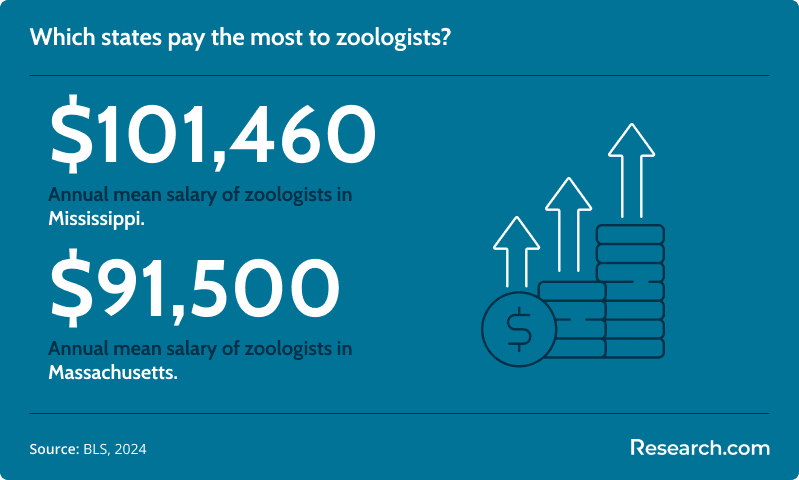
According to 2024 BLS data, the median salary for a zoologist in the US is $70,600 per year. Actual pay depends on employer type, location, education level, specialization, experience, funding source, and job responsibilities. Treat salary figures as planning benchmarks rather than guaranteed outcomes.
- Entry-level zoologists with 0–2 years of experience earn $45,000–$55,000 annually.
- Mid-career zoologists with 5–10 years of experience earn $65,000–$85,000 annually.
- Senior zoologists and researchers with 10+ years of experience can earn over $100,000, especially in leadership or government roles.
Employer setting can significantly affect pay. Government jobs offer stable salaries averaging around $94,900. Zoologists in research and development or environmental consulting can earn $80,070. Education roles, including university positions, may begin at lower pay levels but can reach six-figure salaries with tenure.
Graduate education may improve access to specialized research, policy, management, and teaching roles. Students comparing long-term earning potential can also review degrees that make the most money, but they should remember that zoology compensation varies widely by role, location, funding, and experience.
| Career stage or setting | Salary information stated | What it means for students |
| Median zoologist salary | $70,600 per year | This figure provides a midpoint for setting realistic career expectations. |
| Entry-level roles | $45,000–$55,000 annually | Early salaries may be modest, especially before specialization, graduate study, or advanced technical experience. |
| Mid-career roles | $65,000–$85,000 annually | Experience, technical skills, and employer type can improve earning potential. |
| Senior zoologists and researchers | Over $100,000 | Higher earnings are more likely in leadership, government, and advanced research positions. |
| Government jobs | Averaging around $94,900 | Public-sector employment may offer stability, defined pay structures, and clearer advancement paths. |
| Research and development or environmental consulting | $80,070 | Applied research, data analysis, and consulting skills can be valuable in these settings. |
What are the pros and cons of being a zoologist?
Zoology can be rewarding, but it is not a simple or guaranteed career path. Before committing, students should compare the appeal of wildlife research and conservation with the realities of competitive hiring, physically demanding fieldwork, temporary funding, modest early pay, and possible graduate school.
| Pros | Cons |
| Conservation impact: Zoologists can support species protection, habitat restoration, biodiversity monitoring, and evidence-based environmental decisions. | Competitive hiring: Research and conservation positions can attract many applicants with strong academic and field backgrounds. |
| Varied work environments: Roles may involve field sites, laboratories, zoos, aquariums, government agencies, universities, or consulting projects. | Physical demands: Fieldwork can include harsh weather, remote locations, long days, difficult terrain, and repetitive monitoring. |
| Direct study of animals: Many jobs include wildlife observation, biological sampling, animal care support, or behavior research. | Modest early-career pay: Early-career zoologists often earn $45,000–$55,000 per year. |
| Steady projected growth: Conservation, biodiversity, and environmental research needs support 4% job growth projected by 2033. | Graduate education may be necessary: Higher-paying, research-intensive, or academic roles often require a master’s degree or Ph.D. |
| Higher earning potential with experience: Senior professionals in research, leadership, or government roles can earn over $100,000. | Some work is temporary or grant-funded: Early jobs may depend on seasonal projects, short-term contracts, or limited conservation funding. |
Students considering doctoral study should understand that zoology research careers usually require substantial original investigation. Some people search for the easiest PhD without dissertation, but zoology-focused doctoral work generally depends on field or lab research, scientific writing, and evidence of research ability.
Common mistakes to avoid when planning a zoology career
- Picking a program based only on an animal-related title. Review the curriculum, faculty expertise, research opportunities, fieldwork requirements, and lab access before enrolling.
- Waiting too long to gain experience. Start looking for internships, volunteer roles, field courses, and research opportunities early in college.
- Assuming online coursework is enough. Online classes can help, but zoology employers usually want field, lab, animal-care, or research experience.
- Underestimating statistics and GIS. Wildlife science is increasingly data-heavy, and technical skills can make you more competitive.
- Looking only at salary. Also consider job stability, geographic flexibility, graduate school costs, outdoor conditions, advancement options, and funding sources.
- Believing graduate school is always required. Some entry-level jobs are available with a bachelor’s degree, while advanced research and professor roles often require more education.
- Relying only on rankings or name recognition. A less expensive program with strong field partnerships may serve you better than a famous school with limited wildlife opportunities.
The chart below shows the industries with the highest levels of employment for zoologists, based on BLS data from 2024.
What is the future of zoology as a career?
Zoology’s future will be shaped by conservation priorities, environmental change, new technology, and competition for research funding. The field is likely to remain important because governments, universities, nonprofits, and environmental organizations need specialists who can study animal populations and advise on habitat and species protection.
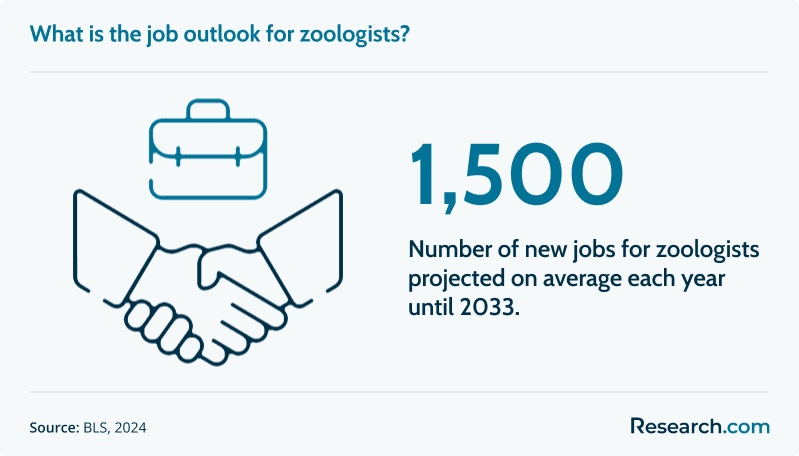
- Steady job openings: About 1,500 positions for zoologists and wildlife biologists open yearly, supporting ongoing demand for research, conservation, and policy-related work.
- Persistent conservation needs: Habitat loss, endangered species protection, biodiversity monitoring, and climate resilience continue to require zoological expertise.
- More data-driven methods: Machine learning, bioinformatics, satellite tracking, GIS, and remote monitoring are becoming more important in wildlife research.
- Growth in cross-sector work: Zoologists may contribute to land management, environmental consulting, sustainability planning, government policy, and corporate environmental responsibility.
- More interdisciplinary overlap: Zoology increasingly connects with genetics, veterinary science, environmental law, urban planning, sustainability, and climate adaptation.
How to decide if zoology is worth it for you
Zoology may be worth pursuing if you enjoy rigorous science coursework, research, field or lab work, and long-term conservation challenges. It may be a poor fit if your main goal is daily animal companionship, high starting pay, or a predictable office-only schedule. Zoologists often care deeply about animals, but their work is scientific and population-focused rather than centered on pets or individual animal companionship.
| Choose zoology if... | Consider another path if... |
| You like biology, ecology, research, data, and long-term conservation questions. | You mainly want to provide medical treatment to individual animals, which may align more closely with veterinary medicine. |
| You are willing to gain field, lab, and data experience while completing your degree. | You want a career with abundant entry-level openings in every city. |
| You can handle outdoor work, travel, seasonal schedules, or remote sites if required. | You strongly prefer predictable indoor work with little or no field activity. |
| You are interested in government, research, conservation, education, or consulting work. | You expect high income immediately after finishing a bachelor’s degree. |
| You are open to graduate school if your preferred role requires advanced research training. | You do not want more education but are aiming for senior research or professor positions. |
Questions to ask before choosing a zoology-related program
- Does the curriculum include animal biology, ecology, genetics, statistics, conservation, and field methods?
- Can undergraduates work with faculty on active research projects?
- Does the department have relationships with zoos, aquariums, wildlife agencies, conservation organizations, museums, or research stations?
- How are laboratory and field requirements completed?
- What internships, seasonal jobs, or research placements have recent students completed?
- Which jobs or graduate programs have recent graduates entered?
- Does the program teach GIS, data analysis, scientific writing, research design, or other technical skills?
- What is the full cost after financial aid, transfer credits, housing, travel, lab fees, and field course fees?
- If the program is online or hybrid, how will you get hands-on experience locally?
What graduates say about becoming a zoologist
Watching animals in the wild remains the most meaningful part of my career. I have tracked jaguars in the Amazon and studied wolves in Yellowstone. Field days can be tiring, but the data we collect directly supports conservation decisions. Each project brings a different challenge. – David
Zoology opened more doors than I expected. I started in a genetics lab and later moved into field research. My training helped me see how research, conservation, government agencies, and environmental work can fit together. – Camille
I entered zoology because I wanted my career to help endangered species. Today, I work on habitat restoration projects where the results are visible. The work can be demanding, but seeing ecosystems recover makes it worthwhile. – Elias
References:
- Bureau of Labor Statistics (BLS). (2024a). 19-1023 Zoologists and Wildlife Biologists. Occupational Employment and Wages, May 2023. BLS.
- Bureau of Labor Statistics (BLS). (2024b). Zoologists and Wildlife Biologists. Occupational Outlook Handbook. BLS.
- US Fish & Wildlife Service. (2024). $48.4M for Collaborative Efforts to Conserve America’s Most Imperiled Species. US Fish & Wildlife Service.
- Zippia. (2025a). What is a Zoologist and How to Become One. Zippia.
- Zippia. (2025b). Zoologist Education Requirements. Zippia.
Key Insights
- Zoology is a scientific career centered on animal research, population trends, habitats, behavior, and conservation, not simply a job for people who like animals.
- A bachelor’s degree is the standard entry point, and 64.3% of zoologists in the U.S. hold a bachelor's degree.
- Relevant majors include zoology, biology, wildlife biology, ecology, animal science, and environmental science, but the curriculum must include strong science, research, field, and data components.
- Hands-on experience is essential. Internships, undergraduate research, field courses, volunteer conservation work, and seasonal technician jobs can strongly improve employability.
- Most zoologists (67%) work for government agencies, so students should understand public-sector hiring, conservation policy, permits, and agency-based wildlife management.
- The usual timeline ranges from 4 to 10 years, depending on whether you begin working after a bachelor’s degree or pursue a master’s degree or Ph.D.
- According to 2024 BLS data, zoologists earn a median salary of $70,600 per year, while early-career roles often pay $45,000–$55,000 annually.
- Technical skills such as GIS, statistics, data analysis, remote sensing, scientific writing, and research design can help candidates stand out in a competitive labor market.
- Zoology can connect to environmental science, sustainability, urban planning, environmental engineering, conservation policy, and consulting for students who want broader career options.
- The best candidates are patient, science-oriented, detail-focused, comfortable with field or lab conditions, and motivated by long-term conservation impact.
Other Things You Should Know About Becoming a Zoologist
Certifications like the Certified Wildlife Biologist credential from The Wildlife Society can enhance career prospects. These certifications validate expertise in wildlife biology, ecology, and conservation, providing opportunities for career advancement and specialized roles within the field of zoology.
In 2027, the average salary for a zoologist is around $64,000 per year, although this can vary significantly based on specialization, education, experience, and geographical location. Entry-level positions may start lower, while senior roles or those requiring advanced degrees can earn more.


