
2027 How To Become an Agricultural Engineer? Salary & Career Paths

Co-Founder and Chief Data Scientist
Some students are drawn to both technology and nature but aren’t sure how to turn that into a real career. They want a job that’s hands-on, meaningful, and future-ready—but with so many engineering fields out there, it’s hard to know where agricultural engineering fits in.
This article helps clarify that path. With over 66% of agricultural engineers working in private industry or government, there’s steady demand for professionals who can solve modern farming challenges through smart design and innovation. Prepared by experts in career planning, this guide explains what agricultural engineers do, how to become one, expected salaries, and where the degree can take you—so students can decide with confidence if it’s the right fit.
Key Things You Should Know About Agricultural Engineering
- Role and Skills – Agricultural engineers use a mix of technical and problem-solving skills to design systems that improve farming efficiency and sustainability.
- Education Path – A bachelor’s degree in agricultural engineering is essential, and ABET-accredited programs offer the best preparation for licensure and career advancement.
- Salary and Demand – Salaries are competitive, especially with specialization or licensure, and job growth is steady due to rising demand for sustainable agriculture.
- Career Options – Engineers can work in areas like irrigation, machinery, environmental consulting, and food systems, with flexibility to move into leadership or innovation roles.
- Real-World Practice – The field offers meaningful, hands-on work that directly addresses global challenges like climate change, water use, and food security.
- What does an agricultural engineer do?
- What skills do you need to become an agricultural engineer?
- How do you become an agricultural engineer for 2027?
- What are the best colleges for agricultural engineering?
- What is the salary of an agricultural engineer?
- What are the career paths in agricultural engineering?
- What is the job outlook for agricultural engineers?
- How does agricultural engineering support environmental sustainability?
- What are the emerging trends in agricultural engineering?
- Can online education complement traditional agricultural engineering studies?
- How Can Advanced Degrees Enhance Career Prospects?
- How Can Agricultural Engineers Expand Their Skill Set Through Online Learning?
- How Can Online Education Expand Interdisciplinary Opportunities in Agricultural Engineering?
- Could a Graduate Degree in Sustainability Elevate Your Agricultural Engineering Career?
- What are the pros and cons of being an agricultural engineer?
- How is agricultural engineering different from related fields?
- What is it like to study agricultural engineering in college?
What does an agricultural engineer do?
An agricultural engineer uses technology and science to solve problems in farming and food production. They design systems, machines, and structures to improve efficiency and sustainability in agriculture. This includes developing irrigation systems, designing farm equipment, and creating waste management solutions for large-scale farms.
They often work on real-world problems like water conservation, soil health, or crop storage. According to the FAO, 72% of freshwater withdrawals globally are used for agriculture, highlighting the need for engineers to design efficient irrigation and water management systems. Agricultural engineers also help adapt farms to new challenges like climate change, population growth, and food security.
Common responsibilities include:
- Designing tools and machines for modern farming
- Improving irrigation and drainage systems
- Managing environmental impacts on farms
- Testing agricultural equipment for safety and efficiency
- Supporting farmers with data and technical advice
Some work in the field, while others spend time in labs or offices. The job often involves teamwork with other engineers, scientists, or farmers. Engineers looking to shift into leadership roles in agribusiness may consider a fast MBA online to build strategic and operational skills quickly.
What skills do you need to become an agricultural engineer?
Agricultural engineers need both technical and problem-solving skills to do their jobs well. They apply math, science, and engineering to real-world agricultural challenges.
Key technical skills include CAD software, mechanics, fluid dynamics, and sometimes programming. Since they often design or improve machines and systems, a solid understanding of mechanical and electrical engineering is helpful. Soft skills are just as important, especially communication and teamwork, as they often work with farmers, researchers, and contractors.
Important skills include:
- Math and physics fundamentals
- Computer-aided design (CAD)
- Problem-solving and critical thinking
- Communication and collaboration
- Project management
Adaptability is also valuable. Agricultural engineers must keep up with changes in technology, climate, and farming practices.
How do you become an agricultural engineer for 2027?
You need a bachelor’s degree in agricultural engineering or a closely related field to become an agricultural engineer. This degree usually takes four years and includes coursework in engineering, biology, and agricultural systems.
Most programs are accredited by ABET, which is important if you plan to become licensed. Some roles may require a Professional Engineer (PE) license, especially in government or consulting. High school students should focus on math, physics, biology, and chemistry to prepare.
In some cases, engineers from other disciplines, like mechanical or civil, can move into agricultural roles with additional training or experience. While not common, a few people take alternate routes, such as on-the-job training combined with certifications.
Internships during college help build hands-on experience. They can also lead to job offers after graduation. Getting involved in research or student engineering competitions can give you an edge.
Data shows that about 1,300 students graduate with degrees in agricultural engineering each year in the United States, making it a small but specialized field.
What are the best colleges for agricultural engineering?
Top agricultural engineering programs offer strong academics, hands-on learning, and industry connections. Schools like Iowa State University, Texas A&M, and University of Florida are often ranked among the best. These programs usually include lab work, internships, and research opportunities.
The best college for you depends on location, tuition, specialization, and career goals. According to ASABE, over 30 accredited programs in the U.S. offer degrees in agricultural or biological engineering, providing a range of options for students nationwide. Some universities focus more on environmental engineering or biotechnology. Others have strong ties to regional farming industries, which can lead to better job placements after graduation.
When choosing a program, look for:
- ABET accreditation
- Internship or co-op programs
- Research centers focused on agriculture
- Industry partnerships and job placement rates
- Affordable tuition and financial aid options
Many schools also offer online or hybrid courses, which may suit working students or those in remote areas. Visiting campus and speaking with current students or faculty can help you decide if it’s the right fit.
What is the salary of an agricultural engineer?
Agricultural engineers earn a stable income that grows with experience. The average starting salary is competitive with other engineering fields, and senior professionals can earn well above the national average.
Location, industry, and education level all impact salary. Engineers working in government or for large agribusinesses often earn more than those in smaller firms or nonprofits. Areas with a strong agricultural economy tend to offer more opportunities and better pay.
In the U.S., the average salary for an agricultural engineer is $82,871 per year, according to ZipRecruiter. The top-paying industries include:
- Federal government agencies
- Food manufacturing companies
- Equipment and machinery design firms
- Environmental consulting
Agricultural engineers with advanced degrees or licenses usually earn higher salaries. Benefits like health insurance, retirement plans, and performance bonuses are common. Those aiming for high-level positions in agricultural tech firms might explore the executive online MBA to expand their business acumen without pausing their careers.
What are the career paths in agricultural engineering?
Agricultural engineers have flexible career options across various sectors. While many work directly with farms or agribusinesses, others go into environmental consulting, food production, or equipment design.
Some engineers specialize in areas like soil and water conservation, automation, or renewable energy. A few may work in international development, helping build sustainable systems in developing countries.
Common career paths:
- Irrigation and water systems engineer
- Agricultural machinery designer
- Food processing systems engineer
- Environmental consultant
- Research and development specialist
The U.S. Bureau of Labor Statistics reports that 15% of agricultural engineers work in the federal government, while 14% are in professional, scientific, and technical services, showing a diverse range of employment.
Engineers can move into leadership roles or become project managers. With experience, some start their own consulting businesses or pursue advanced degrees in related fields. Professionals with a healthcare background moving toward agri-biotech or environmental sectors might find value in MBA MSN dual degree programs online, especially where both health and business management intersect.
What is the job outlook for agricultural engineers?
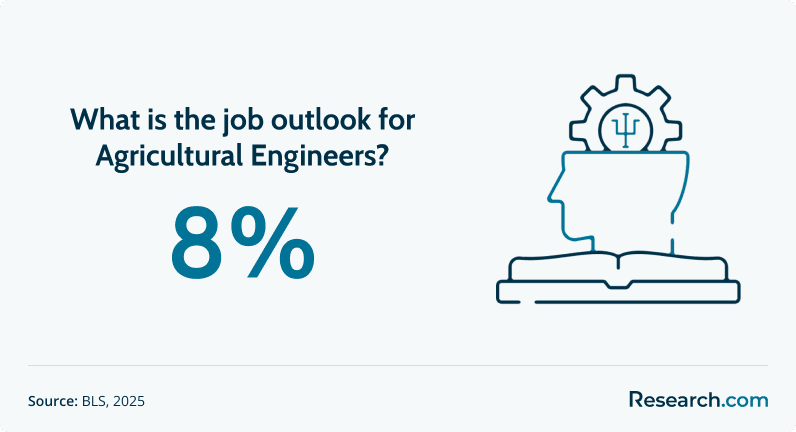
The BLS projects a 4% job growth for agricultural engineers between 2022 and 2032, which is about as fast as the average for all occupations. Demand is expected to grow as farms adopt smart systems and respond to environmental pressures.
Sustainability, climate change, and food security are driving innovation. Engineers who can develop efficient systems for water use, soil health, or renewable energy are especially valuable. As global populations grow, efficient food production becomes more critical.
Government agencies, research institutions, and agritech companies are hiring agricultural engineers to tackle these challenges. While the field is smaller than other engineering disciplines, it plays a vital role in future food systems.
Jobs may not be concentrated in major cities, so flexibility in location can improve your chances of finding work. For those evaluating long-term planning, understanding, How long does an MBA take? can help in mapping out career advancement timelines while balancing current work commitments.
How does agricultural engineering support environmental sustainability?
Agricultural engineering applies innovative technologies to optimize resource use, reduce waste, and conserve ecosystems. By integrating renewable energy systems, precision irrigation techniques, and modern soil management practices, professionals in this field address environmental challenges while enhancing agricultural productivity. This discipline not only advances farm efficiency but also actively contributes to resilient food systems that minimize environmental impacts and promote long-term ecological balance. For those interested in exploring broader opportunities, consider exploring environmental sustainability careers.
What are the emerging trends in agricultural engineering?
Agricultural engineering is rapidly embracing innovations that redefine traditional practices. Novel sensor technologies, IoT integration, and data-driven decision-making are enhancing the precision of farming operations, reducing waste, and improving resource management. Increasing cross-disciplinary collaboration with fields such as robotics, biotechnology, and sustainable systems is creating specialized roles that encourage adaptive problem-solving. Professionals are now expanding their expertise, with opportunities to advance their skills through training for environmental scientist, ensuring they remain at the forefront of technological and environmental innovations.
Can online education complement traditional agricultural engineering studies?
Academic and professional development can be enhanced through focused online coursework that addresses emerging environmental and technical challenges. Specialized digital programs offer advanced insights into sustainable practices and resource management, effectively complementing core engineering curricula. For instance, enrolling in the cheapest online environmental science degree can provide cost-effective access to critical environmental competencies that directly support innovative agricultural solutions.
How Can Advanced Degrees Enhance Career Prospects?
Agricultural engineers seeking to broaden their influence can leverage interdisciplinary advanced studies to integrate technical expertise with urban resilience and policy-making. Specialized programs provide a pathway to merge sustainable agricultural practices with urban development strategies, opening avenues in consultancy, strategic planning, and regulatory roles. For example, enrolling in masters in city planning online can equip professionals with a comprehensive understanding of urban systems, enabling them to address challenges such as food security and environmental impact in metropolitan contexts.
How Can Agricultural Engineers Expand Their Skill Set Through Online Learning?
Agricultural engineering is rapidly evolving with the integration of digital technologies, sustainability practices, and advanced data analysis. Professionals can address emerging challenges by pursuing specialized online courses that complement core technical training while broadening interdisciplinary expertise. This approach enables engineers to master areas such as remote sensing, renewable energy, and environmental policy, which are critical in adapting to changing industry demands. For additional options and detailed program insights, consider exploring environmental science programs online.
How Can Online Education Expand Interdisciplinary Opportunities in Agricultural Engineering?
Agricultural engineers can enhance their expertise through targeted online courses that complement core technical training. Digital programs enable professionals to acquire knowledge in areas such as renewable energy systems, data analytics, and environmental policy without interrupting their work schedules. This approach fosters interdisciplinary collaboration and provides access to the latest innovations that support sustainable agricultural practices. For additional digital learning options, consider exploring the cheapest environmental engineering online degree to further integrate cross-disciplinary insights into your career.
Could a Graduate Degree in Sustainability Elevate Your Agricultural Engineering Career?
Agricultural engineers looking to broaden their expertise and address future industry challenges might consider advanced studies in sustainability. A focused graduate degree can integrate environmental science, renewable energy, and resource management into established engineering practices, enhancing strategic decision-making and leadership potential. This advanced qualification equips professionals to design innovative solutions that merge technical proficiency with sustainable practices, thereby expanding career opportunities beyond traditional roles. For detailed options and program insights, explore the cheapest master of sustainability online.
What are the pros and cons of being an agricultural engineer?
Being an agricultural engineer can be rewarding, but it comes with its own set of challenges. It’s a great fit for people who enjoy problem-solving and care about the environment or food systems.
Pros:
- Meaningful work that impacts global food supply
- Opportunities to work outdoors and in the lab
- High job satisfaction from solving real-world issues
- Competitive salary and benefits
Cons:
- Jobs may be limited in urban areas
- Work can be seasonal or weather-dependent
- Fieldwork may involve travel or long hours
- Requires ongoing learning due to evolving tech
According to Data USA, agricultural engineering graduates report above-average job satisfaction, especially those involved in sustainability or innovation. Overall, if you’re passionate about sustainability and innovation, this could be a great path.
How is agricultural engineering different from related fields?
Agricultural engineering focuses on applying engineering to farming and food systems, while related fields often have a broader or different focus. For example, environmental engineering deals with pollution and ecosystems, not just agriculture.
Agronomy, another related field, is more about plant science and soil than machines or systems. Mechanical engineering overlaps in areas like machinery design but doesn't usually cover biological or environmental factors in farming.
Key differences:
- Agricultural engineering blends biology with mechanical and environmental systems.
- It applies directly to food production and farming.
- It requires knowledge of both natural and man-made systems.
If you’re deciding between related fields, think about whether you're more interested in machines, biology, or the bigger food system. Agricultural engineering is unique in how it brings all three together.
What is it like to study agricultural engineering in college?
Studying agricultural engineering in college involves a mix of theory, lab work, and real-world projects. You’ll take classes in math, biology, mechanics, and computer science.
Programs often include hands-on labs and team projects that simulate real engineering problems. Internships and co-op programs help you apply what you learn in professional settings. Many schools also have student clubs focused on agriculture, robotics, or sustainability.
Common subjects include:
- Soil and water engineering
- Farm machinery and power systems
- Environmental control systems
- Precision agriculture and GPS tech
- Engineering design projects
According to ASABE, many programs require students to complete capstone projects focused on real agricultural problems, giving students practical experience before graduation.
Expect a challenging but rewarding experience. If you enjoy solving problems and making things work better, you’ll likely thrive in this major.
Those preparing for roles that involve budgeting and resource allocation may want to understand EMBA cost to decide if the investment aligns with their career goals.
Here’s What People Have to Say about Their Agricultural Engineering Degree
Working on sustainable irrigation systems during my degree made me realize how much engineering can directly improve lives. Today, I help farms reduce water waste while boosting crop yield—it’s both technically challenging and rewarding. – Benjamin
I liked that the program combined mechanics, biology, and environmental science in a way that always felt relevant. Now, I work with a team designing smart equipment for precision farming, and it’s exciting to see our work make real impact in the field. – Amelie
The hands-on projects were the best part—I got to build and test real prototypes that farmers actually use. It gave me the confidence to work in agtech right after graduation and keep learning on the job. – Henry
Key Findings
- 72% of freshwater withdrawals globally are used for agriculture, highlighting the need for efficient water systems.
- About 1,300 students graduate with degrees in agricultural engineering each year in the United States.
- Over 30 accredited programs in the U.S. offer degrees in agricultural or biological engineering.
- The average salary for an agricultural engineer is $82,871 per year.
- The BLS projects a 4% job growth for agricultural engineers between 2022 and 2032.
References:
- Agricultural Engineer Salary. (2025, April). ZipRecruiter. Retrieved April 9, 2025, from https://www.ziprecruiter.com/Salaries/Agricultural-Engineer-Salary
- Agricultural Engineering | Data USA. (n.d.). Data USA. https://datausa.io/profile/cip/agricultural-engineering
- Agricultural Engineers. (2024, August 29). Bureau of Labor Statistics. https://www.bls.gov/ooh/architecture-and-engineering/agricultural-engineers.htm
- Computer modeling and statistics for agriculture. (n.d.). https://asabe.org/sc21cmsa
- The State of Food and Agriculture 2024. (2024). In FAO eBooks. https://doi.org/10.4060/cd2616en
Other Things You Should Know About Agricultural Engineering
In 2027, obtaining a license in agricultural engineering typically requires completing an ABET-accredited bachelor's degree, gaining four years of work experience, and passing the Principles and Practice of Engineering (PE) exam. Requirements might vary slightly by state, so checking local regulations is essential.
The first step to becoming an agricultural engineer in 2027 is obtaining a bachelor's degree in agricultural engineering or a related field from an accredited university. This foundational education provides essential knowledge in engineering principles, biology, and environmental science necessary for the field.
To begin a career in agricultural engineering in 2027, earn a bachelor's degree in agricultural or biological engineering. Accredited programs by ABET prepare you with relevant skills. Participating in internships can also provide valuable hands-on experience.


