
2027 Why Major In Early Childhood Education: Courses, Career Paths & Job Outlook

Co-Founder and Chief Data Scientist
With growing demand for skilled educators driven by expanding early learning programs and public investment, the Early Childhood Education (ECE) profession is increasingly recognized for its critical role in education and community development.
The National Association for the Education of Young Children (NAEYC), in partnership with MomsRising, conducted a survey that reveals how 65% of parents believe child care providers play an important role in teaching values and morals to children ages zero to five. This further supports the crucial role ECE majors have in shaping young minds during their most formative years.
This guide explores key courses, diverse career options, promising job outlooks, and emerging trends that make early childhood education a vital and fulfilling field for aspiring educators and advocates.
What are the benefits of specializing in Early Childhood Education?
- Specializing in early childhood education can lead to diverse career opportunities focused on supporting young children's development and learning in public schools, private preschools, Head Start programs, and nonprofit organizations.
- Professionals with an ECE degree typically earn a salary ranging from approximately $17 to $25 per hour, depending on the role and location, with potential for higher earnings in leadership or specialized positions.
- Earning an early childhood education degree online offers flexibility for working students or caregivers, access to diverse program options, and often the ability to complete coursework at an accelerated pace without compromising quality instruction and practical experiences.
- What is an early childhood education major? Major Overview
- Why should you major in early childhood education? Benefits of ECE Major
- What classes do you take in an early childhood education program? Courses
- How much hands-on classroom experience is included in a typical ECE program? How much hands-on classroom experience is included in a typical ECE program?
- What skills do you gain from majoring in early childhood education? What skills do you gain from majoring in early childhood education?
- Do you need a license to work in early childhood education? Licensure
- Can you work outside of teaching with an early childhood education degree? Alternative Careers
- Can an early childhood education degree lead to administrative roles? Career Advancement
- What is the job outlook for early childhood education majors? Job Outlook
- What is the average salary for early childhood education graduates? Average Salary
- Can advanced qualifications propel career growth in early childhood education? Can advanced qualifications propel career growth in early childhood education?
What is an early childhood education major?
An early childhood education major focuses on teaching and nurturing children from birth through about age eight, a period considered crucial for cognitive, emotional, and social development. Students in this major study child psychology, learning theories, curriculum design, and hands-on teaching strategies tailored for young learners.
An early childhood education degree provides specialized training in early learning methods, developmental milestones, and family engagement. This focus equips graduates to create supportive, age-appropriate learning environments that lay the foundation for lifelong academic and personal success.
How is an early childhood education degree different from a general education degree?
- Age Focus: ECE centers on infants, toddlers, preschoolers, and early elementary students, while general education covers teaching multiple grade levels (often kindergarten through secondary school).
- Specialized Training: ECE focuses on early learning methods, child development, and family engagement; general education has a broader focus and a wider range of academic subjects like math, science, and language arts.
- Career Paths: ECE graduates often become preschool teachers, childcare directors, or specialists in early learning, whereas general education graduates may teach higher grade levels.
The certification requirements and teaching environments also differ, with early childhood education majors frequently able to work in varied early learning settings beyond traditional classrooms.
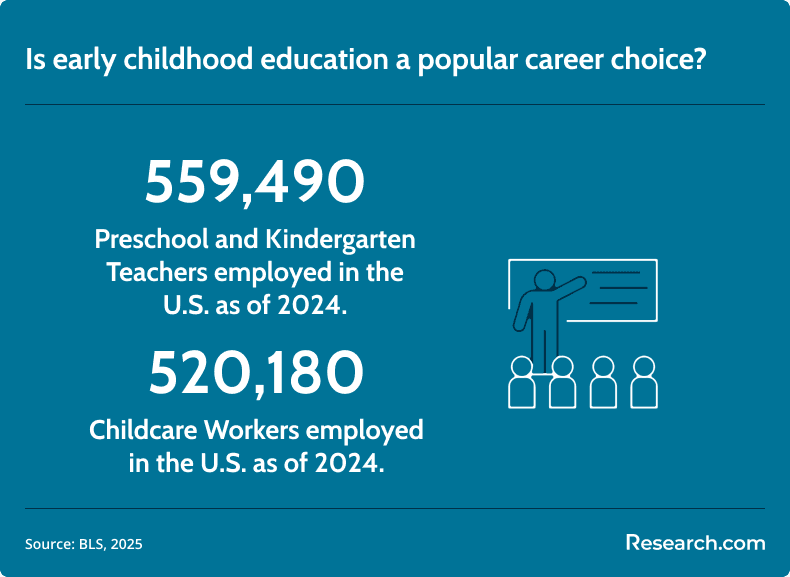
According to 2024 occupational employment data from the U.S. Bureau of Labor Statistics (BLS), there are 559,490 preschool and kindergarten teachers and 520,180 childcare workers employed in the United States.
Why should you major in early childhood education?
Here are a few key reasons why majoring in early childhood education can be a smart choice:
- High Demand for Educators: With growing recognition of the importance of early learning, qualified ECE majors are needed in schools, childcare centers, and community programs.
- Meaningful Career Impact: ECE specialists establish the foundation for a child's lifelong learning, attitude toward school, and social competence, and are the first people to teach fundamental skills like sharing, cooperation, problem-solving, and emotional self-regulation.
- Personal Fulfillment: Working in ECE is rewarding as it nurtures curiosity, creativity, independence, and responsibility in young learners.
- Support for Families and Communities: Early childhood education professionals not only educate children but also empower families and contribute to community wellbeing.
- Opportunities for Advancement: Graduates can pursue leadership roles or further study, such as the shortest master's degree in early childhood education online or master’s degrees in education, administration, or special education.
- Flexibility of Learning Paths: Many programs are available online, allowing students to balance education with work or family responsibilities while gaining the same credentials as on-campus learners.
What classes do you take in an early childhood education program?
In an early childhood education program, students typically take a variety of courses designed to prepare them to support and teach young children effectively.
The course titles may vary in early childhood education bachelor's core coursework and those in an associate or master’s program, but the core areas of study remain consistent.
Common classes include:
- Introduction to Early Childhood Education: Basics of the field, learning theories, and developmentally appropriate practices.
- Child Development: Study of physical, cognitive, social, and emotional growth from birth to age eight.
- Observation and Assessment: Techniques for observing children and assessing development and learning progress.
- Language and Literacy Development: Strategies to support early communication and literacy skills.
- Curriculum Development: Designing and implementing an age-appropriate curriculum for young children.
- Creative Arts, Music, and Movement: Using arts and physical activity to enhance learning and development.
- Diversity and Inclusion in Education: Prepares students to work with children from diverse backgrounds and those with special needs.
- Guidance and Classroom Management: Approaches to fostering positive behavior and social skills.
- Early Childhood Program Administration: Leadership and management of early education settings.
- Family, School, and Community Partnerships: Engaging families and communities in children's education.
- Educational Psychology: Explores how children learn and how teachers can adapt instruction to different needs.
This mix of theoretical, practical, and administrative courses prepares graduates to work effectively in diverse early childhood education environments.
How much hands-on classroom experience is included in a typical ECE program?
Typical Early Childhood Education (ECE) programs include significant hands-on classroom experience through practicum requirements, which are essential for applying theoretical knowledge in real early learning settings. Key details include:
- Practicum experiences usually range from 45 to 90 clock hours per placement, with multiple practicums throughout the program focused on different age groups, such as infants, toddlers, preschool, and school-age children.
- These practicum hours involve supervised teaching and caregiving in licensed childcare centers, preschools, or early elementary classrooms, where students implement lesson plans, observe children, and engage in child development activities.
- Students work under the supervision of both a practicum instructor from their college and on-site mentors, who guide professional growth and assess competencies.
- Requirements often include completion of prerequisite coursework with satisfactory grades before entering the practicum and adherence to professional ethics, including confidentiality and punctuality.
- Practicums aim to develop skills like planning developmentally appropriate activities, classroom management, positive guidance, and child assessment.
- Some programs may offer credit for prior work experience but emphasize the value of varied practicum settings to broaden practical understanding.
Overall, hands-on practicum experiences in ECE programs are structured to prepare graduates for confident, competent work with young children in diverse educational environments.
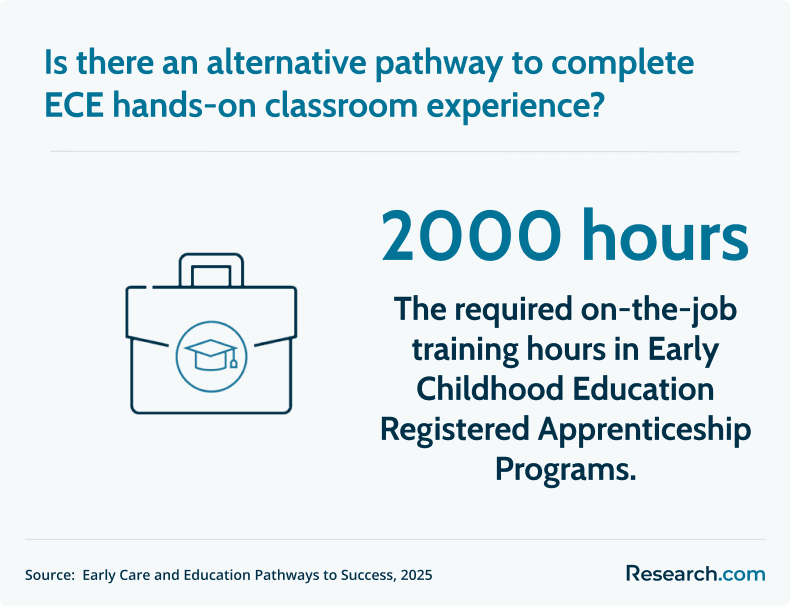
Aside from obtaining hands-on experience via a traditional early childhood education program, an alternative pathway is through an ECE Registered Apprenticeship Program (RAP) that is certified by the U.S. Department of Labor. This is an "earn-while-you-learn" model designed to prepare skilled early childhood educators through a combination of paid on-the-job training (OJT) and classroom instruction.
Apprentices are usually required to complete at least 2,000 hours of OJT, which is much higher than what is needed in traditional programs. However, apprentices enjoy the benefit of receiving incremental wage increases as they gain skills and progress in the program.
For students comparing learning models or certification-based tracks, similar evaluation processes exist in fields like CMAA vs CCMA, where both credentials involve practical, supervised training and classroom study.
What skills do you gain from majoring in early childhood education?
Majoring in early childhood education equips students with a blend of teaching, interpersonal, and leadership skills that are essential for working with young learners. Key skills include:
- Communication and interpersonal skills: Effectively interact with young children, parents, and colleagues to address educational and developmental needs.
- Child development knowledge: Understand physical, cognitive, social, and emotional stages of development to tailor learning experiences appropriately.
- Creativity: Design engaging, playful educational activities that capture children’s interest and support diverse learning styles.
- Observation and assessment: Accurately observe children’s behavior and progress to plan individualized instruction and provide feedback.
- Classroom management and guidance: Foster positive behavior, social skills, and a safe learning environment.
- Organizational skills: Plan lesson activities, document development, and manage classroom resources efficiently.
- Patience and physical stamina: Handle the demands of working with energetic young children while maintaining calm and an encouraging demeanor.
- Problem-solving and adaptability: Respond to classroom challenges with flexibility and creative solutions.
These skills prepare graduates to support young learners holistically and succeed as early childhood education professionals.
These skills prepare graduates to support young learners holistically and succeed as early childhood education professionals. They also align closely with foundational counseling competencies found in ABA vs CBT, where observation, empathy, and adaptive communication are key to effective child-centered practice.
Do you need a license to work in early childhood education?
In most cases, professionals need a license or certification to work in early childhood education, especially if you want to teach in public schools or lead a licensed childcare program. Each state tends to have different policies, so it is best to check ECE and child care workforce licensing requirements for each area.
- Licensing enables educators to teach children from birth through early elementary grades (up to second or third grade, depending on the state).
- To work as a licensed ECE teacher, especially in public schools or formal early learning settings, you generally need at least a bachelor’s degree in early childhood education or a closely related field.
- An associate degree in early childhood education may qualify you for some entry-level roles, such as teaching assistants or positions in childcare centers.
- Some roles, such as preschool teachers in private settings, may accept a Child Development Associate (CDA) credential, which involves coursework, fieldwork, and a competency exam.
- Licensing typically requires completing an accredited ECE teacher preparation program, which includes supervised student teaching, and passing state-specific certification exams.
- In addition to education, many states require background checks, immunizations, and continuing education to maintain licensure.
- Private preschools, daycare centers, or paraprofessional roles may not require a license, but having one increases job opportunities and career advancement potential.
In summary, if your goal is to become a preschool or early elementary school teacher, you will almost always need both a degree in early childhood education and state licensure. However, due to the ongoing teacher shortage, some states are hiring educators who are not yet fully certified or are still completing their preparation while teaching.
If you want to better compare career paths for those with ECE degrees and certifications, you can check out our guide on jobs with early childhood education certificate credentials.
Using data from the Learning Policy Institute, here is the most current status of teacher shortage across all levels:
Can you work outside of teaching with an early childhood education degree?
An ECE degree provides transferable skills in leadership, communication, and child development that extend well beyond teaching. Here are some alternative career paths for early childhood education majors:
- Early Childhood Education Specialist: Working as family counselors or program coordinators, developing personalized plans for children and families.
- Curriculum Development Specialist: Designing, researching, and implementing early learning programs for nonprofits, museums, libraries, community centers, or government agencies.
- Child Case Manager: Supporting at-risk or disadvantaged children through social services, including home visits and family support.
- Preschool Admissions Coach: Advising families through competitive preschool admissions processes.
- Child Life Specialist: Assisting young patients’ emotional coping in healthcare settings using play-based strategies.
- Parent Educator: Teaching parents effective support and developmental techniques according to child growth stages.
- Social Worker (Early Childhood Focus): Providing family counseling and crisis intervention with specialized knowledge of early development.
- Nanny or Au Pair: Offering personalized childcare in home environments, often preferred to have ECE training.
- Education Consultant: Advising schools, childcare centers, or policymakers on best early childhood education practices.
- Policy and Research: Working on early childhood education policy, quality standards, or child development research.
Some professionals with this background transition into areas such as family or faith-based counseling, and others explore distinctions like christian counseling vs biblical counseling to specialize in developmental or spiritual support services for children and families.
Can an early childhood education degree lead to administrative roles?
An early childhood education degree can lead to various administrative and leadership roles as part of career progression. These roles typically involve managing early childhood programs, overseeing staff, and ensuring quality education and compliance. Key administrative positions include:
- Preschool and Childcare Center Director: Responsible for overall center operations, staff supervision, budgeting, program development, and regulatory compliance. This role requires leadership skills and often a degree focusing on early childhood administration.
- Program Coordinator or Manager: Oversee specific programs within early education settings, such as Head Start or special needs services, managing resources and staff.
- Early Childhood Education Administrator: Manage multiple centers or school districts, develop policies, evaluate program outcomes, and advocate for children’s services.
- Family Engagement Coordinator: Facilitate partnerships between families and educational programs, enhancing communication and support.
- Curriculum Development Leader: Create educational content and training for teachers across early childhood programs.
Career advancement from teaching to administration often involves gaining leadership experience, pursuing additional qualifications like a master’s degree in Early Childhood Education Administration, and obtaining relevant state certifications. Additionally, strong skills in communication, budgeting, staff development, and program evaluation are essential for success in these roles.
This progression enables ECE professionals to impact broader educational environments, positively shaping early childhood education systems and community services. Educators moving toward administrative or counseling-based leadership might also consider additional licensure that parallels pathways such as NCMHCE vs NCE, which test advanced competencies for managing professional practice and supervision.
What is the job outlook for early childhood education majors?
The job outlook for early childhood education majors is generally positive with steady growth expected:
- BLS reports that employment for preschool teachers (excluding special education) is projected to grow about 4% from 2024 to 2034, which is roughly in line with or slightly above average compared to all occupations.
- While the outlook for some administrative roles in ECE is less strong (a decline of 3% for Preschool and Childcare Center Directors), there will still be thousands of annual openings due to workers retiring or otherwise leaving. So while “growth” is negative, there are still opportunities.
- The same trend is expected for kindergarten and elementary school teachers, with BLS predicting a 2% decline in growth but hundreds of thousands of job openings for such educators until 2034. Get to know more about which states have the highest demand for teachers in our helpful guide.
- Growing awareness of the importance of quality early childhood education is driving demand for qualified educators and specialists.
- Public investment and policies expanding access to early education programs, including universal preschool initiatives, are increasing workforce needs.
- The sector experiences continuous demand due to rising birth rates, increased female workforce participation, and expanded early learning mandates.
Despite some regional and sector-specific competition, the overall trend indicates favorable prospects for ECE graduates.
Using the most current data from the O*NET OnLine, here are the projected number of job openings for certain early childhood education roles:
What is the average salary for early childhood education graduates?
The average salary for early childhood education graduates varies significantly based on their specific job role, level of education, location, and years of experience.
- Preschool teachers typically earn between $31,000 to $46,000, while childcare center directors earn higher salaries ranging from about $45,000 to $72,000.
- Preschool teachers working in elementary or secondary school settings typically earn significantly more (an average of $56,140 annually) than those in individual and family services (an average of $44,960 annually).
- Some states and cities, particularly those with a higher cost of living or specific legislative mandates, offer much higher wages for ECE professionals. States like New York, New Jersey, Washington, and Massachusetts often show higher average salaries.
- Specialized roles and positions with more responsibility, such as Curriculum or Instructional Coordinators, tend to have higher salaries of about $59,000 to $94,000.
- Salaries for early childhood education majors can also vary by academic credentials, training, and experience, with an ECE bachelor’s opening opportunities for roles like preschool teachers in public settings, lead teachers, and entry-level administration and graduate degrees leading to higher-paying administrative, research, and specialized jobs.
To give you a better idea about the possible earnings for ECE majors, here are the salaries of certain early childhood education roles based on the most current data from BLS:
Here’s What Graduates Have to Say About Their Early Childhood Education Degree
- Jill: "Majoring in Early Childhood Education gave me a strong foundation in child development and the confidence to lead a classroom. The joy of watching young learners grow each day makes the hard work worthwhile. "
- Brandon: "With my early childhood education degree, I’ve been able to work not just as a teacher but also in community programs that support families. Knowing my work shapes a child’s first years is both impactful and deeply rewarding."
- Cassie: "My program taught me everything from classroom management to play-based learning, skills I use daily as a childcare director. I love that my career allows me to make a difference while continuing to grow professionally."
Can advanced qualifications propel career growth in early childhood education?
For educators aiming to elevate their careers beyond traditional classroom roles, pursuing specialized advanced studies can offer a strategic advantage. Additional qualifications cultivate deeper expertise in curriculum innovation, leadership, and policy development while reinforcing a professional's capability to tackle emerging challenges. Targeted programs enable ECE professionals to gain competencies essential for driving institutional improvements and broader educational reforms. Exploring opportunities such as accelerated doctoral programs in education online provides a pathway to refine leadership skills and expedite career progression in dynamic educational environments.
Key Findings
- The average annual salary for early childhood education majors ranges from about $33,000 to $77,000, depending on location, experience, level of education, and specific job roles.
- BLS reports that employment for preschool teachers is projected to grow about 4% from 2024 to 2034.
- There are 5,500 annual job openings projected for Preschool and Childcare Center Directors until 2034.
- Aspiring ECE specialists can obtain the required hands-on experience while already earning through the RAP alternative pathway, which involves completing 2,000 apprenticeship hours.
- As of 2024, there are 559,490 preschool and kindergarten teachers and 520,180 childcare workers employed in the U.S.
References:
- Center for American Progress (n.d.). Data on Child Care and Early Learning in the United States. https://www.americanprogress.org/data-view/early-learning-in-the-united-states Data Retrieved October 2025
- National Association for the Education of Young Children (2025). Parents and Early Childhood Educators See Each Other as Partners. https://www.naeyc.org/sites/default/files/globally-shared/downloads/PDFs/our-work/public-policy-advocacy/parents_and_early_childhood_educators_brief_final2.pdf
- O*NET OnLine (n.d.). O*NET OnLine Help. https://www.onetonline.org/help/online/find_occ Data Retrieved October 2025
- Patrick, S.K. et al. (July 2025). 2025 Update: Latest National Scan Shows Teacher Shortages Persist. Learning Policy Institute. https://learningpolicyinstitute.org/blog/2025-update-latest-national-scan-shows-teacher-shortages-persist
- U.S. Bureau of Labor Statistics (n.d.). Occupational Employment and Wage Statistics, Industry: Cross-industry, Private, Federal, State, and Local Government, Period: May 2024. https://data.bls.gov/oes/#/industry/000000 Data retrieved October 2025
- U.S. Bureau of Labor Statistics (n.d.). Occupational Employment and Wage Statistics (OEWS) Profiles, May 2024 OEWS Profiles. https://data.bls.gov/oesprofile Data Retrieved October 2025
- U.S. Bureau of Labor Statistics (August 2025). Occupational Outlook Handbook, Preschool and Childcare Center Directors. https://www.bls.gov/ooh/management/preschool-and-childcare-center-directors.htm
- U.S. Bureau of Labor Statistics (August 2025). Occupational Outlook Handbook, Preschool Teachers. https://www.bls.gov/ooh/education-training-and-library/preschool-teachers.htm
- Wolfe, R. and Simon, E. (April 2025). Registered Apprenticeship: An Alternative Pathway To Teacher Credentialing. Early Care & Education Pathways to Success. https://ecepts.org/wp-content/uploads/2025/05/Registered-Apprenticeship-An-Alternative-Pathway-to-Teacher-Credentialing.pdf
Other Things You Should Know About Majoring in Early Childhood Education
To enroll in an early childhood education degree program in 2027, students typically need a high school diploma or equivalent. Some programs may require prior coursework in child development. English proficiency and basic computer skills are also often necessary for application.
In 2026, completing an early childhood education degree typically takes four years for a full-time bachelor's program. This includes coursework and hands-on classroom experience, essential for meeting the field's requirements and gaining practical skills.


