
World Online Ranking of Best Mathematics Research Scientists – 2025 Report

Co-Founder and Chief Data Scientist
On April 17, 2025, Research.com released the fourth edition of its yearly ranking of top scientists in mathematics. The report aims to highlight global research leaders and support the academic community. It helps recognize outstanding work in mathematics and guides researchers, educators, and institutions in following the latest developments in the field.
We share these rankings to support progress in mathematics across the globe. This report gives researchers, students, and academic leaders a chance to learn from top experts and better understand who is shaping today’s mathematical research. By knowing which scientists lead the way and where they work, we hope to encourage new ideas, build collaborations, and spark innovation.
For the 2025 edition, Research.com studied over 3,500 scientist profiles drawn from multiple trusted bibliometric databases. The team used several key indicators to decide who should be included, ensuring the ranking highlights researchers who have made substantial and lasting contributions to mathematics.
To be considered for this ranking, scientists needed a D-index (also called Discipline H-index) of at least 30 in mathematics. Other factors also played a role. These include how much of a scientist’s work falls under mathematics, the quality of their research, and any significant awards they have received. These criteria help make sure the report includes only the most active and respected researchers in the field.
Latest discoveries in mathematics research
One of the most exciting breakthroughs in mathematics this year is the full proof of the geometric Langlands conjecture. This result is part of the more extensive Langlands program, one of the deepest frameworks in modern math. The Langlands program links number theory, geometry, and function fields—three different areas of math—through a network of ideas often called the “Rosetta Stone” of mathematics. The geometric version connects ideas from algebraic geometry and quantum field theory. A team of nine researchers, led by Dennis Gaitsgory and Sam Raskin, completed this massive proof across more than 800 pages. Their work could open new paths in theoretical physics, arithmetic geometry, and string theory.
Another significant discovery in 2024 overturned a famous belief in geometry that had lasted over 50 years. Three mathematicians—Elia Brùe, Aaron Naber, and Daniele Semola—disproved the Milnor conjecture, which claimed that certain curved spaces must have simple, well-behaved shapes. Their example showed that it’s possible to have a space with nonnegative Ricci curvature but an infinitely generated fundamental group. This goes against the long-held idea that curved spaces like these must have a limited, predictable structure.
These discoveries shake up core beliefs in modern geometry. Both findings have sparked new questions and may change how researchers think about space, structure, and symmetry in mathematics for years to come.
Key findings for the 2025 edition of the best mathematics scientists ranking
- The United States leads globally with 470 scientists among the top 1000 in mathematics research, far ahead of the second-ranked United Kingdom with 73 scientists.
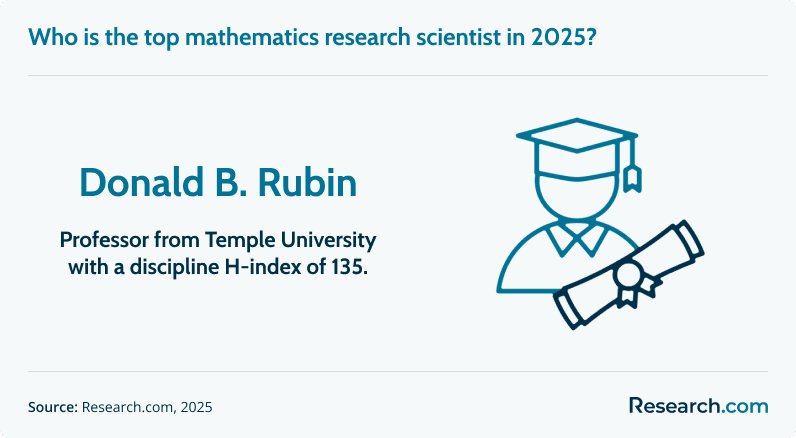
- Donald B. Rubin of Temple University (U.S.) ranks #1 worldwide with a D-index of 135, the highest in the 2025 ranking.
- Stanford University has the world's highest number of leading mathematics researchers, with 26 scientists in the top 1,000.
- Among top institutions, 17 out of 20 are U.S.-based, showing the country's dominance in mathematics research infrastructure.
- The average D-index for the top 1% of mathematics researchers is 127.5, compared to 26, the lowest in the entire ranking.
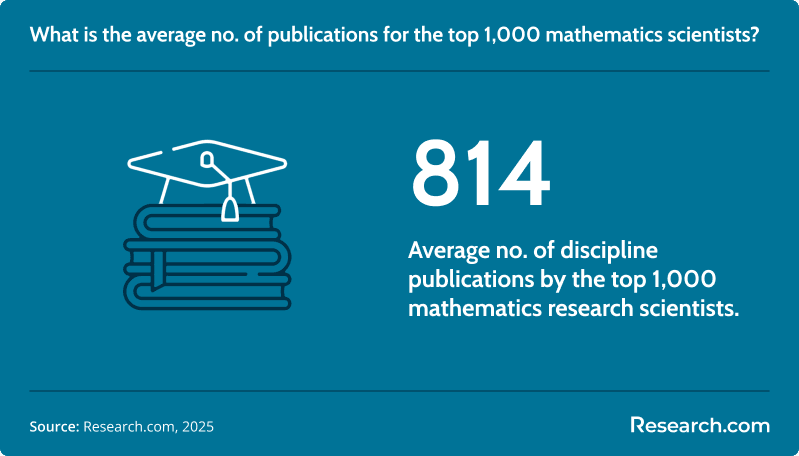
- On average, the top 1% of researchers have 814 publications and 115,762.6 citations, versus 299.54 publications and 26,960.21 citations for all ranked scientists.
The full ranking for the 2025 list of the best mathematics research scientists can be found here:
BEST MATHEMATICS RESEARCH SCIENTISTS IN 2025
Countries with the highest number of leading mathematics research scientists
The United States continues to dominate the field of mathematics research in the 2025 report, with 470 scientists ranked in the top 1000. While this remains a strong lead, it’s a slight drop from last year’s 473 scientists. The US still holds a central role in shaping global mathematics research, with top institutions like Princeton, MIT, and Stanford hosting many of the highest-ranked scholars.
The United Kingdom holds second place again, with a slight increase—from 70 scientists last year to 73 in 2025. This shows steady growth and continued support for math research across top UK universities like Oxford and Cambridge. France also showed a slight rise, from 51 to 52 scientists, keeping its position third. Germany and China follow closely, each adding one more scientist compared to last year, with 49 and 46 researchers, respectively.
The lower half of the top 10 saw a few minor shifts. Canada now has 32 scientists, dropping from 37. Australia also dipped slightly from 28 to 27. Italy dropped by one, moving from 27 to 26. Switzerland climbed from 19 to 20, while Israel remains steady at 17. Austria, which was in last year’s top 10, is now out of the list.
Please note that the country associated with a scientist is based on the affiliated research institution according to MAG, not on their actual nationality.
Institutions with the highest number of leading scientists
In the 2025 report, Stanford University leads the world with 26 mathematics research scientists ranked in the top 1000. While Stanford held this same number last year, its sole lead comes as UC Berkeley drops slightly to 23, tying with Princeton University for second place. This slight shift moves Berkeley down from its former shared first position. MIT holds steady in fourth place but sees a slight drop from 19 to 18 scientists.
Several institutions in the top 10 remain unchanged in presence but have shifted in rank or numbers. Columbia University and the Courant Institute now tie with 15 researchers each. The University of Oxford, a standout non-U.S. institution, rises slightly from 11 to 14 scientists, showing growing strength in UK-based math research. The University of Minnesota follows with 13, while Harvard, Rutgers, and Cornell each have 12 scientists on the list.
Out of the top 20 institutions, 17 are based in the United States, showing that 85% of the leading affiliations come from the U.S. alone. The University of Oxford (UK), ETH Zurich (Switzerland), and the University of Vienna (Austria) are the only non-U.S. institutions represented. Oxford’s upward trend and ETH Zurich’s steady 11 researchers reflect growing international competitiveness in mathematics.
Online universities advancing mathematics proficiency
Online universities are becoming increasingly critical in the world of mathematics research. Over the last few years, more students and researchers have turned to remote learning and digital platforms to study, collaborate, and share ideas. The rise of online education has made it easier for people worldwide to join research communities—no matter where they live.
A significant shift happened during the COVID-19 pandemic. In 2022, over 70% of eighth-grade students and nearly 60% of fourth-graders said they learned remotely at some point during the 2020–21 school year. Among those who performed better in math, most had regular access to a computer, a quiet study space, and frequent help from a teacher. This highlights how access to strong online learning environments can make a real difference in student success—especially in a subject like math, which requires focus and steady support.
Today, online universities continue to improve access to high-quality math education. Many offer advanced programs that encourage students to explore complex topics and contribute to new research. By removing barriers like location or cost, these institutions allow more people to join the academic conversation.
D-index ranking — leaders, averages, and distribution
For North America, Professor Donald B. Rubin of Temple University in the United States leads the global ranking with a D-index of 135, placing him 1st worldwide, with a vast research footprint in statistics.
In Europe, Professor Didier Dubois from Paul Sabatier University in France is the region’s top scientist, holding 3rd place globally with a D-index of 131, and is widely recognized for his contributions to artificial intelligence.
Professor Dumitru Baleanu of the Lebanese American University in Lebanon leads Asia, ranked 5th in the world with a D-index of 129, noted for his work across applied mathematics and fractional calculus.
For Oceania, Professor Jonathan M. Borwein from the University of Newcastle, Australia, is the top scientist, holding the 70th spot globally with a D-index of 89 and is celebrated for his research in optimization and number theory.
Africa’s highest-ranking scientist is Professor Abdon Atangana from the University of the Free State in South Africa, with a D-index of 77, placing him 164th in the world for his advances in mathematical modeling.
In South America, Professor Gauss M. Cordeiro of the Federal University of Pernambuco in Brazil holds a D-index of 74, ranking 194th globally, with his research rooted in statistical distributions.
The average D-index for the top 1% of the world’s top 1000 mathematics scientists is 127.5, compared to 26, the lowest D-index value in the 2025 ranking.
On average, the top 1% have 814 publications, while the overall average across all scientists in the report is 299.54 publications.
Regarding citation impact, the top 1% averages 115,762.6 discipline citations, while the overall average for all included scientists stands at 26,960.21 citations.
You can learn more about the methodology used to create this report here.
About Research.com
All research was coordinated by Imed Bouchrika, Ph.D., a computer scientist with a well-established record of collaboration on a number of international research projects with different partners from the academic community. His role was to make sure all data remained unbiased, accurate, and up-to-date.
Research.com is the number one research portal for science and educational rankings. Our mission is to make it easier for professors, research fellows, and students to progress with their research and find the top experts in a wide range of scientific disciplines. Research.com is also a leading educational platform that helps students find the best colleges, academic opportunities, and career paths.


