
2027 Best Online Mobile App Development Degree Programs

Co-Founder and Chief Data Scientist
The tech industry moves incredibly fast, which can make choosing a degree feel like a gamble. But the truth is, the right program isn't about learning today's hot new thing; it's about building a rock-solid foundation that prepares you for tomorrow's opportunities. The market for mobile apps is exploding, expected to reach $480.58 billion by 2030, and a staggering 90% of organizations report a critical shortage of IT skills.
To help you find your place in this high-demand field, our career planning experts have crafted this guide. An online mobile app development degree is a direct path to a stable and creative career, and we're here to show you how.
What are the benefits of getting an online mobile app development degree?
- It prepares you for a creative and in-demand career that spans nearly every industry imaginable.
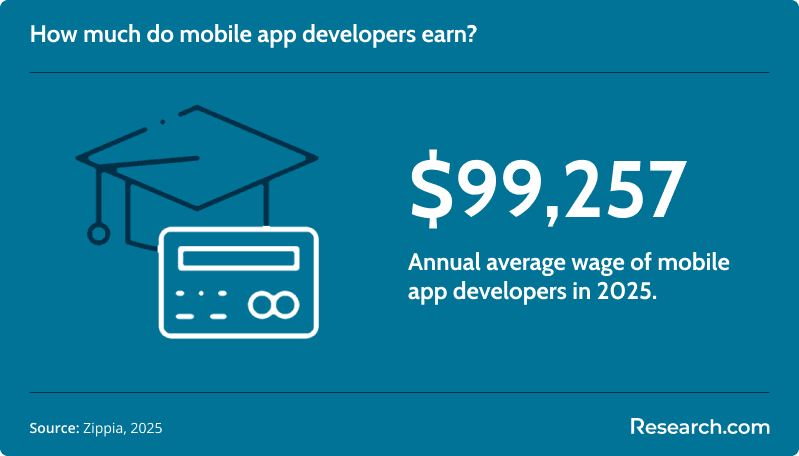
- It offers strong earning potential, with an average salary of around $99,257 for mobile application developers.
- The comprehensive curriculum can prepare you for multiple professional certifications simultaneously, a strategic value that you won't find in shorter courses.
What can I expect from an online mobile app development degree program?
You should expect a structured curriculum that blends practical coding skills, user-focused design principles, and foundational computer science theory. However, it's essential to recognize that this is far more than just a lengthy series of video tutorials.
The real value of these programs is that they teach you how to learn and adapt for your entire career. While you'll undoubtedly learn to code, the deeper goal is to master the timeless principles of logic, problem-solving, and system design. These are the skills that enable you to adapt to any new technology that emerges in the future.
An online mobile app development degree isn't just about building an app today. It's about providing you with the foundational knowledge to be an effective and adaptable software engineer for decades to come. That's the core promise.
Where can I work with an online mobile app development degree?
With this degree, you can work across virtually every industry. While famous tech companies are an option, the largest area of job growth is actually within companies in other sectors—such as finance, healthcare, logistics, and retail. Every company is becoming a tech company, creating a huge demand for what we call "embedded developers."
This is a fantastic opportunity if you already have experience in another field. Combining your industry knowledge with new development skills can make you an incredibly valuable candidate. Beyond these roles, you'll also find positions at dedicated software companies, creative agencies that build apps for various clients, and large enterprises with internal development teams.
How much can I make with an online mobile app development degree?
The average salary for a mobile applications developer is approximately $99,257, and the median salary for all computer occupations is even higher, at around $108,970. But that's just the average.
The real opportunity comes from specialization. Choosing a high-growth, high-value niche is how you can significantly out-earn the median wage. This is possible because nearly every industry now needs specialized developers, and they are willing to pay a premium for them.
For example, developers working in web search portals, libraries, and archives can earn a median wage of $209,350. Those in the financial investments sector see median salaries around $134,810. This shows that combining your development skills with a specific industry focus is the direct path to the highest levels of compensation.
- List of the Best Online Mobile App Development Programs for 2027 List of Programs
- How long does it take to complete an online mobile app development degree program? Completion Time
- How does an online mobile app development degree program compare to an on-campus program? How does an online mobile app development degree program compare to an on-campus program?
- What is the average cost of an online mobile app development program? Program Cost
- What are the financial aid options for students enrolling in an online mobile app development program? Financial Aid
- What are the prerequisites for enrolling in an online mobile app development program? What are the prerequisites for enrolling in an online mobile app development program?
- What courses are typically in an online mobile app development program? What courses are typically in an online mobile app development program?
- How will emerging technologies transform mobile app development careers? How will emerging technologies transform mobile app development careers?
- What types of specializations are available in an online mobile app development program? What types of specializations are available in an online mobile app development program?
- How to choose the best online mobile app development program? How to choose the best online mobile app development program?
- What career paths are available for graduates of an online mobile app development degree program? Career Paths
- What additional credentials can amplify your mobile app development career? What additional credentials can amplify your mobile app development career?
- What is the job market for graduates with an online mobile app development degree? Job Market
Best Online Mobile App Development Degree Programs for 2027
Choosing an online mobile app development program is not just a question of which school teaches coding. The better question is whether the program can help you build job-ready applications, understand software engineering fundamentals, create a portfolio, and qualify for roles in a competitive tech market. This guide is designed for students, career changers, and working professionals who want a structured degree path into mobile, web, software, or applications development.
You will find a ranked list of online programs, cost and timeline comparisons, admissions expectations, common courses, career paths, and practical advice for comparing schools. The goal is to help you decide whether an online mobile app development degree is the right investment—and which program features matter most before you enroll.
If you are comparing mobile development with other digital career paths, you may also want to review related options such as online esports business programs, especially if your long-term goal involves gaming, digital products, or interactive media.
Quick Answer: What Is the Best Online Mobile App Development Program?
The best online mobile app development program is the one that combines regional or recognized accreditation, a strong software development curriculum, hands-on app projects, current tools such as Swift, Kotlin, Java, C#, React Native, Flutter, cloud services, and a portfolio-based capstone. For most students, a bachelor’s program in mobile app development, software engineering, computer science, information technology, or digital technology is the most complete route because it covers both practical coding and durable computer science foundations.
Students who need the fastest job-focused training may consider bootcamps, but a degree generally provides broader preparation for long-term advancement, leadership roles, and graduate study.
How Research.com Evaluates Online Mobile App Development Programs
Program rankings should be used as a starting point, not as the only factor in your decision. A strong online mobile app development degree should match your schedule, budget, learning style, and career target. It should also give you repeated opportunities to build apps, test code, work with databases, and present completed projects to employers.
Our ranking process relies on official and established education data sources, including the IPEDS database, Peterson's database, the College Scorecard, and the National Center for Education Statistics (NCES). These sources help provide a consistent evidence base for reviewing online mobile app development degree options. You can read the full Research.com ranking process in our methodology.
| Rank | School and Program | Best Fit | Key Program Detail |
| 1 | Liberty University — B.S. in Information Technology: Web & Mobile Programming | Students who want IT, web, and mobile programming in one bachelor’s pathway | Certification-oriented curriculum connected to Microsoft and Oracle credentials |
| 2 | Fort Hays State University — B.A. in Information Networking and Telecommunications | Students interested in web, mobile apps, and media convergence | Web and Mobile Application Development concentration |
| 3 | DeVry University — Online Bachelor’s Degree Specialization in Web and Mobile Application Development | Students seeking an accelerated, stackable credential structure | 3-in-1 design that can include a certificate, associate’s degree, and bachelor’s degree |
| 4 | Arkansas State University — B.S. in Digital Technology & Design | Students focused on iOS app development and portfolio creation | Mobile App Development concentration with Swift and Xcode |
| 5 | Baker College — B.S. in Information Systems | Students who want business, management, and development skills | Requires a minimum of 150 hours of relevant work experience |
| 6 | Northeastern University — B.S. in Information Technology | Students who want applications development plus professional experience | STEM-designated program with an Applications Development concentration |
| 7 | ECPI University — B.S. in IT, Software Development, and Coding | Students who want an accelerated UX and web/mobile development path | User Experience and Web/Mobile Development track |
| 8 | Arizona State University — B.S. in Software Engineering | Students who want ABET-accredited software engineering online | Project-driven program with a path to an Accelerated Master’s program |
| 9 | Southern New Hampshire University — B.S. in Computer Science | Students who want a broad computer science degree with software engineering focus | Portfolio-focused curriculum and accelerated BS-to-MS option |
| 10 | Western Governors University — B.S. Software Engineering | Self-paced learners with prior knowledge or strong independent study habits | Competency-based model with Java and C# tracks |
1. Liberty University — B.S. in Information Technology: Web & Mobile Programming
Liberty University offers an online information technology bachelor’s program with a Web & Mobile Programming focus. The curriculum emphasizes applications that work across different platforms and is designed to help students prepare for industry-recognized certifications from organizations such as Microsoft and Oracle.
- Program Length: 4 years
- Required Credits to Graduate: 120
- Tuition: $24,650 per year (full-time)
- Accreditation: Southern Association of Colleges and Schools Commission on Colleges (SACSCOC)
2. Fort Hays State University — B.A. in Information Networking and Telecommunications
Fort Hays State University offers a B.A. in Information Networking and Telecommunications with a Web and Mobile Application Development concentration. The program blends electronic media concepts with web and mobile development tools, and it is structured to support preparation for credentials such as the Certified Web Designer Apprentice (CWDSA).
- Program Length: 4 years
- Concentration: Web and Mobile Application Development
- Required Credits to Graduate: 120
- Cost per Credit: $265.05
- Accreditation: Higher Learning Commission (HLC)
3. DeVry University — Online Bachelor’s Degree Specialization in Web and Mobile Application Development
DeVry University provides a web and mobile application development specialization with a hands-on structure. Its 3-in-1 format lets students work toward a certificate, an associate’s degree, and a bachelor’s degree during the bachelor’s pathway. The program also includes development for connected devices and the Internet of Things (IoT) economy.
- Program Length: 2 years 8 months (accelerated)
- Concentration: Web and Mobile Application Development
- Required Credits to Graduate: 120
- Cost per Credit: $514
- Accreditation: Higher Learning Commission (HLC)
4. Arkansas State University — B.S. in Digital Technology & Design with a Concentration in Mobile App Development
Arkansas State University offers a Digital Technology & Design bachelor’s program with a Mobile App Development concentration. Students focus on iOS development, including Swift and Xcode, and complete the program by producing a market-ready mobile app and a professional portfolio website.
- Program Length: 4 years
- Concentration: Mobile App Development
- Required Credits to Graduate: 120
- Cost per Credit: $282
- Accreditation: Higher Learning Commission (HLC)
5. Baker College — B.S. in Information Systems: Web & Mobile Application Development
Baker College combines business, management, information systems, web development, and mobile application development. The program is built around applied learning and includes a minimum of 150 hours of relevant work experience plus a senior capstone project.
- Program Length: 4 years
- Concentration: Web and Mobile Application Development
- Required Credits to Graduate: 120
- Cost per Credit: $450
- Accreditation: Higher Learning Commission (HLC)
6. Northeastern University — B.S. in Information Technology, Applications Development Concentration
Northeastern University offers a STEM-designated information technology bachelor’s program with an Applications Development concentration. The program uses challenge-based learning, includes business-oriented skills such as project management, and may allow students to apply existing certifications such as A+ or PMP toward credits.
- Program Length: 4 years
- Concentration: Applications Development
- Required Credits to Graduate: 120
- Cost per Credit: $541
- Accreditation: New England Commission of Higher Education (NECHE)
7. ECPI University — B.S. in IT, Software Development, and Coding
ECPI University offers an accelerated bachelor’s program that connects user experience design with software development and coding. Its User Experience and Web/Mobile Development track is designed for students who want to build applications that are functional, usable, and engaging. The program also provides discounted vouchers for selected certification exams.
- Program Length: 2.5 years
- Track: User Experience and Web/Mobile Development
- Required Credits to Graduate: 120
- Cost per Semester: $8,712
- Accreditation: Southern Association of Colleges and Schools Commission on Colleges (SACSCOC)
8. Arizona State University — B.S. in Software Engineering
Arizona State University offers an online B.S. in Software Engineering that is ABET-accredited. The project-based curriculum is suitable for students who want broader software engineering preparation in addition to mobile-related skills. The program also provides a route into an Accelerated Master’s program.
- Program Length: 4 years
- Required Credits to Graduate: 120
- Cost per Credit: $763
- Accreditation: Accreditation Board for Engineering and Technology (ABET)
9. Southern New Hampshire University — B.S. in Computer Science
Southern New Hampshire University offers a B.S. in Computer Science with a Software Engineering concentration. Students work on code improvement, security, testing, and portfolio development. The program also includes an accelerated BS-to-MS pathway that allows qualified students to complete graduate-level courses at the lower undergraduate tuition rate.
- Program Length: 4 years
- Concentration: Software Engineering
- Required Credits to Graduate: 120
- Cost per Credit: $342
- Accreditation: New England Commission of Higher Education (NECHE)
10. Western Governors University — B.S. Software Engineering
Western Governors University uses a competency-based learning model, which can work well for students who already know some programming or IT concepts. The B.S. Software Engineering program includes industry-recognized certifications and gives students a choice between Java and C# tracks.
- Program Length: 35 months (average)
- Tracks: Java and C#
- Required Competency Units to Graduate: 119
- Tuition: $4,125 per 6-month term
- Accreditation: Northwest Commission on Colleges and Universities (NWCCU)
How Long Does an Online Mobile App Development Degree Take?
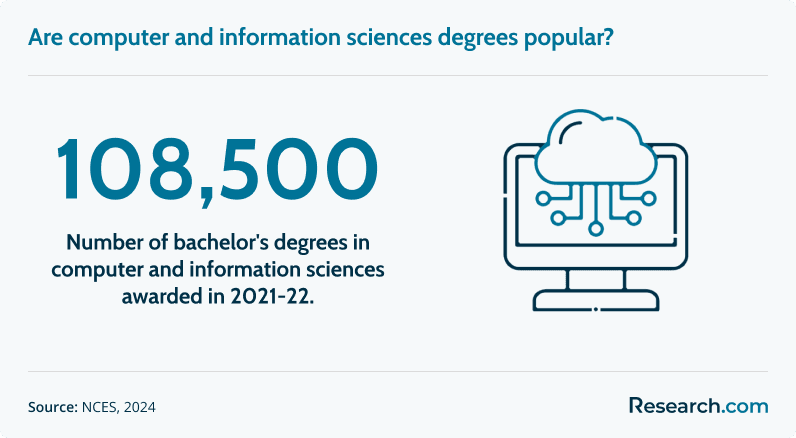
A bachelor’s degree in mobile app development or a closely related field usually requires 4 years of full-time study. This remains a common pathway into technology careers, and more than 108,500 bachelor's degrees in computer and information sciences were awarded in the 2021-22 academic year.
Actual completion time depends on transfer credits, course load, academic calendar, and program format. Some students finish faster in accelerated or competency-based programs, while part-time students may take longer because they balance school with work or family responsibilities.
| Path | Typical Time Commitment | Best For | Main Trade-Off |
| Bachelor’s degree | 4 years | Students who want broad preparation, a credential, and long-term advancement options | Requires more time and tuition than short-form training |
| Accelerated bachelor’s degree | 2.5 years to 35 months (average), depending on the program listed | Motivated students who can manage a heavier pace | Less flexibility if life or work demands increase |
| Part-time online degree | Longer than 4 years in many cases | Working adults and students with caregiving responsibilities | Delays graduation and potential career transition |
| Coding bootcamp | Shorter and more intensive than a degree | Learners who need focused job skills quickly | Usually offers less theory, general education, and long-term credential value |
Degree vs. Bootcamp: Which Makes More Sense?
A bootcamp can be a practical option when you need concentrated training in a specific tool, language, or entry-level development workflow. Students who prioritize speed often compare degree programs with the shortest online software engineering bootcamps.
A degree is broader. It normally includes programming, databases, software engineering, algorithms, security, systems thinking, and general education. That wider foundation can matter when you want to move beyond junior development into senior engineering, product leadership, architecture, or graduate study.
Online vs. On-Campus Mobile App Development Programs: What Changes?
At reputable institutions, the most important academic elements should be the same whether you study online or in person: curriculum standards, faculty oversight, credit requirements, and degree requirements. The main difference is how you participate in class, collaborate with peers, complete labs, and manage your schedule.
Online programs can be especially useful for working adults, students outside major metro areas, and learners who need flexibility. They also require strong self-management. In mobile development, this can be an advantage because remote collaboration, asynchronous communication, version control, and independent problem-solving are common in real software teams.
| Factor | Online Program | On-Campus Program |
| Schedule flexibility | Usually stronger, especially in asynchronous courses | Often tied to fixed class times |
| Networking | Requires more deliberate effort through forums, projects, and virtual events | May provide easier face-to-face networking |
| Hands-on projects | Can be strong if the program uses GitHub, labs, capstones, and team projects | May include in-person labs, clubs, and campus-based collaboration |
| Employer perception | Depends heavily on accreditation, school reputation, and portfolio quality | Also depends on accreditation, school reputation, and portfolio quality |
| Best for | Independent learners who need location or schedule flexibility | Students who want campus life and in-person support |
Accreditation Matters More Than Delivery Format
Before you focus on whether a program is online or campus-based, verify the school’s accreditation. Employers and graduate schools generally care more about whether the institution is recognized and whether you can demonstrate your skills than whether you attended lectures in a classroom.
This same principle applies across many online fields: a properly structured online program from an accredited institution can carry academic weight comparable to its campus counterpart. Students evaluating online formats in other disciplines may see similar considerations in options such as the shortest online bioinformatics master's programs.
How Much Does an Online Mobile App Development Program Cost?
Tuition varies by institution type, residency rules, credit structure, fees, and whether a program charges by credit, semester, year, or term. Among the programs reviewed, the average total tuition for an online mobile app development degree is around $58,586.
The total tuition range is about $31,806 to $98,600. Online students may reduce some non-tuition expenses, including campus housing, meal plans, and commuting, but they should still budget for books, software, hardware, fees, internet access, and possible certification exams.
How to Think About ROI Without Overpromising Outcomes
Cost should be compared with career goals, completion time, debt, employer support, and the strength of your portfolio. The median salary for computer occupations is over $108,000 per year, but salary outcomes vary by role, location, experience, employer, and technical skill level.
A degree can be valuable because it bundles structured instruction, projects, advising, academic support, and preparation for multiple career paths. Students in other career-focused online programs often use a similar time-and-cost lens when comparing options such as the shortest RN to MSN online nursing programs.
| Cost Factor | Why It Matters | Question to Ask |
| Tuition model | Per-credit, per-term, and annual pricing can produce very different totals | What is the estimated total tuition to graduation? |
| Transfer credits | Accepted credits can reduce both time and cost | How many of my credits will apply to the major, not just electives? |
| Fees and technology costs | Online programs may charge platform, lab, assessment, or graduation fees | What costs are not included in advertised tuition? |
| Certifications | Some programs include or discount certification preparation | Are exam vouchers included, discounted, or separate? |
| Financial aid eligibility | Aid access depends on accreditation, enrollment status, and student eligibility | Can students in this online program use federal financial aid? |
Financial Aid Options for Online Mobile App Development Students
Students enrolled in accredited online programs may qualify for many of the same financial aid options available to campus-based students. Eligibility depends on the school, program, enrollment intensity, citizenship or residency status, satisfactory academic progress, and other aid rules.
- Complete the FAFSA first. The Free Application for Federal Student Aid is the starting point for federal aid, including Pell Grants and federal student loans.
- Look for scholarships tied to technology. Search for general scholarships, STEM awards, scholarships for women in technology, and awards for students from underrepresented groups.
- Ask your employer about tuition benefits. Many employers offer tuition reimbursement or education assistance when a degree supports the employee’s current or future role.
- Review school payment plans. Some institutions allow students to divide tuition into scheduled payments rather than paying the full balance at once.
- Compare aid after total cost, not sticker price. A lower tuition program is not always the least expensive after scholarships, transfer credits, and employer support are counted.
Do Not Ignore Employer Funding
Working students should check with human resources before enrolling. If your current job involves IT, product support, data, design, operations, or digital systems, your employer may view mobile development training as a business benefit. Ask whether reimbursement applies only to certain schools, grades, degree levels, or job-related courses.
Admissions Requirements for Online Mobile App Development Programs
Most bachelor’s programs require a high school diploma or equivalent, such as a GED. Applicants may also need transcripts, an application form, and proof of college readiness. A background in Algebra II or similar high school math can help, but most bachelor’s programs are built to teach programming fundamentals from the beginning.
Prior coding experience is helpful but usually not required for admission. A bachelor’s degree is a common route into the field; 69% of mobile app developers hold a bachelor's degree.
Mobile App Development vs. Computer Science
A mobile app development pathway is usually more applied. It is a good fit if you want to design, build, test, and improve apps that people use on phones, tablets, wearables, or connected devices.
A computer science degree is typically broader and more theory-heavy, with deeper coverage of computation, algorithms, systems, and mathematics. If you want to compare a broader CS pathway with a mobile-focused curriculum, review options such as the shortest online bachelor's programs in computer science.
| Choose This Path | If You Want | Watch Out For |
| Mobile app development | Applied app-building, platform tools, UI/UX, and product-focused projects | Some programs may be too narrow if they skip software fundamentals |
| Software engineering | Broader development preparation, testing, systems design, and engineering practices | May not include as much platform-specific mobile work |
| Computer science | Strong theory, algorithms, systems, and flexible long-term technical preparation | May require more self-directed mobile portfolio building |
| Information technology | Applied technology, systems, networks, databases, and business technology support | May be less coding-intensive depending on the concentration |
Common Courses in an Online Mobile App Development Degree
A high-quality program should teach more than one programming language or mobile platform. The strongest curricula balance coding, software design, databases, security, user experience, testing, and project work.
- Programming fundamentals: Students learn core programming logic, syntax, debugging, and problem-solving, often through languages such as Python or Java.
- iOS and Android development: Platform courses may cover Swift for iOS, Kotlin for Android, or development environments such as Xcode.
- Cross-platform development: Some programs include frameworks that allow developers to build for multiple platforms from a shared codebase.
- UI/UX design: Students study usability, accessibility, interaction design, wireframing, and user-centered product decisions. Learners who want to focus more deeply on design can compare options such as an affordable online UI/UX degree.
- Databases and cloud services: Courses may cover how apps store, retrieve, secure, and synchronize data through databases and cloud platforms such as AWS and Azure.
- Security and testing: Mobile apps must protect user data, handle authentication, and perform reliably across devices and operating system versions.
- AI and machine learning concepts: Some programs introduce intelligent features, automation, personalization, and ethical considerations.
- Capstone project: A final project should allow students to build, document, test, and present a complete application for their portfolio.
Why Fundamentals Matter More Than the Newest Tool
Languages, libraries, devices, and development frameworks change. Core concepts such as data structures, algorithms, software architecture, testing, databases, and secure design change much more slowly. These foundations help you adapt when employers shift from one framework to another or when mobile development expands into new device categories.
How Emerging Technologies Are Changing Mobile App Development Careers
Mobile app development is increasingly shaped by artificial intelligence, connected devices, automation, cloud infrastructure, security expectations, and cross-platform development. Employers may look for developers who can build usable apps, integrate APIs, protect data, work with cloud services, and understand how AI-enabled features affect users.
That does not mean every student needs to chase every trend. A better strategy is to build a strong engineering base, then add specialized skills that match your target industry. Students interested in interdisciplinary technology careers can also compare specialized online fields such as online space studies master's programs to see how software skills connect with other technical domains.
Mobile App Development Specializations to Consider
Students can specialize by platform, framework, industry, or function. The right choice depends on the type of products you want to build and the employers you hope to target.
| Specialization | What You Study | Best For |
| iOS development | Swift, Xcode, Apple platform standards, app store requirements | Students who want to build for Apple devices |
| Android development | Kotlin, Android Studio, device compatibility, Google ecosystem tools | Students who want broad global platform exposure; Android holds over 71% of the market |
| Cross-platform development | React Native, Flutter, shared codebases, multi-platform deployment | Developers who want to build apps efficiently for more than one platform |
| Mobile UX/UI | Interaction design, prototyping, usability testing, accessibility | Students who want to connect design decisions with front-end development |
| Mobile security | Authentication, encryption, secure coding, privacy, app hardening | Students interested in protecting apps and user data |
| Gaming and interactive media | Real-time interaction, game interfaces, graphics, user engagement | Students interested in entertainment technology or who may also compare an accelerated online game art and design degree |
When Specializing Helps
General coding ability can get you started, but specialization can make your profile clearer to employers. A healthcare app team may value developers who understand privacy and security. A financial technology employer may prioritize secure transactions. A game studio may look for interactive design and performance skills. The strongest graduates often combine a technical foundation with a visible niche.
How to Choose the Best Online Mobile App Development Program
Start by defining your goal. Do you want to become an iOS developer, Android developer, software engineer, UI/UX engineer, product-focused technologist, or future solutions architect? Once you know the role you are aiming for, compare programs based on evidence rather than marketing language.
- Confirm accreditation. Make sure the institution has recognized accreditation before you consider cost, speed, or curriculum.
- Read the course list carefully. Look for programming, data structures, databases, software engineering, testing, security, cloud, and mobile platform courses.
- Check project requirements. Prioritize programs that require multiple portfolio projects, not just exams and discussion posts.
- Ask about career support. Look for resume help, portfolio reviews, mock interviews, internship guidance, and employer connections.
- Compare transfer policies. Transfer credit can significantly reduce time and cost, but only if credits apply to degree requirements.
- Evaluate faculty and industry relevance. Instructors with applied software experience can help connect theory to real development workflows.
- Calculate total cost. Include tuition, fees, hardware, software, textbooks, certification exams, and lost income if you reduce work hours.
The Portfolio Test
The best program for employment is usually the one that helps you graduate with strong proof of skill. A diploma may help you qualify for an interview, but a portfolio shows what you can build. Look for capstones, GitHub-based assignments, team projects, mobile app demos, documented code, and projects that solve real user problems.
This logic applies beyond mobile development. For example, students in a master's degree in mathematics online program may also need to show applied problem-solving work, not only completed coursework.
| Common Mistake | Why It Can Hurt You | Better Approach |
| Choosing the cheapest program without checking accreditation | Credits, aid, and employer recognition may be limited | Verify accreditation before comparing price |
| Focusing only on mobile tools | Tools change quickly, and narrow training may age poorly | Choose a program with software fundamentals and mobile projects |
| Ignoring portfolio requirements | You may graduate without proof of job-ready skills | Prioritize programs with capstones and repeated project work |
| Assuming online means easier | Online learning requires time management and independent work | Confirm weekly workload and support before enrolling |
| Looking only at rankings | A highly ranked program may not fit your budget, pace, or goals | Use rankings as a shortlist, then compare fit |
| Overlooking transfer credit rules | You may pay for courses you thought would transfer | Request a written transfer evaluation |
Career Paths With an Online Mobile App Development Degree
A mobile app development degree can lead directly to mobile developer roles, but it can also support broader careers in software engineering, applications development, product technology, UX engineering, and technical leadership. Students who want a broader software pathway may also compare the fastest online bachelor's in software engineering.
| Career Path | Typical Responsibilities | What Helps You Stand Out |
| Mobile Developer / Software Engineer (Mobile) | Design, code, test, maintain, and update iOS or Android applications | Published apps, GitHub portfolio, platform-specific skills, and testing experience |
| Application Developer | Build web, mobile, or enterprise applications for internal or customer use | Database, API, cloud, and full-stack development experience |
| UI/UX Engineer | Translate user experience and interface designs into functional front-end experiences | Design systems, accessibility knowledge, prototyping, and front-end coding |
| Product Manager | Define product direction, prioritize features, coordinate teams, and connect user needs with business goals | Technical fluency, user empathy, analytics, communication, and business judgment |
| Solutions Architect (Mobile) | Design the technical structure for complex mobile and connected systems | Years of development experience, systems thinking, cloud knowledge, and leadership skills |
Advancement: From Developer to Architect
Many students begin with coding roles and later move into senior developer, lead engineer, engineering manager, product, or architecture positions. For professionals with an IT background, mobile development can be a bridge into higher-value design and systems roles. Industry data shows that roles in IT architecture and design are among the highest paying in technology, with average salaries exceeding $156,000.
Additional Credentials That Can Strengthen a Mobile Development Career
A bachelor’s degree can provide the foundation, but targeted credentials may help you demonstrate specialized skills. Depending on your goals, useful add-ons may include certifications or training in cloud computing, cybersecurity, data analytics, agile methods, UX design, or a platform-specific development stack.
Students who decide they need deeper theory or a faster route into broader computing roles can compare degree options such as a fast track computer science degree. The best credential strategy is not to collect certificates randomly, but to choose credentials that support a clear target role.
Job Outlook for Online Mobile App Development Graduates
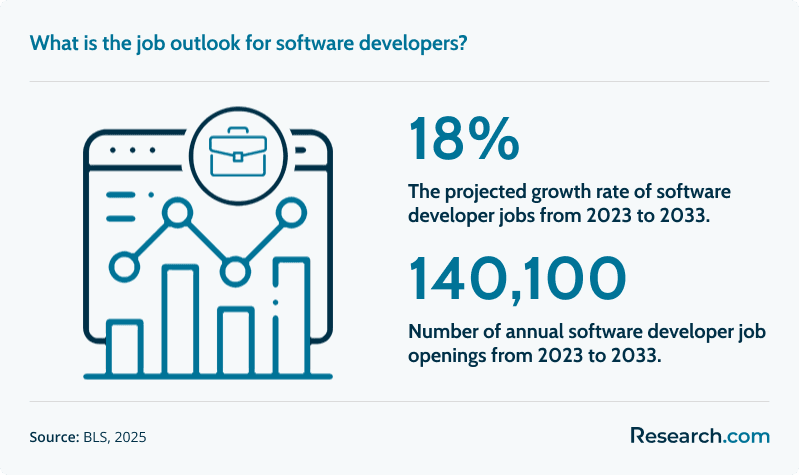
The labor market for software developers remains strong, but entry-level roles are still competitive. According to the U.S. Bureau of Labor Statistics, software developer jobs are projected to grow by 18% between 2023 and 2033.
That projection equals about 140,100 job openings each year, on average, over the decade. An online mobile app development degree can help students prepare for this market, but hiring depends on more than the credential. Employers typically evaluate technical interviews, projects, internships, communication skills, problem-solving ability, and experience with real development tools.
What Employers Are Likely to Look For
- Working applications: Employers want to see apps that run, solve a problem, and show thoughtful design.
- Clean code and documentation: A GitHub repository with readable code can be more persuasive than a vague resume bullet.
- Testing and debugging ability: Mobile apps must work across devices, screen sizes, network conditions, and operating system versions.
- Collaboration skills: Developers often work with designers, product managers, QA testers, data teams, and security teams.
- Adaptability: AI tools, frameworks, and platform requirements change quickly, so employers value learners who can keep improving.
What Graduates Say About Online Mobile App Development Programs
- : "I started the program worried that coding was only for people who already felt technical. The project sequence changed that for me. Each assignment built on the last one, and the first time I ran an app on my own phone, I realized I could actually do this professionally. — Kianna"
- : "I was concerned that I would pay for a degree and leave with skills that were already outdated. What helped most was learning how engineers think. Data structures and algorithms gave me tools I can use even when languages and frameworks change. — Porter"
- : "I enrolled because I wanted to learn app coding, but the UI/UX course completely changed how I approach development. Now I think less about whether a feature simply works and more about whether people can actually use it well. — Adebayo"
Questions to Ask Before Enrolling
- Is the institution accredited, and by which accreditor?
- Does the curriculum include mobile-specific courses, or is mobile development only mentioned briefly?
- Will I graduate with a complete app, a GitHub portfolio, or a capstone project?
- Are iOS, Android, and cross-platform tools covered?
- How many credits can I transfer, and will they apply to the major?
- What is the full cost, including fees, software, books, and equipment?
- Does the program include career services for online students?
- Are internships, work experience, or employer-connected projects available?
- Can I study part-time, accelerate, or pause if my work schedule changes?
- What certifications, if any, are included or supported?
References
- Bureau of Labor Statistics. (2024). Field of degree: Computer and information technology. U.S. Bureau of Labor Statistics. Retrieved July 25, 2025, from BLS.
- Bureau of Labor Statistics. (2025a). 15-1299 Computer Occupations, All Other - Occupational Employment and Wage Statistics (OEWS) Profiles. U.S. Bureau of Labor Statistics. Retrieved July 25, 2025, from BLS.
- Bureau of Labor Statistics. (2025b). Computer and information technology occupations. U.S. Bureau of Labor Statistics. Retrieved July 25, 2025, from BLS.
- IDC. (2024). IT skills shortage expected to impact nine out of ten organizations by 2026 with a cost of $5.5 trillion in delays, quality issues and revenue loss, according to IDC. Retrieved July 25, 2025, from IDC.
- Mordor Intelligence. (2025). Mobile application development platform market size & share analysis - Growth trends & forecasts (2025 - 2030). Retrieved July 25, 2025, from Mordor Intelligence.
- National Center for Education Statistics. (2024). Undergraduate degree fields. U.S. Department of Education, Institute of Education Sciences. Retrieved July 25, 2025, from NCES.
- Skillsoft. (2024). 2024-25 IT skills & salary report. Retrieved July 25, 2025, from Skillsoft.
- Zippia. (2025). Mobile applications developer education requirements. Retrieved July 25, 2025, from Zippia.
- Zippia. (2025). Mobile applications developer salary. Retrieved July 25, 2025, from Zippia.
Key Insights
- An online mobile app development degree is best for students who want structured training, a recognized credential, and a portfolio of completed applications.
- Most bachelor’s programs take 4 years, but accelerated and competency-based formats can shorten the timeline for prepared students.
- Accreditation, curriculum depth, project work, and portfolio outcomes matter more than whether a program is online or campus-based.
- The reviewed programs show an average total tuition of around $58,586, with a range of about $31,806 to $98,600.
- Strong programs teach both current mobile tools and durable fundamentals such as algorithms, databases, testing, security, and software design.
- Bootcamps can be useful for fast skill-building, but a bachelor’s degree usually offers broader preparation for advancement and long-term flexibility.
- The job outlook is favorable, with software developer employment projected to grow by 18% between 2023 and 2033, but entry-level candidates still need a strong portfolio.
- Before enrolling, ask how many real apps you will build, whether you will complete a capstone, how transfer credits apply, and what the true total cost will be.
Other Things You Should Know About Online Mobile App Development Programs
Graduates from the best online mobile app development degree programs in 2027 can expect diverse career prospects. Opportunities include positions like mobile app developer, UX/UI designer, and mobile project manager. The booming tech industry ensures high demand for skilled professionals, promising competitive salaries and career growth.
Yes, many top programs in 2027 incorporate industry certifications such as Apple's iOS Developer Certification or Google Associate Android Developer within their curriculum, enhancing employability and ensuring skills meet current industry standards. Check individual program offerings for specific certifications included.
The top online mobile app development degree programs in 2027 offer unique features like industry-aligned curricula, hands-on project opportunities, and partnerships with tech companies. These programs also emphasize emerging technologies, such as AI and IoT, ensuring that students are prepared for future trends in mobile app development.


