
2027 Best Online MSN in Health/Nursing Informatics Programs

Co-Founder and Chief Data Scientist
Digital health records are essential to modern healthcare’s daily functions. The latest data from the Office of the National Coordinator for Health Information Technology show that 78% of office-based physicians and 96% of non-federal acute care hospitals have adopted certified electronic health record (EHR) systems.
This technology helps healthcare teams analyze health data accurately, and it requires professionals who can bridge the gap between clinical practice and information systems. Through online health/nursing informatics programs, nurses gain the education and training needed to help improve care quality, optimize healthcare operations, and develop data-driven clinical decisions (American Nurses Association, 2023).
In this guide, I'll explore the best online MSN in health/nursing informatics programs. I will also discuss helpful insights into academic requirements, career pathways, job outlook, and salary expectations to help aspiring professionals select the best program.
What are the benefits of getting into online MSN in health/nursing informatics programs?
- Flexible online health/nursing informatics programs help students earn a Master of Science in Nursing (MSN) while balancing work and other commitments.
- Graduates are equipped with the skills to stand out in a competitive job market by combining clinical expertise with advanced knowledge of health information systems and data analytics.
- Both registered nurses (RNs) and health information technologists have bright job prospects, between 9% to 16%, providing plenty of openings throughout the decade.
What can I expect from an MSN in health/nursing informatics program?
An MSN in health or nursing informatics is a graduate-level program that blends advanced nursing practice with data science, health information systems, and digital healthcare technologies. These programs prepare RNs to analyze clinical data, manage electronic health records, and lead digital transformation initiatives that improve care delivery and patient outcomes.
Moreover, online health/nursing informatics programs offer the flexibility to study part-time or full-time. Many utilize asynchronous lectures, interactive modules, and virtual collaboration tools to deliver the lessons and create rich online learning environments. They also support self-paced learning and include practical experiences through local practicums, making them ideal for nurses who want to continue working while earning their MSN.
Where can I work with an online MSN in health/nursing informatics?
Graduates of online health/nursing informatics programs are prepared to work in a variety of healthcare settings. With the ability to analyze data, manage electronic health systems, and lead quality improvement efforts, informatics nurses are needed across the following settings:
- Hospitals and Health Systems: Informatics nurses help implement and manage EHR systems, train staff on digital tools, and analyze clinical workflows.
- Government and Public Health Agencies: Here, they contribute to population health initiatives, policy development, and health data reporting.
- Health IT Companies: Informatics nurses may consult on software development and system usability by testing and evaluating digital health solutions.
- Universities and Research Institutions: In these settings, informatics nurses participate in clinical research, evaluate data systems, and teach future professionals.
- Insurance and Managed Care Organizations: Professionals in this field analyze patient data to track outcomes, improve care coordination, and support value-based care models.
How much can I make with an online MSN in health/nursing informatics?
According to ZipRecruiter, informatics nurses earn an average annual salary of $98,409. Most professionals in this role make between $70,000 and $122,500, while top earners can reach $150,500 yearly. Similarly, the U.S. Bureau of Labor Statistics reports that RNs earn an average income of $98,430, with wages ranging from $66,030 to $135,320.
In comparison, a report from the Healthcare Information and Management Systems Society (HIMSS) shows that 60% of nurse informaticists earned $100,000 or more for their base annual salaries. Certifications in nursing informatics further boost earnings, with those credentialed in the field earning from $101,000 to $125,000.
Informatics nurse salaries may also vary depending on geographic location. For instance, nurses in major metropolitan areas or states with high costs-of-living often earn more than those in rural regions.
Additionally, nurses working in large hospital systems, government agencies, or health tech companies may command higher wages due to the scale and complexity of their work. Lastly, experience and educational attainment can significantly enhance earning potential.
- Best Online MSN in Health/Nursing Informatics Programs for 2027 List of Programs
- How long does it take to complete an online MSN in health/nursing informatics program? Completion Time
- How does an online MSN in health/nursing informatics program compare to an on-campus program? How does an online MSN in health/nursing informatics program compare to an on-campus program?
- What is the average cost of an online MSN in health/nursing informatics program? Program Cost
- What are the financial aid options for students enrolling in an online MSN in health/nursing informatics program? Financial Aid
- What are the prerequisites for enrolling in an online MSN in health/nursing informatics program? What are the prerequisites for enrolling in an online MSN in health/nursing informatics program?
- What courses are typically in an online MSN in health/nursing informatics program? What courses are typically in an online MSN in health/nursing informatics program?
- What types of specializations are available in online MSN in health/nursing informatics programs? What types of specializations are available in online MSN in health/nursing informatics programs?
- How to choose the best online MSN in health/nursing informatics program? How to choose the best online MSN in health/nursing informatics program?
- What career paths are available for graduates of online MSN in health/nursing informatics programs? Career Paths
- What is the job market for graduates with an online MSN in health/nursing informatics program? Job Outlook
- How do accreditation and quality standards impact online MSN in health/nursing informatics programs? How do accreditation and quality standards impact online MSN in health/nursing informatics programs?
- What is the return on investment of an online MSN in health/nursing informatics program? What is the return on investment of an online MSN in health/nursing informatics program?
Best Online MSN in Health/Nursing Informatics Programs for 2027
Choosing an online MSN in health or nursing informatics is not just a question of convenience. It is a decision about how you want to use clinical experience, data, health technology, and systems thinking to improve patient care. For registered nurses who want to move beyond bedside practice, informatics can lead to roles in electronic health records, clinical systems, analytics, workflow redesign, quality improvement, education, consulting, and executive technology leadership.
This guide is for nurses comparing online MSN informatics programs, weighing tuition against career outcomes, or deciding whether informatics is the right graduate pathway. You will find ranked program options, cost and timeline comparisons, admissions expectations, common courses, career paths, job market context, accreditation considerations, and practical questions to ask before enrolling.
Quick Answer: What should you know about online MSN in health/nursing informatics programs?
An online MSN in health or nursing informatics prepares licensed nurses to connect clinical practice with health information systems, data analysis, digital tools, and technology implementation. Most programs take about two years, although timelines vary by enrollment pace, transfer credits, and practicum requirements. Students should prioritize CCNE- or ACEN-accredited programs, clear practicum support, relevant informatics coursework, certification preparation, and total program cost rather than tuition alone.
The strongest choice is not always the cheapest or most prestigious program. The best fit depends on whether you need a flexible schedule, local practicum placement, preparation for the ANCC Informatics Nursing Certification exam, leadership training, analytics depth, or employer tuition support.
How we ranked these online MSN informatics programs
A graduate nursing degree requires a major investment of time, money, and professional energy. Research.com built this ranking using a data-informed ranking methodology designed to help prospective students compare programs with more confidence.
To support the review process, we considered information from the Integrated Postsecondary Education Data System, Peterson’s database and its Distance Learning Licensed Data Set, College Scorecard, and the National Center for Education Statistics (NCES). Students should still verify current tuition, admission policies, clinical placement rules, and state authorization directly with each school before applying.
Best online MSN in health/nursing informatics programs
| Rank | School | Program focus | Program length | Credits | Cost information | Accreditation |
| 1 | Duke University | Health Informatics | 2–3 years | 38 | $2,250 per credit | Commission on Collegiate Nursing Education (CCNE) |
| 2 | University of Mary | Nursing & Health Care Informatics | 2 years | 38 | $510 per credit | CCNE |
| 3 | University of Pittsburgh | Nursing Informatics | 2 years | 39.5 | $1,280 in-state, $1,595 out-of-state per credit | CCNE |
| 4 | University of Maryland | Nursing Informatics | 2 years | 36 | $926 in-state, $1,643 out-of-state per credit | CCNE |
| 5 | University of Utah | Nursing Informatics | 1.5 years | 41 | $21,408 estimated total tuition and fees | CCNE |
| 6 | Vanderbilt University | Nursing Informatics | 2 years | 36 | $2,057 per credit | CCNE |
| 7 | University of Colorado Anschutz Medical Campus | Health Care Informatics | 2.4 years | 34 | $801 in-state, $1,298 out-of-state per credit | CCNE |
| 8 | University of South Carolina-Columbia | Nursing Informatics | 2–3 years | 36 | $32,271 in-state, $57,390 out-of-state estimated total cost | CCNE |
| 9 | Western Governors University | Nursing Informatics | 2 years | 36 | $5,035 per six-month term | CCNE |
| 10 | St. Catherine University | Data Analytics | 2 years | 31 | $760 per credit | Accreditation Commission for Education in Nursing (ACEN) |
1. Duke University
Duke University offers a distance-based MSN in Health Informatics for working professionals who want online coursework with limited in-person engagement. Students complete most academic requirements remotely and attend two on-campus intensives that support face-to-face collaboration, applied learning, and faculty interaction.
The program is built around real-world informatics work in clinical environments. Coursework includes database design, data analytics, and system implementation, and students complete at least 224 clinical hours through a practicum coordinated with healthcare sites in their area.
- Program Length: 2–3 years
- Tracks/Concentrations: Health Informatics
- Cost per Credit: $2,250
- Required Credits to Graduate: 38
- Accreditation: Commission on Collegiate Nursing Education (CCNE)
2. University of Mary
The University of Mary offers an online BSN to MSN in Nursing and Health Care Informatics for nurses who want to use research, analytics, and information systems to improve healthcare operations. The program includes 360 clinical hours, giving students structured opportunities to apply informatics concepts in practice.
Students study how health data, technology, and informatics principles can improve care delivery, safeguard health information, and support better outcomes. The curriculum prepares graduates to work between clinical teams and technology groups, contribute to health policy discussions, and help design informatics tools that fit real healthcare workflows.
- Program Length: 2 years
- Tracks/Concentrations: Nursing & Health Care Informatics
- Cost per Credit: $510
- Required Credits to Graduate: 38
- Accreditation: CCNE
3. University of Pittsburgh
The University of Pittsburgh offers an MSN in Nursing Informatics that brings together nursing, cognitive science, computer science, and information science. The program focuses on preparing nurses to design, improve, and evaluate technologies that support patient care and clinical decision-making.
Students combine academic coursework with applied learning in clinical settings. The concentration also emphasizes leadership development, which can support careers in clinical practice, education, administration, research, consulting, and health technology improvement.
- Program Length: 2 years
- Tracks/Concentrations: Nursing Informatics
- Cost per Credit: $1,280 (in-state), $1,595 (out-of-state)
- Required Credits to Graduate: 39.5
- Accreditation: CCNE
4. University of Maryland
The University of Maryland offers an online MSN in Nursing Informatics using a competency-based model that encourages students to apply new skills as they progress. The format is designed for working professionals who may take one or two courses at a time while continuing to gain field experience.
The curriculum develops practical competence in data management, information technology, informatics tool evaluation, and healthcare technology leadership. Students also receive complimentary access to online nursing informatics certification review workshops, which may be useful for graduates planning to pursue professional certification.
- Program Length: 2 years
- Tracks/Concentrations: Nursing Informatics
- Cost per Credit: $926 (in-state), $1,643 (out-of-state)
- Required Credits to Graduate: 36
- Accreditation: CCNE
5. University of Utah
The University of Utah offers an online MS in Nursing with a Nursing Informatics focus. Clinical experiences may be completed locally or online, which can be helpful for nurses who need flexibility while meeting applied learning requirements.
The program trains students to integrate nursing, information science, and computer science to improve care quality and system performance. Coursework also addresses ethical leadership, regulatory compliance, data analytics, health information system evaluation, and the design of user-centered informatics solutions.
- Program Length: 1.5 years
- Tracks/Concentrations: Nursing Informatics
- Estimated Total Tuition and Fees: $21,408
- Required Credits to Graduate: 41
- Accreditation: CCNE
6. Vanderbilt University
Vanderbilt University offers an online MSN in Nursing Informatics that uses video-streamed lectures, online discussions, virtual exams, and interactive learning activities. The program focuses on designing systems that align people, clinical processes, and technology to support better care delivery.
Students study informatics foundations alongside leadership, quality improvement, and design thinking. Practicum placements are arranged through coordination among the student, Vanderbilt faculty, and a partner organization, making placement planning an important factor for applicants to discuss early.
- Program Length: 2 years
- Tracks/Concentrations: Nursing Informatics
- Cost per Credit: $2,057
- Required Credits to Graduate: 36
- Accreditation: CCNE
7. University of Colorado Anschutz Medical Campus
The University of Colorado Anschutz Medical Campus offers an online MS in Health Care Informatics that blends nursing knowledge with informatics and related disciplines. The curriculum includes core nursing coursework, informatics classes, and specialized study in digital health tools and information systems.
Instead of a traditional clinical practicum, students complete an internship focused on applying informatics skills to improve care quality and support clinical decision-making. This structure may appeal to nurses looking for a flexible pathway into health informatics roles beyond traditional bedside practice.
- Program Length: 2.4 years
- Tracks/Concentrations: Health Care Informatics
- Cost per Credit: $801 (in-state), $1,298 (out-of-state)
- Required Credits to Graduate: 34
- Accreditation: CCNE
8. University of South Carolina-Columbia
The University of South Carolina-Columbia offers an online MSN in Nursing Informatics that combines nursing, computer science, and information science. Students study system design, data management, project coordination, and evidence-informed decision-making for healthcare technology environments.
Coursework is completed online, and students also complete a practicum for hands-on experience. The program is designed to help students prepare for national certification through the ANCC and pursue roles such as informatics nurse specialist, clinical analyst, or director of clinical informatics.
- Program Length: 2–3 years
- Tracks/Concentrations: Nursing Informatics
- Estimated Total Cost: $32,271 (in-state), $57,390 (out-of-state)
- Required Credits to Graduate: 36
- Accreditation: CCNE
9. Western Governors University
Western Governors University offers a BSN to MSN in Nursing Informatics that emphasizes nursing knowledge, data analysis, information management, communication, and systems thinking. The evidence-based curriculum focuses on turning healthcare data into usable insight for care improvement and policy support.
The program includes applied practice and gives students the opportunity to earn the NAHQ HQ Principles certificate while completing the degree. Graduates are prepared to collaborate across clinical, administrative, and technical teams on data-driven healthcare initiatives.
- Program Length: 2 years
- Tracks/Concentrations: Nursing Informatics
- Cost per Six-Month Term: $5,035
- Required Credits to Graduate: 36
- Accreditation: CCNE
10. St. Catherine University
St. Catherine University offers an online MSN in Data Analytics that combines advanced nursing preparation with healthcare-focused analytics training. The program is designed for nurses who want to use patient data, digital systems, and analytical tools to address problems in clinical environments.
The curriculum also covers data privacy, algorithmic fairness, ethical practice, and social justice. Graduates are prepared to support responsible data and AI use in healthcare decision-making while helping organizations improve care through analytics.
- Program Length: 2 years
- Tracks/Concentrations: Data Analytics
- Cost per Credit: $760
- Required Credits to Graduate: 31
- Accreditation: Accreditation Commission for Education in Nursing (ACEN)
How long does it take to complete an online MSN in health/nursing informatics program?
Most online health and nursing informatics MSN programs take around two years to two and a half years. Some accelerated formats can be completed in 12 to 18 months, while part-time or more intensive programs may take up to three years.
Completion time depends on several factors: whether the student enrolls full time or part time, how many credits are required, whether transfer credits are accepted, and how clinical or practicum hours are scheduled. BSN-prepared nurses and ADN-prepared RNs may also explore bridge or accelerated pathways that apply prior nursing coursework toward degree requirements.
Students who want a shorter health information pathway may compare MSN informatics programs with the shortest HIM online degree programs. However, HIM programs do not lead to nursing licensure and may not support the same clinical informatics roles available to licensed nurses with graduate nursing preparation.
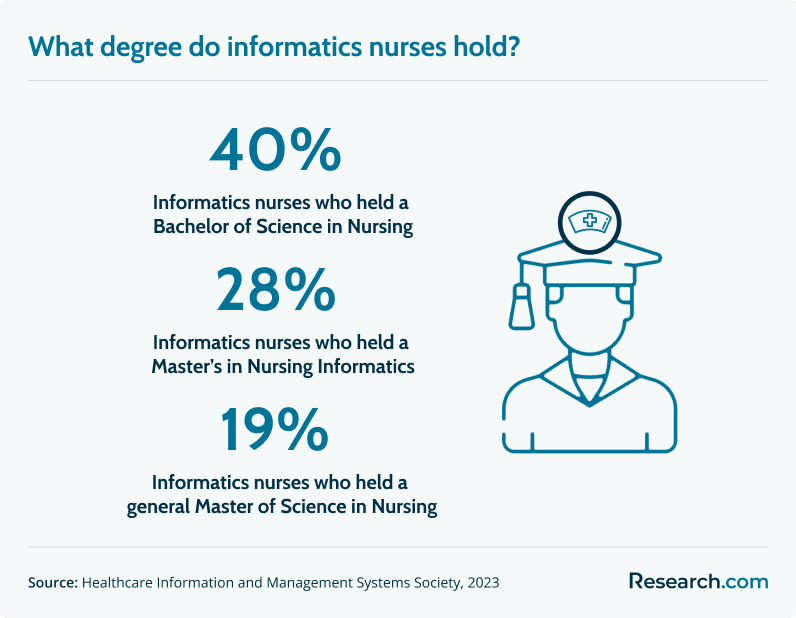
HIMSS reported in 2023 that 40% of nurse informaticists held a BSN, making it the most common educational level among professionals in 2022. By comparison, 28% held a Master’s in Nursing Informatics, and 19% held a general MSN. These figures suggest that graduate informatics training may help some nurses differentiate themselves for advanced roles, although a master’s degree is only one part of career readiness.
| Program pace | Typical timeline | Best for | Trade-off |
| Accelerated | 12 to 18 months | Students with strong time availability and clear career goals | Higher weekly workload and less schedule flexibility |
| Standard full-time | About two years | Working nurses who can manage steady coursework | Requires consistent planning around practicum and work duties |
| Part-time | Two and a half to three years | Nurses balancing full-time work, family, or rotating shifts | Longer time before career benefits may materialize |
How does an online MSN in health/nursing informatics program compare to an on-campus program?
The main difference between online and campus-based MSN informatics programs is delivery format, not necessarily academic quality. Online programs usually use learning management systems, recorded or live video lectures, discussion boards, digital assessments, and virtual collaboration tools. In many cases, the learning outcomes are similar to campus programs, especially when both are accredited. Students also comparing adjacent leadership pathways may want to review MSN in health systems management programs online.
Campus programs rely on in-person lectures, scheduled class meetings, labs, group projects, and direct access to campus-based resources. The best format depends on your schedule, learning preferences, geographic location, and need for in-person networking.
| Factor | Online MSN informatics | On-campus MSN informatics | Decision tip |
| Student profile | Often best for working RNs, remote learners, and students with family or shift-work obligations | Often fits students who can attend scheduled classes and participate in campus life | Choose the format that you can realistically sustain for the full program |
| Schedule | May include asynchronous, synchronous, or self-paced elements | Usually follows fixed class times and campus schedules | Ask whether online courses require live attendance |
| Interaction | Communication happens through video meetings, forums, email, and online group work | Students can access more spontaneous in-person discussion and feedback | If networking matters to you, ask how online students connect with faculty and peers |
| Resources | Typically includes digital libraries, virtual tutoring, online platforms, and technical support | May offer campus labs, hospital partnerships, in-person events, and physical facilities | Do not assume online means fewer resources; verify what is available remotely |
| Practicum or internship | Often completed near the student’s location, depending on school approval | May provide stronger access to faculty-supported placements through affiliated sites | Ask who is responsible for finding and approving placements |
Online learning is often the better fit for experienced nurses who need flexibility. Campus learning may be preferable for students who want more face-to-face mentoring or who live near strong healthcare technology networks.
What is the average cost of an online MSN in health/nursing informatics program?
The cost of an online MSN in health or nursing informatics varies by school type, residency status, credit requirements, fees, and program length. According to the College Board, average tuition and fees for master’s degrees at public four-year institutions is $9,560, while private nonprofit universities charge $31,930 (Ma et al., 2024). Across programs, students may see total costs from $19,000 to $50,000 or more.
Online students may save on commuting and campus housing, but they should still budget for technology fees, textbooks or digital materials, clinical placement expenses, background checks, software, graduation fees, and certification preparation. Some schools charge online learners the same rate regardless of state residency, while others maintain separate in-state and out-of-state pricing.
An MSN typically costs more than many shorter allied health training options, but it also prepares nurses for more advanced clinical-technology roles. For comparison, students exploring the best online medical billing and coding schools may find lower tuition, but those programs generally lead to narrower administrative or coding roles rather than graduate-level nursing informatics positions.
HIMSS reported in 2023 that 31% of informatics nurses said the cost of education, certification, and professional development programs limited their success in the field. That makes cost comparison, employer support, and financial aid planning especially important before enrollment.
| Cost factor | Why it matters | Question to ask |
| Tuition structure | Programs may charge per credit, per term, or by residency status | What is the total program cost if I follow the recommended plan of study? |
| Fees | Technology, clinical, graduation, and assessment fees can raise the final bill | Which fees are mandatory for online students? |
| Transfer credits | Accepted credits can reduce time and cost | How many graduate credits can I transfer, and from which institutions? |
| Practicum expenses | Students may pay for travel, compliance documentation, or site onboarding | Will I need to travel, and who approves my placement? |
| Certification preparation | Some programs include review resources while others charge separately | Does tuition include preparation for informatics certification? |
This chart presents the challenges informatics nurses face.
What financial aid options are available for online MSN informatics students?
Online MSN students are often eligible for many of the same financial aid options as campus-based graduate students. Nurses comparing informatics with other advanced practice or graduate nursing routes, such as an online MSN AGPCNP program, should compare both tuition and aid availability before choosing a path.
- Private scholarships: Nursing organizations, foundations, nonprofits, and professional associations may offer awards for graduate nursing students. Award amounts vary, with some ranging from $500 to $10,000 and others covering full tuition.
- Institutional scholarships and grants: Many universities provide school-based awards for nursing students, informatics students, or graduate learners. Eligibility may be based on academic performance, financial need, leadership, or service commitments.
- Federal student aid: Graduate students can complete the Free Application for Federal Student Aid (FAFSA) to be considered for federal aid. Nurses working in underserved communities may also investigate federal loan forgiveness programs.
- Employer tuition assistance: Hospitals, health systems, and healthcare organizations may offer tuition reimbursement, education stipends, or professional development funds. Some programs require employees to remain with the employer for a defined period after receiving assistance.
- State-based aid: State education agencies may provide grants, scholarships, or loan forgiveness programs for nursing and other high-need healthcare fields.
The best financial aid strategy is to start early. Ask each school for a complete cost of attendance, confirm scholarship deadlines, check whether employer reimbursement is paid before or after course completion, and estimate how much debt you would carry after graduation.
What are the prerequisites for enrolling in an online MSN in health/nursing informatics program?
Admissions requirements vary by university, but online MSN informatics programs generally expect applicants to have a nursing background, current RN licensure, academic readiness for graduate study, and enough professional experience to connect coursework with clinical practice. Students coming from adjacent healthcare education areas, including online master's programs clinical mental health counseling, may recognize transferable skills in patient communication, evidence-based practice, ethics, and data-informed care, but MSN informatics admission still centers on nursing credentials.
- Bachelor’s degree and official transcripts: Applicants are typically expected to hold a Bachelor of Science in Nursing from an accredited institution and submit official transcripts documenting degree completion and prior coursework.
- Prerequisite coursework: Some schools require previous courses in statistics, health assessment, nursing research, or related subjects that support graduate analytics and evidence-based practice.
- Active RN license: Programs generally require a current, unencumbered RN license. The license must be valid in the state where the student completes practicum or clinical requirements.
- Minimum GPA: Many programs require a cumulative GPA of 3.0 on a 4.0 scale, though some schools may review lower GPAs alongside strong professional experience.
- Letters of recommendation: Applicants commonly submit two to three references from academic or professional contacts who can speak to clinical competence, leadership potential, and readiness for graduate work.
- Resume and work experience: A resume usually documents nursing roles, certifications, leadership duties, clinical experience, and administrative or technology exposure. Many programs prefer at least one year of nursing experience.
- Personal statement: The essay should explain why the applicant wants to study informatics, how the degree fits career goals, and what clinical or technology problems the applicant hopes to address.
Compared with business-focused healthcare pathways such as the fastest online MBA in healthcare management programs, MSN informatics programs place heavier weight on RN licensure, nursing experience, and clinical credibility.
What courses are typically in an online MSN in health/nursing informatics program?
Online MSN informatics curricula combine graduate nursing foundations with specialized study in healthcare data, information systems, workflow design, privacy, analytics, and implementation. The goal is to prepare nurses to evaluate technology through a clinical lens rather than treat informatics as a purely technical field.
Students with prior exposure to healthcare operations through pathways such as an online medical assistant associate degree may already understand patient flow, documentation, front-office systems, and clinical communication, which can help when studying advanced informatics workflows.
| Course area | What students learn | Why it matters in informatics practice |
| Introduction to Health Informatics | Core terminology, history, concepts, and current issues in informatics | Builds the foundation for understanding how technology supports care delivery |
| System Design, Implementation, Evaluation, & Maintenance | How health information systems are planned, launched, assessed, and improved | HIMSS reported in 2023 that 41% of informatics nurses identify systems implementation as their top responsibility |
| Foundations of Evidence-Based Practice | How to evaluate research and apply findings in clinical settings | Supports safer decisions and helps nurses connect data tools with patient outcomes |
| Project Management in Health Informatics | Planning, budgeting, risk management, stakeholder communication, and timeline control | Prepares nurses to lead or coordinate health technology initiatives |
| Cybersecurity Compliance and Legal Issues | Privacy laws, HIPAA-related concerns, data security, breach response, and ethics | Protects patient information and supports responsible technology use |
Some administrative competencies overlap with skills discussed in a medical administrative assistant job description, such as documentation accuracy, data handling, and regulatory awareness. However, MSN informatics programs go further by preparing nurses to lead systems-level technology and data initiatives.
This chart displays the main tasks of nurse informaticists.
What types of specializations are available in online MSN in health/nursing informatics programs?
Nursing or health informatics is often already the specialization within an MSN. Still, some programs allow students to narrow their preparation through electives, practicum choices, data analytics coursework, leadership projects, or system design experiences.
| Focus area | What it emphasizes | Best fit for students who want to |
| Informatics system analysis and design | User needs, workflow mapping, system requirements, usability, and clinical effectiveness | Improve how EHRs and digital tools work for nurses and patients |
| Data science and analytics | Large datasets, reporting, trends, dashboards, and evidence-informed decision support | Use healthcare data to guide quality, safety, and operational improvements |
| Nursing informatics leadership | Team management, policy, strategy, change management, and organizational decision-making | Move into management, consulting, or executive informatics roles |
| Health information management | Data governance, compliance, privacy, security, and health records oversight | Work with protected patient information and regulatory requirements |
Health information management can be especially relevant for nurses who want stronger grounding in data governance and secure handling of patient information. These concepts also connect to understanding what is clinical medical assistant training in relation to patient data and documentation workflows.
AI is also shaping specialization choices. According to a McKinsey report (Griffen et al., 2024), 73% of nurses believe that involving them in AI development would reduce skepticism toward the technology. Informatics students who study analytics, implementation, usability, and ethics may be better prepared to help healthcare organizations adopt AI responsibly.
How should you choose the best online MSN in health/nursing informatics program?
The right MSN informatics program should match your professional goals, learning style, budget, licensure situation, and desired level of technical depth. A program that works well for a nurse seeking analytics roles may not be the best fit for someone aiming for EHR implementation, informatics education, or executive leadership.
- Confirm nursing accreditation: Look for recognized nursing accreditation, such as CCNE or ACEN. Accreditation helps signal that the program meets accepted academic and professional standards.
- Review the curriculum in detail: Compare required courses, electives, analytics content, project management training, leadership preparation, and certification support.
- Ask about practicum or internship placement: Find out whether the school finds sites, whether students must secure their own placements, and whether your state or employer setting is eligible.
- Evaluate faculty experience: Faculty with informatics, healthcare IT, quality improvement, analytics, or clinical systems experience can provide practical guidance beyond textbook theory.
- Test the online learning support: Strong online programs should provide reliable technology support, library access, tutoring, advising, and clear communication channels.
- Compare total cost, not just tuition: Include fees, books, software, travel, clinical compliance costs, certification review, and the number of credits required.
- Check career and certification preparation: Ask whether graduates are prepared to pursue the ANCC Informatics Nursing Certification exam and whether career services understand informatics roles.
Questions to ask before applying
- Is the program accredited by CCNE or ACEN?
- Will my RN license qualify me for practicum placement in my state?
- Are online courses asynchronous, synchronous, or both?
- Who is responsible for finding practicum or internship sites?
- Does the curriculum include analytics, implementation, leadership, privacy, and systems evaluation?
- What is the total cost of the program after tuition, fees, books, and required materials?
- Does the school publish relevant career outcomes for informatics graduates?
- Will the program support my target role, such as clinical analyst, informatics nurse specialist, educator, consultant, or CNIO?
Common mistakes to avoid when selecting a program
| Mistake | Why it can hurt you | Better approach |
| Choosing based only on tuition | A low per-credit price may not reflect fees, credits required, or placement costs | Compare full cost of attendance and expected time to completion |
| Ignoring accreditation | Accreditation can affect employer confidence, transfer options, and professional preparation | Verify programmatic and institutional accreditation before applying |
| Assuming online means fully flexible | Some courses require live sessions, group work, or strict deadlines | Ask about weekly schedule expectations and synchronous requirements |
| Overlooking practicum logistics | Placement issues can delay graduation | Ask early how sites are approved and whether your location is supported |
| Relying only on rankings | A highly ranked program may not fit your budget, schedule, or career target | Use rankings as a starting point, then compare fit and outcomes |
| Assuming salary outcomes are guaranteed | Pay varies by role, employer, geography, certification, and experience | Compare local job postings and speak with informatics professionals in your market |
What career paths are available for graduates of online MSN in health/nursing informatics programs?
Graduates of online MSN informatics programs can pursue roles that combine nursing experience with health technology, data, systems analysis, workflow improvement, and leadership. Employers may include hospitals, health systems, software vendors, consulting firms, public health organizations, insurers, academic institutions, and research groups.
| Career path | Average salary listed | Typical responsibilities |
| EHR Implementation Specialists | $70,903 | Support selection, customization, rollout, and optimization of electronic health record systems |
| Nursing Informatics Consultants | $71,182 | Advise healthcare organizations on digital tools, EHR improvement, workflows, and informatics strategy |
| Clinical Systems Analysts | $72,794 | Analyze clinical software performance, troubleshoot issues, document requirements, and support upgrades |
| Nurse Informatics Educators | $87,090 | Create training materials, teach staff to use technology, and support adoption of new systems |
| Nursing Informatics Specialists | $98,409 | Improve documentation, safety, quality, and technology use across nursing practice |
| Health IT Project Managers | $100,984 | Coordinate informatics initiatives among clinical teams, IT staff, vendors, and organizational leaders |
| Health Information Managers | $137,730 | Oversee data compliance, health information operations, privacy, and records-related teams |
| Chief Nursing Informatics Officers | $155,833 | Lead nursing technology strategy and informatics governance at the executive level |
Job titles, salaries, and responsibilities differ by employer, region, experience, certification, and leadership scope. A nurse moving from clinical leadership into informatics may also compare compensation with related nursing roles; for example, a charge nurse salary can provide context when evaluating whether a transition into informatics makes financial sense.
This chart displays the average wages of various nurses.
What is the job market for graduates with an online MSN in health/nursing informatics program?
The job market for MSN informatics graduates is supported by healthcare’s continued reliance on electronic health records, digital tools, data reporting, quality measurement, and technology-enabled care. The BLS projects 6% growth for RNs, with 194,500 annual jobs, from 2023 to 2033. Employment for health information technologists and medical registrars is projected to grow by 16.3%, with 3,200 jobs.
Demand is tied to several forces: expanding EHR use, the need for data-driven clinical decisions, ongoing technology upgrades, and replacement needs as workers retire or leave the labor force. However, informatics roles are not immune to challenges. Employers often seek professionals who can communicate with both clinicians and IT teams, manage change, interpret data responsibly, and understand the limits of automation.
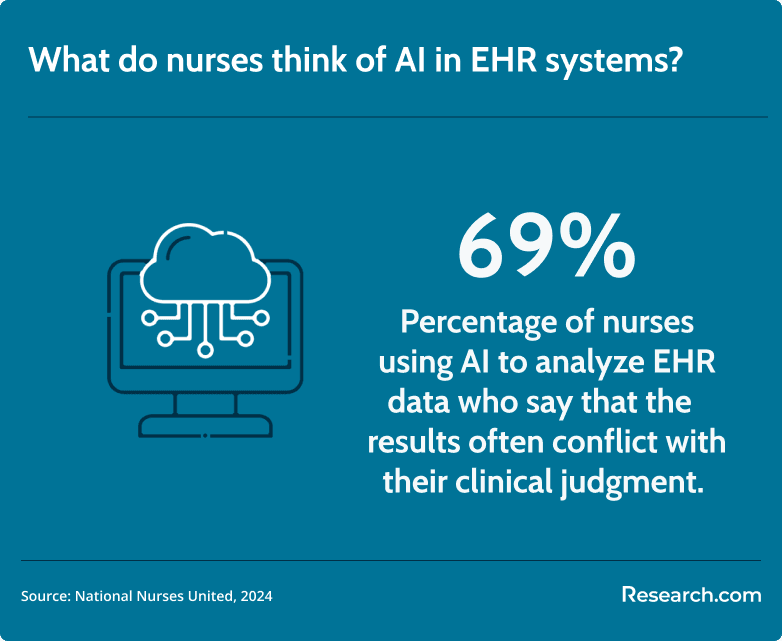
AI is one of the most important issues shaping nursing informatics. In a National Nurses United survey from 2024, 69% of nurses who use AI tools to analyze EHR data said algorithmic outputs often do not align with their clinical judgment. That gap highlights why informatics nurses need not only technical skills but also clinical credibility, ethical judgment, and the ability to challenge unsafe or poorly designed systems.
Rapid technology change also means graduates should expect continuing education throughout their careers. Burnout and work-life balance remain major concerns across nursing specialties, so informatics students should consider whether target roles involve on-call implementation work, travel, system go-lives, or high-pressure organizational change.
How do accreditation and quality standards affect online MSN in health/nursing informatics programs?
Accreditation helps students identify programs that have been reviewed for academic quality, faculty qualifications, curriculum strength, resources, and professional preparation. For MSN informatics students, recognized nursing accreditation can matter because employers, certification bodies, and future doctoral programs may look closely at the credibility of the degree.
Prospective students should distinguish between institutional accreditation and nursing program accreditation. Institutional accreditation applies to the college or university as a whole. Nursing accreditation, such as CCNE or ACEN, focuses specifically on nursing education quality. Students comparing graduate informatics with earlier nursing pathways, including accelerated online BSN programs, should use accreditation as a baseline requirement rather than a bonus feature.
Here’s what graduates have to say about their online MSN in health/nursing informatics programs
- : "The online format allowed me to continue working full time while building a new direction in my nursing career. The courses were demanding, but the projects helped me connect data, systems, and patient care in practical ways. I now use skills in systems analysis and healthcare data management almost every day, and I feel more prepared to guide digital change in nursing. — Shane"
- : "I chose an online MSN in Health Informatics because I wanted to contribute to healthcare innovation without stepping away from my job. The program helped me understand clinical data, information systems, and evidence-based tools in a way I could apply immediately at work. The flexibility helped, but the structure also kept me focused and accountable. — Mason"
- : "Earning my MSN in Nursing Informatics online helped me grow professionally while staying active in my current role. I developed a clearer understanding of how data, technology, and clinical judgment influence one another. I also became more confident communicating across nursing, IT, and administrative teams. — Brianna"
What is the return on investment of an online MSN in health/nursing informatics program?
The ROI of an online MSN in health or nursing informatics depends on the total cost of the program, how much debt you take on, whether your employer contributes tuition assistance, how quickly you complete the degree, and whether the credential helps you move into higher-paying or more sustainable work. ROI is strongest when the program leads directly to a realistic career goal, such as informatics specialist, clinical systems analyst, health IT project manager, educator, consultant, or leadership role.
Before enrolling, compare tuition and fees against the salaries associated with your target roles, not only executive-level positions. Also consider whether you could reach your goal through a lower-cost step, such as a certificate, employer-sponsored training, or a BSN completion pathway. Nurses still building academic credentials may want to compare graduate informatics options with the easiest RN to BSN programs before committing to a master’s degree.
ROI questions to answer before you enroll
- What specific job title am I pursuing after graduation?
- Do employers in my region request or prefer an MSN in informatics?
- Will my employer reimburse tuition, and what conditions apply?
- How much income could I lose if I reduce work hours during the program?
- Does the program include practicum experiences that could help me build a network?
- Will the degree prepare me for certification or only provide academic credit?
- How long would it take to recover the cost based on realistic salary growth?
References
- American Nurses Association. (2023, July 5). What Is Nursing Informatics. https://www.nursingworld.org/content-hub/resources/nursing-resources/nursing-informatics
- Healthcare Information and Management Systems Society. (2023, March 1). 2023 Nursing Informatics Workforce Survey. https://legacy.himss.org/resources/himss-nursing-informatics-workforce-survey
- Ma, J., Pender, M., & Oster, M. (2024). Trends in College Pricing and Student Aid 2024. College Board. https://research.collegeboard.org/trends/college-pricing
- Office of the National Coordinator for Health Information Technology. (n.d.). National Trends in Hospital and Physician Adoption of Electronic Health Records, Health IT Quick-Stat #61. Assistant Secretary for Technology Policy. Retrieved August 6, 2025, from https://www.healthit.gov/data/quickstats/national-trends-hospital-and-physician-adoption-electronic-health-records
- PayScale. (2025, July 6). Average Health IT Project Manager Salary. Retrieved August 6, 2025, from https://www.payscale.com/research/US/Job=Health_IT_Project_Manager/Salary
- U.S. Bureau of Labor Statistics. (2024). Registered Nurses [Interactive data]. Occupational Employment and Wage Statistics (OEWS) Profiles. Retrieved August 6, from https://data.bls.gov/oesprofile
- U.S. Bureau of Labor Statistics. (2025, April 18). Occupational projections, 2023–33, and worker characteristics, 2023 (Numbers in thousands). Employment Projections. https://www.bls.gov/emp/tables/occupational-projections-and-characteristics.htm
- ZipRecruiter. (2025, July 30). Informatics Nurse Salary. Retrieved August 6, 2025, from https://www.ziprecruiter.com/Salaries/Informatics-Nurse-Salary
Key Insights
- An online MSN in health or nursing informatics is best suited for licensed nurses who want to apply clinical knowledge to data, EHRs, digital health tools, workflow redesign, analytics, and technology leadership.
- Most programs take about two years, but accelerated, part-time, bridge, and competency-based formats can change the timeline substantially.
- Accreditation matters. Prioritize programs with recognized nursing accreditation such as CCNE or ACEN, and verify practicum rules before applying.
- Cost should be evaluated as total program cost, not just per-credit tuition. Include fees, materials, practicum expenses, certification preparation, and possible lost income.
- The strongest programs provide practical experience, informatics project work, analytics training, privacy and compliance education, and support for certification or career transition.
- AI and automation are increasing the need for nurses who can evaluate technology critically, represent clinical judgment, and help design safer digital systems.
- Career outcomes vary widely by role, location, experience, and employer. Use salary figures as comparison points, not guarantees.
- The best program is the one that fits your schedule, budget, state licensure situation, practicum needs, and target informatics role.
Other Things You Should Know About Online MSN in Health/Nursing Informatics Programs
The top online MSN programs in Health/Nursing Informatics in 2027 offer strong career support through dedicated career services, including job placement assistance, networking events, and alumni mentorship programs. Graduates gain access to exclusive job boards and professional development resources to enhance their career prospects.
In 2027, rankings are influenced by accreditation status, curriculum quality, faculty expertise, tuition cost, and student support services. Programs with strong clinical partnerships and high NCLEX-RN pass rates are often favored. Online accessibility and flexible scheduling also contribute significantly to a program's ranking.
Admission prerequisites typically include a Bachelor's degree in Nursing, a current RN license, and a minimum GPA of 3.0. Some programs may also require professional nursing experience and completion of courses in statistics or health assessment for 2027.


