
2027 Degree vs. Certificate in UX Design: Education Pathways

Co-Founder and Chief Data Scientist
As companies increasingly prioritize user satisfaction and accessibility, skilled UX professionals have become essential members of design and product teams across industries. Employers now place strong emphasis on formal training—77% of hiring managers report that they look for candidates with a recognized UX qualification (UX Design Institute, 2024). This highlights the importance of UX Design degrees and certifications
As a career planning and education expert, I’ve spent years researching UX education trends alongside my team to guide aspiring designers like you. In this article, we’ll explore the key differences between a UX design certificate and a UX design degree, discuss which pathway best fits your career goals.
Key Things to Know About UX Design Degrees and UX Design Certificates
- Demand for UX professionals is growing rapidly across industries, with the global UX services market projected to reach $54.93 billion by 2032 (Fortune Business Insights, 2025).
- UX Design degrees typically take about four years, while certificate programs last a few months to a year, offering faster entry into the field.
- Both pathways build essential skills in UX research, prototyping, and UI design, preparing graduates for diverse and in-demand roles in the UX industry.
- What are the typical admission requirements for a UX Design Degree compared to a UX Design Certificate? Admission Requirements
- What subjects and design competencies are emphasized in UX Design Degree programs and certificate courses? Core Competencies
- How long does it typically take to complete a UX Design degree versus a certificate? Duration
- What are the average tuition costs for UX Design Degree programs versus UX Design Certificate programs? Tuition Fee
- How do financial aid options differ between UX Design Degree programs versus certificate courses? How do financial aid options differ between UX Design Degree programs versus certificate courses?
- How do employers view a UX Design degree versus a certificate when hiring? How do employers view a UX Design degree versus a certificate when hiring?
- What are the factors to consider when deciding between a UX Design degree and a certificate program? What are the factors to consider when deciding between a UX Design degree and a certificate program?
- What is the average salary range for UX professionals with a degree compared to those with a certificate? Salary
- What is the projected job growth for UX designers and related roles in the next decade? Job Outlook
- What advanced degree or UX certification options are available for UX design professionals? What advanced degree or UX certification options are available for UX design professionals?
What are the typical admission requirements for a UX Design Degree compared to a UX Design Certificate?
Admission requirements for a UX Design degree program are generally more extensive than those for a certificate course. A bachelor’s degree program in UX Design typically requires a high school diploma or equivalent, a minimum GPA (usually 2.5 or higher), official transcripts, and sometimes a portfolio showcasing creative or design-related work. Some universities may also request standardized test scores, letters of recommendation, or a personal statement.
In contrast, a UX design certification online has fewer prerequisites. Most only require basic computer literacy and an interest in design. Some advanced certificates may ask for prior design experience or portfolio samples, but many are open to beginners looking to transition into the UX field quickly.
What subjects and design competencies are emphasized in UX Design Degree programs and certificate courses?
While both pathways teach UX fundamentals, they differ in depth and scope. A UX Design degree provides a broader academic foundation with both theoretical and practical courses, whereas a certificate focuses on rapid, hands-on skill development. Below are the main competencies emphasized in each:
- Bachelor's Degree in UX Design. These programs cover human-computer interaction, design psychology, usability research, and information architecture. Students learn user interface design, coding basics, project management, and design ethics—developing both technical and analytical skills through long-term projects and research-based learning.
- UX Design Certificate Courses. Certificate programs emphasize industry-relevant skills like wireframing, prototyping, user testing, and visual design using tools such as Figma and Adobe XD. They are designed to quickly build job-ready portfolios, often through intensive short-term modules focused on real-world applications rather than theory.
The data below shows that the top skills listed by UX employees include UX Design (13.99%), User Experience (12.99%), Prototype Design (12.40%), Collaboration (9.49%), Usability Design (9.25%), and UI Design (6.66%), reflecting the real-world competencies both degrees and certificates aim to develop.
How long does it typically take to complete a UX Design degree versus a certificate?
The time commitment for a UX Design program largely depends on whether a student pursues a full degree or a certificate. A bachelor’s degree in UX Design typically takes about four years of full-time study to complete, requiring around 120 credit hours. This includes general education courses, core design classes, and capstone projects that provide a well-rounded academic foundation.
In contrast, a UX Design certificate program is much shorter and more flexible, lasting anywhere from three months to one year, depending on whether it’s part-time or full-time. Certificate programs are designed for individuals who want to gain job-ready UX skills quickly without the long-term academic commitment of a degree.
What are the average tuition costs for UX Design Degree programs versus UX Design Certificate programs?
Tuition costs for UX Design programs in the U.S. vary significantly depending on whether a student chooses a degree or certificate pathway. A bachelor’s degree in UX Design typically costs around $28,000 to $30,000 per year before financial aid, with top-tier universities charging up to $60,000 or more annually. For instance, Franklin University’s online B.S. in User Experience & Graphic Design costs $398 per credit hour, or roughly $47,760 total for a 120-credit degree.
In contrast, UX Design certificate programs are much shorter and less expensive, typically ranging from $3,000 to $16,000 for the full course. For example, the General Assembly’s UX Design Bootcamp is priced at $16,450.
How do financial aid options differ between UX Design Degree programs versus certificate courses?
Financial aid opportunities differ considerably between UX Design degree programs and certificate courses, mainly due to accreditation and program structure.
UX Design degree programs offered by accredited colleges and universities typically qualify for federal financial aid, including Free Application for Federal Student Aid (FAFSA) grants, student loans, scholarships, and work-study programs. Students may also apply for institutional scholarships or design-specific grants that help offset tuition costs.
In contrast, UX Design certificate programs usually do not qualify for federal aid, since they are shorter, non-degree courses often run by private training providers or online platforms. Instead, they offer alternative financing options, including monthly payment plans, income share agreements (ISAs), deferred tuition, or private education loans.
Some certificate programs also provide limited scholarships or promotional discounts to make tuition more accessible. Overall, degree programs offer broader and more traditional financial aid opportunities, while certificate courses prioritize flexible payment models suited to working professionals and career changers.
How do employers view a UX Design degree versus a certificate when hiring?
Employers in the UX industry value both degrees and certificates, though they interpret them differently depending on job level and responsibilities. A UX Design degree often signals a strong foundation in theory, research, and analytical skills, which employers associate with roles in UX strategy, user research, or leadership.
On the other hand, certificate holders are viewed as having hands-on, job-ready expertise, making them highly suitable for entry- to mid-level positions that require proficiency in design tools and practical project experience.
Ultimately, employers weigh portfolio quality, problem-solving ability, and user-centered design skills more heavily than formal education. It’s also important to note that a UX graphic designer salary depends on demonstrated skills, professional experience, and role specialization, rather than academic background alone.
The chart below shows that 52% of hiring managers prefer a certificate or diploma in UX, 23% a bachelor’s degree in UX, and 2% a master’s degree or higher in UX.
What are the factors to consider when deciding between a UX Design degree and a certificate program?
When deciding between a UX Design degree and a certificate program, several personal, financial, and career-related factors should be considered:
- Time Commitment. A degree typically requires four years of full-time study, whereas a certificate can be completed in a few months to a year.
- Cost. Degree programs are usually more expensive, while certificates are shorter and more affordable.
- Career Goals. Degrees may open doors to leadership, research, or strategic UX roles, while certificates prepare students for hands-on, entry- to mid-level positions.
- Learning Style and Flexibility. Certificates often offer part-time, online, or intensive formats, which can be more convenient for working professionals.
- Financial Aid Availability. Accredited degree programs qualify for federal aid and scholarships, whereas certificate programs rely on alternative financing like installment plans or private loans.
- Portfolio and Practical Experience. Certificates often emphasize rapid skill-building and portfolio development, which can complement or supplement a degree.
Additionally, pursuing a UX certificate after completing a degree can be advantageous, especially if the certificate focuses on emerging tools, advanced software, or niche areas of UX that are not fully covered in the degree program. This approach can help a degree holder update their skills, demonstrate practical, job-ready expertise, and make them more competitive for specialized roles, leadership positions, or fast-moving industry segments.
Combining a degree with targeted certification can also positively impact UX design salary, as employers often reward candidates who demonstrate both theoretical knowledge and advanced practical skills.
What is the average salary range for UX professionals with a degree compared to those with a certificate?
The average salary for UX professionals varies based on education, experience, and role. According to PayScale, the average salary for a UX Designer is $82,012 per year, with a range from $59,000 to $116,000 (PayScale, 2025).
While the data does not explicitly differentiate between degree and certificate holders, degree holders may have a slightly higher starting salary, though certificate holders with strong portfolios and practical experience can achieve comparable earnings over time. Employers tend to prioritize demonstrable skills, project experience, and portfolio quality over formal credentials when evaluating candidates.
An additional insight below shows that early-career UX Designers with 1–4 years of experience earn an average total compensation of $80,494, mid-career UX Designers with 5–9 years earn $95,406, and experienced UX Designers with 10–19 years earn $106,829, highlighting the clear impact of experience on overall UX design salary growth.
What is the projected job growth for UX designers and related roles in the next decade?
According to the U.S. Bureau of Labor Statistics (BLS), employment for graphic designers, which may include UX professionals, is projected to grow only 2% from 2024 to 2034, slower than the average for all occupations.
The employment for web developers and digital interface designers, which also encompasses many UX designers, is projected to grow 7% over the same period, faster than the average for all occupations. Approximately 14,500 openings per year are expected, driven by the expansion of e-commerce, mobile technology, and digital platforms (BLS, 2024).
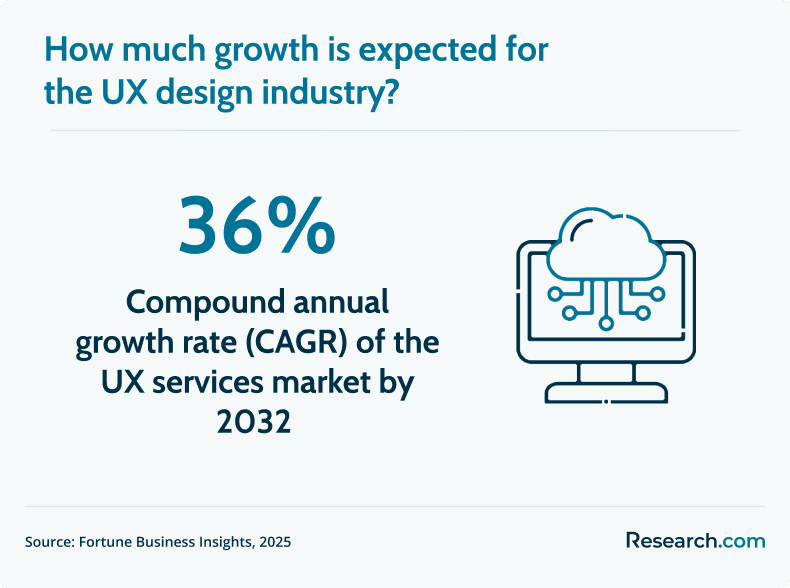
On a global scale, the UX services market is expanding rapidly. It was valued at $4.68 billion in 2024 and is projected to reach $54.93 billion by 2032, reflecting a 36% compound annual growth rate (CAGR) during the forecast period. North America dominated the market in 2024 with a 33.55% share (Fortune Business Insights, 2025).
This growth is fueled in part by the increasing integration of artificial intelligence (AI) in design processes, which enhances user experiences, automates routine tasks, and creates new opportunities for UX professionals. As AI continues to develop, it is expected to influence artificial intelligence jobs, including roles in UX design, by enabling more personalized and data-driven user interactions.
What advanced degree or UX certification options are available for UX design professionals?
UX design professionals looking to advance their careers have several advanced degree and certification options:
- Graduate-level programs include master’s degrees in Human-Computer Interaction (HCI), Interaction Design, UX Design, or related fields, which deepen theoretical knowledge, enhance research skills, and prepare graduates for leadership, UX strategy, or specialized research roles.
- Professional UX certifications in areas such as usability testing, mobile UX, UI design, or specific software tools like Figma, Adobe XD, and Sketch provide practical, job-ready expertise that strengthens portfolios.
- For professionals interested in artificial intelligence, combining UX with AI-focused studies opens pathways to jobs after masters in artificial intelligence that intersect with user experience, including AI-driven interfaces, conversational UIs, and personalized digital experiences.
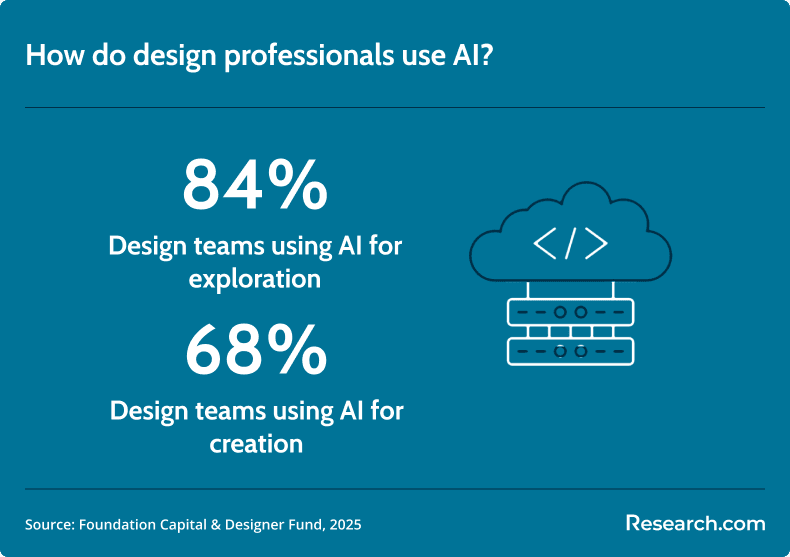
With 84% of design teams using AI for exploration, compared to 68% during the creation phase and 39% during delivery, it is clear that AI is becoming integral to early-stage UX processes such as research, ideation, and strategy (Foundation Capital & Designer Fund, 2025). Advanced degrees and certifications that integrate UX and AI help professionals stay competitive and prepare them for high-demand roles at the intersection of design and emerging technology.
What UX Design Degree or Certificate Holders Say About Their Credentials
- Emma: "Earning my degree in UX design gave me a strong foundation in both design theory and real-world application. The hands-on projects and collaborative studio work helped me build a professional portfolio I’m proud of. It was one of the most creative and fulfilling experiences of my education."
- Liam: "Completing my UX design certificate was the best decision I made for my career. The program’s focus on user research and prototyping prepared me to confidently enter the tech industry. I loved seeing my ideas evolve into designs that solve real problems."
- Chloe: "Studying UX design taught me how to combine empathy, data, and creativity in every project. The mentorship and peer feedback throughout the program pushed me to think critically and design with purpose. I graduated feeling ready to make a meaningful impact in the digital world. "
Key Findings
- The most common skills among UX design professionals include UX Design (13.99%), User Experience (12.99%), and Prototype Design (12.40%), reflecting the field’s focus on usability and product functionality.
- A bachelor’s degree in UX Design typically costs $28,000–$30,000 per year, while UX Design certificate programs are shorter and more affordable, ranging from $3,000 to $16,000 for the entire course.
- 52% of hiring managers look for candidates with a certificate or diploma in UX, while 23% of them prefer a bachelor's degree in UX
- The average UX design salary is $82,012 per year, with earnings ranging from $59,000 to $116,000, depending on experience and expertise.
- With 84% of design teams using AI during exploration, compared to 68% in creation and 39% in delivery, artificial intelligence is becoming a key component of the UX design process.
References:
- Bureau of Labor Statistics. (2024). Graphic designers. U.S. Department of Labor. https://www.bls.gov/ooh/arts-and-design/graphic-designers.htm
- Bureau of Labor Statistics. (2024). Web and digital interface designers. U.S. Department of Labor. https://www.bls.gov/ooh/computer-and-information-technology/web-developers.htm
- Franklin University. (2025). Bachelor’s degree in user experience & graphic design. https://www.franklin.edu/degrees/bachelors/user-experience-graphic-design
- General Assembly. (2025). User experience design bootcamp. https://generalassemb.ly/students/courses/user-experience-design-bootcamp/new-york-city
- Foundation Capital & Designer Fund. (2025). State of AI in Design Report 2025. https://www.stateofaidesign.com/#report
- UX Design Institute. (2024). The state of UX hiring report. https://www.uxdesigninstitute.com/state-of-ux-hiring
- ZipRecruiter. (2025). UX designer resume keywords and skills. https://www.ziprecruiter.com/career/Ux-Designer/Resume-Keywords-and-Skills
Other Things You Should Know About Degree vs. Certificate in UX Design
In 2027, a UX Design degree typically requires around 120 credit hours, which includes courses in user research, interaction design, and usability testing. In contrast, certificate programs often require fewer credit hours, focusing on core skills like prototyping and wireframing.
In 2027, the recognition of UX Design credentials varies by employer, but generally, a degree often holds more academic prestige, while a certificate may be favored for its practical, focused skill development. Each pathway can lead to successful careers, depending on the individual's career goals and the specific program's reputation.


