2027 Online BA in Psychology - General Psychology: How to Check Whether a Program's Career Examples Match Its Degree Level
Audited and Verified:
Our Editorial and Data Verification Process
Research.com uses government datasets, official education statistics and primary institutional information to support its career and degree guides. Our review process checks factual accuracy, occupational definitions, source dates and the requirements associated with the credentials discussed.
How This Article Was Fact-Checked
Our editorial team verifies salary estimates, employment projections, education requirements and program information against original data providers and official organizations. Salary figures are checked against the relevant occupational definitions and reporting periods. Information about licensure, accreditation and required in-person training is reviewed separately.
Fact-checked and verified on:

Co-Founder and Chief Data Scientist
A psychology program may list careers that sound appealing but require far more than the BA it offers. That distinction matters if you are choosing an online general psychology degree to enter the workforce, change careers, or prepare for graduate study.
This guide shows you how to check each career example against actual job requirements, licensing rules, curriculum, and outcomes evidence. You will be able to separate realistic bachelor's-level opportunities from longer professional pathways - and decide whether the program is worth your time and cost.
Key Things You Should Know
- Match each advertised career to a specific job posting or licensing-board requirement; a related psychology curriculum is not proof of job eligibility.
- A psychology BA is typically part of a bachelor's degree requiring about 120 semester credits, but it does not itself qualify graduates to practice as licensed psychologists or therapists.
- Judge a program's career claims using its graduates' actual roles, experience requirements, total cost, and access to relevant projects or placements - not an occupation-wide salary figure.
What Is an Online BA in Psychology - General Psychology?
An online BA in psychology with a general psychology focus is a broad undergraduate education in behavior and psychological science. "General psychology" may describe the major itself or an officially designated concentration; check the catalog and the credential that will appear on your transcript. A BA commonly combines psychology courses with general education and electives. Its exact science, language, and quantitative requirements vary by institution.
Breadth can serve students who have not settled on a specialty, but it also means career preparation depends heavily on elective choices and experience outside class. When comparing online psychology degree curricula, look beyond course titles: identify required statistics and research methods, available advanced electives, and opportunities to produce work you can discuss with an employer.
Can a General Psychology Bachelor's Degree Lead to Licensed Practice?
Not by itself. Studying abnormal psychology, counseling theories, or psychological testing does not authorize a graduate to diagnose conditions, provide psychotherapy, independently conduct restricted assessments, or use a protected professional title.
Licensed psychologist pathways generally require doctoral-level professional preparation and additional jurisdiction-specific steps. Counselor, social-work, and other clinical licenses have their own qualifying degree, supervised-practice, and examination rules.
A BA can provide academic preparation for later applications, but admission to a professional program is a separate decision. If therapy is your goal, compare the BA's prerequisites with the entry requirements and state-recognized training pathway of the profession you actually want. Researching online clinical counseling graduate completion options can help illustrate the additional degree stage; verify each program's licensing alignment in the state where you intend to practice.
How Do You Verify Accreditation for an Online Psychology Bachelor's Program?
Check the institution's current accreditation status in the U.S. Department of Education's accreditation database or the accreditor's directory, then confirm that the online BA is offered by that institution under its accredited scope.
Use the school's catalog to verify the precise degree name and your entry-term requirements. Institutional accreditation matters for matters such as credit recognition and potential federal aid eligibility, but it does not establish that a graduate qualifies for a particular job or license.
Do not expect APA accreditation of a general psychology BA: APA's program accreditation covers specified professional psychology training, not broad undergraduate majors. Accreditation claims for a different degree or campus are not a substitute for checking your program.
If you are considering an occupation-specific alternative, such as substance use counseling, examine aid eligibility for online substance use counseling study separately from that program's credential and state-specific career requirements.
A psychology BA can be relevant to nonclinical support, research, and organizational jobs. It rarely acts as a stand-alone hiring credential: employers may also require direct service experience, data skills, a background check, or a particular certification. The distinctions below help you read career pages without mistaking a related field for an immediately accessible job.
| Career example | What the work may involve | What to check beyond the BA |
| Human-services or case-support assistant | Service coordination, records, and referrals under agency procedures | Client-service experience, local hiring rules, and permitted duties |
| Research assistant | Recruitment support, data handling, and study documentation under supervision | Methods skills, software proficiency, and research experience |
| Victim-services or recovery-support worker | Advocacy, resource navigation, and support within defined boundaries | Employer training, safeguarding policies, and any state credential |
| Licensed therapist or psychologist | Regulated clinical assessment or treatment | A separate qualifying professional pathway and license |
For addiction-service roles in particular, a psychology BA should not be confused with a state-recognized counseling qualification. Compare the actual credential requirements and costs of a more specialized route before choosing based on a job title; substance abuse counseling bachelor's fees and career prospects are useful only when interpreted alongside the rules for your intended state and role.
They match only if the program makes clear whether a role is accessible with the BA, requires prior experience, or depends on later education and licensure. Phrases such as "careers in psychology" may describe a field rather than jobs for new graduates. A forensic psychologist, for example, is not a bachelor's-entry role merely because a BA offers a forensic elective.
Even career planning with a forensic psychology graduate degree requires separating nonclinical opportunities from licensed forensic practice.
Use this check on each career example that matters to you:
- Write down the exact advertised job title and duties; distinguish "assistant" or "coordinator" from independently practicing clinician.
- Compare several local job postings, noting required education, experience, certification, and whether psychology is required or merely preferred.
- For regulated work, consult the relevant state licensing board rather than relying on the program's career page.
- Ask career services for outcomes for graduates of this specific online BA: job titles, employer types, reporting period, number of respondents, and how many pursued additional education.
- Mark each example "BA-accessible," "BA plus experience or credential," or "requires further degree and license." Treat missing evidence as uncertainty, not a promise.
This method also protects career changers from undervaluing their existing experience. Someone with years of nonprofit coordination or data work may be competitive for a role that a new BA graduate is not; someone already eligible for the target job may need only targeted training instead of another degree.
Common subjects include introductory psychology, development, social and biological psychology, statistics, research methods, and electives. Their career value depends on depth and practice.
A research-assistant applicant benefits more from designing a study, documenting data decisions, and explaining limitations than from simply having taken an introductory methods course. A human-services applicant needs to pair psychological knowledge with respectful communication, documentation, confidentiality, and referral boundaries.
Check when required courses are offered and whether electives or a capstone let you build evidence for your target role. An accelerated schedule is useful only if it preserves access to prerequisites and worthwhile applied work. If you are comparing faster forensic psychology undergraduate options with a general BA, verify whether faster pacing changes course choice or merely the calendar; neither route makes an undergraduate a forensic practitioner.
Online and campus BAs can cover similar academic material, but access to experience may differ. Ask how online students join faculty research, obtain references, receive career advising, and arrange approved internships near home. "Asynchronous" coursework does not necessarily make group meetings, exams, research work, or placements asynchronous.
A campus program may make local networking easier; an online program may better fit an existing job or caregiving schedule. Neither format guarantees a placement or remote employment after graduation. Be equally cautious when comparing the BA with forensic psychology master's study with faster pacing: online delivery and speed describe scheduling, not equivalent degree levels or professional qualifications.
Undergraduate admission rules differ for first-year and transfer applicants. Many bachelor's degrees require about 120 semester credits in total, but accepted transfer credits do not necessarily satisfy psychology prerequisites, major requirements, or the school's minimum in-residence credits. Request a written degree audit before estimating your remaining time.
Compare the price of the remaining degree, not just advertised tuition per credit: include mandatory fees, required materials or software, any travel, and the effect of your planned course load on aid eligibility. A low tuition rate may be less valuable if required courses are infrequent or prior credits apply only as electives. When reviewing affordable online psychology degree programs, ask each institution for its current charges and a personalized completion plan.
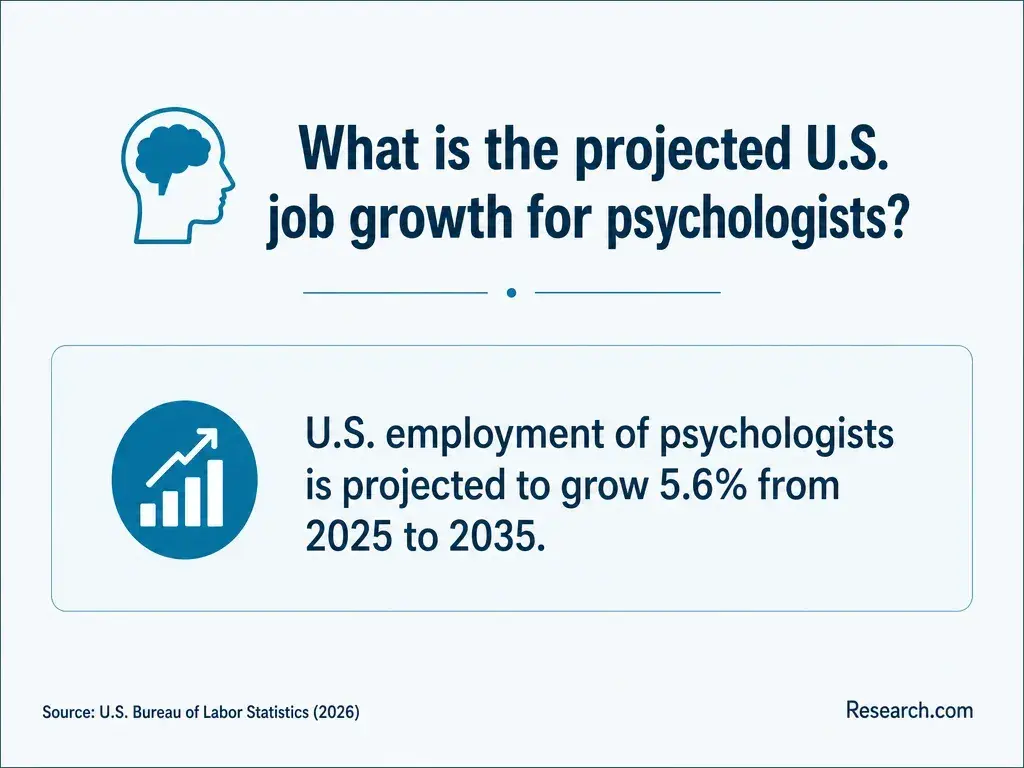
No single salary or growth rate applies to psychology BA graduates. U.S. Bureau of Labor Statistics wages and projections describe occupations, not the earnings or placement rate of a particular program's alumni. Before using an Occupational Outlook Handbook figure, check the occupation's stated entry education and duties. A licensed psychologist's median wage, for example, cannot be used as an expected BA outcome.
For a useful return-on-cost comparison, identify attainable local job titles, examine their posted pay and experience requirements, and compare those prospects with your remaining education expense and current earnings. Include further study if the desired occupation requires it.
Charges outside tuition can materially change that calculation for a later professional degree; review mental health counseling program charges beyond tuition before treating a clinical career's occupation-wide wage as the return on a BA alone.
Which Graduate Degrees, Certifications, or Skills Improve Career Options?
Choose the next step from the target role's requirements. For research support, strengthen statistics, study design, ethical data handling, and supervised project experience; a graduate degree is not automatically necessary. For a state-regulated support or addiction role, check the applicable credential rules. For licensed therapy, investigate a qualifying professional degree and subsequent state requirements rather than assuming a general psychology MS will suffice.
A nonclinical master's can deepen research or specialized knowledge, but its name does not establish licensure eligibility or guarantee advancement. If an accelerated specialization appeals to you, compare intensive forensic psychology master's admissions and study plans against the jobs you actually want, including their credential requirements and the time available for research experience.
The strongest choice may instead be a focused course, employer-supported training, or a supervised entry-level position.
Other Things You Should Know About Psychology
No. A concentration can document focused study, but the awarded credential remains a bachelor's degree unless the institution separately awards another qualification.
Treat it as one person's experience. Ask how many graduates were surveyed, how many responded, and whether the featured person had earlier experience or later credentials.
Not automatically. Remote availability depends on the employer and duties; client-facing support and research work may require scheduled meetings or on-site activity.
For license eligibility, rely on the board responsible for the jurisdiction and occupation. Ask the program to clarify its claim in writing before enrolling.
- Frequently Asked Questions - California Board of Psychology https://www.psychology.ca.gov/licensees/faq.shtml
- Psychology careers guide | apa.org https://www.apa.org/education-career/guide/careers
- Career Outcomes - Psychology Major https://www.scranton.edu/academics/cas/psychology/professional-outcomes/careers-with-bachelors-degree.shtml
- FAQs | umaryland.edu https://www.ssw.umaryland.edu/practicum/faqs/
- Practicum Education | Columbia MSSW https://onlinemsw.socialwork.columbia.edu/practicum-education/
- What is a professional degree? - KU Admissions https://admissions.ku.edu/blog/what-is-a-professional-degree
- Tips for Adding Research to Your Resume | arizona.edu https://career.arizona.edu/blog/2023/03/02/tips-for-adding-research-to-your-resume/
- Practicum Education Manual - VI. Practicum Education Placement Policies, Procedures, and Processes https://socialwork.wayne.edu/practicum/manual/policies