2027 Online MS in Psychology - Forensic Psychology for Senior Center Staff: Compare Prerequisites, Workload, and Career Fit
Audited and Verified:
Our Editorial and Data Verification Process
Research.com uses government datasets, official education statistics and primary institutional information to support its career and degree guides. Our review process checks factual accuracy, occupational definitions, source dates and the requirements associated with the credentials discussed.
How This Article Was Fact-Checked
Our editorial team verifies salary estimates, employment projections, education requirements and program information against original data providers and official organizations. Salary figures are checked against the relevant occupational definitions and reporting periods. Information about licensure, accreditation and required in-person training is reviewed separately.
Fact-checked and verified on:

Co-Founder and Chief Data Scientist
Senior center staff often encounter situations involving suspected exploitation, family conflict, and referrals to protective services. An online MS in psychology with a forensic psychology focus may deepen your understanding of behavior in legal settings, but it may not be the most direct qualification for your next job.
This guide compares admission preparation, coursework, costs, scheduling, and career outcomes against the responsibilities you actually want. It also identifies when targeted training or a different professional degree is the better investment.
Key Things You Should Know
- An online forensic psychology MS can support nonclinical work involving victim services, justice-system partnerships, research, or program evaluation - not independent forensic assessment.
- Compare each program's psychology and statistics prerequisites, total required credits, live sessions, and any approved placement or capstone; online does not necessarily mean self-paced.
- A forensic psychology master's provides no automatic clinical license. Check the qualifications in local job postings before committing to tuition and time away from work.
What Is an Online MS in Psychology-Forensic Psychology for Senior Center Staff?
It is a psychology master's degree focused on how psychological research relates to legal systems and justice-involved people. Depending on the program, "forensic psychology" may be a formal concentration, a set of electives, or part of the degree's name. Confirm which designation appears on the transcript and what the curriculum actually covers.
For senior center staff, the strongest connection is often nonclinical: understanding victimization, communicating with partner agencies, evaluating outreach, and recognizing the limits of behavioral evidence. Coursework does not authorize a staff member to determine whether an older adult has capacity, investigate a crime, or provide a clinical opinion for court.
Accelerated options may appeal to working staff, but a shorter calendar can concentrate the same assignments into fewer weeks. Compare twelve-month forensic psychology graduate study pathways against your busiest service periods, not just their advertised completion dates.
Can Senior Center Staff Use a Forensic Psychology Master's Degree for Career Advancement?
Possibly, if the next role involves coordinating victim-support partnerships, evaluating programs, training staff, or administering services connected to exploitation prevention. Existing experience with older adults, accessible communication, referrals, documentation, and community trust may be as important as the new credential. An employer may still require supervisory experience, a specific degree, or a state-recognized qualification.
The distinction is between advancing within an organization and changing professions. A staff member seeking to manage a center should compare the degree with leadership training and the employer's promotion criteria. Someone seeking to counsel clients or perform protective-services investigations must instead check the relevant professional or agency requirements.
If the immediate goal is supporting people affected by substance use rather than studying legal-system behavior, compare the role requirements and financing of more targeted preparation, including paying for a substance abuse counseling bachelor's degree. Neither route substitutes for a credential required by the state or employer.
Does an Online Forensic Psychology Master's Lead to Professional Licensure?
A nonclinical forensic psychology MS generally should not be treated as a route to independent practice as a psychologist, counselor, or clinical social worker. Studying assessment, psychopathology, or interviewing is different from completing a qualifying professional program, supervised clinical training, examinations, and other jurisdiction-specific requirements.
If you want to provide psychotherapy to older adults, identify the license first and ask the relevant state board which degrees and courses qualify. A counseling applicant, for example, should examine tuition-conscious mental health counseling degree choices against that board's rules - not assume a less expensive forensic psychology MS will count. Likewise, forensic evaluation and expert testimony require qualifications beyond a concentration title.
Start with the university's institutional accreditation by an accreditor recognized by the U.S. Department of Education. Verify the institution and accreditor in official directories, then confirm that the online degree is offered by that institution. Institutional accreditation matters for academic standing, but it does not establish that a particular master's meets licensing rules.
Do not reject a nonclinical psychology MS merely because it lacks APA accreditation: APA accreditation applies to specified professional psychology training programs, not every psychology master's. Conversely, do not interpret an institution's accreditation as APA approval of its forensic concentration. If your goal is licensed counseling, investigate the relevant program recognition and state requirements; clinical mental health counseling course pace and accreditation are a separate comparison.
Request the current catalog, required-course list, and any licensure disclosure for your state. Ask what, if anything, the school claims the degree qualifies graduates to do.
Curricula vary, but a useful program combines psychological research methods and statistics with study of behavior in legal contexts, ethics, and evidence interpretation. Possible topics include victimization, eyewitness evidence, correctional settings, or psychological assessment as an academic subject. An elective on testing does not qualify you to administer restricted instruments.
For senior center work, assess whether assignments let you examine older-adult exploitation, referral systems, accessible services, or the limits of evidence used in agency decisions. The table separates courses that may be interesting from skills you can responsibly apply at work.
| Curricular area | Potential workplace relevance | Boundary to check |
| Research methods and statistics | Evaluate outreach and interpret service data | Agency approval governs access to client information |
| Victimization and legal systems | Improve referrals and partner communication | Staff do not gain investigative authority |
| Ethics and assessment concepts | Recognize when specialist input is needed | Coursework does not authorize diagnosis or capacity evaluation |
If substance-use support is more relevant to your center than legal-system work, compare online addiction counseling coursework and admissions as a distinct route, while checking the credential rules for any counseling job.
Expect to document a completed bachelor's degree and submit the materials specified by each program, which may include transcripts, a statement of purpose, recommendations, or a résumé. Psychology, statistics, and research-methods preparation can be required prerequisites, recommended background, or courses taken after admission. A non-psychology major is not automatically disqualifying; the admissions office decides whether particular coursework or experience satisfies its policy.
Senior center employment can provide strong evidence of professional judgment and exposure to service systems, but it does not replace an expressly required statistics course. If your academic background is in human services, criminal justice, or another field, map your transcript against each program's requirements. An academic preparation through an addiction psychology bachelor's may illustrate one possible foundation, but a second bachelor's is rarely the first assumption to make when a missing prerequisite could be taken separately.
Before applying, send admissions staff your course descriptions and ask which prerequisites are mandatory, whether equivalent courses are accepted, and when any outstanding work must be finished. Obtain the answer for your intended entry term.
Duration depends on required credits, course availability, enrollment pace, and whether a thesis, capstone, or approved experience must be completed. A full-time employee should ask for a term-by-term plan based on the number of courses they can realistically take - not the school's fastest published timeline.
For cost, calculate required credits multiplied by the applicable tuition rate, then add mandatory fees, books or software, and any travel or placement expense. Ask whether tuition changes with residency or enrollment status and whether a pause triggers additional charges. Compare published prices on the same basis; psychology master's tuition comparisons are a starting point, not a substitute for an itemized quote from each school.
Consider the opportunity cost as well: unpaid project hours or reduced work shifts can change the value of a seemingly inexpensive program. Confirm employer education assistance and its repayment conditions before counting it toward your budget.
It can be, but "online" describes delivery, not scheduling freedom. Recorded lectures may coexist with fixed-time discussions, group projects, exams, faculty meetings, or a placement that needs weekday supervision. Senior center staffing peaks and unpredictable client needs make those details consequential.
Ask for a recent syllabus and a sample part-time course sequence. Check weekly assignment deadlines, live-session time zones, campus visits, leave policies, and whether your existing workplace could host a project if the program approves the site and supervisor. A workplace project also requires agency permission for any data use; routine access to client records is not academic research permission.
If a licensed counseling role is your actual aim, do not use the lighter apparent workload of a nonclinical MS as the deciding factor. Compare the distinct practicum and supervision commitments described in tuition-conscious shorter mental health counseling master's study before choosing between pathways.
The most plausible moves build on existing service experience: victim-services coordination, exploitation-prevention outreach, agency partnership work, program evaluation, or human-services supervision. Some justice-system or research-support positions may also fit, but hiring requirements depend on the agency, the candidate's methods skills, and relevant experience. A degree alone does not establish eligibility for a protected title.
Use actual vacancies to distinguish routes. The table shows why a promising job title is not enough to judge degree fit.
| Target responsibility | Likely value of the MS | Additional qualification to verify |
| Coordinate victim referrals and outreach | Relevant legal-system and victimization knowledge | Agency experience, safeguarding training, and hiring standards |
| Evaluate senior-service programs | Research design and evidence interpretation | Data skills and permission to work with agency records |
| Manage a community-service team | Potential subject-matter depth | Supervisory record and employer's degree requirements |
| Provide therapy or forensic evaluations | Academic background only | Qualifying professional training and applicable license |
If the desired role is broad senior-services management rather than legal-system work, compare shorter leadership training or lower-cost online psychology study pathways with the master's before enrolling.
What Salary and Job Outlook Should Forensic Psychology Graduates Expect?
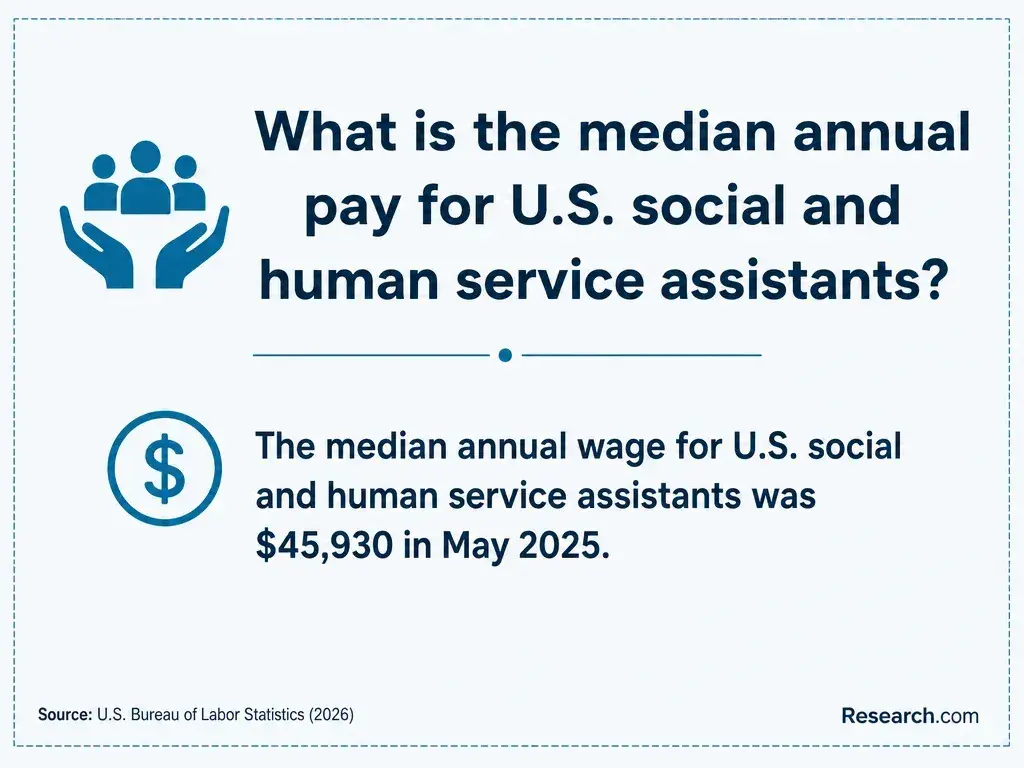
There is no reliable single "forensic psychology master's salary." Pay depends on the occupation, employer, location, experience, and whether a job requires a license. U.S. Bureau of Labor Statistics Occupational Outlook Handbook figures for social and human service assistants or social and community service managers can provide occupational context, but their medians and employment projections are not outcomes for graduates of this degree. Psychologist wages are especially misleading here because the MS does not independently qualify someone for that occupation.
For a useful return-on-investment estimate, compare local postings for jobs you already qualify for with postings for the specific next role. Record the required credential, stated pay range, and whether the employer would recognize this MS. If an alternative undergraduate credential is under consideration, substance abuse counseling bachelor's program value comparisons concern a different job pathway, not a salary forecast for forensic psychology graduates. Choose the route whose requirements match the job - not the broadest-looking wage figure.
Other Things You Should Know About Psychology
Possibly, if the program approves the topic and supervisor and the center authorizes the work. Confirm data access, privacy protections, and whether institutional research review is needed before collecting information.
Discuss what you learned without identifiable details. Follow your employer's confidentiality rules; changing a name alone may not sufficiently protect someone's identity.
It may provide useful context, but workplace protocols and applicable state reporting rules govern your response. Seek role-specific training from your employer or appropriate local authority.
Yes, if they can describe your judgment, communication, and readiness for graduate work. Check whether the program also prefers an academic reference who can speak to your writing or research preparation.
- Frequently Asked Questions - California Board of Psychology https://www.psychology.ca.gov/licensees/faq.shtml
- SAFE Training - Elder Justice Initiative (EJI) https://www.justice.gov/elderjustice/safe-training
- Elder Justice Innovation Grants | acl.gov http://acl.gov/programs/elder-justice/elder-justice-innovation-grants
- NYS Mental Health Counselor - Appendix A https://www.op.nysed.gov/professions/mental-health-counselors/appendix-requirements-supervised-experience-mental-health-counselor
- Cost of Attendance (Budget) | 2025-2026 Federal Student Aid Handbook https://fsapartners.ed.gov/knowledge-center/fsa-handbook/2025-2026/vol3/ch2-cost-attendance-budget
- Types of Financial Aid: Grants, Work-Study, and Loans | studentaid.gov https://studentaid.gov/understand-aid/types
- Capstone Requirement | University of North Texas https://forensic.unt.edu/student-resources/capstone-requirement.html
- FAQs for Clinical Courses: Practicum, Internship, & Field Experience - Wake Forest Department of Counseling https://counseling.wfu.edu/faqs-for-clinical-courses-practicum-internship-field-experience/
- Course Policies | West Chester University Catalog https://catalog.wcupa.edu/undergraduate/academic-policies-procedures/course-policies/
- Master of Arts in Psychology | CUNY SPS https://sps.cuny.edu/academics/graduate/master-arts-psychology-ma