2027 Pharmacist Salary

Co-Founder and Chief Data Scientist
Pharmacists earn some of the highest starting salaries among healthcare professionals, with averages exceeding six figures right out of school. Yet, pay is far from uniform—where you work, your level of experience, and even the industry you choose can shift your earnings by tens of thousands of dollars each year.
This article breaks down pharmacist salaries for 2027 across experience levels, industries, and locations. By the end, you’ll know exactly what to expect, what drives pay differences, and how to evaluate career prospects realistically.
Key Things You Should Know About Pharmacists
- Pharmacists are licensed healthcare professionals who dispense medications, counsel patients, and ensure safe drug use. Their responsibilities extend beyond counting pills—they monitor therapies, give vaccinations, and often collaborate directly with physicians to improve patient outcomes and lower healthcare costs through appropriate medication management.
- To become a pharmacist, you need to complete a Doctor of Pharmacy (Pharm.D.) program, pass licensure exams, and meet internship requirements. Many pharmacists also pursue residencies or fellowships, especially in specialized fields like oncology, cardiology, or pediatrics, to broaden expertise and career opportunities.
- Salaries are among the highest for healthcare roles requiring doctoral education, but they vary widely. Industry, location, and experience all influence pay. Pharmacists also face challenges such as high stress, regulatory requirements, and competitive job markets, making it important to weigh both rewards and realities of this career.
- What is the pharmacist salary for 2027? Pharmacist Salary
- How does pharmacist salary vary by experience level? Salary by Experience
- What do pharmacists make in different industries in 2027? Pay by Industry
- How does location affect pharmacist salary in 2027? Salary by Location
- What are the entry-level vs senior pharmacist salaries in 2027? Entry vs Senior Pay
- What factors determine pharmacist salary in 2027? Salary Factors
- How does pharmacist compensation compare to related healthcare roles in 2027? How does pharmacist compensation compare to related healthcare roles in 2027?
- What is the job outlook and prospects for pharmacist salaries in the coming years? Job Outlook
- Are there additional pay components (bonuses, overtime, benefits) that significantly impact total pharmacist compensation? Are there additional pay components (bonuses, overtime, benefits) that significantly impact total pharmacist compensation?
What is the pharmacist salary for 2027?
In 2027, pharmacists in the United States earn a median annual salary of about $137,480, or roughly $66.10 per hour, according to the Bureau of Labor Statistics. Pay typically ranges from $86,930 at the 10th percentile to more than $172,040 at the 90th percentile, showing how significantly earnings can differ based on role and setting. Industry matters a great deal—those employed in ambulatory healthcare services earn a median of $152,980, while hospital pharmacists average $149,240. Retailers such as chain drugstores tend to pay closer to $131,640, with general merchandise settings slightly higher at $145,210.
These figures place pharmacists among the top-paid healthcare practitioners not working as physicians. However, salary alone doesn’t define career value. Factors like stress, scheduling demands, and advancement opportunities should be considered. For students weighing career paths, comparing pharmacist pay with alternatives—such as considering whether is a masters in healthcare administration worth it—can provide helpful context.
How does pharmacist salary vary by experience level?
Pharmacist pay does not always follow a simple upward curve with years of experience. Entry-level pharmacists earn around $104,000 per year, which is already one of the highest starting salaries in healthcare. This strong baseline reflects both the extensive education required and the high responsibility pharmacists carry from day one.
By mid-career, pharmacists tend to peak financially, averaging about $125,000 annually. At this stage, many have developed specialized skills, taken on leadership roles, or positioned themselves in higher-paying sectors such as hospitals or ambulatory care. Interestingly, senior-level pharmacists see average earnings decline slightly to $121,000, suggesting that longevity alone doesn’t guarantee higher pay. Instead, advancement may require moving into management, academia, or industry roles to surpass mid-career figures.
For those considering long-term earnings potential, comparing pharmacy salaries with fields like healthcare administration is useful. Programs such as the shortest healthcare management master's programs may open pathways to higher executive-level compensation.
What do pharmacists make in different industries in 2027?
Pharmacist salaries vary widely depending on the industry, with workplace setting playing a decisive role in overall compensation. The highest earnings are found in outpatient and ambulatory care, where pharmacists average around $164,180 annually. Professionals comparing healthcare roles may also consider how much do nurse informatics make, as understanding salaries across specialties helps contextualize earning potential and career choices.
Hospital pharmacists also earn above-average salaries, with a median wage of $149,240. Their responsibilities include handling complex medication regimens, supporting specialized units like oncology or cardiology, and collaborating closely with physicians. In contrast, pharmacists in general merchandise stores—such as large retail chains—earn around $145,210, still strong but slightly lower given the focus on volume dispensing and customer interaction over clinical specialization.
The lowest pay bracket within major categories belongs to pharmacists working in traditional pharmacies and drug retailers, where the median wage sits at $131,640. These roles remain common but highlight how sector choice can affect long-term earning potential, sometimes by more than $30,000 annually. For those seeking broader healthcare career comparisons, fields like public health—especially through an accelerated online bachelor's degree in public health—may provide alternative entry points with different salary structures.
The chart below provides a straightforward breakdown of pharmacist pay across key industries, making it easy to compare how compensation shifts depending on workplace setting.
How does location affect pharmacist salary in 2027?
Geographic location is one of the most significant determinants of pharmacist pay. States with high costs of living and dense healthcare networks generally offer higher salaries to remain competitive. California consistently ranks at the top, with pharmacists earning an average of $157,280, according to BLS data. This is partly due to the demand in metropolitan hubs like Los Angeles and San Francisco, where healthcare systems require large pharmacy workforces. Students and professionals should also consider accreditation for doctor of pharmacy programs, as graduating from an accredited program can impact licensure, employment opportunities, and salary potential across different locations.
The Pacific Northwest also ranks highly, with Oregon pharmacists averaging $149,550 and Washington at $148,550. These figures reflect strong demand in both hospital and ambulatory care settings, along with the elevated living costs in Portland, Seattle, and surrounding regions. On the East Coast, Maine’s average salary is $139,517, while Nevada pharmacists average $140,869, highlighting how regional healthcare access and workforce shortages can raise pay even in smaller or less urbanized states.
For pharmacists, choosing a state to practice can mean a salary difference of more than $40,000 annually. Beyond earnings, factors such as job demand, state-level practice authority, and lifestyle considerations also weigh heavily when evaluating where to work.
The chart below highlights five of the highest-paying states for pharmacists, offering a snapshot of how much location alone can influence earnings.
What are the entry-level vs senior pharmacist salaries in 2027?
Pharmacist salaries show notable differences between entry-level and senior-level positions, though the gap is not always as wide as in other healthcare professions. According to Zippia’s 2025 data, entry-level pharmacists typically earn around $104,000 annually, translating to about $49.92 per hour. This is already a strong starting point compared to many other professional healthcare roles, reflecting the advanced education and licensure required to enter the field.
Comparing these figures to the salary of an operating room nurse can provide perspective on how specialization, education, and experience influence compensation across different healthcare careers.
With several years of experience, pharmacists at the mid-level can expect average pay of $125,000 per year. This stage often involves more responsibilities, such as precepting pharmacy students, managing workflows, or taking on clinical decision-making roles in hospitals and specialty settings. Interestingly, senior-level pharmacists—those with more than a decade of experience—tend to average slightly lower at $121,000, a phenomenon tied to market saturation, regional job demand, and evolving industry dynamics.
This leveling off of pay at the senior tier highlights that salary growth for pharmacists is not purely experience-based but instead tied to specialization, management roles, and geographic opportunities. Professionals interested in broader career advancement sometimes pursue alternative tracks like healthcare administration. For instance, completing an MBA online 1 year program may open doors to executive leadership roles with higher earning potential.
The chart below offers a clear snapshot of how pharmacist salaries shift with career stage, highlighting that pay peaks in mid-level roles before plateauing or dipping slightly at senior levels.
What factors determine pharmacist salary in 2027?
Pharmacist salaries in 2027 are influenced by several overlapping factors, with education and licensure forming the baseline. Holding a Pharm.D. degree and passing licensure exams is non-negotiable, but additional certifications—such as in oncology, pediatrics, or emergency care—can raise earning potential. Employers often reward pharmacists with niche expertise since these roles carry added clinical responsibility. Professionals considering career advancement may also explore doctor of education programs no residency, as flexible advanced degrees can support leadership and management roles in healthcare and education.
Industry and work setting are also significant. Pharmacists working in outpatient or ambulatory care centers typically command the highest wages, while those in government or academia may earn less but enjoy steadier schedules or stronger retirement benefits. Geographic location adds another layer: salaries in California and the Pacific Northwest remain among the nation’s highest, while southern and rural states lag behind.
Experience plays a role but plateaus over time, with mid-career pharmacists often out-earning those at the senior tier unless they step into management or administrative positions. Leadership roles—such as pharmacy directors or operations managers—can bridge the wage gap and provide access to performance-based bonuses.
Ultimately, salary outcomes for pharmacists mirror broader healthcare workforce dynamics, where specialization, location, and cross-disciplinary skills matter as much as years on the job. This resembles patterns in other fields, such as the environmental health and safety manager career path, where certification, sector, and region all determine compensation levels.
How does pharmacist compensation compare to related healthcare roles in 2027?
Pharmacists consistently earn above-average salaries compared to many healthcare roles, but their compensation typically falls below that of physicians, dentists, and advanced specialists. According to BLS and industry data, pharmacists average around $118,000 to $137,000 annually, depending on location and industry. By contrast, physicians and surgeons often surpass $200,000 per year, while nurse anesthetists earn close to $195,000.
Pharmacists do, however, earn more than registered nurses, who average about $89,000, and physical therapists, who average about $97,000. Physician assistants, with growing demand and broad clinical authority, report average salaries of $126,000, placing them slightly above or on par with many pharmacists depending on state and setting.
What makes pharmacist pay unique is the combination of high entry-level earnings and relatively low unemployment rates. While wage growth plateaus compared to other advanced healthcare paths, stability and flexibility remain strong draws. For many professionals weighing healthcare careers, pharmacy offers a lucrative middle ground between direct patient care and long-term financial security.
What is the job outlook and prospects for pharmacist salaries in the coming years?
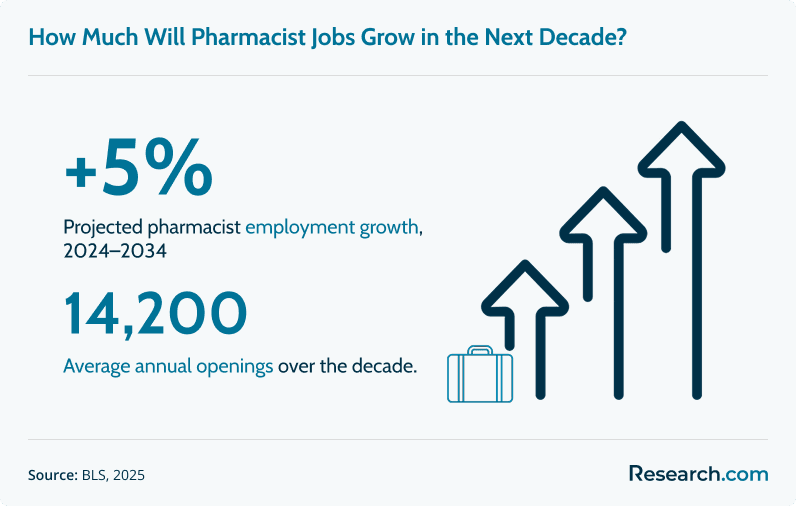
The employment outlook for pharmacists is cautiously positive. The Bureau of Labor Statistics (BLS, 2025) projects a 5% growth in pharmacist jobs between 2024 and 2034, adding around 15,400 positions to the U.S. workforce. Much of this growth will be replacement-driven, with an estimated 14,200 openings annually due to retirements and turnover.
Wage prospects are expected to remain steady, though not rising as dramatically as in physician or nurse practitioner fields. Pharmacist salaries have historically held in the $118,000 to $137,000 range, and incremental increases are likely as healthcare systems rely more heavily on medication therapy management, immunizations, and chronic disease interventions. Salary growth will be strongest in ambulatory and specialty care, where advanced skills command higher pay.
While retail roles may face pressure from automation and consolidation, pharmacists will continue to see opportunities in hospitals, outpatient clinics, and public health initiatives. The profession’s adaptability is what sustains its long-term viability.
The infographic below summarizes projected employment growth and annual openings, providing a quick snapshot of where the pharmacist job market is heading in the next decade.
What are the education, licensure, and training requirements that affect pharmacist salary?
Pharmacist salaries are closely tied to education, licensing, and training. To enter the field, candidates must complete a Doctor of Pharmacy (Pharm.D.) degree from an accredited institution, typically after at least two years of undergraduate study. While some programs offer accelerated three-year pathways, most follow a four-year track, with combined six-year options available. The timeline is often a key concern for students asking how long does it take to become a pharmacist.
After completing the Pharm.D., graduates must pass two critical licensing exams: the North American Pharmacist Licensure Examination (NAPLEX) and the Multistate Pharmacy Jurisprudence Examination (MPJE), or state-specific law exams. In addition, each state requires a set number of supervised intern hours before granting licensure.
Postgraduate training can also influence earnings. Residencies (1–2 years) or fellowships in areas like oncology, cardiology, or ambulatory care open doors to higher-paying roles. Ongoing continuing education (CE) is mandatory to maintain licensure and stay competitive in the field.
Ultimately, pharmacists who pursue advanced training, specialty certification, or leadership roles in healthcare systems are more likely to secure salaries above the national median.
Are there additional pay components (bonuses, overtime, benefits) that significantly impact total pharmacist compensation?
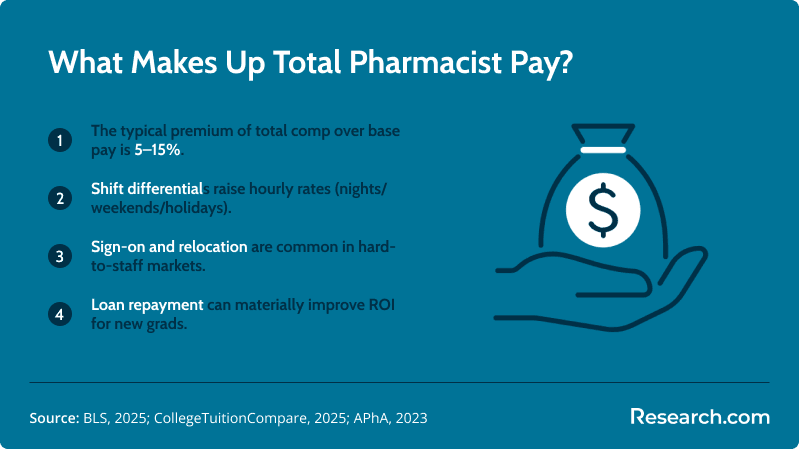
Base salaries make up the bulk of pharmacist earnings, but total compensation often includes other elements that raise take-home pay. Employers in hospitals, ambulatory care, and retail chains frequently offer bonuses, overtime pay, and benefits packages that can add 5–15% to overall compensation. These extras vary by employer type, geographic region, and the difficulty of filling certain roles.
Shift differentials are one of the most consistent pay boosters. Pharmacists working overnight, weekend, or holiday shifts earn higher hourly rates than their daytime counterparts. Additionally, sign-on and relocation bonuses are common in regions with shortages, such as rural or underserved communities. In many cases, these incentives help offset high student loan burdens or the costs of relocation.
Comprehensive benefits packages—health insurance, retirement contributions, paid time off, and tuition assistance—also add significant non-cash value. Some employers and government programs even offer loan repayment assistance, which can substantially improve return on investment for recent Pharm.D. graduates.
The infographic below highlights the most important non-salary components of pharmacist pay, showing how these elements add meaningful value to overall compensation beyond just the base wage.
Here's What Graduates Have To Say About Their Pharmacy Program
- Marian: "Taking my pharmacy degree online gave me the flexibility to work part-time while studying. Now I’m earning over $120,000 a year in retail pharmacy, and I appreciate that the effort I put in is reflected in my paycheck and patient impact."
- Kellan: "I was skeptical about online learning, but the program prepared me well for clinical rotations. Just two years into my career, I’m already making a six-figure salary, which has allowed me to pay off my student loans faster than expected."
- Sahana: "Balancing family life with an online pharmacy degree wasn’t easy, but the return has been incredible. I started at $104,000 and within a few years moved into hospital pharmacy, earning closer to $150,000. It’s rewarding both financially and personally."
Key Findings
- Median pharmacist salary in 2027 is $137,480 annually ($66.10/hour).
- Entry-level pharmacists earn about $104,000, while mid-career pay reaches $125,000.
- Industry pay varies: $164,180 in ambulatory care, $149,240 in hospitals, $131,640 in retail.
- California pharmacists top the list with $157,280 average pay.
- Job outlook shows +5% growth from 2024–2034, adding about 15,400 jobs.
- Total compensation rises 5–15% above base pay with bonuses, overtime, and benefits.
References:
- American Pharmacists Association (APhA). Well-being and Workplace Reports.
- Bureau of Labor Statistics. Occupational Employment and Wage Statistics: Pharmacists.
- Bureau of Labor Statistics. Occupational Outlook Handbook: Pharmacists.
- CollegeTuitionCompare. Pharmacy Major Program Tuition.
- Journal of the American Pharmacists Association (JAPhA). Homepage.
- ZipRecruiter. Pharmacist Resume Keywords and Skills.
- ZipRecruiter. Pharmacist Salary.
- Zippia. Pharmacist Demographics.
- Zippia. Pharmacist Education.
- Zippia. Pharmacist Jobs.
- Zippia. Pharmacist Salary.
Other Things You Should Know About Pharmacists
In 2027, the average salary of a pharmacist is influenced by various factors including geographic location, years of experience, education level, and the specific sector of employment such as hospitals, retail, or academia. Economic conditions and demand for healthcare services also play significant roles.
The average salary for a pharmacist in 2027 varies widely depending on factors such as location, experience, and setting. On average, pharmacists can expect to earn between $120,000 and $135,000 annually. Urban areas and hospital settings tend to offer higher salaries compared to rural areas and retail pharmacy environments.
Yes. All states require pharmacists to complete continuing education (CE) to maintain licensure. Typical requirements range from 15 to 30 hours every two years. CE ensures pharmacists stay updated on new drugs, therapies, and regulations. Many employers provide CE opportunities or reimburse costs, making it easier to stay compliant and current.