
2027 Operating Room Nurse Salary by State

Co-Founder and Chief Data Scientist
Are you being paid what you are truly worth? While the national average salary for an operating room nurse is around $88,644, that single number does not tell you much about your specific situation. A salary figure without context is just data, not a decision-making tool. It can leave you wondering if a move to a new city or a negotiation for a higher salary is the right strategic choice.
That is why our team of career planning experts, with over a decade of experience, created this guide. It is designed to give you the strategic insights and state-by-state data needed to assess your market value, negotiate effectively, and build a rewarding career with confidence.
Key Benefits of Becoming an Operating Room Nurse
- You will have excellent job security in a role that is always in high demand, allowing you to be a critical advocate for patient safety during surgical procedures.
- You can expect strong earning potential, with the national average salary for this specialty at $88,644 per year.
- Flexible and accessible educational pathways are available, making it easier to gain the necessary qualifications to enter this rewarding field.
What can I expect from a career as an operating room nurse?
You can expect a career that is fast-paced, highly technical, and deeply collaborative. Your work environment is the surgical suite, where you are a vital member of a team of surgeons, anesthesiologists, and technicians. Success in this role requires sharp critical thinking, attention to detail, and the ability to remain calm under pressure. This is not a passive role.
You are the patient's primary advocate in the room, responsible for their safety from the moment they arrive until they are transferred to recovery. You will manage the sterile environment, prepare the operating room with the necessary equipment, and ensure all procedures follow strict safety protocols. It’s a career that demands precision and expertise. In return, it offers the profound satisfaction of being an essential protector of patient well-being during their most vulnerable moments.
Where can I work as an operating room nurse?
While many people picture an operating room nurse working in a large hospital, your career options are actually much broader. Your skills are in demand across several key settings. Of course, hospitals are the largest employers, handling everything from routine operations to major trauma surgeries. But the field is changing.
We're seeing significant growth in outpatient and ambulatory surgery centers, which handle procedures that don't require an overnight stay. You'll also find roles in specialized private clinics, such as those focused on plastic surgery or ophthalmology. This trend is great news for you. It means you have more flexibility than ever to choose a work environment—and a schedule—that truly fits your career goals and personal life.
How much can I make as an operating room nurse?
You can expect to earn a national average salary of $88,644 as an operating room nurse. However, you should view this number as a starting point, not a guarantee. Your real earning potential depends on a combination of critical factors that we're about to break down for you. Think of that average figure as the foundation. Now, we’ll build on it by looking at how location, experience, credentials, and the type of facility you work in will shape your actual pay. Let's dig into the details.
- What is the median salary for operating room nurses in each U.S. state? Salary Per State
- What is the average operating room nurse salary in the U.S. in 2025? What is the average operating room nurse salary in the U.S. in 2025?
- How does the national average salary for OR nurses compare to other nursing specialties? How does the national average salary for OR nurses compare to other nursing specialties?
- Which states pay operating room nurses the highest salaries? Highest-Paying States
- Which states offer the best cost-of-living-adjusted pay for OR nurses? Cost of Living
- Which states reward advanced credentials with higher OR nurse pay? Which states reward advanced credentials with higher OR nurse pay?
- Which states provide tuition reimbursement or loan forgiveness for OR nurses? Tuition Reimbursement
- Which states offer the best retirement or pension plans for OR nurses? Which states offer the best retirement or pension plans for OR nurses?
- Which states have the highest demand for operating room nurses? High-demant States
- What certifications or skills can OR nurses add to improve pay offers? What certifications or skills can OR nurses add to improve pay offers?
Operating Room Nurse Salary by State: What to Know Before Comparing Offers
Operating room nurses, also called perioperative nurses, work in one of the most specialized areas of nursing. Their pay can vary sharply by state, facility type, certification, shift, and local demand. A six-figure offer in one state may not stretch as far as a lower offer somewhere with cheaper housing, lower taxes, or stronger benefits.
This guide is for registered nurses considering OR nursing, current perioperative nurses comparing job offers, and nursing students planning where to work after graduation. You will find state salary benchmarks, national pay data, specialty comparisons, high-paying locations, cost-of-living considerations, certifications that may improve compensation, and practical questions to ask before accepting an offer.
Quick Answer: How Much Do Operating Room Nurses Make?
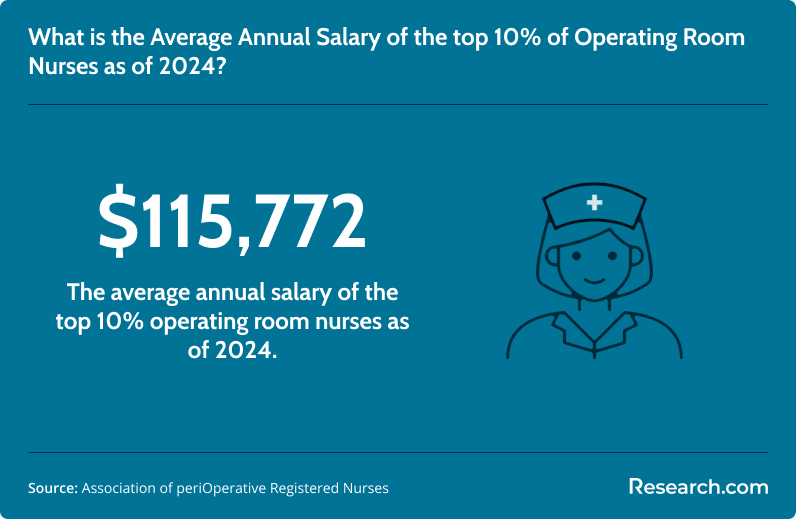
The average operating room nurse salary in the United States is $88,644 per year, or $45.47 per hour. Pay can be much higher for experienced OR nurses, certified perioperative nurses, nurses in high-demand surgical settings, and those working in expensive or competitive labor markets. The top 10% of earners in this field make more than $115,772.
California has the highest salary figure in the state-by-state table at $137,690, followed by Hawaii at $119,710 and Oregon at $113,440. However, the highest listed salary is not always the best financial choice. Nurses should compare take-home pay, cost of living, retirement benefits, tuition assistance, shift differentials, and certification pay before deciding where to work.
What is the median salary for operating room nurses in each U.S. state?
The table below gives a state-by-state salary benchmark for operating room nurses. Use these figures as a starting point when comparing job postings, relocation options, or negotiation ranges. The table labels the figures as average salary, while this section addresses median-style state comparisons; either way, the most useful approach is to treat the numbers as directional benchmarks rather than guaranteed pay.
Location is one of the strongest pay drivers in perioperative nursing. Comparing these figures with another specialty, such as nurse informatics salary by state, can help nurses see how clinical specialization, technology-focused roles, and geography affect compensation differently.
| State | Average salary |
| California | $137,690 |
| Hawaii | $119,710 |
| Oregon | $113,440 |
| Washington | $111,030 |
| Alaska | $109,210 |
| Massachusetts | $108,850 |
| New York | $106,620 |
| Washington, D.C. | $102,686 |
| New Jersey | $101,960 |
| Connecticut | $101,840 |
| Nevada | $97,700 |
| Rhode Island | $95,070 |
| Minnesota | $94,830 |
| Delaware | $94,670 |
| New Mexico | $92,140 |
| Maryland | $92,090 |
| Colorado | $91,730 |
| Arizona | $91,430 |
| Texas | $90,210 |
| Georgia | $90,000 |
| New Hampshire | $89,410 |
| Vermont | $88,380 |
| Virginia | $88,350 |
| Illinois | $87,650 |
| Pennsylvania | $87,530 |
| Wisconsin | $87,220 |
| Michigan | $86,210 |
| Florida | $84,760 |
| Ohio | $84,430 |
| Maine | $84,340 |
| Wyoming | $83,990 |
| Utah | $83,100 |
| Idaho | $83,090 |
| Montana | $82,950 |
| Indiana | $82,700 |
| North Carolina | $82,530 |
| Oklahoma | $82,110 |
| Kentucky | $81,770 |
| South Carolina | $81,390 |
| Louisiana | $80,760 |
| Nebraska | $79,780 |
| North Dakota | $79,190 |
| Tennessee | $78,240 |
| Missouri | $77,590 |
| Kansas | $76,240 |
| West Virginia | $75,990 |
| Mississippi | $75,510 |
| Iowa | $74,610 |
| Arkansas | $72,900 |
| Alabama | $71,370 |
| South Dakota | $69,030 |
What is the average operating room nurse salary in the U.S. in 2025?
The national salary benchmark for operating room nurses in 2025 is shown below. This number is useful when you need a baseline for evaluating an offer, but it should not be treated as the amount every OR nurse should expect to earn.
| Average annual salary | Average hourly rate |
| $88,644 | $45.47 |
National averages can hide major differences. A new OR nurse in a lower-cost market may earn less than the benchmark, while an experienced nurse in a high-volume surgical hospital, trauma center, or competitive metro area may earn more.
What explains the operating room nurse salary range?
The average salary of $88,644 sits within a broader pay range. The top 10% of earners in this specialty make more than $115,772, which shows how much experience, credentials, and workplace setting can matter.
Higher pay is usually tied to factors such as years in perioperative practice, ability to scrub and circulate, experience with complex specialties, leadership duties, call requirements, weekend or night differentials, and certifications such as CNOR or CRNFA. Nurses who can support high-acuity cases or hard-to-staff shifts often have stronger negotiating power.
| Factor | Why it can affect OR nurse pay |
| Experience level | Experienced OR nurses need less training, can manage complex cases, and may precept newer staff. |
| Certifications | Credentials can signal verified perioperative expertise and may qualify nurses for differentials or promotions. |
| Facility type | Trauma centers, large hospital systems, specialty surgical centers, and academic medical centers may have different pay structures. |
| Schedule requirements | Call, nights, weekends, holidays, and high-demand shifts can increase total compensation. |
| Local labor market | Areas with shortages or rapid healthcare growth may offer stronger wages, bonuses, or relocation support. |
How does the national average salary for OR nurses compare to other nursing specialties?
Operating room nursing is generally considered a strong-paying clinical specialty because it requires technical skill, surgical workflow knowledge, sterile technique, teamwork under pressure, and close coordination with surgeons, anesthesia teams, and other perioperative staff. Nurses planning long-term advancement may also compare specialty pay with education options, including flexible doctoral pathways such as online EdD programs with no residency requirement, especially if they are considering education, leadership, or academic roles later.
Within the broader list of highest-paying nursing jobs and careers, specialized roles often pay more than generalist bedside positions. OR nursing belongs in that category because surgical services depend on nurses who understand perioperative safety, instrumentation, sterile fields, positioning, documentation, and emergency response.
How does OR nurse pay compare with surgical and critical-care specialties?
Surgical nurses, a category that includes operating room nurses, have an average pay of around $109,219. That figure is higher than the national OR nurse average shown earlier, which reflects how definitions and data sources can vary across job titles and settings.
Some specialties, including ER nurses and Cardiac Care nurses, are listed with slightly higher averages, often around $116,497. Those differences may reflect acuity, staffing pressure, call expectations, certifications, or regional demand. The main point is not that one specialty is universally better. The better question is which nursing path fits your skills, preferred pace, risk tolerance, schedule needs, and long-term earning strategy.
| Specialty comparison point | What to consider before switching specialties |
| Operating room nursing | Best for nurses who like procedures, structure, teamwork, sterile technique, and technical clinical work. |
| Emergency nursing | May appeal to nurses who prefer rapid triage, unpredictable cases, and high-volume acute care. |
| Cardiac care nursing | Often fits nurses interested in monitoring, cardiovascular disease, ICU step-down care, and advanced hemodynamics. |
| Nursing informatics | Better suited for nurses who want to combine healthcare operations, data, systems, and technology. |
Which states pay operating room nurses the highest salaries?
If you are comparing salaries by gross annual pay alone, several states stand out. These states can be attractive for nurses who want to maximize income, work in large surgical markets, or move to areas with many hospitals and specialty centers. Nurses comparing healthcare career paths may also find it helpful to review related clinical fields, such as occupational therapy certifications and specialties, to understand how credentials and geography influence pay across healthcare professions.
The top-paying states by average annual salary are listed below.
| State | Average annual salary | Notes |
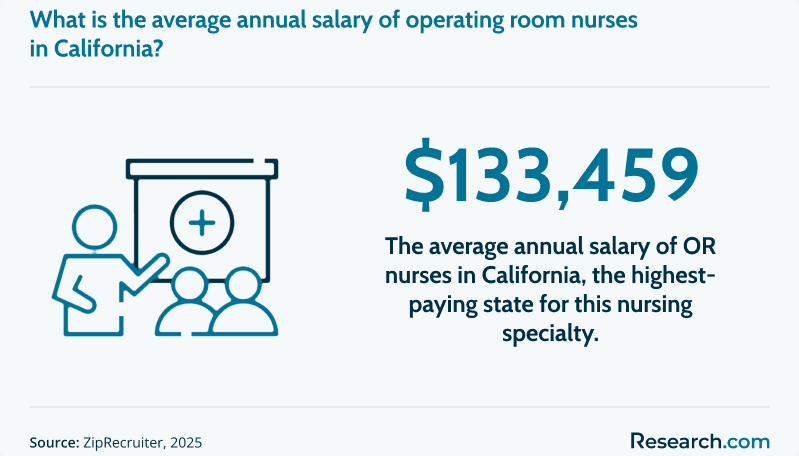
| California | $133,459 | Highest figure in this top-state comparison. |
| Oregon | $118,615 | Strong salary benchmark among West Coast states. |
| New York | $113,561 | High-paying market with major hospital systems. |
These pay levels are appealing and reflect the growing demand for skilled nurses. Still, a high listed salary should be evaluated alongside the full compensation package and the cost of living in the specific city or region.
Why the highest salary is not always the best offer
A large annual salary can lose power quickly in places where rent, home prices, transportation, taxes, childcare, and insurance costs are high. The number that matters most is not only gross pay. It is the amount left after required expenses.
Before relocating for a higher OR nurse salary, compare the job offer against local housing costs, commute time, call requirements, overtime expectations, parking or transit costs, union status, and benefits. A slightly lower salary in a more affordable market can sometimes produce a better quality of life and more savings.
Which states offer the best cost-of-living-adjusted pay for OR nurses?
There is no single best state for every operating room nurse. The strongest financial choice depends on how salary compares with local expenses and personal priorities. A nurse supporting a family, paying student loans, buying a home, or seeking a shorter commute may define “best pay” differently than a travel nurse or a new graduate.
Credentials also matter when crossing state lines. If you are choosing where to study or practice, reviewing how nursing accreditation works can help you understand why recognized programs and valid credentials matter for licensure mobility and employer trust. Nurses who want to move into higher-paid specialized roles may also compare nursing certifications tied to advanced clinical practice, perioperative leadership, or specialty care.
How to estimate your real take-home value
A practical way to compare offers is to estimate your effective income. Start with the annual salary, then subtract major recurring expenses in the city where you would actually live and work. Focus first on housing, state and local taxes, transportation, insurance, and required commuting or parking costs.
For example, a $110,000 salary in a city where core annual expenses total $50,000 leaves $60,000 before other discretionary spending. A $95,000 salary in a city where those same expenses total $30,000 leaves $65,000. In that comparison, the lower salary creates more usable income.
| Offer comparison question | Why it matters |
| What is the expected monthly housing cost near the facility? | Housing is often the biggest factor that reduces the value of a high salary. |
| Are call shifts, nights, weekends, or holidays required? | These duties may raise pay, but they also affect work-life balance. |
| Does the employer offer differentials or certification pay? | Extra compensation can meaningfully change total earnings. |
| How strong are the health, retirement, and tuition benefits? | Benefits can be worth a substantial amount beyond base salary. |
| Will the job require relocation, a longer commute, or higher childcare costs? | Indirect costs can erase part of a raise. |
Which states reward advanced credentials with higher OR nurse pay?
No state universally requires employers to pay more for perioperative credentials. In practice, however, competitive hospitals and surgical centers often value certified nurses because certifications can support quality goals, staff development, leadership pipelines, and patient safety initiatives.
The Certified Nurse of the Operating Room credential, commonly known as CNOR, is one of the most recognized credentials for perioperative nurses. For nurses still building the foundation for RN practice, pathways such as online CNA-to-RN bridge programs can be an earlier step toward eventually qualifying for specialized OR roles and certifications.
What is the return on investment of OR nurse certification?
Certification can pay off in several ways, though the exact return depends on the employer. Some organizations offer hourly differentials, bonuses, promotion preference, or eligibility for specialty roles. Others do not have a formal pay increase but may still favor certified nurses for leadership, educator, charge nurse, or specialty team positions.
Hospitals pursuing quality recognition or trying to strengthen their perioperative workforce may place particular value on certified nurses. For an individual nurse, the best strategy is to ask whether the employer pays for certification exam fees, renewal costs, review courses, continuing education, or paid study time.
Which states provide tuition reimbursement or loan forgiveness for OR nurses?
Tuition reimbursement and loan forgiveness can make a major difference in the real value of a nursing job. These benefits are especially important for nurses completing an RN program, moving into perioperative nursing, or planning graduate education. Nurses with advanced credentials, such as certified registered nurse anesthetic (CRNA), earned $115,000 on average in 2024.
There is not usually one centralized list specifically for OR nurse tuition benefits by state. Instead, programs are often offered by individual hospitals, health systems, state workforce agencies, or federal service programs. Nurses entering the field through flexible routes, including online RN programs for non-nurses, should compare these benefits early because reimbursement rules may affect where they choose to work after graduation.
Where should OR nurses look for tuition and loan repayment help?
- Start with employer benefits pages. Hospital career pages often explain tuition reimbursement, student loan assistance, certification reimbursement, and continuing education funding.
- Ask the recruiter for written details. Confirm eligibility, annual limits, service commitments, grade requirements, repayment clauses, and whether part-time employees qualify.
- Check state nursing and workforce sites. State boards of nursing and workforce agencies may list loan forgiveness or shortage-area programs.
- Review federal options. Programs such as the Nurse Corps Loan Repayment Program may provide financial relief for eligible nurses working in critical shortage facilities.
- Compare benefits with base pay. A job with slightly lower wages but strong tuition support may be better for nurses planning more education.
The following chart shows the growth in median annual earnings for CRNAs from 2017 to 2024. It reflects the high level of training and specialized responsibility associated with one of the highest-paid nursing roles.
Which states offer the best retirement or pension plans for OR nurses?
Retirement benefits are one of the most overlooked parts of an OR nurse job offer. A higher salary can look better upfront, but a strong pension, employer match, or long-term retirement contribution may create more value over a full career.
There is no universal ranking of the best states for OR nurse retirement plans. Benefits usually depend more on the employer than the state. State university hospitals, government facilities, Veterans Affairs facilities, and some large health systems may offer stronger retirement packages than smaller employers. Unionized environments may also have negotiated benefits that differ from nonunion facilities.
Retirement benefits to compare before accepting an OR nurse job
| Benefit | What to ask | Why it matters |
| 401(k) or 403(b) match | What percentage does the employer match, and what contribution is required? | An employer match adds compensation beyond base salary. |
| Vesting schedule | How long must you stay before employer contributions are fully yours? | A generous match may be less valuable if you leave before vesting. |
| Pension | Is a defined-benefit pension available? | A pension can provide predictable retirement income. |
| Retiree health benefits | Are any medical benefits available after retirement? | Healthcare costs can affect long-term financial security. |
| Financial planning resources | Does the employer provide retirement counseling or planning tools? | Good guidance can help nurses make better contribution and savings decisions. |
Which states have the highest demand for operating room nurses?
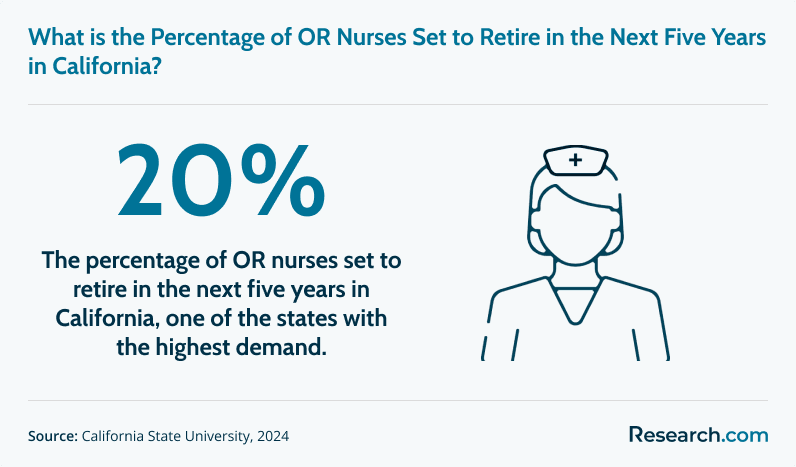
Demand matters because it affects job availability, negotiating leverage, shift options, bonuses, and advancement opportunities. In California, as many as 20% of all OR nurses are set to retire in the next five years, which may increase pressure on employers to recruit and retain perioperative staff.
Operating room nurses are needed across the country, but demand can be especially visible in large healthcare markets and growing regions. California and New York have major hospital systems and large surgical volumes, while Tennessee and New Mexico are examples of markets where healthcare demand is also important. For students preparing to enter nursing, online Associate of Science in Nursing programs may be one route to building the RN foundation required for future OR specialization.
How local demand changes pay and benefits
When employers struggle to fill OR roles, they may compete through higher wages, sign-on bonuses, relocation assistance, call pay, flexible scheduling, tuition benefits, or certification reimbursement. Demand can also open doors to specialty teams, charge nurse roles, educator positions, and management tracks.
However, high demand can also signal heavier workloads, more call, staffing instability, or high turnover. Before accepting an offer in a shortage market, ask how many OR nurse positions are open, how long roles have been vacant, how orientation is structured, and whether the unit relies heavily on travelers or overtime.
| High-demand sign | What it may mean for the nurse | Question to ask |
| Large sign-on bonus | The employer may be competing aggressively for staff. | Is there a repayment clause if I leave early? |
| Frequent call requirements | Total pay may rise, but time demands may be significant. | How often will I be on call, and what is the call-back rate? |
| Heavy use of travel nurses | The unit may have staffing gaps or fluctuating volume. | What is the permanent staff turnover rate? |
| Fast hiring process | The employer may need staff urgently. | Will I still receive a full perioperative orientation? |
| Multiple open OR roles | There may be growth, turnover, or both. | Are these new positions or replacements? |
What certifications or skills can OR nurses add to improve pay offers?
Certifications and specialized skills can strengthen an OR nurse’s pay position because they reduce training needs, support quality goals, and show commitment to perioperative practice. They do not guarantee a raise at every employer, so nurses should always verify whether a facility offers certification pay, clinical ladder credit, reimbursement, or promotion preference.
| Certification or skill | How it can improve an OR nurse’s value | Best fit |
| CNOR, Certified Perioperative Nurse | Shows advanced knowledge of perioperative standards, patient safety, and OR practice. | Experienced OR nurses who want stronger specialty recognition. |
| CRNFA, Certified Registered Nurse First Assistant | Supports expanded perioperative duties such as assisting surgeons with suturing, tissue handling, and hemostasis. | Nurses pursuing advanced intraoperative responsibility. |
| CSSM, Certified Surgical Services Manager | Demonstrates knowledge of surgical services leadership, staffing, budgets, and operations. | OR nurses moving toward management or administrative roles. Nurses comparing education timelines may also review affordable accelerated nursing programs. |
| CAPA or CPAN | Supports expertise in ambulatory perianesthesia care or post-anesthesia care. | Nurses working in PACU, outpatient surgery, or recovery settings. |
| ACLS, BLS, and PALS | Maintains core life support readiness and may be required for surgical, trauma, or pediatric settings. | OR nurses in acute care, pediatric, trauma, or high-acuity environments. |
Skills that can support higher OR nurse compensation
- Scrub and circulate competency: Nurses who can function in both roles may be more flexible and valuable to the schedule.
- Specialty service-line experience: Orthopedics, cardiovascular, neurosurgery, transplant, trauma, robotics, and complex general surgery may strengthen a nurse’s marketability.
- Preceptor or educator experience: Training new OR nurses can support clinical ladder advancement or leadership opportunities.
- Charge nurse experience: Coordinating cases, staffing, and patient flow can prepare nurses for higher-level roles.
- Technology and documentation skill: Familiarity with surgical systems, electronic documentation, and perioperative workflow tools can improve efficiency and reduce onboarding time.
Common Mistakes to Avoid When Comparing OR Nurse Salaries by State
- Looking only at base salary. Base pay is important, but total compensation includes differentials, call pay, retirement contributions, health insurance, tuition reimbursement, bonuses, and paid time off.
- Ignoring cost of living. A higher salary in an expensive city may produce less usable income than a lower salary in a more affordable location.
- Assuming certification always means automatic higher pay. Some employers offer differentials, while others use certification mainly for promotion or clinical ladder eligibility.
- Accepting a sign-on bonus without reading the terms. Bonuses may require a service commitment and repayment if you leave early.
- Not checking orientation quality. OR nursing is highly specialized. A weak orientation can create stress, safety concerns, and early burnout.
- Comparing states instead of specific employers. Pay and benefits can differ widely between hospitals in the same city.
- Overlooking licensure and accreditation. Nurses planning to relocate should understand state licensure requirements and make sure their education meets employer and board expectations.
How to Evaluate an Operating Room Nurse Job Offer
- Confirm the base rate and pay basis. Ask whether the salary is hourly, annualized, or based on scheduled shifts.
- Request the full differential policy. Get details on nights, weekends, holidays, charge shifts, call, call-back, preceptor pay, and certification pay.
- Calculate realistic annual earnings. Include expected overtime, call, and differentials, but avoid assuming overtime is guaranteed.
- Compare benefits in dollar terms. Retirement match, health insurance premiums, tuition reimbursement, parking, and paid time off all affect real compensation.
- Ask about orientation and specialty training. A strong perioperative orientation is especially important for nurses new to the OR.
- Review staffing and turnover. Ask how many positions are vacant, how often nurses take call, and whether travelers are used regularly.
- Check advancement paths. Look for clinical ladders, service-line leadership, educator roles, management opportunities, and certification support.
- Compare the offer against local expenses. Estimate housing, taxes, transportation, childcare, and commute costs before deciding.
Here's What Graduates Say About Operating Nurse Salary by State
- Brian: "I spent five years in med-surg and eventually realized my income growth was slowing down. Moving into the OR changed that. My first perioperative offer came with a 20% increase, and that raise helped my family start saving seriously for a home. For me, specializing was not just a clinical decision. It was a financial turning point."
- Marcus: "My employer pays extra for CNOR certification, so I treated the exam like an investment. Preparing while working full-time was not easy, but the added amount in each paycheck makes the effort feel worthwhile. It proved to me that building deeper expertise can show up directly in compensation."
- Daniel: "At first, I thought the largest salary had to be the best job. After comparing rent, taxes, and everyday costs, I chose a lower-cost state instead of taking a New York offer. My gross pay is smaller, but I keep more of what I earn each month, which has made the move better for my finances."
References
- Association of periOperative Registered Nurses (AORN). (n.d.). AORN Newsroom.
- International Federation of Perioperative Nurses (IFPN).
- Medscape. (n.d.). US nurse workforce bounces back after pandemic shortage.
- OR Manager. (n.d.). Perioperative nursing.
- OR Manager. (2023). The state of the perioperative workforce in 2023, Part 1.
- Watson, A., Peterson, C., Gardner, T., Blank, S., & The Journal of Nursing Regulation. (2025). The 2022 National Nursing Workforce Survey. Journal of Nursing Regulation, 14(1), S1-S90.
Key Insights
- The national average operating room nurse salary is $88,644 per year, or $45.47 per hour, while the top 10% of earners make more than $115,772.
- California, Hawaii, Oregon, Washington, and Alaska appear near the top of the state salary table, but high pay should be weighed against housing, taxes, commuting, and other local costs.
- Gross salary is only one part of the decision. Differentials, call pay, retirement benefits, tuition assistance, certification reimbursement, and paid time off can change the real value of an offer.
- Advanced credentials such as CNOR, CRNFA, CSSM, CAPA, CPAN, ACLS, BLS, and PALS can strengthen an OR nurse’s resume, but pay increases depend on employer policy.
- High-demand markets can create better negotiating leverage, but nurses should also ask about staffing levels, call burden, orientation quality, and turnover before accepting a role.
- The best state for an OR nurse is not automatically the state with the highest salary. The better choice is the location and employer combination that provides the strongest effective income, career growth, and quality of life.
Other Things You Should Know About Operating Room Nurse Salary by State
In 2027, the state with the lowest average salary for operating room nurses is Alabama, where salaries are approximately 10% lower than the national average. Factors include the state's cost of living, demand for healthcare services, and the concentration of healthcare facilities.
Operating room nurse salaries in 2027 are determined by factors including the cost of living, demand for healthcare services, and state healthcare funding. States with higher costs of living or greater demand for specialized healthcare often offer higher salaries to attract and retain skilled nurses.
In 2027, California is typically known to offer the highest average salaries for operating room nurses, due to its high cost of living, strong union presence, and demand for healthcare professionals. This makes the state an attractive but competitive location for nurses.


