
2027 Best Online Health Informatics Courses

Co-Founder and Chief Data Scientist
Choosing an online health informatics course is not just about finding a convenient class. It is about deciding whether a program will help you understand healthcare data, electronic health records, privacy rules, interoperability, analytics, and the real technology problems healthcare organizations face every day. The wrong course can leave you with a certificate that looks good on a profile but does little for your career; the right one can help you move into health IT, analytics, clinical informatics, public health informatics, or healthcare technology leadership.
This guide is for healthcare workers, IT professionals, data analysts, students, nurses, administrators, and career changers who want a practical way to compare online health informatics courses. You will learn what these courses usually cover, which course formats make sense for different goals, what salaries and career paths may look like, how to judge quality, and what questions to ask before enrolling.
Quick Answer: Are online health informatics courses worth taking?
Online health informatics courses can be worthwhile if they teach current healthcare data systems, EHR workflows, privacy and security rules, analytics, interoperability standards, and applied projects. They are especially useful for working adults because many are self-paced and can be completed without leaving a job. However, a short course is not the same as a degree, license, or professional certification. Before enrolling, compare curriculum depth, instructor qualifications, certificate value, hands-on assignments, cost, and whether the course supports your target role.
What are the main benefits of taking an online health informatics course?
- Career relevance: Health informatics sits at the point where patient care, data, technology, compliance, and operations meet, making it useful for many healthcare and health IT roles.
- Flexible learning: Many online courses are self-paced, which helps working professionals study while managing employment, family, or clinical schedules.
- Practical skill building: Strong courses introduce learners to electronic health records, healthcare data standards, analytics, privacy, interoperability, and project-based problem solving.
- Lower commitment than a degree: A single course or certificate can help you test the field before investing in a graduate program or broader credential.
- Career mobility: Informatics knowledge can help clinicians move into technology-enabled leadership and help IT or data professionals specialize in healthcare.
What can I expect from an online health informatics course?
A good online health informatics course should explain how healthcare organizations collect, protect, exchange, analyze, and use data to improve care and operations. The strongest courses go beyond definitions and include assignments that mirror workplace tasks, such as evaluating EHR workflows, designing dashboards, assessing privacy risks, or planning a health IT implementation.
| Course component | What it should help you learn | Why it matters |
| Health data foundations | Sources, types, quality issues, clinical documentation, and population-level data | Healthcare data is complex, sensitive, and often fragmented across systems. |
| Health information systems | EHRs, clinical decision support, patient portals, telehealth platforms, and health information exchange | Most informatics work involves improving how people use systems, not just understanding the software. |
| Analytics and visualization | Basic statistical analysis, dashboards, data interpretation, and reporting | Healthcare teams need evidence they can act on, not just raw data. |
| Privacy, security, and compliance | HIPAA, protected health information, access controls, breach prevention, and ethical use of data | Health data misuse can create legal, financial, and patient trust risks. |
| Interoperability and standards | Data exchange concepts, standards, terminology, and system integration issues | Healthcare systems often need to share information securely across organizations and vendors. |
| Applied projects | Case studies, workflow redesign, dashboards, implementation plans, and risk assessments | Employers value evidence that you can apply informatics concepts to real healthcare problems. |
Where can I work after taking an online health informatics course?
Online health informatics training can support roles in hospitals, clinics, insurance organizations, public health agencies, health technology vendors, research teams, academic institutions, consulting firms, and government or nonprofit health programs. Your options depend heavily on your prior background. A nurse may use informatics training to move toward clinical informatics or nursing informatics, while an IT professional may target EHR support, implementation, cybersecurity, or data systems work.
- Healthcare delivery organizations: Hospitals, medical groups, ambulatory care networks, telehealth providers, and specialty clinics use informatics to improve workflows, documentation, reporting, and quality measures.
- Health technology companies: Vendors need people who understand both software and healthcare operations, especially for implementation, product support, analytics, and customer success.
- Public health agencies: Informatics skills are used in disease surveillance, reporting, population health analytics, and emergency response planning.
- Research and academic settings: Data management, registries, clinical research systems, and analytics are common areas of need.
- Insurance and payer organizations: Informatics supports claims analysis, care management, risk adjustment, utilization review, and quality reporting.
How much can I make after taking an online health informatics course?
Compensation in health informatics depends on role, experience, credentials, geography, employer type, and whether the position requires clinical licensure, advanced analytics, management, or executive responsibility. A course alone does not guarantee a salary increase, but it can help build knowledge for roles with stronger earning potential.
- Health Informatics Specialist: $70,000 - $120,000 per year
- Clinical Informatics Analyst: $65,000 - $110,000 per year
- Health IT Project Manager: $80,000 - $140,000 per year
- Chief Informatics Officer (CIO): $150,000 - $300,000+ per year
Use these figures as broad reference points rather than guaranteed outcomes. Salary can change significantly by employer, region, clinical background, technical depth, and years of experience.
- Online Health Informatics Courses to Compare for 2027
- What is health informatics and why does it matter?
- What core concepts should every course teach?
- What topics should a comprehensive course include?
- What types of online health informatics courses are available?
- What prerequisites should I expect?
- What skills do health informatics professionals need?
- What career paths can health informatics training support?
- How can informatics courses support advanced clinical leadership?
- How can health informatics lead to interdisciplinary careers?
- Can non-clinical professionals combine informatics with clinical education?
- What accreditation and quality checks matter?
- How should I evaluate return on investment?
- How do courses support job search and professional growth?
- Which health informatics specializations are available?
- How do online and in-person courses compare?
- What certificates and industry credentials can I pursue?
- What real-world projects should I look for?
- How do courses prepare learners for the future of healthcare?
- What challenges and mistakes should I consider before enrolling?
- What final questions should I ask before choosing a course?
Online Health Informatics Courses to Compare for 2027
The courses below represent different ways to enter or deepen your knowledge of health informatics, including public health informatics, healthcare AI, data science, healthcare IT support, interoperability, HIPAA, and certification preparation. Treat this list as a comparison starting point, not a substitute for reviewing the current course page, syllabus, cost, refund policy, and certificate details before enrolling.
| Course | Best fit | Length | Certificate | Key caution |
| Public Health Informatics Certificate, Johns Hopkins University | Learners interested in public health data, informatics interventions, and applied problem solving | Approximately 5 courses, each ranging from 10 to 36 hours | Yes | Cost is not specified, so confirm pricing before starting. |
| AI in Healthcare Specialization, Stanford University | Learners who want to understand AI applications, patient safety, and clinical data projects | 5 courses totaling approximately 50 hours | Yes | Basic understanding of machine learning concepts is recommended. |
| The Data Science of Health Informatics, Johns Hopkins University | Beginners who want a shorter introduction to health informatics and data science questions | Approximately 8 hours, 4 modules | Yes | Basic statistics knowledge is helpful. |
| Healthcare IT Support Specialization, Johns Hopkins University | Entry-level learners targeting health IT support environments | 4 courses totaling approximately 20 hours | Yes | Best suited for support skills, not advanced analytics or leadership training. |
| Georgia Tech /GTx Health Informatics on FHIR | Learners focused on interoperability and health data exchange standards | Approximately 4 months at 10-11 hours per week | Yes, available for a fee | Confirm current cohort dates and certificate fee. |
| Understanding and Complying with HIPAA | Healthcare staff or beginners needing a short compliance overview | Approximately 1 hour of video content | Yes | Too short to substitute for a full informatics curriculum. |
| CompTIA Healthcare IT | IT learners preparing for healthcare IT certification topics | Approximately 4 hours of video content | Yes | Understanding of medical terminology, health data requirements and standards, clinical classification and coding systems highly recommended. |
1. Public Health Informatics Certificate, Johns Hopkins University
Johns Hopkins University offers a Public Health Informatics Certificate that introduces learners to the use of information technology, health data, and informatics methods in public health and healthcare improvement. The sequence includes five courses that address problem framing, data access, analysis, and the design of informatics solutions. Learners complete applied work that emphasizes both technical and social dimensions of health informatics challenges. By the end, participants should better understand health care administration, clinical data management, and decision support systems.
- Length: Approximately 5 courses, each ranging from 10 to 36 hours.
- Schedule: Self-paced learning with flexible deadlines.
- Tracks/Concentrations: Public Health Informatics.
- Cost: Not specified.
- Prerequisites: No formal prerequisites; however, familiarity with healthcare or technology is beneficial.
- Certificate: Yes, upon completion of all courses.
- Salient features: Includes an applied learning project and focuses on real-world health informatics challenges.
2. AI in Healthcare Specialization, Stanford University
The AI in Healthcare Specialization at Stanford University examines how artificial intelligence and machine learning can be applied to healthcare problems. Across five courses, learners explore how AI may relate to clinical practice, quality improvement, patient safety, and ethical questions in medicine. The specialization concludes with a capstone project using a dataset created for the program, giving students a structured way to practice healthcare data analysis.
- Length: 5 courses totaling approximately 50 hours.
- Schedule: Self-paced with flexible deadlines.
- Tracks/Concentrations: Artificial Intelligence in Healthcare.
- Cost: Around $49 per month after a free trial at Coursera
- Prerequisites: Basic understanding of machine learning concepts is recommended.
- Certificate: Yes, awarded upon completion of all courses.
- Salient features: Includes a capstone project that simulates real-world patient data analysis.
3. The Data Science of Health Informatics, Johns Hopkins University
Johns Hopkins University's Data Science of Health Informatics course is a shorter option for learners who want to understand how data science connects with healthcare questions. It introduces clinical and population-level data, explains different types of data questions, and shows how analysis can support better decision-making in care and public health settings.
- Length: Approximately 8 hours, 4 modules.
- Schedule: Self-paced learning format.
- Tracks/Concentrations: Data Science in Health Informatics.
- Cost: Typically around $49 per month after a free trial period at Coursera.
- Prerequisites: No formal prerequisites; basic statistics knowledge is helpful.
- Certificate: Yes, upon successful completion.
- Salient features: Focuses on practical applications of data science in healthcare settings.
4. Healthcare IT Support Specialization by Johns Hopkins University
Johns Hopkins University's Healthcare IT Support Specialization is designed for learners who want to understand healthcare IT support responsibilities. The four-course sequence covers health IT fundamentals, operations, patient safety, and data security compliance. It is most relevant for people preparing to support healthcare professionals, troubleshoot systems, and understand the technology environment inside healthcare organizations.
- Length: 4 courses totaling approximately 20 hours.
- Schedule: Self-paced learning with flexible deadlines.
- Tracks/Concentrations: Healthcare IT Support.
- Cost: Typically around $49 per month after a free trial period.
- Prerequisites: No formal prerequisites; interest in IT support is beneficial.
- Certificate: Yes, awarded upon completion of all courses.
- Salient features: Includes case studies and practical problem-solving exercises.
5. Georgia Tech /GTx Health Informatics on FHIR
Georgia Tech's Health Informatics on FHIR course on edX introduces health informatics through the lens of FHIR, or Fast Healthcare Interoperability Resources. This focus is useful for learners who want to understand how healthcare data can move between systems. The course explains foundational informatics concepts and demonstrates why interoperability standards matter for modern healthcare data exchange.
- Length: Approximately 4 months at 10-11 hours per week.
- Schedule: Self-paced with specific start dates for cohorts.
- Tracks/Concentrations: Health Informatics with FHIR focus.
- Cost: Free to audit; verified certificate available for a fee, typically around $99.
- Prerequisites: Basic understanding of healthcare systems is recommended.
- Certificate: Yes, available upon completion for a fee.
- Salient features: Focuses on practical applications of FHIR standards in health informatics.
6. Understanding and Complying with HIPAA, Udemy
The Understanding and Complying with HIPAA course at Udemy provides a concise introduction to the Health Insurance Portability and Accountability Act rules governing protected health information. It covers privacy rules, security obligations, and compliance practices that healthcare professionals need to understand when handling sensitive patient data.
- Length: Approximately 1 hour of video content.
- Schedule: On-demand access; self-paced learning format.
- Tracks/Concentrations: Compliance with HIPAA regulations.
- Cost: Typically priced around $19.99, often discounted.
- Prerequisites: None; suitable for all levels interested in HIPAA compliance.
- Certificate: Yes, upon completion of the course.
- Salient features: Includes quizzes and practical examples related to HIPAA compliance.
7. CompTIA Healthcare IT, Udemy
Udemy's CompTIA Healthcare IT course is built around topics associated with CompTIA's Healthcare IT certification preparation. It addresses health information systems, compliance, and data management practices in healthcare environments. The course may fit learners with IT interests who want healthcare-specific context before supporting clinical technology systems.
- Length: Approximately 4 hours of video content.
- Schedule: On-demand access; self-paced learning format.
- Tracks/Concentrations: CompTIA Healthcare IT certification preparation.
- Cost: Typically priced around $19.99, often discounted.
- Prerequisites: Basic understanding of IT concepts is helpful but not required. Understanding of medical terminology, health data requirements and standards, clinical classification and coding systems highly recommended.
- Certificate: Yes, awarded upon completion of the course.
- Salient features: Focuses on real-world applications relevant to healthcare IT professionals.
What is health informatics and why does it matter?
Health informatics is the use of data, information systems, technology, and workflow design to support healthcare delivery, public health, research, administration, and patient engagement. It is not the same as general IT because healthcare data is highly regulated, clinically sensitive, and tied to patient safety. It is also not only data science because informatics work often requires understanding how clinicians, patients, administrators, vendors, and regulators interact with systems.
- Patient care: Informatics supports access to accurate records, safer medication processes, clinical decision support, and better coordination across care teams.
- Operations: Health systems use informatics to improve scheduling, documentation, billing workflows, reporting, and resource allocation.
- Research: Informatics methods help organize and analyze large clinical, public health, and biological datasets.
- Public health: Data systems support surveillance, prevention, reporting, and response efforts.
- Patient engagement: Patient portals, remote monitoring, mobile health tools, and consumer-facing apps rely on informatics principles.
Educational backgrounds in this field vary. Among health informatics specialists, the most common degree is a bachelor's degree, held by 52% of professionals. Master's degrees account for 23%, associate degrees for 13%, doctorate degrees for 8%, and other degree types for 4%. This pattern suggests that a bachelor's degree can support entry into the field, while graduate study may be useful for more specialized, analytical, or leadership-focused roles.
What are the core concepts and principles of health informatics?
Any serious health informatics course should help you understand the concepts below. If a course skips most of them, it may be too narrow for learners seeking broad career preparation.
| Core concept | What it means in practice |
| Data management | Collecting, storing, retrieving, validating, protecting, and analyzing healthcare data so it can be trusted and used responsibly. |
| Health information systems | Designing, implementing, supporting, and improving systems such as EHRs, telehealth platforms, clinical decision support tools, and registries. |
| Clinical decision support | Using data and evidence to help clinicians make safer and more timely decisions about diagnosis, treatment, and medication management. |
| Health information exchange | Sharing health information securely among approved organizations and users to support coordinated care. |
| Patient engagement | Using technology to help patients access information, manage care, communicate with providers, and participate in decisions. |
| Human-computer interaction | Designing health technology that clinicians and patients can actually use efficiently and safely. |
| Security and privacy | Protecting patient information from unauthorized access, misuse, disclosure, or loss. |
| Standards and interoperability | Using common terminology, data formats, and protocols so systems can exchange and interpret information. |
| Evidence-based practice | Applying data and research evidence to clinical and operational decisions. |
| Systems thinking | Understanding healthcare as an interconnected environment where technology changes can affect workflows, people, risk, and outcomes. |
Learners comparing degree pathways should also check whether broader programs include informatics fundamentals. Some cheap accredited online bachelor degree programs may include relevant coursework in healthcare, information systems, analytics, or technology management.
What topics should a comprehensive online health informatics course include?
A comprehensive course should combine healthcare context, data literacy, systems knowledge, legal awareness, and applied practice. The goal is not simply to know terminology, but to understand how technology decisions affect care quality, workflow, privacy, and organizational performance.
- Introduction to health informatics: Scope of the field, history, professional roles, and impact on healthcare delivery.
- Healthcare data: Data types, sources, documentation quality, privacy requirements, data standards, and data governance.
- Health information systems: EHRs, clinical decision support, telehealth platforms, patient portals, and health information exchange.
- Analytics: Basic statistics, data visualization, quality measurement, dashboards, and healthcare-specific analytical questions.
- Interoperability: Data exchange, standards, terminology, and common barriers to system integration.
- Legal and ethical issues: HIPAA, confidentiality, consent, algorithmic bias, cybersecurity, and responsible use of patient data.
- Project and change management: Needs assessment, stakeholder communication, implementation planning, training, and evaluation.
- Applied assignments: EHR workflow analysis, dashboard design, privacy risk review, telehealth evaluation, or data quality improvement plan.
If your strongest interest is analytics, compare health informatics courses with programs in data science. Some cheapest data science masters online programs may cover overlapping skills such as data management, statistical analysis, visualization, and machine learning, but they may not provide the same depth in healthcare privacy, clinical workflows, or health data standards.
What are the different types of online health informatics courses available?
Online health informatics education ranges from one-hour compliance modules to graduate degrees. The best format depends on your current background, career target, budget, and how much proof of learning you need.
| Format | Best for | Typical trade-off |
| Individual course | Exploring a topic such as EHRs, HIPAA, data analytics, or public health informatics | Low commitment, but may not be enough for a career pivot. |
| Certificate program | Building a structured skill set without completing a full degree | More focused than a degree, but employer recognition varies. |
| Bootcamp | Rapid skill development in analytics, implementation, or technical tools | Intensive and practical, but may not include broad healthcare theory. |
| Microcredential or digital badge | Documenting a specific skill for professional development | Useful for upskilling, but not always equivalent to academic credit. |
| MOOC | Affordable or flexible learning from universities or online platforms | Can be accessible, but support and assessment depth vary. |
| Professional certification preparation | Preparing for an industry-recognized exam or competency area | Exam preparation may be narrow and may require separate eligibility steps. |
| Master's degree | Career changers or professionals targeting leadership, analytics, research, or advanced informatics roles | Higher time and cost commitment than a short course. |
For learners considering a broader analytics path, some cheapest online masters in data analytics programs may be worth comparing against health informatics degrees or certificates. The right choice depends on whether you want a healthcare-specific career or a more general data career that could include healthcare employers.
Are there any prerequisites or eligibility requirements for online health informatics courses?
Requirements vary by course level. Introductory courses may welcome beginners, while graduate certificates and master's programs may require a bachelor's degree, prior coursework, or relevant professional experience. Technical courses may expect comfort with statistics, databases, programming, or IT concepts; clinical informatics courses may assume knowledge of healthcare workflows or terminology.
- Short individual courses: Often have no formal prerequisites, though basic computer literacy is usually expected.
- HIPAA or compliance modules: Usually open to beginners but more useful when paired with workplace context.
- Healthcare IT support courses: May be easier if you understand basic IT concepts, troubleshooting, and end-user support.
- Data analytics courses: Basic statistics, spreadsheets, databases, or programming may be helpful.
- Certificate programs: May require a bachelor's degree or professional experience, depending on the provider.
- Master's programs: Typically require a bachelor's degree and may specify GPA, prerequisite coursework, or professional background expectations.
Students who want more technical breadth can also explore online computing pathways. Some computer science degree online programs include electives, minors, or projects connected to health informatics, health data, or healthcare technology.
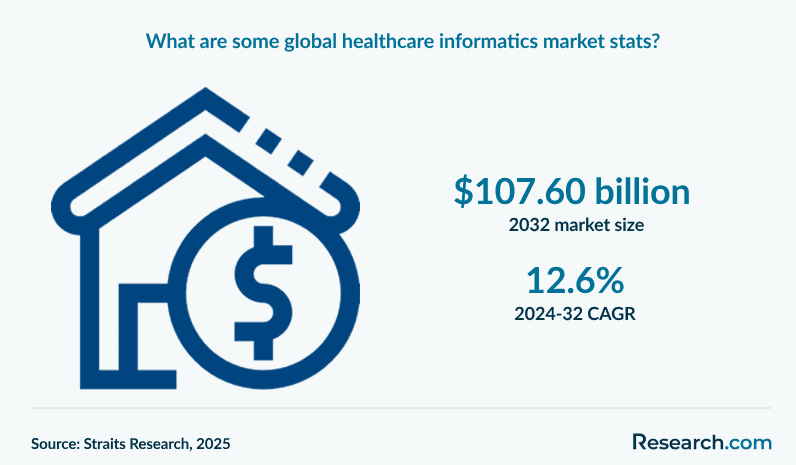
The market context is another reason to evaluate prerequisites carefully. Straits Research (2025) predicts the global healthcare informatics market will reach $107.60 billion by 2032, with a 12.6% compound annual growth rate from 2024 to 2032. This projected growth reflects demand for digital health solutions, technology adoption, and better data management in patient care, but individual job outcomes still depend on skills, credentials, experience, and location.
What are the key skills and knowledge required for a successful career in health informatics?
Health informatics professionals need a blended skill set. Technical ability matters, but so does understanding clinical workflows, privacy rules, stakeholder needs, and how to communicate with people who may not speak the same technical language.
| Skill area | What to build | How an online course can help |
| Healthcare knowledge | Medical terminology, clinical workflows, care delivery models, and regulatory context | Case studies and healthcare-specific examples help translate technology concepts into real settings. |
| Data management | Data quality, databases, reporting, governance, and data lifecycle practices | Assignments can require cleaning, interpreting, and documenting healthcare data. |
| Analytics | Statistics, visualization, dashboards, data interpretation, and outcome measurement | Projects can show how data supports quality improvement and operational decisions. |
| Health IT systems | EHRs, decision support, telehealth, patient portals, and implementation issues | Courses can explain how systems affect clinicians, administrators, and patients. |
| Privacy and security | HIPAA, access controls, breach response, ethical use, and protected health information | Scenario-based exercises can build practical judgment around sensitive data. |
| Communication | Explaining technical issues to clinicians, leaders, vendors, patients, and IT teams | Discussion boards, project presentations, and written analyses can develop clarity. |
| Project management | Planning, implementation, change management, timelines, stakeholders, and evaluation | Capstones and implementation plans can simulate workplace informatics projects. |
| Lifelong learning | Keeping up with changing systems, regulations, standards, AI tools, and employer needs | Strong courses teach frameworks, not just one software tool. |
If you want to move toward healthcare operations or leadership rather than analytics, compare informatics coursework with broader healthcare management training. Some cheapest online healthcare management degree programs may offer relevant preparation in project management, administration, and health system operations.
What career paths are available in health informatics?
Health informatics can lead to analytical, technical, clinical, administrative, research, public health, and leadership roles. Your entry point will usually depend on what you already bring: clinical licensure, IT experience, data skills, healthcare administration experience, or academic training.
| Career path | Typical focus | Who may fit best |
| Health Informatics Analyst | Analyzes healthcare data to identify trends, quality issues, workflow problems, and improvement opportunities. | Data-oriented learners with healthcare context. |
| Health IT Specialist | Supports, implements, and maintains EHRs, telehealth tools, and other healthcare systems. | IT professionals or beginners targeting support roles. |
| Clinical Informatics Specialist | Connects clinical teams and technology teams to improve system use and patient care workflows. | Clinicians or healthcare workers with strong systems interest. |
| Health Data Scientist | Uses advanced analytics, modeling, and machine learning to analyze healthcare data. | Learners with statistics, programming, and data science preparation. |
| Health Informatics Manager | Leads informatics projects, teams, budgets, and technology initiatives. | Experienced professionals with leadership and implementation skills. |
| Health Information Manager | Oversees data quality, records, compliance, governance, and privacy processes. | Learners interested in HIM, compliance, and records management. |
| Public Health Informatician | Applies informatics to surveillance, reporting, outbreak investigation, and population health programs. | Public health, epidemiology, or government-focused learners. |
| Informatics Nurse Specialist | Uses technology and data to support nursing practice, documentation, and care coordination. | Nurses seeking informatics specialization. |
| CMIO or senior informatics executive | Guides technology strategy, governance, and clinical alignment at an organizational level. | Experienced clinical and administrative leaders. |
Other roles may include Health Informatics Consultant, Informatics Pharmacist, Bioinformatician, Health Informatics Educator, Health Informatics Researcher, and Health Informatics Entrepreneur. The field is broad, so it is important to match your course choice to a specific direction rather than choosing the most general option available.
Average salary figures vary by title. A Director of Health Informatics earns an average of $209,898 per year, while a Health Informatics Manager earns $130,780. Health Informatics Specialist I earns $77,810, Health Informatics Specialist II earns $103,290, and Health Informatics Specialist III earns $102,890. A Clinical Informatics Specialist earns an average of $115,397. These averages should be treated as guidelines, not guarantees, because location, experience, education, employer, and job scope can substantially affect pay.
How can online health informatics courses enhance advanced clinical leadership?
For clinicians, health informatics training can strengthen leadership by improving the ability to use data, evaluate workflows, guide EHR optimization, and communicate technology needs to executives and IT teams. Nurses, physicians, pharmacists, and allied health professionals who understand informatics are often better prepared to lead quality improvement, patient safety, documentation, telehealth, and analytics initiatives.
Clinicians pursuing advanced practice or executive roles may pair informatics knowledge with graduate clinical education. For example, learners comparing doctoral nursing pathways can review online doctor of nursing programs to understand how advanced clinical leadership and informatics competencies may complement each other.
How do online health informatics courses facilitate interdisciplinary career pathways?
Health informatics is inherently interdisciplinary. A single project may involve clinicians, IT teams, compliance officers, administrators, data analysts, vendors, and patients. Online courses that include case studies and group discussions can help learners practice translating needs across these groups. This is valuable for professionals working in aging services, public health, chronic disease management, patient advocacy, health technology, and care coordination.
For learners interested in combining informatics with aging-related services, Research.com's guide on how to become a gerontologist can help clarify related career pathways in senior health, long-term care, and aging-focused programs.
Are there complementary advanced clinical programs for non-clinical professionals?
Non-clinical professionals can use health informatics as a bridge into healthcare technology, operations, analytics, or administration. However, informatics coursework does not make someone a licensed clinician. If your goal is to move into direct clinical practice, you will need to evaluate accredited clinical degree programs, admissions requirements, clinical placement expectations, state authorization, and licensure eligibility.
Career changers who want to combine informatics knowledge with a nursing pathway can compare options such as direct entry MSN online programs. Before choosing that route, confirm whether the program meets clinical, licensure, and state requirements for your location.
What accreditation and quality assurance measures should I consider?
Course quality matters more than the name of the platform alone. For a non-degree course, look for transparent faculty credentials, detailed syllabi, applied assignments, current examples, and clear certificate policies. For college credit, certificates, or degrees, verify institutional accreditation and whether the program has any field-specific recognition relevant to your goal.
- Institutional credibility: Confirm who offers the course and whether the institution or platform clearly identifies instructors and learning outcomes.
- Curriculum currency: Check whether the content covers current issues such as EHR optimization, interoperability, healthcare analytics, privacy, cybersecurity, telehealth, and AI ethics.
- Assessment quality: Prefer courses with projects, case studies, or applied assignments over courses that rely only on passive video viewing.
- Certificate transparency: Understand whether the certificate is a completion certificate, academic credit, continuing education, or preparation for a separate exam.
- Transferability: If you plan to continue into a degree, ask whether the course can transfer or count toward future requirements.
- Licensure relevance: If you are pursuing a clinical path, never assume an online course or program satisfies licensure requirements without verifying with the school and state board.
Healthcare professionals weighing additional nursing education can compare affordability and accreditation considerations through resources such as the most affordable RN to BSN online guide.
How can I evaluate the return on investment of online health informatics courses?
ROI depends on what you need the course to do. A short HIPAA course may be worthwhile if it helps you meet workplace training needs. A certificate may be worthwhile if it helps you document applied skills for a job transition. A graduate program may make sense if your target roles commonly require advanced education or leadership preparation.
| ROI factor | Question to ask | Why it matters |
| Total cost | What are tuition, subscription fees, certificate fees, books, software, and exam costs? | A low advertised price may not include every expense. |
| Time commitment | Can you realistically complete the course while working? | Unfinished courses provide little career value. |
| Career alignment | Does the course map to your target role? | A course on AI will not replace EHR support training, and a HIPAA course will not replace analytics training. |
| Portfolio value | Will you complete projects you can discuss in interviews? | Applied work can be more persuasive than a completion badge alone. |
| Employer recognition | Do employers in your target area recognize the credential or skills? | Some certificates are useful for learning but have limited hiring value by themselves. |
| Next-step value | Can the course support future certification, graduate study, or a career pivot? | The best ROI often comes from courses that fit a larger plan. |
Compare informatics ROI with adjacent healthcare education options if you are also considering clinical advancement. For example, affordability-focused learners may review cheapest AGNP programs to understand how cost, career goals, and credential level differ across healthcare pathways.
How do online health informatics courses support career placement and professional growth?
Career support varies widely. Some courses provide only videos and quizzes, while more robust programs may include portfolio projects, instructor feedback, career workshops, networking events, resume guidance, interview preparation, or connections to healthcare organizations. If job placement matters to you, ask direct questions before enrolling rather than assuming support is included.
- Portfolio projects: Look for deliverables such as dashboards, workflow analyses, implementation plans, privacy assessments, or data quality reports.
- Mentorship: Courses with instructor or industry feedback can be more useful than fully automated content.
- Career services: Ask whether resume reviews, interview preparation, or job search guidance are included.
- Employer connections: Stronger programs may involve healthcare partners, guest speakers, practicums, or capstone projects.
- Professional networking: Discussion boards and cohort models can help working adults connect with peers across regions and roles.
If you are comparing healthcare education options more broadly, Research.com's guide What is the easiest nursing school to get into? may help you think through admissions accessibility, though nursing school and health informatics courses serve different purposes.
What specializations are available within health informatics?
Specialization matters because health informatics is too broad to master through one short course. Choose a focus based on the problems you want to solve and the roles you plan to pursue.
- Data Analytics: Uses statistical analysis, data mining, predictive modeling, visualization, and machine learning to improve outcomes, efficiency, and population health.
- Health IT Management: Focuses on planning, implementing, supporting, and managing systems such as EHRs, telehealth platforms, and healthcare applications.
- Public Health Informatics: Applies informatics methods to disease surveillance, prevention programs, outbreak response, reporting, and health promotion.
- Clinical Informatics: Improves decision-making, documentation, and clinical workflows through technology at the point of care.
- Bioinformatics: Bioinformatics combines biology, computer science, and information technology to analyze biological data, including genomic data, for research and clinical use.
- Pharmacy Informatics: Uses technology to support medication safety, electronic prescribing, dispensing systems, and pharmacogenomics.
- Nursing Informatics: Integrates nursing practice, documentation, patient monitoring, care coordination, education, and research with health technology.
- Dental Informatics: Applies informatics concepts to electronic dental records, imaging, teledentistry, and dental practice systems.
- Health Information Management: Emphasizes data quality, records management, privacy, compliance, governance, and security. Learners who want additional security preparation can explore online cybersecurity courses.
- Consumer Health Informatics: Focuses on patient portals, mobile health applications, wearables, and tools that help patients manage their own care.
- Imaging Informatics: Deals with medical image storage, retrieval, analysis, workflow, and reporting systems.
- Telehealth Informatics: Supports remote care delivery, virtual visits, remote monitoring, and digital access to healthcare services.
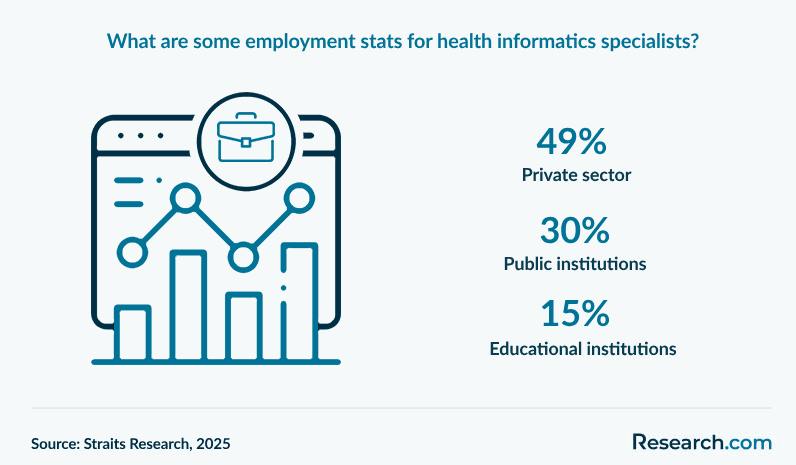
Zippia (2024) reports that 49% of health informatics specialists work in the private sector, 30% in public institutions, and 15% in educational institutions. This spread shows why specialization is important: the skills needed for a vendor implementation role may differ from those needed in public health surveillance, academic research, or hospital operations.
How do online health informatics courses compare to in-person programs?
Online and in-person health informatics programs can both be valuable, but they serve different learners. Online courses are often better for working adults who need flexibility. In-person programs may provide stronger face-to-face networking, immediate faculty access, and campus-based labs or clinical connections. The better choice depends on your schedule, learning style, need for interaction, and career goal.
| Factor | Online courses | In-person programs |
| Schedule | Often self-paced or asynchronous, which helps working adults. | Usually follows fixed class times and campus schedules. |
| Interaction | May rely on discussion boards, video sessions, and virtual collaboration. | Allows face-to-face conversations with faculty and peers. |
| Hands-on learning | Can include virtual labs, datasets, simulations, and projects. | May offer campus labs, clinical site access, or in-person workshops. |
| Networking | Can connect learners across regions and professions. | May offer stronger local employer and alumni connections. |
| Best fit | Professionals needing flexibility, career changers testing the field, and learners comfortable with independent study. | Learners who want structured schedules, direct support, and local campus resources. |
Healthcare professionals comparing flexible clinical programs may also find it useful to review fast track online MSN women’s health NP programs, especially when weighing online delivery, clinical requirements, and advanced healthcare roles.
What certifications and industry credentials can I earn from online health informatics courses?
Many online health informatics courses provide a certificate of completion, but that is not always the same as an industry certification. A completion certificate confirms that you finished a course. A professional certification usually involves an exam, eligibility criteria, continuing education, and recognition by an industry or professional body.
- Course certificates: Often available after finishing a MOOC, specialization, or platform-based course.
- University certificates: May be part of a formal continuing education or academic certificate program.
- Certification preparation: Some courses are designed to help learners prepare for separate exams or professional credentials.
- Specialized credentials: Depending on your background, you may pursue credentials in health informatics, health information management, healthcare IT, privacy, security, analytics, or clinical informatics.
If your long-term goal includes advanced clinical leadership, compare informatics training with degree-based clinical preparation. Research.com's guide to DNP online fast programs can help clinicians understand another type of credential pathway, though DNP programs and health informatics certificates are not interchangeable.
What are some examples of real-world projects or case studies included in online health informatics courses?
Applied work is one of the clearest signs that a health informatics course is designed for career usefulness. Look for assignments that require analysis, decisions, trade-offs, and communication—not just quizzes.
- EHR data analysis: Identify trends in diagnoses, readmissions, treatment patterns, documentation quality, or patient outcomes.
- Health IT implementation plan: Develop a needs assessment, stakeholder map, training plan, timeline, risk plan, and evaluation strategy.
- Telehealth evaluation: Assess how virtual care affects access, satisfaction, cost, workflow, or care quality.
- Dashboard design: Build visual reports that help leaders monitor quality, operations, public health indicators, or patient safety metrics.
- Privacy incident review: Analyze a data breach scenario and recommend prevention, response, and governance improvements.
- Mobile health app concept: Design a patient engagement tool and evaluate usability, privacy, equity, and workflow integration.
- Patient flow improvement: Use data to identify bottlenecks and propose process changes in a clinic or hospital setting.
- Readmission prediction exercise: Identify risk factors and recommend interventions for high-risk patient groups.
- Public health campaign analysis: Use population data or social media signals to shape messaging and outreach.
- Clinical decision support design: Create a concept for an alert, guideline, or rule that supports safer clinical decisions while avoiding alert fatigue.
- Cost-benefit analysis: Evaluate whether a healthcare technology investment is financially and operationally justified.
How can online health informatics courses prepare students for the future of healthcare?
Healthcare organizations continue to face pressure to use data more effectively, improve interoperability, protect patient information, support remote care, and evaluate new technologies such as artificial intelligence. Online health informatics courses can help learners build the conceptual and practical foundation needed to adapt as tools change.
- Artificial intelligence and machine learning: Strong courses explain potential uses, limitations, bias risks, and ethical considerations rather than presenting AI as a cure-all.
- Data-driven decision-making: Learners practice using data to support quality improvement, operations, public health, and clinical decisions.
- Interoperability: Courses that address standards and health information exchange prepare learners for one of healthcare's persistent technology challenges.
- Patient-centered digital care: Patient portals, telehealth, remote monitoring, and mobile health tools require both technical and human-centered design thinking.
- Privacy and cybersecurity: As more health data moves across systems, professionals need to understand protection, governance, and compliance.
- Health equity: Data and algorithms can reveal disparities, but they can also reinforce them if poorly designed or interpreted.
- Interdisciplinary collaboration: Informatics professionals must communicate across clinical, technical, administrative, and patient-facing teams.
- Continuous learning: The field changes quickly, so courses should help learners build adaptable frameworks rather than memorize one platform.
Health informatics professionals can pursue roles with varied compensation. According to the Bureau of Labor Statistics (BLS, 2023), health information technologists and medical registrars have a median annual wage of $62,990. Medical and health services managers, who may oversee health informatics teams, have a median annual wage of $104,280.
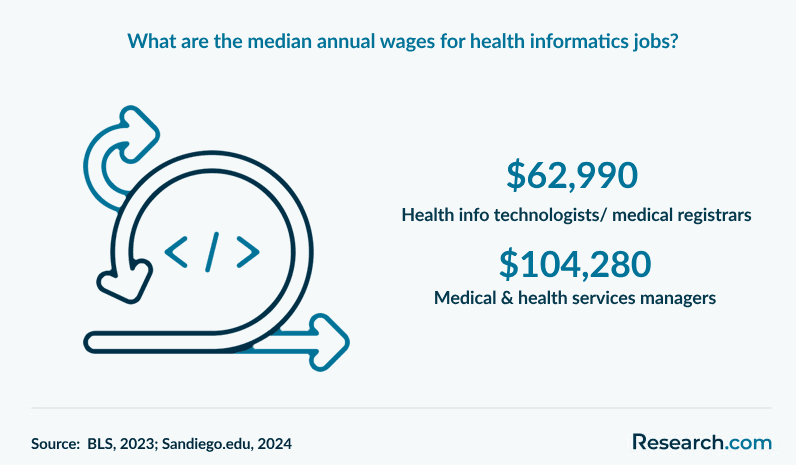
These wage figures highlight the difference between technical, analytical, and management-oriented pathways. They should not be treated as guaranteed earnings, because role scope, location, experience, employer type, and credentials all affect compensation.
What challenges should I consider before choosing an online health informatics course?
Online health informatics courses can be valuable, but they are not all equally rigorous or career-relevant. The biggest risk is enrolling in a course that is convenient but too shallow, outdated, or disconnected from your target role.
| Common mistake | Why it can hurt you | Better approach |
| Choosing based only on price | The cheapest option may lack projects, feedback, or current healthcare content. | Compare cost against curriculum depth, instructor expertise, and portfolio value. |
| Assuming every certificate has employer value | Some certificates prove completion but not competency. | Check whether the certificate is recognized, credit-bearing, or tied to a professional exam. |
| Ignoring prerequisites | You may struggle in analytics, AI, or IT-heavy courses without the expected foundation. | Review required skills and take a preparatory statistics, IT, or healthcare terminology course if needed. |
| Overlooking accreditation or institutional quality | This matters especially if you want academic credit, transfer options, or graduate admission. | Verify accreditation, credit policies, faculty credentials, and program outcomes. |
| Expecting a short course to replace a degree | Advanced roles may require experience, graduate education, clinical background, or professional certification. | Use short courses strategically as part of a larger education and career plan. |
| Ignoring hands-on work | Passive video learning may not prepare you for job interviews or workplace projects. | Prioritize courses with datasets, case studies, implementation plans, dashboards, or capstones. |
| Assuming online clinical programs meet licensure rules | Licensure requirements vary by state and profession. | Confirm requirements with the school and appropriate licensing board before enrolling. |
If you are comparing informatics with advanced nursing practice options, affordability resources such as cheapest FNP online programs can help you evaluate cost and credential differences. Just remember that clinical nursing programs, informatics certificates, and health IT courses lead to different outcomes.
What final questions should I ask before choosing a course?
Before you enroll, make the decision concrete. Write down your target role, your current skill gaps, your budget, and the proof of learning you need. Then compare courses using the questions below.
- Career fit: Does this course match the role I want, such as health IT support, clinical informatics, analytics, public health informatics, or leadership?
- Curriculum depth: Does it cover healthcare data, EHRs, privacy, interoperability, analytics, and applied projects?
- Technical level: Is it beginner-friendly, or does it assume statistics, programming, healthcare experience, or IT knowledge?
- Instructor credibility: Are faculty or instructors clearly identified, and do they have relevant healthcare informatics experience?
- Assessment: Will I complete projects that demonstrate practical skill?
- Credential value: Is the certificate a completion badge, academic credential, continuing education record, or professional certification preparation?
- Cost transparency: Are subscription fees, certificate fees, exam fees, and software costs clear?
- Support: Is there instructor feedback, mentoring, peer interaction, or career guidance?
- Next step: Can this course lead logically to a certificate, degree, certification, promotion, or portfolio project?
Key Insights
- Online health informatics courses are useful when they are applied, current, and aligned with a target role. Look for projects involving EHRs, analytics, privacy, interoperability, dashboards, telehealth, or implementation planning.
- A short course can build knowledge, but it does not replace a degree, clinical license, or professional certification. Match the credential level to your career goal before paying.
- Education patterns show multiple entry points. Bachelor's degrees are most common among health informatics specialists at 52%, while master's degrees account for 23%, associate degrees for 13%, doctorate degrees for 8%, and other degree types for 4%.
- The market outlook supports continued interest in informatics skills. Straits Research (2025) predicts the global healthcare informatics market will reach $107.60 billion by 2032, with a 12.6% compound annual growth rate from 2024 to 2032.
- Salary varies widely by role and responsibility. Reported averages include $209,898 for Director of Health Informatics, $130,780 for Health Informatics Manager, and $77,810 to $102,890 for Health Informatics Specialist levels.
- Employment is spread across sectors. Zippia (2024) reports that 49% of health informatics specialists work in the private sector, 30% in public institutions, and 15% in educational institutions.
- The best choice depends on your background. Clinicians may benefit most from clinical informatics or leadership-focused courses, while IT professionals may prefer healthcare IT support, cybersecurity, or interoperability, and data professionals may target analytics or AI in healthcare.
- Do not choose based on convenience alone. Verify curriculum, instructor qualifications, certificate type, total cost, hands-on work, support services, and whether the course helps you take a clear next step.
References:
- American Medical Informatics Association. (n.d.). AMIA Health Informatics Certification (AHIC). American Medical Informatics Association.
- Salary.com. (2025). Clinical Informatics Specialist Salary in Bethesda, MD. Salary.com.
- Salary.com. (2025). Director of Health Informatics Salary. Salary.com.
- Salary.com. (2025). Health Informatics Manager Salary in the United States. Salary.com.
- Salary.com. (2025). Health Informatics Specialist I Salary in the United States. Salary.com.
- Salary.com. (2025). Health Informatics Specialist II Salary in New Jersey. Salary.com.
- Salary.com. (2025). Health Informatics Specialist III Salary in the United States. Salary.com.
- Straits Research. (2024). Healthcare Informatics Market Size, Share & Trends Report Forecast. Straits Research.
- U.S. Bureau of Labor Statistics. (2023). Health Care Informatics Jobs + Salaries: What You Need to Know. U.S. Bureau of Labor Statistics.
- U.S. Bureau of Labor Statistics. (2023). Health Information Technologists and Medical Registrars. U.S. Bureau of Labor Statistics.
- Zippia. (2024). Health Informatics Specialist demographics and statistics in the US. Zippia.
Other Things You Should Know About Online Health Informatics Courses
Prerequisites for top online health informatics courses in 2027 often include a bachelor's degree in a related field, basic knowledge of healthcare systems, and proficiency in information technology. Some programs may also require prior work experience or specific certifications.
The best online health informatics courses in 2027 are offered by platforms like Coursera, edX, and FutureLearn. These platforms provide courses from top universities like Johns Hopkins University, University of California, Irvine, and Georgia Tech, focusing on current industry trends and skills required for health informatics careers.


