
2027 How to Choose the Best Healthcare Management Degree Program

Co-Founder and Chief Data Scientist
Aspiring healthcare managers must navigate a complex landscape shaped by rising operational costs, unprecedented workforce shortages, and the rapid introduction of technology. Educators and students alike must also contend with shifting program delivery modalities. According to a recent survey, many programs that were once predominantly in-person (59%) are becoming evenly split between in-person, hybrid, and online formats.
Against this backdrop—marked by shifting program formats, technological complexity, and growing demand—choosing the right healthcare management degree is a strategic decision. This article will guide you through evaluating program quality, delivery format, specialization options, accreditation, cost and ROI, and career outcomes with expert precision.
Key things you should know about healthcare management programs
- Graduates of healthcare management degree programs can become a hospital administrator, healthcare operations manager, medical practice manager, health policy analyst, or director of patient services.
- The median annual wage for medical and health services managers is $117,960, with top earners in major metropolitan hospitals making $219,080 per year.
- A bachelor’s in healthcare management degree takes 4 years of full-time study, while a master’s or MHA program takes about 2 years.
- What is the difference between healthcare administration and healthcare management? Admin & Management
- Do you need a master’s degree in healthcare management to advance in your career? Do you need a master’s degree in healthcare management to advance in your career?
- Which healthcare management degree is best for someone with no prior healthcare experience? Which healthcare management degree is best for someone with no prior healthcare experience?
- Which accreditation bodies are recognized for healthcare management degrees? Accreditation
- How much does a healthcare management degree cost? Program Cost
- Are healthcare management degrees eligible for federal student aid and scholarships? Student Aid
- What documents are needed for a healthcare management degree application? Requirements
- What are the pros and cons of online healthcare management degree programs? Online Options
- Which healthcare management jobs pay the highest salaries? Highest-Paying Jobs
- What emerging trends are reshaping healthcare management education? What emerging trends are reshaping healthcare management education?
- How do you compare different healthcare management programs? Comparing Programs
- How does healthcare management compare to public health degrees? How does healthcare management compare to public health degrees?
What is the difference between healthcare administration and healthcare management?
Healthcare administration focuses on the day-to-day operations of healthcare facilities. Administrators oversee staff schedules, ensure compliance with regulations, manage budgets, and maintain high standards of patient care. Their work is more operational in nature, guaranteeing that hospitals, clinics, and nursing facilities run smoothly and efficiently daily.
On the other hand, healthcare management emphasizes the broader strategic direction of healthcare organizations. Managers are often involved in long-term planning, policy development, and organizational growth initiatives. They may focus on financial sustainability, expanding into new service lines, forming partnerships with other institutions, or adopting technology.
Just as professionals in tech often pursue the fastest online master's programs in cybersecurity to stay competitive in a rapidly evolving field, healthcare managers invest in advanced education to stay ahead of industry changes and position themselves for leadership roles.
Administrators make sure the facility operates properly, but managers are more concerned with where the organization is headed in the future and how to align resources with those goals. In practice, there is some overlap between the two roles, and job titles may vary by institution.
The key distinction lies in scope: healthcare administration typically focuses on operations and execution, while healthcare management concentrates on strategy and leadership.
Do you need a master’s degree in healthcare management to advance in your career?
Many entry-level and mid-level roles can be secured with a bachelor’s degree in healthcare management, business, or a related field. But as the healthcare industry grows more complex and competitive, employers often prefer or require candidates for senior management and executive roles to hold a graduate degree.
A Master of Healthcare Administration (MHA), Master of Business Administration (MBA) with a healthcare concentration, or Master of Public Health (MPH) with a focus on management can equip professionals with advanced skills.
For those seeking leadership pathways outside of strictly healthcare-focused programs, exploring the shortest online organizational leadership master's programs can also provide a streamlined route to developing essential management and leadership competencies.
According to the BLS, demand for medical and health services managers is projected to grow 23% from 2024 to 2034. Holding a master’s degree can give applicants a competitive edge for these high-responsibility, higher-paying roles.
At least 25% of medical and health services managers hold a master's degree, as indicated in the chart below.
Which healthcare management degree is best for someone with no prior healthcare experience?
For someone with no prior healthcare experience, the best starting point is normally a bachelor’s degree in healthcare management or healthcare administration.
These undergraduate programs introduce students to both the business and clinical aspects of healthcare, covering health policy, medical terminology, finance, human resources, and organizational leadership. Because they don’t assume previous industry knowledge, they provide a solid foundation for newcomers while still preparing graduates for entry-level roles.
If you already hold a bachelor’s degree in another field but want to transition into healthcare, a master’s degree in healthcare management with a healthcare concentration or even online MBA in management programs can be a great pathway. These programs welcome students from diverse academic backgrounds and include introductory courses to bridge the knowledge gap.
For those who want flexibility, certificate programs and online associate degrees in healthcare administration can serve as stepping stones. These shorter programs help students gain foundational knowledge and industry exposure before committing to a full degree.
The chart below indicates that the physician workforce will be adequate to meet demand in 2036.
Which accreditation bodies are recognized for healthcare management degrees?
Accredited programs mean that the curriculum meets industry standards, employers recognize the degree, and students remain eligible for federal financial aid. Below are the leading accreditation bodies recognized for healthcare management degree programs:
- Commission on Accreditation of Healthcare Management Education (CAHME): CAHME is the gold standard for graduate-level healthcare management programs, particularly MHA and related degrees. Employers look for candidates with CAHME-accredited degrees because they demonstrate rigorous training and industry relevance.
- Accreditation Council for Business Schools and Programs (ACBSP): ACBSP accredits business-related healthcare management programs. This accreditation signals a strong emphasis on practical business skills, leadership, and applied learning outcomes.
- Association to Advance Collegiate Schools of Business (AACSB): AACSB accreditation is held by top business schools and may apply to healthcare-focused MBA programs. Programs with this accreditation are highly respected worldwide and indicate excellence in business and management education.
- Regional Accrediting Commissions: Institutions with regional accreditation (e.g., Middle States Commission on Higher Education, Higher Learning Commission) pass high academic standards, covering all programs, including healthcare management. It’s often required for credit transferability and graduate school admissions.
- Council for Higher Education Accreditation (CHEA) and U.S. Department of Education Recognition: While not accrediting bodies themselves, CHEA and the U.S. Department of Education recognize and validate accrediting organizations. Students should verify that any program’s accreditor is approved by these entities.
Choosing an accredited program is especially important for individuals new to the field. For those exploring how to become a healthcare administrator with no experience, accredited degrees help build credibility, ensure access to internships or practicum placements, and provide structured pathways into entry-level roles within hospitals, clinics, and long-term care organizations. This foundation can significantly accelerate career progression in the healthcare industry.
How much does a healthcare management degree cost?
At the bachelor’s level, tuition at public universities in the U.S. ranges from $9,000 to $12,000 per year for in-state students and up to $25,000 or more per year for out-of-state students.
Private universities charge significantly higher rates, with annual tuition averaging $30,000 to $45,000. Over four years, the total cost of a bachelor’s in healthcare management can range from $40,000 at public institutions to well over $150,000 at private schools.
At the graduate level, tuition ranges from $25,000 to $60,000 in total. Elite or executive programs can cost more than $80,000.
Online programs are often more affordable, with some accredited schools offering MHA programs for $15,000 to $25,000. Costs may increase if you study part-time, since tuition is usually charged per credit hour.
Are healthcare management degrees eligible for federal student aid and scholarships?
Healthcare management degrees are mostly eligible for federal student aid as long as the program is accredited. Students of either a bachelor’s or master’s degree in healthcare management can apply for aid through the Free Application for Federal Student Aid (FAFSA).
There are also numerous scholarship opportunities available specifically for students of healthcare-related degrees. These scholarships may come from professional organizations such as the American College of Healthcare Executives (ACHE), universities themselves, or healthcare foundations aiming to encourage leadership in the field.
Many scholarships are merit-based, while others focus on financial need, diversity in healthcare leadership, or specialized areas.
For students considering online or part-time programs, eligibility for aid and scholarships is usually the same as for traditional on-campus options. Many employers also offer tuition reimbursement programs for employees pursuing degrees that align with organizational goals.
Combining federal aid, scholarships, and employer support can dramatically lower the overall cost of earning a healthcare management degree.
What documents are needed for a healthcare management degree application?
Applying to a healthcare management degree program necessitates careful preparation and submission of certain documents. Most schools request materials that manifest academic readiness, professional potential, and commitment to the field.
- Application Form: This is the official online or paper form where you list personal details, academic history, and program preferences. It must be completed accurately to begin the admissions process.
- Official Transcripts: Schools require transcripts from all previously attended high schools, colleges, or universities. These documents verify your academic background and help admissions committees assess your preparedness.
- Letters of Recommendation: Two or three letters are needed from professors, employers, or supervisors. These recommendations highlight your academic ability, leadership potential, and suitability for healthcare management.
- Resume or Curriculum Vitae (CV): This document outlines your academic achievements, work experience, and extracurricular involvement. It helps exhibit how your background aligns with healthcare management training.
- English Language Proficiency Test Results (for international students): Applicants whose first language is not English may need TOEFL or IELTS scores. These results prove you can succeed in an English-speaking academic environment.
Understanding these requirements early ensures a more organized and stress-free application process. Students who are exploring related health administration or technology pathways may also wonder how hard is health information technology as a field of study. While it involves learning specialized software systems and health data standards, most students find it manageable with consistent study habits and strong support from academic advisors and program resources.
What are the pros and cons of online healthcare management degree programs?
Online healthcare management degree programs come with advantages that make them an attractive option for many students. Evaluating accreditation, program design, and support services will help you figure out if an online format fits you.
Online programs, such as a fast-track public administration master's degree online, allow learners to study at their own pace and balance coursework with work or family responsibilities. They also eliminate the need for commuting, making education more accessible for students in rural areas or those with busy schedules.
However, not all employers value online degrees equally. Hence, it’s important to choose an accredited program with a good reputation to make your credential respectable in the job market.
Tuition for online programs can also be cheaper than on-campus options. Students can save money on housing, transportation, and campus fees.
One important drawback to consider with online programs is the lack of face-to-face interaction. This can limit networking opportunities with professors, peers, and industry professionals. Some programs may also require residencies, labs, or internships, which can complicate scheduling for fully online learners.
Which healthcare management jobs pay the highest salaries?
Among the most lucrative positions in this field are hospital CEOs and COOs. According to industry salary data, executives at major hospitals and health systems earn over $200,000 per year.
Another high-paying path is becoming a healthcare finance director or CFO. Because of the complexity and stakes involved, salaries for CFOs in healthcare organizations range from $150,000 to over $250,000 annually.
Health information executives, such as CIOs and CTOs, also command salaries of $140,000 to $200,000 or more. Professionals entering this track often explore health informatics salary trends to understand earning potential in roles that merge technology, data, and patient care.
Specialized directors, such as those in operations, human resources, and compliance, usually earn $120,000 to $180,000 as well.
What emerging trends are reshaping healthcare management education?
Curricula are evolving to incorporate digital health technologies, advanced data analytics, and telehealth innovations that address the growing complexity in patient care and operational management. Programs now emphasize interdisciplinary approaches and virtual learning environments to mirror real-world challenges, ensuring graduates are equipped to lead through technological disruption. Integrating specialized certifications, such as affordable medical billing and coding programs online, further enhances practical skills and competitiveness in the job market.
How do you compare different healthcare management programs?
Choosing the right healthcare management program is about assessing quality, outcomes, and alignment with your career goals. Since programs can differ in curriculum, accreditation, delivery format, and career support, it’s important to compare them across several key dimensions.
- Accreditation: Get a program accredited by CAHME, AACSB, or regional accreditors. Accreditation certifies that the curriculum conforms to industry and employer standards.
- Curriculum and Specializations: Review the core courses and available concentrations. Selecting a program that matches your interests will help you develop expertise in your desired career path.
- Faculty and Industry Connections: Research professors' real-world healthcare management experience and active ties to the industry. Professional networks present better internship and job placement opportunities.
- Format and Flexibility: Compare on-campus, online, and hybrid delivery models to see which caters to your schedule. Working professionals may benefit more from part-time or online options, while full-time students may prefer in-person learning.
- Career Support and Outcomes: Investigate the program’s internship opportunities, alumni network, and job placement rates. Career services can make a significant difference in post-graduation success.
As you compare options, it’s also helpful to consider how each program may influence long-term earning potential. Graduates entering administrative and leadership roles often see steady income growth as they gain experience. Exploring health care administration degree salary trends can provide insight into which programs and specializations yield the strongest return on investment in the job market.
How does healthcare management compare to public health degrees?
Healthcare management and public health degrees both prepare students to improve health systems, but they do so from different perspectives.
The Business & Organizational Side of Healthcare
Healthcare management focuses primarily on the business and organizational side of healthcare. It trains students to administer hospitals, clinics, and other healthcare facilities.
The curriculum gravitates toward leadership, finance, operations, human resources, and strategic planning. Graduates land jobs as hospital administrators, department directors, or healthcare executives.
For those who want to broaden their leadership and policy expertise beyond healthcare, an accelerated online public administration degree can also provide valuable skills in governance, organizational management, and public service.
Population Health & Preventative Care
A public health degree is centered on population health and preventative care. It stresses research, policy, and community health initiatives. Public health students basically study epidemiology, biostatistics, environmental health, and health promotion to understand and address health disparities on a larger scale.
Career paths for public health graduates include epidemiologist, health educator, public health policy analyst, or researcher for government agencies and nonprofit organizations.
Key Differences
Healthcare management is more organization-focused, dealing with the internal operations of healthcare systems. Public health is more community-focused, tackling health outcomes for populations at large.
Those interested in running healthcare facilities or advancing into executive leadership choose healthcare management, while those passionate about research, prevention, and policy work often pursue public health. Both degrees, however, create a more productive and equitable healthcare system.
Additionally, many prospective students consider potential earnings when choosing between these paths. Leadership roles in healthcare management, especially hospital administration, often come with strong income potential. Researching how much does a hospital administrator make can help illustrate the financial trajectory and career stability associated with this field.
Here’s What Graduates Have to Say About Their Healthcare Management Degrees
- Rainn: "Studying healthcare management gave me the confidence to step into leadership roles I never thought possible. The program balanced business strategy with healthcare-specific knowledge, which made me job-ready from day one. I now feel prepared to make a real difference in how care is delivered."
- Darryl: "What I loved most about pursuing healthcare management was how practical the learning felt. From analyzing budgets to working on case studies about hospital operations, I could see the direct impact of every skill. It gave me both the tools and the motivation to grow into a career with purpose."
- Arya: "Coming from a completely different field, I was nervous about starting fresh in healthcare. The healthcare management curriculum not only bridged the gap but also opened my eyes to how leadership and compassion can go hand in hand. It turned my career transition into a fulfilling journey."
Key Findings
- Healthcare administration is about operations and execution, while healthcare management is about strategy and leadership.
- Employers prefer or require a graduate degree for senior management and executive roles.
- A bachelor’s in healthcare management can range from $40,000 to $150,000.
- Executives at major hospitals and health systems earn over $200,000 per year.
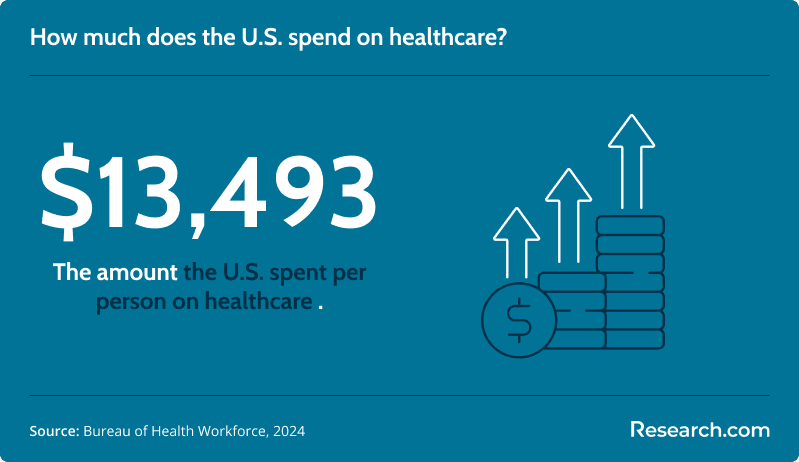
- As of 2024, the U.S. spent $13,493 per person on healthcare.
References:
- BLS. (2025, April 18). Medical and Health Services Managers. Retrieved September 8, 2025, from BLS.
- Commission on Accreditation of Healthcare Management Education. (2023, July 5). Charting a New Course: Impact of COVID-19 on Healthcare Management Education. Retrieved September 8, 2025, from CAHME.
- Indeed. (2025, April 18.). 12 of the Highest-Paying Healthcare Administration Jobs. Retrieved September 8, 2025, from Indeed.
- St. Louis College of Health Careers. (n.d.). Key Challenges Facing Healthcare Administrators. Retrieved September 8, 2025, from St. Louis College of Health Careers.
Other Things You Should Know About Healthcare Management Degree Programs
Admission requirements typically include a high school diploma or equivalent, a minimum GPA, and possibly standardized test scores like the SAT or ACT. Some programs may require prerequisite coursework in subjects like biology or business as of 2027.
When choosing a healthcare management degree program in 2027, consider accreditation, curriculum relevance, faculty expertise, and the success rate of graduates. It's also essential to look at the flexibility of the program, especially if you need part-time study options, and opportunities for hands-on experience or internships.


