
2027 How Hard is Health Information Technology: What Students Can Expect

Co-Founder and Chief Data Scientist
For a student considering a healthcare career, the question of whether health information technology (HIT) is a difficult field can be a major source of concern. While the job requires a specific skill set, understanding the demands and rewards of the profession can help students make an informed decision. This article provides a comprehensive overview of what to expect from an HIT career, from the challenges to the rewarding opportunities.
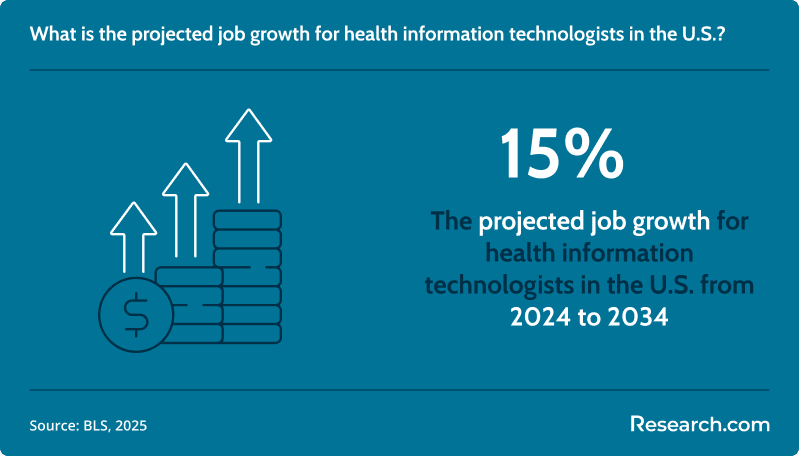
With the job outlook for health information technologists projected to grow by 15% from 2024 to 2034, this career path offers a strong sense of security and long-term potential. By the end of this article, you will be able to determine if health IT is the right path for you by learning about its daily responsibilities, required skills, and career opportunities.
Key Things to Know about How Hard Health Information Technology Is
- Health information technology is a moderately challenging, interdisciplinary field that requires mastering both healthcare and technical knowledge.
- Educational paths for this career range from associate to bachelor's degrees, with various specializations available, and financial aid options are accessible to students.
- The field offers significant career potential, along with high-paying roles and opportunities for remote work. In 2024, about 41,900 jobs were held by information technologists.
- What exactly is health information technology? Career Overview
- Is health information technology hard? Difficulty
- What are the most common pros and cons of working in health information technology? Pros & Cons
- What are the typical educational pathways to become a health information technologist, from associate to bachelor's degrees? Educational Paths
- How much does a typical health information technology degree or certification program cost? Program Cost
- Are there specific scholarships, grants, or financial aid options available for health IT students? Financial Aid
- What are the most popular specializations within health information technology? Specializations
- Do I need to have a background in both healthcare and IT to get into a health IT program? Do I need to have a background in both healthcare and IT to get into a health IT program?
- What should I consider when selecting a quality health IT program? What should I consider when selecting a quality health IT program?
- What is the current job growth outlook for health information technology professionals for 2027 and beyond? Job Outlook
- Can I work remotely or have flexible hours in a health IT job? Remote Work
- What are some emerging or niche career paths in health IT that students should consider? What are some emerging or niche career paths in health IT that students should consider?
What exactly is health information technology, and how is it different from health informatics or health information management?
Health information technology refers to the electronic systems and technologies used to store, transfer, communicate, and manage health information digitally. These technologies include EHRs, health information exchanges (HIEs), telehealth platforms, clinical decision support systems, coding and billing software, and cybersecurity measures.
HIT aims to improve patient safety, streamline healthcare operations, reduce costs, and enhance data-driven decision-making and patient engagement by enabling quick, accurate access and exchange of health data among healthcare providers and patients.
Health information technology primarily focuses on the hardware, software, and systems used to electronically manage health data. HIT professionals often develop, implement, and maintain these technological systems.
Students interested in a career protecting healthcare data can look into one of the fastest online cybersecurity bootcamps to get started.
Is health information technology hard?
Health information technology is considered moderately challenging due to its interdisciplinary nature, requiring knowledge of both healthcare and information technology. It involves mastering medical terminology, regulatory compliance (such as HIPAA), technical systems like electronic health records (EHRs), and data security.
Continuous learning is essential as technology and regulations frequently evolve. While the subject can be demanding, a good program can provide the necessary skills and support to succeed. Those who are flexible, enjoy problem-solving, and can adapt to rapid changes may find it a rewarding field rather than overly hard.
Challenges include navigating complex healthcare regulations, interdisciplinary collaboration between IT and healthcare professionals, and adapting to constantly evolving technologies. However, with proper education, certifications, and practical experience, the difficulties are manageable, making it accessible to dedicated learners who are willing to invest the necessary effort.
Some prospective students compare this major’s difficulty level to other science or healthcare pathways and ask similar questions, such as “is biology a hard major?” In both cases, the answer often depends on personal strengths, study habits, and interest in the subject matter, rather than the subject being universally “hard” or “easy.”
What are the most common pros and cons of working in health information technology?
The most common pros and cons of working in health information technology are:
Pros
- HIT professionals work at the forefront of technological innovation in healthcare, engaging with systems like EHRs, telemedicine, and predictive analytics that improve patient outcomes and healthcare delivery. This dynamic work environment can be very rewarding and stimulating.
- There is strong demand and job security for skilled HIT workers as healthcare digital transformation accelerates, creating numerous job opportunities across hospitals, clinics, pharmaceutical companies, and government agencies.
- The career offers competitive compensation and a variety of roles, from EHR implementation to clinical data management, allowing for specialization and professional growth.
- HIT roles contribute meaningfully to patient care by ensuring accurate, accessible, and secure health data that supports medical decision-making and regulatory compliance.
Cons
- The field requires navigation of a complex regulatory environment, demanding continuous education and meticulous attention to compliance, which can be burdensome.
- Healthcare IT professionals face interdisciplinary challenges since they must frequently collaborate with both IT and clinical staff who may have differing priorities, which can complicate communication and project success.
- The rapid evolution of healthcare technology means continuous learning and adaptation are necessary, which may be overwhelming for some.
- There can be high-stress situations, given the critical nature of healthcare systems' uptime and data security, with errors potentially impacting patient safety.
- Some HIT jobs may involve sedentary office work and considerable time spent on data entry or administrative tasks, which can be monotonous and affect work-life balance.
What are the typical educational pathways to become a health information technologist, from associate to bachelor's degrees?
Typical educational pathways to become a health information technologist range from an associate degree to a bachelor's degree, often combined with professional certification:
Associate Degree Pathway
- Most entry-level health information technologist positions require an associate degree in health information technology, health information management, or a related healthcare discipline. This degree generally takes about two years to complete.
- Coursework covers medical terminology, healthcare data management, coding systems like ICD-10 and CPT, healthcare laws and regulations, health information systems, and data privacy and security.
- Many programs include practical learning opportunities such as internships or virtual labs.
- Graduates of associate degree programs are eligible to sit for the Registered Health Information Technician (RHIT) certification exam offered by the American Health Information Management Association (AHIMA), which is highly valued by employers.
- Associate degree programs are often offered fully online or in hybrid formats, making them accessible for non-traditional students.
Bachelor's Degree Pathway
- A Bachelor of Science in Health Information Management (HIM) or Health Information Technology is a common four-year degree for those aiming for leadership roles, broader career options, or higher pay in HIT.
- Bachelor's programs include more comprehensive education, including healthcare ecosystems, data analytics, healthcare project management, advanced coding and classification systems, healthcare statistics, reimbursement methods, and quality management.
- These programs are typically accredited by the Commission on Accreditation for Health Informatics and Information Management (CAHIIM), qualifying graduates to sit for advanced certifications such as the Registered Health Information Administrator (RHIA) exam.
- Graduates are prepared for roles beyond entry-level technical work, such as healthcare data analysis, compliance management, health IT leadership, and clinical documentation improvement.
For those who want to advance their career quickly, there are also fast-track online HIM degree programs available. Building on these educational paths, the chart below illustrates the most common degree types held by professionals in health information management.
How much does a typical health information technology degree or certification program cost?
Typical costs for health information technology degree and certification programs generally range as follows:
- Associate degree programs in health information technology typically cost between $5,000 and $18,000 in total, depending on whether the institution is public or private, in-state or out-of-state tuition, and additional fees for books, technology, and certifications. Many community colleges and technical schools offer such programs mainly in this cost range.
- Bachelor's degree programs in related fields like health information management generally cost more, often ranging from approximately $20,000 to $50,000 or more for a full four-year degree, varying widely by institution.
- Certificate or diploma programs in HIT for entry-level positions or certification preparation can be less expensive, generally from a few hundred to several thousand dollars.
- Additional costs include professional certification exams, such as the Registered Health Information Technician (RHIT) exam, which typically cost a few hundred dollars.
- Many programs offer online options to help reduce costs and add flexibility.
When comparing costs, it can be helpful to look at your long-term career goals—particularly if you’re considering moving into administrative or leadership roles later. Some students explore guidance on how to pick a healthcare management degree as they plan potential career pathways that extend beyond entry-level HIT roles.
Are there specific scholarships, grants, or financial aid options available for health IT students?
There are specific scholarships, grants, and financial aid options available for health information technology (health IT) students, including:
The AHIMA Foundation
The AHIMA Foundation offers several scholarships annually for students pursuing degrees in health information management or health informatics at all levels (associate, bachelor's, master's, doctoral). Awards range from about $3,000 for associate degree students to up to $10,000 for doctoral candidates. Eligibility requires AHIMA membership and enrollment in CAHIIM-accredited programs.
The HIMSS Foundation
The HIMSS Foundation awards two $5,000 scholarships annually—one undergraduate and one graduate student scholarship—for those enrolled in accredited health information technology or healthcare management programs, with priority for active HIMSS student members.
General Medical Technology and IT Scholarships
Various general medical technology and IT scholarships are available from professional associations, including the American Society of Radiologic Technologists (ASRT) Foundation, Association for the Advancement of Medical Instrumentation (AAMI) Foundation, and American Society for Clinical Pathology (ASCP) Foundation. These often require program enrollment and have grade point average (GPA) and membership requirements, with awards typically ranging from $500 to $5,000.
Colleges and Universities
Many colleges and universities also provide institution-specific scholarships and grants for health IT or related healthcare technology programs, often based on academic performance and financial need. If you're pursuing an information technology degree online, it's a good idea to check with your school's financial aid office to see what scholarships they offer.
Traditional Financial Aid Options
Students pursuing healthcare IT degrees can also access traditional financial aid options such as federal grants (Pell Grants), state aid, and institutional scholarships, depending on their eligibility.
What are the most popular specializations within health information technology?
The most popular specializations within health information technology (HIT) include:
Medical Coding and Billing Specialist
A specialist in this area translates medical procedures, diagnoses, and services into standardized codes for accurate billing and insurance claims. They play a crucial role in the financial health of a practice by ensuring proper reimbursement from insurers and other payers.
Health Services Administrator
These professionals manage the day-to-day operations of healthcare facilities or specific departments. They use health information technology systems to improve organizational efficiency, oversee regulatory compliance, and ensure high-quality care delivery.
Health Informatics Specialist
This specialization combines healthcare expertise with IT and data analysis to optimize healthcare delivery and patient care. They implement and manage clinical systems and data analytics to improve health outcomes and streamline workflows.
Clinical Informatics Analyst
An analyst in this field focuses on analyzing clinical data and workflows to improve the performance and usability of healthcare information systems. Their work provides critical data-driven insights that support better decision-making for healthcare providers.
Health Data Analyst
A health data analyst collects, analyzes, and interprets complex healthcare data for research, operational, and clinical purposes. They provide actionable, data-driven insights that help healthcare providers and administrators make informed decisions to improve patient care and organizational performance.
Health Information Manager
Managers in this area oversee the overall management, quality, and protection of patient records. They ensure that all data practices and systems are in full compliance with healthcare laws and regulations, and they supervise data security protocols.
Informatics Nurse Specialist
This specialization is for nurses who integrate their clinical experience with informatics to enhance patient care through technology. They are often responsible for improving nursing workflows, training staff on new HIT systems, and ensuring seamless adoption of new technologies.
Health Information Technician
This role focuses on organizing and managing health data and EHRs. Technicians are responsible for ensuring patient data is accurate, secure, and easily accessible for use by clinical staff. They are the backbone of data integrity within a healthcare system.
For many professionals already working in healthcare—such as those transitioning from clinical support roles—specialization in HIT can be a strategic way to broaden career options. For example, someone considering a surgical tech to nurse career pathway may find that gaining skills in health information technology strengthens both their clinical understanding and their ability to support technology-driven patient care environments.
In addition to the various specializations, it is also important to understand the demographics of the profession, as highlighted in the chart on health information technician demographics by race.
Do I need to have a background in both healthcare and IT to get into a health IT program?
No, a background in both healthcare and IT is not strictly required to get into a health information technology program.
Most HIT programs require a minimum of a high school diploma or equivalent. Applicants typically need to complete certain prerequisite courses, which may include biology, anatomy and physiology, medical terminology, and introductory computer or information technology courses. These prerequisites ensure a foundational understanding but do not require prior professional experience in healthcare or IT.
HIT programs are designed to teach students the necessary healthcare knowledge, including medical terminology and coding, alongside technical skills like health data management, electronic health records, and healthcare laws and compliance. Many students enter with diverse backgrounds and receive comprehensive training in both healthcare and IT concepts during the program.
Additionally, some programs emphasize professional behavior, communication, and interdisciplinary collaboration skills to prepare students for working with healthcare and IT teams. This comprehensive training helps graduates secure excellent health information technology careers salary, and job prospects.
What should I consider when selecting a quality health IT program?
When evaluating a health IT program, prioritize accreditation, up-to-date curriculum, and experienced faculty with real-world expertise. Examine program partnerships with industry leaders and verify if the course content reflects current technological and regulatory advancements. It is equally important to assess financial value by comparing tuition costs, financial aid opportunities, and the availability of affordable medical billing and coding certification programs. Consider also whether the program provides hands-on training, career services, and access to professional networks that can support long-term career growth in health IT.
What is the current job growth outlook for health information technology professionals for 2027 and beyond?
Based on the data from the Bureau of Labor Statistics, the job outlook for health information technologists and medical registrars is projected to grow by 15% from 2024 to 2034. This rate is much faster than the average for all occupations.
The BLS projects approximately 3,200 job openings per year, on average, over this decade. Many of these openings will be due to the need to replace workers who transfer to different occupations or leave the workforce for reasons such as retirement.
In 2024, about 41,900 jobs were held by information technologists and medical registrars. The largest employers of these professionals were as follows:
Can I work remotely or have flexible hours in a health IT job?
Yes, many health IT jobs offer opportunities for remote work and flexible hours. The nature of the work, which often involves data management, analysis, and system administration, makes it well-suited for a non-traditional office setting.
Common roles with remote or flexible options include:
- Health Information Technician/Medical Coder and Biller: These roles primarily involve data entry and coding, which can be done from anywhere with a secure internet connection.
- Health Data Analyst: Analyzing and interpreting data for research or operational improvement is a task that often doesn't require a physical presence.
- Clinical Informatics Specialist: While some on-site work may be necessary for system implementation or training, many aspects of this job, such as data analysis and system support, can be done remotely.
- Health IT Consultant: Consultants often work on a project basis and can manage their own schedules, working with various clients from a remote location.
As remote health services expand and healthcare data systems continue moving toward cloud-based models, the flexibility within health IT roles is expected to grow. Many professionals are attracted to the field specifically because it allows them to maintain work-life balance while still engaging in meaningful healthcare work. This flexibility is also appealing to individuals exploring other data-driven fields and wondering how competitive is data science, as both areas value analytical skills and offer opportunities for remote, project-based, and hybrid work arrangements.
What are some emerging or niche career paths in health IT that students should consider?
Emerging and niche career paths in health IT that students should consider include:
- Healthcare Data Analysts: Roles focusing on analyzing large-scale healthcare data to drive decision-making and improve patient outcomes.
- Cybersecurity Experts for Health IT: Specialists protecting digital health platforms, ensuring privacy and security of healthcare data.
- Telehealth Specialists and Virtual Care Coordinators: Professionals developing and managing telemedicine solutions and remote patient monitoring systems.
- Biomedical 3D Printing Specialists: Careers in additive manufacturing for customized prosthetics, implants, and biofabrication.
- Regulatory Affairs and Compliance Specialists in MedTech: Experts navigating evolving regulations such as the FDA and the EU Medical Device Regulation compliance.
- UX/UI Designers for Medical Applications and Wearable Device Developers: Creating user-friendly interfaces for personalized healthcare technologies and wearable biosensors.
- Clinical Informatics Specialists and Pharmacy Informatics Coordinators: Niche roles requiring health informatics expertise to improve clinical workflows and pharmacy operations.
- Informatics Nurse Specialists: Nurses with additional informatics training to lead technology integration and patient care coordination.
- IT Consultants specialized in health systems: Advising healthcare organizations on optimizing IT infrastructure and technologies.
- AI Specialists in Healthcare: Professionals skilled in AI and machine learning are needed for applications like AI-driven medical imaging, predictive analytics, and robotic-assisted surgeries. To pursue this path, students can consider a fast track artificial intelligence certification online to quickly gain the necessary skills.
Key Findings
- The job outlook for health information technologists is projected to grow by 15% from 2024 to 2034, a rate much faster than the average for all occupations.
- In 2024, approximately 41,900 jobs were held by health information technologists and medical registrars.
- An associate degree in health information technology typically costs between $5,000 and $18,000.
- A bachelor's degree in a related field like health information management can cost from $20,000 to $50,000 or more.
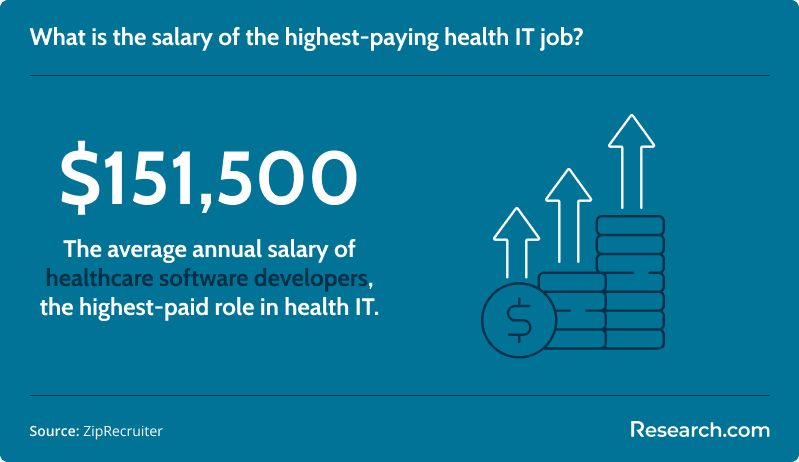
- The highest-paying job in health IT is a healthcare software developer, with top earners making $151,500 annually.
References:
- Health Information Technician Demographics and Statistics [2025]: Number of health information technicians in the US. (2025, January 8). https://www.zippia.com/health-information-technician-jobs/demographics
- Health information technologists and medical registrars. (2025, August 28). U.S. Bureau of Labor Statistics. Retrieved September 6, 2025, from https://www.bls.gov/ooh/healthcare/health-information-technologists-and-medical-registrars.htm#tab-6
- Healthcare Project Manager salary. (2026). ZipRecruiter. Retrieved September 6, 2025, from https://www.ziprecruiter.com/Salaries/Healthcare-Project-Manager-Salary#Yearly
- Healthcare software developer salary. (2025). ZipRecruiter. Retrieved September 6, 2025, from https://www.ziprecruiter.com/Salaries/Healthcare-Software-Developer-Salary#TableView
- Healthcare Technology Consultant salary. (2025). ZipRecruiter. Retrieved September 6, 2025, from https://www.ziprecruiter.com/Salaries/Healthcare-Technology-Consultant-Salary#Yearly
- HIMSS Foundation. (n.d.). HIMSS. Retrieved September 6, 2025, from https://www.himss.org/initiatives/himss-foundation
- How to become a Health Information Manager: What it is and career path - Zippia. (2025, January 8). https://www.zippia.com/health-information-manager-jobs
Other Things You Should Know About How Hard Health Information Technology Is
In 2027, students pursuing health information technology may face challenges like keeping up with rapidly evolving technology, understanding cybersecurity complexities, and integrating new digital tools into healthcare settings. Additionally, mastering data management while adhering to privacy regulations poses a significant challenge.
To succeed in a health information technology program, students should have strong skills in data analysis, understanding electronic health records, and proficiency with IT systems. Courses typically include medical coding, health data standards, and information security, which are crucial for a career in this field.


